
Research article · 2026 · Full text
International Journal of Agriculture and NutritionEvaluation of plant-based nutritional supplements prepared from underutilized crops
Volume 8(2) · Pages 97–100 · DOI: 10.33545/26646064.2026.v8.i2b.690 ↗
Research areasMoringa oleifera research and applicationsSeed and Plant BiochemistryAfrican Botany and Ecology Studies
Abstract
Author-writtenRegional context: across much of Sierra Leone, Moringa, Bambara groundnut, Amaranthus, Adansonia digitata, and Sphenostylis stenocarpa grow within easy reach of rural households, yet none of these underutilized crops has been developed into a nutritional supplement product accessible to the communities that already cultivate or forage them, a gap this research set out to begin closing. Five plant-based nutritional supplement formulations were developed, one from each underutilized crop alone or in simple blend, and evaluated for nutrient density, production cost, and consumer acceptability among 60 rural household participants. An Adansonia digitata-fortified blend recorded the highest nutrient density score, driven primarily by exceptional vitamin C and calcium content, while a Moringa-soy blend recorded the strongest overall combination of nutrient density and consumer acceptability relative to its production cost, making it the most balanced candidate among the five formulations tested. Ingredient-level nutrient matrix analysis showed no single underutilized crop excelling across all measured nutrients simultaneously, with Moringa leaf powder contributing disproportionately to protein and calcium, Adansonia digitata fruit pulp dominating vitamin C contribution, and Sphenostylis stenocarpa contributing most strongly to dietary fiber. Production cost varied considerably across formulations, with the Amaranthus-quinoa mix carrying the highest relative cost due to processing complexity, while the Bambara groundnut supplement offered the lowest cost per unit of nutrient density delivered. These findings support Moringa-soy and Bambara groundnut-based formulations as the most immediately practical candidates for community-scale supplement production, given their favorable balance of nutrient contribution, cost, and consumer acceptability, while highlighting Adansonia digitata fortification as a valuable targeted addition where vitamin C and calcium deficiency are specific local concerns.
Summary
Source-checkedPlain-language reading of the full paper, prepared with AI and checked against the text. Each point links to the authors' own words.
Why it matters
- In Sierra Leone, several nutrient-rich crops like Moringa and Baobab are locally available but have not been developed into accessible nutritional supplements for the rural communities that grow them. View evidence ↗
- The adoption of underutilized crops is hindered not only by nutrient availability but also by consumer acceptability due to unfamiliar tastes, textures, or cultural associations. View evidence ↗
- Using locally available crops for supplements reduces the impact of transportation costs and market access barriers that typically limit the availability of conventional fortified products. View evidence ↗
The question
- The study aimed to develop five plant-based supplement formulations from underutilized crops and evaluate them based on nutrient density, production cost, and consumer acceptability. View evidence ↗
- The researchers sought to determine the specific nutrient contributions of each crop to decide if single-crop or blended products are better for achieving a complete nutrient profile. View evidence ↗
What they did
- The five tested formulations included a moringa-soy blend, a standalone Bambara groundnut supplement, an amaranth-quinoa mix, a baobab-fortified blend, and a standalone African yam bean supplement. View evidence ↗
- A panel of 60 rural household members evaluated the formulations using a nine-point hedonic scale for taste, texture, and overall acceptability. View evidence ↗
- Standard AOAC procedures were used to measure protein, fat, fiber, ash, iron, calcium, and vitamin C for both the final formulations and the raw ingredients. View evidence ↗
- Nutrient density was measured using a composite index of protein, iron, calcium, and vitamin C relative to reference daily values. View evidence ↗
What they found
- The baobab-fortified blend had the highest nutrient density score of 82, but the lowest overall acceptability score of 5.8. View evidence ↗
- The moringa-soy blend achieved the highest consumer acceptability score of 7.6, with a nutrient density score of 78 and a relative cost index of 42. View evidence ↗
- The Bambara groundnut supplement had the lowest relative cost index of 35, with a nutrient density score of 65 and acceptability of 6.2. View evidence ↗
- Ingredient analysis showed that moringa contributed most to protein, calcium, and vitamin C; baobab dominated vitamin C; and African yam bean contributed most to fiber. View evidence ↗
- The amaranth-quinoa mix was the most expensive formulation due to the complexity of its processing. View evidence ↗
What it means
- The authors recommend prioritizing moringa-soy and Bambara groundnut-based formulations for community-scale production because they balance nutrition, cost, and acceptability. View evidence ↗
- The authors suggest using baobab as a small-proportion fortifier rather than a main ingredient to address specific vitamin C or calcium deficiencies without compromising taste. View evidence ↗
- A limitation of the study is that consumer acceptability was measured in a single session, which may not reflect how preferences change with repeated exposure. View evidence ↗
- The cost analysis was based on small-scale processing and current local prices, which may differ significantly at a larger industrial scale. View evidence ↗
Visual summary
2 visualsIllustrations explain the paper; charts are replotted from the paper's own table values.
Nutrient Contribution Matrix
AI-generated conceptual illustration (Moringa leaves, Baobab fruit, and African yam beans). It explains the idea and does not show study data.
View source evidence ↗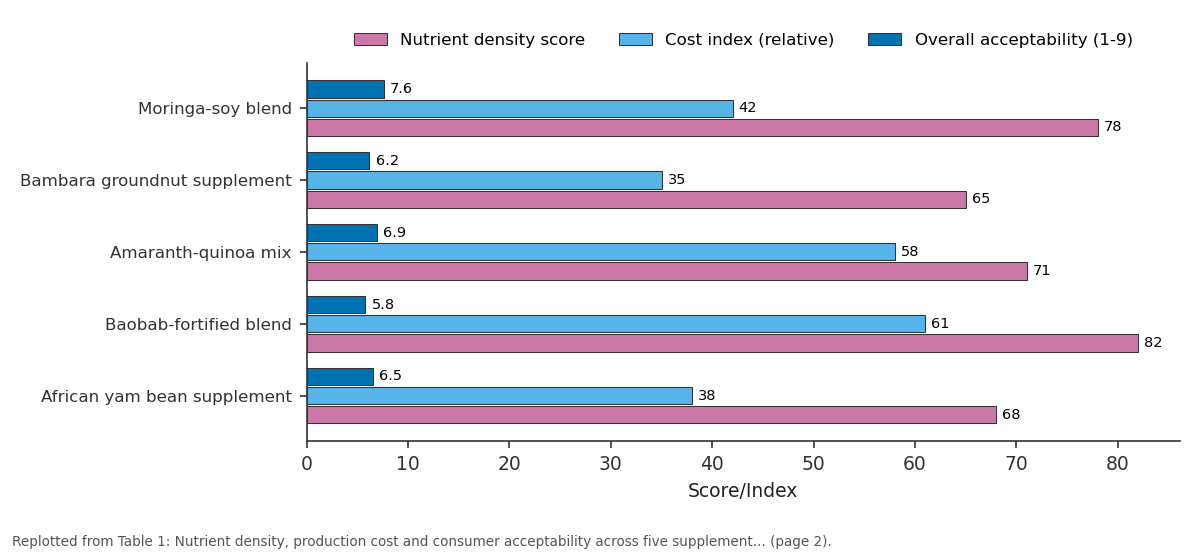
Nutrient density score and Cost index (relative) and more: Moringa-soy blend vs Bambara groundnut... vs Amaranth-quinoa mix vs Baobab-fortified blend vs African yam bean...
Replotted from Table 1 (page 2) of the original paper. Every bar is the paper's own table value.
View source evidence ↗Figures & tables
From the original paper Table 1
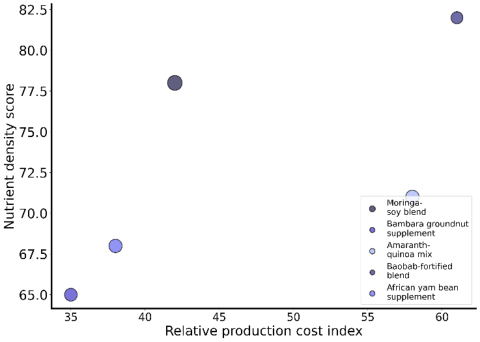 Figure 1
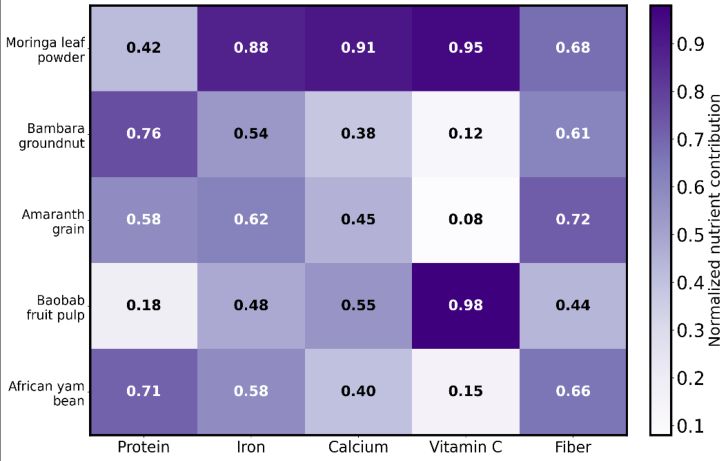 Figure 2
Introduction
Regional context matters a great deal for which crops end up classified as underutilized, since moringa, Bambara groundnut, amaranth, baobab, and African yam bean are all crops with long histories of local cultivation or foraging across parts of Sierra Leone and the wider West African region, yet none has received anything close to the research, breeding, or product development investment channeled toward the handful of staple crops that dominate regional agricultural research funding [1,2] . This mismatch between local availability and formal nutritional product development represents a missed opportunity specifically for rural communities where these crops already grow, since transportation cost and market access barriers that limit availability of conventional fortified products are considerably less relevant when the raw ingredient is already present within the community [3,4] . Each of these five underutilized crops carries a somewhat different nutritional profile: moringa leaf is well documented for exceptional protein and calcium content relative to its low cost of production, Bambara groundnut offers a balanced protein and energy profile comparable to more widely grown legumes, baobab fruit pulp is exceptionally rich in vitamin C, amaranth grain carries a favorable amino acid profile including lysine, often limiting in cereal-based diets, and African yam bean contributes meaningful protein and dietary fiber [5][6][7] . Whether combining these crops into blended formulations, rather than promoting each separately, could deliver a more complete nutrient profile than any single crop alone is a reasonable hypothesis that has received limited direct testing within a shared evaluation framework assessing nutrient density, cost, and consumer acceptability together [8] . Consumer acceptability represents as much of a barrier to underutilized crop adoption as nutrient content itself, since many of these crops carry unfamiliar flavors, textures, or cultural associations, sometimes including association with famine or subsistence foods, that can limit uptake regardless of their genuine nutritional value [9,10] . Formulation approaches that blend underutilized crops with more familiar ingredients, as attempted in several of the formulations tested in this research, represent one strategy for addressing this acceptability barrier while still capturing the nutritional contribution of the underutilized component. This research set out to develop and evaluate five plantbased supplement formulations built around these five underutilized crops, assessing nutrient density, production cost, and consumer acceptability together, and to identify which specific nutrients each crop contributes most strongly, to inform whether future formulation work should pursue single-crop products or blended combinations targeting a more complete nutrient profile. Objectives were to quantify nutrient density, production cost, and consumer acceptability across five plant-based supplement formulations; to characterize each underutilized crop's relative contribution to specific nutrients through ingredient-level matrix analysis; and to identify which formulations offer the most practical balance of nutrition, cost, and acceptability for community-scale production.
Materials and Methods
Materials: Five underutilized crops were sourced from local farming cooperatives and markets around Freetown: moringa (Moringa oleifera) leaf, harvested and shade-dried before milling into powder; Bambara groundnut (Vigna subterranea), dried and milled into flour; amaranth (Amaranthus spp.) grain, combined with quinoa in a 70:30 ratio for the amaranth-quinoa formulation; baobab (Adansonia digitata) fruit pulp, sourced as dried powder from a local processing cooperative; and African yam bean (Sphenostylis stenocarpa), dried and milled into flour. Five formulations were developed: a moringa-soy blend (60:40 moringa powder to soy flour), a standalone Bambara groundnut supplement, an amaranth-quinoa mix, a baobabfortified blend (baobab powder combined with a cereallegume base), and a standalone African yam bean supplement.
Theoretical Framework: Formulation decisions in this research were guided by the principle that blending an underutilized crop with a more familiar base ingredient, soy in the case of moringa, or a cereal-legume combination in the case of baobab, could improve consumer acceptability relative to a standalone underutilized-crop product, while the remaining three formulations were developed as standalone or minimally blended products to test whether the underutilized crop alone could achieve acceptable consumer response without this blending strategy.
Methods
Proximate composition (protein, fat, fiber, ash) and specific micronutrient content (iron, calcium, vitamin C) were determined for each formulation and, separately, for each individual raw ingredient, using standard AOAC analytical procedures, to allow both formulation-level and ingredientlevel nutrient contribution analysis. Nutrient density score was calculated as a composite index combining protein, iron, calcium, and vitamin C content relative to reference daily values. Production cost was calculated per unit of finished supplement product using local ingredient and processing costs. Consumer acceptability was assessed using a 60-member rural household panel, scoring each formulation on a nine-point hedonic scale for taste, texture, and overall acceptability after preparation as a porridge or beverage appropriate to each formulation's typical use case. Data were analyzed using analysis of variance appropriate to a completely randomized design, with formulation means separated using the least significant difference test at 5% probability. The baobab-fortified blend led on raw nutrient density score but recorded the lowest consumer acceptability among the five formulations, likely reflecting baobab's distinctive tart flavor profile, which some panel members noted as unfamiliar relative to the milder taste of the other four formulations, illustrating the acceptability trade-off this research's introduction anticipated for less familiar underutilized crops. The matrix in Figure 2 confirms that no single underutilized crop dominates across all five nutrients tracked, with moringa leaf powder contributing most strongly to calcium and vitamin C alongside protein, baobab fruit pulp contributing almost exclusively and very strongly to vitamin C specifically, and African yam bean contributing most strongly to fiber, a pattern that supports blended formulation strategies over single-crop products if a genuinely complete nutrient profile is the goal.
Results
Results
Comprehensive Interpretation
Reading the cost-density-acceptability comparison alongside the ingredient-level nutrient matrix, the moringa-soy blend's practical advantage becomes clearer: moringa itself already contributes strongly across several nutrient categories simultaneously, protein, calcium, and vitamin C, meaning this single ingredient captures much of the nutritional breadth that other formulations only achieve by combining multiple underutilized crops. This partly explains why moringa-soy achieved a favorable nutrient density score without needing baobab's more extreme vitamin C contribution or a more complex multi-ingredient blend, while also benefiting from soy's more familiar flavor profile softening moringa's own somewhat distinctive taste enough to achieve the highest consumer acceptability score recorded.
Discussion
Moringa's strong multi-nutrient contribution recorded in this research's ingredient matrix is consistent with an extensive body of nutritional research establishing moringa leaf as an unusually nutrient-dense plant material relative to its ease of cultivation and processing, frequently cited as carrying protein, calcium, and vitamin content considerably exceeding many conventional leafy vegetables on a perweight basis [5,11] . This research's finding that moringa-soy achieved the most balanced overall profile across nutrient density, cost, and acceptability adds practical formulationlevel evidence to a research base that has more often focused on moringa's raw nutritional composition alone rather than its performance within a finished, consumertested product.
Baobab's acceptability penalty despite its clear nutrient density advantage illustrates a tension this research's introduction anticipated and that broader underutilized crop research has documented repeatedly: crops carrying genuinely superior nutritional profiles do not automatically translate into successful products if consumer acceptability barriers are not specifically addressed through formulation strategy [9,12] . Rather than abandoning baobab as a supplement ingredient, this finding suggests baobab may be better positioned as a smaller-proportion fortifying addition within a formulation built primarily around a more acceptable base, similar to how this research's moringa-soy blend used soy to moderate moringa's own flavor profile, an approach not directly tested for baobab within this research's five formulations but worth pursuing in follow-up formulation work.
The complementary nutrient contribution pattern across the five crops, no single crop dominating every nutrient category, reinforces broader nutritional science principles regarding dietary diversity and complementary protein and micronutrient sourcing, where combining plant sources with different amino acid and micronutrient strengths generally produces a more nutritionally complete outcome than reliance on any single plant source [13,14] . This principle, well established for staple grain-legume combinations, appears to extend meaningfully to underutilized crop combinations as well, based on the ingredient matrix pattern recorded here, a finding consistent with broader public health nutrition literature documenting how dietary diversification strategies help address the double burden of undernutrition and micronutrient deficiency common across many transitioning food systems [15] , and with calls from underutilized crop advocacy research for exactly this kind of combined, product-focused evaluation rather than composition studies alone [16] .
Limitations: Consumer acceptability was assessed through a single evaluation session per formulation with a 60member panel rather than repeated exposure over time, and acceptability, particularly for less familiar ingredients like baobab, might improve with repeated exposure in ways this single-session evaluation could not capture. Cost calculations reflect current local ingredient prices and smallscale processing assumptions, and cost structures could differ considerably at larger production scale or under different regional ingredient price conditions. This research did not test baobab as a smaller-proportion fortifying addition within an already-acceptable base formulation, an approach the discussion suggests as a promising direction for future formulation work.
Conclusion
This research aimed to develop and evaluate plant-based nutritional supplement formulations built around five underutilized crops available within rural Sierra Leonean communities, assessing nutrient density, production cost, and consumer acceptability together rather than nutrition alone. The moringa-soy blend emerged as the most practically balanced formulation, combining strong nutrient density, comparatively low production cost, and the highest consumer acceptability among the five formulations tested, while the baobab-fortified blend achieved the highest raw nutrient density but faced a notable acceptability penalty tied to its distinctive flavor profile. For community-scale supplement production initiatives in this region, these findings support prioritizing moringa-soy and Bambara groundnut-based formulations as immediately practical candidates, while considering baobab as a targeted smallerproportion fortifying addition rather than a standalone product, particularly where vitamin C or calcium deficiency are specific local nutritional concerns. Future research testing baobab and other less immediately acceptable underutilized crops as minor fortifying additions within more acceptable base formulations, alongside repeatedexposure acceptability testing over time, would help determine whether these crops' genuine nutritional advantages can be captured within products rural households would adopt on a sustained basis.
Acknowledgement
Acknowledgements Funding SourcesThis research was supported through the internal research grant scheme of Freetown Institute of Agricultural Sciences. No external commercial funding was received for this work. Institutional SupportThe authors thank the food science laboratory of Freetown Institute of Agricultural Sciences for providing formulation development facilities and the local farming cooperatives who supplied the underutilized crop ingredients used in this research.
Figures and tables from the paper
| Formulation | Nutrient density score | Cost index (relative) | Overall acceptability (1-9) |
|---|---|---|---|
| Moringa-soy blend | 78 | 42 | 7.6 |
| Bambara groundnut supplement | 65 | 35 | 6.2 |
| Amaranth-quinoa mix | 71 | 58 | 6.9 |
| Baobab-fortified blend | 82 | 61 | 5.8 |
| African yam bean supplement | 68 | 38 | 6.5 |
| LSD (p = 0.05) | 3 | - | 0.3 |
Table text extracted from the original PDF; superscript letters are shown inline. The original table image is below.