
Research article · 2026 · Full text
International Journal of Horticulture and Food ScienceProfitability and economic performance of horticulture-based farming systems: Evidence from Dharwad district, Karnataka, India
Volume 8(7S) · Pages 14–19 · DOI: 10.33545/26631067.2026.v8.i7sa.781 ↗
Research areasAgricultural Economics and PracticesAgricultural Systems and PracticesAgricultural economics and policies
Abstract
Author-writtenHorticulture has emerged as an important component of agricultural diversification in India, contributing significantly to farm income, employment generation, and nutritional security. The present study examines the economic performance of horticulture-based farming systems in Dharwad district of Karnataka. Primary data collected from selected farmers representing major horticulture-based farming systems were analyzed using cost and return measures. The study identified five dominant horticulture-based farming systems comprising combinations of fruit crops, field crops, and livestock enterprises. The results indicate that integrated farming systems generated higher gross and net returns compared to specialized crop enterprises. Farming systems integrating horticultural crops with dairy activities exhibited greater profitability and income stability. The findings suggest that diversification through horticulture and an allied enterprise enhances resource utilization and improves farm profitability. The study recommends strengthening infrastructure, extension services, and market support to promote sustainable horticulture-based farming systems in Karnataka.
Summary
Source-checkedPlain-language reading of the full paper, prepared with AI and checked against the text. Each point links to the authors' own words.
Why it matters
- Horticulture is a key part of agricultural diversification in India, helping to increase farm income, create jobs, and ensure nutritional security. View evidence ↗
- Karnataka is a top horticultural state in India due to its favorable climate for growing fruit crops like banana, guava, sapota, and mango. View evidence ↗
- Combining horticulture with livestock and other crops can increase profitability and lower the risks associated with production. View evidence ↗
The question
- The study aims to address the lack of empirical evidence regarding the comparative economic performance of horticulture-based farming systems in Northern Karnataka. View evidence ↗
What they did
- The research was conducted in the Dharwad district of Karnataka, an area known for significant horticultural activity and diverse agricultural production. View evidence ↗
- The study used primary farm-level data collected from a sample of 120 farmers representing various horticulture-based farming systems. View evidence ↗
- The economic performance of the farming systems was analyzed using cost and return measures. View evidence ↗
What they found
- All five studied farming systems are economically viable because their Benefit-Cost Ratios (BCR) are greater than one. View evidence ↗
- Farming system FS-V was the most economically efficient and profitable, recording the highest BCR of 1.87. View evidence ↗
- FS-V also had the highest Net Returns Ratio (NRR) of 0.87, meaning every ₹1 invested produced ₹0.87 in net profit. View evidence ↗
- FS-V showed the highest Profitability Index (PI) of 0.466, indicating that 46.6% of its gross revenue was kept as profit. View evidence ↗
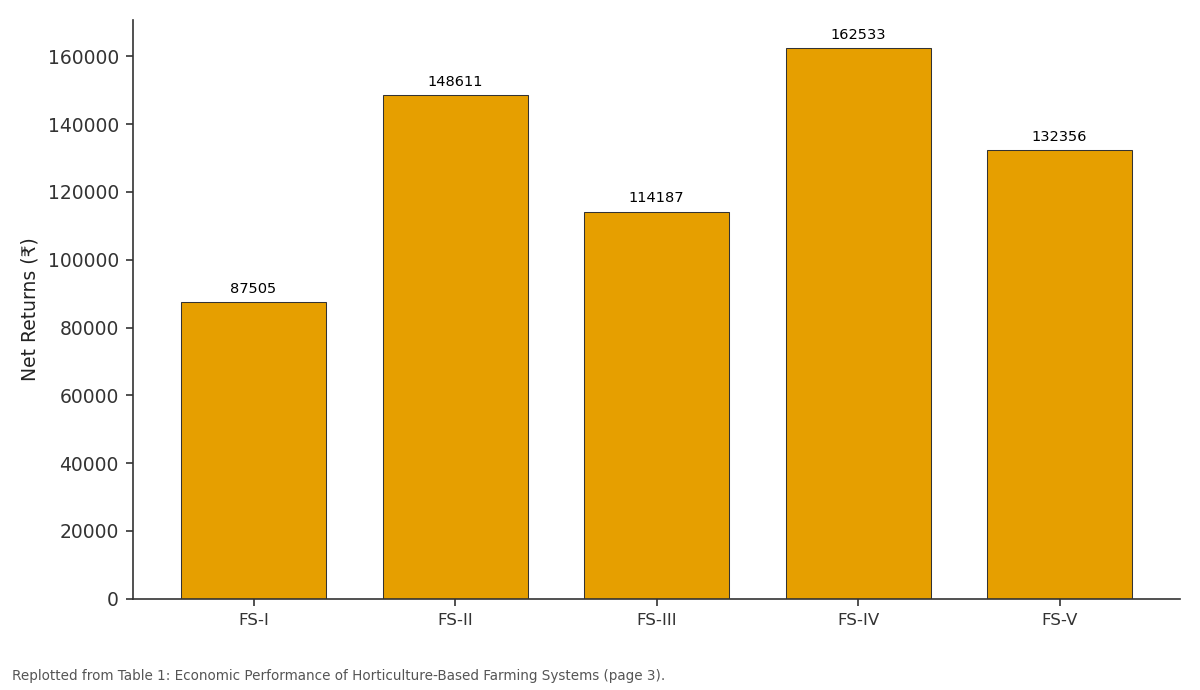
- In terms of absolute income, FS-IV generated the highest net returns at ₹1,62,533 per farm, followed by FS-II (₹1,48,611) and FS-V (₹1,32,356). View evidence ↗
- Across all systems, the average total cost was ₹180,191, with mean gross returns of ₹309,230, mean net returns of ₹129,038, and an average BCR of 1.72. View evidence ↗
- FS-III was the least profitable system, recording the lowest BCR (1.58), NRR (0.58), and PI (0.368). View evidence ↗
What it means
- The authors conclude that horticulture-based farming systems in Dharwad are economically viable, with integrated systems (crops and livestock) being more profitable than specialized ones. View evidence ↗
- The authors recommend promoting diversified farming systems through market linkages, institutional support, and infrastructure development to improve rural livelihoods in Karnataka. View evidence ↗
Visual summary
1 visualsIllustrations explain the paper; charts are replotted from the paper's own table values.
Net Returns (₹): FS-I vs FS-II vs FS-III vs FS-IV vs FS-V
Replotted from Table 1 (page 3) of the original paper. Every bar is the paper's own table value.
View source evidence ↗Figures & tables
From the original paper Table 1
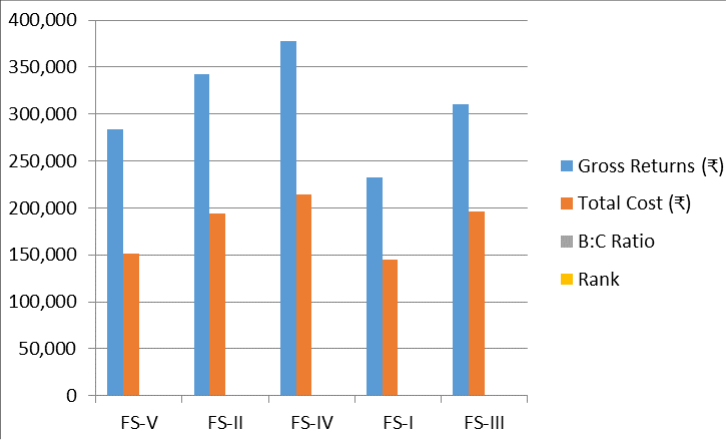 Figure 1
 Table 2
 Table 3
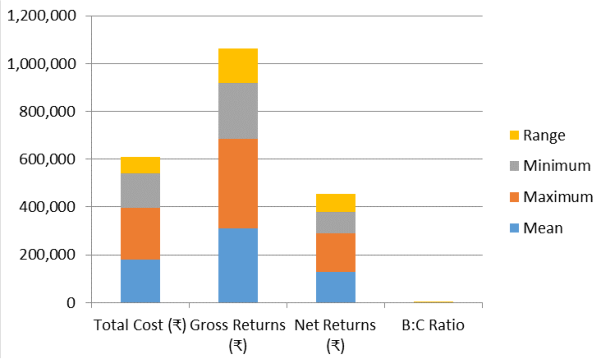 Figure 2
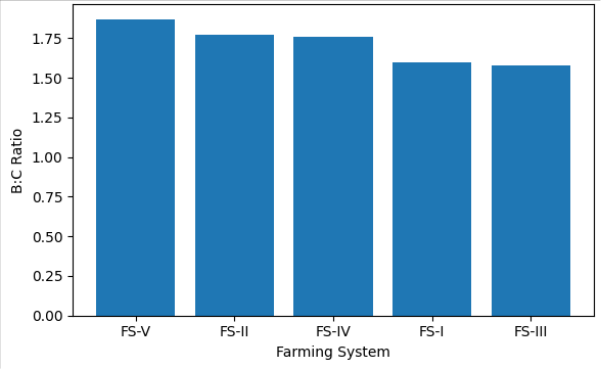 Figure 3
Introduction
Agriculture continues to play a pivotal role in the Indian economy by providing employment and livelihood opportunities to a large proportion of the rural population. In recent decades, diversification towards horticultural crops has gained momentum due to increasing demand, higher returns, and greater export potential. Horticulture-based farming systems integrate fruit crops with livestock and other complementary enterprises, thereby enhancing farm productivity and income. Karnataka is one of the leading horticultural states in India, possessing favorable agroclimatic conditions for the cultivation of mango, sapota, guava, banana, and other fruit crops. Dharwad district occupies an important position in the state's horticultural economy. The integration of horticultural enterprises with crop and livestock activities offers opportunities for increasing profitability while reducing production risks. An assessment of the economic performance of these systems is essential for designing appropriate agricultural development strategies.
Review of Literature
Several studies have reported that integrated farming systems generate higher income and employment compared to conventional crop-based agriculture. Rangaswamy et al. (1992) [4] observed that integrated farming systems enhanced farm profitability and employment generation. Kandasamy (1998) [3] reported that dairy-based integrated systems were more profitable than sole cropping systems. Channabasavanna and Biradar (2007) [2] found that integrated crop-livestock systems improved productivity and net returns.
Previous studies indicate that diversification through horticulture and livestock enterprises contributes significantly to farm income and sustainability. However, empirical evidence on the comparative economic performance of horticulture-based farming systems in Northern Karnataka remains limited. The present study attempts to fill this gap. To suggest policy measures for improving farm income and sustainability.
Objectives of the
Objectives of the
Methodology
Study Area: The study was conducted in Dharwad district of Karnataka, which is characterized by diversified agricultural production and significant horticultural activity. Data Source: The study is based on primary data collected from sample farmers representing different horticulture-based farming systems.
Results and Discussion
Results and Discussion
Interpretation
The Benefit-Cost Ratio (BCR) analysis indicates that all five farming systems are economically viable, as their BCR values exceed unity. Among them, FS-V recorded the highest BCR of 1.87, demonstrating superior economic efficiency and profitability. This implies that every ₹1 invested in FS-V generated a return of ₹1.87, making it the most remunerative farming system. FS-II (1.77) and FS-IV (1.76) also exhibited strong economic performance, indicating efficient resource utilization and higher returns.
In contrast, FS-III registered the lowest BCR of 1.58, suggesting comparatively lower profitability. Overall, the results reveal that diversified farming systems, particularly FS-V, offer better economic returns and sustainability to farm households.
Net Return Ratio (NRR)
Farming System NRR FS-I 0.60 FS-II 0.77 FS-III 0.58 FS-IV 0.76 FS-V 0.87
The Net Returns Ratio (NRR) analysis reveals that all farming systems generated positive net returns, indicating their economic feasibility. Among the systems, FS-V recorded the highest NRR of 0.87, implying that every ₹1 invested yielded a net profit of ₹0.87. This highlights FS-V as the most profitable and economically efficient farming system among the five categories. FS-II (0.77) and FS-IV (0.76) also demonstrated relatively high profitability, reflecting effective resource utilization and income generation. In contrast, FS-III registered the lowest NRR of 0.58, indicating comparatively lower net returns. Overall, the findings suggest that FS-V offers the greatest economic advantage to farmers, while all farming systems remain financially viable and contribute positively to farm income.
Profitability Index
Farming System PI FS-I 0.377 FS-II 0.434 FS-III 0.368 FS-IV 0.431 FS-V 0.466
The Profitability Index (PI) measures the proportion of gross returns that is converted into net profit. The results indicate that FS-V achieved the highest PI value of 0.466, suggesting that approximately 46.6% of its gross revenue was retained as profit after meeting all production costs. This reflects the superior profit-generating capacity and operational efficiency of FS-V compared to the other farming systems. FS-II (0.434) and FS-IV (0.431) also exhibited relatively high profit conversion efficiency, indicating effective cost management. In contrast, FS-III recorded the lowest PI value of 0.368, implying that only 36.8% of gross returns were realized as profit. Overall, the findings demonstrate that FS-V is the most profitable farming system, while FS-III exhibits comparatively lower efficiency in converting gross income into net earnings. The ranking of farming systems based on net returns indicates that FS-IV generated the highest absolute income of ₹1,62,533 per farm, followed by FS-II (₹1,48,611) and FS-V (₹1,32,356). FS-III and FS-I occupied the fourth and fifth positions, respectively, with net returns of ₹1,14,187 and ₹87,505. The results suggest that FS-IV is the most successful farming system in terms of total income generation, making it attractive for farmers seeking higher absolute earnings. However, despite ranking third in net returns, FS-V recorded the highest Benefit-Cost Ratio and Net Returns Ratio, indicating superior efficiency in utilizing resources. Thus, while FS-IV maximizes total income, FS-V offers the highest return per rupee invested, reflecting better economic efficiency and profitability. This will statistically test whether differences in profitability among farming systems are significant. Table 1 presents the comparative economic performance of five horticulture-based farming systems in terms of total cost, gross returns, net returns, and Benefit-Cost (B:C) ratio.
| Farming System | Total Cost (₹) | Gross Returns (₹) | Net Returns (₹) | B: C Ratio |
|---|---|---|---|---|
| FS-I | 144,764 | 232,270 | 87,505 | 1.60 |
| FS-II | 193,976 | 342,587 | 148,611 | 1.77 |
| FS-III | 195,812 | 309,999 | 114,187 | 1.58 |
| FS-IV | 214,783 | 377,316 | 162,533 | 1.76 |
| FS-V | 151,621 | 283,977 | 132,356 | 1.87 |
Table text extracted from the original PDF; superscript letters are shown inline. The original table image is below.
View original table image
Ranking of Farming Systems
Ranking of Farming Systems
Econometric Model for
The results reveal considerable variation in profitability across the farming systems. FS-IV incurred the highest total cost of ₹214,783 and generated the highest gross returns (₹377,316) as well as the highest net returns (₹162,533), indicating its strong income-generating potential. FS-II also performed well, recording net returns of ₹148,611 and a B: C ratio of 1.77. In terms of economic efficiency, FS-V emerged as the most profitable system with the highest B: C ratio of 1.87, implying that every rupee invested generated ₹1.87 in returns. Despite having lower gross and net returns than FS-IV, FS-V utilized resources more efficiently and produced higher returns per unit of investment. FS-I and FS-III recorded relatively lower profitability, with B: C ratios of 1.60 and 1.58, respectively. Overall, all farming systems were economically viable as their B: C ratios exceeded unity, but FS-IV was superior in terms of absolute income generation, whereas FS-V demonstrated the highest investment efficiency and profitability. This suggests that diversified horticulture-based farming systems can significantly enhance farm income and economic sustainability. The maximum total cost of ₹214,783 and maximum gross returns of ₹377,316 were observed in FS-IV, reflecting its higher scale of operation and income generation. The minimum values of total cost (₹144,764), gross returns (₹232,270), and net returns (₹87,505) were recorded in FS-I. The range values reveal substantial variation among the farming systems, particularly in gross returns (₹145,046) and net returns (₹75,028), indicating differences in enterprise combinations, productivity, and resource utilization. However, the relatively small range in the B: C ratio (0.29) suggests that all farming systems maintained a comparable level of economic viability. Overall, the descriptive statistics confirm that horticulture-based farming systems are economically rewarding, with notable differences in profitability and efficiency across the systems.2. Benefit-Cost Analysis Table 3 presents the Benefit-Cost (B: C) ratio and ranking of the horticulture-based farming systems. The analysis shows that FS-V achieved the highest B: C ratio of 1.87 and secured the first rank, indicating superior economic efficiency. This implies that every ₹1 invested in FS-V generated ₹1.87 in gross returns, making it the most remunerative farming system in terms of investment efficiency. FS-II ranked second with a B: C ratio of 1.77, closely followed by FS-IV with a ratio of 1.76.
| Farming System | Gross Returns (₹) | Total Cost (₹) | B: C Ratio | Rank |
|---|---|---|---|---|
| FS-V | 283,977 | 151,621 | 1.87 | I |
| FS-II | 342,587 | 193,976 | 1.77 | II |
| FS-IV | 377,316 | 214,783 | 1.76 | III |
| FS-I | 232,270 | 144,764 | 1.60 | IV |
| FS-III | 309,999 | 195,812 | 1.58 | V |
Table text extracted from the original PDF; superscript letters are shown inline. The original table image is below.
View original table image
Descriptive Statistics
Although FS-IV generated the highest gross returns (₹377,316), its higher production cost reduced its relative efficiency compared to FS-V and FS-II. FS-I and FS-III recorded lower B: C ratios of 1.60 and 1.58, respectively, and were ranked fourth and fifth, indicating comparatively lower returns per unit of investment. Nevertheless, all farming systems exhibited B: C ratios greater than one, confirming their economic viability. The findings suggest that FS-V is the most efficient farming system from an investment perspective, while FS-IV remains the highest income-generating system in absolute terms. Thus, both profitability and resource-use efficiency should be considered when evaluating the performance of horticulturebased farming systems. Identification of Farming Systems
Cost and Returns Analysis
The analysis revealed considerable variation in costs and returns among the farming systems. Systems combining horticultural crops with dairy enterprises generated higher gross returns due to multiple income sources. Although integrated systems incurred relatively higher production costs, their net returns were substantially greater than those of specialized crop enterprises.
Profitability Comparison
Among the identified systems, integrated horticulturelivestock systems recorded the highest profitability. Diversification reduced dependence on a single enterprise and ensured stable income throughout the year. Fruit crops such as mango, sapota, and guava contributed significantly to farm income owing to their high market value.
Economic Implications
The findings indicate that diversification through horticulture and livestock enterprises improves farm income, employment opportunities, and resource utilization. Integrated farming systems also reduce production risks associated with market fluctuations and climatic uncertainties.
Conclusion
The study concludes that horticulture-based farming systems are economically viable and contribute significantly to farm income in Dharwad district. Integrated systems involving horticultural crops and livestock enterprises were found to be more profitable than specialized crop enterprises. Promotion of diversified farming systems through infrastructure development, institutional support, and market linkages can enhance agricultural sustainability and rural livelihoods in Karnataka.
Figures and tables from the paper
| Particulars | Total Cost (₹) | Gross Returns (₹) | Net Returns (₹) | B: C Ratio |
|---|---|---|---|---|
| Mean | 180,191 | 309,230 | 129,038 | 1.72 |
| Maximum | 214,783 | 377,316 | 162,533 | 1.87 |
| Minimum | 144,764 | 232,270 | 87,505 | 1.58 |
| Range | 70,019 | 145,046 | 75,028 | 0.29 |
Table text extracted from the original PDF; superscript letters are shown inline. The original table image is below.
View original table image
References
13 in the original paper- Byerlee D, Harrington L, Winkelmann DL. Farming systems research: Issues in research strategy and technology design. American Journal of Agricultural Economics. 1982;64(5):897-904.
- Channabasavanna AS, Biradar DP. Relative performance of integrated farming system models under irrigated conditions in Karnataka. Karnataka Journal of Agricultural Sciences. 2007;20(2):273-275.
- Kandasamy OS. Economics of integrated farming systems in Tamil Nadu. Madras Agricultural Journal. 1998;85(7-9):534-536.
- Rangaswamy A, Venkitaswamy R, Purushothaman S, Palaniappan SP. Integrated farming systems for small and marginal farmers. Indian Journal of Agronomy. 1992;37(1):1-5.
- Singh K, Bohra JS, Singh Y, Singh JP. Efficient farming systems for irrigated agro-ecosystems of eastern Uttar Pradesh. Indian Research Journal of Extension Education. 2007;7(2-3):18-22.
- Food and Agriculture Organization. Sustainable Food and Agriculture: Integrated Farming Systems. Rome: FAO; 2018.
- Behera UK, Jha KP, Mahapatra IC. Integrated management of available resources of the farming system for sustainable crop production. Indian Journal of Agronomy. 2004;49(4):284-287.
- Das A, Patel DP, Kumar M, Ramkrushna GI, Layek J, Ngachan SV. Impact of integrated farming system on productivity, profitability, employment generation and energy use efficiency. Indian Journal of Agricultural Sciences. 2015;85(3):408-414.
- Gangwar B, Ram B. Integrated farming systems for increasing productivity and employment opportunities in rural areas. Indian Farming. 2005;55(2):27-31.
- Jayanthi C, Balusamy M, Chinnusamy C, Mythili S. Integrated farming systems for sustainable livelihood in Tamil Nadu. Agricultural Economics Research Review. 2003;16(2):241-246.
- Ministry of Agriculture and Farmers Welfare. Agricultural Statistics at a Glance 2024. New Delhi: Government of India; 2024.
- Patil SL, Sheelavantar MN, Rajkumara S. Economic evaluation of diversified farming systems under dryland conditions. Karnataka Journal of Agricultural Sciences. 2012;25(2):239-242.
- Kumar S, Shivani D, Singh R. Economic analysis of integrated and diversified farming systems for enhancing farmers' income. Agricultural Economics Research Review. 2021;34(1):95-104.
Cited by 1
From OpenAlex, OpenCitations and reference lists read by Scinovex
- Growth, trends, and productivity performance of total horticultural crops in India: An empirical analysis (1991-92 to 2025-26)
Shivaraj Golappanavar, Raghupathi Bidari, Saleema Badgi, Sachin kurade · International Journal of Horticulture and Food Science · 2026
The horticulture sector has become one of the fastest-growing segments of Indian agriculture, contributing significantly to agricultural diversification, nutritional security, employment generation, export earnings, and farmers' income. Over the past three decades, the sector has witnessed substantial growth due to technological advancements, improved production practices, and supportive government initiatives. This study examines the growth, trends, and productivity performance of total horticultural crops in India during the period 1991-92 to 2025-26 (First Advance Estimates). The study is b