
Research article · 2026 · Full text
International Journal of Horticulture and Food ScienceGrowth, trends, and productivity performance of total horticultural crops in India: An empirical analysis (1991-92 to 2025-26)
Volume 8(8S) · Pages 01–08 · DOI: 10.33545/26631067.2026.v8.i8sa.831 ↗
Research areasAgricultural Economics and PracticesAgricultural economics and policiesAgricultural Development and Management
Abstract
Author-writtenThe horticulture sector has become one of the fastest-growing segments of Indian agriculture, contributing significantly to agricultural diversification, nutritional security, employment generation, export earnings, and farmers' income. Over the past three decades, the sector has witnessed substantial growth due to technological advancements, improved production practices, and supportive government initiatives. This study examines the growth, trends, and productivity performance of total horticultural crops in India during the period 1991-92 to 2025-26 (First Advance Estimates). The study is based on annual secondary data obtained from the National Horticulture Board (NHB), Ministry of Agriculture and Farmers' Welfare, Government of India. Area (million hectares), production (million tonnes), and productivity (metric tonnes per hectare) are considered as the principal indicators of horticultural development. The analysis employs descriptive statistics, trend analysis, Compound Annual Growth Rate (CAGR), Annual Growth Rate (AGR), correlation analysis, and regression analysis to evaluate the long-term performance of the sector. The results reveal a consistent upward trend in all three indicators over the study period. The area under horticultural crops increased from 13.00 million hectares in 1991-92 to 30.13 million hectares in 2025-26, while production expanded from 97.00 million tonnes to 370.85 million tonnes. Productivity also improved from 8.00 MT/ha to 12.31 MT/ha, reflecting gradual technological progress and improved resource-use efficiency. The estimated growth rates indicate that production increased more rapidly than area and productivity, suggesting that both expansion of cultivated area and improvements in yield contributed to the growth of the horticulture sector. The study concludes that sustained investment in advanced technologies, climate-resilient production systems, efficient irrigation, post-harvest infrastructure, and market integration is essential to enhance productivity and ensure the long-term sustainability of horticultural development in India.
Summary
Source-checkedPlain-language reading of the full paper, prepared with AI and checked against the text. Each point links to the authors' own words.
Why it matters
- The horticulture sector is a rapidly growing part of Indian agriculture that supports nutritional security, job creation, and increased income for farmers. View evidence ↗
- Despite its growth, the sector faces obstacles including climate variability, poor cold-chain infrastructure, and post-harvest losses. View evidence ↗
- Previous research often focused on specific regions or crops, leaving a gap for a comprehensive national analysis using data up to 2025-26. View evidence ↗
The question
- The study aims to analyze the growth, trends, and productivity of India's total horticultural crops from 1991-92 to 2025-26. View evidence ↗
What they did
- The research used annual secondary data from the Government of India's Department of Agriculture & Farmers Welfare. View evidence ↗
- The primary indicators measured were cultivated area in million hectares, production in million tonnes, and productivity in metric tonnes per hectare. View evidence ↗
- The analysis employed several statistical methods, including CAGR, Pearson's correlation, and multiple regression. View evidence ↗
What they found
- The area used for horticultural crops grew from 13.00 million hectares in 1991-92 to 30.13 million hectares by 2025-26. View evidence ↗
- Production had the highest Compound Annual Growth Rate (4.02%), while area (2.50%) and productivity (1.28%) grew more slowly. View evidence ↗
- There is a very strong positive correlation (0.984) between the cultivated area and total production. View evidence ↗
- Regression analysis shows that increasing the cultivated area by one million hectares increases production by approximately 11.32 million tonnes. View evidence ↗
- A one MT/ha increase in productivity is associated with a production increase of approximately 18.64 million tonnes. View evidence ↗
What it means
- The authors recommend focusing on technological innovation, climate-resilient practices, and better post-harvest infrastructure to maintain growth. View evidence ↗
Visual summary
3 visualsIllustrations explain the paper; charts are replotted from the paper's own table values.
Growth Trends in Indian Horticulture
AI-generated conceptual illustration (Indian horticultural crops (mangoes, citrus fruits, vegetables, and flowers)). It explains the idea and does not show study data.
View source evidence ↗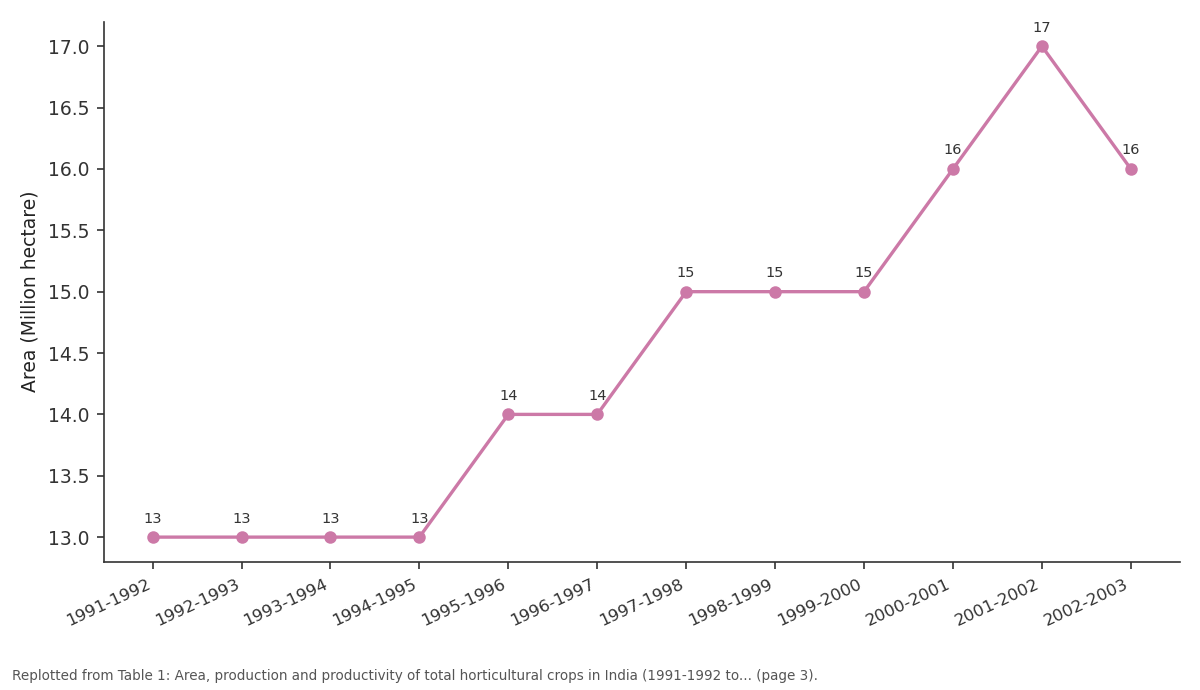
Area (Million hectare): 1991-1992 vs 1992-1993 vs 1993-1994 vs 1994-1995 vs 1995-1996
Replotted from Table 1 (page 3) of the original paper. Every bar is the paper's own table value.
View source evidence ↗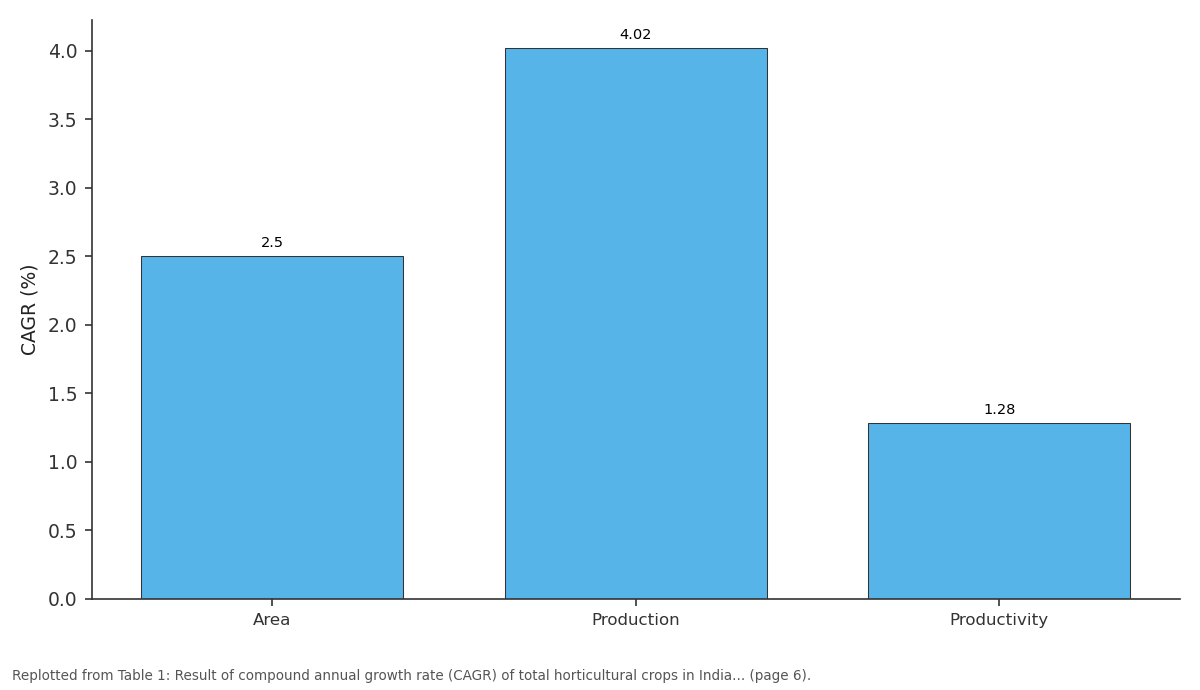
CAGR (%): Area vs Production vs Productivity
Replotted from Table 1 (page 6) of the original paper. Every bar is the paper's own table value.
View source evidence ↗Figures & tables
From the original paper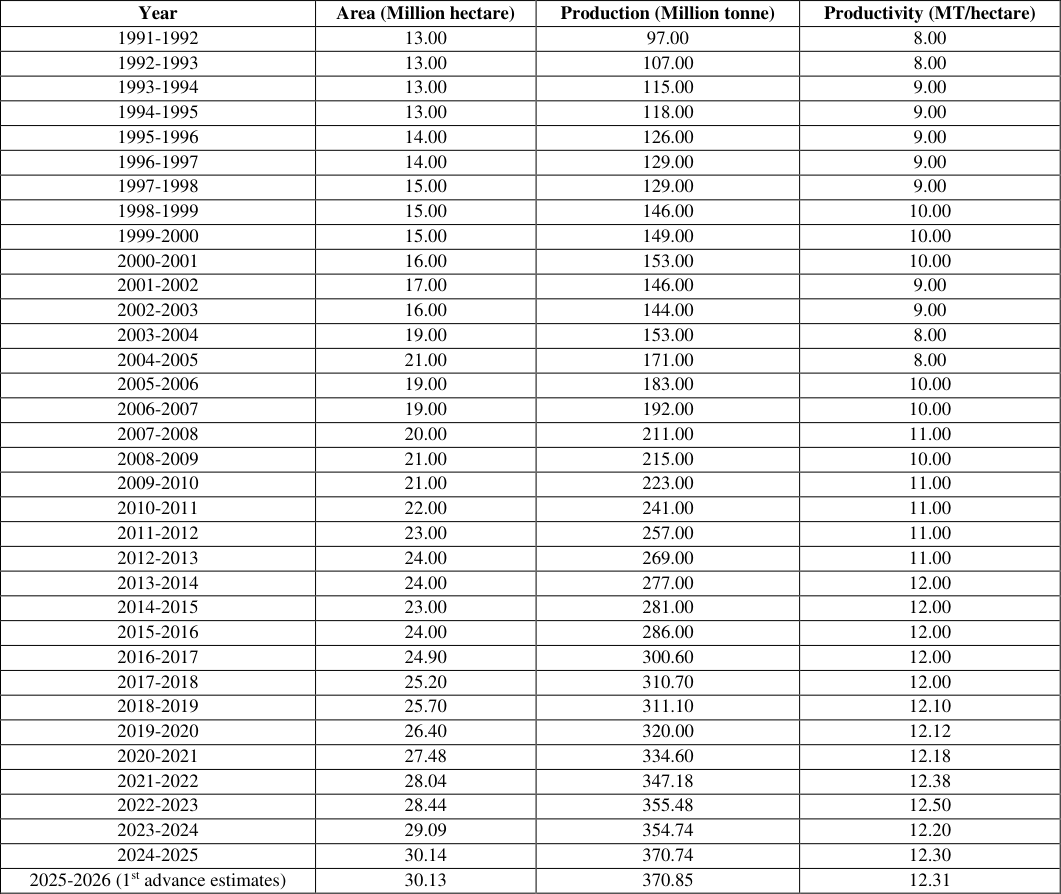 Table 1
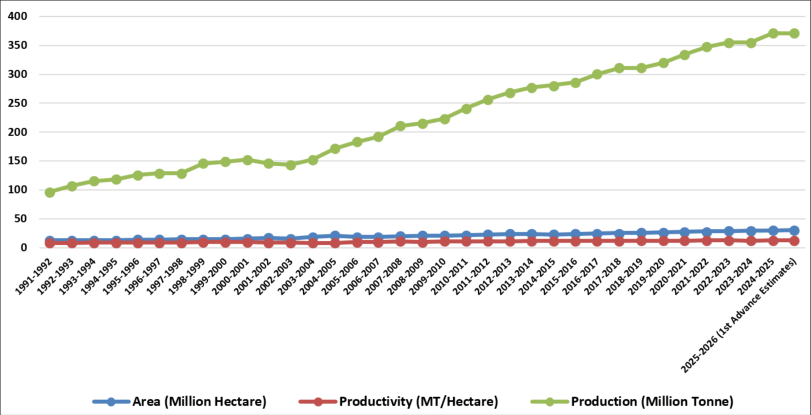 Figure 1
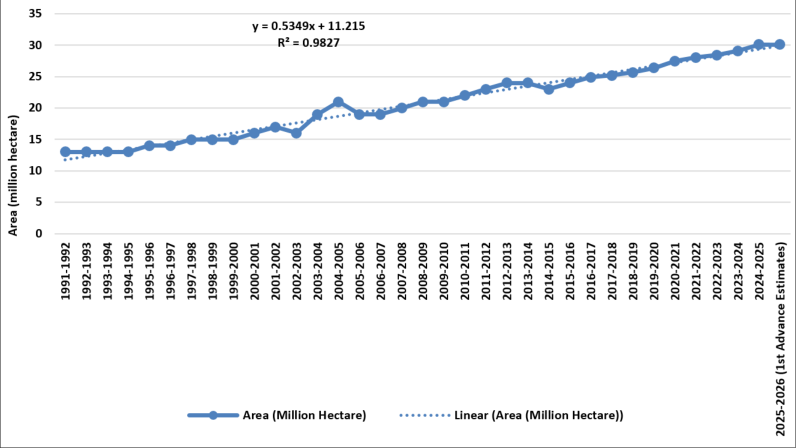 Figure 2
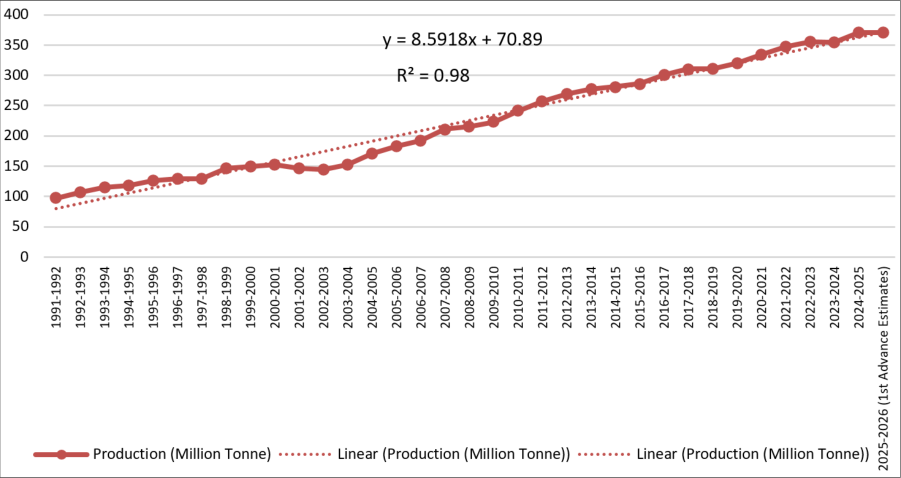 Figure 3
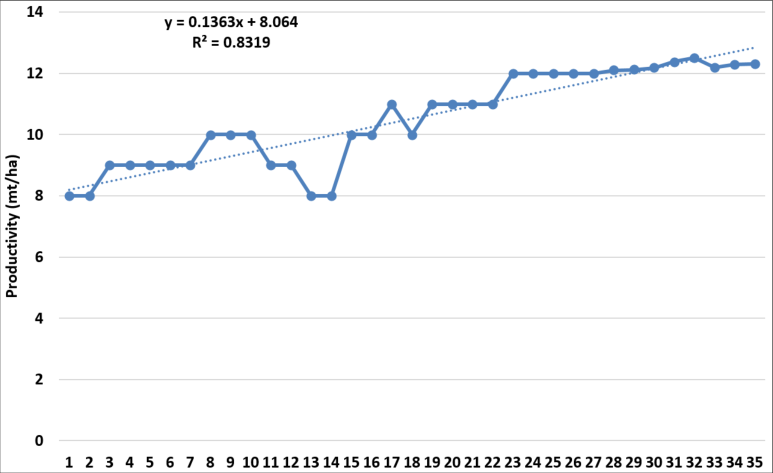 Figure 4
 Table 1
 Table 1
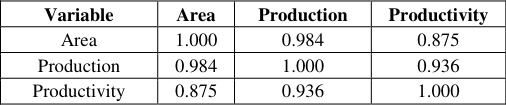 Table 1
Introduction
Horticulture has emerged as one of the fastest-growing segments of Indian agriculture and plays a pivotal role in enhancing agricultural diversification, improving farm incomes, ensuring nutritional security, and promoting export earnings. Unlike many traditional field crops, horticultural crops including fruits, vegetables, spices, flowers, plantation crops, and medicinal and aromatic plants generate higher value per unit of land and create substantial employment opportunities throughout the production, processing, transportation, and marketing chain. Consequently, the horticulture sector has become increasingly important in achieving sustainable agricultural growth and supporting rural livelihoods in India. Over the past three decades, India's horticulture sector has undergone significant structural transformation. The area devoted to horticultural crops has expanded steadily due to rising domestic demand, increasing urbanization, changing dietary preferences, technological advancements, and supportive government interventions. Policy initiatives such as the National Horticulture Mission (NHM), the Mission for Integrated Development of Horticulture (MIDH), and investments in irrigation, post-harvest infrastructure, and supply chain development have contributed to improvements in production and productivity across many regions of the country. India is currently among the world's leading producers of several horticultural commodities, including bananas, mangoes, potatoes, onions, and a wide range of spices. The sector contributes significantly to agricultural output and provides an important source of income for millions of small and marginal farmers. In addition to meeting domestic consumption requirements, horticultural products contribute to export earnings and support agro-based industries. Despite these achievements, the sector continues to face challenges such as fragmented landholdings, post-harvest losses, climate variability, inadequate cold-chain infrastructure, price volatility, and unequal technological adoption across production systems. An assessment of the long-term performance of the horticulture sector is essential for understanding its growth trajectory and identifying areas that require policy attention. While increasing production is an important indicator of sectorial expansion, improvements in productivity are equally critical because they reflect technological progress, efficient resource utilization, and better farm management practices. Evaluating changes in cultivated area, total production, and productivity over time provides valuable insights into the sustainability and efficiency of horticultural development in India. Although several studies have examined specific horticultural crops or short-term performance, comprehensive analyses covering more than three decades of national-level horticultural development remain relatively limited. The inclusion of the latest available estimates allows for a more complete understanding of recent developments and emerging trends in the sector. Against this background, the present study investigates the growth, trends, and productivity performance of total horticultural crops in India during the period from 1991-92 to 2025-26. Using annual secondary data, the study evaluates long-term changes in area, production, and productivity through descriptive statistics, trend analysis, compound annual growth rate estimation, annual growth analysis, correlation analysis, and regression techniques. The findings are expected to provide empirical evidence that can assist policymakers, researchers, and agricultural planners in formulating strategies for sustainable horticultural development and improving the competitiveness of the sector.
Review of Literature
The horticulture sector has emerged as one of the most dynamic segments of Indian agriculture, contributing significantly to agricultural diversification, rural employment, nutritional security, and export earnings. Over the years, researchers have extensively examined its growth, productivity, policy interventions, and sustainability. Joshi et al., (2004) [10] observed that increasing consumer demand, rapid urbanization, and agricultural commercialization encouraged farmers to diversify from traditional cereal cultivation towards high-value horticultural crops, thereby improving farm income and resource-use efficiency. Similarly, Chand et al., (2008) [3] highlighted that the horticulture sector had become a major engine of agricultural growth in India, emphasizing that technological advancements, irrigation development, infrastructure expansion, and improved market access were key drivers of sustained sectoral development. Extending this perspective, Jha et al., (2019) [9] reported that horticulture has played a crucial role in enhancing farmers' income, employment generation, and export competitiveness, while stressing the importance of strengthening value chains, post-harvest infrastructure, and technological innovation to sustain future growth. The impact of government interventions has also received considerable attention in the literature. Ramesh et al., (2020) [20] found that the implementation of the National Horticulture Mission (NHM) significantly accelerated the growth of area, production, and productivity compared with the pre-NHM period, demonstrating the effectiveness of policy support in promoting horticultural development. Likewise, Narmadha and Karunakaran (2022) [21] reported that government initiatives substantially enhanced horticultural performance during the post-NHM period, although productivity improvements varied across different crop groups due to regional and technological disparities. More recently, forecasting studies have enriched the literature by incorporating advanced time-series techniques. Kumar et al., (2026) [22] employed ARIMA models to forecast India's horticulture sector and confirmed a persistent upward trend in area, production, and productivity, highlighting the usefulness of time-series forecasting for agricultural planning. Similarly, Kumar et al., (2026) [23] projected continued expansion of the sector but argued that future growth would increasingly depend on productivity enhancement, climate-resilient technologies, efficient supply chains, and sustainable resource management rather than continued expansion of cultivated area. Overall, the existing literature consistently demonstrates that India's horticulture sector has achieved remarkable progress over the past three decades, driven by technological advancement, supportive government policies, improved irrigation, and market development. Nevertheless, most previous studies have concentrated on specific crops, individual states, or limited time periods, with relatively few providing a comprehensive national-level assessment using the latest available data extending to the 2025-26 First Advance Estimates. This gap provides the rationale for the present study, which offers a long-term empirical analysis of the growth, trends, and productivity performance of total horticultural crops in India over the period 1991-92 to 2025-26.
Research gap
Although previous studies have significantly enhanced understanding of India's horticulture sector, three important gaps remain. First, few studies examine the complete longterm period from 1991-92 to 2025-26 (First Advance Estimates), thereby limiting understanding of structural changes over more than three decades. Second, most studies concentrate on selected crops or regions rather than evaluating the overall performance of total horticultural crops at the national level. Third, limited research combines descriptive statistics, trend analysis, compound annual growth rate estimation, annual growth analysis, correlation analysis, and regression analysis within a single empirical framework using the latest available national data. The present study addresses these gaps by providing a comprehensive assessment of the growth, trends, and productivity performance of total horticultural crops in India over a 35-year period. By incorporating the latest national estimates and employing multiple statistical techniques, the study provides updated empirical evidence to support policy formulation for sustainable horticultural development.
Objectives of the study 1) To examine the trends in area, production, and productivity of total horticultural crops in India during 1991-92 to 2025-26. 2) To estimate the growth performance of area, production, and productivity using Annual Growth Rate (AGR) and Compound Annual Growth Rate (CAGR). 3) To analyze the relationship among area, production, and productivity of total horticultural crops in India using correlation analysis. 4) To assess the impact of area and productivity on total horticultural production in India using a multiple regression model.
Research hypotheses H01:
There is no significant long-term growth in the area, production, and productivity of total horticultural crops in India during the study period (1991-92 to 2025-26). H02: There is a significant long-term growth in the area, production, and productivity of total horticultural crops in India during the study period (1991-92 to 2025-26). H₀₃: Cultivated area and productivity have no significant influence on total horticultural production in India. H04: Cultivated area and productivity have a significant influence on total horticultural production in India.
Research Methodology
The Figure 1 illustrates the trends in area, production, and productivity of total horticultural crops in India during 1991-92 to 2025-26 (First Advance Estimates). All three indicators exhibit a positive long-term trend, although production increased at a much faster rate than area and productivity. The area expanded steadily from 13.00 to 30.13 million hectares, while production rose sharply from 97.00 to 370.85 million tonnes. Productivity also improved from 8.00 to 12.31 MT/ha, indicating gradual technological progress. The findings suggest that the growth in horticultural output was driven by both expansion of cultivated area and continuous improvements in productivity, reflecting the sector's sustained development. Where:
Trend analysis
The time-series analysis reveals a clear and positive upward trend in the area, production, and productivity of total horticultural crops in India during the period 1991-92 to 2025-26 (First Advance Estimates). The results indicate sustained growth in the horticulture sector over the last three and a half decades. Area: The area under horticultural crops increased from 13.00 million hectares in 1991-92 to 30. 13 Pearson's correlation analysis was conducted to examine the relationship among area, production, and productivity of total horticultural crops in India during 1991-92 to 2025-26. The results indicate a strong positive association among all the variables. The correlation coefficient between area and production was 0.984, indicating that an increase in the cultivated area is strongly associated with higher horticultural production. Similarly, the correlation between production and productivity was 0.936, suggesting that improvements in productivity substantially contribute to increased production. The correlation between area and productivity was 0.875, which also indicates a strong positive relationship, although comparatively lower than the other coefficients. Since all correlation coefficients are close to +1, the variables exhibit a strong linear relationship with one another. These findings imply that both expansion of cultivated area and improvements in productivity have played significant roles in enhancing horticultural production in India. Overall, the correlation analysis confirms that the long-term growth of the horticulture sector has been supported by simultaneous improvements in land utilization and production efficiency.
Regression analysis
Multiple linear regression analysis was carried out to examine the influence of cultivated area and productivity on total horticultural production in India during 1991-92 to 2025-26. Production was considered the dependent variable, while area and productivity were used as the independent variables. The estimated regression model is:
Conclusion
The present study examined the growth, trends, and productivity performance of total horticultural crops in India during the period 1991-92 to 2025-26 (First Advance Estimates) using annual secondary data on area, production, and productivity. The findings reveal that the horticulture sector has witnessed remarkable and sustained growth over the last three and a half decades. The area under horticultural crops expanded from 13.00 million hectares to 30.13 million hectares, while production increased substantially from 97.00 million tonnes to 370.85 million tonnes. Productivity also improved from 8.00 MT/ha to 12.31 MT/ha, indicating gradual technological advancement and improved resourceuse efficiency. Trend analysis confirmed a strong positive growth pattern in all three indicators, while the CAGR analysis showed that production recorded the highest annual growth (4.02%), followed by area (2.50%) and productivity (1.28%). The descriptive statistics highlighted steady expansion with moderate variability, and the correlation analysis revealed a strong positive relationship among area, production, and productivity. Furthermore, the regression analysis confirmed that both cultivated area and productivity significantly influence horticultural production, emphasizing their combined contribution to sectoral growth. Overall, the study concludes that India's horticulture sector has emerged as a key driver of agricultural diversification, rural employment, nutritional security, and farmers' income. To sustain this growth, policy efforts should focus on improving productivity through technological innovation, quality planting materials, efficient irrigation systems, climateresilient cultivation practices, post-harvest infrastructure, value-chain development, and better market integration. Such measures will strengthen the long-term sustainability and global competitiveness of India's horticulture sector while contributing to inclusive agricultural and rural development.
Figures and tables from the paper
| Year | Area (Million hectare) | Production (Million tonne) | Productivity (MT/hectare) |
|---|---|---|---|
| 1991-1992 | 13.00 | 97.00 | 8.00 |
| 1992-1993 | 13.00 | 107.00 | 8.00 |
| 1993-1994 | 13.00 | 115.00 | 9.00 |
| 1994-1995 | 13.00 | 118.00 | 9.00 |
| 1995-1996 | 14.00 | 126.00 | 9.00 |
| 1996-1997 | 14.00 | 129.00 | 9.00 |
| 1997-1998 | 15.00 | 129.00 | 9.00 |
| 1998-1999 | 15.00 | 146.00 | 10.00 |
| 1999-2000 | 15.00 | 149.00 | 10.00 |
| 2000-2001 | 16.00 | 153.00 | 10.00 |
| 2001-2002 | 17.00 | 146.00 | 9.00 |
| 2002-2003 | 16.00 | 144.00 | 9.00 |
| 2003-2004 | 19.00 | 153.00 | 8.00 |
| 2004-2005 | 21.00 | 171.00 | 8.00 |
| 2005-2006 | 19.00 | 183.00 | 10.00 |
| 2006-2007 | 19.00 | 192.00 | 10.00 |
| 2007-2008 | 20.00 | 211.00 | 11.00 |
| 2008-2009 | 21.00 | 215.00 | 10.00 |
| 2009-2010 | 21.00 | 223.00 | 11.00 |
| 2010-2011 | 22.00 | 241.00 | 11.00 |
| 2011-2012 | 23.00 | 257.00 | 11.00 |
| 2012-2013 | 24.00 | 269.00 | 11.00 |
| 2013-2014 | 24.00 | 277.00 | 12.00 |
| 2014-2015 | 23.00 | 281.00 | 12.00 |
| 2015-2016 | 24.00 | 286.00 | 12.00 |
| 2016-2017 | 24.90 | 300.60 | 12.00 |
| 2017-2018 | 25.20 | 310.70 | 12.00 |
| 2018-2019 | 25.70 | 311.10 | 12.10 |
| 2019-2020 | 26.40 | 320.00 | 12.12 |
| 2020-2021 | 27.48 | 334.60 | 12.18 |
| 2021-2022 | 28.04 | 347.18 | 12.38 |
| 2022-2023 | 28.44 | 355.48 | 12.50 |
| 2023-2024 | 29.09 | 354.74 | 12.20 |
| 2024-2025 | 30.14 | 370.74 | 12.30 |
| 2025-2026 (1st advance estimates) | 30.13 | 370.85 | 12.31 |
Table text extracted from the original PDF; superscript letters are shown inline. The original table image is below.
View original table image
| Variable | CAGR (%) |
|---|---|
| Area | 2.50 |
| Production | 4.02 |
| Productivity | 1.28 |
Table text extracted from the original PDF; superscript letters are shown inline. The original table image is below.
View original table image
| Variable | Mean | Standard deviation | Minimum | Maximum |
|---|---|---|---|---|
| Area (Million hectare) | 20.84 | 5.53 | 13.00 | 30.14 |
| Production (Million tonne) | 225.54 | 88.93 | 97.00 | 370.85 |
| Productivity (MT/hectare) | 10.52 | 1.53 | 8.00 | 12.50 |
Table text extracted from the original PDF; superscript letters are shown inline. The original table image is below.
View original table image
| Variable | Area | Production | Productivity |
|---|---|---|---|
| Area | 1.000 | 0.984 | 0.875 |
| Production | 0.984 | 1.000 | 0.936 |
| Productivity | 0.875 | 0.936 | 1.000 |
Table text extracted from the original PDF; superscript letters are shown inline. The original table image is below.
View original table image
References
22 in the original paper- Bidari R, Golappanavar S, Kurade S, Badgi S. Profitability and economic performance of horticulturebased farming systems: Evidence from Dharwad district, Karnataka, India. International Journal of Horticulture and Food Science. 2026;SP-8(7):14-19. DOI:10.33545/26631067.2026.v8.i7Sa.781.
- Chand R, Raju SS, Pandey LM. Progress and potential of horticulture in India. Indian Journal of Agricultural Economics. 2008;63(3):299-309.
- Department of Agriculture and Farmers Welfare. Horticulture statistics at a glance 2024. New Delhi: Ministry of Agriculture and Farmers Welfare, Government of India; 2024.
- Department of Agriculture and Farmers Welfare. First advance estimates of area and production of horticultural crops 2025-26. New Delhi: Ministry of Agriculture and Farmers Welfare, Government of India; 2025.
- Dhiman T, Rani KD, Sharma D, Prajith J, Kurade S. Interlinkages of investment, consumption, and saving in determining short-run equilibrium: An Aggregate Demand (AD)-Aggregate Supply (AS) framework. Lex Localis -Journal of Local Self-Government. 2025;23(S5).
- Food and Agriculture Organization of the United Nations. FAOSTAT: Crops and livestock products database. Rome: Food and Agriculture Organization of the United Nations; 2024. https://www.fao.org/faostat/
- Government of India. Economic Survey 2024-25. Vol. 2. New Delhi: Ministry of Finance; 2025.
- Jha GK, Suresh A, Punera B, Supriya. Growth of horticulture sector in India: Trends and prospects. Indian Journal of Agricultural Sciences. 2019;89(2):314-321.
- Joshi PK, Gulati A, Birthal PS, Tewari L. Agriculture diversification in South Asia: Patterns, determinants and policy implications. Economic and Political Weekly. 2004;39(24):2457-2467.
- Kumari Deepa Rani, Sharma R, Kurade S, Shobhit, Sahu SK, Dhiman T. A comprehensive analysis of inflation dynamics, monetary policy transmission and their impact on national economic performance. The Journal of African Development. 2026;7(1):187-196.
- Kurade S, Bharadi HH, Badgi BSM, Mallikarjun A. Vikshit Bharat @2047: Quantitative projections of growth, income, and regional divergence. In: Kamble PS, editor. Vikshit Bharat @2047: Facets and Facts. Manas Publishers and Distributors; 2026. p. 100-113.
- Madival R, Bharadi HH, Kurade S. A study on socioeconomic impacts of digitalization in fisheries of Uttara Kannada District, Karnataka. International Journal for Multidisciplinary Research. 2025;7(6).
- Ministry of Agriculture and Farmers Welfare. Annual report 2024-25. New Delhi: Government of India; 2025.
- National Horticulture Board. Indian horticulture database. Ministry of Agriculture and Farmers Welfare, Government of India; 2025.
- NITI Aayog. Transforming Indian agriculture: Strategies for sustainable growth. New Delhi: Government of India; 2023.
- Reserve Bank of India. Handbook of statistics on the Indian economy 2023-24. Mumbai: Reserve Bank of India; 2024.
- Kurade S, Bharadi HH, Badagi BS, Mallikarjun A. Vikshit Bharat @2047: Quantitative projections of growth, income, and regional divergence. In: Kamble PS, editor. Vikshit Bharat @2047: Facets and facts. Manas Publishers and Distributors; 2026. p. 100-113.
- Rani KD, Sharma R, Kurade S, Shobhit, Sahu SK, Dhiman T. A comprehensive analysis of inflation dynamics, monetary policy transmission and their impact on national economic performance. The Journal of African Development. 2026;7(1):187-196.
- Ramesh GB, Lokesha H, Deshmanya JB, Wali VB, Patil MG, Tewari P. Impact of NHM on growth of horticultural crops in Karnataka. Indian Journal of Extension Education. 2020;56(2):154-158.
- Narmadha N, Karunakaran KR. Growth performance in horticulture: Temporal dynamics under different crop groups in India. Journal of Applied Horticulture. 2022;24(2):172-177. DOI:10.37855/jah.2022.v24i02.31.
- Kumar S, Kumar S. Projecting growth in Indian horticulture: A time series analysis of area, production, and productivity using ARIMA models. The Indian Journal of Agricultural Sciences. 2026;96(4):433-438. DOI:10.56093/ijas.v96i4.169507.
- Kumar D, Chhoidub C, Sharma M, Rani S. Growth, trends and future projections in India's horticulture sector: Insights from a time series analysis. Discover Agriculture. 2026;4:47. DOI:10.1007/s44279-02600490-x.