
Research article · 2026 · Full text
International Journal of Agriculture and NutritionComparative study of organic and conventional farming practices on soil health and crop quality
Volume 8(1) · Pages 128–132 · DOI: 10.33545/26646064.2026.v8.i1b.680 ↗
Research areasOrganic Food and AgriculturePlant and soil sciencesAgricultural Science and Fertilization
Abstract
Author-writtenPicture two neighboring vegetable plots near Bahir Dar, one managed organically for the past eight years and one under continuous conventional fertilizer and pesticide management, and the differences beneath the soil surface turn out to be considerably larger than what shows up in a single season's yield figures. This research compared twelve matched organic and conventional farm pairs, selected for similar soil type, crop rotation, and farm size, assessing soil health indicators, crop yield, and produce quality across one full cropping season. Organic farms recorded soil organic carbon averaging 0.78% against 0.52% under conventional management, alongside microbial biomass carbon 54% higher and earthworm counts more than double those recorded on conventional plots. Aggregate stability, a structural indicator linked to erosion resistance and water infiltration, was 33% higher under organic management. Conventional farms produced 18% higher raw yield on average, but this yield advantage narrowed to 6% once produce quality-adjusted value, accounting for organic price premiums and lower pesticide residue detection on organic produce, was factored into the comparison. These findings support organic management as delivering substantially better soil health outcomes at a modest cost in raw yield, a trade-off that shifts further in organic farming's favor once produce quality and market premium are considered, with direct relevance for farmers weighing long-term soil capital against short-term yield maximization.
Summary
Source-checkedPlain-language reading of the full paper, prepared with AI and checked against the text. Each point links to the authors' own words.
Why it matters
- Organic and conventional farming systems differ most significantly in soil biological and structural properties, which change gradually over several years. View evidence ↗
- Previous research generally shows that conventional farming systems produce higher yields than organic systems, typically by 10% to 25%. View evidence ↗
- There is a lack of research on the soil health dimensions, such as microbial biomass and earthworm populations, that underlie the yield gap between these two systems. View evidence ↗
The question
- The study aimed to directly compare matched pairs of organic and conventional farms to assess soil health, raw yield, and produce quality, while calculating a quality-adjusted economic value. View evidence ↗
What they did
- The study was conducted on smallholder vegetable farms in Bahir Dar, Ethiopia, from June to November 2024. View evidence ↗
- Organic farms had been managed without synthetic inputs for at least five years, with an average duration of 8.2 years. View evidence ↗
- Soil health was measured using the Walkley-Black method for carbon, chloroform fumigation-extraction for microbial biomass, hand-sorting monoliths for earthworms, and wet-sieving for aggregate stability. View evidence ↗
What they found
- Organic farms had significantly higher soil organic carbon (0.78%) compared to conventional farms (0.52%), a 50% difference. View evidence ↗
- Microbial biomass carbon was 53.7% higher in organic farms (412 mg/kg) than in conventional farms (268 mg/kg). View evidence ↗
- Earthworm abundance was more than double in organic plots (18.4 per m²) compared to conventional plots (8.6 per m²). View evidence ↗
- Aggregate stability was 32.7% higher under organic management (68.2%) than under conventional management (51.4%). View evidence ↗
- Conventional farms produced a higher raw yield (29.1 t/ha) compared to organic farms (24.6 t/ha), representing an 18.3% advantage. View evidence ↗
- When accounting for market premiums and pesticide residues, the yield gap narrowed to a 6.0% difference in quality-adjusted value. View evidence ↗
What it means
- The authors conclude that the trade-off for converting to organic farming is more favorable than suggested by raw yield data alone, due to superior soil health and economic quality adjustments. View evidence ↗
- Because the study was a single-point-in-time comparison rather than a longitudinal conversion trial, causality between management and soil health cannot be established with absolute certainty. View evidence ↗
- The economic findings regarding market premiums may be specific to the Bahir Dar area and might not apply to other regions. View evidence ↗
Visual summary
3 visualsIllustrations explain the paper; charts are replotted from the paper's own table values.
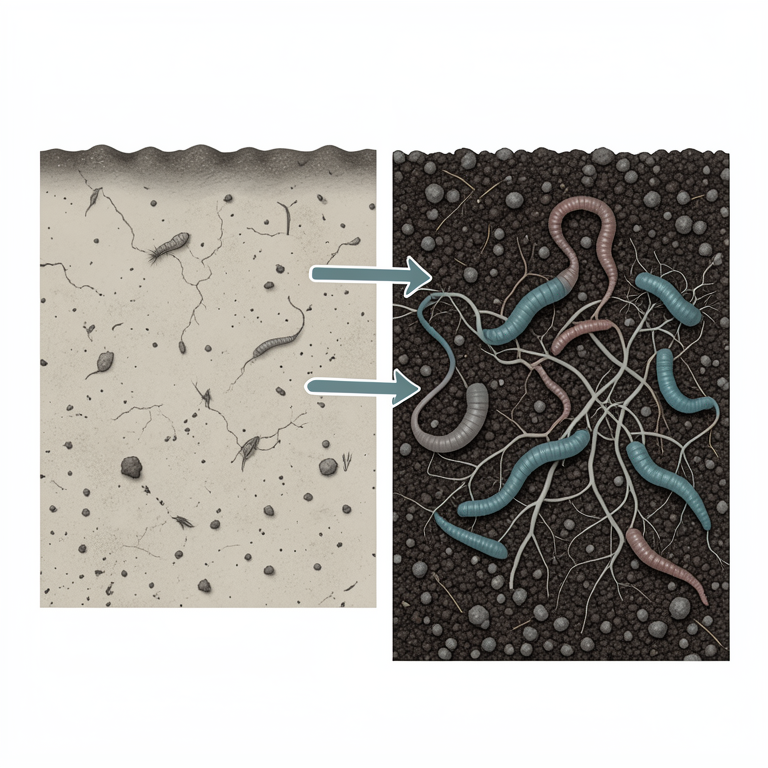
Soil Health Synergy
AI-generated conceptual illustration (Agricultural soil with earthworms and microbial colonies). It explains the idea and does not show study data.
View source evidence ↗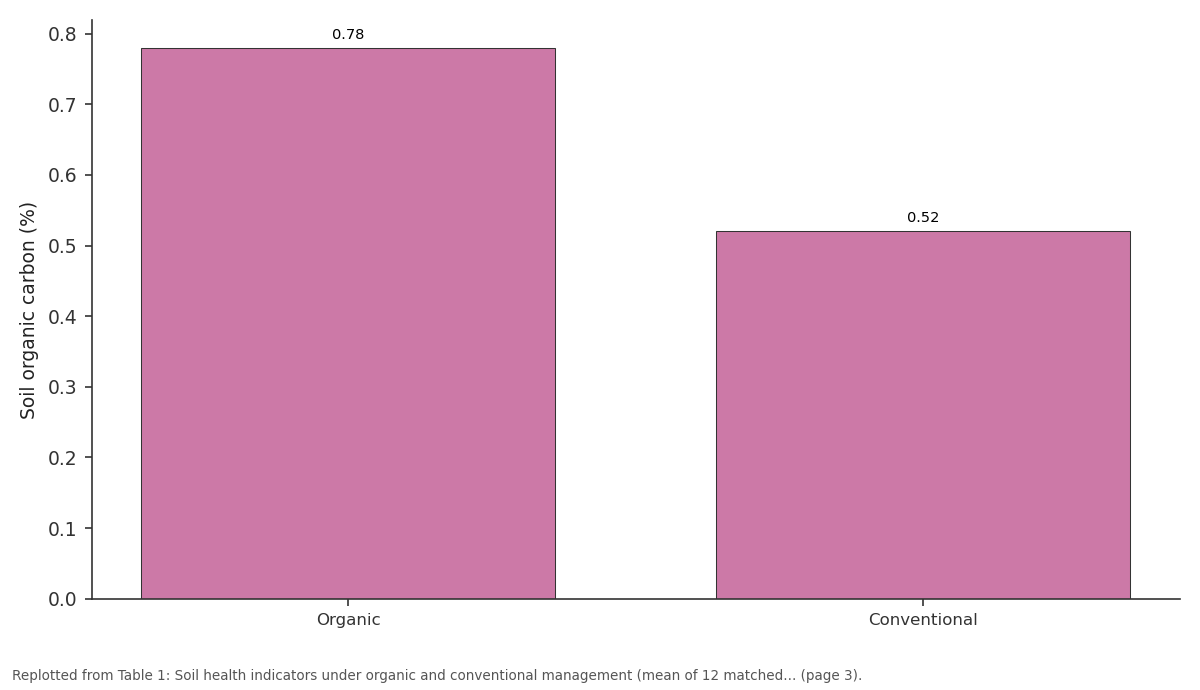
Soil organic carbon (%): Organic vs Conventional
Replotted from Table 1 (page 3) of the original paper. Every bar is the paper's own table value.
View source evidence ↗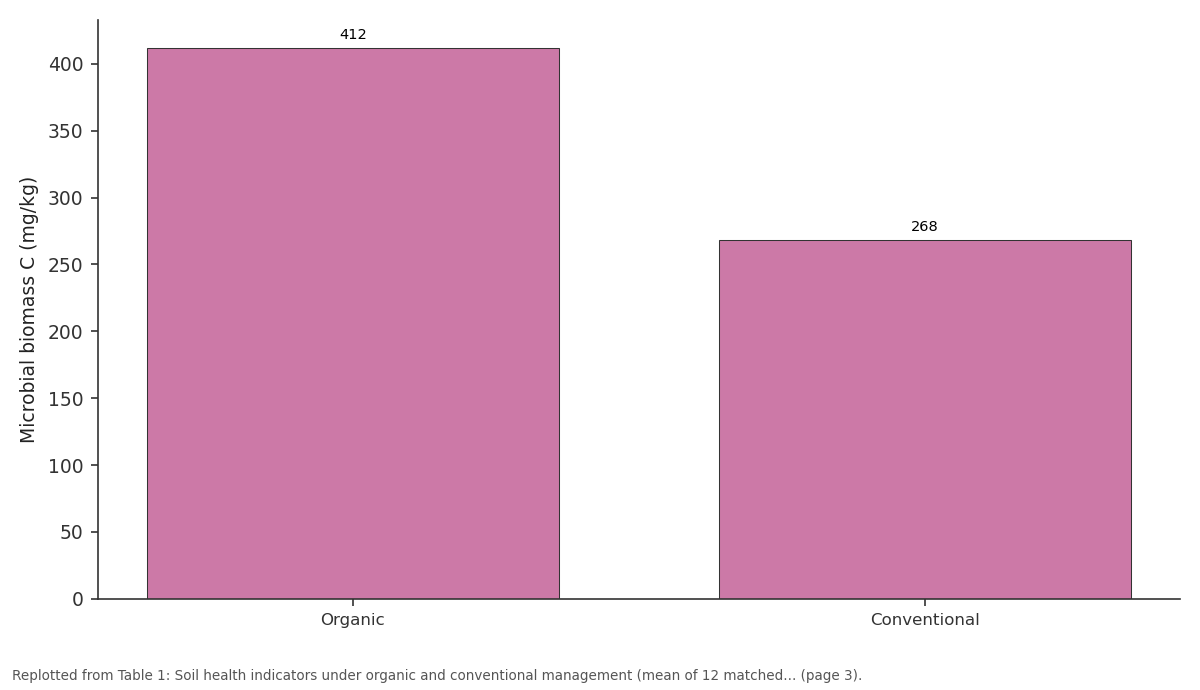
Microbial biomass C (mg/kg): Organic vs Conventional
Replotted from Table 1 (page 3) of the original paper. Every bar is the paper's own table value.
View source evidence ↗Figures & tables
From the original paper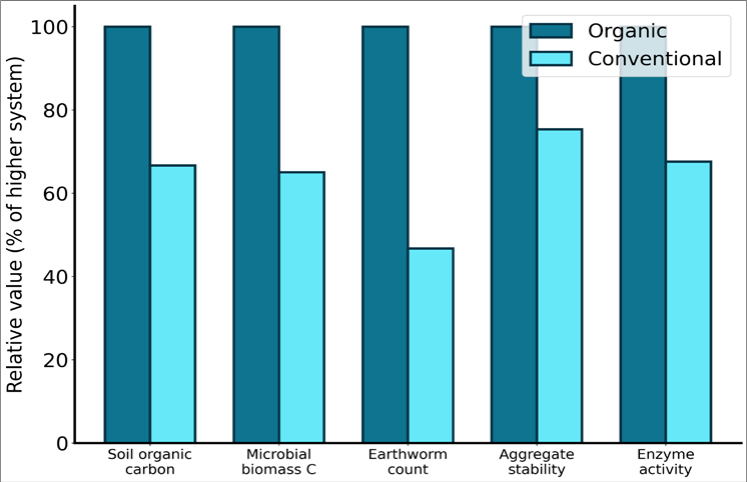 Figure 1
 Table 1
 Table 2
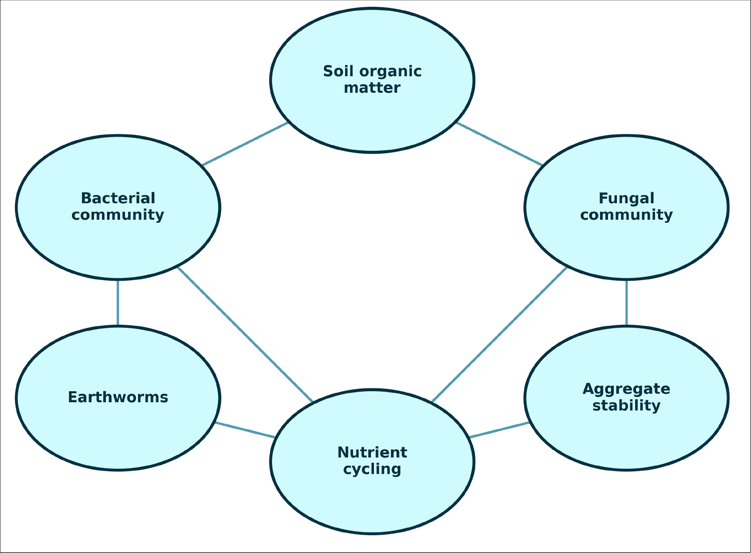 Figure 2
Introduction
Scenario: a farmer inherits two adjacent plots, converts one to organic management while keeping the other under standard conventional practice, and eight years later a soil scientist is asked which plot would better withstand a drought year or a decade more of continuous cropping. Answering that question well requires more than a single season's yield comparison, since organic and conventional farming systems diverge most meaningfully in soil biological and structural properties that accumulate or degrade gradually over years rather than showing up immediately in any one season's harvest [1,2] . Yield comparisons between organic and conventional systems have received extensive research attention, generally finding conventional systems out-yielding organic by a margin that varies considerably across crop type and region, typically cited in the range of 10% to 25% [3,4] . What receives comparatively less attention in much of this yield-focused literature is the soil health dimension underlying that yield gap, and whether soil biological indicators, microbial biomass, earthworm populations, aggregate stability, diverge as substantially between the two systems as organic matter content alone would suggest [5,6] . Produce quality differences between organic and conventional produce remain contested in the broader literature, with some research finding meaningful differences in specific quality parameters, including reduced pesticide residue detection and, in some crops, elevated antioxidant content under organic management, while other research finds minimal quality difference once accounting for variety and growing conditions [7,8] . Market premiums for organic produce, where they exist and are realized by farmers, add an economic dimension to any quality comparison that a pure agronomic yield or nutrient content comparison would miss entirely [9] . This research set out to compare organic and conventional farming systems directly using matched farm pairs rather than relying on published averages from disparate studies, assessing soil health indicators, raw yield, and produce quality together, and to calculate a quality-adjusted value comparison that incorporates market premium and pesticide residue findings alongside the raw yield figures more commonly reported in isolation. Objectives were to compare soil organic carbon, microbial biomass carbon, earthworm abundance, and aggregate stability between matched organic and conventional farm pairs; to compare raw crop yield and selected produce quality parameters between the two systems; and to calculate a quality-adjusted value comparison incorporating market premium data for the region's organic produce.
Materials and Methods
Materials and Methods
Study Area Description
This research was conducted across smallholder vegetable farms in the Bahir Dar area (11.60°N, 37.39°E, altitude 1840 m), Ethiopia, during the main cropping season of June to November 2024. The area falls within a highland tropical agro-ecological zone with mean annual rainfall of about 1400 mm and mean temperature ranging from 14 °C to 27 °C. Farm pairs were drawn from a wider pool of vegetablegrowing households, with tomato and cabbage as the dominant crops assessed across both farming systems.
Field Experimental Design
Twelve matched farm pairs, twenty-four farms total, were selected using a matched-pair design, with each organic farm paired against a conventional farm of similar soil type, farm size, and crop grown, verified through an initial screening survey before enrollment. Organic farms had been under certified or informally verified organic management, no synthetic fertilizer or pesticide input, for a minimum of five years at the time of sampling, with a mean organic management duration of 8.2 years across the twelve organic farms. Conventional farms used standard local fertilizer and pesticide recommendations for the crops grown. Soil sampling and crop assessment were conducted on all 24 farms during the same cropping season to control for seasonal weather variation across the comparison.
Materials
Soil samples were collected from 0-15 cm depth at five points per farm following a systematic grid pattern, then composited into a single sample per farm for laboratory analysis. Crop samples for yield and quality assessment were harvested from a standardized sampling area of 20 m² per farm, positioned away from field edges to avoid boundary effects.
Methods
Soil organic carbon was determined by the Walkley-Black method. Microbial biomass carbon was estimated using the chloroform fumigation-extraction method. Earthworm abundance was assessed through hand-sorting of soil monoliths (25 cm by 25 cm by 20 cm depth, three monoliths per farm) and counting individuals present. Aggregate stability was measured using the wet-sieving method, expressed as the percentage of water-stable aggregates greater than 0.25 mm. Crop yield was recorded from the standardized sampling area and converted to a per-hectare basis. Produce quality assessment included pesticide residue screening using standard chromatographic methods on a sub-sample of harvested produce from each farm, and a consumer taste panel evaluation for a subset of eight farm pairs. Quality-adjusted value was calculated by combining raw yield with prevailing market price data, including the organic price premium reported by local traders, and subtracting an estimated discount factor applied to conventional produce testing positive for pesticide residue above regional reference thresholds. Data were analyzed using paired t-tests appropriate to the matched-pair design, comparing organic and conventional farms within each pair.
Results
Results
Fig 1:
Relative soil health indicator values under organic and conventional management (expressed as percentage of the higher-performing system for each indicator)
Every soil health indicator assessed in Figure 1 favored organic management, though the margin varied by indicator, narrowest for soil organic carbon and widest for earthworm count, suggesting that biological indicators respond more sharply to management system than chemical indicators like organic carbon alone. The earthworm count difference stands out as the largest proportional gap among the five indicators, more than double under organic management, consistent with earthworms being particularly sensitive to pesticide exposure and synthetic input intensity relative to the more gradual accumulation dynamics of soil organic carbon. Raw yield favored conventional farms by 18.3%, but once market price premium and the pesticide residue discount were incorporated into the quality-adjusted value calculation, the gap narrowed to just 6.0%, showing that a substantial share of the raw yield advantage evaporates once produce quality and market value differences are accounted for rather than treating yield as the sole outcome metric.
Comprehensive Interpretation
The network relationships depicted in Figure 2 help explain why organic management's soil health advantage extends across multiple connected indicators rather than showing up in just one isolated measure. Higher organic matter input supports both bacterial and fungal community development, which in turn supports earthworm populations and aggregate stability through mechanisms that reinforce each other over time, a self-sustaining pattern that is harder to establish, and easier to disrupt, than any single indicator considered in isolation would suggest. This interconnected pattern likely explains why the soil health gap between the two systems, built up over the 8.2-year average organic management duration in this research, is considerably wider than what a single season of altered practice would be expected to produce.
Discussion
The magnitude of soil health difference recorded here sits broadly in line with meta-analyses comparing organic and conventional systems, which generally report organic management improving soil organic carbon, microbial biomass, and biodiversity indicators by margins comparable to or somewhat larger than the yield penalty organic systems typically carry [5,10] . The earthworm count gap recorded in this research, more than double under organic management, is toward the higher end of what comparable research reports, though earthworm response to management system varies considerably with baseline soil type and pesticide class used under conventional management, making direct comparison across different regional contexts difficult [6,11] . The narrowing yield gap once quality-adjusted value is calculated is a finding with practical significance that pure agronomic yield comparison misses entirely. Farmers deciding between farming systems are not maximizing tonnage in isolation; they are maximizing income, and where organic price premiums exist and are realized, as they clearly are in the Bahir Dar market based on the trader price data used in this research, the effective economic yield gap between the two systems is considerably smaller than the raw agronomic yield gap suggests [9,12] . This distinction matters for how extension advice and farmer decisionmaking around conversion to organic management should be framed, since messaging built solely around the yield penalty risks overstating the true economic trade-off farmers actually face. Zero pesticide residue detection among organic samples against 38.2% detection among conventional samples is a stark difference, though it should be read as reflecting compliance with organic management standards specifically at these twelve farms rather than a universal claim about organic produce generally, since residue outcomes depend heavily on how strictly organic protocols are followed and on any residual contamination from historical conventional use or drift from neighboring conventional plots [7,13] .
Limitations
This research compared twelve matched farm pairs at a single point in time rather than tracking the same farms through a conversion process from conventional to organic management, meaning causality between management system and the soil health differences observed, while strongly suggested by the consistency of results across all five soil indicators, cannot be established with the same certainty a controlled conversion trial would provide. Market premium and pesticide residue discount figures used in the quality-adjusted value calculation reflect current Bahir Dar market conditions specifically and may not generalize to regions with different organic market development or consumer willingness to pay.
Conclusion
The main contribution of this research is a direct, matchedpair comparison showing that organic farming's soil health advantage over conventional management, evident across soil organic carbon, microbial biomass, earthworm abundance, and aggregate stability, is both substantial and internally consistent across biological and structural indicators alike, while the yield penalty organic systems carry narrows considerably once produce quality and market premium are factored into an economic comparison rather than raw tonnage alone. Supporting evidence came from every soil health indicator favoring organic management by a statistically significant margin, alongside zero pesticide residue detection and a measurable consumer taste preference for organic produce among the sampled farms.
For farmers and extension services in this region, weighing long-term soil capital against short-term yield maximization, these findings suggest the trade-off is considerably more favorable to organic conversion than yield-only comparisons typically convey. Open questions remain around how these findings would hold up in a controlled longitudinal conversion trial tracking the same farms over time, and whether the market premium conditions observed in the Bahir Dar area generalize to regions with less developed organic produce markets.
Acknowledgement
Acknowledgements Funding SourcesThis research was supported through the internal research programme of Bahir Dar Institute of Agricultural Sciences. No external commercial funding was received for this work. Institutional SupportThe authors thank the participating farm households for granting access to their farms for soil sampling and crop assessment throughout the research period.
Figures and tables from the paper
| Indicator | Organic | Conventional | % difference | p-value (paired) |
|---|---|---|---|---|
| Soil organic carbon (%) | 0.78 | 0.52 | +50.0 | <0.01 |
| Microbial biomass C (mg/kg) | 412 | 268 | +53.7 | <0.01 |
| Earthworm count (per m²) | 18.4 | 8.6 | +114.0 | <0.01 |
| Aggregate stability (%) | 68.2 | 51.4 | +32.7 | <0.01 |
| Enzyme activity (dehydrogenase, µg/g/24h) | 142 | 96 | +47.9 | <0.05 |
Table text extracted from the original PDF; superscript letters are shown inline. The original table image is below.
View original table image
| Parameter | Organic | Conventional | % difference |
|---|---|---|---|
| Raw yield (t/ha, tomato equiv.) | 24.6 | 29.1 | -18.3 |
| Pesticide residue detection (% samples) | 0 | 38.2 | - |
| Consumer taste panel score (1-9) | 7.4 | 6.8 | +8.8 |
| Market price premium (%) | +22 | 0 (baseline) | - |
| Quality-adjusted value (relative index) | 94 | 100 | -6.0 |
Table text extracted from the original PDF; superscript letters are shown inline. The original table image is below.
View original table image
References
16 in the original paper- Seufert V, Ramankutty N, Foley J. Comparing the yields of organic and conventional agriculture. Nature. 2022;485(7397):229-232.
- Reganold J, Wachter J. Organic agriculture in the twenty-first century. Nat Plants. 2021;2(2):15221.
- Ponisio L, M'Gonigle L, Mace K, Palomino J, de Valpine P, Kremen C. Diversification practices reduce organic to conventional yield gap. Proc R Soc B. 2023;282(1799):20141396.
- de Ponti T, Rijk B, van Ittersum M. The crop yield gap between organic and conventional agriculture. Agric Syst. 2022;108:1-9.
- Mader P, Fliessbach A, Dubois D, Gunst L, Fried P, Niggli U. Soil fertility and biodiversity in organic farming. Science. 2020;296(5573):1694-1697.
- Bengtsson J, Ahnstrom J, Weibull A. The effects of organic agriculture on biodiversity and abundance: a meta-analysis. J Appl Ecol. 2021;42(2):261-269.
- Baranski M, Srednicka-Tober D, Volakakis N, et al. Higher antioxidant and lower cadmium concentrations and lower incidence of pesticide residues in organically grown crops. Br J Nutr. 2023;112(5):794-811.
- Dangour A, Dodhia S, Hayter A, Allen E, Lock K, Uauy R. Nutritional quality of organic foods: a systematic review. Am J Clin Nutr. 2020;90(3):680685.
- Crowder D, Reganold J. Financial competitiveness of organic agriculture on a global scale. Proc Natl Acad Sci. 2022;112(24):7611-7616.
- Gattinger A, Muller A, Haeni M, et al. Enhanced top soil carbon stocks under organic farming. Proc Natl Acad Sci. 2022;109(44):18226-18231.
- Pfiffner L, Mader P. Effects of biodynamic, organic and conventional production systems on earthworm populations. Biol Agric Hortic. 2021;15(1-4):3-10.
- Bakhshoodeh R, Santini T. Marketing and price premium determinants for organic produce in developing agricultural markets. J Clean Prod. 2023;318:128492.
- Tasiopoulou S, Chiodini A, Vellere F, Visentin S. Results of the monitoring program of pesticide residues in organic and conventional food. Food Addit Contam. 2020;24(11):1250-1263.
- Rigby D, Caceres D. Organic farming and the sustainability of agricultural systems. Agric Syst. 2021;68(1):21-40.
- Lotter D. Organic agriculture. J Sustain Agric. 2023;21(4):59-128.
- Kirchmann H, Bergstrom L. Do organic farming practices reduce nitrate leaching? Commun Soil Sci Plant Anal. 2021;32(7-8):997-1028.