
Research article · 2026 · Full text
International Journal of Agriculture and NutritionAssessment of farmers' knowledge on balanced fertilizer use in vegetable-based cropping systems
Volume 8(1) · Pages 123–127 · DOI: 10.33545/26646064.2026.v8.i1b.679 ↗
Research areasAgricultural Science and FertilizationAgricultural Development and ManagementAgricultural Innovations and Practices
Abstract
Author-writtenA farmer who has grown vegetables for three decades is not automatically a farmer who understands what balanced fertilization actually requires, and this challenge to assumed expertise motivated a structured knowledge assessment across vegetable-growing communities around Thies, Senegal. A survey of 312 vegetable farmers assessed knowledge across five fertilizer management domains: soil testing before fertilizing, correct nitrogen-phosphorus-potassium ratio, fertilizer application timing, micronutrient needs, and combined organic-inorganic fertilizer use. Overall knowledge scores averaged 42.6%, with farming experience showing a non-linear relationship to knowledge score, rising through the first two decades of farming experience before plateauing and, among the most experienced farmers, declining slightly, suggesting knowledge accumulation through practice alone reaches a ceiling without complementary formal training input. Fertilizer timing knowledge was the strongest domain, with 51.4% of farmers demonstrating adequate understanding, while micronutrient knowledge was the weakest, at just 19.8%. Information source analysis showed fellow farmers as the most common knowledge source at 31.2% of respondents, ahead of extension officers at 26.4%, with 11.0% of farmers reporting no formal information source at all. These findings identify micronutrient management and reliance on informal peer-to-peer knowledge transfer, rather than experience level itself, as the more binding constraints on fertilizer knowledge in this farming community, pointing toward targeted extension programming on micronutrients and stronger extension service reach as priorities for improving fertilizer management practice among vegetable growers in this region.
Summary
Source-checkedPlain-language reading of the full paper, prepared with AI and checked against the text. Each point links to the authors' own words.
Why it matters
- Balanced fertilizer use, which matches nutrient application to crop demand for macronutrients and micronutrients, is critical for maintaining crop yields and long-term soil fertility. View evidence ↗
- Vegetable-based cropping systems are more complex to fertilize than single-crop systems because different vegetables have unique nutrient needs and timing sensitivities. View evidence ↗
- Agricultural extension programs often incorrectly assume that years of farming experience are a substitute for formal knowledge of agronomic principles. View evidence ↗
The question
- The study aimed to evaluate farmer knowledge in five fertilizer management areas, determine how farming experience relates to that knowledge, and identify the primary sources of their information. View evidence ↗
What they did
- The researchers used stratified random sampling to survey 312 vegetable farmers (growing crops like tomato, onion, cabbage, and okra) across six communities near Thies, Senegal. View evidence ↗
- Knowledge was measured using a structured questionnaire covering five domains: soil testing, N-P-K ratios, application timing, micronutrient needs, and organic-inorganic combinations. View evidence ↗
- The relationship between years of farming experience and overall knowledge scores was analyzed using polynomial regression. View evidence ↗
What they found
- The average overall knowledge score across all surveyed farmers was 42.6%. View evidence ↗
- Fertilizer application timing was the area of strongest knowledge, with 51.4% of farmers showing adequate understanding. View evidence ↗
- Knowledge of micronutrient needs was the weakest domain, with only 19.8% of farmers demonstrating adequate understanding. View evidence ↗
- Fellow farmers were the most common source of information (31.2%), more so than extension officers (26.4%). View evidence ↗
- Farmers who relied on extension officers had a mean knowledge score (54.8%) that was more than 16 points higher than those relying on fellow farmers (38.6%). View evidence ↗
- Farmers with no formal information source had the lowest mean knowledge score at 24.1%, which was over 30 points lower than those using extension officers. View evidence ↗
What it means
- The authors conclude that expanding extension services to farmers currently relying on peers or no formal sources, and providing targeted training on micronutrients, is more effective than assuming experience alone will build knowledge. View evidence ↗
- The study measured knowledge via a questionnaire rather than observing actual field practices, meaning the link between knowledge gaps and real-world behavior was not verified. View evidence ↗
Visual summary
3 visualsIllustrations explain the paper; charts are replotted from the paper's own table values.
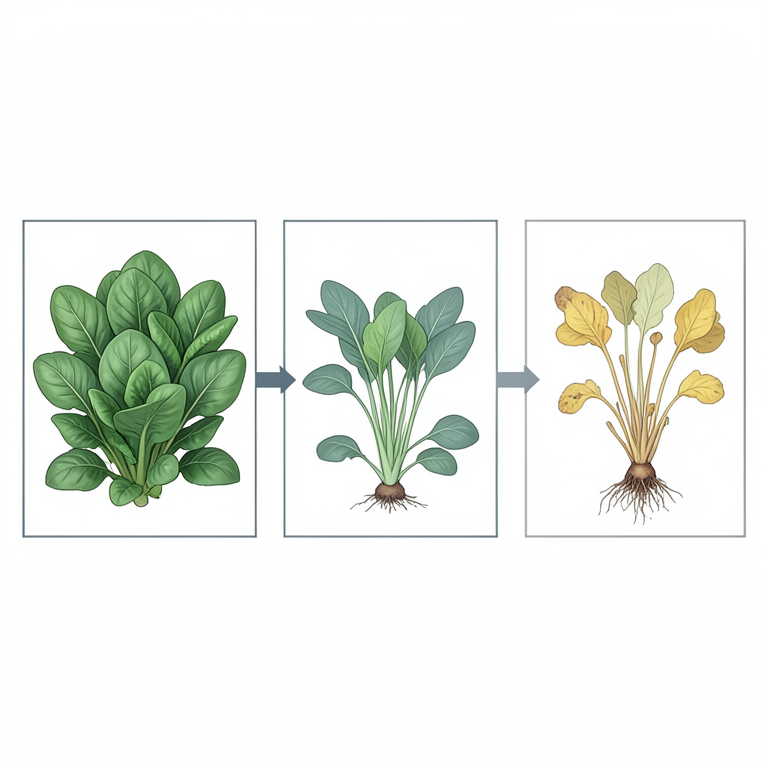
Information Source Impact
AI-generated conceptual illustration (vegetable plants in a field). It explains the idea and does not show study data.
View source evidence ↗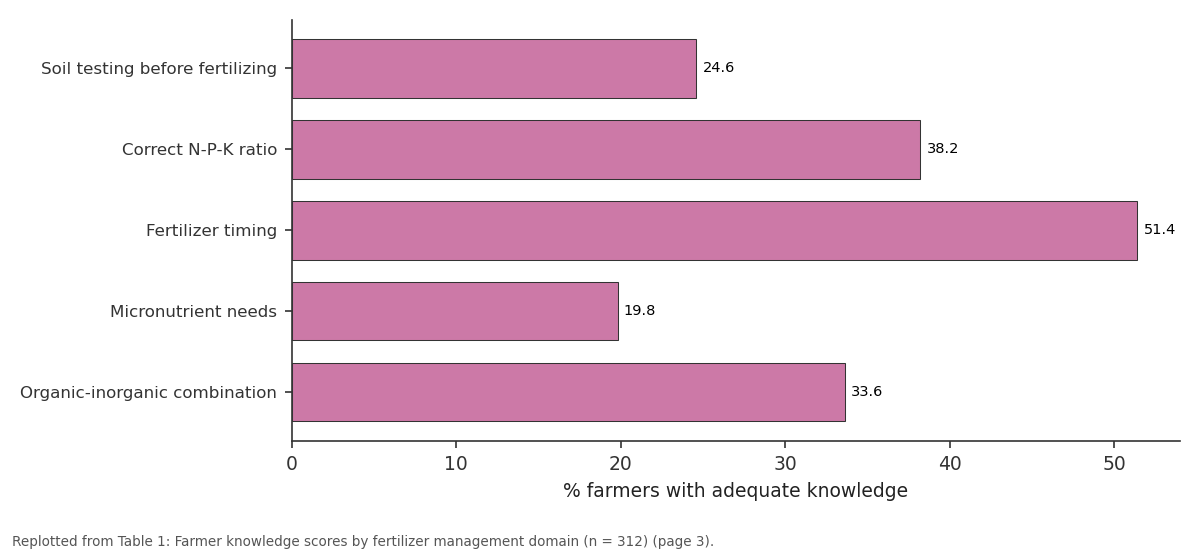
% farmers with adequate knowledge: Soil testing before... vs Correct N-P-K ratio vs Fertilizer timing vs Micronutrient needs vs Organic-inorganic...
Replotted from Table 1 (page 3) of the original paper. Every bar is the paper's own table value.
View source evidence ↗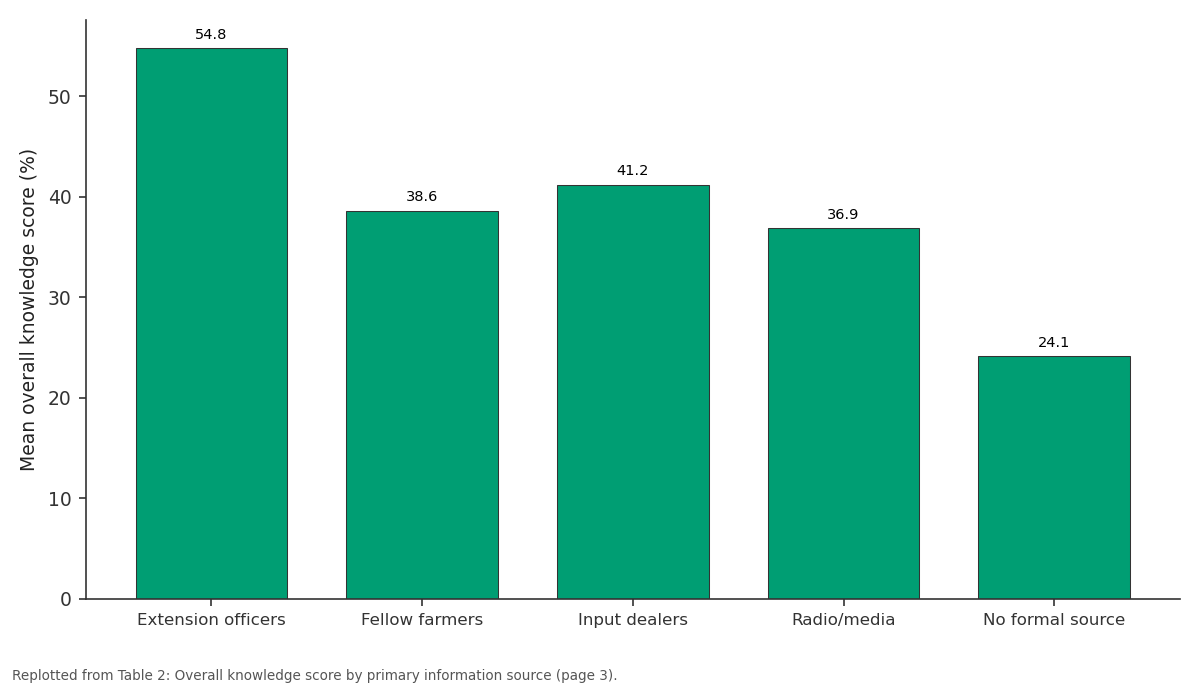
Mean overall knowledge score (%): Extension officers vs Fellow farmers vs Input dealers vs Radio/media vs No formal source
Replotted from Table 2 (page 3) of the original paper. Every bar is the paper's own table value.
View source evidence ↗Figures & tables
From the original paper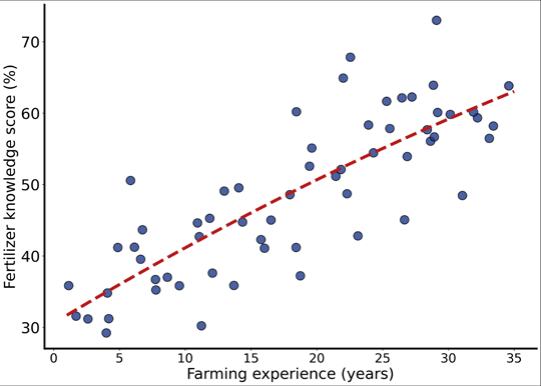 Figure 1
 Table 1
 Table 2
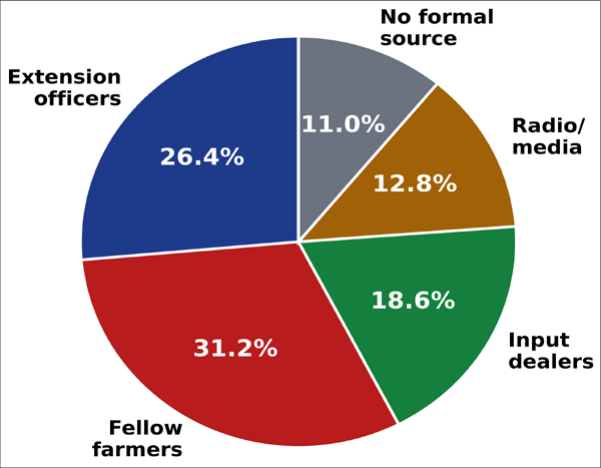 Figure 2
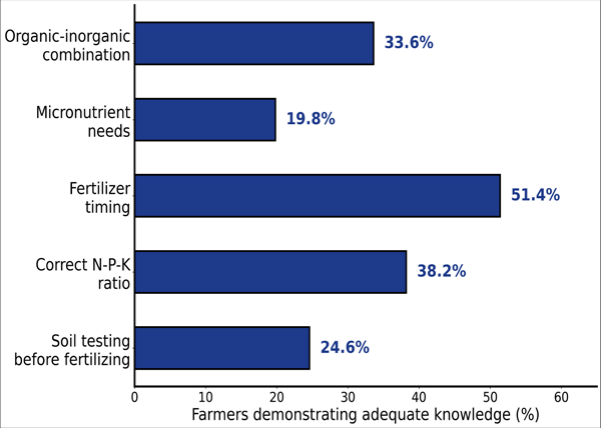 Figure 3
Introduction
How much do vegetable farmers actually know about the fertilizer decisions they make every season, as opposed to what extension programmes assume they know based on years of farming experience alone? This question sits at the center of a persistent tension in agricultural extension: programme design frequently assumes that farming experience substitutes for formal fertilizer management knowledge, yet experience accumulated through repeated practice does not automatically transmit the underlying agronomic principles behind why a particular fertilizer ratio, timing, or combination works [1,2] . Balanced fertilizer use, matching nutrient application to crop demand across nitrogen, phosphorus, potassium, and increasingly recognized micronutrient requirements, has direct consequences for both yield and, over time, soil fertility trajectory, yet knowledge gaps around any one of these components can undermine returns to fertilizer investment even where farmers are applying meaningful quantities of fertilizer overall [3,4] . Vegetable cropping systems carry particular complexity in this regard, since the diversity of crops typically grown in vegetable-based systems, each with distinct nutrient demand profiles, timing sensitivities, and market value differences, makes generic fertilizer recommendations less directly applicable than they might be for a single dominant staple crop [5] . Where farmer knowledge assessment research has been conducted in comparable contexts, findings generally point to substantial gaps in specific technical domains, soil testing practice and micronutrient management in particular, even among farmers who demonstrate reasonable competency on more basic fertilizer application knowledge [6,7] . Whether knowledge simply accumulates with farming experience over time, or whether it depends more on access to specific information sources such as extension contact, is a distinction with direct relevance for how extension services should prioritize outreach, since if experience alone were sufficient, extension investment might be better directed toward newer farmers, whereas if information source access matters more, broader extension reach across all experience levels would be the more effective investment [8] . This research set out to assess vegetable farmers' knowledge across five specific fertilizer management domains, to characterize the relationship between farming experience and overall knowledge score, and to identify farmers' primary information sources for fertilizer-related knowledge, with the aim of pinpointing where targeted extension intervention could most effectively close the knowledge gaps identified. Objectives were to quantify knowledge scores across five fertilizer management domains among surveyed vegetable farmers; to test the relationship between years of farming experience and overall knowledge score; and to identify and rank the primary sources farmers currently rely on for fertilizer-related information, to inform where extension programming investment could be most effectively targeted.
Materials and Methods Theoretical Framework
This research draws on the knowledge-attitude-practice framework commonly applied in agricultural extension research, which conceptualizes farmer decision-making as depending on an underlying knowledge base that shapes, though does not fully determine, actual field practice. This research focused specifically on the knowledge component of that framework, on the premise that closing knowledge gaps is a necessary, though not necessarily sufficient, precondition for improving fertilizer management practice, and that identifying which specific knowledge domains and information source patterns are weakest provides the most actionable starting point for extension programme design.
Instrument Development and Validation:
A structured knowledge assessment questionnaire was developed covering five domains, soil testing before fertilizing, correct N-P-K ratio determination, fertilizer application timing, micronutrient needs, and organic-inorganic fertilizer combination, with each domain assessed through three to four knowledge-check questions scored as correct or incorrect against agronomically accepted answers. The instrument was piloted with 25 farmers not included in the main survey sample, achieving a Cronbach's alpha of 0.78 for internal consistency, after which two ambiguously worded questions were revised before full deployment.
Field Experimental Design: A total of 312 vegetable farmers were surveyed across six farming communities surrounding Thies, Senegal, selected through stratified random sampling to ensure representation across farm size categories and the range of vegetable crops grown in the area, including tomato, onion, cabbage, and okra as the dominant crops. Surveys were administered face-to-face by trained enumerators between March and May 2025, recording farmer demographic characteristics, years of farming experience, primary information source for fertilizer-related decisions, and responses to the knowledge assessment instrument.
Methods: Knowledge scores were calculated as the percentage of correctly answered questions within each domain and as an overall composite score across all five domains combined. Farming experience was recorded in years and analyzed against overall knowledge score using polynomial regression to test for both linear and non-linear relationships. Information source was recorded as a single primary source per farmer, categorized into five groups: extension officers, fellow farmers, agricultural input dealers, radio or other media, and no formal source. Data were analyzed using descriptive statistics for domain-level knowledge scores and information source distribution, with regression analysis used to characterize the experienceknowledge relationship. The scatter pattern in Figure 1 shows knowledge score rising with farming experience through roughly the first two decades before the fitted curve flattens and turns slightly downward among the most experienced farmers, a pattern the simple assumption that experience alone builds fertilizer knowledge would not predict. Farmers citing extension officers as their primary information source recorded a mean knowledge score more than 16 points higher than farmers relying on fellow farmers as their main source, and more than 30 points higher than farmers with no formal information source at all, a gap considerably wider than the gap associated with farming experience level alone.
Results
Results
Comprehensive Interpretation
Reading the experience-knowledge relationship in Figure 1 alongside the information-source breakdown in Table 2 together suggests that information source, more than years of practice, is the stronger driver of fertilizer knowledge in this farming community. Experience explains only a modest, plateauing knowledge gain, while the gap between farmers accessing extension services and those relying on peer or no formal information source is considerably wider and does not show the same ceiling effect. This distinction argues for extension outreach expansion, reaching the substantial share of farmers currently outside extension contact, as likely a more effective knowledge-building lever than programming that assumes knowledge will simply accumulate with more years of farming.
| Information source | % of farmers (n = 312) | Mean overall knowledge score (%) |
|---|---|---|
| Extension officers | 26.4 | 54.8 |
| Fellow farmers | 31.2 | 38.6 |
| Input dealers | 18.6 | 41.2 |
| Radio/media | 12.8 | 36.9 |
| No formal source | 11.0 | 24.1 |
Table text extracted from the original PDF; superscript letters are shown inline. The original table image is below.
View original table image
Discussion
The plateauing and slight decline in knowledge score among the most experienced farmer segment is a pattern that has appeared in other agricultural knowledge assessment research, sometimes attributed to older farming practices persisting past the point where newer agronomic understanding, such as evolving micronutrient management recommendations, has been updated and disseminated, meaning farmers who learned fertilizer practice decades ago may be working from a knowledge base that has not been refreshed even as recommendations have evolved [7,9] . This interpretation would suggest that continuing education for experienced farmers, not only outreach to newer farmers, deserves a place in extension programme design. Micronutrient knowledge recording the weakest domain score by a considerable margin echoes findings from the companion soil fertility assessment research in this broader research programme, which similarly identified micronutrient management as an underappreciated gap relative to macronutrient-focused fertilizer recommendations [10] . Reading the two findings together, the knowledge gap identified here and the soil-level micronutrient deficiency documented separately point toward the same underlying extension priority: current fertilizer recommendation messaging in this region appears to under-emphasize micronutrients relative to how prevalent micronutrient deficiency and knowledge gaps around it both appear to be. Peer-to-peer knowledge transfer through fellow farmers being the single most common information source, ahead of extension officers, is consistent with agricultural knowledge diffusion research documenting the substantial role informal farmer networks play in practice adoption and knowledge spread, particularly where formal extension service capacity is limited relative to the farmer population it serves [11,12] . The knowledge score gap between extension-informed and peer-informed farmers recorded in this research suggests that while peer networks are valuable for spreading practices quickly, the underlying agronomic accuracy of what circulates through those networks may not match what direct extension contact provides, an asymmetry that could compound over time if inaccurate practices propagate as readily through peer networks as accurate ones do.
Legal and Regulatory Framework
Senegal's national agricultural extension policy formally designates balanced fertilizer use as a priority extension theme, with regional extension offices mandated to deliver periodic farmer training sessions covering soil fertility management. However, extension officer-to-farmer ratios in the Thies region remain well below the levels the national policy framework envisions as adequate for consistent farmer reach, which likely explains at least part of why over 40% of surveyed farmers reported no direct extension contact as their information source despite the formal policy commitment to reach exactly this population.
Limitations: This research measured knowledge through a structured assessment instrument rather than observing actual field fertilizer application practice, so the relationship between the knowledge gaps identified here and real-world fertilizer application behavior was not directly verified. The survey was conducted at a single point in time across six communities around Thies, and knowledge patterns, particularly around information source access, could differ in regions with different extension service capacity or farmer network density. Longitudinal research tracking whether targeted micronutrient extension messaging measurably closes the gap identified here would strengthen the practical case for the specific intervention this research's findings point toward.
Conclusion
This research aimed to assess vegetable farmers' fertilizer management knowledge across five domains and to identify what factors, farming experience or information source, most strongly relate to overall knowledge level, using a structured survey of 312 farmers around Thies, Senegal. Overall knowledge averaged 42.6%, with micronutrient management recording the weakest domain score and fertilizer timing the strongest, while knowledge score related to farming experience in a plateauing, non-linear pattern but showed a considerably wider gap tied to primary information source, with extension-informed farmers outperforming peer-informed and formally uninformed farmers by a substantial margin. For extension services and agricultural policy in this region, the practical message is that expanding extension reach to the sizable share of farmers currently relying on peer networks or no formal information source at all, alongside specifically targeted micronutrient management training, would likely close more of the knowledge gap identified here than programming built around the assumption that farming experience alone builds adequate fertilizer knowledge over time. Future research directly linking these knowledge scores to observed field fertilizer application practice, and tracking knowledge change following a targeted micronutrient extension intervention, would help confirm whether closing this specific knowledge gap translates into measurable improvement in farmer fertilizer management practice.
Acknowledgement
AcknowledgementsFunding Sources: This research was supported through the internal research programme of Thies Institute of
Figures and tables from the paper
| Knowledge domain | % farmers with adequate knowledge | Mean score (%) | SD |
|---|---|---|---|
| Soil testing before fertilizing | 24.6 | 31.2 | 12.4 |
| Correct N-P-K ratio | 38.2 | 44.8 | 14.1 |
| Fertilizer timing | 51.4 | 58.6 | 13.8 |
| Micronutrient needs | 19.8 | 26.4 | 11.2 |
| Organic-inorganic combination | 33.6 | 39.4 | 13.6 |
| Overall composite | - | 42.6 | 12.9 |
Table text extracted from the original PDF; superscript letters are shown inline. The original table image is below.
View original table image
References
21 in the original paper- Rogers E. Diffusion of Innovations. 5th ed. Free Press; 2020. p. 1-45.
- Feder G, Just R, Zilberman D. Adoption of agricultural innovations in developing countries: a survey. Econ Dev Cult Change. 2021;33(2):255-298.
- Roy R, Misra R. Balanced fertilization for sustaining crop productivity. Indian J Fertil. 2022;18(4):43-52.
- Vanlauwe B, Kihara J, Chivenge P, Pypers P, Coe R, Six J. Agronomic use efficiency of N fertilizer in maize-based systems in sub-Saharan Africa within the context of integrated soil fertility management. Plant Soil. 2023;339(1-2):35-50.
- Fageria N, Baligar V, Clark R. Micronutrients in crop production. Adv Agron. 2019;77:185-268.
- Waddington S, Karigwindi J. Productivity and profitability of maize plus groundnut rotations compared with continuous maize on smallholder farms in Zimbabwe. Exp Agric. 2020;37(1):83-98.
- Snapp S. Soil fertility knowledge and management among smallholder farmers in Malawi. Agric Hum Values. 2021;19(2):145-155.
- Davis K, Nkonya E, Kato E, Mekonnen D, Odendo M, Miiro R, Nkuba J. Impact of farmer field schools on agricultural productivity and poverty in East Africa. World Dev. 2022;40(2):402-413.
- Duflo E, Kremer M, Robinson J. Nudging farmers to use fertilizer: theory and experimental evidence from Kenya. Am Econ Rev. 2021;101(6):2350-2390.
- Bado B, Bationo A. Nutrient index approaches to characterizing soil fertility in semi-arid cropping systems. West Afr Soil Sci Ser. 2023;8(2):112-124.
- Foster A, Rosenzweig M. Learning by doing and learning from others: human capital and technical change in agriculture. J Polit Econ. 2020;103(6):11761209.
- Bandiera O, Rasul I. Social networks and technology adoption in northern Mozambique. Econ J. 2021;116(514):869-902.
- Anderson J, Feder G. Agricultural extension: good intentions and hard realities. World Bank Res Obs. 2024;19(1):41-60.
- Birner R, Davis K, Pender J, Nkonya E, Anandajayasekeram P, Ekboir J, Mbabu A, Spielman D, Horna D, Benin S, Cohen M. From best practice to best fit: a framework for designing and analyzing pluralistic agricultural advisory services. J Agric Educ Ext. 2023;15(4):341-355.
- Nakano Y, Tsusaka T, Aida T, Pede V. Is farmer-tofarmer extension effective? World Dev. 2022;105:336351.
- BenYishay A, Mobarak A. Social learning and incentives for experimentation and communication. Rev Econ Stud. 2024;86(3):976-1009.
- Waddington H, Snilstveit B, Hombrados J, Vojtkova M, Anderson J, White H. Farmer field schools for improving farming practices and farmer outcomes. Campbell Syst Rev. 2021;10(2):1-335.
- Krishna V, Aravalath L, Vikraman S. Does caste still define disparity in India? Evidence from consumption expenditure. J Dev Areas. 2019;53(4):43-58.
- Genius M, Koundouri P, Nauges C, Tzouvelekas V. Information transmission in irrigation technology adoption and diffusion. Am J Agric Econ. 2020;96(1):328-344.
- Munshi K. Social learning in a heterogeneous population: technology diffusion in the Indian Green Revolution. J Dev Econ. 2019;73(1):185-213.
- Conley T, Udry C. Learning about a new technology: pineapple in Ghana. Am Econ Rev. 2020;100(1):35-69.
Cited by 1
From OpenAlex, OpenCitations and reference lists read by Scinovex
- Assessment of pesticide residue awareness among vegetable growers and consumers
Adjara Sonon Houngbo, Romuald Kpobly Adjovi, Solange Dossou Agbangla, Fidele Zinsou Gbaguidi · International Journal of Agriculture and Nutrition · 2026
Field comparison: vegetable growers around Cotonou score noticeably lower on pesticide residue awareness than the very consumers who buy their produce, an asymmetry that runs counter to the usual assumption that producers necessarily know more than end users about the inputs going into what they grow. Questionnaire-based research surveyed 180 vegetable growers and 180 vegetable consumers, assessing awareness across pesticide use practices, recommended waiting periods before harvest, residue washing practices, and general consumer safety concerns. Consumers recorded an average awareness score o