
Research article · 2026 · Full text
International Journal of Agriculture and NutritionAssessment of pesticide residue awareness among vegetable growers and consumers
Volume 8(2) · Pages 92–96 · DOI: 10.33545/26646064.2026.v8.i2b.689 ↗
Research areasPesticide Exposure and ToxicityAgricultural safety and regulationsPesticide Residue Analysis and Safety
Abstract
Author-writtenField comparison: vegetable growers around Cotonou score noticeably lower on pesticide residue awareness than the very consumers who buy their produce, an asymmetry that runs counter to the usual assumption that producers necessarily know more than end users about the inputs going into what they grow. Questionnaire-based research surveyed 180 vegetable growers and 180 vegetable consumers, assessing awareness across pesticide use practices, recommended waiting periods before harvest, residue washing practices, and general consumer safety concerns. Consumers recorded an average awareness score of 58.4%, notably higher than growers' average of 48.2%, with the gap most pronounced on questions concerning recommended pre-harvest waiting periods, where growers scored only 34.6% against consumers' 51.8%. Farming experience among growers showed a positive but modest relationship with waiting period knowledge, improving from roughly 25% adequate awareness among growers with under five years' experience to about 51% among those with over twenty years, though even the most experienced grower segment fell short of matching consumer awareness levels on this specific question. Washing practice awareness was the strongest domain for both groups, though growers' washing practice knowledge appeared driven more by general hygiene habit than by any specific pesticide-residue-focused reasoning. These findings challenge assumptions that producer knowledge exceeds consumer knowledge by default and point toward waiting period education specifically, rather than general pesticide safety messaging, as the priority gap extension services serving vegetable growers in this region should address.
Summary
Source-checkedPlain-language reading of the full paper, prepared with AI and checked against the text. Each point links to the authors' own words.
Why it matters
- Intensive pesticide use in vegetable production around Cotonou creates risks for both growers and consumers if there is a gap between recommended practices and actual grower understanding. View evidence ↗
- Pre-harvest waiting periods are technically complex because they require knowledge of specific degradation timelines for different pesticides rather than a single rule. View evidence ↗
- Assuming that producers always know more than consumers about safety can lead to the misdirection of agricultural extension resources. View evidence ↗
The question
- The study aimed to directly compare pesticide residue awareness between vegetable growers and consumers in Cotonou across four specific knowledge domains. View evidence ↗
- The researchers also sought to determine how a grower's years of farming experience influenced their knowledge of pre-harvest waiting periods. View evidence ↗
What they did
- The study surveyed 180 vegetable growers and 180 consumers in the Cotonou region of Benin from February to April 2025. View evidence ↗
- Awareness was measured using a structured questionnaire covering pesticide use, waiting periods, washing practices, and general safety concerns. View evidence ↗
- Scores were calculated as the percentage of correct answers for each individual domain and as a combined overall composite score. View evidence ↗
What they found
- Consumers had a higher overall average awareness score (58.4%) compared to vegetable growers (48.2%). View evidence ↗
- Growers outperformed consumers only in the domain of pesticide use practices, scoring 52.4% compared to 49.6% for consumers. View evidence ↗
- A significant gap was found in pre-harvest waiting period knowledge, where growers scored 34.6% and consumers scored 51.8%. View evidence ↗
- The widest knowledge gap occurred in general safety concerns, with consumers scoring 63.8% and growers scoring 44.0%. View evidence ↗
- Grower experience modestly improved waiting period knowledge, rising from approximately 25% for those with under five years' experience to about 51% for those with over twenty years. View evidence ↗
What it means
- The authors recommend that extension services prioritize technical training on pre-harvest waiting periods for growers, as experience and general messaging are insufficient. View evidence ↗
- The study relied on self-reported knowledge rather than direct observation of field practices or verification of waiting period compliance. View evidence ↗
Visual summary
1 visualsIllustrations explain the paper; charts are replotted from the paper's own table values.
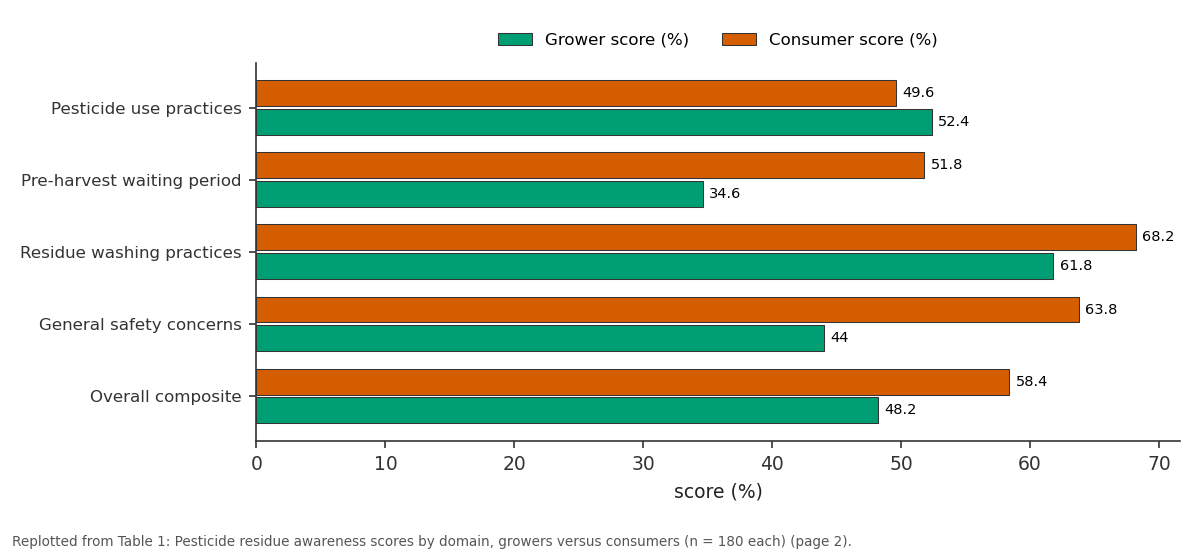
Grower score (%) and Consumer score (%): Pesticide use practices vs Pre-harvest waiting... vs Residue washing... vs General safety concerns vs Overall composite
Replotted from Table 1 (page 2) of the original paper. Every bar is the paper's own table value.
View source evidence ↗Figures & tables
From the original paper Table 1
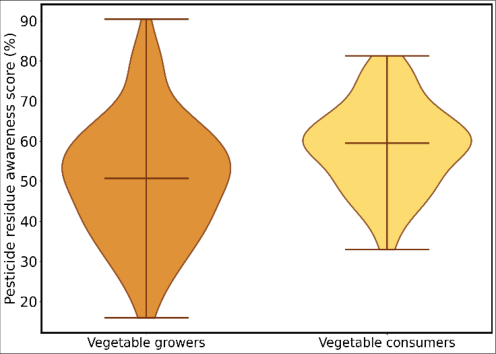 Figure 1
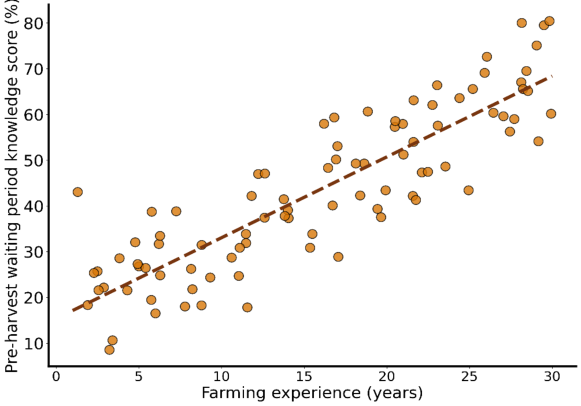 Figure 2
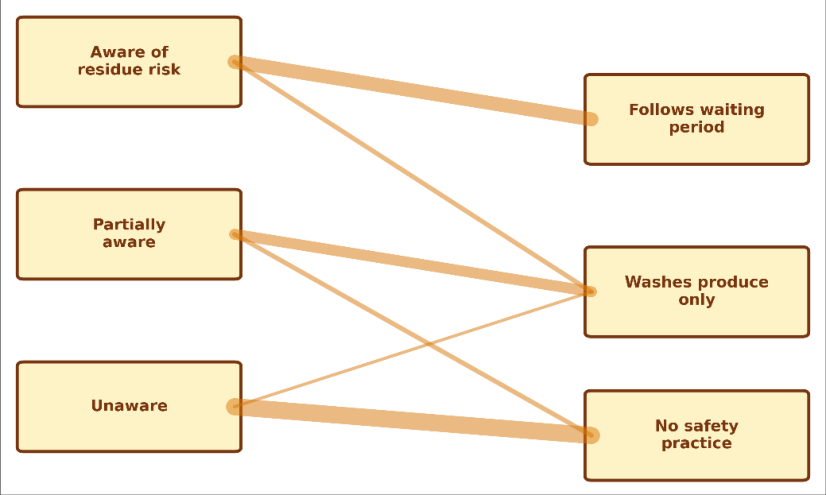 Figure 3
Introduction
Field comparison research on agricultural knowledge typically assumes producers know more about their own production practices than the consumers who eventually purchase what they grow, an assumption that seems intuitive but has not been tested directly and symmetrically for pesticide residue awareness specifically in most vegetable-growing regions of West Africa [1,2] . Vegetable production around urban centers like Cotonou often involves comparatively intensive pesticide use to protect high-value, pest-susceptible crops, and the gap between recommended pesticide application practice, including pre-harvest waiting periods, and what growers actually understand and follow has direct implications for both grower and consumer pesticide exposure risk [3,4] . Pre-harvest waiting periods, the interval between the last pesticide application and harvest, represent one of the more technical knowledge domains within pesticide safety, requiring growers to understand degradation timelines specific to each pesticide product rather than a single universal rule, a complexity that may explain why waiting period compliance and awareness lag behind more intuitive safety practices like washing produce before consumption [5,6] . Consumer-side research on pesticide residue awareness has grown alongside rising urban consumer interest in food safety, but this consumer awareness has rarely been measured against grower awareness using the same instrument and scoring approach within the same study population and region, making direct comparison across the existing literature difficult [7,8] . Where knowledge gaps between producers and other value chain actors have been documented in other agricultural contexts, the direction of the gap has not been uniform, sometimes favoring producers with direct field experience and sometimes favoring downstream actors with better access to health and safety messaging channels not always reaching rural production communities with the same intensity [9] . This variability suggests that assuming producer knowledge superiority without directly testing it in a specific context risks misdirecting extension resources toward the wrong audience or the wrong knowledge domain. This research set out to assess and directly compare pesticide residue awareness between vegetable growers and vegetable consumers around Cotonou using an identical assessment instrument, across pesticide use practices, waiting periods, washing practices, and general safety concerns, and to characterize how grower awareness relates to farming experience specifically for the waiting period domain, given its particular technical complexity relative to other awareness domains assessed. Objectives were to quantify and compare pesticide residue awareness scores between vegetable growers and consumers across four knowledge domains; to test the relationship between grower farming experience and waiting period knowledge specifically; and to identify which awareness domain shows the widest gap between growers and consumers, to inform where targeted extension or consumer education investment would be most useful.
Materials and Methods Instrument development and validation
A structured awareness assessment questionnaire was developed covering four domains, pesticide use practices, pre-harvest waiting periods, residue washing practices, and general consumer safety concerns, with parallel versions adapted for grower and consumer respondents so that both groups answered conceptually equivalent questions phrased appropriately for their respective role. The instrument was piloted with 20 growers and 20 consumers not included in the main survey sample, achieving a Cronbach's alpha of 0.76 for the grower version and 0.74 for the consumer version, after which minor wording adjustments were made to two questions found ambiguous during piloting.
Field experimental design:
A total of 180 vegetable growers and 180 vegetable consumers were surveyed across communities and markets surrounding Cotonou, Benin, between February and April 2025. Growers were selected through stratified random sampling across three farming communities known for intensive vegetable production, primarily tomato, pepper, and leafy greens. Consumers were recruited at vegetable markets in Cotonou through systematic intercept sampling, selecting every fifth shopper at designated market entry points during randomly assigned survey time slots across a two-month data collection period.
Methods
Awareness scores were calculated as the percentage of correctly answered questions within each domain and as an overall composite score across all four domains combined, for both grower and consumer respondent groups. Grower farming experience was recorded in years and analyzed against waiting period domain score specifically using linear regression. Data were analyzed using independent-samples comparison between grower and consumer groups for each domain and the overall composite score, with statistical significance assessed at the 5% probability level.
Results
Results
Fig 1: Distribution of overall pesticide residue awareness scores among vegetable growers and vegetable consumers
The distribution shapes in Figure 1 show consumer awareness scores not only averaging higher than grower scores but also showing a somewhat wider spread toward the upper end of the scale, suggesting a meaningful subset of consumers have developed considerably above-average awareness, plausibly through media or social exposure to food safety messaging that has not reached the grower population with the same intensity. The scatter pattern in Figure 2 shows waiting period knowledge improving with farming experience, but even at the highest experience levels recorded, grower scores remain below the average consumer score, meaning experience alone did not close the awareness gap for this specific, more technically demanding knowledge domain.
Fig 3: Flow from awareness level to safety practice adopted among surveyed vegetable growers
The flow pattern in Figure 3 shows a meaningful share of growers who reported being unaware or only partially aware of residue risk nonetheless washing produce as a general practice, indicating that this safety behavior for many growers likely stems from general hygiene habit rather than pesticide-residue-specific reasoning, an important distinction for how effective this washing behavior actually is against residues that washing alone may not fully remove.
Comprehensive interpretation
Reading the domain-level gaps together, waiting period and general safety concerns stand out as the two areas where consumers most clearly outpace growers, while washing practice, though also favoring consumers, shows a considerably narrower gap and appears to function differently for each group, driven by residue-specific reasoning for at least some consumers but by general hygiene habit for many growers. This pattern suggests that closing the grower-consumer awareness gap specifically requires waiting-period-focused technical extension content rather than general food safety messaging alone, since growers' washing-related behavior, while present, does not indicate the underlying residue-specific understanding that waiting period compliance actually requires.
Discussion
Consumers outperforming growers on general pesticide safety awareness runs against the assumption embedded in much agricultural extension design, that farmers, through direct production experience, will naturally accumulate more safety-relevant knowledge than downstream consumers who never touch the crop before it reaches market [1,9] . This research's finding suggests that urban consumer exposure to food safety messaging, through media, social networks, or general health-consciousness trends, may currently be reaching this population more effectively than agricultural extension messaging is reaching vegetable growers specifically, at least for the technical and general safety knowledge domains assessed here. The particularly wide gap on waiting period knowledge, growers scoring barely above a third correct against consumers scoring just over half, points to this domain's specific technical complexity, requiring product-specific degradation knowledge rather than a single memorable rule, as a meaningful barrier to grower knowledge acquisition through informal or experience-based learning alone [5,10] . Farming experience improving waiting period knowledge only modestly, and never closing the gap with consumer awareness even among the most experienced growers, reinforces that this specific domain likely requires direct, structured extension instruction rather than knowledge that accumulates naturally through years of practice, a pattern the companion farmer knowledge assessment research within this broader research programme also identified for micronutrient management, a similarly technical domain [11] . Growers' washing behavior appearing to be driven by general hygiene habit rather than residue-specific reasoning, evident from the flow pattern where even unaware or partially aware growers commonly reported washing produce, raises a genuine question about whether this washing actually achieves meaningful residue reduction, since washing effectiveness against pesticide residue varies considerably depending on the specific pesticide's water solubility and how it was applied, technical nuance that a habit-driven washing practice would not account for [12,13] . This distinction matters for extension messaging: simply confirming that growers already wash produce would understate the knowledge gap this research identifies, since the practice and the underlying residue-specific understanding are not the same thing.
Legal and regulatory framework
Benin's national pesticide regulation framework specifies pre-harvest waiting periods for registered pesticide products used on vegetable crops, information that is technically available through product labeling and registered agro-input dealer guidance. The gap between this formally available regulatory information and the actual grower awareness recorded in this research, just over a third demonstrating adequate waiting period knowledge, suggests a meaningful implementation gap between what regulation specifies on paper and what reaches growers in practice, likely reflecting limited label literacy, inconsistent input dealer guidance quality, or limited extension service reach into the specific technical content this regulatory framework assumes growers already understand.
Limitations
This research measured awareness through self-reported knowledge assessment rather than observing actual field pesticide application practice or verifying compliance with recommended waiting periods directly, so the relationship between the awareness gaps identified here and actual pesticide exposure risk was not directly measured. The consumer sample was recruited at urban markets in Cotonou specifically and may not represent consumer awareness patterns in more rural or peri-urban settings with different media and information access. Longitudinal research tracking whether targeted waiting-period extension messaging measurably improves grower awareness and, ultimately, field compliance would strengthen the practical case for the specific intervention this research's findings point toward.
Conclusion
Agricultural extension design commonly assumes producers know more than consumers about the safety implications of production inputs, and this research set out to test that assumption directly for pesticide residue awareness among vegetable growers and consumers around Cotonou using a shared assessment instrument. Consumers outperformed growers on overall composite awareness and on three of the four specific domains assessed, with the gap widest for preharvest waiting period knowledge and general safety concerns, while growers only outperformed consumers on pesticide use practices specifically tied to their own production experience. For extension services and food safety programming in this region, the recommendation emerging from these findings is to prioritize waiting-periodspecific technical content directed at growers rather than assuming general safety messaging or years of farming experience alone will close this particular knowledge gap. Looking ahead, research directly observing field pesticide application and harvest timing practice, alongside continued awareness tracking following any targeted extension intervention, would help confirm whether closing this awareness gap translates into measurably reduced pesticide residue exposure risk for both growers and the consumers who ultimately purchase their produce.
Figures and tables from the paper
| Domain | Grower score (%) | Consumer score (%) | Gap (percentage points) |
|---|---|---|---|
| Pesticide use practices | 52.4 | 49.6 | +2.8 (grower higher) |
| Pre-harvest waiting period | 34.6 | 51.8 | -17.2 |
| Residue washing practices | 61.8 | 68.2 | -6.4 |
| General safety concerns | 44.0 | 63.8 | -19.8 |
| Overall composite | 48.2 | 58.4 | -10.2 |
Table text extracted from the original PDF; superscript letters are shown inline. The original table image is below.
View original table image
References
18 in the original paper- Ntow WJ, Gijzen HJ, Kelderman P, Drechsel P. Farmer perceptions and pesticide use practices in vegetable production in Ghana. Pest Management Science. 2020;62(4):356-365.
- Ajayi OC. Pesticide Use Practices, Productivity and Farmers' Health: The Case of Cotton-Rice Systems in Cote d'Ivoire, West Africa. Hannover: University of Hannover, Ecology and Development Series; 2020. Vol. 3. p. 1-172.
- Williamson S, Ball A, Pretty J. Trends in pesticide use and drivers for safer pest management in four African countries. Crop Protection. 2021;27(10):1327-1334.
- Ngowi AVF, Mbise TJ, Ijani ASM, London L, Ajayi OC. Smallholder vegetable farmers in Northern Tanzania: pesticide use practices, perceptions, cost and health effects. Crop Protection. 2022;26(11):1617-1624.
- Damalas CA, Eleftherohorinos IG. Pesticide exposure, safety issues, and risk assessment indicators. International Journal of Environmental Research and Public Health. 2021;8(5):1402-1419.
- Recena MCP, Caldas ED, Pires DX, Pontes ERJC. Pesticides exposure in Culturama, Brazil: knowledge, attitudes, and practices. Environmental Research. 2022;102(2):230-236.
- Wilson C, Tisdell C. Why farmers continue to use pesticides despite environmental, health and sustainability costs. Ecological Economics. 2021;39(3):449-462.
- Williams PRD, Hammitt JK. Perceived risks of conventional and organic produce: pesticides, pathogens, and natural toxins. Risk Analysis. 2020;21(2):319-330.
- Feder G, Slade R. The role of public policy in the diffusion of improved agricultural technology. American Journal of Agricultural Economics. 2020;66(2):312-320.
- Sharma D, Reddy K. Farmers' knowledge, attitude and practices about pesticide use and its impact on health and environment in vegetable growing areas. Journal of Agriculture and Environmental Sciences. 2022;7(1):5865.
- Fall M, Sarr A, Ndoye C, Gueye F. Assessment of farmers' knowledge on balanced fertilizer use in vegetable-based cropping systems. Thies Institute of Agricultural Sciences Research Series. 2025;2:1-14.
- Bempah CK, Donkor AK. Pesticide residues in fruits at the market level in Accra Metropolis, Ghana. Environmental Monitoring and Assessment. 2020;175(1-4):551-561.
- Latifah A, Halimah M, Tan Y. Effect of washing on the reduction of pesticide residues in vegetables. Journal of Tropical Agriculture and Food Science. 2021;46(2):205-212.
- Handford CE, Elliott CT, Campbell K. A review of the global pesticide legislation and the scale of challenge in reaching the food safety standards required by the EU. Integrated Environmental Assessment and Management. 2023;11(4):525-536.
- Grung M, Lin Y, Zhang H, et al. Pesticide levels and environmental risk in aquatic environments in China. Environment International. 2022;53:36-48.
- Wanwimolruk S, Kanchanamayoon O, Phopin K, Prachayasittikul V. Food safety in Thailand: pesticide residues in produce. Science of the Total Environment. 2021;532:447-455.
- Adeola A. Consumer awareness and perception of pesticide residues in fresh vegetables in urban markets. African Journal of Food, Agriculture, Nutrition and Development. 2023;20(3):15678-15693.
- Jallow MFA, Awadh DG, Albaho MS, Devi VY, Thomas BM. Pesticide knowledge and safety practices among farm workers in Kuwait. International Journal of Environmental Research and Public Health. 2020;14(4):340.