
Research article · 2026 · Full text
International Journal of Biology SciencesIn vitro evaluation of rumen-protected b-complex vitamins using a protected fat-protected casein carrier system
Volume 8(6) · Pages 225–228 · DOI: 10.33545/26649926.2026.v8.i6c.901 ↗
Research areasRuminant Nutrition and Digestive PhysiologyAnimal Nutrition and PhysiologyMicroencapsulation and Drying Processes
Abstract
Author-writtenThis study evaluated a protected fat-protected casein carrier system for protection of B-complex vitamins under in vitro gas production. Treatments included substrate alone (CG), substrate with protected fat alone (T1), substrate with protected fat and B-complex vitamins (T2), substrate with protected fat and protected casein (T3), and substrate with protected fat, protected casein and B-complex vitamins (T4). Gas production, fermentation kinetics, dry matter digestibility, and total volatile fatty acids were measured. Protected fat alone and protected fat with B-complex vitamins did not affect gas production, whereas T3 reduced gas production during active fermentation (p < 0.05), with the lowest values observed in T4 (p < 0.05). Despite lower gas production, dry matter digestibility and total volatile fatty acid concentration were unchanged among treatments. These results suggest that the protected fat-protected casein matrix reduced ruminal degradation of the carrier system without impairing fermentation.
Summary
Source-checkedPlain-language reading of the full paper, prepared with AI and checked against the text. Each point links to the authors' own words.
Why it matters
- B-complex vitamins are critical for ruminant health, supporting essential functions like energy metabolism, protein synthesis, and immunity. View evidence ↗
- While rumen microbes synthesize B-complex vitamins, the production is often insufficient for high-yielding, stressed, or fast-growing animals. View evidence ↗
- Supplemented B-complex vitamins are often degraded in the rumen, which reduces their absorption and overall biological effectiveness. View evidence ↗
The question
- The study aimed to evaluate whether a carrier system combining protected fat and protected casein could protect B-complex vitamins from ruminal degradation. View evidence ↗
What they did
- Protected fat (PF) was created by converting the free fatty acids of rice bran oil into calcium salts. View evidence ↗
- Protected casein (PP) was produced by treating the protein with 40% (v/v) formaldehyde at a level of 1% of its protein content. View evidence ↗
- The substrate used for the in vitro study was a total mixed ration (TMR) with a 70:30 roughage-to-concentrate ratio. View evidence ↗
- The experiment used a completely randomized design with five treatment groups and 15 replicates per group. View evidence ↗
What they found
- Protected fat alone (T1) and protected fat with B-complex vitamins (T2) did not significantly affect gas production compared to the control. View evidence ↗
- At the 4-hour mark, treatments including protected casein (T3 and T4) showed significantly lower gas production than the control and PF-only groups (p < 0.05). View evidence ↗
- Between 18 and 60 hours, the group with protected fat, protected casein, and B-complex vitamins (T4) had the lowest gas production, with significant reductions at 36, 48, and 60 hours (p < 0.05). View evidence ↗
- T4 produced the lowest cumulative gas (31.76 ml) and asymptotic gas yield (31.20 ml) compared to other treatments (p < 0.05). View evidence ↗
- Despite changes in gas production, the total volatile fatty acid concentration and in vitro dry matter digestibility were not significantly affected by the treatments (p > 0.05). View evidence ↗
What it means
- The authors concluded that combining protected fat and protected casein creates an effective carrier system that improves the protection of B-complex vitamins in the rumen. View evidence ↗
- The authors state that further in vivo studies are needed to validate the carrier system's efficiency and practical use in animal feeding. View evidence ↗
Visual summary
2 visualsIllustrations explain the paper; charts are replotted from the paper's own table values.
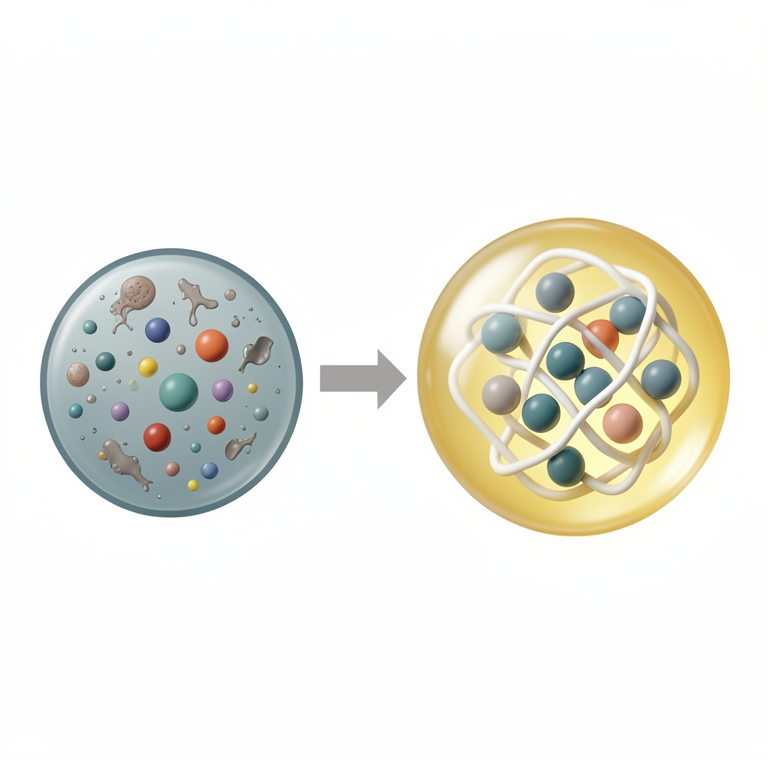
Carrier System Concept
AI-generated conceptual illustration (B-complex vitamin molecules encapsulated in a fat and casein matrix within a rumen fluid environment). It explains the idea and does not show study data.
View source evidence ↗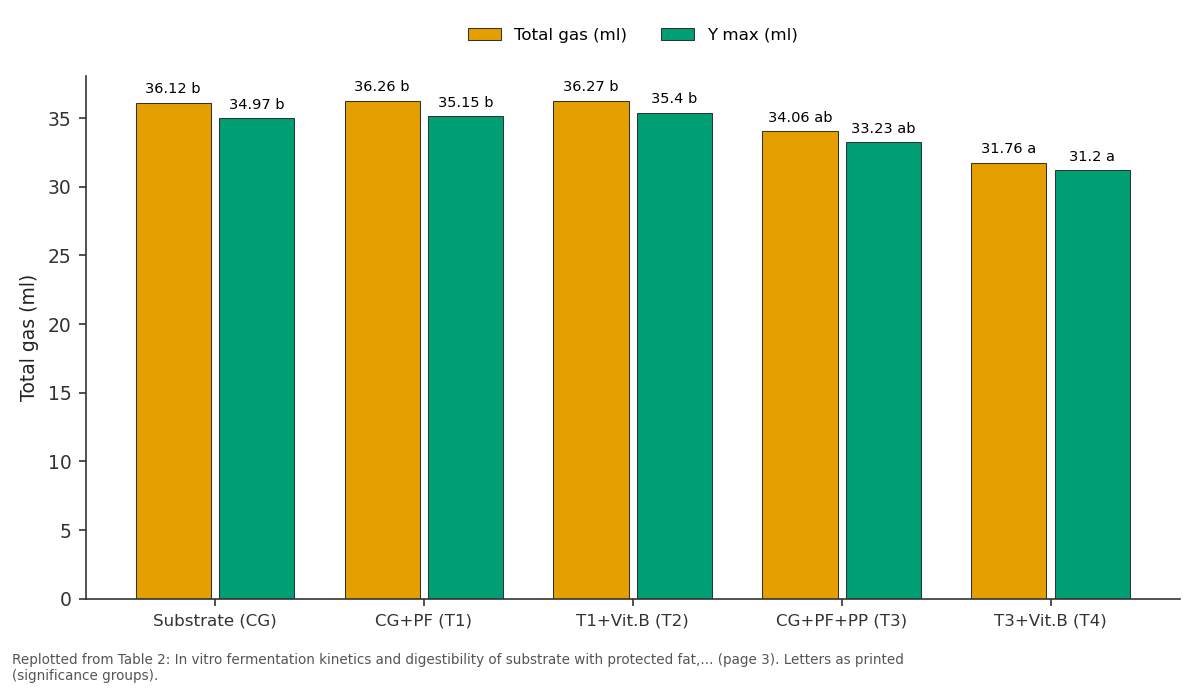
Total gas (ml) and Y max (ml): Substrate (CG) vs CG+PF (T1) vs T1+Vit.B (T2) vs CG+PF+PP (T3) vs T3+Vit.B (T4)
Replotted from Table 2 (page 3) of the original paper. Every bar is the paper's own table value.
View source evidence ↗Figures & tables
From the original paper Table 1
 Table 2
Introduction
B-complex vitamins are essential for energy metabolism, protein synthesis, nucleic acid formation, and many enzyme-mediated processes that support growth, reproduction, immunity, and overall health in ruminants (Duplessis et al., 2014; Sacadura et al., 2008) [1,2] . Although rumen microbes can synthesize these vitamins, the amount produced is often not enough to satisfy the needs of fast-growing, high-yielding, or stressed animals. Moreover, a substantial portion of supplemented B-complex vitamins may be degraded in the rumen before reaching the small intestine, which limits their absorption and biological usefulness (Santschi et al., 2005; Schwab et al., 2006) [3,4] . For this reason, rumen-protected vitamin supplementation has attracted interest as a means of improving vitamin supply and supporting animal performance. To reduce ruminal degradation while allowing release in the lower gut, several protection methods such as encapsulation and coating with lipid-or protein-based materials have been developed. An ideal carrier should remain stable in the rumen, avoid disturbing normal fermentation, and release the protected nutrient after the rumen. Protected fat is commonly used because it is largely resistant to microbial fermentation (Sergio et al., 2012), while protein-based materials can strengthen the protective matrix; among them, casein is particularly attractive because of its good film-forming and encapsulating properties (Rodriguez et al., 1975) [5] . In vitro rumen fermentation offers a practical way to test such carrier systems before animal trials, and gas production techniques are widely used to assess fermentation behavior and microbial degradation (Fekri et al., 2025) [7] . Therefore, the present study was designed to evaluate a protected fat-protected casein carrier system for Bcomplex vitamins under in vitro rumen conditions by measuring gas production, fermentation kinetics, dry matter digestibility, and total volatile fatty acid production.
Materials and methods
2.1 Protection of B complex vitamins B-complex vitamins were protected using two carrier materials, namely rice bran oil and casein. Rumen-protected rice bran oil (PF) was prepared by converting the free fatty acids into calcium salts. The calcium soap of rice bran oil was synthesized in the laboratory following the double decomposition method (Kumar et al., 2017) [8] . Rumenprotected casein (PP) was produced by treating the protein with 40% (v/v) formaldehyde at a level equivalent to 1% of its protein content (Aasiwal et al., 2015) [9] . The protected carrier materials were incorporated into the substrate at a rate of 1 mg per 200 mg, corresponding to a daily supplementation level of 25 g/d of the protected ingredient per animal. Feed-grade B-complex vitamins were procured from M/s Varsha Multi Tech, Bangalore, India, and the vitamin supplementation levels were determined based on the recommendations reported by Ashwin and Srinivas (2019) [10] . Half of the total B-complex vitamin requirement (50%) was encapsulated using the respective carrier materials and subsequently evaluated using the in vitro gas production (IVGP) technique.
Substrate for in vitro study
A total mixed ration (TMR) with a roughage-to-concentrate ratio of 70:30 was used as the substrate for the in vitro gas production (IVGP) study. The roughage component comprised 75% ragi straw (RS) as the dry fodder and 25% green fodder, which consisted of para grass, guinea grass, hybrid napier, and maize in a ratio of 3:1:1:1, respectively. The ragi straw and concentrate supplement (CS) were dried in a hot air oven at 90 ± 5 °C until a constant weight was achieved (AOAC 2005; Method No. 934.01). In contrast, the green fodders (para grass, guinea grass, hybrid napier, and maize) were shade-dried at ambient temperature (approximately 32 °C) until constant weight. All dried feed ingredients were then ground to pass through a 1-mm sieve, mixed and stored in airtight plastic containers.
In vitro experimental groups
The in vitro experiment was conducted using a completely randomized design comprising five treatment groups, each with 15 replicates. The treatment groups included: CG (substrate alone), T 1 (substrate supplemented with PF), T 2 (substrate supplemented with PF and B-complex vitamins), T 3 (substrate supplemented with PF and PP), and T 4 (substrate supplemented with PF, PP, and B-complex vitamins). The effectiveness of B-complex vitamin protection against ruminal degradation was assessed by comparing in vitro gas production, fermentation characteristics, and gas production kinetic parameters across the different treatment groups.
In vitro gas production
Rumen fluid was collected before the morning feeding (08:00 h) from rumen-cannulated cattle maintained on a diet similar to the experimental ration, ensuring a minimum 6 h interval after the last water intake. The rumen liquor was transported to the laboratory in a pre-warmed thermos flask and filtered through a double layer of muslin cloth to obtain strained rumen liquor (SRL). For the in vitro gas production (IVGP) assay, 200 mg of substrate was incubated with 10 mL of SRL and 20 mL of buffer medium (Srinivas and Krishnamoorthy, 2005) [11] under continuous CO₂ flushing to maintain anaerobic conditions (Menke and Steingass, 1988) [12] . Gas production was recorded periodically over 72 h incubation after blank correction. At the end of incubation, the filtrate was analyzed for total volatile fatty acids (TVFA) using the Markham distillation method (Barnett and Reid, 1956) [13] , and in vitro dry matter digestibility was determined according to Lokesha et al. (2017) [14] . Data were analyzed by one-way ANOVA using SPSS version 19.
Results and Discussion
Results and Discussion
Effect of protected fat, protected casein and Bcomplex vitamins on in vitro gas production
In vitro gas production profile of the substrate supplemented with protected fat (PF), protected casein (PP) and protected B-complex vitamins is presented in Table 1. Gas production during the initial incubation period (1-2 h) did not differ among treatments. However, significant differences were observed during the active fermentation phase (4-60 h). At 4 h, treatments containing protected casein (T 3 and T 4 ) produced significantly lower gas than the control and PFonly treatment (p < 0.05). At 12 h, T 2 recorded the highest gas production, while T 3 and T 4 remained comparable. From 18 to 60 h, T 4 consistently exhibited the lowest gas production, with significant reductions at 36, 48 and 60 h (p < 0.05), whereas no significant differences were observed at 72 h. The comparable gas production between the control, PF (T 1 ) and PF supplemented with B-complex vitamins (T 2 ) indicates that protected fat alone had minimal influence on ruminal fermentation. In contrast, the inclusion of protected casein (T 3 ) and its combination with protected B-complex vitamins (T 4 ) reduced gas production during the later stages of incubation, suggesting reduced ruminal fermentability of the protected carrier matrix.
| Treatment | Incubation intervals (hr) | — | — | — | — | — | — | — | — | — | — | — | — |
|---|---|---|---|---|---|---|---|---|---|---|---|---|---|
| 0 | 0.5 | 1 | 2 | 4 | 8 | 12 | 18 | 24 | 36 | 48 | 60 | 72 | |
| Substrate (CG) | - | - | 0.20 | 0.78 | 2.74b | 4.11 | 4.90a | 6.35c | 4.89a | 6.26b | 2.55b | 2.35b | 0.98 |
| CG+PF (T1) | - | - | 0.20 | 0.58 | 2.03a | 4.91 | 5.59ab | 5.48b | 4.81a | 6.26b | 2.50b | 2.41b | 1.44 |
| T1+Vit.B (T2) | - | - | 0.10 | 0.86 | 2.49ab | 4.32 | 6.72c | 5.76bc | 5.61b | 5.86b | 2.02b | 1.92ab | 1.35 |
| CG+PF+PP (T3) | - | - | 0.10 | 0.93 | 1.76a | 4.55 | 6.45bc | 4.56a | 5.49b | 5.68ab | 1.78ab | 1.69ab | 1.12 |
| T3+Vit.B (T4) | - | - | 0.00 | 0.75 | 1.88a | 4.77 | 6.32bc | 4.58a | 4.80a | 4.68a | 1.12a | 1.12a | 0.75 |
| SEM | - | - | 0.11 | 0.13 | 0.24 | 0.26 | 0.29 | 0.29 | 0.12 | 0.39 | 0.26 | 0.30 | 0.21 |
| P Value | - | - | 0.69 | 0.43 | 0.03* | 0.20 | 0.001** | 0.001** | 0.001** | 0.04* | 0.001** | 0.03* | 0.14 |
Table text extracted from the original PDF; superscript letters are shown inline. The original table image is below.
View original table image
In vitro fermentation kinetics and digestibility of substrates supplemented with protected fat, protected casein and B-complex vitamins
The inclusion of protected fat (PF) alone (T 1 ) or in combination with B-complex vitamins (T 2 ) did not significantly alter total gas production compared with the control, indicating that PF exerted minimal influence on ruminal fermentation (Table 2). The addition of Ca salts of fatty acids was more or less inert at ruminal pH and did not affect fiber digestion (Chalupa W, 1975; Jenkins and Palmiquist, 1984) [15,16] . Sirohi et al., (2001) [17] also reported that the addition of 7.5% of Ca salts of FA supplementation did not affect digestibilities of OM and DM besides no effect on the rumen fermentation. Treatments containing protected casein (PP) (T 3 and T 4 ) exhibited lower gas production during the active fermentation phase (4-60 h), with T 4 producing the lowest cumulative gas (31.76 ml) and asymptotic gas yield (31.20 ml) (p < 0.05). Furthermore, T 4 showed a shorter lag time and half-life with higher fermentation rate constants than the other treatments, whereas in vitro dry matter digestibility and total volatile fatty acid concentration remained unaffected (p > 0.05). Rodriguez et al. (1975) [5] found that formaldehyde treatment of casein at 0.25 to 3% reduced the solubility of protein by 10% at pH 6.8 and 30% at pH 2.5. Decrease in gas production while using protein sources (casein) might be due to the production of ammonia during fermentation which neutralizes and lowers gas production (Fekri et al., 2025) [7] .
| Treatment | Total gas (ml) | Lag Ferm (hr) | T1/2 (hr) | Rate constant (%) | — | Y max (ml) | Ferm Rate (%) | In vitro (%) | — |
|---|---|---|---|---|---|---|---|---|---|
| k1 | k2 | DMD | TVFA | ||||||
| Substrate (CG) | 36.12b | 0.35b | 17.58b | 3.95a | 8.11a | 34.97b | 4.92a | 69.58 | 15.91 |
| CG+PF (T1) | 36.26b | 0.33b | 17.62b | 3.94a | 8.42a | 35.15b | 4.95a | 69.85 | 15.46 |
| T1+Vit.B (T2) | 36.27b | 0.31ab | 16.18ab | 4.40ab | 9.20ab | 35.40b | 5.57ab | 70.28 | 14.96 |
| CG+PF+PP (T3) | 34.06ab | 0.30ab | 15.79ab | 4.56ab | 9.46ab | 33.23ab | 5.79ab | 69.19 | 15.01 |
| T3+Vit.B (T4) | 31.76a | 0.28a | 14.22a | 5.09b | 10.32b | 31.20a | 6.50b | 68.34 | 15.25 |
| SEM | 1.24 | 0.02 | 0.75 | 0.27 | 0.47 | 1.18 | 0.37 | 0.68 | 0.32 |
| P Value | 0.05* | 0.03* | 0.02* | 0.03* | 0.02* | 0.08• | 0.03* | 0.62 | 0.48 |
Table text extracted from the original PDF; superscript letters are shown inline. The original table image is below.
View original table image
Protected fat alone acted as a rumen-inert ingredient, the incorporation of protected casein limited microbial access to the carrier matrix, thereby decreasing its fermentability. The further reduction in gas production in T 4 suggests that the protected fat-protected casein matrix effectively entrapped the B-complex vitamins and reduced their exposure to ruminal microbial degradation. Since dry matter digestibility and total volatile fatty acid concentration were maintained across treatments, the lower gas production is more likely to reflect reduced degradation of the protected nutrient complex rather than impaired ruminal fermentation, indicating that the combination of protected fat and protected casein provided an effective carrier system for improving the ruminal protection of B-complex vitamins.
Conclusion
The incorporation of protected casein along with protected fat reduced ruminal fermentation of the carrier matrix, as reflected by lower gas production, while maintaining dry matter digestibility and TVFA concentration. These findings suggest that the protection strategy effectively reduced ruminal degradation of the fat, casein-based vitamin carrier without adversely affecting overall fermentation. However, further in vivo studies are warranted to validate the protective efficiency of the carrier system and its practical application in ruminant feeding.
Acknowledgement
AcknowledgementThe authors are grateful to the Director, ICAR-National Dairy Research Institute for providing necessary facilities to conduct this study.
References
17 in the original paper- Duplessis M, Girard CL, Santschi DE, Lefebvre DM, Pellerin D. Milk production and composition, and body measurements of dairy cows receiving intramuscular injections of folic acid and vitamin B12 in commercial dairy herds. Livest Sci. 2014;167:186-194.
- Sacadura FC, Robinson PH, Evans E, Lordelo M. Effects of a ruminally protected B vitamin supplement on milk yield and composition of lactating dairy cows. Anim Feed Sci Technol. 2008;144:111-124.
- Santschi DE, Berthiaume R, Matte JJ, Mustafa AF, Girard CL. Fate of supplementary B vitamins in the gastrointestinal tract of dairy cows. J Dairy Sci. 2005;88:2043-2054.
- Schwab EC, Schwab GC, Shaver RD, Girard CL, Putnam DE, Whitehouse NL. Dietary forage and nonfiber carbohydrate contents influence B-vitamin intake, duodenal flow, and apparent ruminal synthesis in lactating dairy cows. J Dairy Sci. 2006;89:174-187.
- Juchem SO, Robinson PH, Evans E. A fat based rumen protection technology post-ruminally delivers a B vitamin complex to impact performance of multiparous Holstein cows. Anim Feed Sci Technol. 2012;174(12):68-78.
- Rodriguez D, Muller LD, Schingoethe DJ. In vitro and mouse evaluation of methods for protecting whey protein and casein from ruminal degradation. J Dairy Sci. 1975;58(12):1841-1846.
- Fekri A, Ganjkhanlou M, Ramin M, Zali A, DehghanBanadaky M, Sadeghi M. Effects of rumen protected choline and methionine on in vitro gas production kinetics and the characteristics of rumen fermentation. J Hellenic Vet Med Soc. 2025;76(2):9271-9280.
- Kumar SR, Reddy YR, Kumari NN, Sridhar K, Rao DS. In vitro, in situ and in vivo evaluation of straw based diets supplemented with bypass fat as concentrated energy source in Murrah buffaloes. Buffalo Bull. 2017;36(2):357-368.
- Aasiwal DP, Meena BS, Mahesh MS, Sharma K, Lalremuta. Effect of feeding formaldehyde treated rapeseed and cottonseed cakes on milk yield and composition at various stages of lactation and parity in Jersey cows. J Anim Res. 2015;5(1):15-20.
- Ashwin K, Srinivas B. Optimized oral supplementation of vitamins improve feed intake and rumen microbial International Journal of Biology Sciences https://www.biologyjournal.net protein synthesis in Deoni calves. Turk J Vet Anim Sci. 2019;43:197-205.
- Srinivas B, Krishnamoorthy U. Influence of diet induced changes on gas production kinetics of straw substrates in vitro. Asian-Australas J Anim Sci. 2005;18:990-996.
- Menke KH, Steingass H. Estimation of energetic feed value obtained from chemical analysis and in vitro gas production using rumen fluid. Anim Res Dev. 1988;28:7-55.
- Barnett JGA, Reid RL. Studies on production of volatile fatty acids from grass by rumen liquor in an artificial rumen. J Agric Sci. 1956;48:315-321.
- Lokesha E, Kumar RD, Srinivas B. Effect of feed additives on in vitro fermentation kinetics and substrate utilization with and without buffer. Appl Biol Res. 2017;19(1):56-62.
- Chalupa W. Rumen bypass and protection of proteins and amino acids. J Dairy Sci. 1975;58:1198-1218.
- Jenkins TC, Palmquist DL. Effect of fatty acid or calcium soaps on rumen and total nutrient digestibility of dairy rations. J Dairy Sci. 1984;67:978-986.
- Sirohi SK, Malik R, Walli TK. Development and evaluation of protected fat in wheat straw based total mixed ration. Asian-Australas J Anim Sci. 2001;14(10):1405-1408.