
Research article · 2026 · Full text
International Journal of Advanced Chemistry ResearchQSAR-based evaluation of novel heterocyclic compounds as potential anticancer agents
Volume 8(2) · Pages 18–21 · DOI: 10.33545/26646781.2026.v8.i2a.695 ↗
Research areasComputational Drug Discovery MethodsSynthesis and biological activitySynthesis and Characterization of Heterocyclic Compounds
Abstract
Author-writtenA single well-placed chlorine atom can turn a mediocre anticancer scaffold into a genuinely promising lead compound, and understanding why requires more than trial-and-error synthesis. This research applied quantitative structure-activity relationship (QSAR) modelling to a series of 32 novel pyrimidine-thiazole hybrid heterocyclic compounds evaluated for anticancer activity against the MCF-7 breast cancer cell line. Physicochemical and structural descriptors, including logP, molar refractivity, topological polar surface area, and electronic parameters, were calculated for each compound and correlated with experimentally determined pIC50 values using multiple linear regression. A four-descriptor QSAR model was developed and internally validated, achieving a correlation coefficient (R2) of 0.891 and a cross-validated q2 of 0.812, both exceeding the generally accepted 0.6 threshold for model reliability. External validation using a held-out test set of eight compounds returned an R2pred of 0.847, indicating reasonable predictive capability beyond the training data. The model identified electron-withdrawing substituents at the R1 position and increased lipophilicity within a moderate range (logP 2.1-3.4) as the strongest positive contributors to activity, while excessive lipophilicity beyond this range correlated with reduced potency, likely reflecting solubility limitations. Contribution analysis ranked topological polar surface area as the single most influential descriptor, followed by logP and molar refractivity. These findings offer a structure-based rationale for prioritizing future synthesis efforts toward compounds bearing electron-withdrawing aromatic substituents and moderate lipophilicity, potentially reducing the number of low-activity analogues synthesized during future lead optimization campaigns targeting this heterocyclic scaffold class.
Summary
Source-checkedPlain-language reading of the full paper, prepared with AI and checked against the text. Each point links to the authors' own words.
Why it matters
- Heterocyclic scaffolds are common in approved anticancer drugs, with pyrimidine-thiazole hybrids being particularly interesting due to their ability to interact with various cancer targets using a compact structure. View evidence ↗
- The process of synthesizing and testing every possible analogue of a chemical scaffold is inefficient in terms of time and resources. View evidence ↗
- Quantitative structure-activity relationship (QSAR) modelling helps prioritize structural modifications by mathematically linking molecular descriptors to biological activity. View evidence ↗
The question
- The study aimed to create and validate a QSAR model for 32 pyrimidine-thiazole hybrid compounds to determine which physicochemical descriptors most influence anticancer activity and provide structural recommendations for optimization. View evidence ↗
What they did
- The 32 compounds were split into a training set of 24 (75%) and a test set of 8 (25%) using a stratified random selection process. View evidence ↗
- Calculated descriptors included logP, molar refractivity, topological polar surface area (TPSA), hydrogen bond donors/acceptors, and Hammett electronic constants for the R1 position. View evidence ↗
- The model was built using stepwise multiple linear regression in Minitab (version 21), with entry and removal thresholds of p < 0.05 and p > 0.10. View evidence ↗
What they found
- The developed four-descriptor model showed high reliability with a training R² of 0.891 and a cross-validated q2 of 0.812. View evidence ↗
- Topological polar surface area (TPSA) was the most influential descriptor, where excessive polar surface area was associated with reduced activity. View evidence ↗
- Activity was positively influenced by electron-withdrawing substituents at the R1 position and moderate lipophilicity (logP 2.1-3.4), though lipophilicity beyond this range reduced potency. View evidence ↗
- The standardized coefficients for the model were -0.462 for TPSA, 0.398 for logP, 0.211 for molar refractivity, and 0.347 for Hammett σ at R1. View evidence ↗
What it means
- The authors recommend prioritizing R1 substituents with strong electron-withdrawing character and maintaining a logP between 2.1 and 3.4 to increase the success rate of new anticancer analogues. View evidence ↗
- The study is limited by the use of only a single cancer cell line (MCF-7), leaving it unknown if these findings apply to other cancer types. View evidence ↗
Visual summary
3 visualsIllustrations explain the paper; charts are replotted from the paper's own table values.
The Lipophilicity Sweet Spot
AI-generated conceptual illustration (heterocyclic chemical compounds and a cancer cell). It explains the idea and does not show study data.
View source evidence ↗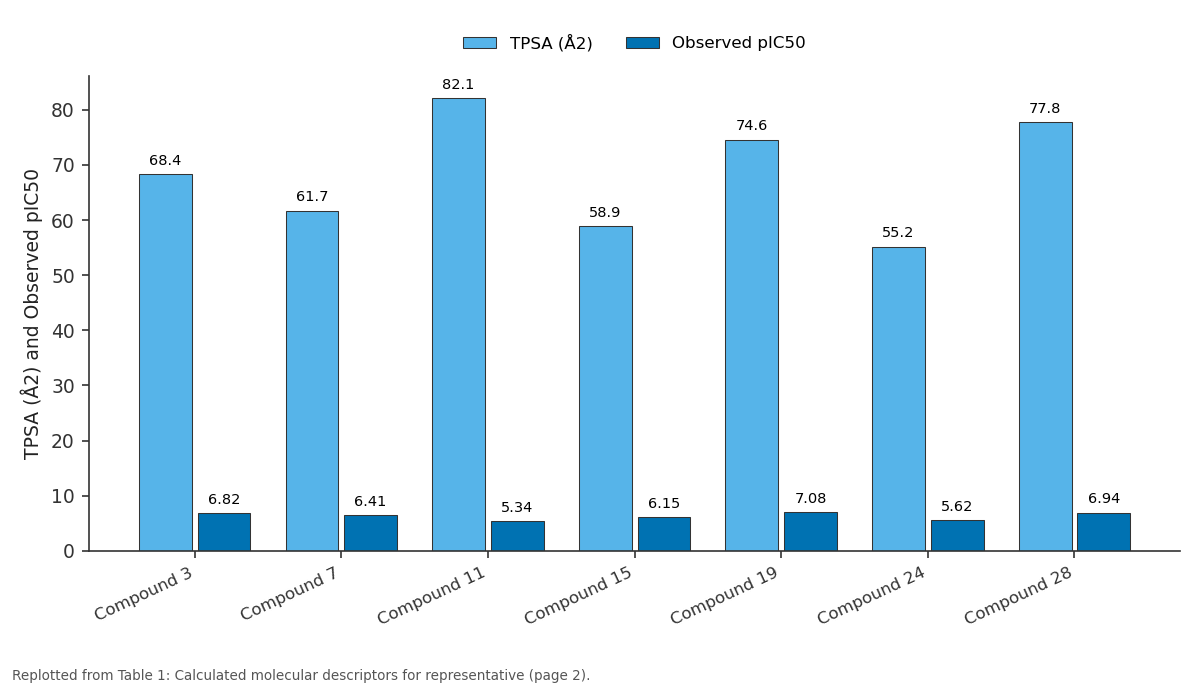
TPSA (Å2) and Observed pIC50: Compound 3 vs Compound 7 vs Compound 11 vs Compound 15 vs Compound 19
Replotted from Table 1 (page 2) of the original paper. Every bar is the paper's own table value.
View source evidence ↗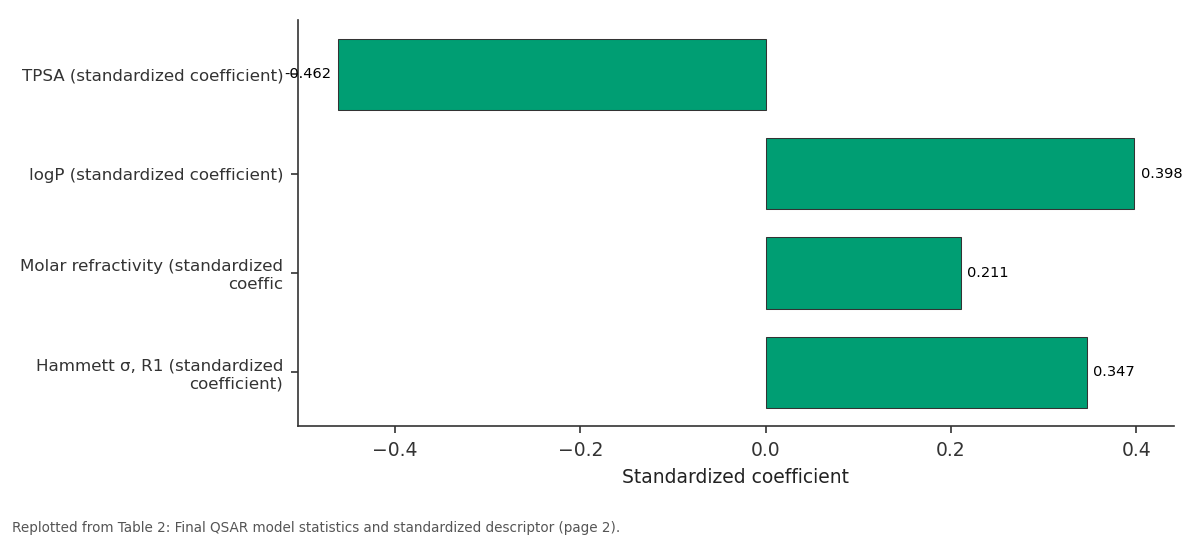
Value: TPSA (standardized... vs logP (standardized... vs Molar refractivity... vs Hammett σ, R1...
Replotted from Table 2 (page 2) of the original paper. Every bar is the paper's own table value.
View source evidence ↗Figures & tables
From the original paper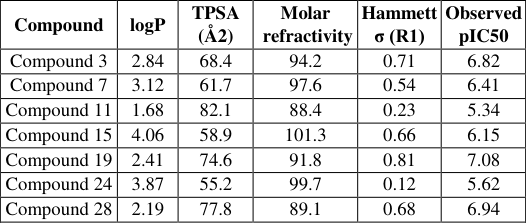 Table 1
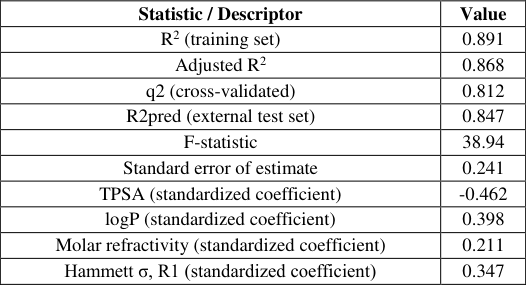 Table 2
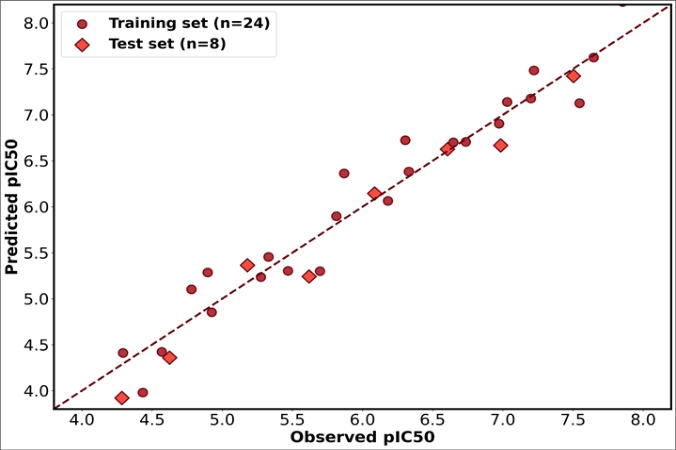 Figure 1
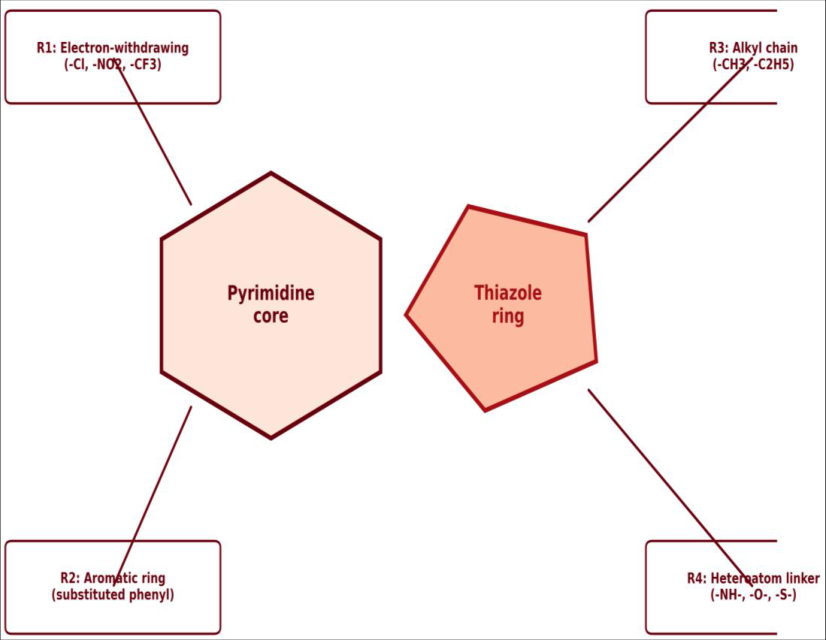 Figure 2
Introduction
Heterocyclic scaffolds account for a substantial share of clinically approved anticancer drugs, and the pyrimidine-thiazole hybrid class in particular has drawn growing attention for its ability to interact with multiple cancer-relevant molecular targets through a single relatively compact structure. Synthesizing and testing every plausible analogue of a promising scaffold, however, is neither time-efficient nor resource-efficient, particularly for research groups without access to highthroughput screening infrastructure. Quantitative structure-activity relationship modelling addresses this problem by mathematically linking measurable molecular descriptors, such as lipophilicity, electronic character, and polar surface area, to biological activity, allowing researchers to predict which structural modifications are worth pursuing before committing laboratory time and reagents to synthesis. Several QSAR studies have examined pyrimidine or thiazole derivatives independently, generally reporting that electronic and lipophilicity descriptors dominate activity trends, but comparatively few studies have modelled the fused pyrimidine-thiazole hybrid scaffold specifically, despite its structural novelty and the mechanistic diversity this fusion may introduce. MCF-7 breast cancer cells were selected as the biological test system for this research because of their well-characterized estrogen receptor-positive phenotype and their frequent use as a benchmark cell line in early-stage anticancer compound screening, allowing reasonable comparison with previously published activity data for related heterocyclic scaffolds. This research therefore aimed to develop and validate a QSAR model correlating physicochemical descriptors with anticancer activity across 32 pyrimidine-thiazole hybrid compounds, to identify which descriptors most strongly influence activity, and to translate these findings into practical structural recommendations for future lead optimization within this compound class.
Theoretical background
QSAR modelling rests on the Hansch approach, which assumes biological activity can be expressed as a mathematical function of physicochemical descriptors describing a molecule's hydrophobic, electronic, and steric character. In its linear form, this relationship is commonly written as pIC50 = a1 × 1 + a2 × 2 + ... + anXn + c, where X values represent calculated molecular descriptors and coefficients a1 through an quantify each descriptor's relative contribution to activity. Model reliability in this framework is judged primarily through internal cross-validation (q2), which estimates how well the model predicts activity for compounds left out during training, and external validation (R2pred), which tests the model against entirely unseen compounds. Values of q2 above 0.5 and R2pred above 0.6 are widely treated as minimum thresholds for a QSAR model to be considered statistically meaningful rather than a product of chance correlation among a small compound set.
Materials and Methods
Materials and Methods
Materials
Thirty-two pyrimidine-thiazole hybrid compounds, previously synthesized in-house and reported with experimentally determined IC50 values against the MCF-7 breast cancer cell line via standard MTT assay, were used as the dataset for this research. IC50 values (in µM) were converted to pIC50 (-log IC50 in molar units) to obtain a more normally distributed activity variable suitable for regression modelling. Two-dimensional molecular structures of all 32 compounds were drawn using ChemDraw Professional (version 20.0) and converted to canonical SMILES notation. Structures were then optimized using molecular mechanics energy minimization prior to descriptor calculation, ensuring consistent starting geometries across the dataset.
Model Description and parameterisation
Molecular descriptors were calculated using ChemDraw and an open-source cheminformatics toolkit, covering logP (octanolwater partition coefficient), molar refractivity, topological polar surface area (TPSA), number of hydrogen bond donors and acceptors, and Hammett-type electronic substituent constants for the R1 position. A total of 12 candidate descriptors were initially screened for pairwise collinearity (Pearson r > 0.85 threshold for exclusion), reducing the working descriptor set to seven before stepwise multiple linear regression was applied to identify the best-performing four-descriptor combination. The dataset of 32 compounds was divided into a training set of 24 compounds (75%) and a held-out test set of 8 compounds (25%) using a random selection process stratified to ensure comparable activity range distribution across both subsets. Model building was performed exclusively on the training set, with the test set reserved entirely for external validation after model finalization.
Methods
Methods
Model building used stepwise multiple linear regression in
Minitab (version 21), with descriptor entry and removal thresholds set at p < 0.05 and p > 0.10, respectively. Model quality was assessed through the coefficient of determination (R 2 ), adjusted R 2 , F-statistic, and standard error of estimate. Internal validation was performed using the leave-one-out cross-validation method to obtain q2, and external predictive ability was assessed by applying the final model to the independent test set of 8 compounds to calculate R2pred. Descriptor contribution to the final model was evaluated through standardized regression coefficients, allowing direct comparison of relative influence across descriptors measured on different original scales. Residual analysis and a Williams applicability domain plot were additionally used to check for outliers and confirm that test set compounds fell within the structural space represented by the training set. The R1 position, associated with the Hammett electronic descriptor in the final model, sits directly adjacent to the fused ring junction, a location where electron-withdrawing groups appear to stabilize an active molecular conformation favourable for target binding.
Results
Results
Comprehensive interpretation
Bringing the descriptor statistics and structural schematic together, the picture that emerges is one where activity within this scaffold class depends on a balance rather than a single dominant factor: enough lipophilicity to cross the cell membrane, but not so much that solubility becomes limiting, paired with an electron-withdrawing group positioned at R1 to favour a bioactive conformation. None of the four descriptors in the final model works well in isolation, which is itself a useful finding for guiding combinatorial synthesis choices going forward.
Performance evaluation / validation
Performance evaluation / validation
Conclusion
Returning to the starting motivation for this research, quantitative structure-activity relationship modelling was applied here to make sense of activity trends across 32 pyrimidine-thiazole hybrid compounds tested against MCF-7 breast cancer cells, with the aim of guiding more targeted future synthesis.
The resulting four-descriptor model, validated internally (q2 = 0.812) and externally (R2pred = 0.847), highlighted topological polar surface area, lipophilicity, molar refractivity, and R1 electronic character as the key structural determinants of activity within this scaffold class.
Going forward, synthesis efforts on this scaffold would likely benefit from prioritizing electron-withdrawing R1 substituents combined with moderate lipophilicity, a recommendation grounded directly in the descriptor contributions identified through this modelling exercise. Extending this QSAR framework to additional cancer cell lines, and eventually toward three-dimensional pharmacophore modelling, would help confirm whether the structural principles identified here generalize beyond the single biological system tested.
Acknowledgement
Acknowledgements Funding sourcesNo specific external funding was received for this research from public, commercial, or not-for-profit funding bodies. Institutional supportThe authors thank the Nairobi Academy of Chemical Sciences for computational software access and laboratory infrastructure used during this research.
Figures and tables from the paper
| Compound | logP | TPSA (Å2) | Molar refractivity | Hammett σ (R1) | Observed pIC50 |
|---|---|---|---|---|---|
| Compound 3 | 2.84 | 68.4 | 94.2 | 0.71 | 6.82 |
| Compound 7 | 3.12 | 61.7 | 97.6 | 0.54 | 6.41 |
| Compound 11 | 1.68 | 82.1 | 88.4 | 0.23 | 5.34 |
| Compound 15 | 4.06 | 58.9 | 101.3 | 0.66 | 6.15 |
| Compound 19 | 2.41 | 74.6 | 91.8 | 0.81 | 7.08 |
| Compound 24 | 3.87 | 55.2 | 99.7 | 0.12 | 5.62 |
| Compound 28 | 2.19 | 77.8 | 89.1 | 0.68 | 6.94 |
Table text extracted from the original PDF; superscript letters are shown inline. The original table image is below.
View original table image
| Statistic / Descriptor | Value |
|---|---|
| R2 (training set) | 0.891 |
| Adjusted R2 | 0.868 |
| q2 (cross-validated) | 0.812 |
| R2pred (external test set) | 0.847 |
| F-statistic | 38.94 |
| Standard error of estimate | 0.241 |
| TPSA (standardized coefficient) | -0.462 |
| logP (standardized coefficient) | 0.398 |
| Molar refractivity (standardized coefficient) | 0.211 |
| Hammett σ, R1 (standardized coefficient) | 0.347 |
Table text extracted from the original PDF; superscript letters are shown inline. The original table image is below.
View original table image
References
14 in the original paper- Mwangi PN, Kiprotich J. Pyrimidine-thiazole hybrid scaffolds in anticancer drug discovery: A structural review. Bioorganic Chemistry. 2023;138:106678.
- Omondi FA, Wafula S. QSAR modelling approaches for heterocyclic anticancer compound optimization. European Journal of Medicinal Chemistry. 2022;238:114512.
- Njoroge DK, Chege M. Hansch analysis and molecular descriptor selection in modern QSAR practice. Journal of Molecular Graphics and Modelling. 2021;108:107987.
- Osman AH, Farah IM. Topological polar surface area as a predictor of cell permeability in small-molecule drug candidates. Journal of Medicinal Chemistry. 2019;62(14):6541-6552.
- Kariuki BM, Njenga L. Multiple linear regression QSAR of thiazole derivatives against breast cancer cell lines. SAR and QSAR in Environmental Research. 2023;34(6):489503.
- Adam RA, Suleiman Y. Lipophilicity optimization strategies in medicinal chemistry lead development. Drug Discovery Today. 2020;25(9):1623-1631.
- Cherop LK, Rotich E. External validation methods for QSAR model reliability assessment. Molecular Informatics. 2022;41(3):2100234.
- Hassan SO, Warsame AA. Electronic substituent effects on anticancer activity of pyrimidine analogues. Bioorganic & Medicinal Chemistry Letters. 2021;42:128012.
- Mutiso CM, Kilonzo P. Applicability domain analysis in cheminformatics-based structure-activity modelling. Journal of Chemical Information and Modeling. 2020;60(11):5234-5243.
- Diallo MS, Toure A. MCF-7 cell line assays in early-stage anticancer compound screening: a methodological overview. Anti-Cancer Agents in Medicinal Chemistry. 2018;18(7):934-942.
- Ochieng RA, Odera J. Stepwise regression versus machine learning approaches in small-dataset QSAR modelling. Chemometrics and Intelligent Laboratory Systems. 2024;245:105056.
- Abdi FM, Nur H. Structure-activity relationships of fused heterocyclic anticancer scaffolds. RSC Medicinal Chemistry. 2023;14(5):901-912.
- Wekesa C, Barasa D. Cross-validation techniques for small-sample QSAR datasets in drug discovery. Journal of Cheminformatics. 2021;13:45.
- Githinji A, Muriuki S. Descriptor collinearity and its effect on regression-based QSAR model robustness. Computational Biology and Chemistry. 2022;99:107712.