
Research article · 2026 · Full text
International Journal of Agriculture and NutritionRelationship of MyoD1 (myogenic) gene polymorphism with production performance of for Pekin ducks raised in Iraq
Volume 8(7) · Pages 01–05 · DOI: 10.33545/26646064.2026.v8.i7a.665 ↗
Research areasGenetic and phenotypic traits in livestockLivestock and Poultry ManagementMeat and Animal Product Quality
Abstract
Author-writtenThis study was conducted in the education hall of the Animal Production Field at the Faculty of Agriculture at the University of Basra from 10-10-2025 to 5-12-2025 and this study aimed at the relationship between genetic polymorphism of the MyoD1 gene and some productive traits of the Raised Pekin ducks in Iraq, and the use of 100 unnaturalized ducklings at the age of one day with an average weight of 45 grams and distributed The birds were randomly measured inside the breeding hall and then the weights of the birds were measured at the ages of (2, 4, 6, 8) weeks and both weight gain, feed conversion efficiency, amount of feed consumed and live body weight were calculated, and 65 samples of bird blood were collected at the age of 8 weeks before slaughter in order to complete the work of the genetic aspect of the study, which includes DNA extraction and detection of the genetic formations of the MyoD1 gene and its relationship with Yielding and carcass traits where the results showed that there is heterogeneity in the nitrogenous base of Adnine A and the thymine base at the site of A>T260 in the second segment of the first axon of the MyoD1 gene and resulted in three genetic formations that led to significant differences (p<0.05).) at the ages (2, 4, 6, 8) weeks of overweight, feed conversion efficiency, amount of feed consumed and body weight, as the highest averages were reached in the genetic polymorphism AA followed by AT TT, in each of the productive traits that were calculated as well as.
Summary
Source-checkedPlain-language reading of the full paper, prepared with AI and checked against the text. Each point links to the authors' own words.
Why it matters
- Ducks are the second most abundant domesticated poultry species globally, following chickens. View evidence ↗
- The MyoD1 gene is essential for muscle formation (myogenesis) because it encodes a transcription factor that regulates muscle gene expression and the conversion of stem cells into muscle cells. View evidence ↗
The question
- The study aims to identify the optimal genetic makeup for production performance to serve as a marker for genetic improvement programs in domestic ducks. View evidence ↗
What they did
- The experiment used 100 local ducklings from one day to 8 weeks of age. View evidence ↗
- Birds were fed a starter diet (18% protein, 2900 kcal/kg) for the first 3 weeks, followed by a growth diet (20% crude protein, 3100 kcal/kg) until 8 weeks of age. View evidence ↗
- Blood samples were collected from 65 birds at 8 weeks of age for DNA extraction. View evidence ↗
- ARMS PCR technology was used to detect genetic heterogeneity at the 260 bp site of the first exon of the MyoD1 gene. View evidence ↗
What they found
- The study identified three genetic formations resulting from a substitution of adenine (A) with thymine (T) at the A>T260 site of the MyoD1 gene's first exon. View evidence ↗
- The AA genotype achieved the highest weight gain throughout the study, starting with 444.852 g in the first two weeks and remaining superior through 8 weeks. View evidence ↗
What it means
- The authors conclude that the MyoD1 gene regulates muscle growth and weight gain, making it a viable candidate gene for genetic selection programs to improve growth in ducks. View evidence ↗
Visual summary
2 visualsIllustrations explain the paper; charts are replotted from the paper's own table values.
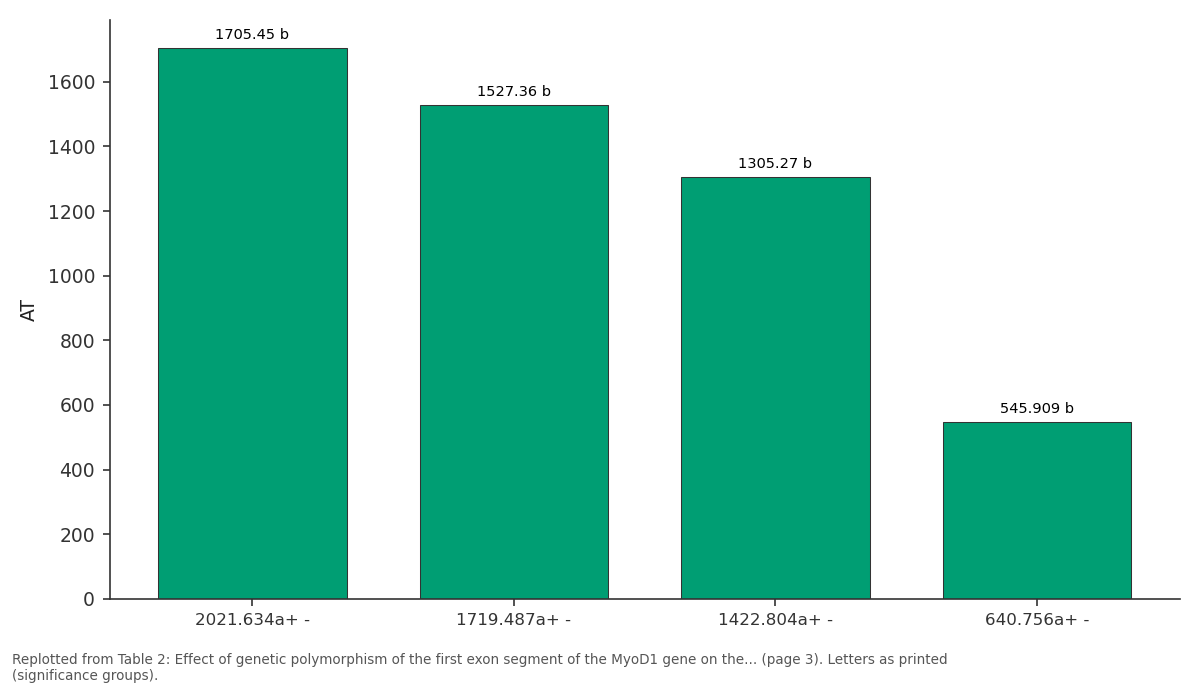
AT: 2021.634a+ - vs 1719.487a+ - vs 1422.804a+ - vs 640.756a+ -
Replotted from Table 2 (page 3) of the original paper. Every bar is the paper's own table value.
View source evidence ↗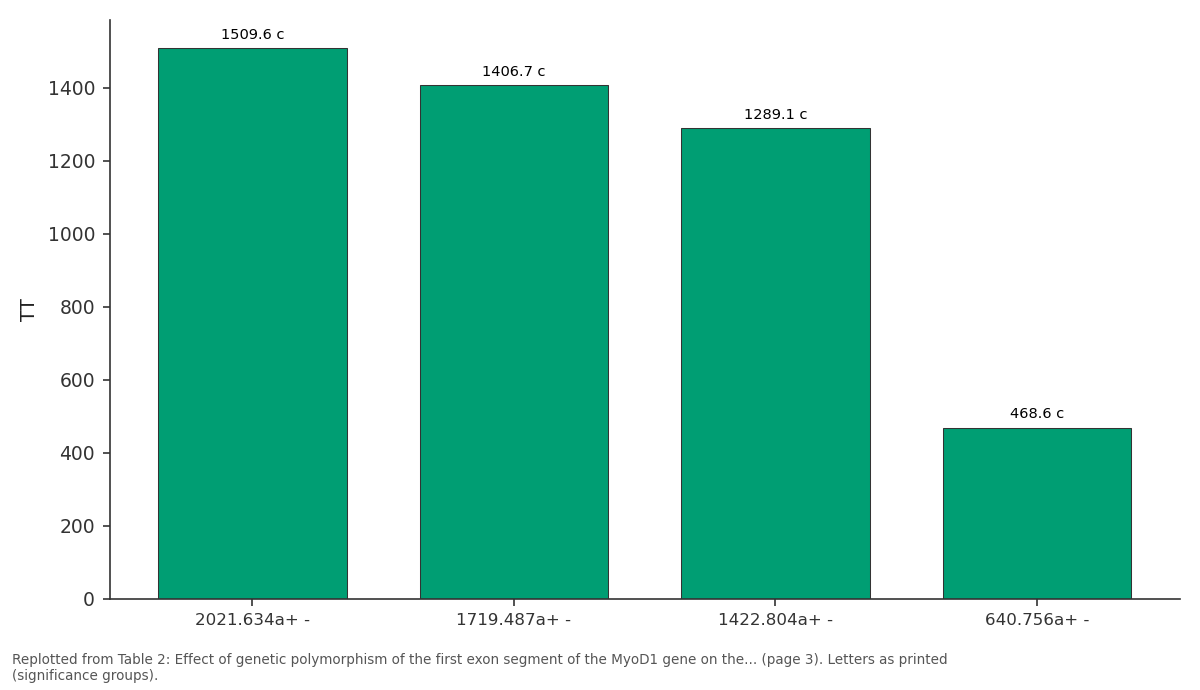
TT: 2021.634a+ - vs 1719.487a+ - vs 1422.804a+ - vs 640.756a+ -
Replotted from Table 2 (page 3) of the original paper. Every bar is the paper's own table value.
View source evidence ↗Figures & tables
From the original paper Table 1
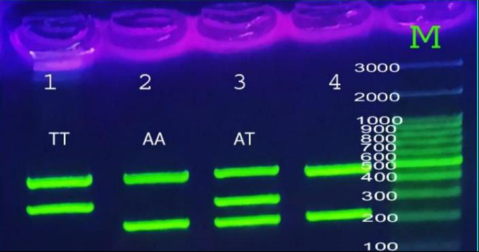 Figure 1
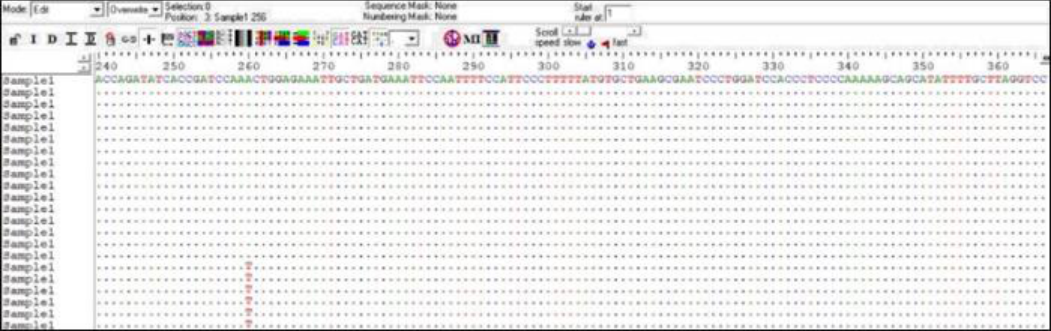 Figure 2
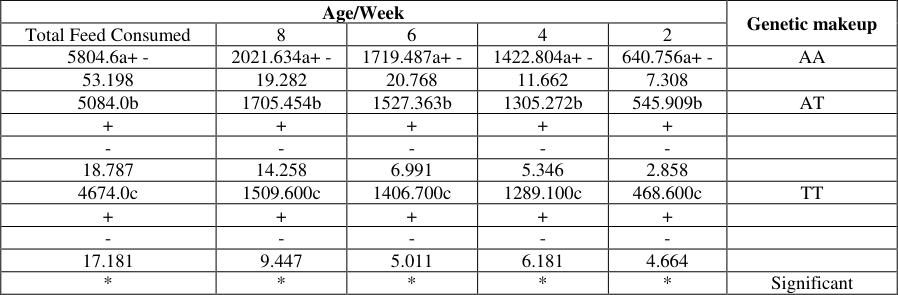 Table 2
 Table 3
 Table 4
 Table 5
Introduction
Ducks rank second in the world in terms of the abundance of domesticated poultry species, after chickens (Bello et al., 2022) [4] . Ducks are characterized by their ease of breeding and their low susceptibility to many common diseases in poultry (Abo Ghanima., 2020 (Global production of duck meat and eggs has been increasing in recent years, with Asia being the main producer and China leading the way as the largest contributor to this sector,) [2] Huang et al., 2012; Zeng et al., 2016) [7] .Genetic improvement programs for ducks for meat production have significantly enhanced their production performance (Fouad et al., 2018) [18] .The MyoD1 gene is a key gene in the process of muscle formation (Myogenesis) and encodes a protein that acts as a transcription factor that regulates muscle gene expression and plays a crucial role in the transformation of stem cells into muscle cells (Xinyang Dong et al., 2019).The duck MyoD1 gene was found to be located on the fifth chromosome and contains three exons, and the gene length (61603575-61606523 (NCBL) and the structure of the introns differ in sequence of the MyoD1 gene by species (Wu et al, 2012) [15] . (Baylies, 2001) [3] . Several studies have shown that birds and mammals have one copy of the MyoD1 gene (Session et al., 2016) [13] . Many fish have been found to have more than one copy of the MyoD1 gene (Fisher et al., 2003) [6] . This may be due to the occurrence of complete genome duplication (WGD) in bony fish (Macqueen, 2008; Aase-Remedios, 2020) [10,1] . The aim of this study is to determine the best genetic makeup in terms of production performance to be used as an electoral marker in genetic improvement programs for domestic ducks.
Materials & Procedures
This study was conducted in a hall of the Animal Production Field at the Faculty of Agriculture at the University of Basra from 10-10-2025 to 5-12-2025 Ducklings were raised under traditional conditions and in this study, 100 birds of local ducks with a lifespan of one day to 8 weeks were used and the birds were fed freely on two ready-made feeders, the first one containing (18% protein and energy represented 2900 kcal/kg) and continued The brood was introduced to 3 weeks of the bird's life, while the second brood was a growth brood containing (20% crude protein and an energy of 3100 kcal/kg) up to 8 weeks of the bird's life (N.R.C.1994) and the birds were also free to access the water continuously, and the lighting program was applied during the study period and 65 blood samples were collected before slaughtering them at the age of 8 weeks, and the blood samples were kept in vacuum tubes containing On an anticoagulant agent (EDTA) and tubes were shaken to mix the blood with an anticoagulant, and then the samples were transported in a refrigerated container and the blood samples were preserved in the laboratory at a temperature of (-18) °C, after which the DNA extraction procedure was performed. The use of ARMS PCR technology for a piece of the first axon, and through the use of NCBI The presence of heterogeneity in the wild allele was detected in this piece of the first axon of this gene and the ARMS PCR technique was worked on, through which the location of the heterogeneity at the site of 260 bp was known, and using the Electrophoresis technique of the samples, the genetic polymorphism of each sample was detected and known.
Results and discussion
The results of electrophoresis amplify the MyoD1 gene and detect Nitrogenous bases in the nitrogenous bases The results of electrolysis on an agarose gel with a concentration of 1.5% showed the appearance of a bundle with a size of 476 base pairs, the appearance of a bundle of 226 base pairs (for allele A), as well as the appearance of a bundle of 307 base pairs (for the Tallele) in addition to the genetic genotype. The mixture is AT, as shown in Figure (1). [17,9] , where the average total amount of feed consumed was 5.36 kg/bird, and a positive and strong genetic correlation was observed between the amount of feed consumed and the final body weight, where the correlation reached within the range of (0.40 -0.91) at 42 days of age. and growth and the body's food need (Zhang et al., 2017) [17] . The results show that there are significant differences (p<0.05) between the genetic structures of the first exon fragment of the MyoD1 gene and the averages of feed conversion efficiency (g / g of overweight), where the best genotype (TT) was achieved in the efficiency of food conversion at the age of two weeks, where the average of (1.331) g / g feed/g weight gain was achieved, while the average genotype was 1.442 (AA) The average of the two was (1.367) g/g feed/g weight gain, and at 4 weeks of age, there were no significant differences (P>0.05) between the genetic polymorphisms because the efficiency of food conversion is considered one of the quantitative traits (QTL) that are controlled by many genes and in addition, are affected by many environmental and administrative factors.)Li et al., 2022) [8] while the AT genotype achieved the lowest value in the efficiency of feed conversion at 6 weeks of age, amounting to (2.624) g feed, followed by TT and AA, which reached (2.626, 2.908) g / g overweight, and the superiority continued in favor of the TT genotype, as the efficiency of dietary conversion at 8 weeks of age reached (3.275) g / g feed/g weight gain, followed by the genetic makeup AT and These results of TT genotype at 6 weeks of age were consistent with the results of Li et al. (2020) [9] , where the efficiency of food conversion at the age of 21 to 42 days was (2.61) kg in Peking ducks, as it was shown in their study that the efficiency of food conversion is considered one of the traits with high heritability, which confirms that it can be improved through genetic selection programs. Zhang et al. (2017) [17] also indicated that when studying the efficiency of feed conversion, it was an average at the age of (15-42) at 2.53 g of feed/g weight gain. weeks for the TT genotype was significantly superior to the genetic makeup of AA and AT for Muscovy ducks and Jingjiang ducks. No significant differences were observed in vivo weight (p>0.05) for the genetic structure (AA, AT, TT) genotype, and the reason may be attributed to the genetic background of the strain, the small effect of the A359T mutation in this strain, or the genetic influence. The results showed that individuals carrying the AA genotype of the MyoD1 gene recorded the highest weight and had higher levels of the gene expression of the MyoD1 gene at the site of (G.2967A>G, g.3044G>A) as shown by (Bhuiyan et al., 2009) [5] when studying the detection of nucleotide polymorphism (SNPs) in the MyoD1 gene. The results showed that the mutation in the g.1274G>A site in the first intron was significantly related to body weight and carcass weight in Korean cows.
Figures and tables from the paper
| Product Size | — | Prefixes | Gene |
|---|---|---|---|
| 476 Base Pairs | Outer F | CTTCTCTGTCCCTGGTCATTTAGCTGA | Myod1 |
| Outer R | AGCAAGTGGCTGAAAGTACTCATTTGTG | ||
| 226 Base Pairs | inner primer (A allele): | GATAAAAATACATTCCTCTCGGCAACTGAT | ARMS-PCR |
| 307 Base Pairs | inner primer (T allele) | ATGCAAAACATGGTTTTAAAGACTGGGGT |
Table text extracted from the original PDF; superscript letters are shown inline. The original table image is below.
View original table image
| Age/Week | — | — | — | — | Genetic makeup |
|---|---|---|---|---|---|
| Total Feed Consumed | 8 | 6 | 4 | 2 | |
| 5804.6a+ - | 2021.634a+ - | 1719.487a+ - | 1422.804a+ - | 640.756a+ - | AA |
| 53.198 | 19.282 | 20.768 | 11.662 | 7.308 | |
| 5084.0b | 1705.454b | 1527.363b | 1305.272b | 545.909b | AT |
| + | + | + | + | + | |
| - | - | - | - | - | |
| 18.787 | 14.258 | 6.991 | 5.346 | 2.858 | |
| 4674.0c | 1509.600c | 1406.700c | 1289.100c | 468.600c | TT |
| + | + | + | + | + | |
| - | - | - | - | - | |
| 17.181 | 9.447 | 5.011 | 6.181 | 4.664 | |
| * | * | * | * | * | Significant |
Table text extracted from the original PDF; superscript letters are shown inline. The original table image is below.
View original table image
| Age in week | — | — | — | — | Genetic makeup |
|---|---|---|---|---|---|
| Total weight gain | 6-8 | 4-6 | 2-4 | 0-2 | |
| 2120.243^a + -3.237 | 534.195^a + -2.019 | 592.365^a + -5.250 | 548.829^a + -1.329 | 444.853^a + -2.694 | AA |
| 1996.727^b + -4.081 | 495.181^b + -3.269 | 582.090^b + -1.268 | 520.090^b + -1.090 | 399.363^b + -2.899 | AT |
| 1852.40^c + - | 460.900^c + - | 535.700^c + - | 503.200^c + - | 352.600^c + - | TT |
| 5.23 | 1.642 | 1.813 | 1.339 | 5.371 | |
| * | * | * | * | * | Significant |
Table text extracted from the original PDF; superscript letters are shown inline. The original table image is below.
View original table image
| Age/Week | — | — | — | — | Genetic makeup |
|---|---|---|---|---|---|
| Total Nutrient Conversion Efficiency | 8 | 6 | 4 | 2 | |
| 2.737a+ -0.240 | 3.786a+ -0.391 | 2.908a+ -0.362 | 2.593+ -0.218 | 1.442a+ -0.185 | AA |
| 2.546b+ -0.115 | 3.446b+ -0.407 | 2.624b+ -0.148 | 2.510+ -0.139 | 1.367ba+ -0.126 | AT |
| 2.523b+ -0.094 | 3.275c+ -0.257 | 2.626b+ -0.158 | 2.561+ -0.163 | 1.331b+ -0.210 | TT |
| * | * | * | N | * | Significant |
Table text extracted from the original PDF; superscript letters are shown inline. The original table image is below.
View original table image
| Age/Week | — | — | — | — | Genetic makeup |
|---|---|---|---|---|---|
| Final Body Weight | 8 | 6 | 4 | 2 | |
| 2165.243a+ - 3.237 | 2165.243a+ - 3.237 | 1631.048a+ - 4.838 | 1038.682a+ - 2.435 | 489.853a+ - 2.694 | AA |
| 2041.727b+ - 4.081 | 2041.727b+ - 4.081 | 1546.545b+ - 2.465 | 964.454b+ - 2.559 | 444.363b+ - 2.899 | AT |
| 1897.400c+ - 5.232 | 1897.400c+ - 5.232 | 1436.500c+ - 5.055 | 900.800c+ - 4.649 | 397.600c+ - 5.371 | TT |
| * | * | * | * | * | Significant |
Table text extracted from the original PDF; superscript letters are shown inline. The original table image is below.
View original table image
References
18 in the original paper- Aase-Remedios ME, Coll-Lladó C, Ferrier DEK. More than one-to-four via 2R: Evidence of an independent amphioxus expansion and two-gene ancestral vertebrate state for MyoD1-related myogenic regulatory factors (MRFs). Mol Biol Evol. 2020;37(10):2966-2982. DOI:10.1093/molbev/msaa147.
- Abo Ghanima MM, El-Edel MA, Ashour EA, Abd ElHack ME, Othman SI, Alwaili MA, et al. The influences of various housing systems on growth, carcass traits, meat quality, immunity and oxidative stress of meat-type ducks. Animals. 2020;10(3):410.
- Baylies MK, Michelson AM. Invertebrate myogenesis: Looking back to the future of muscle development. Curr Opin Genet Dev. 2001;11(4):431-439. DOI:10.1016/S0959-437X(00)00217-8.
- Bello SF, Adeola AC, Nie Q. The study of candidate genes in the improvement of egg production in ducks: A review. Poult Sci. 2022;101(7):101850.
- Bhuiyan MSA, Kim NK, Cho YM, Yoon D, Kim KS, Jeon JT, et al. Identification of SNPs in MyoD1 gene family and their associations with carcass traits in cattle. Livest Sci. 2009;126(1-3):292-297.
- Fisher ME, Peck W, Branney PA, Pownall ME. Cloning and characterization of Myf5 and MyoD1 orthologues in Xenopus tropicalis. Biol Cell. 2003;95(8):555-561. DOI:10.1016/j.biolcel.2003.09.002.
- Huang JF, Pingel H, Guy G, Łukaszewicz E, Baéza E, Wang SD. A century of progress in waterfowl production, and a history of the WPSA Waterfowl Working Group. Worlds Poult Sci J. 2012;68(3):551563.
- Li F, Yang C, Xie Y, Gao X, Zhang Y, Ning H, et al. Maternal nutrition altered embryonic MYOD1, MYF5, and MYF6 gene expression in genetically fat and lean lines of chickens. Anim Biosci. 2022;35(8):1223-1232.
- Li GS, Zhu F, Yang FX, Hao JP, Hou ZC. Selection response and genetic parameter estimation of feeding behavior traits in Pekin ducks. Poult Sci. 2020;99(5):2375-2384.
- Macqueen DJ, Johnston IA. An update on MyoD1 evolution in teleosts and a proposed consensus nomenclature to accommodate the tetraploidization of different vertebrate genomes. PLoS One. 2008;3(2):e1567. DOI:10.1371/journal.pone.0001567.
- Mao H, Wang M, Ke Z, Wang J, Raza SHA, Dong X, et al. Association of variants and expression levels of MYOD1 gene with carcass and muscle characteristic traits in domestic pigeons. Anim Biotechnol. 2023;34(9):4927-4937.
- National Research Council. Nutrient requirements of poultry. 9th rev ed. Washington (DC): National Academies Press; 1994.
- Session AM, Uno Y, Kwon T, Chapman JA, Toyoda A, Takahashi S, et al. Genome evolution in the allotetraploid frog Xenopus laevis. Nature. 2016;538(7625):336-343. DOI:10.1038/nature19840.
- Taylor MV, Hughes SM. MEF2 and the skeletal muscle differentiation program. Semin Cell Dev Biol. 2017;72:33-44. DOI:10.1016/j.semcdb.2017.11.020.
- Wu Y, Pi JS, Pan AL, Pu YJ, Du JP, Shen J, et al. An SNP in the MyoD1 gene intron 2 associated with growth and carcass traits in three duck populations. Biochem Genet. 2012;50(11-12):898-907.
- Zeng T, Chen L, Du X, Lai SJ, Huang SP, Liu YL, et al. Association analysis between feed efficiency studies and expression of hypothalamic neuropeptide genes in laying ducks. Anim Genet. 2016;47(5):606-609.
- Zhang Y, Guo ZB, Xie M, Zhang Z, Hou S. Genetic parameters for residual feed intake in a random population of Pekin duck. Asian-Australas J Anim Sci. 2017;30(2):167-170. DOI:10.5713/ajas.15.0577.
- Fouad AM, Ruan D, Wang S, Chen W, Xia W, Zheng C. Nutritional requirements of meat-type and egg-type ducks: What do we know? J Anim Sci Biotechnol. 2018;9(1):1-10. DOI:10.1186/s40104-017-0217-x.