
Research article · 2026 · Full text
International Journal of Agriculture and NutritionSustainable practices to mitigate environmental wastage in food supply chain: A review
Volume 8(6) · Pages 139–144 · DOI: 10.33545/26646064.2026.v8.i6b.663 ↗
Research areasAgriculture Sustainability and Environmental ImpactFood Waste Reduction and SustainabilityEnvironmental Impact and Sustainability
Abstract
Author-writtenAs the global population continues to rise, the food industry faces increasing scrutiny for its environmental impact, specifically regarding carbon footprints. The study aims to provide a holistic understanding of the carbon footprints in the food industry, examining the complexities associated with agriculture, food processing and food packaging, transportation and distribution as well as consumption of food. The research methodology employed a meticulous approach to data collection. Both online databases, including peer-reviewed journals, conference papers, and reputable publications, as well as offline resources such as books and reports, were scrutinized. A set of carefully chosen keywords, encompassing terms like "carbon footprints," "food industry," "sustainability," and more, were employed to ensure a thorough examination of relevant articles. The literature review uncovered that the sustainable practices in agriculture, eco-friendly and innovative food processing and packaging strategies as well as innovative transportation emerged as pivotal areas for mitigating carbon emissions. The synthesis of diverse studies allowed for the identification of emerging trends and successful initiatives, offering a roadmap for future sustainable practices. In conclusion, this review underscores the pressing need for a paradigm shift in the food industry towards sustainable practices. The synthesis of information from various sources emphasizes the importance of collaborative efforts across the supply chain. While challenges persist, the study provides a foundation for informed decision-making and a call to action for stakeholders to collectively work towards a greener and more sustainable future for the food industry.
Summary
Source-checkedPlain-language reading of the full paper, prepared with AI and checked against the text. Each point links to the authors' own words.
Why it matters
- Food production is a major driver of climate change, contributing over 26% of total global greenhouse gas emissions. View evidence ↗
- Agriculture places a heavy burden on water resources, accounting for 70% of freshwater withdrawals and 78% of global ocean and freshwater eutrophication. View evidence ↗
- Livestock dominates non-human mammal biomass, making up 94% of that total. View evidence ↗
The question
- The study aims to provide a comprehensive understanding of carbon footprints across all stages of the food industry, from agriculture to consumption. View evidence ↗
What they did
- The researchers used a comprehensive literature review approach to analyze the food industry's environmental impact. View evidence ↗
- Data was collected from online databases (Scopus, Web of Science, Google Scholar), peer-reviewed journals, conference papers, books, and government reports. View evidence ↗
- The review limited its inclusion to articles published within the last 10 years to maintain data currency. View evidence ↗
- The analysis used thematic categorization based on the five main stages of the food supply chain. View evidence ↗
What they found
- In agriculture, implementing crop rotation and polyculture helps enhance soil health and break cycles of pests and diseases. View evidence ↗
- Conservation agriculture, specifically minimal tillage and cover cropping, is essential for carbon sequestration and preserving soil structure. View evidence ↗
- Reducing the footprint of food processing requires adopting energy-efficient technologies like solar-powered equipment and advanced heating/cooling systems. View evidence ↗
- Sustainable packaging focuses on a circular economy approach, emphasizing the design of materials that can be easily repurposed or recycled. View evidence ↗
- Transportation emissions can be mitigated by switching to low-emission vehicles, such as hybrid or electric trucks. View evidence ↗
- Local and regional sourcing strategies reduce the distance food travels, thereby decreasing transportation-related emissions. View evidence ↗
- The energy demand of the cold chain can be significantly lowered through advanced insulation and temperature monitoring systems. View evidence ↗
- Retail operations can reduce their environmental impact by optimizing store layouts and using energy-efficient lighting. View evidence ↗
- Consumer behavior can be shifted toward sustainability by educating them on the benefits of seasonal produce and the impact of their food choices. View evidence ↗
What it means
- The authors conclude that achieving a sustainable food industry requires a collaborative effort between farmers, processors, retailers, consumers, and policymakers. View evidence ↗
- The study is limited by its reliance on secondary data and the difficulty of obtaining region-specific or real-time data. View evidence ↗
Visual summary
1 visualsIllustrations explain the paper; they do not show study data.
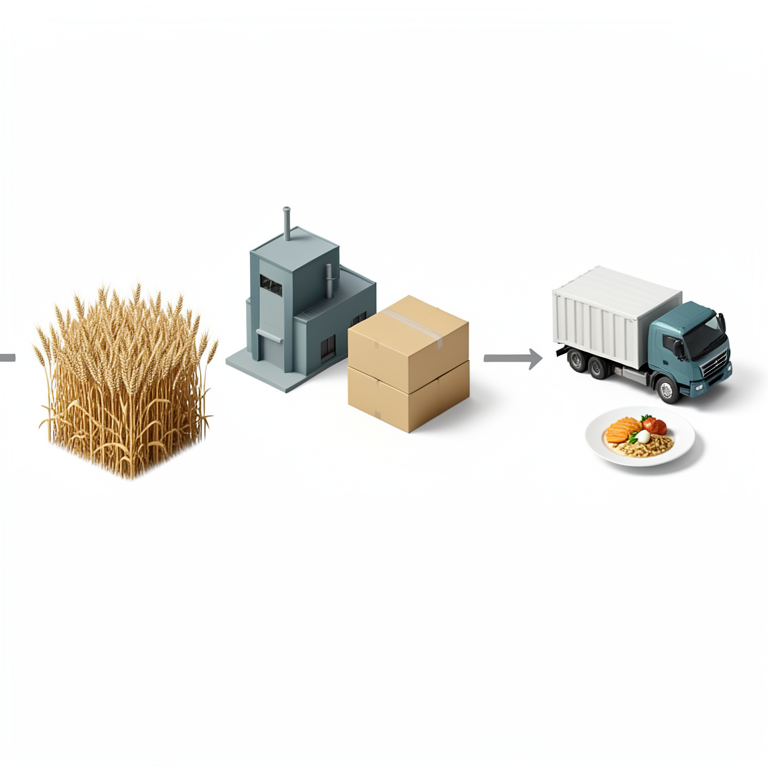
Food Supply Chain Carbon Flow
AI-generated conceptual illustration (Agricultural crops, a food processing factory, cardboard packaging, a delivery truck, and a dinner plate). It explains the idea and does not show study data.
View source evidence ↗Figures & tables
From the original paper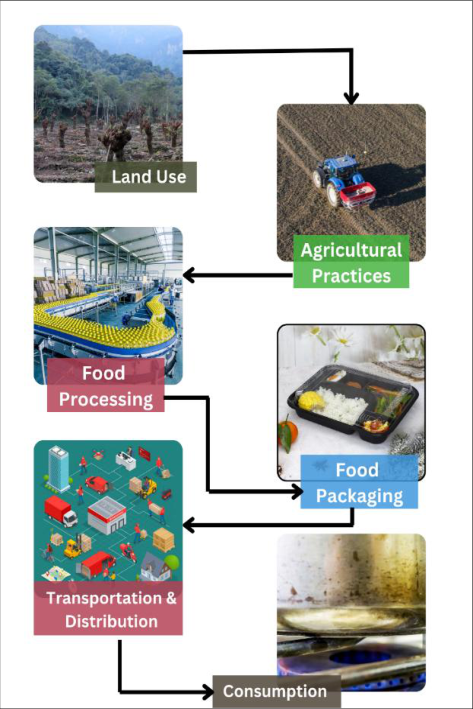 Figure 1
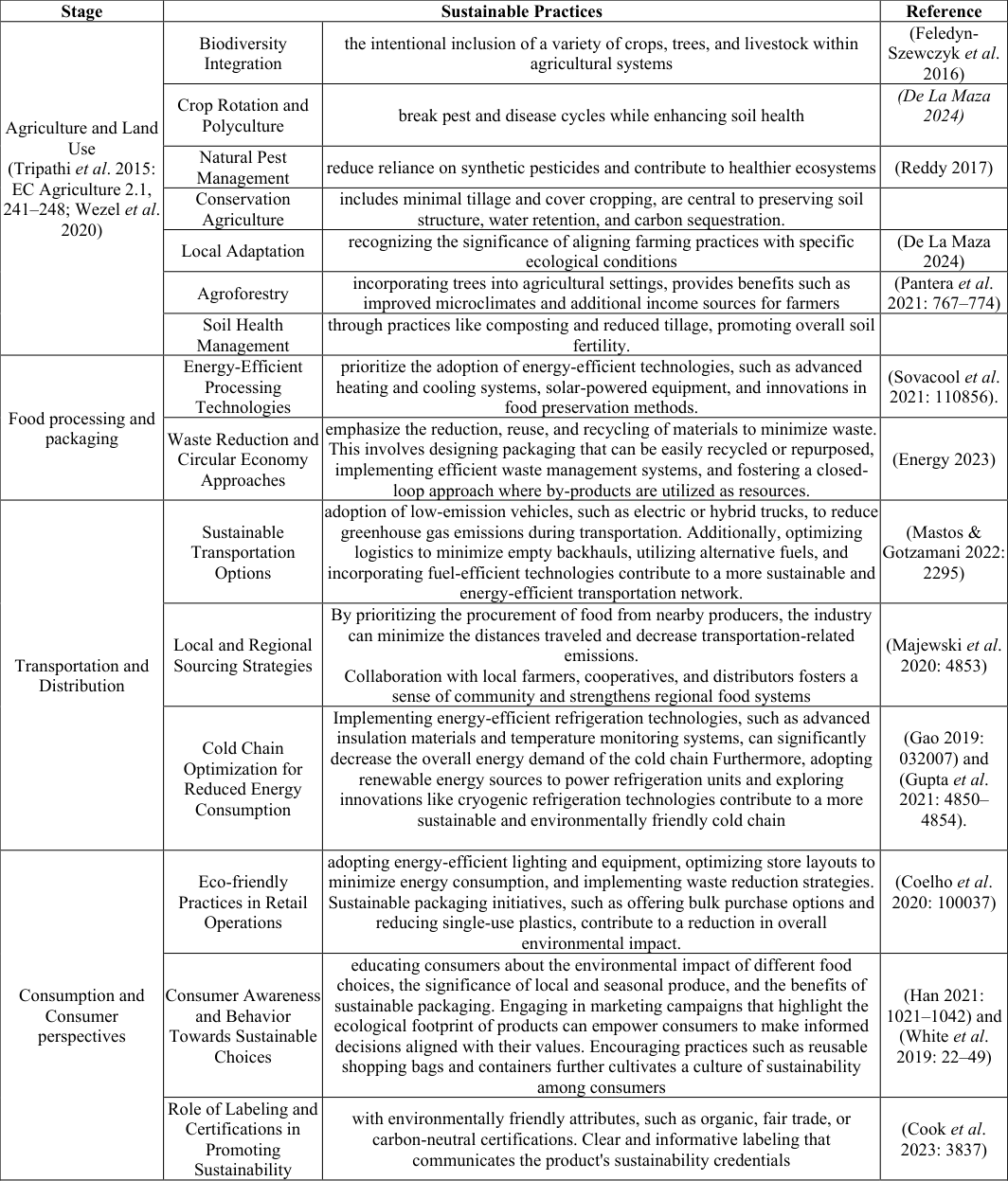 Table 1
Introduction
The prevailing consensus among the scientific community unequivocally affirms that our climate is undergoing profound changes, and the primary driver of this transformation is attributed to human activities (Anttonen et al. 2023: 100139) [2] . The global food industry, an integral component of human civilization, stands at a critical juncture as it grapples with the imperative to address its substantial environmental impact (Climate Seed, 2023). Amidst the growing concerns of climate change and ecological degradation, the concept of carbon footprints has emerged as a pivotal metric in evaluating the sustainability of various sectors (Baek & Pride 2014: 6-10) [3] , and the food industry is no exception (Shabir et al. 2023: 100215; Kumar & Chakabarti 2018: 19-44) [24,16] . The background of this review study stems from the realization that the production, processing, transportation, and consumption of food collectively contribute significantly to greenhouse gas emissions and environmental degradation (Shabir et al. 2023: 100215) [24] . The intricate web of activities involved in bringing food from farm to table encompasses practices that, if left unchecked, can exacerbate climate change and deplete natural resources (Metabolic, 2021) [19] . Food production is responsible for more than a quarter (26%) of the total global greenhouse gas emissions. Approximately half of the Earth's habitable land is utilized for agriculture, defined as land that is free from ice and deserts. Agriculture accounts for 70% of the world's freshwater withdrawals, and a significant 78% of global ocean and freshwater eutrophication is attributed to agricultural activities, referring to the pollution of waterways with nutrientrich water. Livestock constitutes a substantial portion of non-human mammal biomass, comprising 94%. This indicates that the combined weight of livestock is 15 times greater than that of wild mammals. When considering only landbased mammals, this proportion increases to 97%. Furthermore, poultry livestock constitutes 71% of bird biomass, highlighting that the collective weight of poultry livestock surpasses that of wild birds by more than threefold (Ritchie 2022) [23] . Historically, the food industry's focus has been on meeting the escalating demands of a burgeoning global population, often at the expense of environmental considerations. Conventional agricultural practices, reliance on fossil fuels for transportation, and extensive packaging have led to a substantial carbon footprint, posing a threat to the delicate balance of ecosystems. As societies increasingly recognize the urgent need for sustainability, the food industry is under increasing pressure to reassess its practices. The understanding that unchecked carbon emissions contribute to global warming, altered weather patterns, and other adverse environmental effects has catalyzed a paradigm shift towards more environment friendly and sustainable practices within the sector. It is evident that the path to sustainability requires a holistic approach, encompassing all facets of the food supply chain. Therefore, this review study aims to navigate through the complex landscape of carbon footprints within the food industry.
Aims of the study
Aims of the study
Methodology
This study adopts a comprehensive literature review approach to analyse the environmental impact of the food industry, with a focus on carbon footprints. The study synthesizes data from a wide range of sources to provide a holistic understanding of sustainable practices and strategies to mitigate carbon emissions across the food supply chain. A thorough search was conducted across several peerreviewed journals, conference proceedings, and reputable publications using online databases such as Scopus, Web of Science, and Google Scholar. Books, industry reports, and government publications related to the food industry and environmental sustainability were also reviewed. A set of carefully chosen keywords, encompassing terms like "carbon footprints," "food industry," "sustainability," and more, were employed to ensure a thorough examination of relevant articles.
Inclusion Criteria
• Articles published within the last 10 years to ensure current data and trends.
• Studies that focus on carbon emissions in different stages of the food supply chain. • Research papers and case studies on sustainable practices in agriculture, processing, packaging, and distribution.
Exclusion Criteria
• Data from unreliable sources • Studies focussing solely on carbon prints outside food industry
Synthesis of Data
• Thematic Analysis: The literature was thematically categorized based on the stages of the food supply chain-agriculture, food processing, packaging, transportation, and consumption. Each theme was analysed for its contribution to carbon emissions and its potential for sustainability improvements. • Content Analysis: Sustainable practices in agriculture, innovative food processing, eco-friendly packaging, and transportation methods were evaluated for their effectiveness in reducing carbon footprints.
Synthesis of Results
• A synthesis of diverse studies was performed to identify overarching trends, gaps in existing research, and successful initiatives in the food industry's efforts to reduce carbon emissions. • The data reviewed was mapped to current industry practices to assess alignment with sustainable development goals (SDGs).
Limitations
• The methodology acknowledges potential limitations, including the reliance on secondary data and the challenges of obtaining real-time or region-specific data for certain food industry practices. The carbon footprints in the food industry represent the total amount of greenhouse gas emissions, particularly carbon dioxide (CO2), associated with the production, processing, transportation, and consumption of food. This metric provides a comprehensive measure of the environmental impact of the entire food supply chain, from farm to table.
• Agriculture and Land Use: The cultivation of crops and livestock is often associated with emissions from the use of fertilizers, pesticides, and machinery. Additionally, land-use changes, such as deforestation for agriculture, contribute to carbon emissions. • Food Processing: Energy-intensive processing methods contribute to the carbon footprint.
• Food Packaging: The manufacturing of non-renewable packaging material and disposal of packaging materials also play a role. • Transportation and Distribution: The transportation of raw materials to processing facilities, as well as the distribution of finished products to retailers and consumers, involves the combustion of fossil fuels, leading to carbon emissions. • Retail and Consumption: Energy use in retail operations and the preparation of food at home contribute to the carbon footprint. Additionally, food waste at the consumer level results in unnecessary emissions from the decomposition of organic matter in landfills.
Sustainable practices in Food Supply Chain Sustainable Practices in Agriculture and Land Use
Agroecology is a holistic and interconnected approach to agriculture that integrates ecological principles, social values and economic dimensions to create sustainable and resilient farming systems (Agroecology Europe, 2024). It emphasizes the importance of understanding and harnessing ecological processes to enhance agricultural productivity while minimizing negative environmental and social impacts.
Eco-friendly and Sustainable food processing and packaging
Traditional packaging materials, such as plastics, contribute significantly to environmental pollution. In response, the industry is increasingly exploring alternative materials, including biodegradable plastics, compostable materials, edible packaging, and plant-based packaging derived from renewable resources. These materials aim to minimize the environmental impact of packaging waste, reduce dependence on fossil fuels, and promote a more circular and sustainable approach to packaging (Moshood et al. 2022: 100273) [20] .
Transportation and Distribution
The transportation and distribution phase of the food supply chain plays a pivotal role in determining the overall environmental impact of the food industry. Sustainable practices in this domain are essential for reducing carbon emissions, optimizing resource use, and fostering an ecofriendlier approach (Mastos & Gotzamani 2022: 2295) [18] .
Consumption and Consumer perspectives
The retail and consumer perspectives are pivotal in influencing the sustainability of the food industry. By incorporating eco-friendly practices in retail operations and fostering consumer awareness, the industry can promote and encourage sustainable choices. Additionally, the role of labeling and certifications emerges as a crucial factor in guiding consumers towards more environmentally conscious decisions.
Future Outlook
The future of the food industry is poised for transformation through the integration of emerging technologies and innovations. This includes advancements in precision agriculture, where technologies like drones, sensors, and data analytics optimize resource use, enhance crop yields, and minimize environmental impact. Biotechnological innovations, such as gene editing for crop improvement and alternative protein sources, have the potential to revolutionize food production. Additionally, blockchain technology can enhance traceability and transparency in the supply chain, ensuring ethical and sustainable sourcing practices. Embracing these technologies can pave the way for a more efficient, resilient, and sustainable food industry. Climate change, resource scarcity, and the increasing global population pose significant challenges to sustainable food production. The industry must grapple with the need to adapt to changing climatic conditions, reduce water usage, and address the social and ethical implications of food production. However, these challenges also present opportunities for innovation and collaboration. Sustainable farming practices, circular economy approaches, and community engagement can unlock new possibilities for addressing these challenges and creating a more sustainable and equitable food system.
Conclusion
The examination of various facets within the food industry, from production to retail, highlights the critical importance of transitioning towards a more sustainable and environmentally conscious model. The key findings from this comprehensive review underscore the need for immediate action to address the challenges posed by climate change, resource depletion, and environmental degradation. Throughout this review, key findings have emphasized the interconnectedness of sustainable practices within the food industry. From adopting eco-friendly agricultural methods and energy-efficient processing technologies to promoting responsible consumption and waste reduction, each aspect contributes to the overall goal of building a more sustainable and resilient food system. The incorporation of agroecological principles, circular economy approaches, and the utilization of emerging technologies emerges as a pathway towards mitigating the environmental impact of food production and consumption. Crucially, the journey towards a sustainable food industry necessitates collaborative efforts from all stakeholders involved. Farmers, processors, retailers, consumers, and policymakers must work hand-in-hand to implement and promote sustainable practices. The review underscores the significance of partnerships, knowledge sharing, and shared responsibility. By fostering collaboration, the industry can leverage collective expertise and resources to overcome challenges and drive positive change.
Figures and tables from the paper
References
27 in the original paper- Agroecology Europe. Principles of agroecology [Internet]. 2024.
- Anttonen H, Kinnunen A, Heinonen J, Ottelin J, Junnila S. The spatial distribution of carbon footprints and engagement in pro-climate behaviors: trends across urban-rural gradients in the Nordics. Clean Respons Consum. 2023;11:100139.
- Baek J, Pride D. On the income-nuclear energy-CO₂ emissions nexus revisited. Energy Econ. 2014;43:6-10.
- Bălan C. How does retail engage consumers in sustainable consumption? A systematic literature review. Sustainability. 2021;13(1):96.
- Climate Seed. The environmental impact of the food industry [Internet]. 2023.
- Coelho PM, Corona B, Klooster RT, Worrell E. Sustainability of reusable packaging: current situation and trends. Resour Conserv Recycl X. 2020;6:100037.
- Cook B, Leite JC, Rayner M, Stoffel S, Van Rijn E, Jan W. Consumer interaction with sustainability labelling on food products: a narrative literature review. Nutrients. 2023;15(17):3837.
- De La Maza A. Sustainable agriculture: definition, advantages and policies [Internet]. 2024.
- Global Footprint Network. Ecological footprint [Internet]. 2024.
- Energy C. Circular economy and sustainable approaches to packaging materials [Internet]. 2023.
- Feledyn-Szewczyk B, Kuś J, Stalenga J, Berbeć AK, Radzikowski P. The role of biological diversity in agroecosystems and organic farming. In: InTech eBooks; 2016.
- Gao H. Analysis of new energy-saving technology for cold chain logistics. IOP Conf Ser Earth Environ Sci. 2019;252:032007.
- Gupta A, Sankhla VS, Sharma D. A comprehensive review on the sustainable refrigeration systems. Mater Today Proc. 2021;44:4850-4854.
- Han H. Consumer behavior and environmental sustainability in tourism and hospitality: a review of theories, concepts, and latest research. J Sustain Tour. 2021;29(7):1021-1042.
- Kumar S, Chakabarti B. Energy and carbon footprint of food industry. In: Environmental footprints and ecodesign of products and processes. 2018. p. 19-44.
- Majewski E, Komerska A, Kwiatkowski J, MalakRawlikowska A, Wąs A, Sulewski P, et al. Are short food supply chains more environmentally sustainable than long chains? A life cycle assessment of the ecoefficiency of food chains in selected EU countries. Energies. 2020;13(18):4853.
- Mastos T, Gotzamani K. Sustainable supply chain management in the food industry: a conceptual model from a literature review and a case study. Foods. 2022;11(15):2295.
- Metabolic. The global food system: trends, impacts, and solutions [Internet]. 2021.
- Moshood TD, Nawanir G, Mahmud F, Mohamad F, Ahmad MH, AbdulGhani A. Sustainability of biodegradable plastics: new problem or solution to solve the global plastic pollution? Curr Res Green Sustain Chem. 2022;5:100273.
- Pantera A, Mosquera-Losada MR, Herzog F, Herder MD. Agroforestry and the environment. Agrofor Syst. 2021;95(5):767-774.
- Reddy PP. Agro-ecological approaches to pest management for sustainable agriculture. In: Springer eBooks. 2017.
- Ritchie H. Environmental impacts of food production [Internet]. 2022.
- Shabir I, Dash KK, Dar AH, Pandey VK, Fayaz U, Srivastava S, et al. Carbon footprints evaluation for sustainable food processing system development: a comprehensive review. Future Foods. 2023;7:100215.
- Sovacool BK, Bazilian M, Griffiths S, Kim J, Foley A, Rooney D. Decarbonizing the food and beverages industry: a critical and systematic review of developments, sociotechnical systems and policy options. Renew Sustain Energy Rev. 2021;143:110856.
- Tripathi N, Singh RK, Pal D, Singh R. Agroecology and sustainability of agriculture in India: an overview. EC Agric. 2015;2(1):241-248.
- Wezel A, Herren B, Kerr RB, Barrios E, Gonçalves AL, Sinclair F. Agroecological principles and elements and their implications for transitioning to sustainable food systems: a review. Agron Sustain Dev. 2020;40(6):59.
- White K, Habib R, Hardisty DJ. How to SHIFT consumer behaviors to be more sustainable: a literature review and guiding framework. J Mark. 2019;83(3):2249.