
Research article · 2026 · Full text
International Journal of Advanced Chemistry ResearchEffect of drying conditions on pH of dried basil (Ocimum Sanctum) leaves
Volume 8(5) · Pages 07–09 · DOI: 10.33545/26646781.2026.v8.i5a.667 ↗
Research areasFood Drying and ModelingAgricultural Engineering and MechanizationMicroencapsulation and Drying Processes
Abstract
Author-writtenThe present study was conducted to evaluate the effect of different drying methods, temperatures, and blanching pretreatment on the pH of dried basil (Ocimum sanctum.) leaves. Fresh basil leaves with an initial pH of 4.86 were subjected to four drying techniques: hot air tray drying, solar drying, vacuum drying, and fluidized bed drying at three temperature levels (45 °C, 55 °C, and 65 °C), with both blanched and unblanched treatments. Results indicated that pH changes were nonlinear and varied significantly with drying method, temperature, and pretreatment. The maximum pH (5.29) was observed in unblanched samples dried at 45 °C in the solar dryer, while the minimum pH (4.50) occurred in blanched samples dried at 55 °C in the solar dryer. ANOVA results showed that dryer type, temperature, and treatment had significant effects on pH at the 5% level. The findings highlight the need to optimize drying parameters to maintain pH stability and ensure the quality of dried basil products.
Summary
Source-checkedPlain-language reading of the full paper, prepared with AI and checked against the text. Each point links to the authors' own words.
Why it matters
- Basil (Ocimum sanctum), also known as Tulsi, is highly valued for its pharmacological, medicinal, and religious importance. View evidence ↗
- The pH level of a product is a key indicator of its chemical stability, which in turn affects storage quality, enzymatic activity, and the growth of microbes. View evidence ↗
- Blanching is frequently used as a pretreatment to stop enzymes that cause oxidative and enzymatic browning. View evidence ↗
The question
- The study aims to determine how different drying methods, temperatures (45 °C, 55 °C, and 65 °C), and blanching pretreatments affect the pH of dried basil leaves. View evidence ↗
What they did
- Blanching was performed by steaming the leaves for 30 seconds and then cooling them with cold water. View evidence ↗
- Samples were dried under controlled conditions until they reached a final moisture content of approximately 5-6% on a wet basis. View evidence ↗
What they found
- Fresh basil leaves had an initial pH of 4.86, while dried leaves ranged from 4.50 to 5.29 depending on the conditions. View evidence ↗
- The maximum pH of 5.29 occurred in unblanched samples dried at 45 °C in the solar dryer, and the minimum pH of 4.50 occurred in blanched samples dried at 55 °C in the solar dryer. View evidence ↗
- In vacuum drying, pH decreased for unblanched samples at 45 °C and 55 °C, but increased significantly at 65 °C, particularly for blanched samples. View evidence ↗
What it means
- The authors conclude that using hot air or vacuum dryers at higher temperatures, particularly with blanched samples, can help maintain or increase pH, which may improve storage stability. View evidence ↗
- The authors recommend optimizing drying parameters to ensure the chemical quality of basil leaves intended for commercial use. View evidence ↗
Visual summary
2 visualsIllustrations explain the paper; charts are replotted from the paper's own table values.
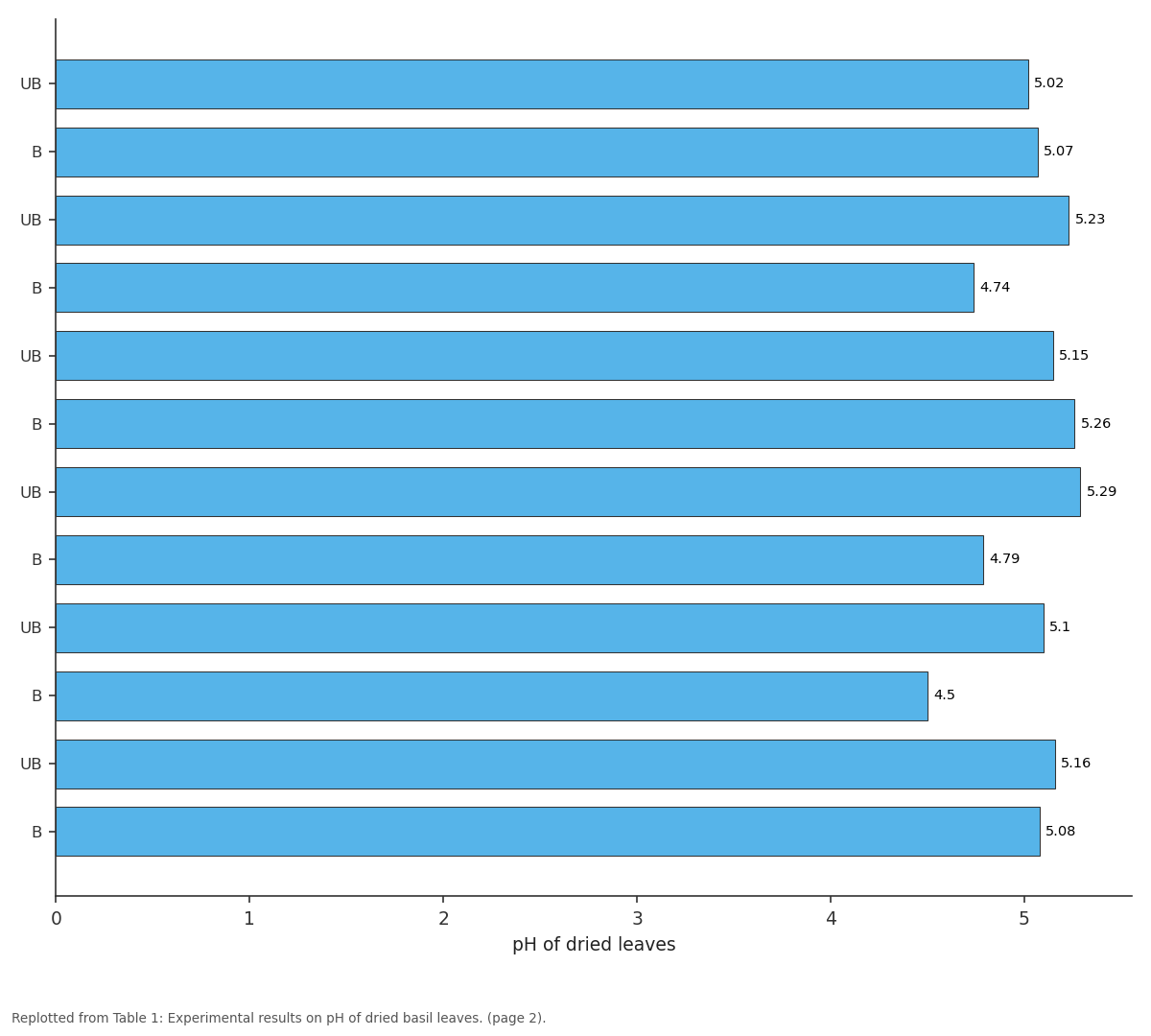
pH of dried leaves: UB vs B vs UB vs B vs UB
Replotted from Table 1 (page 2) of the original paper. Every bar is the paper's own table value.
View source evidence ↗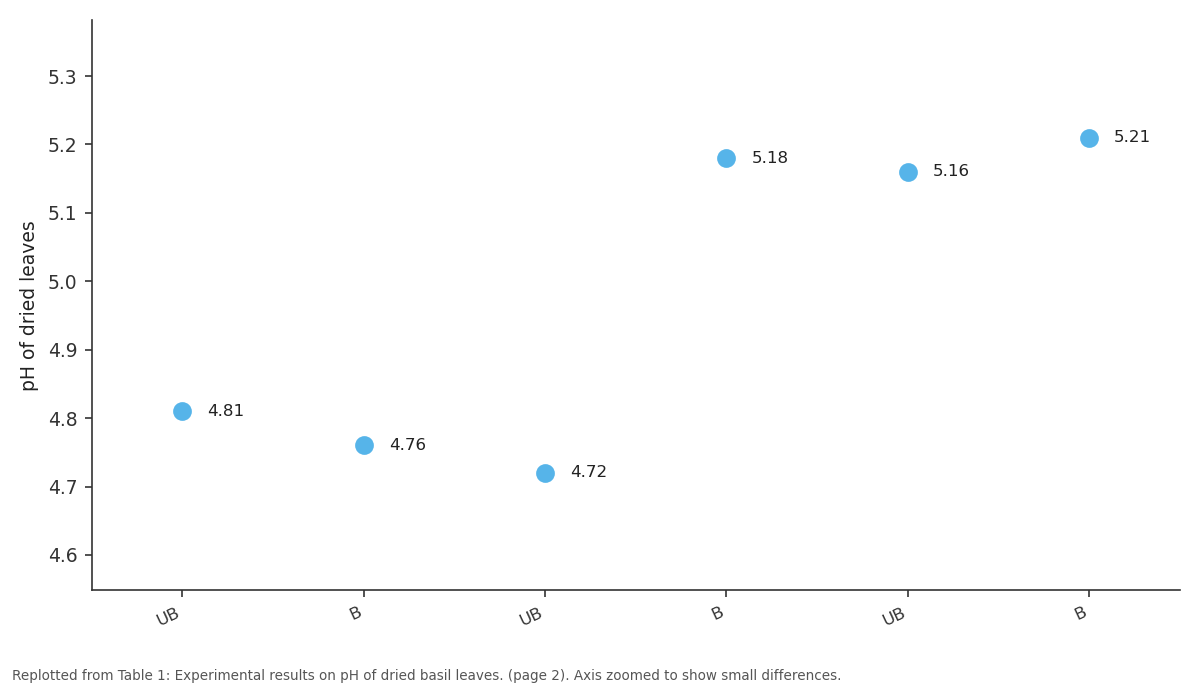
pH of dried leaves: UB vs B vs UB vs B vs UB
Replotted from Table 1 (page 2) of the original paper. Every bar is the paper's own table value.
View source evidence ↗Figures & tables
From the original paper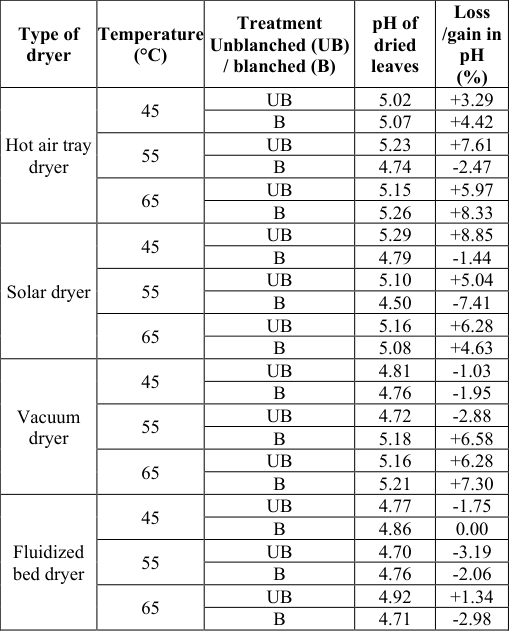 Table 1
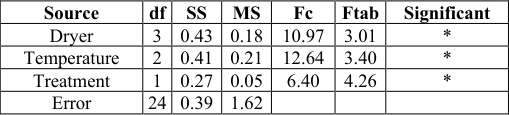 Table 2
Introduction
Basil (Ocimum sanctum), commonly known as holy basil or Tulsi, is a plant of immense importance due to its religious, medicinal, and pharmacological significance. Beyond its sacred value in Indian culture, basil serves as a potent therapeutic agent widely recognized by physicians and pharmacologists. It exhibits strong antimicrobial and insecticidal properties, making it valuable in traditional as well as modern medicine. Basil leaves have been extensively used in the treatment of various ailments such as diarrhoea, dysentery, typhoid, fever, stomachache, piles, and hemorrhages. Additionally, Ocimum leaves are effective in managing parasitical skin diseases and certain eye disorders (Naithani and Karkar, 2002) [2] . Furthermore, basil leaf powder has demonstrated the ability to reduce fasting blood glucose and postprandial glucose levels in patients with non-insulindependent diabetes mellitus (NIDDM). The leaves are rich in essential oils, particularly eugenol, which possesses significant antioxidant properties and effectively inhibits lipid peroxidation (Sethi, 2004) [3] . For leafy vegetables like basil, pretreatment prior to drying is essential to maintain product quality. According to Van Arsdel et al. (1963) [4] , pretreatments help in color retention, enzyme inactivation, and enhancement of drying rate. Blanching is one of the most commonly employed pretreatments, primarily used to inactivate enzymes responsible for enzymatic and oxidative browning. Common blanching methods include hot water, steam, and chemical blanching. It has also been observed that blanched materials tend to dry faster than unblanched ones, particularly in high-moisture products. Among quality parameters, pH is a critical indicator of chemical stability, influencing microbial growth, enzymatic activity, and storage quality (Maskan, 2000) [1] . Therefore, this study aims to investigate the effect of different drying techniques-hot air tray drying, solar drying, vacuum drying, and fluidized bed drying-at three temperature levels (45 °C, 55 °C, and 65 °C), along with blanching pretreatment, on the pH of dried basil leaves.
Materials and Methods
Materials and Methods
Raw Material Collection
Fresh basil leaves were harvested from the research farm and cleaned to remove dust and damaged leaves. Uniform, mature leaves were selected for the experiment.
Experimental Design
A factorial design was used, involving: 1. Four drying methods: hot air tray dryer, solar dryer, vacuum dryer, and fluidized bed dryer 2. Three temperatures: 45 °C, 55 °C, and 65 °C 3. Two treatments: unblanched (UB) and blanched (B) (blanching was done by steaming for 30 seconds followed by cold water cooling)
This resulted in 24 drying combinations, with triplicate samples for each treatment.
Drying Process
Each drying method was operated under controlled conditions until the sample reached a final moisture content of approximately 5-6% (wet basis). Solar drying was done using a forced convection dryer; the drying temperature was moderated.
pH Measurement
Five grams of dried basil leaves were mixed with 50 mL of distilled water, stirred, filtered, and analyzed using a digital pH meter (±0.01 accuracy). Mean values of three replicates were recorded.
Statistical Analysis
The effect of dryer type, temperature, and treatment on pH was analyzed using one-way ANOVA. Significance was tested at the 5% level, and results were interpreted using Fcalculated (Fc) vs. F-tabulated (Ftab) values.
Results and Discussion
Results and Discussion
pH Variation with Drying Conditions
The pH of the fresh basil leaves was 4.86. Post-drying, pH values ranged from 4.50 to 5.29, depending on the drying method and treatment (Table 1). The highest pH (5.29) was found in unblanched samples dried at 45 °C in the solar dryer, while the lowest pH (4.50) was observed in blanched samples dried at 55 °C in the solar dryer.
Hot Air Tray Dryer
Generally, this method showed an increase in pH for both unblanched and blanched samples, with the highest value of 5.26 at 65 °C for blanched samples (+8.33% from fresh).
Only the blanched sample at 55 °C showed a pH drop.
Solar Dryer
Unblanched samples consistently showed a pH increase; however, blanched samples at 45 °C and 55 °C exhibited a notable pH decrease, likely due to thermal degradation or leaching of buffering compounds during blanching.
Vacuum Dryer
At lower temperatures (45 °C and 55 °C), pH decreased in unblanched samples, while at 65 °C, pH increased significantly, especially in blanched samples. This indicates that higher vacuum drying temperatures may reduce acidity through breakdown of organic acids.
Fluidized Bed Dryer
This method generally led to decreased pH values in all treatments. Only the unblanched sample at 65 °C showed a slight increase (4.92, +1.34%).
ANOVA Analysis
The ANOVA test (Table 2) showed that all three factorsdryer type, temperature, and treatment-significantly influenced pH at the 5% level: The interaction between treatment and drying conditions led to complex effects on pH, indicating the need for careful optimization in processing basil leaves.
| Source | df | SS | MS | Fc | Ftab | Significant |
|---|---|---|---|---|---|---|
| Dryer | 3 | 0.43 | 0.18 | 10.97 | 3.01 | * |
| Temperature | 2 | 0.41 | 0.21 | 12.64 | 3.40 | * |
| Treatment | 1 | 0.27 | 0.05 | 6.40 | 4.26 | * |
| Error | 24 | 0.39 | 1.62 |
Table text extracted from the original PDF; superscript letters are shown inline. The original table image is below.
View original table image
Conclusion
The study demonstrated that drying conditions significantly affect the pH of dried basil leaves. While hot air tray drying and higher vacuum drying temperatures tend to increase pH, fluidized bed and solar drying (especially with blanching) may reduce pH depending on temperature. The findings suggest that drying at higher temperatures in hot air or vacuum dryers, especially for blanched samples, can help retain or slightly elevate pH, contributing to better storage stability. Optimizing drying parameters is thus crucial for preserving the chemical quality of dried basil for commercial use.
References
5 in the original paper- Maskan M. Microwave/air and microwave finish drying of banana. Journal of Food Engineering. 2000;44(2):7178.
- Naithani V, Karkar P. Ocimum gratissimum, Ocimum canum and Ocimum kilimanscharicum: a review. Journal of Medicinal and Aromatic Plant Science. 2002;24:441-455.
- Sethi J, Sood S, Seth S, Anjana T. Evaluation of hypoglycemic and antioxidant effect of Ocimum sanctum. Indian Journal of Clinical Biochemistry. 2004;19(2):152-155.
- Van Arsdel WB, Copley JJ. Food Dehydration. Vol. 2. 2nd ed. Westport, New York: AVI Publishing Co.; 1963.
- Sethi J, Sood S, Seth S, Anjana T. Evaluation of hypoglycemic and antioxidant effect of Ocimum sanctum. Indian Journal of Clinical Biochemistry. 2004;19(2):152-155.