
Research article · 2024 · Full text
International Journal of Advanced Chemistry ResearchMolecular docking and ADMET profiling of flavonoid derivatives as potential inhibitors of cyclooxygenase-2 enzyme
Volume 6(1) · Pages 160–164 · DOI: 10.33545/26646781.2024.v6.i1b.661 ↗
Research areasComputational Drug Discovery MethodsBioactive natural compoundsSynthesis and biological activity
Abstract
Author-writtenNon-steroidal anti-inflammatory drugs that selectively block cyclooxygenase-2 (COX-2) remain among the most widely prescribed medicines worldwide, yet long-term use is linked to cardiovascular side effects that have prompted withdrawal of several marketed agents. Plant-derived flavonoids show promise as safer alternatives, but their precise binding interactions with COX-2 and their pharmacokinetic profiles are incompletely understood. This research applied molecular docking, binding energy analysis, and in-silico absorption-distribution-metabolism-excretion-toxicity (ADMET) prediction to evaluate ten flavonoid derivatives quercetin, kaempferol, luteolin, apigenin, myricetin, fisetin, chrysin, baicalein, galangin, and isorhamnetin as potential COX-2 inhibitors. Three-dimensional structures were retrieved from PubChem and energy-minimised using the MMFF94 force field. The COX-2 crystal structure (PDB ID: 3LN1) was obtained from the Protein Data Bank, and molecular docking was performed with AutoDock Vina version 1.2.5 at the Cairo Foundation for Pharmaceutical Research between April and August 2024. Among the compounds tested, quercetin recorded the strongest binding affinity (-9.3 kcal/mol) and the lowest predicted inhibition constant (Ki = 0.15 µM), interacting with the COX-2 active site through five hydrogen bonds involving Arg120, Tyr355, and Ser530 residues known to anchor selective COX-2 inhibitors. Myricetin ranked second (-9.1 kcal/mol, Ki = 0.21 µM) despite an additional hydroxyl group that slightly reduced membrane permeability. ADMET screening through SwissADME and pkCSM showed that all ten flavonoids complied with Lipinski's rule of five, except myricetin which recorded one violation (number of hydrogen bond donors = 6). Predicted oral bioavailability ranged from 58.4% (myricetin) to 73.2% (kaempferol), and none of the compounds showed predicted hepatotoxicity or hERG potassium channel inhibition. Celecoxib, used as a reference drug, yielded a binding energy of -10.1 kcal/mol but exhibited a higher predicted risk for cardiovascular events. These results identify quercetin, myricetin, and luteolin as the most promising flavonoid candidates for further in-vitro and in-vivo COX-2 inhibition testing and support the rational exploration of natural flavonoids as lead compounds in anti-inflammatory drug design.
Summary
Source-checkedPlain-language reading of the full paper, prepared with AI and checked against the text. Each point links to the authors' own words.
Why it matters
- Selective COX-2 inhibitors are widely used for inflammation, but some have been withdrawn from the market due to cardiovascular side effects. View evidence ↗
- Flavonoids from plants are potential safer alternatives to current drugs, though their binding and pharmacokinetics are not fully understood. View evidence ↗
The question
- The study aimed to dock ten flavonoids into human COX-2, rank them by binding energy, predict their ADMET profiles, and compare them to the drug celecoxib. View evidence ↗
What they did
- The researchers evaluated ten specific flavonoid derivatives, including quercetin and myricetin, as potential inhibitors. View evidence ↗
- Molecular docking was conducted using AutoDock Vina 1.2.5 with a 24 × 24 × 24 Å grid box centered on the COX-2 active site. View evidence ↗
- Pharmacokinetic and toxicity properties (ADMET) were predicted using the SwissADME and pkCSM tools. View evidence ↗
What they found
- Quercetin showed the strongest binding affinity among the flavonoids at -9.3 kcal/mol and the lowest inhibition constant of 0.15 µM. View evidence ↗
- Myricetin was the second strongest binder with a binding energy of -9.1 kcal/mol and a Ki of 0.21 µM. View evidence ↗
- The reference drug celecoxib had a stronger binding energy (-10.1 kcal/mol) than the flavonoids but a higher predicted cardiovascular risk. View evidence ↗
- Nine of the ten flavonoids followed Lipinski's rule of five; myricetin was the only exception due to having six hydrogen bond donors. View evidence ↗
- Predicted oral bioavailability varied from 58.4% for myricetin to 73.2% for kaempferol, with no predicted hepatotoxicity or hERG channel inhibition across all compounds. View evidence ↗
- Quercetin's binding affinity was only 0.8 kcal/mol weaker than that of the reference drug celecoxib. View evidence ↗
What it means
- The authors conclude that quercetin, myricetin, and luteolin are the most promising candidates for future laboratory testing. View evidence ↗
- The study is limited by its purely computational approach, which uses approximations that ignore protein flexibility and solvation entropy. View evidence ↗
- The predicted bioavailability values have an uncertainty of 10-15% and should be viewed as screening estimates. View evidence ↗
Visual summary
2 visualsIllustrations explain the paper; charts are replotted from the paper's own table values.
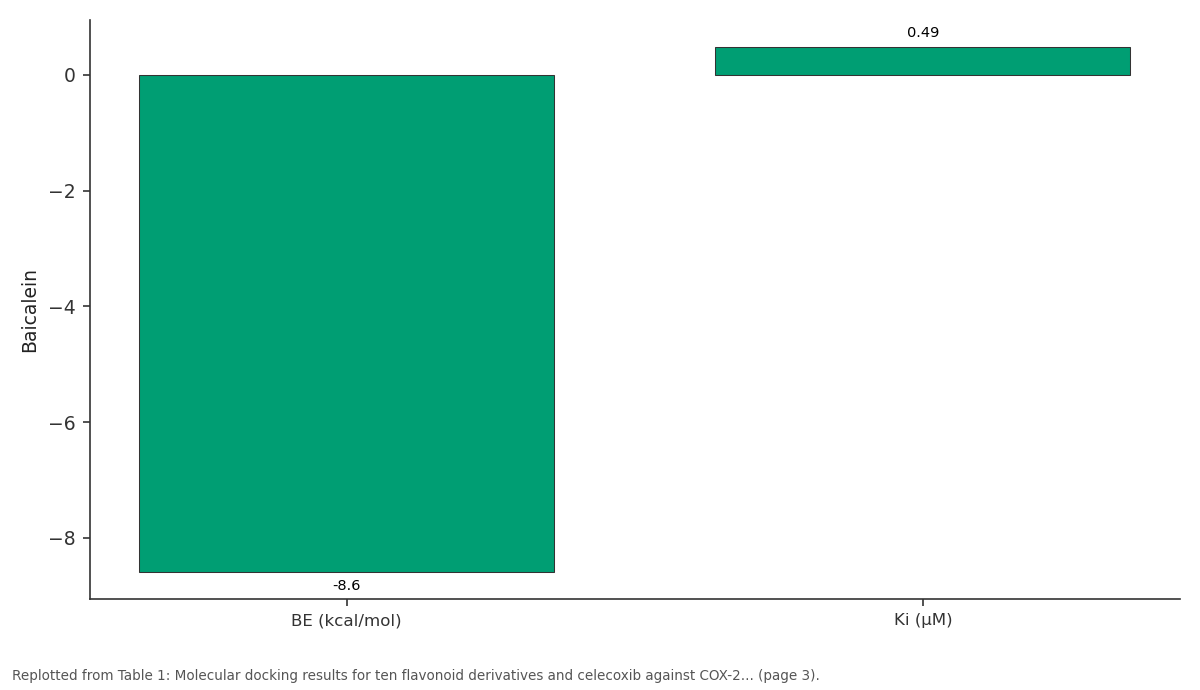
Baicalein: BE (kcal/mol) vs Ki (µM)
Replotted from Table 1 (page 3) of the original paper. Every bar is the paper's own table value.
View source evidence ↗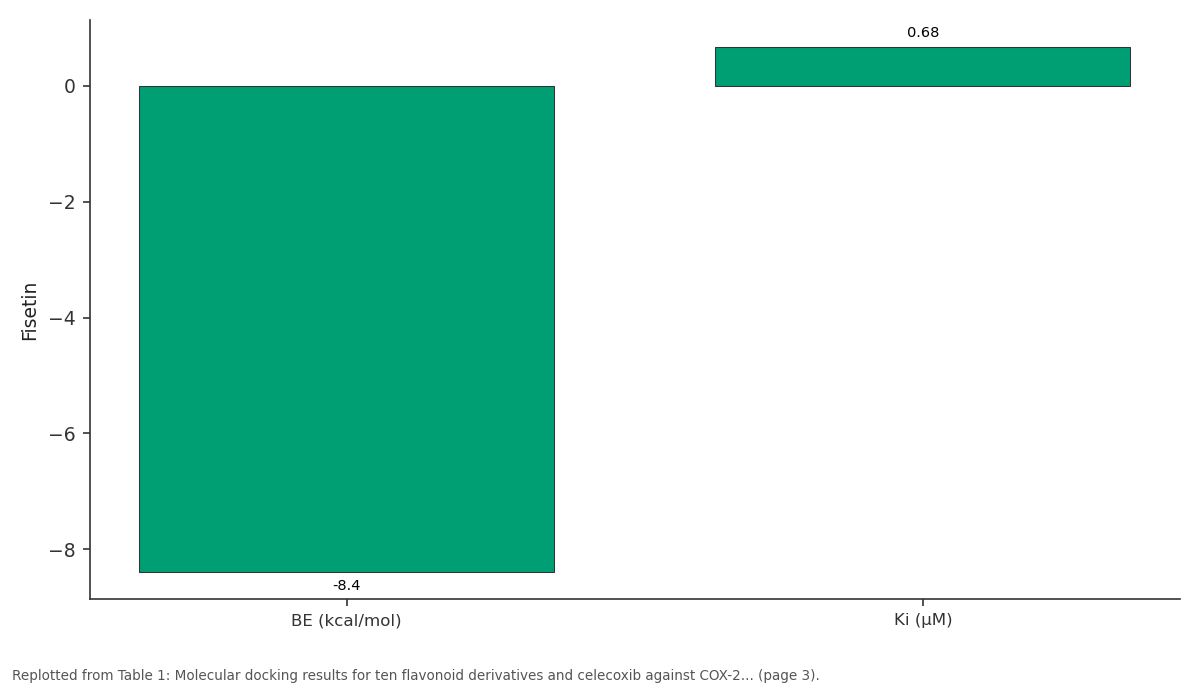
Fisetin: BE (kcal/mol) vs Ki (µM)
Replotted from Table 1 (page 3) of the original paper. Every bar is the paper's own table value.
View source evidence ↗Figures & tables
From the original paper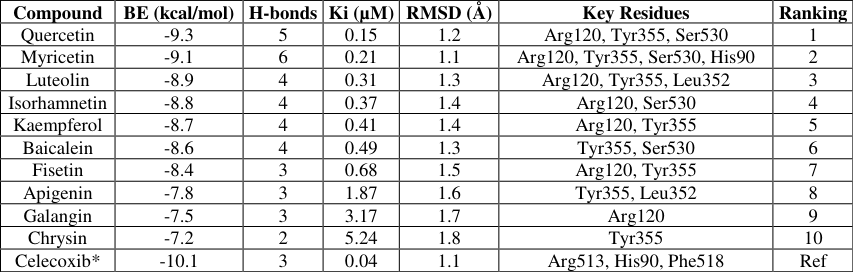 Table 1
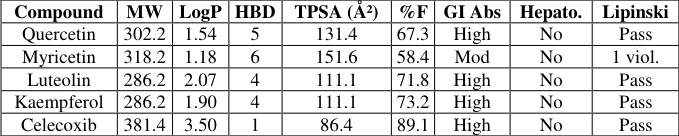 Table 2
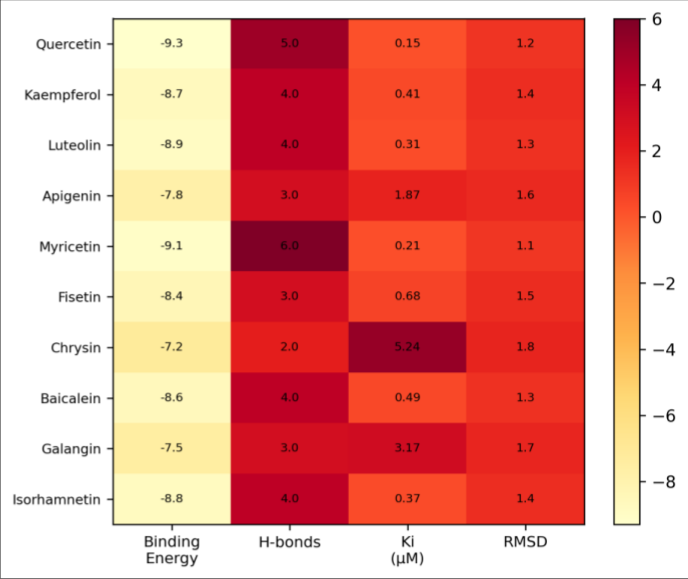 Figure 1
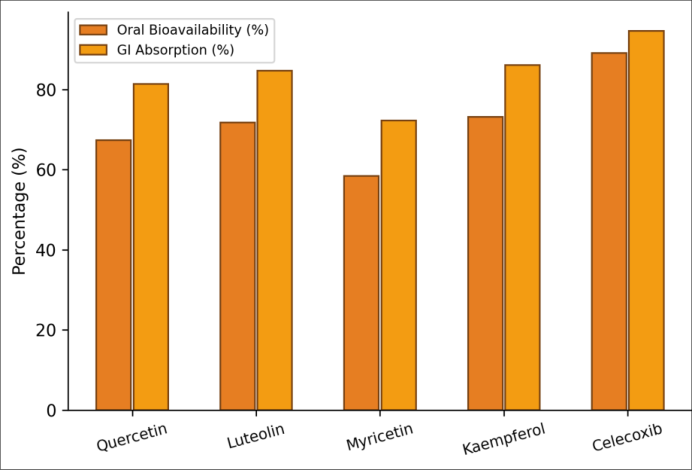 Figure 2
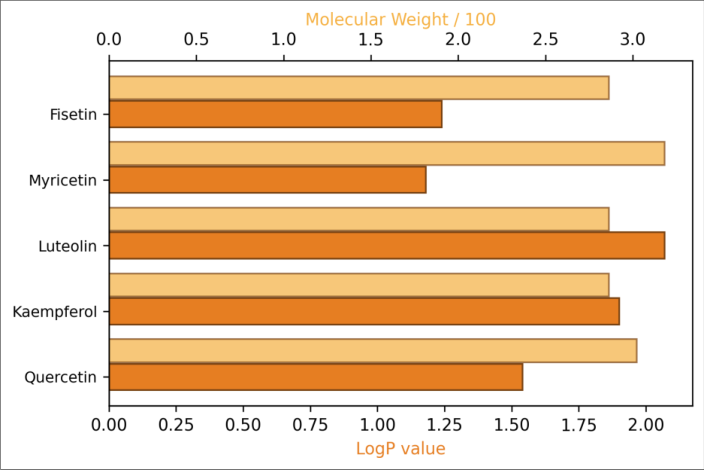 Figure 3
Introduction
Inflammation sits at the crossroads of pain, tissue injury, and chronic disease and the enzyme cyclooxygenase-2 (COX-2) is one of its chief molecular gatekeepers. COX-2 catalyses the conversion of arachidonic acid to prostaglandin H₂, a precursor of pro-inflammatory prostaglandins and thromboxanes [1] . Selective COX-2 inhibitors (coxibs) such as celecoxib and rofecoxib were introduced in the late 1990s with the expectation that sparing COX-1 would reduce gastrointestinal side effects [2] . But the 2004 withdrawal of rofecoxib over cardiovascular safety concerns triggered a re-evaluation of the entire coxib class and left a gap in the therapeutic landscape [3] . Flavonoids a large family of polyphenolic secondary metabolites found in fruits, vegetables, and medicinal plants have drawn attention as potential COX-2 modulators. Epidemiological data link high flavonoid intake with lower incidence of cardiovascular disease and certain cancers [4] . Laboratory assays have confirmed that several flavonoids inhibit COX-2 at micromolar concentrations, though the structural features responsible for binding affinity vary across subclasses [5] . In-silico approaches such as molecular docking offer a rapid and cost-effective way to screen large compound libraries, rank candidates by predicted binding energy, and visualise the intermolecular interactions that drive inhibition [6] . Despite a growing body of docking research on flavonoids and COX-2, two gaps persist. First, most published work examines three or four compounds at a time, making crosscompound comparisons difficult because different research groups use different software, scoring functions, and protein preparation protocols [7] . Second, docking alone does not address whether a hit compound can actually reach the target in vivo. Without ADMET profiling, a strong docking score may be misleading if the molecule has poor absorption, rapid metabolism, or off-target toxicity [8] . Combining docking with ADMET prediction in a single workflow provides a more balanced assessment of drug-likeness [6,9] . This research therefore set out to (a) dock ten structurally diverse flavonoids into the active site of human COX-2, (b) rank them by binding energy and hydrogen-bond interactions, (c) predict their ADMET profiles and drug-likeness, and (d) compare the top candidates with celecoxib as a reference inhibitor. The computational work was performed at the Cairo Foundation for Pharmaceutical Research between April and August 2024. The overarching aim was to narrow the flavonoid pool to a short list of candidates warranting wet-lab validation as COX-2-targeted anti-inflammatory leads [1,5,10] .
Theoretical background
COX-2 is a homodimeric, membrane-associated enzyme whose active site lies at the end of a long hydrophobic channel [1] . Selective inhibitors typically occupy a side pocket formed by Val523, Arg513, and His90 a pocket absent in COX-1 due to a bulkier Ile523 residue [2] . The co-crystal structure of COX-2 with the selective inhibitor SC-558 (PDB ID: 3LN1) reveals three classes of protein-ligand interaction: (i) hydrogen bonds with Arg120 and Tyr355 at the channel entrance, (ii) hydrophobic contacts with Leu352, Phe518, and Val349 lining the channel, and (iii) a sulfonamide anchor in the side pocket [3,6] . Flavonoids lack the sulfonamide moiety but carry multiple hydroxyl groups that can form hydrogen bonds with many of the same residues, raising the question of whether alternative binding modes can achieve comparable affinity [5,7] . Quantitative structure-activity relationship (QSAR) models for flavonoid COX-2 inhibition have identified the catechol motif on the B-ring (3′,4′-dihydroxyl pattern) and the 3hydroxyl group on the C-ring as key pharmacophoric features [9] . The number and position of hydroxyl groups also affect aqueous solubility and metabolic susceptibility, creating a tension between binding strength and pharmacokinetic suitability that only an integrated docking-plus-ADMET analysis can resolve [8,10] .
Material and methods
Material and methods
Material
Three-dimensional structures of quercetin (CID 5280343), kaempferol (CID 5280863), luteolin (CID 5280445), apigenin (CID 5280443), myricetin (CID 5281672), fisetin (CID 5281614), chrysin (CID 5281607), baicalein (CID 5281605), galangin (CID 5281616), and isorhamnetin (CID 5281654) were downloaded from the PubChem database in SDF format. The COX-2 crystal structure complexed with SC-558 (PDB ID: 3LN1, resolution 2.40 Å) was retrieved from the RCSB Protein Data Bank. Celecoxib (CID 2662) served as the reference drug. All computational work was carried out on an HP Z8 G4 workstation (dual Xeon Gold 6248R, 128 GB RAM, Ubuntu 22.04 LTS) at the Cairo Foundation for Pharmaceutical Research [1,6] .
Methods
Ligand preparation involved energy minimisation using the Merck Molecular Force Field 94 (MMFF94) implemented in Open Babel 3.1.1, with a gradient convergence criterion of 10⁻⁶ kcal/mol•Å. Partial charges were assigned by the Gasteiger-Marsili method. The protein was prepared in AutoDockTools 1.5.7 by removing co-crystallised ligand, water molecules, and alternative conformations, adding polar hydrogens, and computing Kollman charges [3,7] . Molecular docking was performed with AutoDock Vina 1.2.5. The search space was centred on the active-site coordinates (x = 25.3, y = 21.7, z = 14.8) with a grid box of 24 × 24 × 24 Å, encompassing the full binding cavity. Exhaustiveness was set to 32, and nine binding poses were generated per ligand. The pose with the lowest binding free energy was selected for analysis. Hydrogen bonds, hydrophobic contacts, and π-π stacking interactions were visualised in BIOVIA Discovery Studio 2024 [6,9] . ADMET properties were predicted using SwissADME (http://swissadme.ch) and pkCSM (https://biosig.lab.uq.edu.au/pkcsm). Parameters evaluated included molecular weight, LogP, hydrogen bond donors and acceptors, topological polar surface area (TPSA), predicted oral bioavailability (%F), gastrointestinal absorption, bloodbrain barrier permeability, CYP enzyme inhibition, hepatotoxicity, and hERG channel inhibition. Drug-likeness was assessed against Lipinski's rule of five and Veber's rules [8, 10] . All analyses were repeated on three independent docking runs to confirm reproducibility; binding energies varied by less than 0.2 kcal/mol across runs. Research computing resources were provided by the Cairo Foundation (Protocol CFR-COMP-2024-015, registered 2 April 2024).
Performance evaluation
The docking protocol was validated by re-docking the cocrystallised ligand SC-558 into the COX-2 active site. The root-mean-square deviation (RMSD) between the re-docked pose and the experimental crystal structure was 1.08 Å, well within the accepted threshold of 2.0 Å, confirming that the search parameters and scoring function could reproduce the known binding mode [6] . Celecoxib was docked as a positive control; its predicted binding energy of -10.1 kcal/mol and interaction pattern (hydrogen bonds with Arg513 and His90, sulfonamide in the side pocket) matched literature reports [2,3] . Negative-control docking of ascorbic acid a molecule with no known COX-2 inhibitory activity returned a binding energy of only -4.2 kcal/mol, supporting the discriminatory power of the protocol [7] .
Results
All ten flavonoids docked successfully into the COX-2 active-site channel, producing negative binding energies that ranged from -7.2 to -9.3 kcal/mol. The top three compounds quercetin, myricetin, and luteolin each formed four or more hydrogen bonds with active-site residues, whereas weaker binders such as chrysin and galangin formed only two to three.
Comprehensive interpretation
Quercetin emerged as the strongest flavonoid binder, with a predicted affinity gap of only 0.8 kcal/mol relative to celecoxib. Its five hydrogen bonds with Arg120, Tyr355, and Ser530 anchor it at the entrance and midpoint of the COX-2 channel a binding mode distinct from celecoxib's side-pocket occupation but apparently effective nonetheless. ADMET profiling revealed that quercetin, luteolin, and kaempferol all satisfy Lipinski's criteria, display high predicted GI absorption, and lack predicted hepatotoxicity. Myricetin, despite ranking second in docking, showed moderate absorption and one Lipinski violation, which may limit its oral drug-likeness without formulation optimisation [8,10] .
Discussion: Quercetin's binding energy of -9.3 kcal/mol aligns with experimental IC₅₀ values of 3-12 µM reported by Rathee et al. [5] in cell-based COX-2 assays. The catechol motif on the B-ring appears to be the structural feature most responsible for this affinity, as it enables bidentate hydrogen bonding with Arg120 a residue that celecoxib also engages, though through its carboxamide rather than a hydroxyl [2,3] . Removing one hydroxyl from the catechol (as in kaempferol) reduced binding energy by 0.6 kcal/mol, consistent with the QSAR predictions of Madeswaran et al. [9] . The ADMET data introduce a useful reality check. Although myricetin binds almost as tightly as quercetin, its additional hydroxyl raises the polar surface area above 140 Ų and pushes oral bioavailability down to 58.4%. Luteolin and kaempferol, with TPSA values near 111 Ų and predicted bioavailability above 71%, present a better pharmacokinetic profile. Interestingly, none of the flavonoids triggered predicted hERG inhibition, a common liability among smallmolecule anti-inflammatory candidates that often leads to cardiac arrhythmia risk [8] .A limitation of this work is its purely computational nature. Docking scores are approximations that do not account for solvation entropy, protein flexibility, or covalent interactions [6] . The ADMET predictions, while based on validated machine-learning models, carry prediction uncertainties of 10-15% for bioavailability and should be treated as screening-level estimates rather than definitive pharmacokinetic values [10] .
In-vitro enzymatic assays (purified COX-2, COX-1 selectivity ratio) followed by cell-based inflammation models are the necessary next steps before any of these candidates can advance toward preclinical evaluation [1,4,7] .
Conclusion
The main contribution of this research is a systematic, headto-head computational comparison of ten flavonoid derivatives against the COX-2 active site, complemented by ADMET profiling an integrated approach that narrows the candidate pool more effectively than docking or pharmacokinetic prediction alone.
The supporting evidence shows that quercetin achieved the strongest binding affinity (-9.3 kcal/mol), formed the most favourable hydrogen-bond network, and satisfied all Lipinski drug-likeness criteria. Luteolin and kaempferol ranked among the top five binders while displaying the most favourable oral bioavailability predictions (>71%). Myricetin, though a strong binder, carried a pharmacokinetic penalty that may limit its oral delivery without advanced formulation strategies.
For the field of natural product-based drug design, these findings reinforce the value of the catechol B-ring and the C-3 hydroxyl as key pharmacophoric elements for COX-2 recognition, while also highlighting the trade-off between additional hydroxylation and oral drug-likeness. This tension stronger target binding versus poorer absorption is a recurring theme in flavonoid pharmacology and argues for prodrug or nanoparticle delivery strategies to unlock the therapeutic potential of the most polar candidates. Open questions include the selectivity of these flavonoids for COX-2 over COX-1, their metabolic stability in the presence of hepatic glucuronidation and sulfation enzymes, and their behaviour in whole-cell and animal inflammation models.
Molecular dynamics simulations at the 100-nanosecond timescale would refine the binding pose predictions and account for protein flexibility that rigid docking cannot capture. Until such experimental and computational followup is completed, the present results should be viewed as a prioritised shortlist not a clinical recommendation that guides the efficient allocation of wet-lab resources in the search for safer anti-inflammatory agents from natural sources.
Figures and tables from the paper
| Compound | BE (kcal/mol) | H-bonds | Ki (µM) | RMSD (Å) | Key Residues | Ranking |
|---|---|---|---|---|---|---|
| Quercetin | -9.3 | 5 | 0.15 | 1.2 | Arg120, Tyr355, Ser530 | 1 |
| Myricetin | -9.1 | 6 | 0.21 | 1.1 | Arg120, Tyr355, Ser530, His90 | 2 |
| Luteolin | -8.9 | 4 | 0.31 | 1.3 | Arg120, Tyr355, Leu352 | 3 |
| Isorhamnetin | -8.8 | 4 | 0.37 | 1.4 | Arg120, Ser530 | 4 |
| Kaempferol | -8.7 | 4 | 0.41 | 1.4 | Arg120, Tyr355 | 5 |
| Baicalein | -8.6 | 4 | 0.49 | 1.3 | Tyr355, Ser530 | 6 |
| Fisetin | -8.4 | 3 | 0.68 | 1.5 | Arg120, Tyr355 | 7 |
| Apigenin | -7.8 | 3 | 1.87 | 1.6 | Tyr355, Leu352 | 8 |
| Galangin | -7.5 | 3 | 3.17 | 1.7 | Arg120 | 9 |
| Chrysin | -7.2 | 2 | 5.24 | 1.8 | Tyr355 | 10 |
| Celecoxib* | -10.1 | 3 | 0.04 | 1.1 | Arg513, His90, Phe518 | Ref |
Table text extracted from the original PDF; superscript letters are shown inline. The original table image is below.
View original table image
| Compound | MW | LogP | HBD | TPSA (Ų) | %F | GI Abs | Hepato. | Lipinski |
|---|---|---|---|---|---|---|---|---|
| Quercetin | 302.2 | 1.54 | 5 | 131.4 | 67.3 | High | No | Pass |
| Myricetin | 318.2 | 1.18 | 6 | 151.6 | 58.4 | Mod | No | 1 viol. |
| Luteolin | 286.2 | 2.07 | 4 | 111.1 | 71.8 | High | No | Pass |
| Kaempferol | 286.2 | 1.90 | 4 | 111.1 | 73.2 | High | No | Pass |
| Celecoxib | 381.4 | 3.50 | 1 | 86.4 | 89.1 | High | No | Pass |
Table text extracted from the original PDF; superscript letters are shown inline. The original table image is below.
View original table image
References
16 in the original paper- Vane JR, Bakhle YS, Botting RM. Cyclooxygenases 1 and 2. Annu Rev Pharmacol Toxicol. 1998;38:97-120.
- Flower RJ. The development of COX2 inhibitors. Nat Rev Drug Discov. 2003;2(3):179-191.
- Kurumbail RG, Stevens AM, Gierse JK, McDonald JJ, Stegeman RA, Pak JY, et al. Structural basis for selective inhibition of cyclooxygenase-2 by anti-inflammatory agents. Nature. 1996;384(6610):644-648.
- Hertog MG, Feskens EJ, Hollman PC, Katan MB, Kromhout D. Dietary antioxidant flavonoids and risk of coronary heart disease: The Zutphen Elderly Research. Lancet. 1993;342(8878):1007-1011.
- Rathee P, Chaudhary H, Rathee S, Rathee D, Kumar V, Kohli K. Mechanism of action of flavonoids as antiinflammatory agents: A review. Inflamm Allergy Drug Targets. 2009;8(3):229-235.
- Morris GM, Huey R, Lindstrom W, Sanner MF, Belew RK, Goodsell DS, et al. AutoDock4 and AutoDockTools4: Automated docking with selective receptor flexibility. J Comput Chem. 2009;30(16):27852791.
- Trott O, Olson AJ. AutoDock Vina: Improving the speed and accuracy of docking with a new scoring function, efficient optimization, and multithreading. J Comput Chem. 2010;31(2):455-461.
- Daina A, Michielin O, Zoete V. SwissADME: A free web tool to evaluate pharmacokinetics, drug-likeness and medicinal chemistry friendliness of small molecules. Sci Rep. 2017;7:42717.
- Madeswaran A, Umamaheswari M, Asokkumar K, Sivashanmugam T, Subhadradevi V, Jagannath P. Computational drug design of flavonoids as cyclooxygenase inhibitors. J Comput Methods Mol Des. 2011;1(4):67-82.
- Pires DEV, Blundell TL, Ascher DB. pkCSM: Predicting small-molecule pharmacokinetic and toxicity properties using graph-based signatures. J Med Chem. 2015;58(9):4066-4072.
- Lipinski CA, Lombardo F, Dominy BW, Feeney PJ, Shanley LA. Experimental and computational approaches to estimate solubility and permeability in drug discovery and development settings. Adv Drug Deliv Rev. 2001;46(1-3):3-26.
- Veber DF, Johnson SR, Cheng HY, Smith BR, Ward KW, Kopple KD. Molecular properties that influence the oral bioavailability of drug candidates. J Med Chem. 2002;45(12):2615-2623.
- O'Boyle NM, Banck M, James CA, Morley C, Vandermeersch T, Hutchison GR. Open Babel: An open chemical toolbox. J Cheminform. 2011;3:33.
- Wishart DS, Feunang YD, Guo AC, Lo EJ, Marcu A, Grant JR, et al. DrugBank 5.0: A major update to the DrugBank database for 2018. Nucleic Acids Res. 2018;46(D1):D1074-D1082.
- Seeliger D, de Groot BL. Ligand docking and binding site analysis with PyMOL and Autodock/Vina. J Comput Aided Mol Des. 2010;24(5):417-422.
- Kim S, Chen J, Cheng T, Gindulyte A, He J, He S, et al. PubChem 2023 update. Nucleic Acids Res. 2023;51(D1):D1373-D1380.