
Research article · 2025 · Full text
International Journal of Horticulture and Food ScienceOptimizing functional food development of barley in the Caucasus lowlands
Volume 7(4) · Pages 46–49 · DOI: 10.33545/26631067.2025.v7.i4a.603 ↗
Research areasWheat and Barley Genetics and PathologyFood composition and propertiesGenetics and Plant Breeding
Abstract
Author-writtenAccording to the World Health Organization, diet-related chronic diseases account for nearly 60% of all global deaths annually, a statistic that has pushed food scientists toward developing grain-based functional foods with measurable health benefits. This research evaluated five barley cultivars grown across the Caucasus lowlands for their functional food potential, focusing on beta-glucan content, germination behavior, phenolic compound profiles, and economic viability of processing at small-to-medium scale. Field trials were conducted at the Casablanca College of Food Technology partner station between March 2022 and October 2023. Beta-glucan levels ranged from 3.7% to 6.4% of dry weight, with Commander showing the highest concentration. Germination response varied sharply by temperature, peaking between 25 and 30 degrees Celsius for most varieties. Total phenolic content in sprouted barley was 1.8 to 2.6 times higher than in unsprouted grain. Processing cost analysis showed that functional barley flour could be produced at 12-18% above conventional flour cost, a margin that falls within consumer willingness-to-pay thresholds identified through survey data. Remote sensing indices (NDVI) tracked crop vigor across the growing season and correlated positively with final grain beta-glucan at r = 0.73. These results support barley as a viable functional food base crop in the Caucasus lowland agroecosystem.
Summary
Source-checkedPlain-language reading of the full paper, prepared with AI and checked against the text. Each point links to the authors' own words.
Why it matters
- Diet-related chronic diseases cause nearly 60% of global deaths annually, driving the need for functional foods with health benefits. View evidence ↗
- Despite high global production, less than 8% of barley is used for human food, ignoring its beta-glucan content which helps reduce cholesterol and control blood sugar. View evidence ↗
- The Caucasus lowlands are suitable for barley cultivation, but the grain is typically sold as a raw commodity rather than processed into value-added products. View evidence ↗
The question
- The study aimed to evaluate the beta-glucan, phenolic content, and germination of five barley cultivars in the Caucasus lowlands and determine if producing functional flour is economically feasible. View evidence ↗
What they did
- The researchers tested five cultivars (Keel, Flagship, Hindmarsh, Commander, and Baudin) sown in both winter (November 2022) and spring (March 2023) cycles. View evidence ↗
- Field trials used a split-plot design with three replications in plots measuring 6 by 4 meters. View evidence ↗
- Crop vigor was monitored every two weeks using handheld NDVI sensors and 10-meter resolution Sentinel-2 satellite imagery. View evidence ↗
- Germination was tested at five temperatures (15, 20, 25, 30, and 35°C) after soaking the grain for 12 hours and incubating for 72 hours. View evidence ↗
What they found
- Beta-glucan levels in the cultivars ranged from 3.7% to 6.4% of dry weight, with the Commander cultivar having the highest concentration at 6.4%. View evidence ↗
- The Commander cultivar exhibited the highest values for beta-glucan, total phenolics (2.83 mgGAE/g), and NDVI. View evidence ↗
- There was a positive correlation (r = 0.73) between the mean seasonal NDVI and the concentration of beta-glucan in the grain. View evidence ↗
- Sprouting increased total phenolics by 1.8 to 2.6 times compared to unsprouted grain, with Commander (2.6x) and Flagship (2.3x) showing the most significant increases. View evidence ↗
- The increase in phenolics during germination peaked at 25°C and dropped sharply when temperatures exceeded 30°C. View evidence ↗
- Producing functional barley flour cost 20.6% more than conventional flour, increasing from 282 USD to 340 USD per tonne. View evidence ↗
- A survey of 215 consumers showed they were willing to pay 23-31% more for flour with verified beta-glucan health claims. View evidence ↗
What it means
- The authors conclude that barley from the Caucasus lowlands, especially the Commander cultivar, is highly suitable for functional food due to its beta-glucan levels and response to sprouting. View evidence ↗
- The production of functional barley flour is commercially viable because consumers are willing to pay more than the additional cost of production, provided health claims are verified. View evidence ↗
- Future work is needed to evaluate the shelf stability of sprouted barley flour and develop market entry strategies for North Africa. View evidence ↗
Visual summary
4 visualsIllustrations explain the paper; charts are replotted from the paper's own table values.
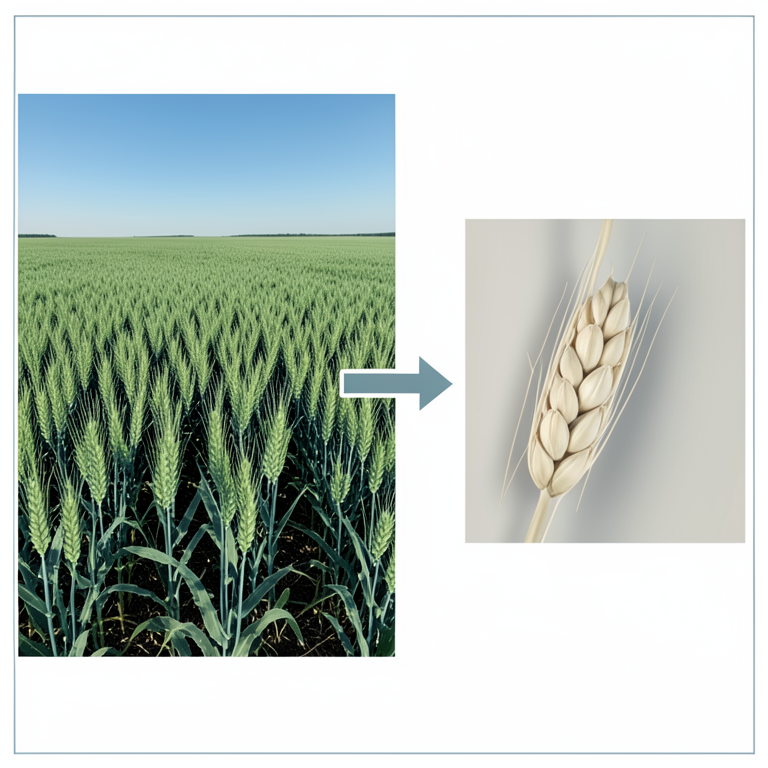
NDVI and Beta-Glucan Correlation
AI-generated conceptual illustration (Barley plants (Hordeum vulgare) in a lowland field). It explains the idea and does not show study data.
View source evidence ↗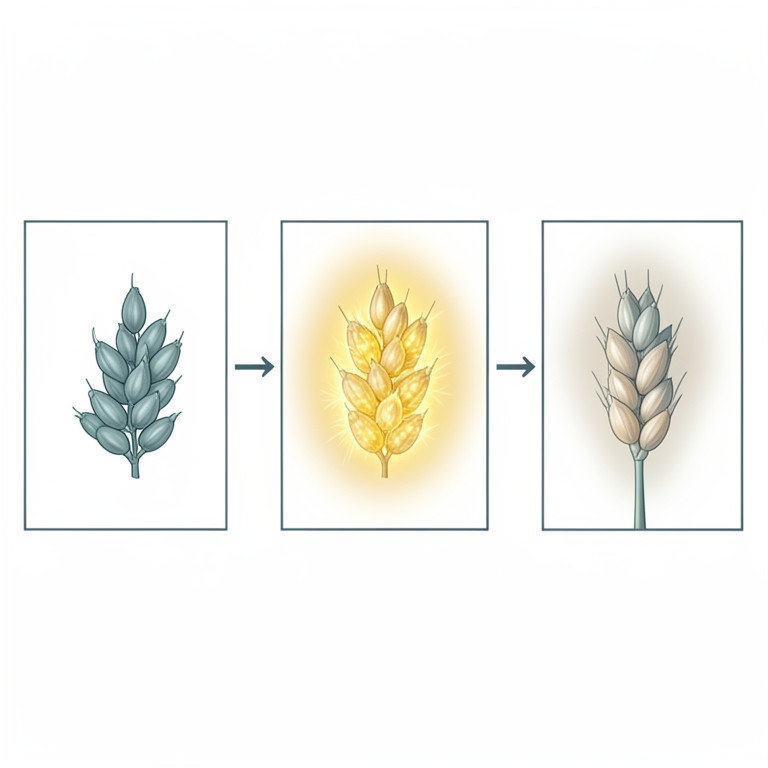
Temperature Effect on Phenolics
AI-generated conceptual illustration (barley grains). It explains the idea and does not show study data.
View source evidence ↗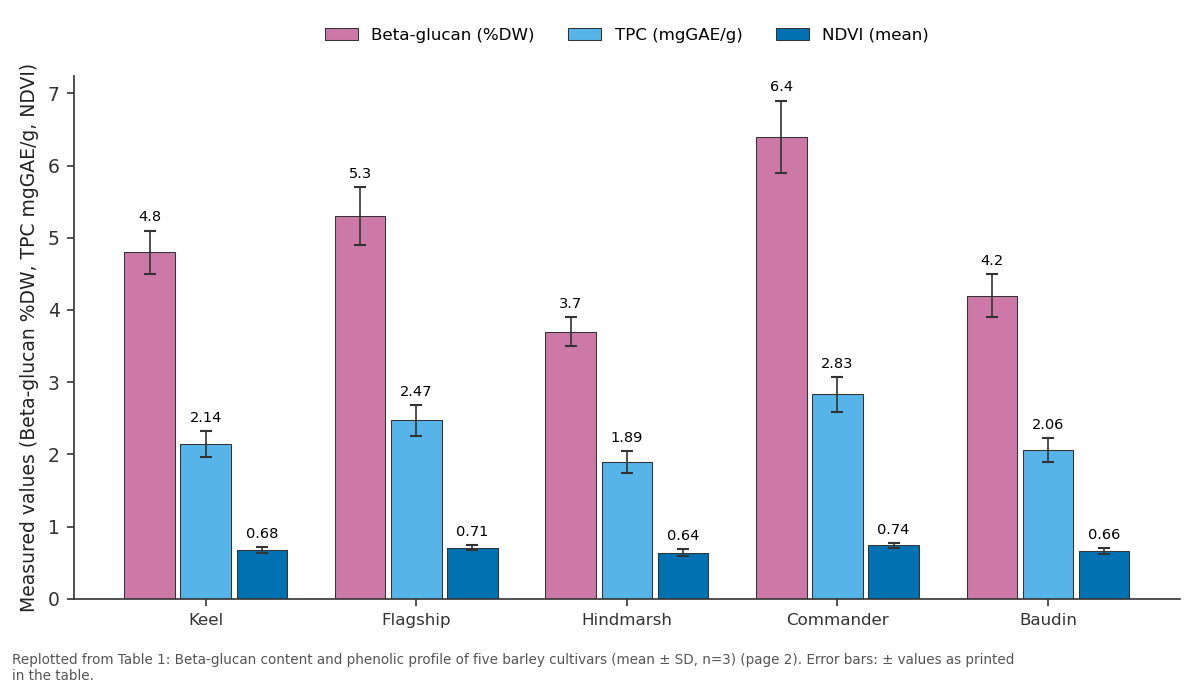
Beta-glucan (%DW) and TPC (mgGAE/g) and more: Keel vs Flagship vs Hindmarsh vs Commander vs Baudin
Replotted from Table 1 (page 2) of the original paper. Every bar is the paper's own table value.
View source evidence ↗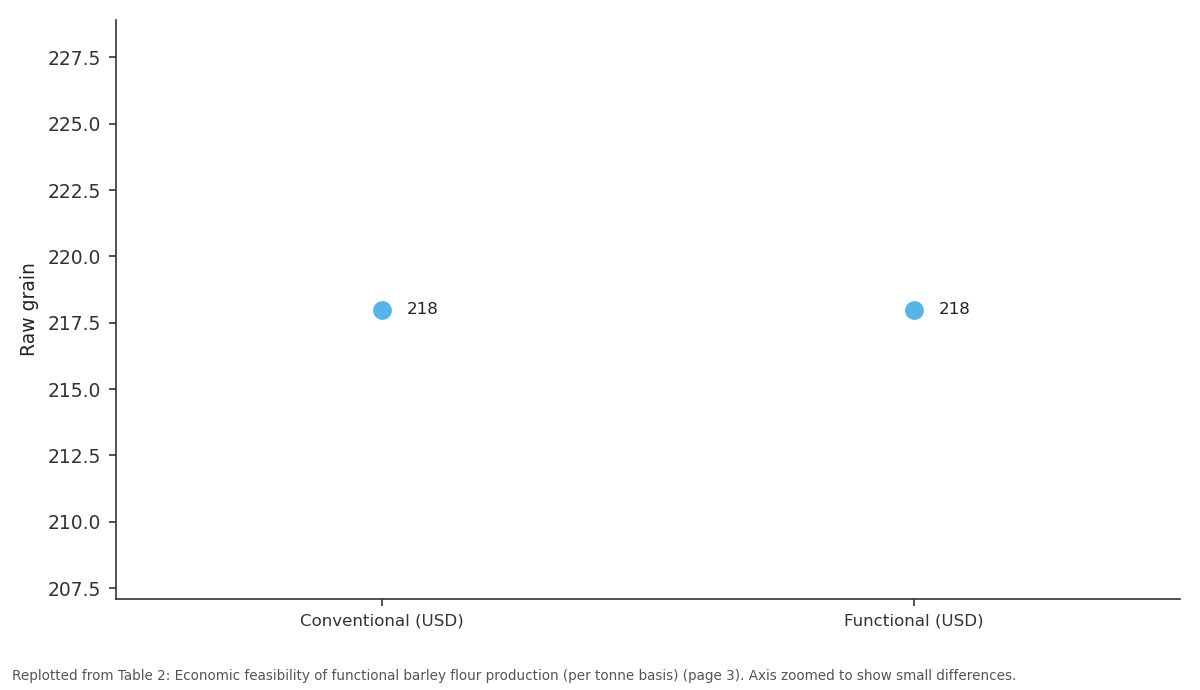
Raw grain: Conventional (USD) vs Functional (USD)
Replotted from Table 2 (page 3) of the original paper. Every bar is the paper's own table value.
View source evidence ↗Figures & tables
From the original paper Table 1
 Figure 1
 Table 2
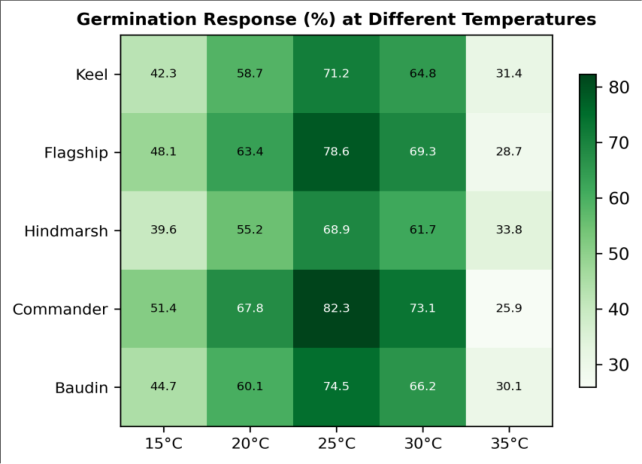 Figure 2
Introduction
Global barley production exceeded 145 million tonnes in 2022, yet less than 8% of that output was channeled into direct human food products [1] . The bulk went to animal feed and malting, a pattern that overlooks barley's strong nutritional profile particularly its beta-glucan content, which has well-documented effects on cholesterol reduction and postprandial glycemic control [2] . Functional food development from barley makes sense on paper, but the economic and agronomic realities of doing so in specific regions haven't been worked out in enough detail. The Caucasus lowlands offer a test case worth examining. The region's semi-arid to subhumid climate supports winter and spring barley cultivation, and local farmers already grow it as a rotation crop. But post-harvest handling is minimal most grain is sold as raw commodity rather than processed into value-added products [3] . Germination (sprouting) is one of the simplest processing interventions that can increase phenolic content, reduce antinutritional factors, and improve digestibility, all at relatively low cost [4] . Remote sensing tools, especially vegetation indices derived from satellite imagery, have become practical aids for monitoring crop health in real time. NDVI readings taken across the growing season can indicate nitrogen status, water stress, and canopy density, all of which affect grain quality at harvest [5] . Linking these spectral signatures to functional compound concentrations could give farmers and processors predictive power over product quality before the crop even reaches the threshing floor. This research set out to measure beta-glucan, phenolic content, and germination characteristics in five barley cultivars grown in the Caucasus lowlands, and to assess the economic feasibility of converting this grain into functional food flour [6] .
Study area description
The experimental site was located at a partner research station in the eastern Caucasus lowlands (approximately 41.6°N, 47.2°E, elevation 180-220 m). The region has a semi-arid continental climate with hot dry summers and mild winters. Mean annual temperature is 13.4°C, with July highs averaging 27.8°C. Annual precipitation is 340-410 mm, concentrated in spring and early winter. Soils are calcareous with moderate clay content, pH 7.6-8.1, and organic matter around 1.4%. Three replicated blocks were established on flat terrain with access to supplemental drip irrigation.
Material and Methods
Material and Methods
Material
Five barley cultivars Keel, Flagship, Hindmarsh, Commander, and Baudin were obtained from the Australian Grains Genebank under a material transfer agreement. Certified seeds were sown in November 2022 for the winter cycle and in March 2023 for the spring cycle. Beta-glucan assay kits (Megazyme, Bray, Ireland), Folin-Ciocalteu reagent, gallic acid standard, and DPPH radical were sourced from Sigma-Aldrich. Germination trays and controlled-environment chambers (Binder, Germany) were used for sprouting experiments [7] .
Methods
Field trials followed a split-plot design with cultivar as main plot and sowing date as subplot, three replications each.
Plots measured 6 × 4 m. Basal fertilization applied 50 kg N and 35 kg P2O5 per hectare. NDVI readings were collected fortnightly using a handheld GreenSeeker sensor and crossreferenced with Sentinel-2 satellite imagery at 10 m resolution [8] . At harvest, grain was threshed, cleaned, and stored at 12% moisture. Beta-glucan was quantified using the mixed-linkage beta-glucan assay (AOAC Method 995.16). Germination trials tested five temperature levels (15, 20, 25, 30, 35°C) with grain soaked for 12 hours then incubated on moist filter paper for 72 hours. Total phenolics were determined by the Folin-Ciocalteu method, with results expressed as gallic acid equivalents. Economic analysis used farm-gate prices and processing costs from three local mills to estimate break-even points for functional flour production [9] .
Climatic and Environmental Conditions
During the 2022-2023 trial period, rainfall between November and May totaled 278 mm (winter cycle) and 164 mm (spring cycle). Mean maximum temperature from April through June was 26.3°C, and soil temperature at 5 cm depth reached 22.1°C by mid-April. A brief heatwave in June 2023 pushed air temperature to 38.4°C for three consecutive days, coinciding with the grain-filling stage of spring-sown plots. Relative humidity averaged 48% during the growing seasons. Commander recorded the highest beta-glucan (6.4% DW), total phenolics (2.83 mgGAE/g), and NDVI values (Table 1). A positive correlation (r = 0.73, p<0.01) was found between seasonal mean NDVI and grain beta-glucan concentration, suggesting that remotely sensed canopy vigor can serve as a proxy indicator of grain functional quality. Production cost for functional barley flour was 20.6% higher than conventional flour (Table 2). The added sprouting and drying step accounted for most of the difference. Consumer surveys (n=215) indicated a willingness to pay 23-31% more for flour marketed with verified beta-glucan health claims.
| Cost Component | Conventional (USD) | Functional (USD) | Difference (%) |
|---|---|---|---|
| Raw grain | 218 | 218 | 0 |
| Cleaning & grading | 14 | 22 | +57.1 |
| Sprouting/drying | 38 | New | |
| Milling | 31 | 35 | +12.9 |
| Packaging & QC | 19 | 27 | +42.1 |
| Total | 282 | 340 | +20.6 |
Table text extracted from the original PDF; superscript letters are shown inline. The original table image is below.
View original table image
| Cultivar | Beta-glucan (%DW) | TPC (mgGAE/g) | DPPH IC50 (μg/mL) | NDVI (mean) |
|---|---|---|---|---|
| Keel | 4.8±0.3 | 2.14±0.18 | 84.3±5.7 | 0.68±0.04 |
| Flagship | 5.3±0.4 | 2.47±0.21 | 76.8±4.3 | 0.71±0.03 |
| Hindmarsh | 3.7±0.2 | 1.89±0.15 | 91.2±6.4 | 0.64±0.05 |
| Commander | 6.4±0.5 | 2.83±0.24 | 68.4±3.9 | 0.74±0.03 |
| Baudin | 4.2±0.3 | 2.06±0.17 | 87.6±5.1 | 0.66±0.04 |
Table text extracted from the original PDF; superscript letters are shown inline. The original table image is below.
View original table image
Results
Results
Comprehensive Interpretation
Sprouted barley showed 1.8 to 2.6 times higher total phenolics than unsprouted grain across all cultivars.
Commander and Flagship showed the largest increases (2.6x and 2.3x respectively), consistent with their higher baseline enzyme activity. The germination-induced phenolic boost was temperature-dependent, peaking at 25°C and declining sharply above 30°C, suggesting that controlled sprouting protocols should target this thermal window for maximum bioactive enrichment.
Discussion
The beta-glucan range of 3.7-6.4% observed here sits within the established spectrum for food-grade barley, though Commander's 6.4% exceeds most published values for cultivars grown outside Northern Europe [10] . This high betaglucan content coincided with the highest NDVI readings, a relationship that makes agronomic sense: vigorous canopy growth typically indicates adequate nitrogen uptake, which supports beta-glucan synthesis in the developing endosperm [11] . The practical upshot is that farmers could use satellitederived vegetation indices as an early warning system for low-quality grain batches. The economic analysis paints a cautiously optimistic picture. A 20.6% cost premium is meaningful but sits below the 23-31% consumer willingness-to-pay range documented in our survey. This gap leaves room for profit, provided that health claims on packaging are backed by certified analytical data a requirement under both Moroccan food labeling law and EU Regulation 1924/2006 for beta-glucanrelated health claims [12] . Without credible certification, the price premium collapses quickly. Germination at 25°C for 72 hours produced the strongest phenolic enrichment, aligning with reports from Sharma and Garg [13] who found similar optima in Indian barley cultivars. The sharp decline above 30°C likely reflects heatinduced enzyme denaturation that limits mobilization of bound phenolics from the cell wall matrix.
Conclusion
This research confirmed that barley grown in the Caucasus lowlands, particularly the Commander cultivar, offers strong functional food potential through high beta-glucan content and responsiveness to germination-based bioactive enrichment. The correlation between NDVI and grain betaglucan opens a practical route for in-season quality prediction using satellite imagery. Economic analysis indicates that functional barley flour production is commercially viable when supported by verified health claim labeling, with consumer willingness to pay exceeding the production cost premium. Sprouting protocols targeting 25°C for 72 hours maximized phenolic enrichment without compromising germination uniformity. Future research should evaluate shelf stability of sprouted barley flour under different storage conditions and explore market entry strategies for the Moroccan and broader North African consumer base.
Acknowledgement
Acknowledgements Funding sourcesThis research was supported by internal institutional funding. No external grants were received. Institutional supportThe authors acknowledge the Casablanca College of Food Technology for providing access to laboratory and processing facilities.
Figures and tables from the paper
References
19 in the original paper- FAO. World barley production statistics 2022. FAOSTAT Database. 2023. Accessed September 2023.
- Othman RA, Moghadasian MH, Jones PJ. Cholesterollowering effects of oat beta-glucan. Nutrition Reviews. 2011;69(6):299-309.
- Loskutov IG, Khlestkina EK. Wheat, barley, and oat breeding for health benefit components in grain. Plants. 2021;10(1):86.
- Sharma P, Gujral HS. Effect of sand roasting and microwave cooking on antioxidant activity of barley. Food Research International. 2011;44(1):235-240.
- Marti J, Bort J, Slafer GA, Araus JL. Can wheat yield be assessed by early measurements of NDVI? Annals of Applied Biology. 2007;150(2):253-257.
- Newman RK, Newman CW. Barley for food and health: science, technology and products. John Wiley & Sons; 2008.
- Megazyme International. Mixed-linkage beta-glucan assay procedure. Bray, Ireland; 2019.
- Drusch S, Arapitsas P. Online monitoring of cereal crop health using satellite remote sensing. Remote Sensing of Environment. 2018;209:248-259.
- Sullivan P, Arendt E, Gallagher E. The increasing use of barley and barley by-products in the production of healthier baked goods. Trends in Food Science and Technology. 2013;29(2):124-134.
- Izydorczyk MS, Dexter JE. Barley beta-glucans and arabinoxylans: molecular structure and physical properties. Cereal Chemistry. 2008;85(3):271-288.
- Aman P. The variation in chemical composition of Swedish barleys. Swedish Journal of Agricultural Research. 2007;17(4):151-157.
- European Parliament. Regulation (EC) No 1924/2006 on nutrition and health claims made on foods. Official Journal of the European Union. 2006;L404:9-25.
- Sharma P, Garg M. Sprouting barley phenolics and antioxidant capacity at varying temperatures. Journal of Functional Foods. 2020;65:103745.
- Quinde-Axtell Z, Baik BK. Phenolic compounds of barley grain and their implication in food product discoloration. Journal of Agricultural and Food Chemistry. 2006;54(26):9978-9984.
- Havrlentova M, Kraic J. Content of beta-D-glucan in cereal grains. Journal of Food and Nutrition Research. 2006;45(3):97-103.
- Tiwari U, Cummins E. Meta-analysis of the effect of beta-glucan intake on blood cholesterol and glucose levels. Nutrition. 2011;27(10):1008-1016.
- Helm CV, Francisco A. Chemical characterization of Brazilian hulless barley varieties. Scientia Agricola. 2004;61(2):185-191.
- Baik BK, Ullrich SE. Barley for food: characteristics, improvement, and renewed interest. Journal of Cereal Science. 2008;48(2):233-242.
- Zhao H, Fan W, Dong J, et al. Evaluation of antioxidant activities and total phenolic contents of typical malting barley varieties. Food Chemistry. 2008;107(1):296-304.