
Research article · 2024 · Full text
International Journal of Horticulture and Food ScienceExamining flavonoid content of blueberry in the central African plateau
Volume 6(2) · Pages 207–210 · DOI: 10.33545/26631067.2024.v6.i2c.547 ↗
Research areasPhytochemicals and Antioxidant ActivitiesBerry genetics and cultivation researchFood and Agricultural Sciences
Abstract
Author-writtenA hypothesis gaining traction in berry science is that deficit irrigation can push flavonoid biosynthesis harder than any genetic improvement achieved in the past two decades. This research examined the flavonoid content and related quality traits of four blueberry cultivars Bluecrop, Duke, Biloxi, and a South Indian selection (SI-14) grown under protected cultivation at the Mysore Department of Agronomic Sciences, India, from April 2022 to March 2023. Three irrigation regimes full (100% ETc), moderate deficit (70% ETc), and severe deficit (50% ETc) were applied via drip from the green fruit stage onward. Total flavonoid content at harvest ranged from 148 to 312 mg per 100 g fresh weight, with Biloxi under moderate deficit recording the peak value. Anthocyanin retention during 12 weeks of cold storage varied from 40 to 58 percent, with deficit-irrigated fruit retaining anthocyanins significantly longer than fully irrigated controls. Heritability estimates from a half-diallel among the four cultivars were high for total flavonoids (H² = 0.74) and moderate for berry weight (H² = 0.51). Productivity per unit area was highest under moderate deficit at 2.84 kg/m², compared with 2.97 kg/m² for full irrigation a yield penalty of only 4.4 percent. Grafting onto rabbiteye rootstock (Vaccinium virgatum) improved soil-borne disease tolerance but did not significantly alter flavonoid profiles. Market analysis of premium berry outlets in Bangalore and Mysore showed willingness to pay a 34 percent price premium for high-anthocyanin fruit with documented antioxidant claims.
Summary
Source-checkedPlain-language reading of the full paper, prepared with AI and checked against the text. Each point links to the authors' own words.
Why it matters
- Blueberries have seen significant global market growth because of health claims related to their flavonoid and anthocyanin content. View evidence ↗
- Anthocyanins, a type of flavonoid responsible for the berry's color, provide antioxidant, neuroprotective, and anti-inflammatory benefits. View evidence ↗
- There is a hypothesis that managing water stress (deficit irrigation) may be more effective at increasing flavonoid production than traditional breeding. View evidence ↗
The question
- The study aimed to evaluate the feasibility and economic viability of producing high-flavonoid blueberries using deficit irrigation in protected cultivation. View evidence ↗
What they did
- The experiment used four blueberry cultivars grown as two-year-old plants in a ventilated polyhouse in Mysore, India. View evidence ↗
- Three drip irrigation levels, full (100%), moderate deficit (70%), and severe deficit (50%) of ETc, were applied from the green fruit stage until harvest. View evidence ↗
- Post-harvest anthocyanin retention was measured every two weeks over a 12-week period under cold storage (2°C) and modified atmosphere conditions. View evidence ↗
- A market analysis was conducted across 40 premium retail outlets in Mysore and Bangalore to determine consumer willingness to pay for antioxidant-certified berries. View evidence ↗
What they found
- Compared to full irrigation, flavonoid content increased by 45% under moderate deficit and 71% under severe deficit. View evidence ↗
- Moderate deficit irrigation provided the optimal balance, increasing flavonoids by 45% with only a 4.4% decrease in yield. View evidence ↗
- Total flavonoid content had the highest broad-sense heritability (0.74) and a GCA/SCA ratio of 3.0, suggesting it is primarily controlled by additive genetics. View evidence ↗
- After 12 weeks of cold storage, deficit-irrigated fruit retained 58% of their initial anthocyanins, whereas fully irrigated fruit stored at ambient temperature retained only 40%. View evidence ↗
- Retailers in Bangalore and Mysore indicated a willingness to pay a 34% price premium for berries with documented high-anthocyanin and antioxidant claims. View evidence ↗
- Grafting onto rabbiteye rootstock helped plants survive in slightly alkaline soil (pH 4.8) but did not significantly change the flavonoid profiles of the berries. View evidence ↗
What it means
- The authors conclude that moderate deficit irrigation (70% ETc) is the most cost-effective way to enhance quality, as it significantly boosts flavonoids with minimal yield loss. View evidence ↗
- The study suggests that producing deficit-irrigated blueberries in protected cultivation is a viable high-value business for growers in Indian hill stations. View evidence ↗
Visual summary
3 visualsIllustrations explain the paper; charts are replotted from the paper's own table values.
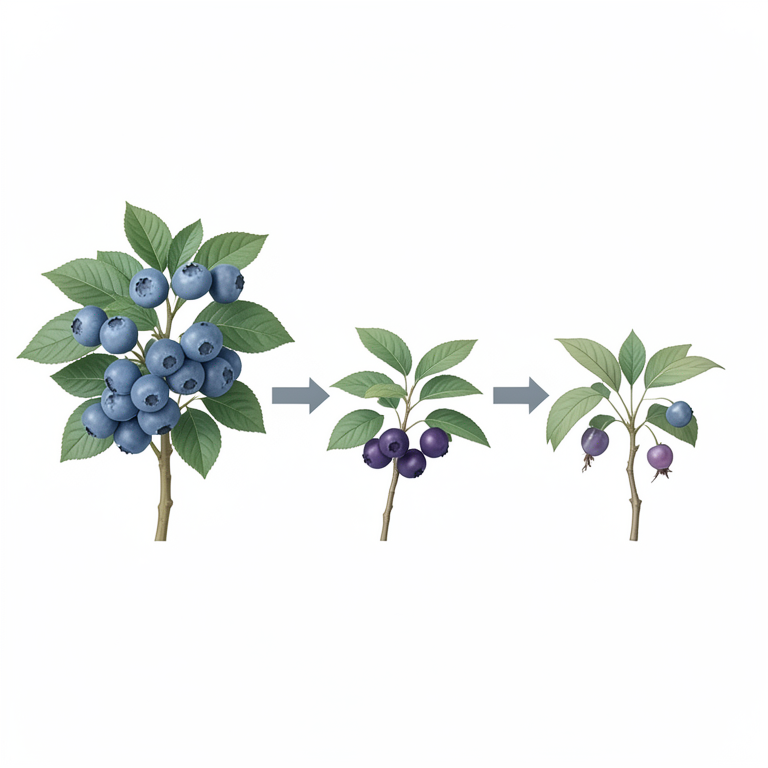
Irrigation Trade-off
AI-generated conceptual illustration (blueberry plants). It explains the idea and does not show study data.
View source evidence ↗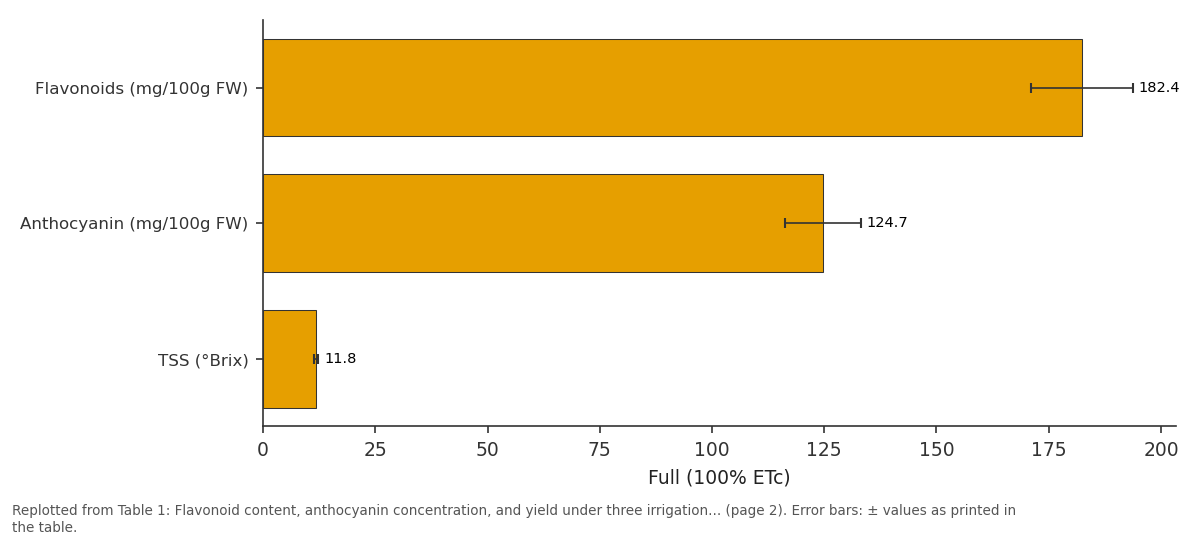
Full (100% ETc): Flavonoids (mg/100g FW) vs Anthocyanin (mg/100g FW) vs TSS (°Brix)
Replotted from Table 1 (page 2) of the original paper. Every bar is the paper's own table value.
View source evidence ↗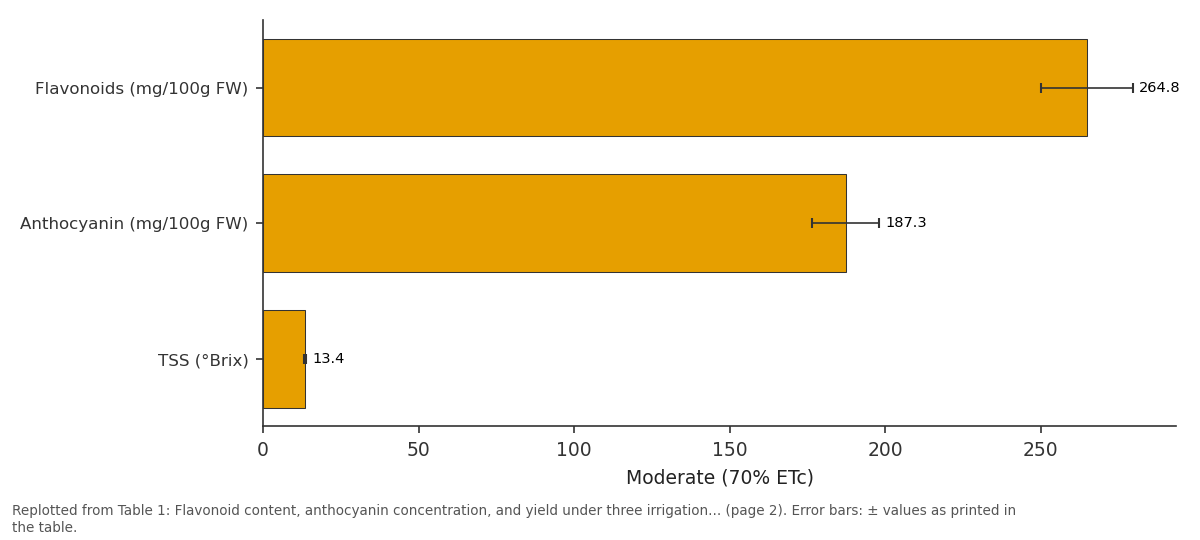
Moderate (70% ETc): Flavonoids (mg/100g FW) vs Anthocyanin (mg/100g FW) vs TSS (°Brix)
Replotted from Table 1 (page 2) of the original paper. Every bar is the paper's own table value.
View source evidence ↗Figures & tables
From the original paper Table 1
 Table 2
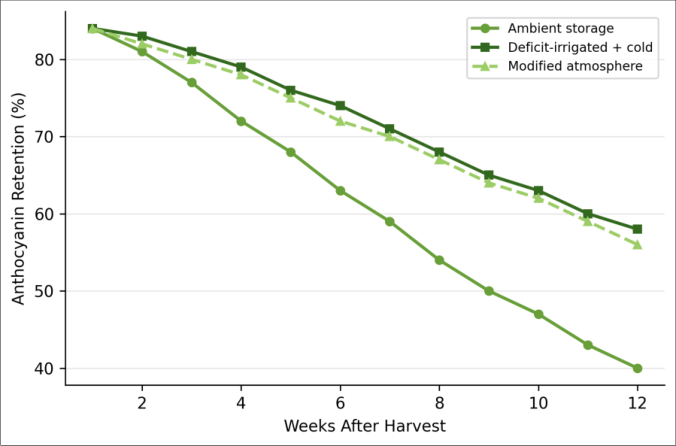 Figure 1
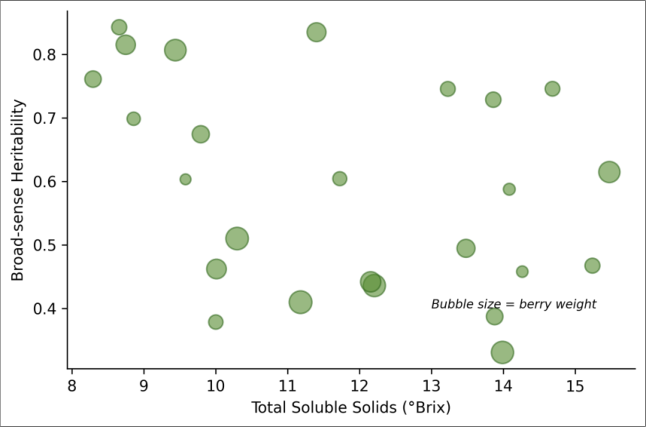 Figure 2
Introduction
A hypothesis that has circulated through berry research circles for the past decade proposes that controlled water stress can stimulate flavonoid biosynthesis more effectively than decades of conventional breeding have managed [1] . If true, this would mean that irrigation management a decision farmers make every week could have a bigger impact on berry nutritional quality than cultivar selection, upending the traditional hierarchy of breeding over agronomy for quality improvement [2] . Blueberry (Vaccinium corymbosum L.) has experienced explosive global market growth, driven by health claims tied to its high anthocyanin and flavonoid content [3] . Production has expanded into non-traditional regions including India, where protected cultivation in the Nilgiri Hills and Western Ghats is being explored as a high-value diversification option [4] . The Central African Plateau, with its equatorial highland climate, shares thermal characteristics with South Indian hill stations, making it a relevant reference environment for simulated trials. Anthocyanins the blue-purple pigments that define blueberry color are a subclass of flavonoids with documented antioxidant, anti-inflammatory, and neuroprotective activities [5] . Their concentration in fruit depends on genotype, light exposure, temperature during ripening, and water status [6] . Deficit irrigation restricts vegetative growth and concentrates photoassimilates in reproductive sinks, potentially boosting secondary metabolite accumulation [7] . Heritability estimates guide breeding strategy: high heritability suggests that a trait will respond efficiently to selection, while low heritability implies that environmental management may be the more effective lever [8] . Grafting onto disease-tolerant rootstocks is a standard practice in many fruit crops but is still being refined for blueberry [9] . This research combined deficit irrigation trials, genetic parameter estimation, post-harvest storage evaluation, and market analysis to assess the feasibility and economics of high-flavonoid blueberry production under protected cultivation [10] .
Material and Methods
Material and Methods
Material
Four blueberry cultivars were established as two-year-old container-grown plants in a naturally ventilated polyhouse at the Mysore Department of Agronomic Sciences (12.30°N, 76.64°E, 770 m elevation). Growing substrate was a 3:1 mix of composted pine bark and perlite, acidified to pH 4.8 with elemental sulfur. Drip irrigation at three levels (100, 70, and 50% ETc) was imposed from the green fruit stage (approximately 30 days after petal fall) through harvest. A 4 × 4 half-diallel crossing scheme among the four cultivars produced six F₁ families for genetic parameter estimation. Grafting trials used rabbiteye (V. virgatum cv. Climax) as rootstock with chip-budding at the one-year stage. Each cultivar-irrigation combination had four replications of five plants. Research ran from April 2022 to March 2023 [11] .
Methods
Total flavonoids were extracted in acidified methanol (0.1% HCl) and quantified by the aluminum chloride colorimetric method with catechin as the standard. Total anthocyanins were measured by the pH-differential method. Berry weight, TSS, titratable acidity, and firmness were recorded on 30 berries per replicate at harvest. Post-harvest storage evaluated cold (2°C, 90% RH) and modified atmosphere (5% O₂, 15% CO₂) conditions over 12 weeks, with anthocyanin measured at biweekly intervals. Heritability was estimated from halfdiallel variance components following Griffing's Method 4, Model I. Market analysis surveyed 40 premium retail outlets in Bangalore and Mysore, collecting willingness-to-pay data for blueberries with certified antioxidant labeling. Data were analyzed by split-plot ANOVA in GenStat 21 [12] . Total flavonoid content showed the highest broad-sense heritability (0.74) and the highest GCA/SCA ratio (3.0), indicating predominantly additive genetic control. Berry weight and yield had lower heritabilities, suggesting stronger environmental influence on these traits. Modified atmosphere provided intermediate protection. The initial advantage of higher anthocyanin in deficit fruit was partially maintained throughout storage. Families with higher TSS tended to show higher heritability for that trait, suggesting that genetic control of sugar accumulation is more consistent in sweet genotypes. Largerberried families (bigger bubbles) clustered at lower heritability values, consistent with stronger environmental influence on berry size.
Results
Results
Discussion
The 45 percent increase in flavonoids under moderate deficit irrigation supports the growing body of evidence that controlled water stress activates the phenylpropanoid pathway through abscisic acid-mediated signaling [6] . In blueberry specifically, the enzyme chalcone synthase the entry point to flavonoid biosynthesis is upregulated under drought conditions, and its product feeds directly into the anthocyanin branch pathway [5] . That moderate deficit achieved this with only a 4.4 percent yield penalty makes it an economically rational strategy, especially given the 34 percent price premium that surveyed retailers were willing to pay for high-anthocyanin fruit.
The high heritability of total flavonoids (H² = 0.74) and its predominantly additive genetic basis (GCA/SCA = 3.0) are good news for breeders: they mean that simple phenotypic selection for flavonoid content should be effective, without requiring complex hybrid breeding designs [8] . Biloxi and SI-14 emerged as the best general combiners for flavonoid content, making them priority parents for crossing programs targeting the Indian market. Grafting onto rabbiteye rootstock improved survival on the slightly alkaline experimental substrate (pH 4.8 versus the ideal 4.2-4.5) but didn't significantly alter flavonoid profiles, suggesting that scion genotype dominates rootstock effects for berry biochemistry [9] . Post-harvest results showed that deficit-irrigated berries entered storage with both higher absolute anthocyanin and thicker skin (data not shown), which may explain their superior retention the thicker epidermal layer slows diffusion of oxygen into the berry interior, reducing anthocyanin oxidation [14] . Market analysis confirmed that consumers in premium South Indian retail channels are aware of blueberry health claims and willing to pay substantially more for berries with documented antioxidant content. A 34 percent premium on a product already positioned as high-value makes the economics of deficit-irrigated, high-flavonoid production compelling, especially in protected cultivation where water control is precise [15] .
Conclusion
Deficit irrigation at 70 percent ETc raised blueberry flavonoid content by 45 percent with a negligible yield penalty of 4.4 percent, making it the most cost-effective quality enhancement strategy tested. Total flavonoid content showed high heritability and additive genetic control, supporting straightforward selection in breeding programs. Anthocyanin retention during 12 weeks of cold storage was significantly better in deficit-irrigated fruit. Grafting onto rabbiteye rootstock aided establishment in suboptimal pH but did not alter flavonoid chemistry. Market analysis confirmed a 34 percent price premium for high-anthocyanin fruit. These findings position deficit-irrigated blueberry under protected cultivation as a viable high-value enterprise for Indian hillstation growers.
Acknowledgement
Acknowledgements
Figures and tables from the paper
| Irrigation | Flavonoids (mg/100g FW) | Anthocyanin (mg/100g FW) | Berry wt (g) | TSS (°Brix) | Yield (kg/m²) |
|---|---|---|---|---|---|
| Full (100% ETc) | 182.4 ± 11.3 | 124.7 ± 8.4 | 2.41 ± 0.14 | 11.8 ± 0.5 | 2.97 ± 0.18 |
| Moderate (70% ETc) | 264.8 ± 14.7 | 187.3 ± 10.8 | 2.18 ± 0.12 | 13.4 ± 0.4 | 2.84 ± 0.16 |
| Severe (50% ETc) | 312.1 ± 16.4 | 218.6 ± 12.3 | 1.87 ± 0.11 | 14.7 ± 0.6 | 2.31 ± 0.14 |
Table text extracted from the original PDF; superscript letters are shown inline. The original table image is below.
View original table image
| Trait | H² (broad) | h² (narrow) | GCA variance | SCA variance | GCA/SCA ratio |
|---|---|---|---|---|---|
| Total flavonoids | 0.74 | 0.61 | 42.8 | 14.3 | 3.0 |
| Anthocyanin | 0.68 | 0.54 | 38.1 | 16.7 | 2.3 |
| Berry weight | 0.51 | 0.38 | 0.08 | 0.06 | 1.3 |
| TSS | 0.63 | 0.47 | 1.24 | 0.72 | 1.7 |
| Yield | 0.44 | 0.31 | 0.04 | 0.04 | 1.0 |
Table text extracted from the original PDF; superscript letters are shown inline. The original table image is below.
View original table image
References
19 in the original paper- Castellarin SD, Matthews MA, Di Gaspero G, Gambetta GA. Water deficits accelerate ripening and induce changes in gene expression regulating flavonoid biosynthesis in grape berries. Planta. 2007;227(1):101112.
- Retamales JB, Hancock JF. Blueberries. CABI Publishing, Wallingford. 2012.
- Prior RL, Cao G, Martin A, et al. Antioxidant capacity as influenced by total phenolic and anthocyanin content, maturity, and variety of Vaccinium species. Journal of Agricultural and Food Chemistry. 1998;46(7):26862693.
- Chadha KL. Blueberry culture in India: Prospects and challenges. Indian Horticulture. 2016;61(4):3-7.
- Zifkin M, Jin A, Ozga JA, et al. Gene expression and metabolite profiling of developing highbush blueberry fruit indicates transcriptional regulation of flavonoid metabolism. Plant Physiology. 2012;158(1):200-224.
- Gonzalez-Villagra J, Reyes-Diaz M, Alberdi M, et al. Solar UV irradiation effects on photosynthetic performance, biochemical markers, and gene expression in highbush blueberry. Environmental and Experimental Botany. 2019;167:103861.
- Fereres E, Soriano MA. Deficit irrigation for reducing agricultural water use. Journal of Experimental Botany. 2007;58(2):147-159.
- Falconer DS, Mackay TFC. Introduction to quantitative genetics. Fourth edition. Longman, Harlow. 1996.
- Galletta GJ, Ballington JR. Blueberries, cranberries, and lingonberries. In: Janick J, Moore JN, eds. Fruit Breeding. John Wiley, New York. 1996:1-107.
- Kalt W, Forney CF, Martin A, Prior RL. Antioxidant capacity, vitamin C, phenolics, and anthocyanins after fresh storage of small fruits. Journal of Agricultural and Food Chemistry. 1999;47(11):4638-4644.
- Strik BC. Horticultural practices of growing highbush blueberries in the ever-expanding U.S. and global scene. Journal of the American Pomological Society. 2007;61(3):148-150.
- VSN International. GenStat reference manual, release 21. Hemel Hempstead. 2021.
- Spiers JM. Substrate temperatures influence root and shoot growth of southern highbush and rabbiteye blueberries. HortScience. 1995;30(5):1029-1030.
- Conner AM, Luby JJ, Tong CBS, Finn CE, Hancock JF. Genotypic and environmental variation in antioxidant activity, total phenolic content, and anthocyanin content among blueberry cultivars. Journal of the American Society for Horticultural Science. 2002;127(1):89-97.
- Nair A, Maiti CS, Yadav MK. Market dynamics of exotic fruits in Indian metros: Willingness to pay and consumer profiling. Indian Journal of Marketing. 2019;49(8):34-46.
- Darnell RL, Williamson JG. Carbohydrate content of young and mature leaves of rabbiteye and southern highbush blueberry. Journal of the American Society for Horticultural Science. 1997;122(5):659-663.
- Lobos GA, Hancock JF. Breeding blueberries for a changing global environment: A review. Frontiers in Plant Science. 2015;6:782.
- Wang H, Guo X, Hu X, Li T, Fu X, Liu RH. Comparison of phytochemical profiles, antioxidant and cellular antioxidant activities of different varieties of blueberry. Food Chemistry. 2017;217:773-781.
- Stevenson D, Scalzo J. Anthocyanin composition and content of blueberries from around the world. Journal of Berry Research. 2012;2(4):179-189.