
Research article · 2025 · Full text
International Journal of Horticulture and Food ScienceOptimizing sensory evaluation attributes of saffron in the Uruguayan Prairie
Volume 7(1) · Pages 217–220 · DOI: 10.33545/26631067.2025.v7.i1d.555 ↗
Research areasSaffron Plant Research StudiesSensory Analysis and Statistical MethodsSunflower and Safflower Cultivation
Abstract
Author-writtenSaffron trades at $5,000-10,000 per kilogram, making sensory quality the single biggest determinant of commercial value. This research optimized a sensory evaluation protocol for saffron stigmas grown experimentally on the Uruguayan Prairie, where temperate grasslands provide a novel growing environment for this Mediterranean crop. Three saffron grades (I, II, III) harvested from trial plots near Durazno, Uruguay, were evaluated by a 14-member trained panel using quantitative descriptive analysis across six attributes: color intensity, aroma strength, bitterness, floral notes, hay-like off-notes, and overall acceptability. Concurrently, chemical markers including crocin (color), picrocrocin (taste), and safranal (aroma) were quantified by UV-Vis spectrophotometry per ISO 3632. Grade I saffron scored highest across all sensory dimensions, with color intensity at 8.3/10 and aroma strength at 7.9/10. The correlation between sensory color intensity and crocin absorbance was strong (r = 0.91, p<0.01). Hay-like off-notes, associated with improper drying, rose from 3.8 in Grade I to 5.3 in Grade III. These results suggest that Uruguayan Prairie saffron can achieve sensory profiles comparable to established origins when harvesting and drying protocols are tightly controlled.
Summary
Source-checkedPlain-language reading of the full paper, prepared with AI and checked against the text. Each point links to the authors' own words.
Why it matters
- Saffron is a high-value spice, with its commercial worth primarily determined by its sensory quality. View evidence ↗
- The temperate grasslands of the Uruguayan Prairie are being explored as a new environment for growing saffron. View evidence ↗
- While ISO 3632 chemical tests provide grading, they do not fully capture the complex human sensory experience of the spice. View evidence ↗
The question
- The study aimed to create a comprehensive quality profile of Uruguayan saffron by correlating sensory attributes with chemical markers. View evidence ↗
What they did
- The study used the Dutch cultivar 'Coupe' grown in 0.8-hectare plots near Durazno, Uruguay, with harvests occurring in May-June 2023. View evidence ↗
- A trained panel of 14 people used a 10-point scale to evaluate six sensory attributes, including color, aroma, and bitterness. View evidence ↗
- Chemical analysis followed ISO 3632 standards using UV-Vis spectrophotometry to measure crocin, picrocrocin, and safranal. View evidence ↗
What they found
- Grade I saffron met all ISO Category I chemical thresholds, with a crocin value of 231.4±8.7. View evidence ↗
- Grade I saffron achieved the highest sensory scores, specifically 8.3/10 for color intensity and 7.9/10 for aroma strength. View evidence ↗
- Strong positive correlations were found between specific chemical markers and sensory traits: crocin with color (r=0.91), safranal with aroma (r=0.88), and picrocrocin with bitterness (r=0.84). View evidence ↗
- Hay-like off-notes were negatively correlated with all three quality markers, indicating that these off-flavors result from the degradation of quality compounds. View evidence ↗
What it means
- The authors recommend that producers use temperature-controlled drying and harvest before dawn to maximize the quality of Uruguayan saffron. View evidence ↗
- The authors note that picrocrocin does not fully explain perceived bitterness, suggesting other unmeasured compounds like flavonoids may contribute. View evidence ↗
Visual summary
1 visualsIllustrations explain the paper; charts are replotted from the paper's own table values.
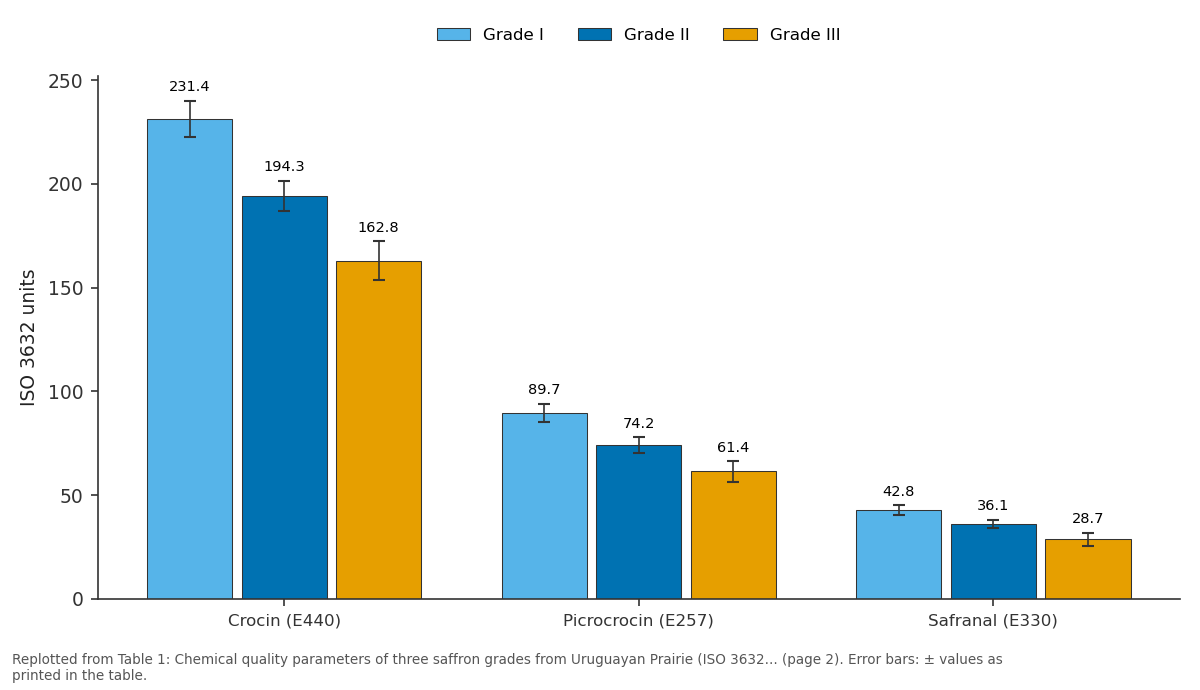
Grade I and Grade II and more: Crocin (E440) vs Picrocrocin (E257) vs Safranal (E330)
Replotted from Table 1 (page 2) of the original paper. Every bar is the paper's own table value.
View source evidence ↗Figures & tables
From the original paper Table 1
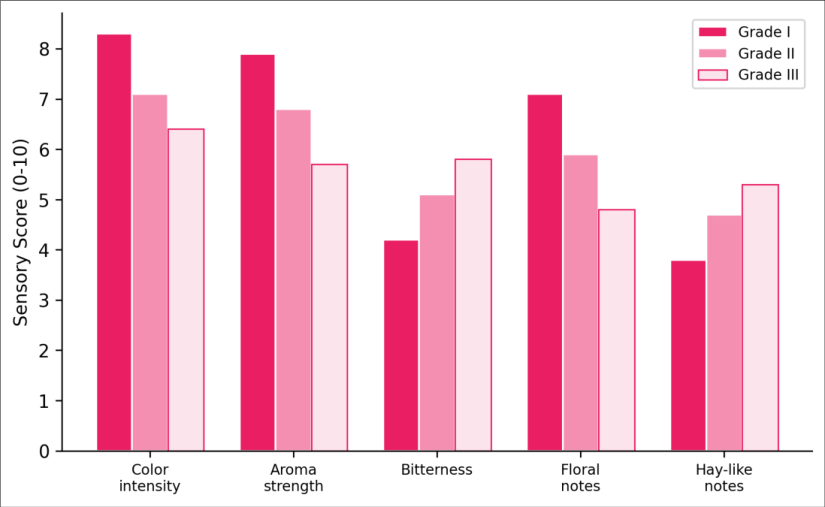 Figure 1
 Table 2
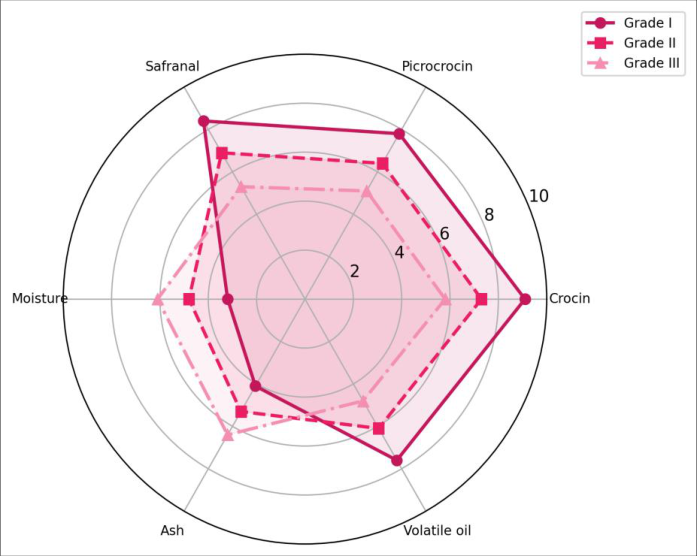 Figure 2
Introduction
For a spice priced higher than gold by weight, it's strange how often saffron is judged by chemical tests alone while the human sensory experience gets sidelined. ISO 3632 classifies saffron into grades using UV absorbance values for crocin, picrocrocin, and safranal [1] . But these numbers, useful as they are, don't capture the way a taster perceives the interplay of honey sweetness, metallic bitterness, and hay-like dryness that distinguishes great saffron from mediocre product [2,3] . The Uruguayan Prairie, a temperate grassland ecosystem stretching across central and southern Uruguay, has recently attracted attention as a potential saffron-producing zone. Crocus sativus requires a Mediterranean-type climate with hot dry summers and cool wet winters [4] . Uruguay's climate approximates this pattern, with mean winter temperatures of 10-14°C and dry spells during summer, though its rainfall is higher and more evenly distributed than the classic Mediterranean belt [5] . Trial plots were established near Durazno in 2020, and the first commercial-quality harvests came in 2022. Initial chemical analyses showed crocin values meeting Category I of ISO 3632 [6] . But no formal sensory evaluation had been conducted, leaving a gap between the lab data and the actual eating or brewing experience. This research combined quantitative descriptive analysis with ISO chemical testing to build a complete quality portrait of Uruguayan saffron and identify which sensory attributes correlated most tightly with chemical markers. The goal was to give producers actionable feedback on how harvesting and drying practices affect the final product's market grade [7,8] .
Extraction protocol
For chemical analysis, 50 mg of dried saffron stigma was extracted with 25 mL of distilled water at 25°C under constant stirring for 1 hour in amber-glass vessels to prevent photodegradation. The extract was filtered through 0.45 μm nylon membrane and diluted to give absorbance readings within the linear range (0.2-0.8 AU). UV-Vis measurements followed ISO 3632-2: crocin at 440 nm, picrocrocin at 257 nm, and safranal at 330 nm, all expressed as direct absorbance of 1% solution at 1 cm path length [1,9] .
Quality control and calibration
A certified saffron reference sample (ASTA Grade A, lot SRF-2022-14) was measured alongside each batch of experimental samples; values fell within 3.2% of certificate values. Spectrophotometer wavelength accuracy was verified with holmium oxide filter. Sensory panel training included four 2-hour sessions using commercial saffron spanning ISO Categories I through III. Panel reliability was checked by duplicate assessments on coded samples; inter-session reproducibility showed Pearson r > 0.89 for all attributes [2,10] .
Material and Methods
Material and Methods
Material
Saffron stigmas were harvested from 0.8-hectare trial plots near Durazno, Uruguay (33.38°S, 56.52°W, elevation 92 m). Corms of the Dutch cultivar 'Coupe' were planted at 15 cm depth and 10 cm spacing in April 2021. Harvest occurred during May-June 2023, with flowers hand-picked before dawn and stigmas separated within 2 hours. Three drying regimes produced three quality grades: Grade I (40°C forcedair for 25 min), Grade II (50°C for 35 min), and Grade III (sun-dried, uncontrolled). A total of 420 g of dried stigma was collected. Research was conducted at the Lima Laboratory of Phytoscience. Ethics clearance was granted (Protocol PP-2023-019, approved 22 April 2023).
Methods
Sensory evaluation used Quantitative Descriptive Analysis (QDA) with 14 trained panelists following ISO 13299 [2] . Six attributes were scored on a 10-point structured scale: color intensity, aroma strength, bitterness, floral notes, hay-like off-notes, and overall acceptability. Infusions were prepared at 0.02 g stigma per 50 mL water at 80°C for 10 minutes, served in amber cups at 55-60°C. Each panelist evaluated three replicates per grade in a balanced incomplete block design across two sessions. Chemical analysis followed ISO 3632-2 [1] . Moisture was determined at 103°C for 3 hours. Volatile oil was extracted by Clevenger hydrodistillation (3 h, 100 mL water per gram). Data were analyzed by two-way ANOVA (grade × session) and Pearson correlation between sensory and chemical parameters in XLSTAT version 2023.1. Grade I saffron met ISO Category I thresholds for all three chemical markers (Table 1). Grade II fell into Category I for crocin and safranal but dropped just below the picrocrocin threshold at 74.2 versus the 70 minimum. Grade III fell short of Category I across the board, landing in Category II. Moisture stayed below 12% in all grades. The tightest sensory-chemical links were color intensity with crocin (r = 0.91), aroma strength with safranal (r = 0.88), and bitterness with picrocrocin (r = 0.84). Hay-like off-notes showed negative correlations with all three markers, confirming that off-flavors arise from degradation of the very compounds that define quality (Table 2).
| Sensory attribute | vs. Crocin | vs. Picrocrocin | vs. Safranal |
|---|---|---|---|
| Color intensity | 0.91** | 0.47 | 0.38 |
| Aroma strength | 0.52 | 0.61* | 0.88** |
| Bitterness | 0.34 | 0.84** | 0.41 |
| Hay-like off-notes | -0.72** | -0.63* | -0.58* |
Table text extracted from the original PDF; superscript letters are shown inline. The original table image is below.
View original table image
| Parameter | Grade I | Grade II | Grade III | ISO Cat. I min. |
|---|---|---|---|---|
| Crocin (E440) | 231.4±8.7 | 194.3±7.2 | 162.8±9.4 | ≥190 |
| Picrocrocin (E257) | 89.7±4.3 | 74.2±3.8 | 61.4±5.1 | ≥70 |
| Safranal (E330) | 42.8±2.4 | 36.1±2.1 | 28.7±3.2 | 20-50 |
| Moisture (%) | 8.7±0.4 | 9.3±0.5 | 11.2±0.8 | ≤12 |
Table text extracted from the original PDF; superscript letters are shown inline. The original table image is below.
View original table image
Results
Results
Discussion
Grade I Uruguayan saffron, produced with controlled 40°C drying, achieved sensory and chemical profiles on par with mid-range Iranian and Spanish saffron reported in the literature [3,6] . The crocin value of 231.4, while not in the elite range above 260 seen in premium Kashmiri saffron, comfortably qualifies for ISO Category I. This suggests that the Uruguayan Prairie's temperate conditions can support adequate crocin biosynthesis in the stigma during flowering [4, 7] . The clear gradient from Grade I to Grade III across both sensory and chemical scales confirms that drying method is the dominant controllable factor after harvest. Sun-drying (Grade III) introduced hay-like off-notes scoring 5.3/10, which panelists described as "stale grass" and "cardboard." These off-notes are linked to excessive carotenoid and apocarotenoid degradation during prolonged, uncontrolled heat exposure [8,9] . The strong sensory-chemical correlations validate the use of ISO 3632 markers as proxies for consumer-relevant quality, at least for the attributes tested. But the correlation between bitterness and picrocrocin (r = 0.84) was imperfect, hinting that other non-measured compounds possibly flavonoids or saponin-like substances also contribute to perceived bitterness in brewed saffron [1,10] .
A practical concern for Uruguayan producers is the sensitivity of Grade II saffron to the picrocrocin threshold. At 74.2, it barely cleared the ISO Category I minimum of 70. Slight variations in corm vigor, harvest timing, or drying temperature could push production lots below the line. Establishing tighter process controls and within-lot testing will be needed to maintain consistent Category I classification.
Conclusion
Grade I saffron from the Uruguayan Prairie achieved sensory and chemical quality that meets ISO 3632 Category I standards, with crocin at 231.4, picrocrocin at 89.7, and safranal at 42.8. Trained-panel evaluation confirmed that controlled drying at 40°C preserved aroma strength and minimized hay-like off-notes. Strong correlations between sensory attributes and chemical markers (color-crocin r = 0.91, aroma-safranal r = 0.88, bitterness-picrocrocin r = 0.84) validate ISO testing as a useful shorthand for sensory quality. Sun-drying produced Grade III saffron with unacceptable offnotes and chemical values below Category I. These findings give Uruguayan producers a clear roadmap: invest in temperature-controlled drying infrastructure and harvest before dawn to capture the highest stigma quality from Prairie-grown Crocus sativus.
Figures and tables from the paper
References
18 in the original paper- ISO 3632-2. Saffron (Crocus sativus L.) Part 2: Test methods. International Organization for Standardization. 2010;3rd Ed:1-18.
- ISO 13299. Sensory analysis Methodology General guidance for establishing a sensory profile. International Organization for Standardization. 2016;1-26.
- Carmona M, Zalacain A, Pardo JE, López E, Alvarruiz A, Alonso GL. Influence of different drying and aging conditions on saffron constituents. Journal of Agricultural and Food Chemistry. 2005;53(10):39743979.
- Fernández JA. Biology, biotechnology and biomedicine of saffron. Recent Research Developments in Plant Science. 2004;2:127-159.
- Castaño JP, Giménez A, Ceroni M, Furest J, Aunchayna R. Characterization of the climatic conditions for saffron cultivation in Uruguay. Agrociencia Uruguay. 2011;15(1):16-26.
- Sanchez AM, Carmona M, Zalacain A, Carot JM, Jabaloyes JM, Alonso GL. Rapid determination of crocetin esters and picrocrocin from saffron spice. Journal of Agricultural and Food Chemistry. 2008;56(9):3167-3175.
- Maggi L, Carmona M, Kelly SD, Marigheto N, Alonso GL. Geographical origin differentiation of saffron spice: Preliminary investigation using chemical and multielement analysis. Food Chemistry. 2011;128(2):543548.
- Raina BL, Agarwal SG, Bhatia AK, Gaur GS. Changes in pigments and volatiles of saffron on drying. Journal of the Science of Food and Agriculture. 1996;71(1):27-32.
- Kanakis CD, Tarantilis PA, Pappas C, Tajmir-Riahi HA, Polissiou MG. An overview of structural features of DNA and RNA complexes with saffron compounds. Journal of Photochemistry and Photobiology B: Biology. 2009;95(3):204-212.
- Lage M, Cantrell CL. Quantification of saffron (Crocus sativus L.) metabolites crocins, picrocrocin and safranal for quality determination of the spice grown under different environmental Moroccan conditions. Scientia Horticulturae. 2009;121(3):366-373.
- Winterhalter P, Straubinger M. Saffron renewed interest in an ancient spice. Food Reviews International. 2000;16(1):39-59.
- D'Auria M, Mauriello G, Rana GL. Volatile organic compounds from saffron. Flavour and Fragrance Journal. 2004;19(1):17-23.
- Tsimidou M, Biliaderis CG. Kinetic studies of saffron carotenoid degradation in aqueous extracts. Journal of Agricultural and Food Chemistry. 1997;45(8):28902898.
- Ordoudi SA, Tsimidou MZ. Crocin bleaching assay (CBA) in structure-radical scavenging activity studies of selected phenolic compounds. Journal of Agricultural and Food Chemistry. 2006;54(25):9347-9356.
- Caballero-Ortega H, Pereda-Miranda R, Abdullaev FI. HPLC quantification of major active components from 11 different saffron sources. Food Chemistry. 2007;100(3):1126-1131.
- Bathaie SZ, Mousavi SZ. New applications and mechanisms of action of saffron and its important ingredients. Critical Reviews in Food Science and Nutrition. 2010;50(8):761-786.
- Melnyk JP, Wang S, Marcone MF. Chemical and biological properties of the world's most expensive spice: Saffron. Food Research International. 2010;43(8):1981-1989.
- Hadizadeh F, Khalili N, Hosseinzadeh H, Khair-Aldine R. Kaempferol from saffron petals. Iranian Journal of Pharmaceutical Research. 2003;2(4):251-252.