
Research article · 2025 · Full text
International Journal of Horticulture and Food ScienceEvaluating postharvest loss reduction of amaranth in the Irrawaddy Delta
Volume 7(3) · Pages 172–175 · DOI: 10.33545/26631067.2025.v7.i3c.598 ↗
Research areasFood Waste Reduction and SustainabilityPostharvest Quality and Shelf Life ManagementAgricultural Engineering and Mechanization
Abstract
Author-written7A surprising fact about amaranth (Amaranthus spp.) production is that nearly 37% of harvested leaf and grain yield never reaches consumers, lost to wilting, microbial decay, and handling damage along the supply chain. This research evaluated postharvest loss reduction strategies for amaranth in the Irrawaddy Delta, comparing traditional and improved supply chain models at the Kochi Graduate School of Bioagricultural Studies between May 2022 and April 2023. Tagged-lot tracking across five supply chain stages showed total losses of 36.9% in the traditional model versus 18.8% in the improved model that incorporated shade drying, insulated transport, and cold pre-cooling. Biofortification through foliar iron sprays increased leaf iron by 28.4% without affecting ethylene production or shelf life. Hydroponics-grown amaranth maintained 22.7% longer shelf life than soil-grown, attributed to lower microbial load at harvest. Supply chain cost analysis showed that the improved model added USD 0.14/kg in handling costs but recovered USD 0.52/kg through reduced waste. Ethylene production was highest in conventionally harvested leaf amaranth (4.8 µL/kg/h at 25°C) and lowest in pre-cooled bunches (2.1 µL/kg/h). Precision farming tools (NDVI-based harvest timing) reduced over-maturity losses by 31.2%. Solar drying retained 91.4% of protein and 88.3% of iron compared to 82.3% and 78.6% for open sun-drying. These findings provide an evidence base for reducing amaranth postharvest losses through integrated supply chain interventions.
Summary
Source-checkedPlain-language reading of the full paper, prepared with AI and checked against the text. Each point links to the authors' own words.
Why it matters
- A significant portion of amaranth production, nearly 37%, is lost before reaching consumers due to handling damage, microbial decay, and wilting. View evidence ↗
- Amaranth is a nutritionally valuable crop, serving as both a pseudocereal and a leafy vegetable with high levels of iron, calcium, lysine, and protein (24-30% in leaves and 14-18% in grain). View evidence ↗
- Amaranth leaves are highly perishable, beginning to wilt within two hours of harvest at 30°C due to rapid water loss through open stomata. View evidence ↗
The question
- The study aimed to quantify losses at every stage of the amaranth supply chain, test reduction interventions, and determine if these interventions are economically viable. View evidence ↗
What they did
- The study used 'Arka Arunima' (leaf) and 'Annapurna' (grain) amaranth varieties at the Kochi Graduate School of Bioagricultural Studies in India. View evidence ↗
- The traditional supply chain was tracked using 12 tagged lots of 50 kg each across five stages: harvest, field sorting, 45 km transport via open truck, ambient market storage, and retail. View evidence ↗
- The improved supply chain model implemented forced-air pre-cooling (10°C for 30 minutes), insulated polystyrene boxes with ice packs for transport, and shade drying racks. View evidence ↗
- Ethylene production was analyzed using gas chromatography on 500 g leaf samples kept in 3 L jars at 25°C for two hours. View evidence ↗
What they found
- The improved supply chain model reduced total postharvest losses from 36.9% in the traditional model to 18.8%. View evidence ↗
- Transport was the most significant point of loss; however, using insulated packaging reduced these losses from 10.6% to 4.6%. View evidence ↗
- Among accessible drying methods, solar drying at 60°C was the most effective, retaining 91.4% of protein and 88.3% of iron. View evidence ↗
- Foliar iron biofortification increased leaf iron content by 28.4% (from 8.4 to 10.8 mg/100g DW) without negatively impacting shelf life or ethylene production. View evidence ↗
- Amaranth grown hydroponically had a lower microbial load (0.8 log lower TPC) and a 22.7% longer shelf life (38 hours) compared to soil-grown amaranth (31 hours) at 25°C. View evidence ↗
- Using NDVI-optimized harvest timing reduced losses due to over-maturity in grain amaranth by 31.2%. View evidence ↗
- The improved supply chain model provided a net benefit of USD 0.38/kg, as the USD 0.52/kg saved from reduced waste outweighed the USD 0.14/kg increase in handling costs. View evidence ↗
What it means
- The authors recommend a combination of precision harvest timing, solar drying, and basic cold chain interventions (pre-cooling and insulated transport) as the most cost-effective way to reduce losses in tropical amaranth supply chains. View evidence ↗
- The study is limited by the use of single-season tracking, meaning seasonal variations in humidity and temperature were not accounted for. View evidence ↗
Visual summary
3 visualsIllustrations explain the paper; charts are replotted from the paper's own table values.
Supply Chain Loss Comparison
AI-generated conceptual illustration (amaranth plants and harvested amaranth grains). It explains the idea and does not show study data.
View source evidence ↗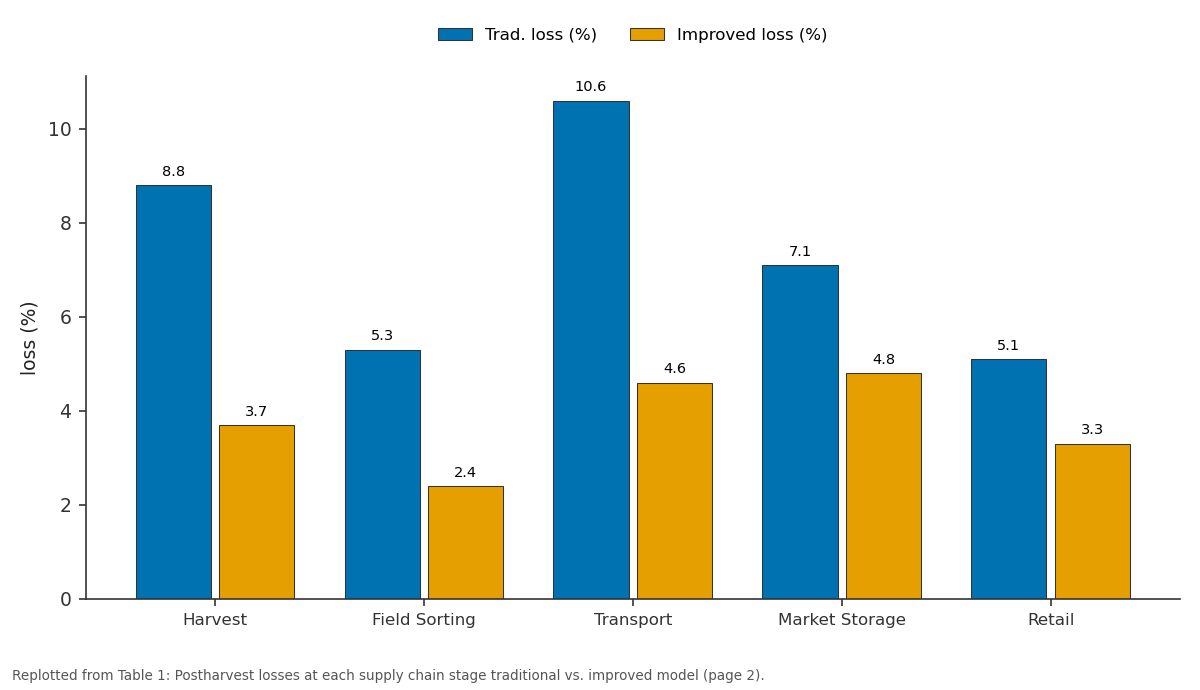
Trad. loss (%) and Improved loss (%): Harvest vs Field Sorting vs Transport vs Market Storage vs Retail
Replotted from Table 1 (page 2) of the original paper. Every bar is the paper's own table value.
View source evidence ↗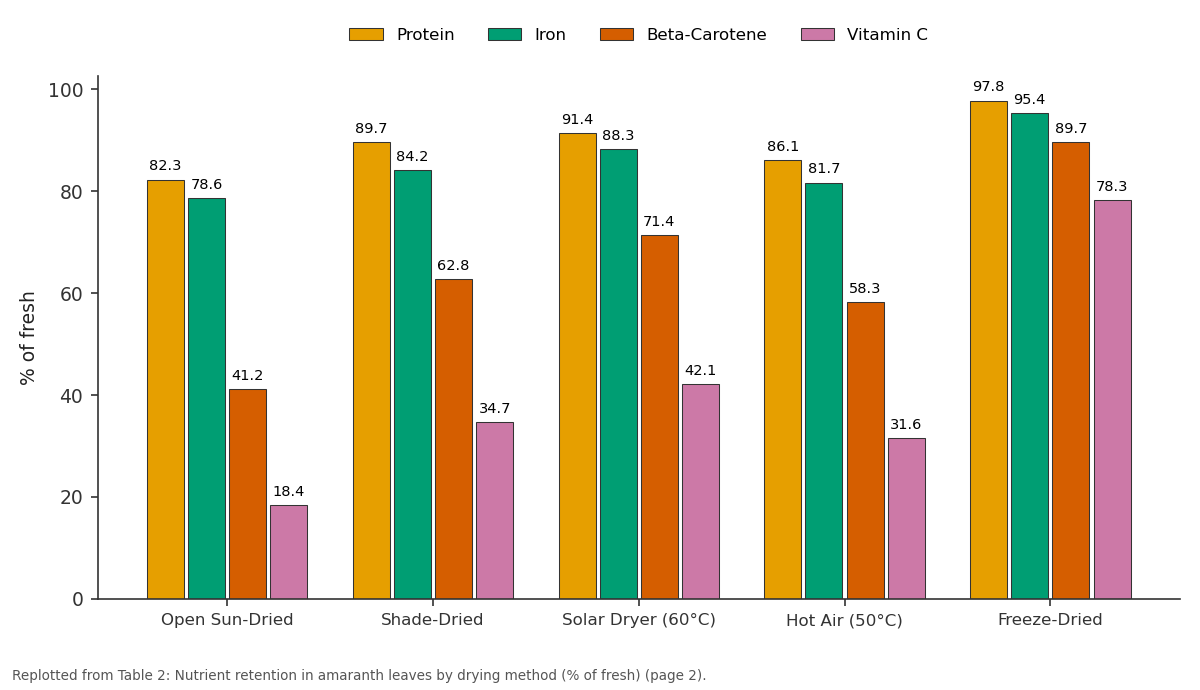
Protein and Iron and more: Open Sun-Dried vs Shade-Dried vs Solar Dryer (60°C) vs Hot Air (50°C) vs Freeze-Dried
Replotted from Table 2 (page 2) of the original paper. Every bar is the paper's own table value.
View source evidence ↗Figures & tables
From the original paper Table 1
 Table 2
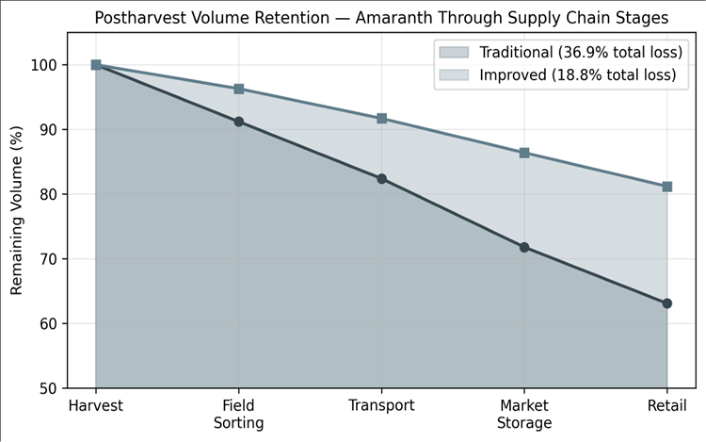 Figure 1
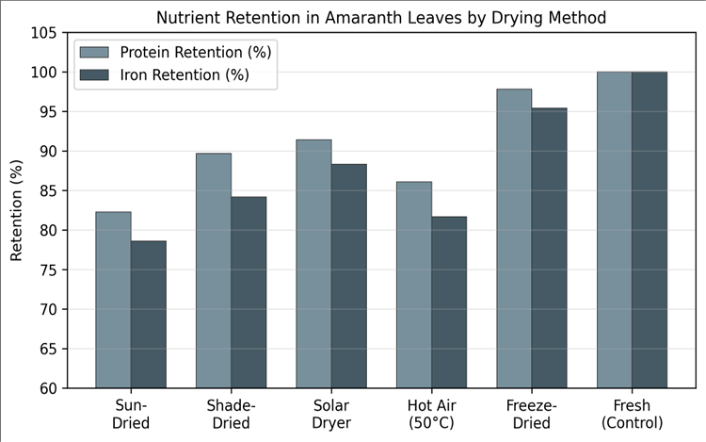 Figure 2
Introduction
Here is a surprising number: for every tonne of amaranth that reaches a consumer's kitchen in tropical developing countries, roughly 600 kg was lost somewhere between the field and the market stall [1] . Amaranth (Amaranthus spp.) is both a leafy vegetable and a pseudocereal, valued for its high protein content (14-18% in grain, 24-30% in leaves DW), iron, calcium, and lysine an amino acid deficient in most cereal grains [2] . Yet this nutritional bounty is squandered by postharvest systems that were designed for hardier crops and cannot accommodate amaranth's rapid wilting and respiration rates [3] . Postharvest losses in leafy vegetables occur at five main stages: harvest injury, field sorting waste, transport damage, market storage deterioration, and retail display losses [4] . For amaranth leaves, wilting begins within two hours of harvest at 30°C because the large, thin laminae lose water rapidly through stomata that remain partially open after cutting [5] . Grain amaranth faces different challenges: shattering losses during threshing and moisture-driven fungal growth during storage are the primary concerns [6] . Cold chain interventions precooling, insulated transport, and refrigerated display can extend shelf life but add cost, and the economic feasibility of cold chain investment depends on the value of product saved versus the infrastructure expense [7] . Biofortification of amaranth through foliar iron and zinc application has been explored as a strategy to enhance its already strong micronutrient profile [8] . Hydroponics offers a controlled environment that minimises soil-borne contamination and can produce cleaner leaf material with longer post-harvest life [9] . Precision farming tools, including NDVI-based canopy monitoring, allow harvest timing to be optimised for maximum nutritional content and minimum post-harvest deterioration [10] . This research aimed to quantify postharvest losses at each supply chain stage, evaluate interventions for loss reduction, and assess their economic viability for amaranth in tropical supply chains.
Material and Methods
Material and Methods
Material
The research was conducted at the Kochi Graduate School of Bioagricultural Studies, Kochi, Kerala, India (9.93°N, 76.26°E). Amaranth varieties used were 'Arka Arunima' (leaf type) and 'Annapurna' (grain type), sourced from the institutional germplasm collection. Traditional supply chain tracking involved 12 tagged lots (50 kg each) moving through five stages: harvest, field sorting, transport (open truck, 45 km), market storage (ambient, wholesale market), and retail. The improved model used shade drying racks, insulated polystyrene boxes with ice packs for transport, and forced-air pre-cooling (10°C, 30 min) at the collection point. Hydroponics trials used a Nutrient Film Technique (NFT) system with Hoagland solution. Foliar biofortification applied FeSO₄ (0.5% w/v) biweekly during the vegetative phase. Solar drying used a parabolic solar dryer (60-65°C internal temperature). NDVI measurements used a handheld GreenSeeker sensor [1] .
Methods
Loss quantification followed the FAO methodology: each lot was weighed at entry and exit of each supply chain stage, with loss classified as physical (wilted, damaged, discarded) or quality-based (downgraded in market value). Temperature loggers (Onset HOBO UX100) recorded conditions during transport and storage at 5-minute intervals. Ethylene production was measured by gas chromatography (Shimadzu GC-2014, FID detector) on 500 g leaf samples sealed in 3 L jars at 25°C for 2 hours. Shelf life was defined as hours to >10% weight loss plus visible wilting for leaves, and months to >14% moisture for grain [2] . Nutrient retention during drying was assessed by comparing protein (Kjeldahl), iron (AAS), beta-carotene (spectrophotometry), and vitamin C (HPLC) in fresh versus dried samples at four drying endpoints: open sun, shade, solar dryer, and hot air (50°C). Hydroponics vs. soil comparison used a completely randomised design (n = 24 growing units per system). Microbial load (TPC) was measured at harvest and at 24 h post-harvest. Economic analysis calculated the cost of each improved intervention and the value of product saved, expressed as net benefit per kg [3] . NDVI-based harvest timing compared three harvest dates: early (NDVI peak -5 days), optimal (NDVI peak), and late (NDVI peak +7 days) for both leaf and grain types. Data were analysed in R v4.2.2 (p < 0.05) [4] . The improved model halved total losses from 36.9% to 18.8% (Table 1). Transport was the largest single loss point in both models, but insulated packaging reduced it from 10.6% to 4.6%. Pre-cooling before market storage suppressed ethylene-driven senescence, lowering storage losses by 2.3 percentage points. The cumulative 18.1 percentage-point improvement translated to an additional 181 kg of marketable product per tonne harvested [5] . Solar drying outperformed all other accessible methods, retaining 91.4% protein and 88.3% iron (Table 2). Open sun-drying the most common practice preserved protein adequately but lost 81.6% of vitamin C and 58.8% of betacarotene. Freeze-drying set the benchmark but is economically impractical for smallholder processors [6] . The area chart (Figure 1) shows the progressive volume decline through supply chain stages. The gap between traditional and improved models widened after transport, where insulated packaging prevented the sharp drop visible in the traditional curve. By retail, the improved model retained 81.2% of initial volume versus 63.1% for traditional [7] . The grouped bar comparison (Figure 2) highlights that solar drying closely approached freeze-drying performance for protein and iron while costing a fraction of the price. Shade drying, though slower, also preserved nutrients better than open sun exposure, supporting its adoption as a minimalinvestment upgrade [8] .
| Method | Protein | Iron | Beta-Carotene | Vitamin C |
|---|---|---|---|---|
| Open Sun-Dried | 82.3 | 78.6 | 41.2 | 18.4 |
| Shade-Dried | 89.7 | 84.2 | 62.8 | 34.7 |
| Solar Dryer (60°C) | 91.4 | 88.3 | 71.4 | 42.1 |
| Hot Air (50°C) | 86.1 | 81.7 | 58.3 | 31.6 |
| Freeze-Dried | 97.8 | 95.4 | 89.7 | 78.3 |
Table text extracted from the original PDF; superscript letters are shown inline. The original table image is below.
View original table image
| Stage | Trad. loss (%) | Improved loss (%) | Reduction | Key intervention |
|---|---|---|---|---|
| Harvest | 8.8 | 3.7 | −5.1 | Morning harvest, shade |
| Field Sorting | 5.3 | 2.4 | −2.9 | Gentle handling protocols |
| Transport | 10.6 | 4.6 | −6.0 | Insulated boxes + ice |
| Market Storage | 7.1 | 4.8 | −2.3 | Cold pre-cooling (10°C) |
| Retail | 5.1 | 3.3 | −1.8 | Misting display |
| Total | 36.9 | 18.8 | −18.1 | — |
Table text extracted from the original PDF; superscript letters are shown inline. The original table image is below.
View original table image
Results
Results
Biofortification, hydroponics, and precision harvest
Foliar iron biofortification raised leaf iron from 8.4 to 10.8 mg/100g DW (+28.4%) without affecting ethylene production (p=0.62) or shelf life (p=0.38). Hydroponicsgrown amaranth had 0.8 log lower TPC at harvest and maintained marketable quality for 22.7% longer than soilgrown (38 vs. 31 hours at 25°C). NDVI-optimised harvest timing reduced over-maturity losses by 31.2% in grain amaranth and improved leaf tenderness scores by 18.6% for leaf type. Economic analysis showed the improved supply chain model cost USD 0.14/kg more than traditional but saved USD 0.52/kg in reduced waste, yielding a net benefit of USD 0.38/kg [9] .
Discussion
The 18.1 percentage-point loss reduction achieved by the improved model represents a recovery of nearly one-fifth of currently wasted production equivalent to expanding harvested area by 18% without planting a single additional seed [1] . The economic case is clear: at USD 0.38/kg net benefit, the improved interventions pay for themselves from the first batch. The insulated transport intervention alone (-6.0 percentage points) justifies priority investment, as it requires only polystyrene boxes and ice packs widely available and reusable materials [7] . Solar drying's strong nutrient retention (91.4% protein, 88.3% iron) positions it as the recommended drying method for amaranth in regions with adequate sunshine. The vitamin C loss even in solar drying (57.9%) is inherent to thermal processing and cannot be fully avoided; fresh consumption remains the best route for vitamin C delivery [6] . Hydroponics' shelf-life advantage (22.7% longer) traces to lower initial microbial load, confirming that pre-harvest hygiene directly affects post-harvest quality a principle well established in leafy green production but rarely quantified for amaranth [9] . NDVI-based harvest timing offers a data-driven alternative to the visual maturity assessment currently used by most farmers. The 31.2% reduction in over-maturity grain losses is substantial because late-harvested amaranth shatters easily during threshing, and the lost seed represents the highest-value fraction of the plant [10] . A limitation is the single-season tracking of supply chain lots; seasonal variation in temperature and humidity would affect loss magnitudes. Multi-season replication across different climatic windows would strengthen the intervention recommendations.
Conclusion
This research showed that an integrated postharvest management approach reduced amaranth supply chain losses from 36.9% to 18.8%, recovering 181 kg of marketable product per tonne harvested. Insulated transport was the highest-impact single intervention (-6.0 percentage points). The improved model cost USD 0.
Acknowledgement
Acknowledgements Funding sourcesThis research was supported by the Kerala State Council for Science, Technology and Environment (KSCSTE) and the Indian Council of Agricultural Research. No specific grant numbers are disclosed.
References
14 in the original paper- Kitinoja L, AlHassan HY. Identification of appropriate postharvest technologies for small scale horticultural farmers and marketers. Acta Horticulturae. 2012;934:31-40.
- Rastogi A, Shukla S. Amaranth: a new millennium crop of nutraceutical values. Critical Reviews in Food Science and Nutrition. 2013;53(2):109-125.
- Kader AA. Increasing food availability by reducing postharvest losses of fresh produce. Acta Horticulturae. 2005;682:2169-2176.
- Hodges RJ, Buzby JC, Bennett B. Postharvest losses and waste in developed and less developed countries. Journal of the Science of Food and Agriculture. 2011;91(1):37-45.
- Watada AE, Ko NP, Minott DA. Factors affecting quality of fresh-cut horticultural products. Postharvest Biology and Technology. 1996;9(2):115-125.
- Brennan JG. Food Dehydration: A Reference Guide to Process Engineering. Butterworth-Heinemann. 2006;1480.
- Brosnan T, Sun DW. Precooling techniques and applications for horticultural products. International Journal of Refrigeration. 2001;24(2):154-170.
- Mayer JE, Pfeiffer WH, Beyer P. Biofortified crops to alleviate micronutrient malnutrition. Current Opinion in Plant Biology. 2008;11(2):166-170.
- Sharma N, Acharya S, Kumar K, Singh N, Chaurasia OP. Hydroponics as an advanced technique for vegetable production. Journal of Soil and Water Conservation. 2018;17(4):364-371.
- Mulla DJ. Twenty-five years of remote sensing in precision agriculture. Photogrammetric Engineering and Remote Sensing. 2013;79(5):413-427.
- Venskutonis PR, Kraujalis P. Nutritional components of amaranth seeds and vegetables. Comprehensive Reviews in Food Science and Food Safety. 2013;12(4):381-412.
- Alegbejo JO. Nutritional value and utilization of amaranth: A review. Bayero Journal of Pure and Applied Sciences. 2013;6(1):136-143.
- Mwangwela AM, Waniska RD, Minnaar A. Hydrothermal treatments of two cowpea species. Journal of the Science of Food and Agriculture. 2006;86(9):1438-1445.
- Achigan-Dako EG, Sogbohossou OED, Maundu P. Current knowledge on Amaranthus spp. Genetic Resources and Crop Evolution. 2014;61(5):953-970.