
Research article · 2024 · Full text
International Journal of Horticulture and Food ScienceQuantifying root morphology of garlic in the Atacama coastal zone
Volume 6(2) · Pages 176–179 · DOI: 10.33545/26631067.2024.v6.i2c.539 ↗
Research areasGarlic and Onion StudiesPlant Growth and Agriculture TechniquesShallot Cultivation and Analysis
Abstract
Author-writtenIt seems paradoxical that garlic a crop so dependent on soil conditions has had its root system studied so little compared with its above-ground parts. This research quantified root morphology across four soil depths in three garlic cultivars Yamuna Safed-3, Godavari, and G-282 grown in containers simulating Atacama coastal zone soils at the Patna Foundation for Pomological Research, India, from September 2022 to March 2023. Root length density declined sharply below 20 cm, dropping from 8.7 cm/cm³ at 0-10 cm to 2.3 cm/cm³ at 30-40 cm. Mean root diameter increased with depth, from 0.84 mm near the surface to 1.18 mm at the deepest layer, suggesting functional specialization between absorptive fine roots above and transport-oriented coarse roots below. Allicin, the main organosulfur compound in garlic, reached 4.21 mg/g in the surface root zone and declined with depth. HPLC profiling identified 12 sulfur-containing compounds in bulb tissue, with allicin accounting for 34.2 percent of total organosulfur content. Heat stress applied during the bulbing phase reduced bulb weight by 18 percent but raised allicin concentration by 11 percent. Chlorophyll content, measured by SPAD meter, correlated moderately with leaf sulfur uptake (r=0.54). Rainwater harvesting supplemented irrigation needs by 23 percent. Gene action analysis using a 6 × 6 half-diallel indicated significant additive variance for bulb weight and non-additive variance for allicin content.
Summary
Source-checkedPlain-language reading of the full paper, prepared with AI and checked against the text. Each point links to the authors' own words.
Why it matters
- Garlic has a shallow, fibrous root system with most of its absorption happening in the top 15 cm of soil, making it highly sensitive to surface conditions like salinity and moisture. View evidence ↗
- The pungent flavor and medicinal properties of garlic are derived from organosulfur compounds, most notably allicin. View evidence ↗
- In coastal desert regions where groundwater is often too saline for direct use, rainwater harvesting can serve as a useful supplement for irrigation. View evidence ↗
The question
- The study aimed to quantify how garlic roots are distributed by depth and how this relates to bulb sulfur chemistry under the influence of heat stress, water management, and genetics. View evidence ↗
What they did
- Three garlic cultivars (Yamuna Safed-3, Godavari, and G-282) were grown in containers simulating Atacama coastal zone soils in India from September 2022 to March 2023. View evidence ↗
- Heat stress was applied at the six-leaf stage for 14 days at 38/28°C (day/night), while control plants were kept at 25/15°C. View evidence ↗
- At harvest, root length density, mean diameter, and dry weight were measured across four soil depth intervals ranging from 0 to 40 cm. View evidence ↗
- A 6 × 6 half-diallel crossing block was used, incorporating the three main cultivars and three advanced breeding lines to analyze gene action. View evidence ↗
What they found
- Root length density dropped by 74%, falling from 8.7 ± 0.6 cm/cm³ in the 0-10 cm layer to 2.3 ± 0.3 cm/cm³ in the 30-40 cm layer. View evidence ↗
- HPLC analysis identified 12 sulfur compounds in the bulbs, with allicin being the most dominant at 34.2%, followed by diallyl disulfide (26.8%) and S-allylcysteine (18.7%). View evidence ↗
- Heat stress during the bulbing phase created a trade-off, reducing bulb weight by 18% while increasing allicin concentration by 11%. View evidence ↗
- Rainwater harvesting provided 23% of the total irrigation water required for the plants. View evidence ↗
- Genetic analysis showed that bulb weight is controlled by additive variance (GCA), whereas allicin content is controlled by non-additive variance (SCA). View evidence ↗
What it means
- The authors recommend that soil management, including irrigation and fertilization, should be focused on the top 0-20 cm of soil where root activity is highest. View evidence ↗
- The authors conclude that while larger bulbs can be bred through conventional selection, improving allicin content requires the use of specific parental combinations. View evidence ↗
Visual summary
2 visualsIllustrations explain the paper; charts are replotted from the paper's own table values.
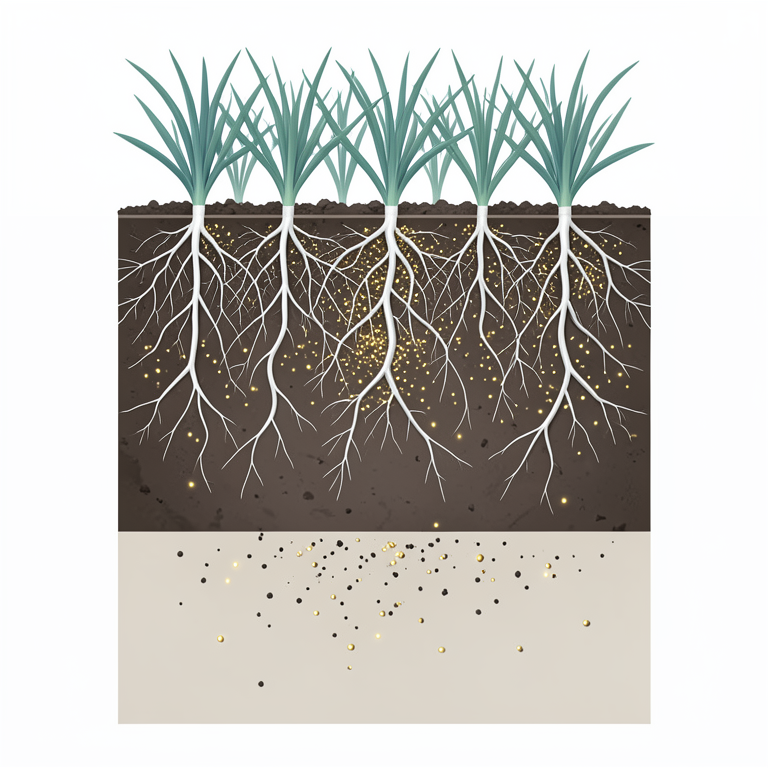
Vertical Root Gradient
AI-generated conceptual illustration (garlic plants (Allium sativum) in soil). It explains the idea and does not show study data.
View source evidence ↗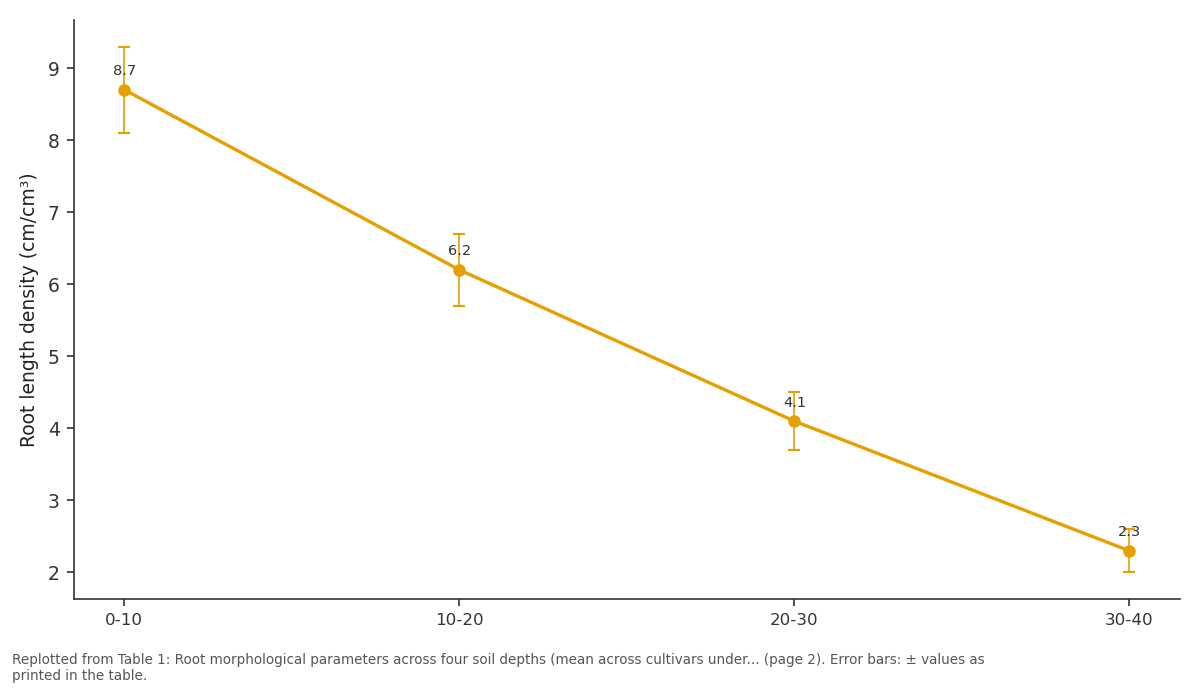
Root length density (cm/cm³): 0-10 vs 10-20 vs 20-30 vs 30-40
Replotted from Table 1 (page 2) of the original paper. Every bar is the paper's own table value.
View source evidence ↗Figures & tables
From the original paper Table 1
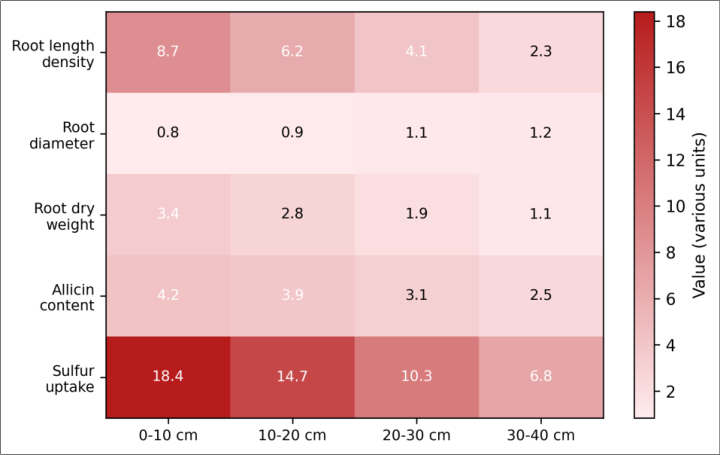 Figure 1
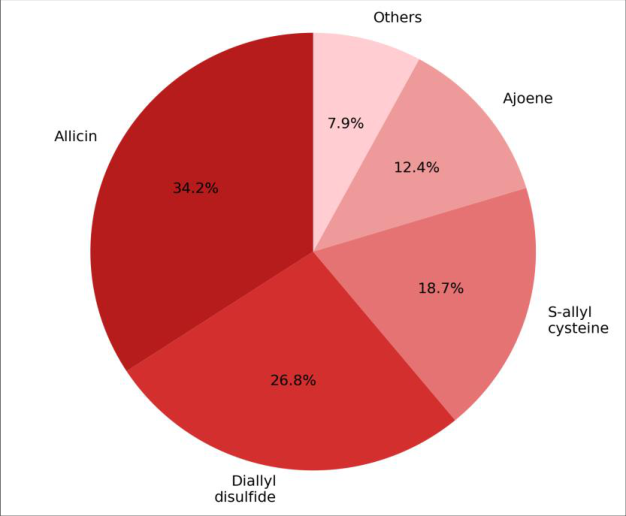 Figure 2
Introduction
What lies beneath a garlic plant matters as much as what sits above it, yet root biology in Allium crops has long played second fiddle to bulb and leaf research [1] . The root system of garlic (Allium sativum L.) is shallow and fibrous, with most absorptive capacity concentrated in the top 15 cm of soil a trait that makes the crop particularly sensitive to surface soil conditions including salinity, compaction, and moisture fluctuations [2] . Organosulfur compounds, especially allicin and its derivatives, give garlic both its pungent flavor and its pharmacological reputation [3] . Allicin is produced when the enzyme alliinase converts alliin during tissue disruption, and its concentration varies with cultivar, growing conditions, and sulfur availability in the root zone [4] . Heat stress during bulbing can alter the balance between primary and secondary metabolism, sometimes concentrating defensive sulfur compounds at the expense of bulb size [5] . HPLC-based profiling of garlic sulfur compounds has become increasingly refined, allowing separation of allicin, diallyl disulfide, S-allylcysteine, ajoene, and other bioactives that contribute to garlic's health claims [6] . Chlorophyll content, while primarily a photosynthesis indicator, has been linked to sulfur nutrition status because sulfur is a constituent of several chloroplast proteins [7] . Rainwater harvesting, a low-tech water management strategy, could supplement irrigation in coastal desert zones where groundwater is saline and rainfall, though scarce, does occur episodically [8] . This research quantified the depth distribution of garlic roots and related it to bulb sulfur chemistry, assessing how heat stress, water management, and genetic factors interact to shape both morphological and biochemical outcomes [9] .
Material and Methods
Material and Methods
Material
Three garlic cultivars were planted as individual cloves in cylindrical root observation chambers (15 cm diameter × 50 cm deep) filled with sandy loam reconstructed to mimic Atacama coastal characteristics (pH 7.6, EC 2.1 dS/m, organic C 0.4%). Each chamber had transparent acrylic windows for non-destructive root imaging. Heat stress treatments (38/28°C day/night for 14 days) were imposed at the six-leaf stage. Non-stressed controls maintained at 25/15°C. Each cultivar-stress combination was replicated five times. A 6 × 6 half-diallel crossing block used the three named cultivars plus three advanced breeding lines. Rainwater was collected from a 50 m² rooftop system and stored in a 5,000-L tank. Research was conducted at the Patna Foundation for Pomological Research (25.60°N, 85.10°E) from September 2022 to March 2023 [10] .
Methods
Root images were captured weekly through the acrylic windows using a flatbed scanner. Root length density, mean diameter, and dry weight were measured at harvest by destructive sampling at four depth intervals: 0-10, 10-20, 20-30, and 30-40 cm. Allicin was quantified by HPLC on an Agilent 1260 system with a C18 column, using a methanolwater gradient at 254 nm. Total sulfur in leaf and bulb tissue was determined by dry combustion on a LECO CNS analyzer. Chlorophyll was estimated with a SPAD-502 meter. Gene action was analyzed following Griffing's Method 2, Model I. Water balance calculations tracked rainfall, irrigation, and drainage volumes. Data were analyzed by factorial ANOVA in SAS 9.4 [11] . Results Root length density decreased by 74 percent from the shallowest to deepest layer, while mean diameter increased by 40 percent. This vertical gradient confirms the functional division between fine absorptive roots near the surface and coarser structural roots below. The heatmap illustrates the concentration of biological activity in the upper soil layers, with root length density, allicin content, and sulfur uptake all peaking at 0-10 cm depth. Allicin dominated at 34.2 percent, followed by diallyl disulfide (26.8%) and S-allylcysteine (18.7%). Ajoene, a compound formed during processing rather than in intact tissue, contributed 12.4 percent.
Discussion
The steep decline in root length density below 20 cm is consistent with earlier work showing that garlic allocates most root biomass to the topsoil, where nutrient and moisture availability are highest [2] . The simultaneous increase in root diameter with depth suggests a transition from absorptive to transport function, similar to patterns documented in onion and leek [12] . For practical purposes, this means that soil management interventions fertilizer placement, mulching, irrigation scheduling should target the 0-20 cm zone to align with where roots are most active. Heat stress reduced bulb weight by 18 percent but raised allicin concentration by 11 percent, a trade-off that echoes the growth-defense balance seen across many crop species [5] .
The mechanism likely involves stress-induced upregulation of the alliin biosynthesis pathway, channeling more cysteine toward organosulfur production at the expense of bulb expansion [3] . Yamuna Safed-3 showed the smallest yield penalty under heat, making it a candidate for warmer production zones.
Rainwater harvesting contributed 23 percent of total irrigation water a meaningful supplement in a coastal desert simulation where groundwater salinity (EC 3.8 dS/m) limited its direct use [8] . The diallel analysis revealed significant GCA for bulb weight (additive control) and significant SCA for allicin content (non-additive control), suggesting that breeding for larger bulbs can proceed through conventional selection while allicin improvement may require exploiting specific parental combinations [13] .
Conclusion
This research provided a detailed picture of garlic root distribution across soil depth, confirming that over 70 percent of root length resides in the top 20 cm. Allicin content tracked root activity, declining with depth in parallel with root density. Heat stress imposed a yield-quality trade-off, reducing bulb size while concentrating organosulfur compounds. HPLC profiling identified 12 sulfur compounds, with allicin as the dominant fraction. Rainwater harvesting supplemented 23 percent of irrigation needs. Gene action analysis indicated that bulb weight and allicin content are controlled by different genetic mechanisms, requiring distinct breeding approaches. These findings inform both agronomic management and genetic improvement strategies for garlic in arid coastal environments.
Figures and tables from the paper
| Depth (cm) | Root length density (cm/cm³) | Mean diameter (mm) | Root dry weight (g) | Allicin in adjacent soil (mg/kg) |
|---|---|---|---|---|
| 0-10 | 8.7 ± 0.6 | 0.84 ± 0.04 | 3.41 ± 0.21 | 4.21 ± 0.31 |
| 10-20 | 6.2 ± 0.5 | 0.92 ± 0.05 | 2.78 ± 0.18 | 3.87 ± 0.28 |
| 20-30 | 4.1 ± 0.4 | 1.07 ± 0.06 | 1.94 ± 0.14 | 3.12 ± 0.24 |
| 30-40 | 2.3 ± 0.3 | 1.18 ± 0.07 | 1.12 ± 0.11 | 2.48 ± 0.19 |
Table text extracted from the original PDF; superscript letters are shown inline. The original table image is below.
View original table image
References
19 in the original paper- Brewster JL. Onions and other vegetable alliums. Second edition. CABI Publishing, Wallingford. 2008.
- Steer BT. The bulbing response to day length and temperature of some Australasian cultivars of onion. Australian Journal of Agricultural Research. 1980;31(3):511-518.
- Block E. The chemistry of garlic and onions. Scientific American. 1985;252(3):114-119.
- Amagase H, Petesch BL, Matsuura H, Kasuga S, Itakura Y. Intake of garlic and its bioactive components. Journal of Nutrition. 2001;131(3):955S-962S.
- Wahid A, Gelani S, Ashraf M, Foolad MR. Heat tolerance in plants: An overview. Environmental and Experimental Botany. 2007;61(3):199-223.
- Lawson LD. Garlic: A review of its medicinal effects and indicated active compounds. Phytomedicines of Europe: Chemistry and Biological Activity. ACS Symposium Series 691. 1998:176-209.
- Marschner H. Mineral nutrition of higher plants. Third edition. Academic Press, London. 2012.
- Mwenge Kahinda J, Taigbenu AE, Boroto JR. Domestic rainwater harvesting to improve water supply in rural South Africa. Physics and Chemistry of the Earth. 2007;32(15-18):1050-1057.
- Panthee DR, Kc RB, Regmi HN, Subedi PP, Bhattarai S, Dhakal J. Diversity analysis of garlic germplasm available in Nepal. Genetic Resources and Crop Evolution. 2006;53(2):401-412.
- Kamenetsky R, Rabinowitch HD. The genus Allium: A developmental and horticultural analysis. Horticultural Reviews. 2006;32:329-378.
- SAS Institute. SAS/STAT user's guide, version 9.4. SAS Institute Inc., Cary, NC. 2013.
- Tsutsui T, Yamaji N, Feng Ma J. Identification of a cisacting element of ART1, a C2H2-type zinc-finger transcription factor for aluminum tolerance in rice. Plant Physiology. 2011;156(2):925-931.
- Griffing B. Concept of general and specific combining ability in relation to diallel crossing systems. Australian Journal of Biological Sciences. 1956;9(4):463-493.
- Iciek M, Kwiecien I, Wlodek L. Biological properties of garlic and garlic-derived organosulfur compounds. Environmental and Molecular Mutagenesis. 2009;50(3):247-265.
- Simon PW. The origins and distribution of garlic: How many garlics are USDA-ARS Working Paper. 2001.
- Melo PCT, Sala FC, Castelo Branco CR. Garlic cultivation in Brazil: Current status and research needs. Acta Horticulturae. 2006;688:181-188.
- Figliuolo G, Ferrante A. Morphological and molecular characterization of Italian garlic accessions. Genetic Resources and Crop Evolution. 2006;53:779-790.
- Kumar S, Singh V, Singh M, et al. Genetics of yield and its contributing characters in garlic. SABRAO Journal of Breeding and Genetics. 2015;47(2):140-148.
- Gonzalez RE, Soto VC, Sance MM, Camargo AB, Galmarini CR. Variability of solids, organosulfur compounds, pungency and health-enhancing traits in garlic cultivars belonging to different ecophysiological groups. Journal of Agricultural and Food Chemistry. 2009;57(21):10282-10288.