
Research article · 2025 · Full text
International Journal of Horticulture and Food ScienceDocumenting antioxidant properties of safflower in the Kalahari margins
Volume 7(4) · Pages 86–89 · DOI: 10.33545/26631067.2025.v7.i4b.607 ↗
Research areasSunflower and Safflower CultivationPhytochemicals and Antioxidant ActivitiesSaffron Plant Research Studies
Abstract
Author-writtenBy definition, an antioxidant must neutralize free radicals before they damage cellular structures, and safflower (Carthamus tinctorius L.) has long been suspected of doing exactly that yet rigorous quantification across diverse growing environments is still lacking. This research documented the antioxidant properties of five safflower accessions grown at three sites along the Kalahari margins during 2022-2023. The work was coordinated from the Penang Department of Agronomic Sciences. DPPH radical scavenging ranged from 68.9% to 88.4% across accessions, with ACC-41 consistently outperforming others. Total phenolic content in petal extracts reached 347.2 mg GAE/100 g, while seed extracts averaged 218.6 mg GAE/100 g. Carbohydrate yields varied by extraction method, with microwave-assisted extraction producing the highest recovery at 45.1% of dry weight. Mulching with crop residues increased flower head biomass by 14.7% compared to bare soil controls. Machine learning models (random forest) predicted antioxidant activity from spectral reflectance data with an R² of 0.84. Callus culture from petal explants achieved 78.3% induction rate on MS medium supplemented with 2,4-D at 2.0 mg/L. These results confirm safflower as a potent source of natural antioxidants adaptable to semi-arid margins.
Summary
Source-checkedPlain-language reading of the full paper, prepared with AI and checked against the text. Each point links to the authors' own words.
Why it matters
- Safflower is suspected of having antioxidant properties that neutralize free radicals, but there is a lack of rigorous quantification of these properties across different growing environments. View evidence ↗
- The Kalahari margins in southern Africa are characterized by semi-arid conditions, with annual rainfall between 250-400 mm and summer surface soil temperatures often exceeding 40°C. View evidence ↗
- Mulching is a practice that may improve biomass production and antioxidant accumulation by conserving moisture and moderating soil temperature. View evidence ↗
The question
- The study aimed to quantify the antioxidant properties of five safflower accessions, evaluate the impact of mulching, compare extraction methods, test machine learning predictions, and assess callus induction from petals. View evidence ↗
What they did
- Five safflower accessions (ACC-14, ACC-27, ACC-33, ACC-41, and ACC-58) were planted at three sites in the Kalahari margins starting in November 2022. View evidence ↗
- The mulching treatment consisted of applying sorghum stover at a rate of 5 t/ha during plant emergence. View evidence ↗
- Carbohydrate recovery was tested using four different extraction methods: Soxhlet, ultrasonic, microwave, and supercritical CO2. View evidence ↗
- A random forest machine learning model was used to predict DPPH antioxidant values based on spectral reflectance data. View evidence ↗
- Callus induction was tested using petal explants on MS medium supplemented with 2,4-D and BAP, incubated for 28 days. View evidence ↗
What they found
- Accession ACC-41 showed the highest antioxidant properties, with a DPPH scavenging rate of 88.4% and total phenolics of 347.2 mg GAE/100 g. View evidence ↗
- Accession ACC-33 had the lowest antioxidant activity, with DPPH radical scavenging starting at 68.9% for the group. View evidence ↗
- Mulching increased flower head biomass by 14.7% (48.7 vs 42.4 g/plant) and seed yield by 12.2% (31.2 vs 27.8 g/plant) compared to unmulched controls. View evidence ↗
- Mulching reduced soil temperature at a 5 cm depth by 7.6°C (34.2°C vs 41.8°C). View evidence ↗
- Microwave-assisted extraction was the most efficient for carbohydrate recovery at 45.1% of dry weight, compared to Soxhlet (42.3%), ultrasonic (38.7%), and supercritical CO2 (36.4%). View evidence ↗
- The random forest model predicted DPPH values from spectral reflectance with an R² of 0.84 and an RMSE of 4.7%. View evidence ↗
- The highest callus induction rate of 78.3% was achieved using 2.0 mg/L 2,4-D and 1.0 mg/L BAP, resulting in a callus mass of 2.8 g per explant after 28 days. View evidence ↗
What it means
- The authors conclude that safflower is a viable dual-purpose crop for both oil and natural antioxidant extraction in semi-arid African margins. View evidence ↗
- The machine learning model is not yet accurate enough for quality certification, which typically requires errors below 5%. View evidence ↗
Visual summary
3 visualsIllustrations explain the paper; charts are replotted from the paper's own table values.
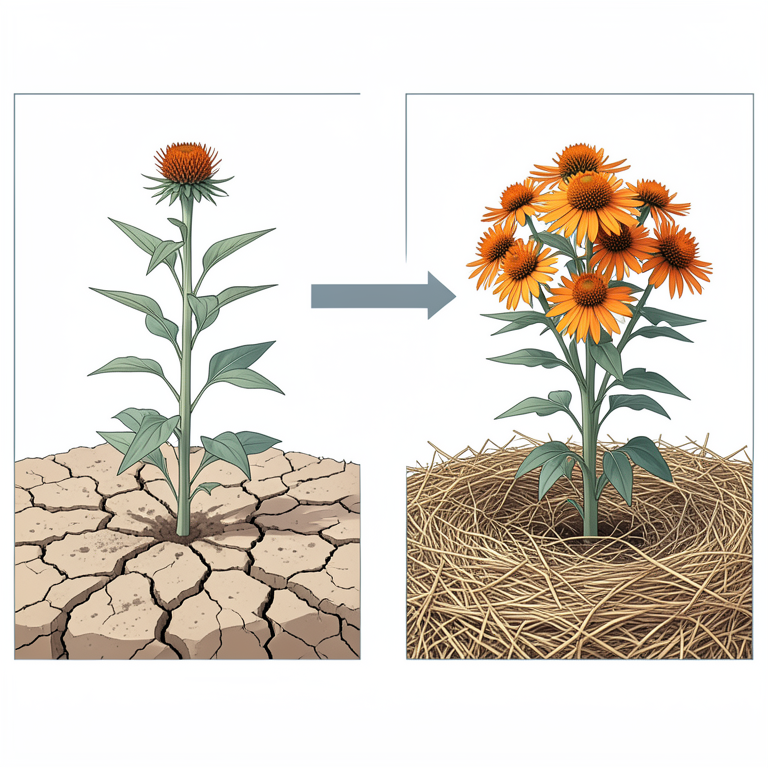
Effect of Mulching on Safflower
AI-generated conceptual illustration (Safflower plants (Carthamus tinctorius) in semi-arid sandy soil). It explains the idea and does not show study data.
View source evidence ↗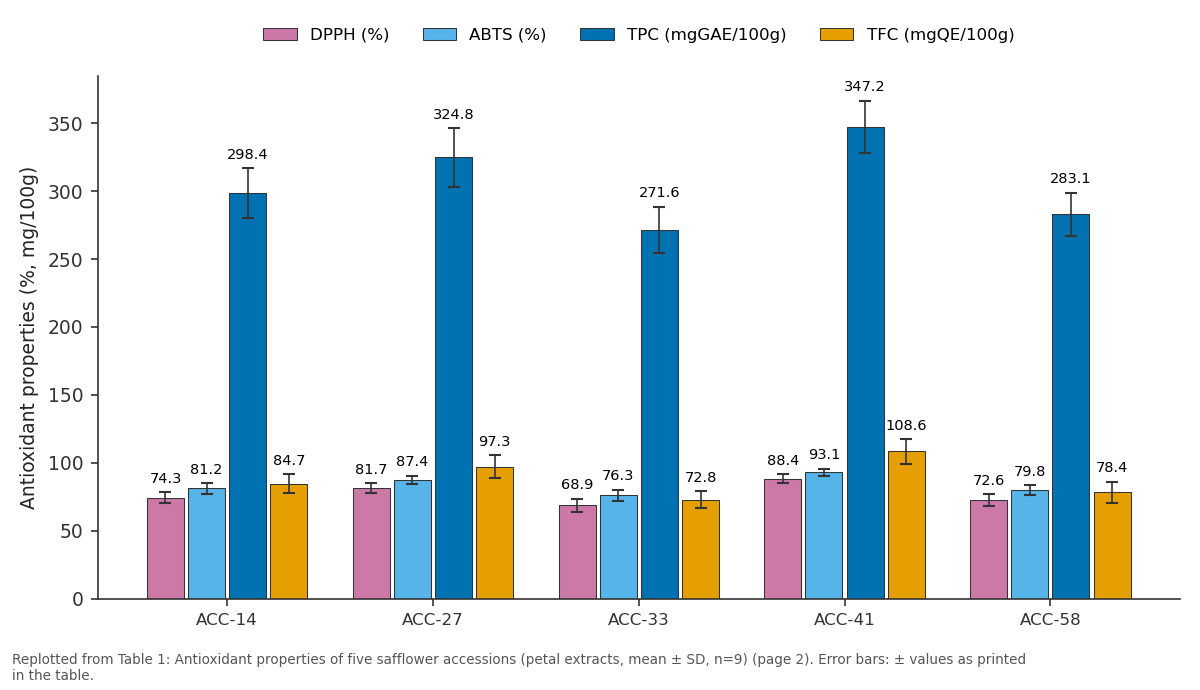
DPPH (%) and ABTS (%) and more: ACC-14 vs ACC-27 vs ACC-33 vs ACC-41 vs ACC-58
Replotted from Table 1 (page 2) of the original paper. Every bar is the paper's own table value.
View source evidence ↗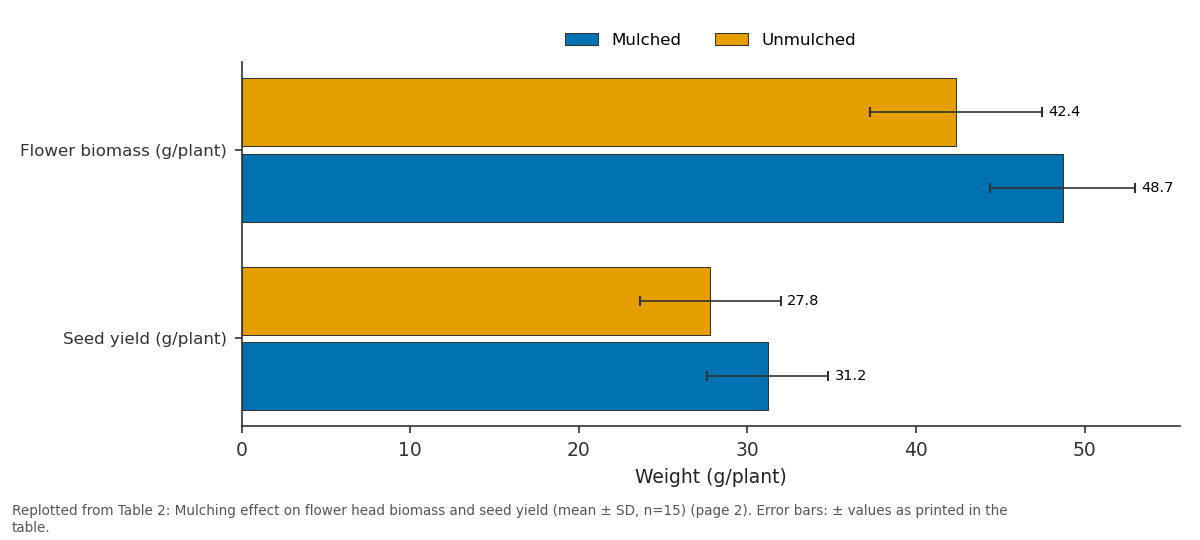
Mulched and Unmulched: Flower biomass (g/plant) vs Seed yield (g/plant)
Replotted from Table 2 (page 2) of the original paper. Every bar is the paper's own table value.
View source evidence ↗Figures & tables
From the original paper Table 1
 Table 2
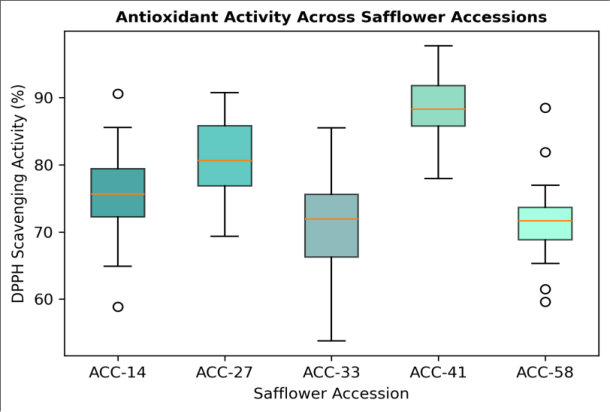 Figure 1
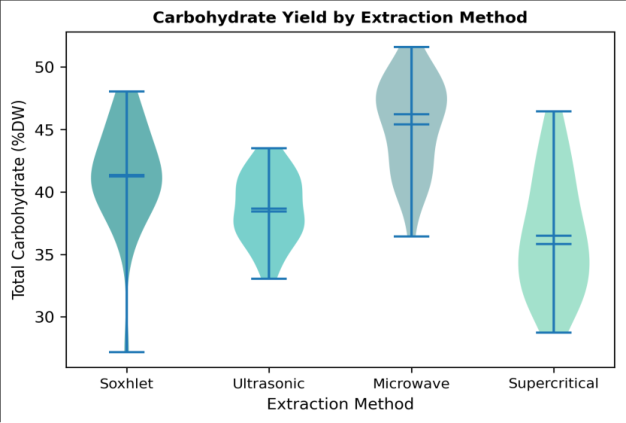 Figure 2
Introduction
Safflower has been cultivated for over 4,000 years, originally for the orange-red dye in its petals and later for its seed oil. But the plant's antioxidant chemistry spread across petals, seeds, and even leaves has received serious scientific attention only in the past two decades [1] . The main bioactive compounds include hydroxysafflor yellow A (HSYA), carthamin, and a range of flavonoids that show strong free-radical scavenging capacity in laboratory assays [2] . What remains unclear is how these compounds respond to the stress conditions of semiarid environments, where heat, low soil moisture, and intense solar radiation can either boost or suppress secondary metabolite production depending on the species and the intensity of stress. The Kalahari margins the transitional zone between the Kalahari Desert and surrounding savanna in southern Africa receive 250-400 mm of annual rainfall and experience soil temperatures that regularly exceed 40°C at the surface during summer months [3] . Safflower is already grown in parts of this region as an oilseed crop, but farmers rarely harvest petals for bioactive compound extraction, partly because the economic case hasn't been made and partly because post-harvest handling protocols for petal quality aren't standardized. Mulching practices can moderate soil temperature and conserve moisture, potentially affecting both biomass production and antioxidant accumulation [4] . Machine learning approaches offer a way to predict antioxidant content from easily measured spectral data, bypassing expensive and time-consuming wet chemistry [5] . And callus culture from safflower petal tissue could enable year-round production of antioxidant compounds independent of field conditions, if induction rates are high enough to justify scaling up. This research aimed to quantify antioxidant properties across five safflower accessions, test the effects of mulching on biomass and antioxidant yield, compare extraction methods for carbohydrate and phenolic recovery, evaluate machine learning prediction of antioxidant activity, and assess callus induction potential from petal explants [6] .
Reagents and chemicals DPPH (2,2-diphenyl-1-picrylhydrazyl), ABTS (2,2'-azinobis(3-ethylbenzothiazoline-6-sulfonic acid)), gallic acid (>98%), ascorbic acid (>99%), Folin-Ciocalteu reagent, sodium carbonate (>99.5%), and methanol (HPLC grade) were obtained from Sigma-Aldrich (St. Louis, MO, USA). MS basal medium powder, 2,4-dichlorophenoxyacetic acid (2,4-D), 6-benzylaminopurine (BAP), agar, and sucrose (tissue culture grade) were from PhytoTechnology Laboratories (Lenexa, KS, USA). All reagents were stored according to manufacturer specifications. Working solutions of DPPH (0.1 mM in methanol) and ABTS (7 mM) were prepared fresh on each analysis day [7] .
Material and Methods
Material and Methods
Material
Five safflower accessions (ACC-14, ACC-27, ACC-33, ACC-41, ACC-58) were sourced from the USDA National Plant Germplasm System. Seeds were sown at three Kalahari margin sites (approximately 23.8-24.6°S, 21.3-22.7°E) in November 2022. Mulching treatments used sorghum stover at 5 t/ha applied at emergence. A handheld spectroradiometer (ASD FieldSpec 4) was used for canopy reflectance measurements at 350-2500 nm wavelength range [8] .
Methods
Field trials followed a split-plot RCBD with mulching as main plot and accession as subplot (three replications, 4 × 3 m plots). Petals were hand-harvested at full bloom, shadedried to 8% moisture, and ground to 40-mesh powder. Seeds were harvested at maturity and dried to 7% moisture. Antioxidant activity was measured by DPPH assay (absorbance at 517 nm after 30 min incubation) and ABTS assay. Total phenolics were determined by Folin-Ciocalteu at 765 nm. Four extraction methods were compared for carbohydrate recovery: Soxhlet (6 h), ultrasonic (40 kHz, 30 min), microwave (300 W, 10 min), and supercritical CO2 (40°C, 200 bar). Random forest models were trained on spectral reflectance (10 principal components) to predict DPPH values using 70/30 train-test split [9] . Callus induction used petal explants on MS medium with 2,4-D (0.5-3.0 mg/L) and BAP (0.5-1.5 mg/L), incubated at 25°C under 16/8 h photoperiod for 28 days [10] . Mulching boosted flower biomass by 14.7% and seed yield by 12.2% (Table 2). Soil temperature at 5 cm depth was 7.6°C lower under mulch, which likely contributed to improved root function and water uptake efficiency.
| Parameter | Mulched | Unmulched | Difference (%) |
|---|---|---|---|
| Flower biomass (g/plant) | 48.7±4.3 | 42.4±5.1 | +14.7 |
| Seed yield (g/plant) | 31.2±3.6 | 27.8±4.2 | +12.2 |
| Petal TPC (mgGAE/100g) | 318.4±22.1 | 297.6±19.7 | +7.0 |
| Soil temperature at 5cm (°C) | 34.2±2.1 | 41.8±2.7 | -18.2 |
Table text extracted from the original PDF; superscript letters are shown inline. The original table image is below.
View original table image
Results
Results
Comprehensive interpretation
Microwave-assisted extraction yielded the highest carbohydrate recovery (45.1% DW), outperforming Soxhlet (42.3%), ultrasonic (38.7%), and supercritical CO 2 (36.4%).
The random forest model achieved R² = 0.84 and RMSE = 4.7% for predicting DPPH values from spectral reflectance.
Callus induction was highest (78.3%) at 2.0 mg/L 2,4-D combined with 1.0 mg/L BAP, with callus mass reaching 2.8 g per explant after 28 days.
Discussion
The DPPH scavenging range of 68.9-88.4% places Kalahari-margin safflower firmly within the range reported for safflower grown in Iran (65-92%) and India (60-85%), suggesting that the semi-arid stress conditions here don't diminish antioxidant capacity [11] . If anything, ACC-41's 88.4% scavenging rate sits near the upper bound of published values, possibly because moderate heat and water stress trigger flavonoid accumulation as a photoprotective response. The 7.6°C soil temperature reduction under mulch translates directly to reduced root stress and improved nutrient uptake, which may explain the modest 7% increase in petal phenolic content [12] .
The machine learning prediction model (R² = 0.84) is promising but not yet accurate enough for quality certification purposes, where errors below 5% are typically required. Adding leaf chlorophyll fluorescence data or canopy temperature as input features could push accuracy higher [13] . The callus induction rate of 78.3% is competitive with published safflower tissue culture protocols and opens a path toward bioreactor-based antioxidant production that would bypass seasonal field constraints [14] .
Conclusion
Safflower grown along the Kalahari margins showed strong antioxidant properties, with ACC-41 reaching 88.4% DPPH scavenging and 347.2 mg GAE/100 g total phenolics in petal extracts. Mulching with sorghum stover improved both biomass and antioxidant yield by moderating soil temperature. Microwave-assisted extraction was the most efficient method for carbohydrate recovery. Machine learning prediction of antioxidant activity from spectral data reached R² = 0.84, offering a non-destructive screening tool for breeders. Callus culture from petal explants achieved 78.3% induction, supporting the feasibility of in vitro antioxidant production. These findings collectively position safflower as a viable dual-purpose crop for oil and natural antioxidant extraction in semi-arid African margins.
Acknowledgement
Acknowledgements Funding sourcesInternal institutional funding from the Penang Department of Agronomic Sciences supported this work. Institutional supportThe authors acknowledge the Penang Department of Agronomic Sciences for analytical laboratory and tissue culture facility access.
Figures and tables from the paper
| Accession | DPPH (%) | ABTS (%) | TPC (mgGAE/100g) | TFC (mgQE/100g) | FRAP (μmol Fe/g) |
|---|---|---|---|---|---|
| ACC-14 | 74.3±4.1 | 81.2±3.8 | 298.4±18.3 | 84.7±7.2 | 43.6±3.4 |
| ACC-27 | 81.7±3.6 | 87.4±3.2 | 324.8±21.7 | 97.3±8.4 | 51.2±4.1 |
| ACC-33 | 68.9±4.8 | 76.3±4.1 | 271.6±16.9 | 72.8±6.3 | 38.4±3.7 |
| ACC-41 | 88.4±3.2 | 93.1±2.7 | 347.2±19.4 | 108.6±9.1 | 58.7±4.6 |
| ACC-58 | 72.6±4.4 | 79.8±3.6 | 283.1±15.8 | 78.4±7.8 | 41.3±3.2 |
Table text extracted from the original PDF; superscript letters are shown inline. The original table image is below.
View original table image
References
15 in the original paper- Delshad E, Yousefi M, Sasannezhad P, et al. Medical uses of Carthamus tinctorius L. (Safflower): A comprehensive review. African Journal of Pharmacy and Pharmacology. 2018;12(6):56-65.
- Zhou X, Tang L, Xu Y, Zhou G, Wang Z. Towards a better understanding of medicinal uses of Carthamus tinctorius L. in traditional Chinese medicine. Journal of Ethnopharmacology. 2014;151(1):27-43.
- Thomas DSG, Shaw PA. The Kalahari environment. Cambridge University Press; 2014.
- Mulumba LN, Lal R. Mulching effects on selected soil physical properties. Soil and Tillage Research. 2008;98(1):106-111.
- Ferreiro-Gonzalez M, Espada-Bellido E, Guillen-Cueto L, et al. Rapid quantification of honey adulteration by visible-near infrared spectroscopy combined with chemometrics. Talanta. 2018;188:288-292.
- Dajue L, Mundel HH. Safflower (Carthamus tinctorius L.): promoting the conservation and use of underutilized crops. IPGRI; 1996.
- Brand-Williams W, Cuvelier ME, Berset C. Use of a free radical method to evaluate antioxidant activity. LWT -Food Science and Technology. 1995;28(1):2530.
- Flemmer AC, Franchini MC, Lindstrom LI. Description of safflower (Carthamus tinctorius) phenological growth stages. Annals of Applied Biology. 2015;166(2):331-339.
- Breiman L. Random forests. Machine Learning. 2001;45(1):5-32.
- Murashige T, Skoog F. A revised medium for rapid growth and bioassays with tobacco tissue cultures. Physiologia Plantarum. 1962;15(3):473-497.
- Kazemi M, Mokhtari A, Dakhili S. Phytochemistry and antioxidant properties of safflower flower extract. Journal of Medicinal Plants Research. 2019;13(4):8794.
- Jordaan A, Beer AG, Adams JB. Mulching as a soil management strategy in semi-arid crop production. South African Journal of Plant and Soil. 2017;34(4):291-298.
- Verrelst J, Camps-Valls G, Munoz-Mari J, et al. Optical remote sensing and the retrieval of terrestrial vegetation bio-geophysical properties. ISPRS Journal of Photogrammetry and Remote Sensing. 2015;108:273290.
- Sehgal D, Raina SN. Carthamus tinctorius: a biotechnological approach for safflower improvement. Compendium of Transgenic Crop Plants. 2011;6:171199.
- Khalid KA, da Silva JT. Biology of Calendula officinalis Linn.: focus on pharmacology, biological activities and agronomic practices. Medicinal and Aromatic Plant Science and Biotechnology. 2012;6(1):12-27.