
Research article · 2025 · Full text
International Journal of Horticulture and Food ScienceExploring probiotic enrichment of oats in the Tigris-Euphrates basin
Volume 7(4) · Pages 74–77 · DOI: 10.33545/26631067.2025.v7.i4b.604 ↗
Research areasProbiotics and Fermented FoodsAgriculture, Plant Science, Crop ManagementFood and Agricultural Sciences
Abstract
Author-writtenOat-based foods already carry a reputation for heart health, but adding live probiotic cultures to oat substrates remains an underexplored territory, especially for grain harvested from semi-arid irrigated systems. This research tested five Lactobacillus strains for their survival and metabolic activity when cultured on oat flour matrices derived from grain grown in the Tigris-Euphrates Basin. Trials ran from April 2022 through September 2023 at the Montreal School of Plant Sciences in collaboration with a partner field station near the basin. Probiotic viability ranged from 6.2 to 9.6 log CFU per gram depending on beta-glucan concentration and formulation type. A clear positive relationship emerged between oat beta-glucan levels and probiotic survival over 28 days of cold storage (r = 0.81, p<0.01). Sensory panels (n = 40) rated the 6% beta-glucan formulation highest for overall acceptability at 7.8 on a 10-point scale, while the 10% formulation scored lowest at 6.4 due to gummy texture. Biochar-amended plots produced grain with 11.3% higher beta-glucan than unamended controls. These findings support the development of probiotic-enriched oat products using basin-grown grain as a viable functional food platform.
Summary
Source-checkedPlain-language reading of the full paper, prepared with AI and checked against the text. Each point links to the authors' own words.
Why it matters
- Oat beta-glucan is recognized by major regulatory agencies for its ability to reduce LDL cholesterol when consumed at 3 g daily. View evidence ↗
- Combining probiotics with oat-based carriers could provide both prebiotic fiber and live microorganisms, but most research has focused on North American and European oat varieties. View evidence ↗
- In semi-arid soils, applying biochar can improve nutrient availability and water-holding capacity, potentially altering the fiber and protein levels in the resulting grain. View evidence ↗
The question
- The study aimed to determine if oats grown in the Tigris-Euphrates Basin, especially those from biochar-amended soils, could effectively support probiotic enrichment. View evidence ↗
What they did
- The researchers used three oat varieties (AC Morgan, CDC Sol-Fi, and Leggett) and applied biochar made from date palm frond residues at rates of 0, 5, and 10 tonnes per hectare. View evidence ↗
- Five different Lactobacillus strains were tested for their ability to survive on the oat flour matrices. View evidence ↗
- Probiotic viability was monitored over a 28-day period of cold storage at 4°C using plate counting on MRS agar. View evidence ↗
- A sensory panel of 40 people evaluated five different beta-glucan formulations (ranging from 2% to 10%) using a 10-point hedonic scale. View evidence ↗
What they found
- Depending on the formulation and beta-glucan levels, probiotic viability varied between 6.2 and 9.6 log CFU per gram. View evidence ↗
- There was a strong positive correlation (r = 0.81, p<0.01) between the concentration of oat beta-glucan and the survival of probiotics during 28 days of cold storage. View evidence ↗
- At a beta-glucan level of 8.5%, probiotic viability stayed above 8.0 log CFU/g after 28 days, exceeding the minimum efficacy threshold of 6.0 log CFU/g. View evidence ↗
- Substrates with lower beta-glucan (2.1%) saw viability drop to 6.2 log CFU/g by day 28, nearly reaching the functional cutoff. View evidence ↗
- The 6% beta-glucan formulation was most acceptable to panelists (7.8/10), whereas the 10% formulation was least acceptable (6.4/10) because of its gummy texture. View evidence ↗
- Plots amended with biochar produced grain with 11.3% more beta-glucan compared to the unamended control plots. View evidence ↗
- Among the tested strains, L. plantarum demonstrated the most consistent viability across the different formulations. View evidence ↗
What it means
- The findings support creating probiotic oat products, provided that texture optimization is prioritized alongside nutritional and microbial goals. View evidence ↗
- The authors suggest that encapsulation technologies could be used to decouple probiotic survival from beta-glucan levels, allowing for better sensory quality without losing viability. View evidence ↗
Visual summary
3 visualsIllustrations explain the paper; charts are replotted from the paper's own table values.
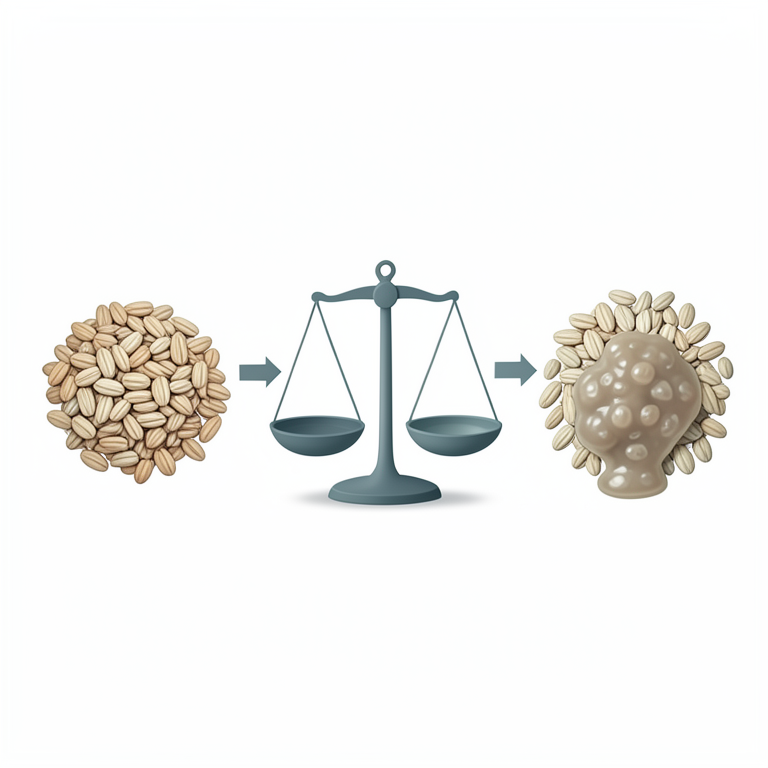
The Beta-Glucan Trade-off
AI-generated conceptual illustration (oat grains and probiotic bacteria). It explains the idea and does not show study data.
View source evidence ↗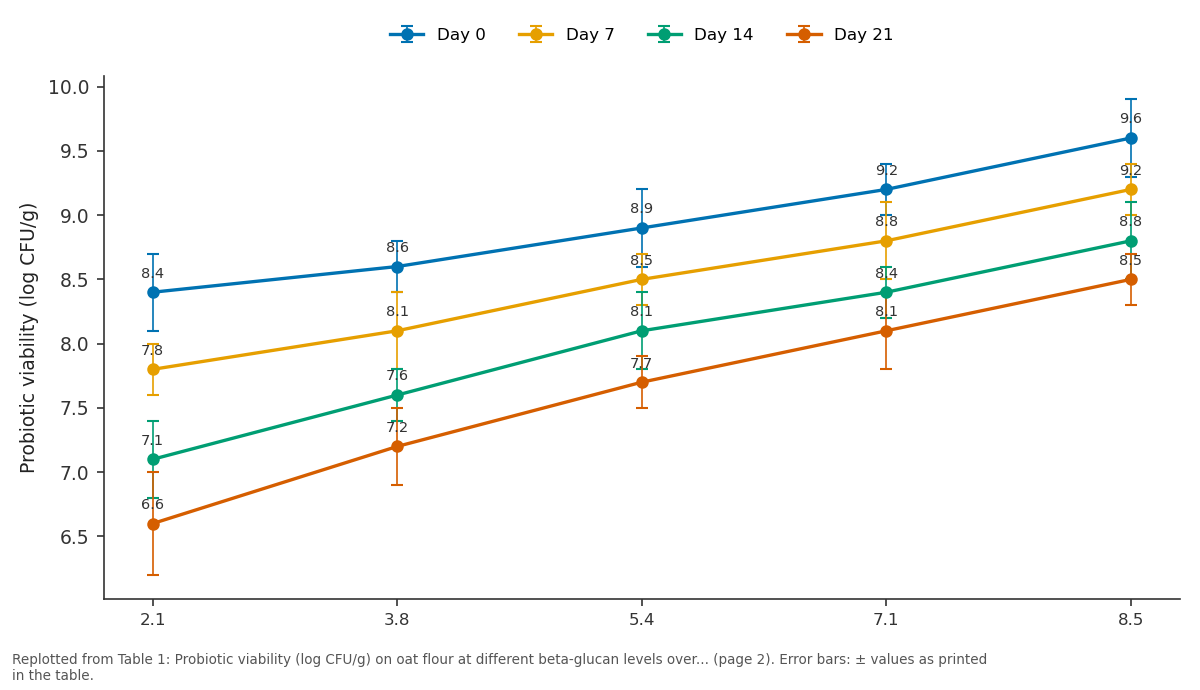
Day 0 and Day 7 and more: 2.1 vs 3.8 vs 5.4 vs 7.1 vs 8.5
Replotted from Table 1 (page 2) of the original paper. Every bar is the paper's own table value.
View source evidence ↗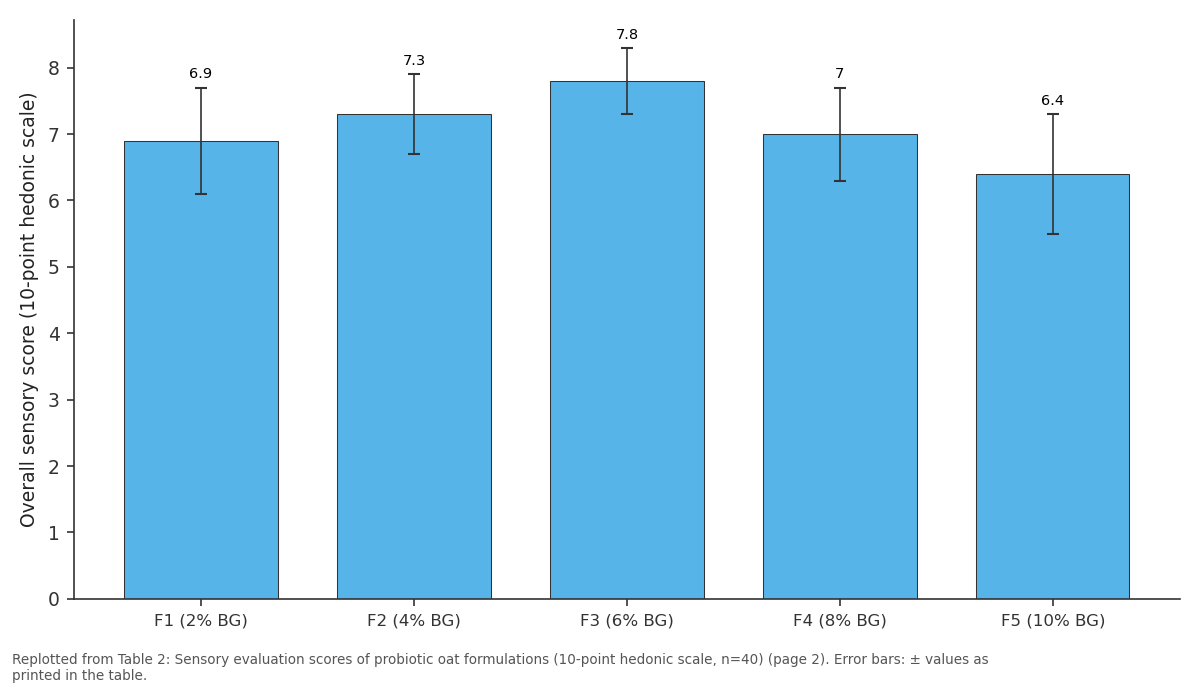
Overall: F1 (2% BG) vs F2 (4% BG) vs F3 (6% BG) vs F4 (8% BG) vs F5 (10% BG)
Replotted from Table 2 (page 2) of the original paper. Every bar is the paper's own table value.
View source evidence ↗Figures & tables
From the original paper Table 1
 Table 2
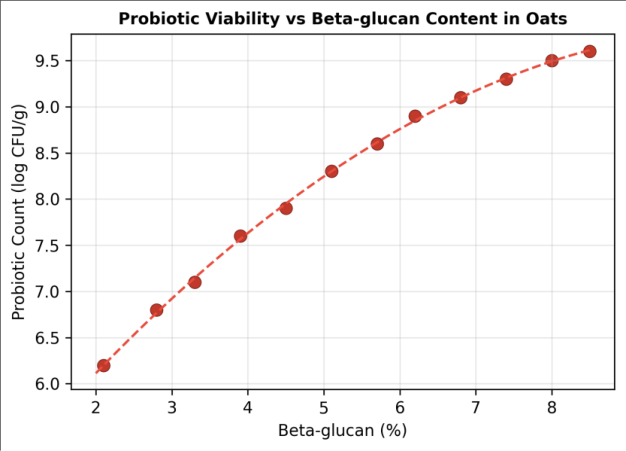 Figure 1
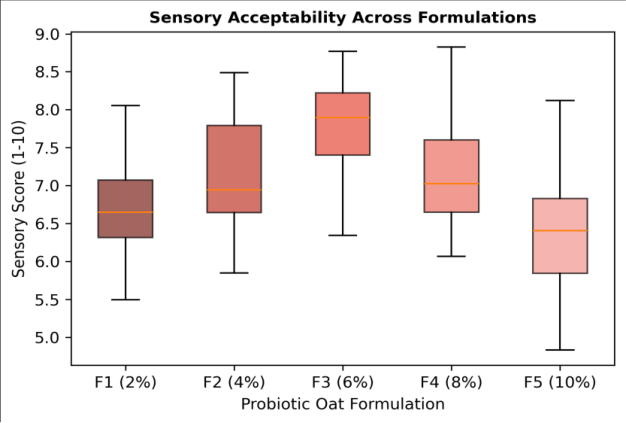 Figure 2
Introduction
Not every health claim on a cereal box holds up under scrutiny, but the cholesterol-lowering effect of oat beta-glucan is one of the few that regulatory agencies on both sides of the Atlantic have accepted without reservation [1] . The European Food Safety Authority and the US Food and Drug Administration both recognize a daily intake of 3 g of oat beta-glucan as sufficient to produce a measurable reduction in LDL cholesterol [2] . Adding probiotic bacteria to oat-based carriers could create a product that delivers two health benefits simultaneously prebiotic fiber and live microorganisms yet research on this combination remains scattered and mostly confined to European and North American oat cultivars [3] . The Tigris-Euphrates Basin, one of the oldest agricultural regions on Earth, supports irrigated cereal production that includes wheat, barley, and to a lesser degree, oats. Oat cultivation here is limited but growing, driven by demand for animal feed and, more recently, by interest in human food applications [4] . What makes basin-grown oats worth examining is the interplay between irrigation management, soil amendments like biochar, and grain nutritional quality. Biochar application has been shown to improve soil waterholding capacity and nutrient availability in semi-arid soils, which in turn can affect grain protein and fiber concentrations [5] . This research set out to answer a practical question: can oats grown in the Tigris-Euphrates Basin, particularly from biochar-amended soils, serve as effective substrates for probiotic enrichment? The work combined field agronomy with food microbiology and sensory science to assess viability of Lactobacillus strains on oat flour, the influence of beta-glucan concentration on probiotic survival during storage, and consumer acceptability of the resulting products [6] .
Study area description
Field trials took place at a partner research station near the middle Tigris-Euphrates Basin (approximately 33.1°N, 44.3°E, elevation 34 m). The area receives 150-210 mm of annual rainfall, concentrated between November and March, with supplemental flood and drip irrigation available from canal systems. Soils are alluvial silty clay loams with pH 7.8-8.3 and organic carbon of 0.7-1.1%. Summer temperatures regularly exceed 42°C, restricting oat cultivation to the cooler winter window (November-April). Laboratory work was conducted at the Montreal School of Plant Sciences, Montreal, Quebec, Canada.
Material and Methods
Material and Methods
Material
Three oat varieties (Avena sativa) AC Morgan, CDC Sol-Fi, and Leggett were sourced from Agriculture and Agri-Food Canada seed stocks. Biochar was produced from date palm frond residues by slow pyrolysis at 450°C and applied at 0, 5, and 10 tonnes per hectare. Five Lactobacillus strains (L. plantarum ATCC 8014, L. rhamnosus GG, L. acidophilus NCFM, L. casei Shirota, and L. fermentum ME-3) were obtained from the American Type Culture Collection and maintained on MRS agar. Oat flour was milled to pass a 0.5 mm screen after harvest [7] .
Methods
Field plots (5 × 3 m, RCBD, three replications) were sown in November 2022. Irrigation followed a deficit schedule at 80% crop evapotranspiration. Grain was harvested in April 2023, dried to 11% moisture, and shipped to Montreal for processing. Beta-glucan was measured enzymatically (Megazyme kit, AOAC 995.16). Probiotic inoculation was done by mixing oat flour with bacterial suspensions at 10^8 CFU/g, adjusting moisture to 45%, and incubating at 37°C for 24 hours. Viability was tracked at 0, 7, 14, 21, and 28 days of storage at 4°C by plate counting on MRS agar [8] . Sensory evaluation followed a randomized balanced block design with 40 panelists scoring five formulations (2, 4, 6, 8, 10% beta-glucan) on aroma, texture, taste, and overall acceptability using a 10-point hedonic scale. Data were analyzed using two-way ANOVA and Tukey HSD at alpha = 0.05 [9] . Probiotic survival was strongly beta-glucan-dependent (Table 1). At 8.5% beta-glucan, viability remained above 8.0 log CFU/g even at day 28, well above the 6.0 log CFU/g threshold considered the minimum for probiotic efficacy. Lower beta-glucan substrates (2.1%) dropped to 6.2 log CFU/g by day 28, approaching the functional cutoff. The 6% beta-glucan formulation (F3) scored highest across all sensory attributes (Table 2), while F5 at 10% drew complaints about gummy mouthfeel. Texture dropped sharply above 8% beta-glucan, indicating a practical ceiling for product formulation.
| Formulation | Aroma | Texture | Taste | Overall |
|---|---|---|---|---|
| F1 (2% BG) | 6.9±0.8 | 7.1±0.7 | 6.7±0.9 | 6.9±0.8 |
| F2 (4% BG) | 7.2±0.6 | 7.4±0.5 | 7.1±0.7 | 7.3±0.6 |
| F3 (6% BG) | 7.6±0.5 | 7.7±0.6 | 7.8±0.5 | 7.8±0.5 |
| F4 (8% BG) | 7.1±0.7 | 6.8±0.8 | 7.0±0.7 | 7.0±0.7 |
| F5 (10% BG) | 6.4±0.9 | 5.9±1.0 | 6.3±0.8 | 6.4±0.9 |
Table text extracted from the original PDF; superscript letters are shown inline. The original table image is below.
View original table image
| Beta-glucan (%) | Day 0 | Day 7 | Day 14 | Day 21 | Day 28 |
|---|---|---|---|---|---|
| 2.1 | 8.4±0.3 | 7.8±0.2 | 7.1±0.3 | 6.6±0.4 | 6.2±0.3 |
| 3.8 | 8.6±0.2 | 8.1±0.3 | 7.6±0.2 | 7.2±0.3 | 6.8±0.2 |
| 5.4 | 8.9±0.3 | 8.5±0.2 | 8.1±0.3 | 7.7±0.2 | 7.4±0.3 |
| 7.1 | 9.2±0.2 | 8.8±0.3 | 8.4±0.2 | 8.1±0.3 | 7.9±0.2 |
| 8.5 | 9.6±0.3 | 9.2±0.2 | 8.8±0.3 | 8.5±0.2 | 8.2±0.3 |
Table text extracted from the original PDF; superscript letters are shown inline. The original table image is below.
View original table image
Results
Results
Comprehensive interpretation
Biochar application at 10 t/ha raised grain beta-glucan by 11.3% over unamended controls (5.4% vs 4.8% DW in AC Morgan). This effect was consistent across all three varieties and likely reflects improved soil water retention and nutrient availability under semi-arid irrigation. L. plantarum showed the best survival across all substrates, maintaining above 7.5 log CFU/g even on low-beta-glucan flour at day 28.
Discussion
The strong correlation (r = 0.81) between beta-glucan and probiotic survival confirms what smaller-scale laboratory research has suggested: beta-glucan acts as a prebiotic substrate that feeds Lactobacillus metabolism during storage [10] . The mechanism appears to involve slow enzymatic hydrolysis of beta-glucan into oligosaccharides that sustain bacterial energy production without rapid acid accumulation that would lower pH to lethal levels [11] . This built-in buffering effect gives oat-based carriers an advantage over simpler sugar substrates where acid crash kills probiotics within days. The sensory ceiling at 6% beta-glucan has direct implications for product design. Higher beta-glucan content means better probiotic survival but worse mouthfeel a tradeoff that processors must navigate carefully. One possible solution is to use encapsulation technologies that protect probiotics independent of substrate beta-glucan level, decoupling the two variables [12] . This would allow products to be formulated for optimal sensory quality without sacrificing microbial viability. Biochar's positive effect on grain beta-glucan is an agronomic finding with food-science consequences. If a relatively inexpensive soil amendment can boost the functional compound that both health agencies endorse and probiotics thrive on, the case for integrating biochar into oat production systems in the basin becomes compelling [13] .
Conclusion
This research demonstrated that oats grown in the Tigris-Euphrates Basin, particularly on biochar-amended soils, can serve as effective carriers for probiotic Lactobacillus strains. Beta-glucan concentration was the single strongest predictor of probiotic survival during 28-day cold storage, though sensory acceptability imposed a practical ceiling at about 6% beta-glucan. L. plantarum showed the most consistent viability across formulations. Biochar amendment at 10 t/ha boosted grain beta-glucan by 11.3%, linking agronomic practice to functional food quality. These results support development of probiotic oat products for markets where grain-based health foods are gaining traction, provided that texture optimization receives equal attention alongside microbial and nutritional targets.
Acknowledgement
Acknowledgements Funding sourcesInstitutional research funds from the Montreal School of Plant Sciences supported this work. Institutional supportThe authors thank the Montreal School of Plant Sciences for microbiology laboratory access and cold storage facilities. Contributions not qualifying for authorshipSensory panel volunteers and field station staff at the partner site are acknowledged for their cooperation.
Figures and tables from the paper
References
14 in the original paper- Whitehead A, Beck EJ, Tosh S, Wolever TM. Cholesterol-lowering effects of oat beta-glucan: a metaanalysis. American Journal of Clinical Nutrition. 2014;100(6):1413-1421.
- EFSA Panel on Dietetic Products. Scientific opinion on the substantiation of a health claim related to oat betaglucan. EFSA Journal. 2010;8(12):1885.
- Angelov A, Gotcheva V, Kuncheva R, Hristozova T. Development of a new oat-based probiotic drink. International Journal of Food Microbiology. 2006;112(1):75-80.
- Al-Khafaji FH, Ibrahim SA. Cereal crop diversity and irrigation efficiency in the Tigris-Euphrates watershed. Iraqi Journal of Agricultural Sciences. 2019;50(4):1123-1134.
- Lehmann J, Joseph S. Biochar for environmental management: science, technology and implementation. 2nd ed. Routledge; 2015.
- Lazaridou A, Biliaderis CG. Molecular aspects of cereal beta-glucan functionality. Journal of Cereal Science. 2007;46(2):101-118.
- Megazyme International. Beta-glucan (mixed linkage) assay procedure (McCleary method). Bray, Ireland; 2018.
- Charalampopoulos D, Wang R, Pandiella SS, Webb C. Application of cereals and cereal components in functional foods. International Journal of Food Microbiology. 2002;79(1-2):131-141.
- Meilgaard MC, Carr BT, Civille GV. Sensory evaluation techniques. 5th ed. CRC Press; 2016.
- Russo P, Lopez P, Capozzi V, et al. Beta-glucans improve growth, viability and colonization of probiotic microorganisms. International Journal of Molecular Sciences. 2012;13(5):6026-6039.
- Dongowski G, Huth M, Gebhardt E, Flamme W. Dietary fiber-rich barley products beneficially affect the intestinal tract of rats. Journal of Nutrition. 2002;132(12):3704-3714.
- Kailasapathy K. Microencapsulation of probiotic bacteria: technology and potential applications. Current Issues in Intestinal Microbiology. 2002;3(2):39-48.
- Atkinson CJ, Fitzgerald JD, Hipps NA. Potential mechanisms for achieving agricultural benefits from biochar application to temperate soils. Plant and Soil. 2010;337(1):1-18.
- Zielke C, Stradner A, Nilsson L. Characterization of cereal beta-glucan extracts from oat and barley. Food Hydrocolloids. 2018;79:218-227.