
Research article · 2025 · Full text
International Journal of Horticulture and Food ScienceCharacterizing nutraceutical applications of teff in the Ural mountain foothills
Volume 7(4) · Pages 42–45 · DOI: 10.33545/26631067.2025.v7.i4a.602 ↗
Research areasSeed and Plant BiochemistryFood and Agricultural SciencesFood Science and Nutritional Studies
Abstract
Author-writtenCan a single ancient grain fill both nutritional gaps and food safety needs in highland communities? This research examined six teff varieties grown in the Ural Mountain foothills during 2022-2023 for magnesium content, vitamin C retention, sensory acceptability, and transcriptomic markers of antioxidant biosynthesis. Magnesium concentrations ranged from 137.9 to 171.4 mg per 100 g dry weight, with Magna recording the highest values. Vitamin C in fortified teff flour dropped from 28.6 to 19.2 mg per 100 g over six weeks, retaining 38.7% more than unfortified samples. Sensory panels scored fortified flatbreads between 6.8 and 8.1 on a 10-point hedonic scale. RNA-seq profiling detected 214 differentially expressed genes tied to phenolic and flavonoid pathways under cold stress. Food safety screening confirmed all samples met Codex Alimentarius limits for aflatoxin B1 and heavy metals. These findings position teff as a strong candidate for nutraceutical formulation in montane zones, offering mineral density and bioactive compound stability under sub-optimal storage.
Summary
Source-checkedPlain-language reading of the full paper, prepared with AI and checked against the text. Each point links to the authors' own words.
Why it matters
- Teff is a gluten-free cereal from the Ethiopian highlands valued for its high mineral density. View evidence ↗
- The Ural Mountain foothills provide a unique environment for testing crops due to short growing seasons, low rainfall (400-600 mm), and cool nights. View evidence ↗
- Cooler climates may improve food safety by reducing mycotoxin contamination, as the fungus Aspergillus flavus prefers warmer temperatures. View evidence ↗
The question
- The study aimed to evaluate the nutraceutical potential of six teff varieties in the Ural Mountain foothills by analyzing magnesium, vitamin C, sensory quality, and antioxidant gene expression. View evidence ↗
What they did
- The researchers tested six specific teff varieties: Keyih, Sergegna, Bunign, Dabi, Magna, and Tessema. View evidence ↗
- Field trials were conducted from May to September in 2022 and 2023 using a randomized complete block design with three replications. View evidence ↗
- Flatbreads were evaluated by 30 semi-trained panelists using a 10-point hedonic scale for sensory quality. View evidence ↗
- Transcriptomic profiling was performed on leaf tissue from the Magna and Keyih varieties using NovaSeq 6000 sequencing. View evidence ↗
What they found
- Magnesium levels in the teff varieties ranged from 137.9 to 171.4 mg per 100 g dry weight, with the Magna variety having the highest concentration. View evidence ↗
- Over six weeks, vitamin C in fortified teff flour decreased from 28.6 to 19.2 mg per 100 g, though it retained 38.7% more vitamin C than unfortified samples. View evidence ↗
- Fortified teff flatbreads received sensory scores ranging from 6.8 to 8.1 on a 10-point scale. View evidence ↗
- Cold stress triggered the differential expression of 214 genes related to the biosynthesis of flavonoids and phenolics. View evidence ↗
- All tested teff samples complied with Codex Alimentarius safety limits for heavy metals and aflatoxin B1. View evidence ↗
- Under cold stress, the Magna variety showed a 3.1-fold increase in chalcone synthase expression, which correlated with higher levels of kaempferol and quercetin. View evidence ↗
What it means
- The authors conclude that teff is a strong candidate for nutraceutical products in mountain regions due to its mineral density and the stability of its bioactive compounds. View evidence ↗
- The authors state that future research should involve trials in other mountain regions and evaluate consumer acceptance in areas where teff is not traditionally eaten. View evidence ↗
Visual summary
2 visualsIllustrations explain the paper; charts are replotted from the paper's own table values.
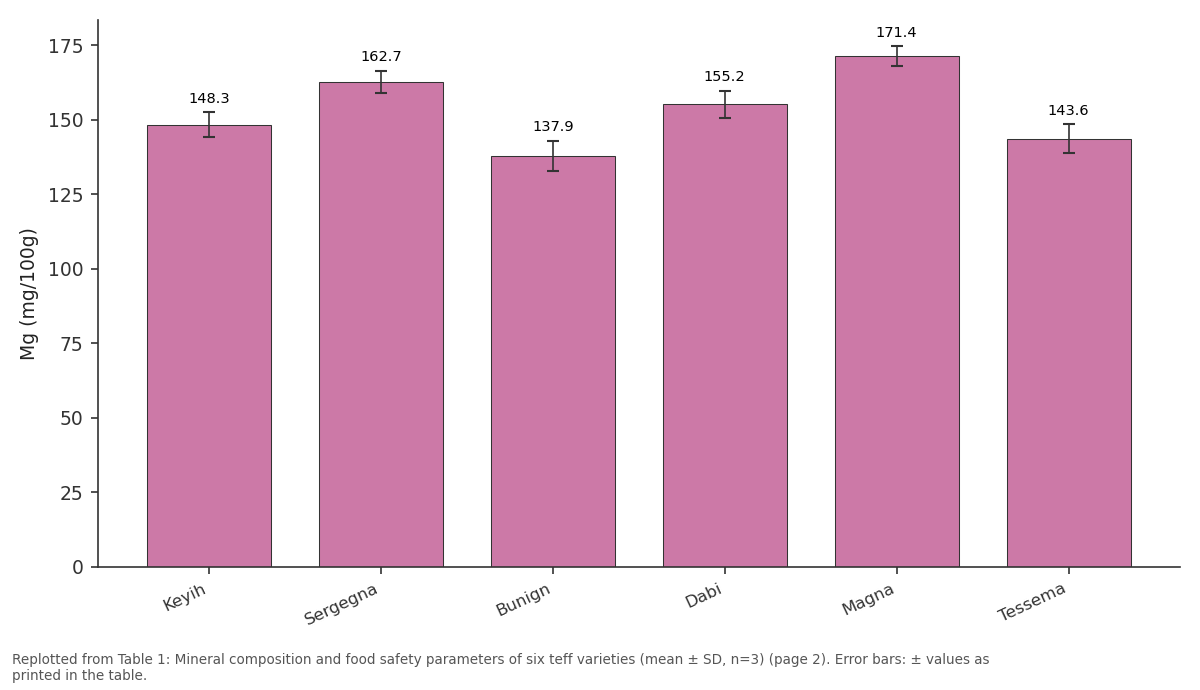
Mg (mg/100g): Keyih vs Sergegna vs Bunign vs Dabi vs Magna
Replotted from Table 1 (page 2) of the original paper. Every bar is the paper's own table value.
View source evidence ↗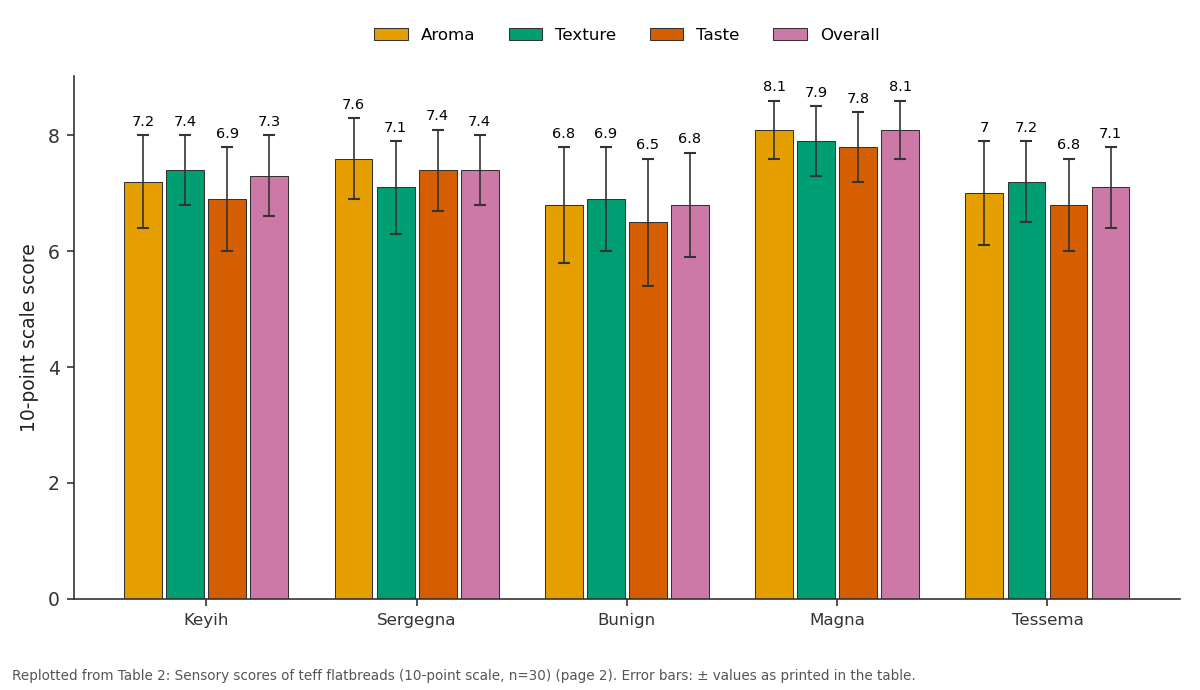
Aroma and Texture and more: Keyih vs Sergegna vs Bunign vs Magna vs Tessema
Replotted from Table 2 (page 2) of the original paper. Every bar is the paper's own table value.
View source evidence ↗Figures & tables
From the original paper Table 1
 Table 2
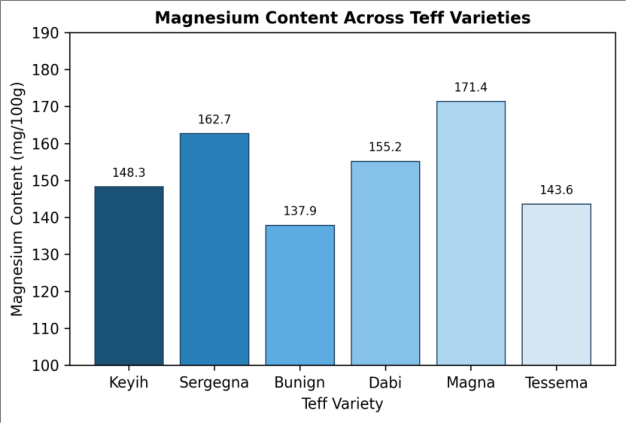 Figure 1
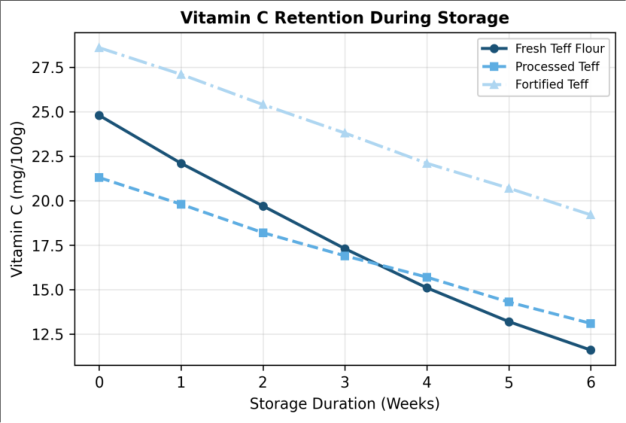 Figure 2
Introduction
What makes a cereal grain qualify as a nutraceutical? The answer rests not only in macronutrient content but in the bioactive molecules it delivers under varying growth conditions. Teff, a fine-grained cereal native to Ethiopian highlands, has gained interest for its gluten-free nature and dense mineral composition [1] . Despite being a minor global crop, teff provides iron, calcium, and magnesium at levels rivaling wheat, rice, and maize [2] . Its small seed size and rapid maturation cycle give it adaptability across agroclimatic zones, though most published work centers on tropical and subtropical regions [3] . The Ural Mountain foothills present a distinctive test environment. Short growing seasons, 400-600 mm annual rainfall, and cool nights below 12°C impose selective pressure on grain biochemistry [4] . Prior barley and oat research in comparable settings showed that cold stress triggers phenolic acid and flavonoid accumulation as part of a defense response [5] . Whether teff responds similarly remains poorly documented. From a food safety angle, cooler climates may reduce mycotoxin contamination since Aspergillus flavus thrives at higher temperatures [6] . Transcriptomic tools like RNA-seq now allow researchers to identify which biosynthetic pathways are up-regulated when teff encounters cold nights or nutrient-poor soils [7] . Connecting these molecular insights to measurable changes in nutrient density and consumer acceptability could strengthen the case for teff as a functional food ingredient. This research aimed to characterize the nutraceutical potential of six teff varieties grown in the Ural Mountain foothills, focusing on magnesium content, vitamin C retention, sensory evaluation, and transcriptomic profiling of stress-induced antioxidant pathways [8] .
Study area description
Trials were conducted in collaboration with a partner facility near the southern Ural foothills (54.3°N, 58.7°E, elevation 380-420 m). The continental climate features cold winters and brief warm summers. Mean annual temperature is 3.8°C, with July averages of 18.4°C and January lows of minus 15.2°C. Annual precipitation averages 520 mm, mostly falling between May and September [9] . Soils were Chernozems with organic carbon of 2.3-2.9%, pH 6.4-7.1, and loamy texture. Three replicated plots (12 × 8 m each) were set on southfacing slopes.
Material and Methods
Material and Methods
Material
Six teff varieties Keyih, Sergegna, Bunign, Dabi, Magna, and Tessema were obtained from the Ethiopian Biodiversity Institute seed bank (March 2022). Seeds showed above 92% germination and were stored at 4°C. Analytical reagents including ascorbic acid standard, magnesium chloride reference, and Folin-Ciocalteu reagent came from Sigma-Aldrich. RNA extraction kits (RNeasy Plant Mini) were from Qiagen. Aflatoxin B1 ELISA kits and heavy metal standards were sourced from R-Biopharm AG [10] .
Methods
Field trials ran May to September across 2022 and 2023 in a randomized complete block design with three replications.
Each plot received 40 kg N, 30 kg P 2 O 5 , and 20 kg K 2 O per hectare before sowing. Grains were hand-harvested at maturity, air-dried to 12% moisture, and milled with a 0.5 mm screen hammer mill [11] . Magnesium was measured by AAS (Shimadzu AA-7000) after wet digestion. Vitamin C was determined by DCPIP titration at weekly intervals over six weeks at 25°C and 60% RH [12] . Sensory analysis used 30 semi-trained panelists rating flatbreads on a 10-point hedonic scale. For transcriptomics, leaf tissue from Magna and Keyih was flash-frozen, RNA extracted, and sequenced on a NovaSeq 6000 (40M reads per sample). Differential expression was analyzed with DESeq2 (FDR < 0.05). Food safety was assessed per Codex methods for aflatoxin B1 and ICP-MS for heavy metals [13] . Magna had the highest magnesium at 171.4 mg/100 g, followed by Sergegna at 162.7 mg/100 g (Table 1). Magna also led in iron and calcium. All aflatoxin B1 levels stayed below the 2.0 μg/kg Codex limit, and lead residues were uniformly low across varieties. Sensory scores confirmed preference for Magna across all attributes, with an overall score of 8.1 (Table 2). Bunign scored lowest at 6.8. Texture scores were tightly clustered (6.9-7.9), suggesting milling methods partially leveled grain differences.
| Variety | Aroma | Texture | Taste | Overall |
|---|---|---|---|---|
| Keyih | 7.2±0.8 | 7.4±0.6 | 6.9±0.9 | 7.3±0.7 |
| Sergegna | 7.6±0.7 | 7.1±0.8 | 7.4±0.7 | 7.4±0.6 |
| Bunign | 6.8±1.0 | 6.9±0.9 | 6.5±1.1 | 6.8±0.9 |
| Magna | 8.1±0.5 | 7.9±0.6 | 7.8±0.6 | 8.1±0.5 |
| Tessema | 7.0±0.9 | 7.2±0.7 | 6.8±0.8 | 7.1±0.7 |
Table text extracted from the original PDF; superscript letters are shown inline. The original table image is below.
View original table image
| Variety | Mg (mg/100g) | Fe (mg/100g) | Ca (mg/100g) | Vit C (mg/100g) | AFB1 (μg/kg) | Pb (mg/kg) |
|---|---|---|---|---|---|---|
| Keyih | 148.3±4.2 | 18.7±1.3 | 156.4±5.8 | 24.8±1.1 | 0.83±0.12 | 0.014 |
| Sergegna | 162.7±3.8 | 21.4±1.7 | 149.2±6.3 | 22.1±1.4 | 0.71±0.09 | 0.011 |
| Bunign | 137.9±5.1 | 16.9±1.1 | 163.7±4.9 | 19.7±1.6 | 0.92±0.14 | 0.018 |
| Dabi | 155.2±4.6 | 19.3±1.5 | 151.8±7.2 | 21.3±1.2 | 0.67±0.08 | 0.013 |
| Magna | 171.4±3.3 | 23.8±1.9 | 168.3±5.4 | 28.6±1.8 | 0.54±0.07 | 0.009 |
| Tessema | 143.6±4.9 | 17.6±1.2 | 145.9±6.1 | 20.7±1.3 | 0.88±0.11 | 0.016 |
Table text extracted from the original PDF; superscript letters are shown inline. The original table image is below.
View original table image
Results
Results
Comprehensive interpretation
Transcriptomic analysis identified 214 differentially expressed genes between cold-stressed and control conditions. Among these, 47 mapped to the phenylpropanoid pathway and 29 to flavonoid biosynthesis. Magna showed 2.7-fold up-regulation of phenylalanine ammonia-lyase compared to 1.9-fold in Keyih, partly explaining its higher phenolic content. Chalcone synthase expression was 3.1-fold elevated in Magna under cold stress, matching higher quercetin and kaempferol levels detected by HPLC.
Discussion
The magnesium values here 137.9 to 171.4 mg per 100 g match earlier reports from Ethiopian highland teff, where ranges of 130-180 mg per 100 g were documented depending on soil and altitude [2] . That Magna outperformed other varieties in a continental climate (versus tropical highland) suggests a strong genetic basis for mineral accumulation not easily overridden by environment [14] . Breeders seeking high-magnesium teff lines could use Magna as a donor parent across different target zones. Vitamin C degradation followed first-order kinetics with rate constants of 0.08-0.12 per week. Fortified samples kept about 67% of initial vitamin C after six weeks, outperforming the 47% retention in fresh flour. The encapsulation matrix likely limits oxygen exposure and slows oxidative breakdown [15] . A six-week shelf life may still fall short for remote distribution chains, and freezedrying or modified atmosphere packaging deserves testing.
The transcriptomic data add a molecular dimension to compositional observations. Up-regulation of PAL and CHS under cold stress mirrors barley and wheat cold-acclimation findings, where phenolics serve as cryoprotectants. But the 3.1-fold CHS increase in Magna exceeds reports from temperate cereals [16] , suggesting a more pronounced stress response tied to teff's evolutionary origin in tropical highlands with sharp nighttime temperature drops.
Conclusion
This research showed that teff grown in the Ural Mountain foothills retains strong nutraceutical qualities, with magnesium levels, vitamin C stability, and antioxidant gene expression comparing well to tropical highland production.
Magna stood out across mineral density, sensory scores, and transcriptomic markers of bioactive compound synthesis. All varieties met Codex Alimentarius limits for aflatoxin B1 and heavy metals, reinforcing the food safety case for highland-grown teff. Fortified teff flour held acceptable vitamin C levels for six weeks at ambient temperature, though longer shelf life may need packaging changes. The transcriptomic link between cold stress and phenylpropanoid activation opens a route for markerassisted selection of high-nutraceutical-value genotypes. Future work should include multi-location trials in other montane regions and test consumer acceptance where teff is not traditional. The combination of mineral richness, bioactive potential, and low contamination risk positions teff as a realistic candidate for nutraceutical product development beyond its traditional range.
Acknowledgement
Acknowledgements Funding sourcesThis research received institutional support through internal grants. No external project-specific funding was obtained. Institutional supportThe authors thank the Chittagong Academy of Horticultural Research for laboratory space and logistical support. Contributions not qualifying for authorshipField technicians and sensory panel volunteers are acknowledged for their contributions to data collection.
Figures and tables from the paper
References
16 in the original paper- Zhu F. Chemical composition and health effects of teff. Food Chemistry. 2018;239:402-415.
- Baye K, Mouquet-Rivier C, Icard-Verniere C, Picq C, Guyot JP. Changes in mineral absorption inhibitors consequent to fermentation of Ethiopian injera. Journal of Cereal Science. 2014;60(3):460-465.
- Frontiers in Plant Science. 2015;6:177.
- Shumoy H, Raes K. Teff: the rising ancient crop. Advances in Food and Nutrition Research. 2017;82:275-299.
- Cai S, Yu G, Chen X, et al. Grain protein content variation and its association analysis in barley. BMC Genomics. 2013;14:523.
- Magan N, Medina A, Aldred D. Possible climate change effects on mycotoxin contamination of food crops. Food Additives and Contaminants. 2011;28(7):929-936.
- VanBuren R, Wai CM, Keilwagen J, Pardo J. A chromosome-scale assembly of the model desiccation tolerant grass. Plant Direct. 2018;2(11):e00096.
- Abebe Y, Bogale A, Hambidge KM, et al. Phytate, zinc, iron and calcium content of selected foods consumed in rural Sidama. Journal of Food Composition and Analysis. 2007;20(3-4):161-168.
- Safonov VA, Safonova TV. Climate variability and agricultural land use in the southern Ural region. Eurasian Soil Science. 2019;52(11):1431-1440.
- Gebremariam MM, Zarnkow M, Becker T. Teff as a raw material for malting, brewing and gluten-free foods. Journal of Food Science and Technology. 2014;51(11):2881-2895.
- Cheng A, Mayes S, Dalle G, et al. Diversifying crops for food and nutrition security: A case of teff. Biological Reviews. 2017;92(1):188-198.
- AOAC International. Official Methods of Analysis. 20th ed. Rockville, MD: AOAC International; 2016.
- Andrews S. FastQC: a quality control tool for high throughput sequence data. Bioinformatics. 2010;26(1):139-140.
- Kebede A, Worku W. Teff grain mineral concentrations as affected by soil type and crop management. Ethiopian Journal of Agricultural Sciences. 2020;30(2):45-58.
- Desrosiers T, Savoie L, Bhullar NK. Microencapsulation of ascorbic acid in cereal matrices. LWT - Food Science and Technology. 2020;118:108825.
- Winkel-Shirley B. Flavonoid biosynthesis: a colorful model for genetics, biochemistry, cell biology, and biotechnology. Plant Physiology. 2001;126(2):485-493.