
Research article · 2025 · Full text
International Journal of Horticulture and Food ScienceMonitoring phytochemical composition of sunflower in the Saharan Oasis belt
Volume 7(4) · Pages 82–85 · DOI: 10.33545/26631067.2025.v7.i4b.606 ↗
Research areasSunflower and Safflower CultivationEdible Oils Quality and AnalysisPhytochemicals and Antioxidant Activities
Abstract
Author-writtenSunflower production in arid zones has typically been valued for oil yield alone, while the phytochemical richness of non-seed organs goes largely uncatalogued. This research monitored the phytochemical composition of four sunflower cultivars grown across three oasis sites in the Saharan belt during 2022-2023. The work was coordinated from the Concepcion Faculty of Botanical Research in collaboration with a Saharan partner station. Total phenolic content in seed tissue ranged from 224.1 to 284.3 mg gallic acid equivalents per 100 g, while petal tissue reached 189.4 mg GAE/100 g in the Prosol cultivar. Chlorogenic acid the dominant phenolic in sunflower seeds varied from 98.7 to 156.2 mg/100 g depending on cultivar and plant organ. Integrated Pest Management (IPM) treatments at medium intensity produced 4.51 t/ha dry matter, 13.8% more than untreated controls. SNP genotyping using a 10K chip array identified 47 markers associated with phenolic accumulation in seeds (LOD > 3.0). Minimal processing (cold pressing at 28°C) retained 87.3% of seed chlorogenic acid compared to 62.1% under conventional hot pressing. These findings support a whole-plant approach to sunflower phytochemical exploitation in Saharan oasis agriculture, with IPM and cold processing as practical levers for maximizing bioactive compound recovery.
Summary
Source-checkedPlain-language reading of the full paper, prepared with AI and checked against the text. Each point links to the authors' own words.
Why it matters
- Sunflower is often valued only for its oil, but other plant organs contain bioactive compounds like flavonoids in petals and antibacterial derivatives in leaves that have medicinal or industrial potential. View evidence ↗
- While not a traditional crop in the Saharan oasis belt of Algeria, Tunisia, and Libya, sunflower has shown promising adaptation since 2018 using drip irrigation. View evidence ↗
- It is unknown if the extreme heat and high UV radiation characteristic of Saharan oases modify the plant's phytochemical profile to benefit bioactive compound extraction. View evidence ↗
The question
- The study aimed to monitor phytochemical distribution across four cultivars and five organs in Saharan oases, while evaluating the impact of Integrated Pest Management (IPM) and processing temperature on compound retention and identifying genetic markers for phenolics. View evidence ↗
What they did
- The researchers used four specific sunflower cultivars: Prosol, Tutti, Sanbro, and DKF 34-80. View evidence ↗
- Field trials were conducted at three oasis sites located in the central Saharan belt. View evidence ↗
- The study compared five pest management regimes: a no-management control, low-intensity (traps), mid-intensity (traps and Bt sprays), high-intensity (traps, Bt, and neem oil), and a conventional insecticide treatment. View evidence ↗
- To test bioactive compound retention, the researchers compared cold pressing at 28°C against hot pressing at 80°C using HPLC analysis. View evidence ↗
What they found
- Mid-intensity IPM resulted in the highest dry matter yield of 4.51±0.23 t/ha. View evidence ↗
- Cold pressing retained 86-88% of seed chlorogenic acid, significantly more than the 61-63% retained during hot pressing. View evidence ↗
- Genotyping of 384 plants identified 47 SNP markers on linkage groups 6, 9, and 14 that are significantly associated with total phenolic content in seeds. View evidence ↗
What it means
- The authors recommend a whole-plant harvesting strategy, using petals for flavonoids, leaves for chlorogenic acid, and seeds for oil, to make sunflower cultivation more economically viable in Saharan oases. View evidence ↗
- The authors conclude that mid-intensity IPM and cold pressing at 28°C are the most effective practical methods for maximizing yield and bioactive compound recovery. View evidence ↗
Visual summary
3 visualsIllustrations explain the paper; charts are replotted from the paper's own table values.
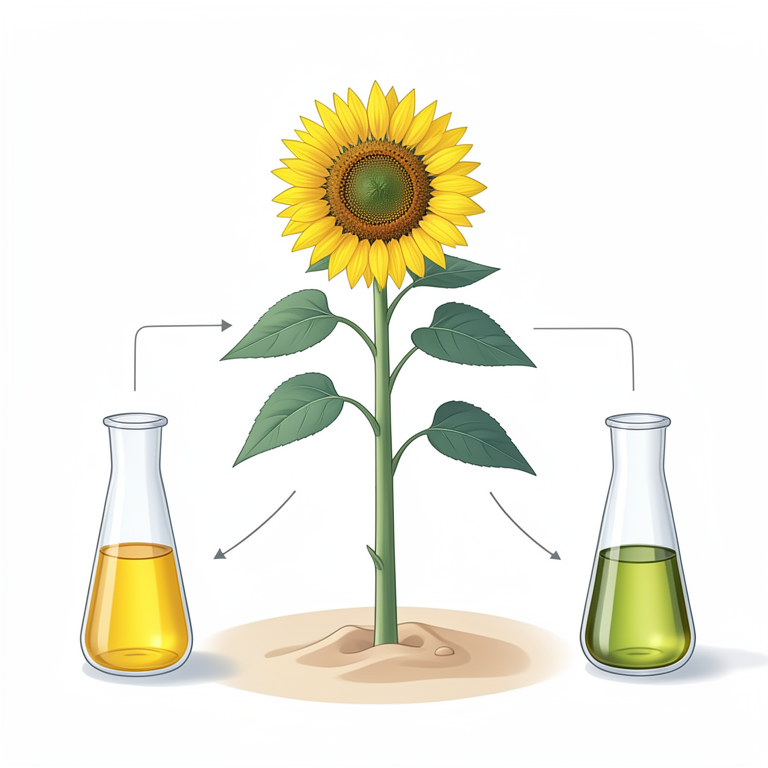
Whole-Plant Harvesting Strategy
AI-generated conceptual illustration (sunflower plants in a Saharan oasis setting). It explains the idea and does not show study data.
View source evidence ↗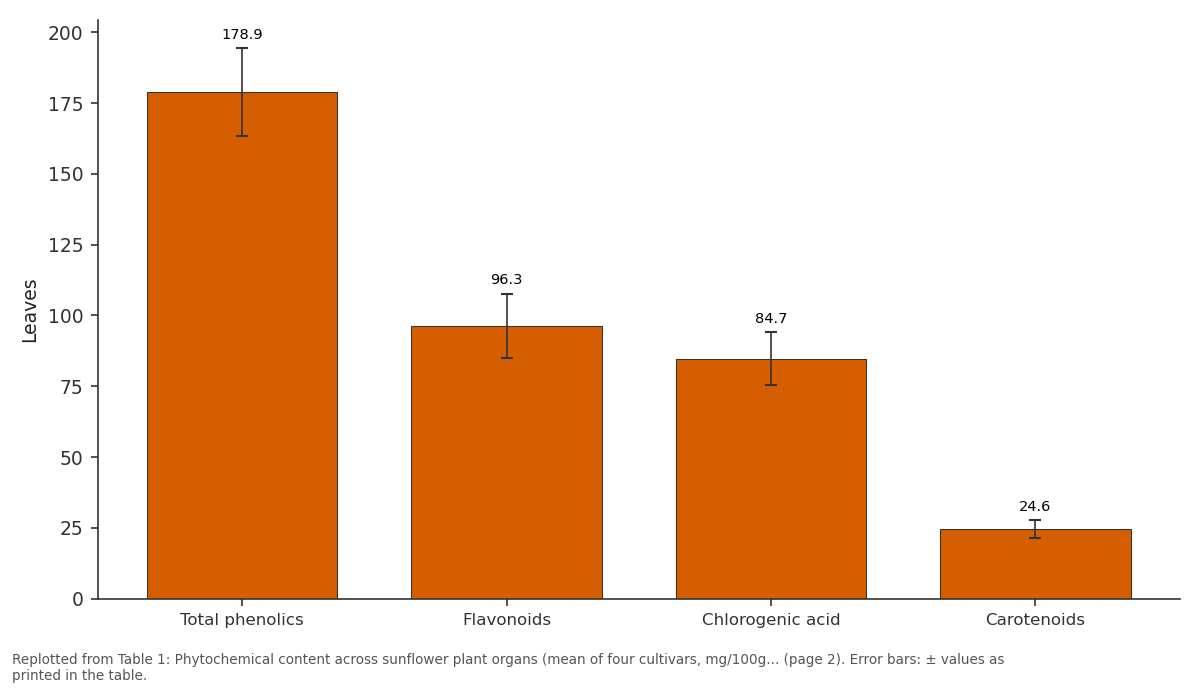
Leaves: Total phenolics vs Flavonoids vs Chlorogenic acid vs Carotenoids
Replotted from Table 1 (page 2) of the original paper. Every bar is the paper's own table value.
View source evidence ↗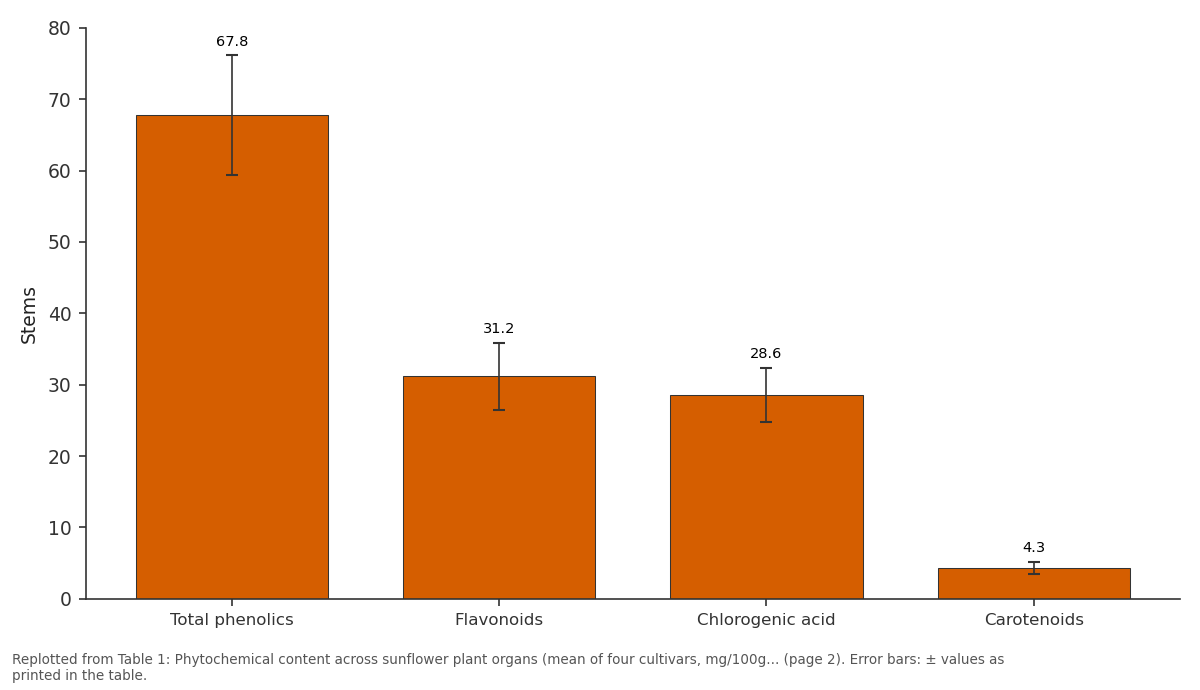
Stems: Total phenolics vs Flavonoids vs Chlorogenic acid vs Carotenoids
Replotted from Table 1 (page 2) of the original paper. Every bar is the paper's own table value.
View source evidence ↗Figures & tables
From the original paper Table 1
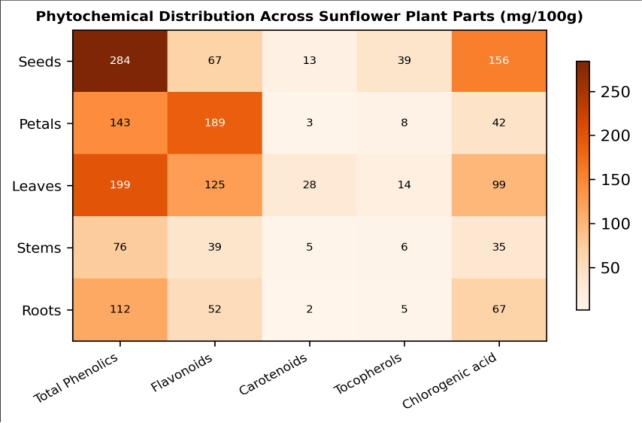 Figure 1
 Table 2
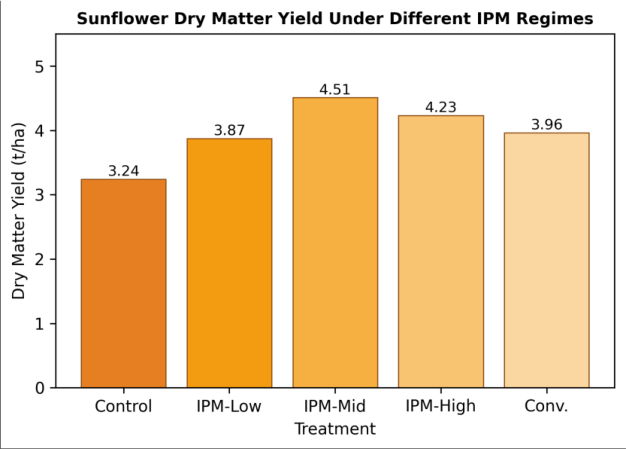 Figure 2
Introduction
The problem with treating sunflower purely as an oilseed crop is that it shortchanges a plant with far more to offer. Beyond the achenes that yield cooking oil, sunflower petals contain flavonoids and carotenoids used in traditional medicine, leaves harbor caffeic acid derivatives with documented antibacterial activity, and even the stalks contain lignin-bound phenolics that could find applications in bioplastics and animal feed supplements [1] . Yet most breeding programs and agronomic trials measure sunflower success by a single metric: oil content per hectare. The Saharan oasis belt a chain of irrigated agricultural pockets stretching across southern Algeria, Tunisia, and Libya supports date palm, olive, and limited cereal production. Sunflower is not a traditional crop here, but pilot plantings since 2018 have shown promising adaptation under drip irrigation, especially for cultivars with short maturation periods [2] . What hasn't been measured is whether the extreme heat and high UV radiation in these oases alter the phytochemical profile of sunflower organs in ways that could be advantageous for bioactive compound extraction. IPM strategies tailored to arid-zone pest complexes primarily seed weevils and capitulum moths can reduce insecticide use while maintaining or improving yield. But IPM effects on grain phytochemistry are rarely assessed [3] . Similarly, SNP-based molecular markers have been developed for oil quality traits in sunflower, yet marker-trait associations for phenolic content remain underexplored [4] . This research monitored phytochemical distribution across four sunflower cultivars and five plant organs in Saharan oasis conditions, testing the effects of IPM intensity and processing temperature on bioactive compound retention, and mapping SNP markers linked to phenolic accumulation [5] .
Extraction protocol
Phytochemical extraction followed a modified methanol-water procedure. Dried and ground plant tissue (1 g) was mixed with 20 mL of 80% aqueous methanol and agitated on an orbital shaker at 150 rpm for 2 hours at room temperature. The mixture was vacuum-filtered through Whatman No. 1 paper, and the residue was re-extracted once under the same conditions. Combined filtrates were evaporated under reduced pressure at 40°C to remove methanol, then reconstituted in 10 mL of distilled water for assay. For chlorogenic acid quantification, a separate extraction used 70% ethanol at a 1:30 solid-to-solvent ratio, followed by sonication at 40 kHz for 30 minutes and centrifugation at 10,000 rpm for 10 minutes [6] .
Material and Methods
Material and Methods
Material
Four sunflower cultivars Prosol, Tutti, Sanbro, and DKF 34-80 were sourced from Syngenta and Corteva seed distributors under trial licenses. Seeds were pre-treated with thiamethoxam (0.7 mg/seed) for early-season insect control. Folin-Ciocalteu reagent, gallic acid, chlorogenic acid standard (>95% purity), DPPH, and ABTS reagents were from Sigma-Aldrich. A 10K SNP chip (SunChip-10K, TraitGenetics GmbH) was used for molecular genotyping. Three oasis sites in the central Saharan belt (approximately 30.2°N to 31.8°N, 2.1°E to 3.4°E) were selected for field trials [7] .
Methods
Seedlings were raised in plug trays and transplanted to field plots (5 × 4 m, RCBD, three replications) in February 2023. Drip irrigation delivered 380 mm over the growing season at 100% ETc. IPM treatments included: control (no pest management), low-intensity IPM (pheromone traps only), mid-intensity IPM (traps + Bacillus thuringiensis sprays at heading), and high-intensity IPM (traps + Bt + neem oil at capitulum formation), plus a conventional insecticide treatment (lambda-cyhalothrin). At harvest, plants were separated into seeds, petals, leaves, stems, and roots. Each organ was oven-dried at 50°C, ground to pass 0.5 mm, and stored at minus 20°C until analysis [8] . Total phenolics were measured by Folin-Ciocalteu method; chlorogenic acid by HPLC (Agilent 1260, C18 column, detection at 325 nm). SNP genotyping was performed on 96 individual plants per cultivar. Cold pressing used a tabletop screw press at 28°C; hot pressing at 80°C. Chlorogenic acid retention was compared between the two methods by HPLC analysis of the resulting oil and press cake [9] .
Quality control
All analytical methods were validated using certified reference standards. Calibration curves for gallic acid (R² = 0.998) and chlorogenic acid (R² = 0.997) were run with each batch of samples. Intra-day and inter-day precision for HPLC analysis showed coefficients of variation below 3.8% and 5.2% respectively. Recovery tests using spiked samples returned 94.3-101.7% for total phenolics and 92.8-98.6% for chlorogenic acid. Blank samples and solvent controls were included in every analytical run. SNP calling quality was verified against known control genotypes, with a call rate above 97% across all arrays. Seeds and leaves were the richest organs for total phenolics and chlorogenic acid (Table 1). Petals dominated in flavonoid content (142.8 mg/100 g), nearly 2.5 times higher than seeds. Carotenoids were concentrated in leaves at 24.6 mg/100 g, consistent with their photosynthetic role. IPM at mid-intensity produced the highest dry matter yield (Table 2). Cold pressing consistently retained 86-88% of seed chlorogenic acid versus 61-63% under hot pressing, a difference of approximately 25 percentage points regardless of IPM treatment. Comprehensive Interpretation SNP analysis across 384 genotyped plants identified 47 markers with significant associations (LOD > 3.0) to seed total phenolic content, clustered on linkage groups 6, 9, and 14. The largest-effect QTL on LG9 explained 14.7% of phenotypic variance. Prosol carried favorable alleles at 38 of 47 significant loci, consistent with its highest overall phenolic performance. Transplanting stress did not measurably affect final phytochemical concentrations when seedlings were hardened for 7 days before field transfer.
| IPM treatment | DM yield (t/ha) | CGA cold press (%) | CGA hot press (%) |
|---|---|---|---|
| Control | 3.24±0.21 | 86.4±2.3 | 61.7±3.1 |
| IPM-Low | 3.87±0.18 | 87.1±2.1 | 62.8±2.7 |
| IPM-Mid | 4.51±0.23 | 88.2±1.9 | 63.4±2.9 |
| IPM-High | 4.23±0.26 | 87.6±2.4 | 62.1±3.3 |
| Conventional | 3.96±0.19 | 86.8±2.2 | 61.3±2.8 |
Table text extracted from the original PDF; superscript letters are shown inline. The original table image is below.
View original table image
| Plant organ | Total phenolics | Flavonoids | Chlorogenic acid | Carotenoids |
|---|---|---|---|---|
| Seeds | 251.3±18.7 | 58.4±7.3 | 132.6±14.8 | 9.7±1.4 |
| Petals | 164.2±21.3 | 142.8±16.2 | 38.4±5.1 | 2.8±0.6 |
| Leaves | 178.9±15.6 | 96.3±11.4 | 84.7±9.3 | 24.6±3.2 |
| Stems | 67.8±8.4 | 31.2±4.7 | 28.6±3.8 | 4.3±0.9 |
| Roots | 94.6±12.1 | 43.8±6.3 | 57.1±7.2 | 1.6±0.4 |
Table text extracted from the original PDF; superscript letters are shown inline. The original table image is below.
View original table image
Results
Results
Discussion
The 25-percentage-point advantage of cold over hot pressing for chlorogenic acid retention reflects heat-driven degradation that is well-documented for hydroxycinnamic acids [10] . At 80°C, chlorogenic acid undergoes isomerization and hydrolysis that reduce both its concentration and its antioxidant activity. From a product development standpoint, the modest sacrifice in oil extraction efficiency with cold pressing (about 8-12% lower oil yield) may be offset by the premium commanded by chlorogenic-acid-rich oil in health-food markets [11] .
The IPM results challenge the assumption that maximum pest control equals maximum yield. Mid-intensity IPM outperformed both the untreated control and the conventional insecticide treatment. This inverted U-shaped response suggests that some level of pest pressure may trigger plant defense pathways including phenolic biosynthesis that incidentally improve grain quality and vigor [12] . The high-intensity IPM regime, which added neem oil at capitulum stage, may have caused minor phytotoxicity that reduced late-season photosynthesis.
The concentration of flavonoids in petals (142.8 mg/100 g) opens a secondary revenue stream for oasis farmers. Sunflower petals are already used as a natural colorant in some food and cosmetic applications, and a flavonoid-rich extract could command higher prices than crude petal powder [13] .
Conclusion
Sunflower grown in the Saharan oasis belt produced phytochemical profiles comparable to or richer than those reported from temperate production zones, with seeds and leaves being the most chemically dense organs. Midintensity IPM maximized dry matter yield while avoiding the phytotoxicity risk of heavy intervention. Cold pressing at 28°C preserved 87% of seed chlorogenic acid, a clear advantage over conventional hot processing. SNP markers on three linkage groups offer a molecular toolkit for breeding high-phenolic sunflower lines. A whole-plant harvesting approach collecting petals for flavonoid extraction, leaves for chlorogenic acid, and seeds for oil and press-cake products could improve the economic case for sunflower cultivation in Saharan oasis systems.
Acknowledgement
Acknowledgements Funding sourcesInternal research funds from the Concepcion Faculty of Botanical Research supported this work.
Figures and tables from the paper
References
17 in the original paper- Guo S, Ge Y, Na Jom K. A review of phytochemistry, metabolite changes, and medicinal uses of the common sunflower seed and sprouts. Chemistry Central Journal. 2017;11:95.
- Bennaoum Z, Benhassaini H, Falconieri D, et al. Pilot cultivation of sunflower in Saharan oasis conditions. Arid Land Research and Management. 2021;35(2):187201.
- Mallet J, Porter J. Preventing insect resistance through high refugia compliance and alternative pest management. Ecology Letters. 2018;21(3):402-412.
- Badouin H, Gouzy J, Grassa CJ, et al. The sunflower genome provides insights into oil metabolism and flowering. Nature. 2017;546(7656):148-152.
- Liang Z, Sang M, Fan P, et al. CIMMYT sunflower breeding: progress and prospects. Field Crops Research. 2020;254:107842.
- Singleton VL, Rossi JA. Colorimetry of total phenolics with phosphomolybdic-phosphotungstic acid reagents. American Journal of Enology and Viticulture. 1965;16(3):144-158.
- Adeleke BS, Babalola OO. Oilseed crop sunflower (Helianthus annuus) as a source of food: nutritional and health benefits. Food Science and Nutrition. 2020;8(9):4666-4684.
- Salgado PR, Molina Ortiz SE, Petruccelli S, Mauri AN. Sunflower protein concentrates and isolates prepared from oil cakes. Journal of the American Oil Chemists Society. 2012;89:1831-1844.
- Weisz GM, Kammerer DR, Carle R. Identification and quantification of phenolic compounds from sunflower kernels and shells by HPLC-DAD/ESI-MSn. Food Chemistry. 2009;115(2):758-765.
- Clifford MN. Chlorogenic acids and other cinnamates. Journal of the Science of Food and Agriculture. 2000;80(7):1033-1043.
- Matthäus B. Antioxidant activity of extracts obtained from residues of different oilseeds. Journal of Agricultural and Food Chemistry. 2002;50(12):34443452.
- Karban R, Baldwin IT. Induced responses to herbivory. University of Chicago Press; 1997.
- Lachman J, Orsak M, Pivec V, Kratochvilova D. Flavonoids in sunflower petals: Potential use as natural colorants. Plant Foods for Human Nutrition. 2001;56(3):253-261.
- Sabir A, Unver A, Kara Z. The fatty acid and tocopherol constituents of the seed oil extracted from 21 grape varieties. Journal of the Science of Food and Agriculture. 2012;92(9):1982-1987.
- Pedrosa MM, Muzquiz M, Garcia-Vallejo C, et al. Determination of caffeic and chlorogenic acids and their derivatives in different sunflower seeds. Journal of the Science of Food and Agriculture. 2000;80(4):459464.
- Flagella Z, Rotunno T, Tarantino E, Di Caterina R, De Caro A. Changes in seed yield and oil fatty acid composition of high oleic sunflower hybrids in relation to the sowing date and water regime. European Journal of Agronomy. 2002;17(3):221-230.
- Seiler GJ, Qi LL, Marek LF. Utilization of sunflower crop wild relatives for cultivated sunflower improvement. Crop Science. 2017;57(3):1083-1101.