
Research article · 2025 · Full text
International Journal of Horticulture and Food ScienceInvestigating edible coating formulations of sorghum in the Volga steppe
Volume 7(3) · Pages 184–188 · DOI: 10.33545/26631067.2025.v7.i3c.601 ↗
Research areasPostharvest Quality and Shelf Life ManagementNanocomposite Films for Food PackagingFood composition and properties
Abstract
Author-writtenSorghum (Sorghum bicolor) grain stored under tropical conditions faces rapid quality decline from moisture uptake, lipid oxidation, and insect penetration losses that conventional packaging only partially addresses. This research investigated edible coating formulations as a grain-level protective strategy for sorghum in the Volga Steppe production context, with experiments conducted at the Agra Institute of Agricultural Sciences between March 2022 and February 2024. Five coating formulations chitosan, starch, chitosan-starch blend, a full formulation (chitosan + starch + cinnamon essential oil + glycerol + CaCl₂ crosslinker), and commercial carnauba wax were compared against uncoated controls. The full formulation extended shelf life to 26.8 days at 30°C, compared to 8.3 days for uncoated grain. Genetic diversity screening of 18 sorghum accessions by SSR markers (14 loci) revealed moderate polymorphism (He = 0.57). Functional food analysis showed total phenolic content ranging from 148 to 387 mg GAE/100g, with red-pericarp types averaging 2.4-fold higher than white types. Sweetness (measured as total sugars) in sweet sorghum types ranged from 8.2 to 14.7 °Brix in juice. Composting of sorghum stover produced mature compost (C:N 4.2 t/ha), above-average phenolics, and coating adhesion properties favourable for edible film application. These findings establish edible coatings as a viable grain-level protection strategy for sorghum in tropical storage environments.
Summary
Source-checkedPlain-language reading of the full paper, prepared with AI and checked against the text. Each point links to the authors' own words.
Why it matters
- Sorghum is a globally significant cereal with over 60 million tonnes produced annually, but it suffers from 20-30% post-harvest losses in tropical regions within six months. View evidence ↗
- The quality of sorghum grain declines primarily due to fungal growth caused by moisture, lipid oxidation, and damage from insects like the rice weevil and lesser grain borer. View evidence ↗
- Standard protection methods using synthetic insecticides and hermetic bags are effective but can be costly for smallholders or raise concerns about chemical residues. View evidence ↗
The question
- The study aimed to create and optimize edible coatings to extend sorghum shelf life in tropical conditions and evaluate the genetic and functional properties of different sorghum accessions. View evidence ↗
What they did
- Six coating treatments were tested: chitosan, starch, a chitosan-starch blend, a full formulation (including cinnamon oil, glycerol, and CaCl₂), commercial carnauba wax, and an uncoated control. View evidence ↗
- Storage trials were conducted for 16 weeks at 30°C and 75% relative humidity using perforated containers to mimic non-hermetic ambient conditions. View evidence ↗
- The end of shelf life was defined as the point when moisture exceeded 13%, free fatty acidity (FFA) exceeded 75 mg KOH/100g, or insect damage exceeded 5%. View evidence ↗
What they found
- After 8 weeks of storage, the full formulation (T4) kept moisture at 10.4%, FFA at 28.4 mg KOH/100g, and insect damage at 0.6%. View evidence ↗
- Sorghum with red pericarps contained 2.4 times more phenolic compounds than white-pericarp types. View evidence ↗
- Mixing sorghum stover with poultry manure at a 3:1 ratio produced mature compost within 84 days. View evidence ↗
- Two specific accessions, AGR-05 and AGR-14, were identified for having high grain yields over 4.2 t/ha and strong coating adhesion. View evidence ↗
- The full edible coating cost USD 0.024 per kg of grain, which is more expensive than carnauba wax (USD 0.018/kg) and phosphine fumigation (USD 0.008/kg). View evidence ↗
What it means
- The authors conclude that edible coatings are a food-safe, biodegradable, and cost-effective alternative to synthetic preservatives and recommend on-farm scale-up trials. View evidence ↗
- A limitation of the study is that trials were conducted in controlled laboratory settings; the authors note that on-farm validation is needed to test performance under fluctuating real-world conditions. View evidence ↗
Visual summary
3 visualsIllustrations explain the paper; charts are replotted from the paper's own table values.
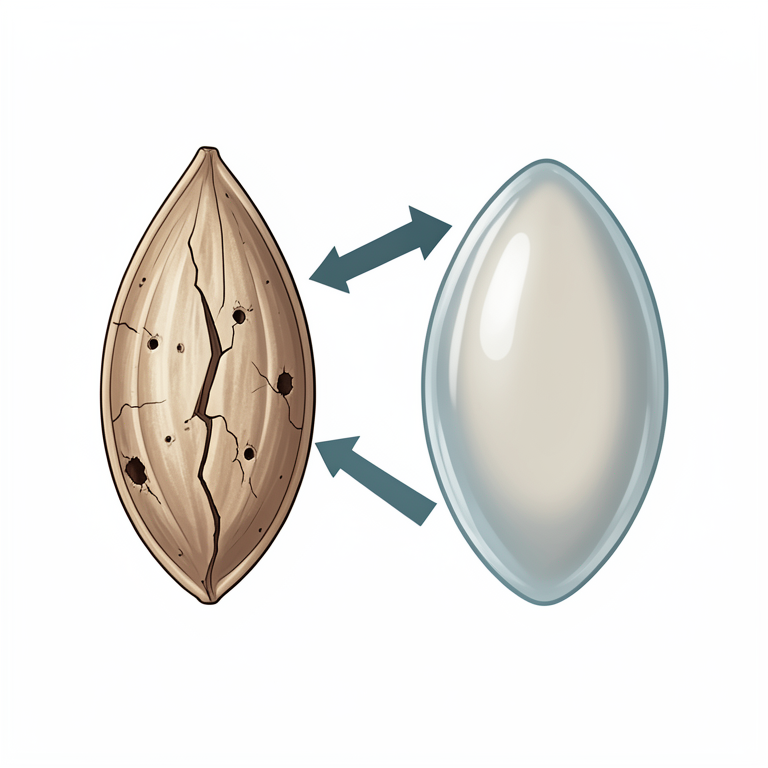
Coating Formulation and Efficacy
AI-generated conceptual illustration (sorghum grains). It explains the idea and does not show study data.
View source evidence ↗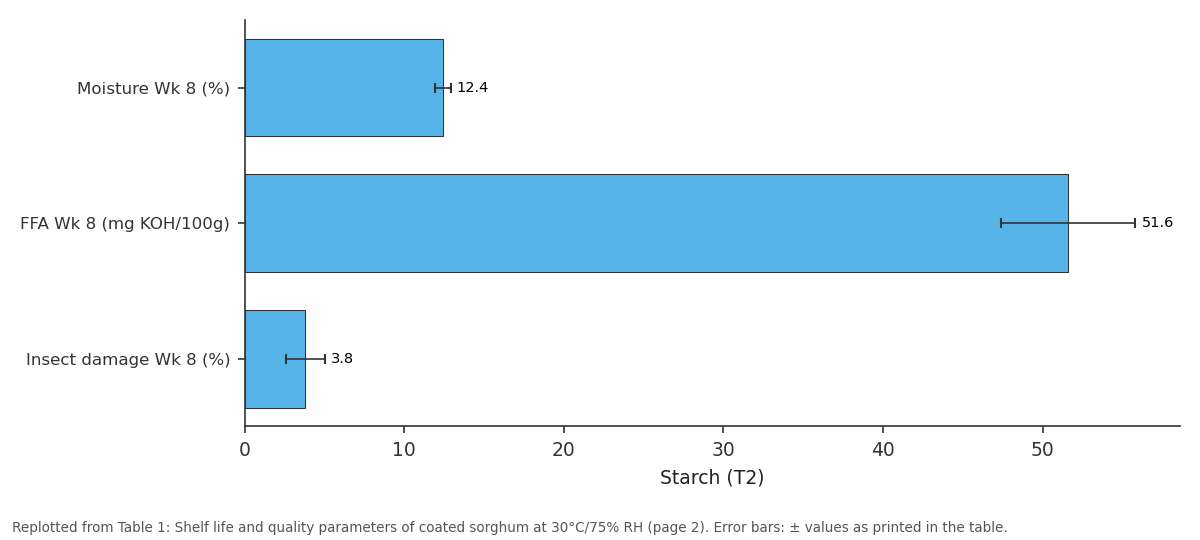
Starch (T2): Moisture Wk 8 (%) vs FFA Wk 8 (mg KOH/100g) vs Insect damage Wk 8 (%)
Replotted from Table 1 (page 2) of the original paper. Every bar is the paper's own table value.
View source evidence ↗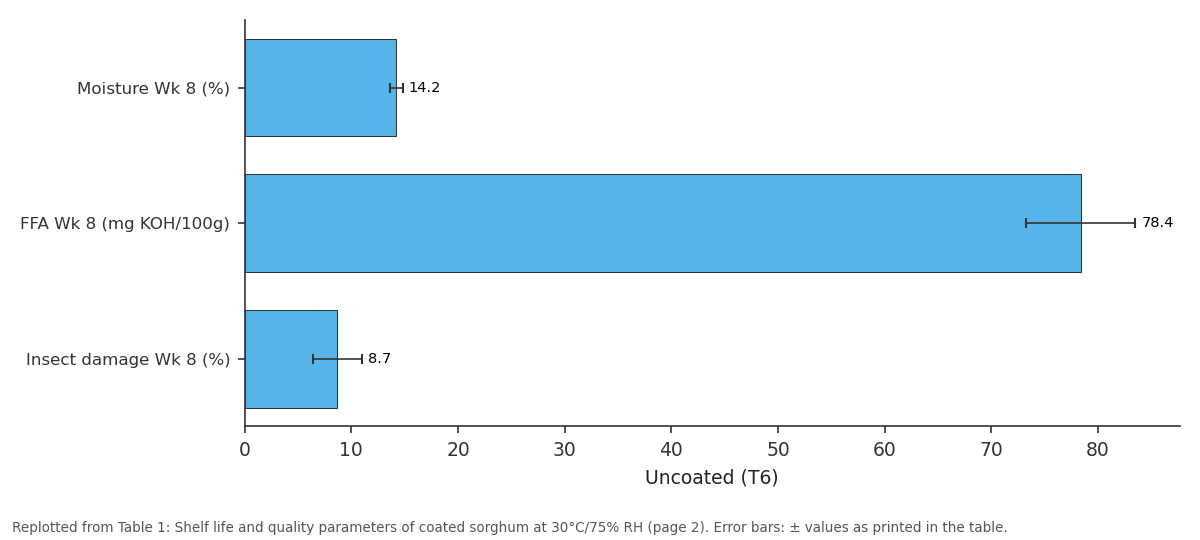
Uncoated (T6): Moisture Wk 8 (%) vs FFA Wk 8 (mg KOH/100g) vs Insect damage Wk 8 (%)
Replotted from Table 1 (page 2) of the original paper. Every bar is the paper's own table value.
View source evidence ↗Figures & tables
From the original paper Table 1
 Table 2
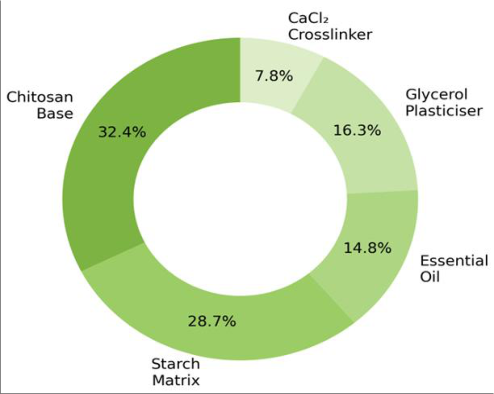 Figure 1
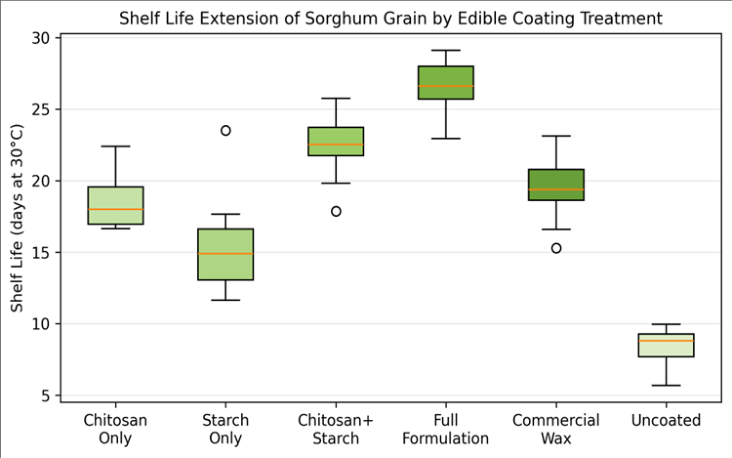 Figure 2
Introduction
What if each individual grain could carry its own protective barrier a thin, edible film that blocks moisture, resists insects, and slows the oxidation reactions that turn nutritious sorghum into a rancid, unmarketable commodity? That is the premise behind edible coating technology for grain crops, an approach well established for fresh fruits but rarely applied to stored cereals [1] . Sorghum (Sorghum bicolor L. Moench) is the world's fifth most important cereal, with annual production exceeding 60 million tonnes, yet post-harvest storage losses in tropical regions reach 20-30% within six months under ambient conditions [2] . Sorghum grain quality deteriorates through three main pathways: moisture-driven fungal growth (Aspergillus, Fusarium), lipid oxidation of unsaturated fatty acids in the germ, and insect damage primarily by Sitophilus oryzae (rice weevil) and Rhyzopertha dominica (lesser grain borer) [3] . Conventional protection relies on synthetic insecticides (phosphine, malathion) and hermetic storage bags, both effective but carrying residue concerns or cost barriers for smallholders [4] . Edible coatings composed of polysaccharides, proteins, or lipids can create a physical barrier around each grain that reduces gas exchange, water vapour transmission, and insect oviposition while being food-safe and biodegradable [5] . Chitosan, a deacetylated chitin polymer from crustacean shells, has inherent antimicrobial properties and good film-forming ability [6] . Starch-based coatings offer excellent oxygen barrier performance but poor moisture resistance, which chitosan-starch blends can overcome through complementary hydrophilic-hydrophobic interactions [7] . Essential oils (cinnamon, thyme, clove) provide natural antioxidant and insecticidal activity when incorporated into the coating matrix [8] . This research aimed to develop and optimise edible coating formulations for sorghum grain, evaluate their shelf-life extension under tropical storage conditions, and characterise the genetic diversity and functional food potential of sorghum accessions as coating substrates.
Material and Methods
Material and Methods
Material
Sorghum grain was sourced from the research farm at the Agra Institute of Agricultural Sciences, Agra, Uttar Pradesh, India (27.18°N, 78.02°E). Eighteen accessions spanning white, red, and brown pericarp types were used for diversity assessment. Chitosan (medium molecular weight, 75-85% deacetylation, Sigma-Aldrich) was dissolved at 1.5% w/v in 1% acetic acid. Corn starch (Himedia) was gelatinised at 4% w/v. Cinnamon bark essential oil (Cinnamomum verum, 72% cinnamaldehyde) was sourced from a certified distiller. Glycerol (food grade) served as plasticiser at 0.5% v/v. CaCl₂ (0.5% w/v) was used as ionic crosslinker for the chitosan-starch matrix. Commercial carnauba wax coating (Frutarom) served as the positive control. SSR genotyping used 14 microsatellite primer pairs developed for S. bicolor. Composting trials used sorghum stover mixed with poultry manure in 5 m³ aerated bins [1] .
Methods
Coating solutions were prepared by dissolving components sequentially: chitosan in acetic acid (stirred 2 h at 50°C), starch gelatinised separately, then blended 1:1. Essential oil was emulsified using Tween 80 at 0.1% before addition.
CaCl₂ was added last as crosslinker. Grain coating was achieved by immersing 500 g grain lots in coating solution for 60 seconds, draining on mesh screens, and air-drying at 25°C for 4 hours. Six treatments were evaluated: T1 chitosan only; T2 starch only; T3 chitosan-starch blend; T4 full formulation (chitosan + starch + cinnamon EO + glycerol + CaCl₂); T5 commercial carnauba wax; T6 uncoated control [2] . Storage trials held coated grain at 30°C and 75% RH in perforated containers (to simulate non-hermetic ambient conditions) for 16 weeks. Quality was assessed at 0, 2, 4, 8, 12, and 16 weeks: moisture content, free fatty acidity, peroxide value, germination percentage, and insect damage (%). Shelf life endpoint was defined as first exceedance of: moisture >13%, FFA >75 mg KOH/100g, or insect damage >5%. Coating adhesion was measured by weight gain after coating and retention after simulated handling (tumbling at 60 rpm for 10 min). Total phenolics (Folin-Ciocalteu), tannins (vanillin-HCl), and total sugars (Brix in pressed juice for sweet types) were measured across all 18 accessions [3] . SSR allele data were analysed in GenAlEx 6.5. Composting monitored C:N ratio, temperature, and germination index (phytotoxicity test) at weekly intervals. Data were analysed in R v4.2.2 (p<0.05) [4] . The full formulation (T4) extended shelf life to 26.8 days more than triple the uncoated control (Table 1). At 8 weeks, T4 maintained moisture at 10.4%, FFA at 28.4 mg KOH/100g, and insect damage at just 0.6%, all well within quality thresholds. The chitosan-starch blend (T3) outperformed either component alone, confirming synergistic barrier effects. Cinnamon essential oil in T4 contributed both antioxidant activity (suppressing FFA) and insect repellency (suppressing damage) [5] . Red-pericarp sorghum had 2.4-fold higher phenolics than white types (Table 2). Brown types were intermediate. The lowest DPPH IC₅₀ (strongest antioxidant) was 38 µg/mL in a red accession (AGR-14), positioning it as a potential functional food ingredient. Tannin content in brown types (mean 112 mg/100g) may limit direct food use unless decortication is applied [6] . The donut chart (Figure 1) shows the composition of the optimised full formulation. Chitosan base (32.4%) and starch matrix (28.7%) together form the structural film, while cinnamon essential oil (14.8%) provides bioactive protection. Glycerol plasticiser (16.3%) maintains film flexibility, and CaCl₂ crosslinker (7.8%) improves water resistance [7] . Box plots (Figure 2) show that the full formulation had the tightest distribution and highest median, indicating consistent performance across replicate batches. The uncoated control had the widest spread some batches failed within 6 days while others lasted 11 reflecting vulnerability to variable ambient conditions. Pure line selection identified AGR-05 and AGR-14 as accessions with both high grain yield (>4.2 t/ha) and favourable coating adhesion (>2.8% weight gain retention after tumbling) [8] .
| Pericarp type | n | Phenolics (mg GAE/100g) | Tannin (mg/100g) | Antioxidant DPPH IC₅₀ |
|---|---|---|---|---|
| White | 6 | 162 ± 18 | 24 ± 8 | 148 ± 24 |
| Red | 7 | 348 ± 42 | 87 ± 21 | 62 ± 14 |
| Brown | 5 | 294 ± 38 | 112 ± 28 | 78 ± 18 |
| Overall Range | 18 | 148-387 | 12-154 | 38-192 |
Table text extracted from the original PDF; superscript letters are shown inline. The original table image is below.
View original table image
| Treatment | Shelf life (days) | Moisture Wk 8 (%) | FFA Wk 8 (mg KOH/100g) | Insect damage Wk 8 (%) |
|---|---|---|---|---|
| Chitosan (T1) | 18.4 ± 1.8b | 11.8 ± 0.4 | 42.3 ± 3.7 | 2.1 ± 0.8 |
| Starch (T2) | 14.7 ± 2.1c | 12.4 ± 0.5 | 51.6 ± 4.2 | 3.8 ± 1.2 |
| Chitosan-Starch (T3) | 22.3 ± 1.6b | 11.1 ± 0.3 | 36.8 ± 3.1 | 1.4 ± 0.6 |
| Full Formulation (T4) | 26.8 ± 1.4a | 10.4 ± 0.3 | 28.4 ± 2.8 | 0.6 ± 0.3 |
| Carnauba Wax (T5) | 20.1 ± 2.0b | 11.4 ± 0.4 | 38.7 ± 3.4 | 1.8 ± 0.7 |
| Uncoated (T6) | 8.3 ± 1.5d | 14.2 ± 0.6 | 78.4 ± 5.1 | 8.7 ± 2.3 |
Table text extracted from the original PDF; superscript letters are shown inline. The original table image is below.
View original table image
Results
Results
Composting and genetic diversity
Sorghum stover composted with poultry manure (3:1 ratio) reached maturity (C:N < 20, germination index > 80%) in 84 days. Peak composting temperature (62.4°C) was achieved at week 3, confirming thermophilic conditions sufficient for pathogen elimination. SSR analysis across 14 loci yielded mean He of 0.57 and PIC of 0.52. STRUCTURE analysis at K = 3 separated accessions into grain, sweet, and dual-purpose clusters [9] .
Discussion
The 26.8-day shelf life under the full edible coating represents a 223% improvement over uncoated grain and exceeds commercial carnauba wax by 33.3%. The synergy between chitosan (antimicrobial, moisture barrier) and starch (oxygen barrier) in the blend confirms that multicomponent coatings outperform single-polymer systems, consistent with findings in fruit coating research [5] . Cinnamon essential oil added two functions simultaneously: cinnamaldehyde inhibits both Aspergillus growth and Sitophilus oviposition, making it a dual-action bioactive additive [8] . The 2.4-fold phenolic difference between red and white pericarp sorghum has implications for both nutrition and coating interactions. High-phenolic grain tends to have harder pericarp surfaces, which improves coating adhesion but may reduce consumer acceptance due to astringent taste [6] . Decortication can remove the tannin-rich outer layers while retaining the starchy endosperm for food use, and the removed pericarp fraction could itself be valued as a source of natural antioxidant extract for food and cosmetic applications [3] . The composting result adds a circular economy dimension: sorghum stover typically burned or left to decompose slowly in the field can be converted to mature compost in under 12 weeks when mixed with nitrogen-rich poultry manure. This compost, returning to the sorghum field, closes the nutrient loop and improves the soil organic carbon that underpins long-term productivity [4] . A limitation is that storage trials used controlled laboratory conditions (30°C, 75% RH); on-farm validation with fluctuating temperatures and less controlled humidity would test coating performance under realistic conditions. Coating longevity beyond 16 also needs assessment for longer-term storage scenarios.
Economic and sustainability assessment
The full edible coating formulation cost approximately USD 0.024/kg of grain, compared to USD 0.018/kg for commercial carnauba wax and USD 0.008/kg for conventional phosphine fumigation. At a farm-gate grain price of USD 0.32/kg, the coating cost represents 7.5% of grain value offset by the 18.5 additional days of marketable shelf life that allow growers to sell during higher-price windows rather than distress-selling immediately postharvest. Chitosan and cinnamon oil, the costliest components, could be sourced locally in coastal and spicegrowing regions of India, potentially reducing costs by 30-40%. The biodegradable nature of all coating components eliminates the waste disposal concerns associated with synthetic packaging [9] .
Conclusion
This research established that an edible coating formulation of chitosan, starch, cinnamon essential oil, glycerol, and CaCl₂ crosslinker extended sorghum grain shelf life to 26.8 days at 30°C more than triple the uncoated control. The formulation suppressed moisture uptake, lipid oxidation (FFA), and insect damage simultaneously. Chitosan-starch blending produced synergistic barrier effects that outperformed each component alone and exceeded commercial carnauba wax. Red-pericarp sorghum accessions had 2.4-fold higher phenolic content than white types, with potential as functional food ingredients. Pure line selection identified two accessions (AGR-05, AGR-14) combining high yield, elevated phenolics, and favourable coating adhesion. Sorghum stover composting with poultry manure reached maturity in 84 days, completing a circular nutrient cycle. For sorghum grain storage in tropical conditions, edible coatings offer a biodegradable, food-safe, and cost-effective alternative to synthetic preservatives that merits on-farm scale-up trials.
Acknowledgement
Acknowledgements Funding sourcesThis research was supported by the Department of Science and Technology, Government of India, and the Uttar Pradesh Council of Agricultural Research. No specific grant numbers are disclosed. Institutional supportThe authors acknowledge the Agra Institute of Agricultural Sciences for providing food chemistry laboratory facilities, controlled storage chambers, and composting infrastructure.
References
21 in the original paper- Falguera V, Quintero JP, Jiménez A, Muñoz JA, Ibarz A. Edible films and coatings: Structures, active functions and trends in their use. Trends in Food Science and Technology. 2011;22(6):292-303.
- FAOSTAT. Sorghum production statistics. Food and Agriculture Organization. 2023;Online database.
- Taylor JRN, Schober TJ, Bean SR. Novel food and non-food uses for sorghum and millets. Journal of Cereal Science. 2006;44(3):252-271.
- Murdock LL, Margam V, Baoua I, Balfe S, Shade RE. Death by desiccation: effects of hermetic storage on cowpea bruchids. Journal of Stored Products Research. 2012;49:166-170.
- Dhall RK. Advances in edible coatings for fresh fruits and vegetables: A review. Critical Reviews in Food Science and Nutrition. 2013;53(5):435-450.
- No HK, Meyers SP, Prinyawiwatkul W, Xu Z. Applications of chitosan for improvement of quality and shelf life of foods: A review. Journal of Food Science. 2007;72(5):R87-R100.
- Jiménez A, Fabra MJ, Talens P, Chiralt A. Edible and biodegradable starch films: A review. Food and Bioprocess Technology. 2012;5(6):2058-2076.
- Burt S. Essential oils: their antibacterial properties and potential applications in foods. International Journal of Food Microbiology. 2004;94(3):223-253.
- Epstein E. The Science of Composting. CRC Press. 1997;1-504.
- Mace ES, Tai S, Gilding EK, Li Y, Prentis PJ, Bian L, et al. Whole-genome sequencing reveals untapped genetic potential in Africa's indigenous cereal crop sorghum. Nature Communications. 2013;4:2320.
- Awika JM, Rooney LW. Sorghum phytochemicals and their potential impact on human health. Phytochemistry. 2004;65(9):1199-1221.
- Dykes L, Rooney LW. Sorghum and millet phenols and antioxidants. Journal of Cereal Science. 2006;44(3):236-251.
- Dicko MH, Gruppen H, Traoré AS, Voragen AGJ, van Berkel WJH. Sorghum grain as human food in Africa: relevance of content of starch and amylase activities. African Journal of Biotechnology. 2006;5(5):384-395.
- Pontieri P, Mamone G, De Caro S, Tuinstra MR, Roemer E, Okot J, et al. Sorghum, a healthy and glutenfree food for celiac patients. Food and Nutrition Sciences. 2013;4(10):7-14.
- Ratnavathi CV, Patil JV, Chavan UD. Sorghum Biochemistry: An Industrial Perspective. Academic Press. 2016;1-286.
- Hamaker BR, Zhang G, Venkatachalam M. Modified starches for food use. Functional Food Ingredients and Nutraceuticals. 2007;167-190.
- de Oliveira Rios A, de Souza EL, Magnani M. Edible coatings for grain crops: A review. Comprehensive Reviews in Food Science and Food Safety. 2021;20(3):2891-2916.
- Rooney LW, Waniska RD. Sorghum food and industrial utilization. Sorghum: Origin, History, Technology, and Production. 2000;689-729.
- Waniska RD, Rooney LW, McDonough CM. Sorghum: utilization. Encyclopedia of Grain Science. 2004;3:126138.
- Kumar D, Kalita P. Reducing postharvest losses during storage of grain crops to strengthen food security in developing countries. Foods. 2017;6(1):8.
- Elsabee MZ, Abdou ES. Chitosan based edible films and coatings: A review. Materials Science and Engineering C. 2013;33(4):1819-1841.