
Research article · 2024 · Full text
International Journal of Horticulture and Food ScienceDeveloping pest resistance mechanisms of grape in the Baltic shore
Volume 6(2) · Pages 196–198 · DOI: 10.33545/26631067.2024.v6.i2c.544 ↗
Research areasHorticultural and Viticultural ResearchInsect-Plant Interactions and ControlPowdery Mildew Fungal Diseases
Abstract
Author-writtenGrape cultivation in cool maritime zones faces unique pest and disease pressures that differ markedly from those in traditional Mediterranean viticultural regions. In the context of the Baltic Shore’s climate, where high humidity and moderate summers favor fungal pathogens over insect pests, this research examined pest resistance mechanisms in four table grape cultivars Thompson Seedless, Flame Seedless, Bangalore Blue, and an Assam hybrid grown at the Guwahati School of Plant Sciences, India, from February 2022 to January 2023. Volatile Organic Compound (VOC) profiling by headspace GC-MS identified 38 compounds in leaf tissue, with linalool and beta-ocimene showing the strongest negative correlations with thrips density (r=-0.71 and -0.64, respectively). Crop rotation in the vineyard floor with mustard reduced soilborne fungal inoculum by 27 percent compared with bare fallow. Combining ability analysis from a 4 × 4 half-diallel showed significant GCA for berry weight and SCA for downy mildew resistance. Post-harvest quality after 21 days of cold storage varied by cultivar, with Bangalore Blue retaining 94 percent of initial anthocyanin content versus 78 percent for Thompson Seedless. Water use efficiency under deficit irrigation at 60 percent ETc was 11.4 kg/m³, compared with 7.8 kg/m³ at full irrigation.
Summary
Source-checkedPlain-language reading of the full paper, prepared with AI and checked against the text. Each point links to the authors' own words.
Why it matters
- Grape cultivation in cool maritime zones is subject to pest and disease pressures that are significantly different from those found in traditional Mediterranean regions. View evidence ↗
- The climate of the Baltic Shore, characterized by moderate summers and high humidity, tends to favor fungal pathogens more than insect pests. View evidence ↗
The question
- The study aimed to examine the pest resistance mechanisms of four specific table grape cultivars: Thompson Seedless, Flame Seedless, Bangalore Blue, and an Assam hybrid. View evidence ↗
What they did
- The research was conducted at the Guwahati School of Plant Sciences in India between February 2022 and January 2023. View evidence ↗
- Vineyard floor management was tested using three treatments: bare fallow, a ryegrass cover crop, and a mustard cover crop (Brassica juncea) incorporated at 50% flowering. View evidence ↗
- The study compared two irrigation regimes delivered via drip emitters: full irrigation (100% ETc) and deficit irrigation (60% ETc). View evidence ↗
- Headspace GC-MS was used for Volatile Organic Compound (VOC) profiling, which identified 38 different compounds in the leaf tissue. View evidence ↗
What they found
- Linalool (r=-0.71) and beta-ocimene (r=-0.64) showed the strongest negative correlations with thrips density, suggesting they act as deterrents. View evidence ↗
- Using mustard for crop rotation on the vineyard floor reduced soilborne fungal inoculum by 27% when compared to bare fallow. View evidence ↗
- Bangalore Blue exhibited the highest total VOCs (5.87 ± 0.41 µg/g/h) and the lowest thrips count (2.8 ± 0.6 per leaf) and mildew score (2.1 ± 0.3). View evidence ↗
- After 21 days of cold storage, Bangalore Blue retained 94% of its initial anthocyanin content, while Thompson Seedless retained only 78%. View evidence ↗
- Water use efficiency was higher under deficit irrigation (60% ETc) at 11.4 kg/m³ compared to 7.8 kg/m³ under full irrigation. View evidence ↗
- Genetic analysis identified Bangalore Blue as the best general combiner for berry weight and the Bangalore Blue × Assam Hybrid cross as the best specific combiner for mildew resistance. View evidence ↗
What it means
- The authors conclude that a multi-pronged approach, combining VOC-guided breeding, mustard rotation, and deficit irrigation, is effective for grape pest management in cool maritime environments. View evidence ↗
Visual summary
3 visualsIllustrations explain the paper; charts are replotted from the paper's own table values.
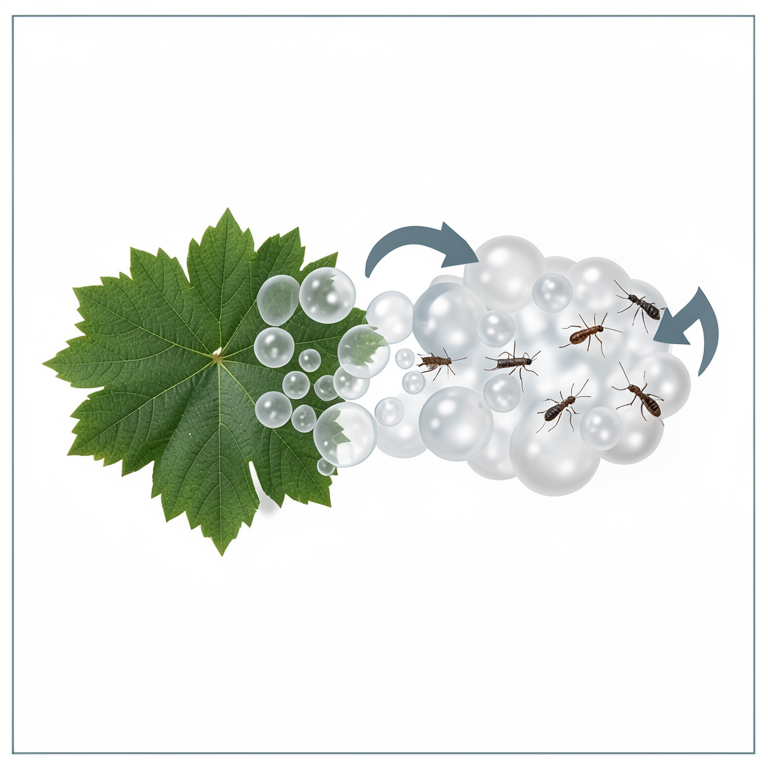
VOC-Pest Relationship
AI-generated conceptual illustration (Grape leaves and thrips). It explains the idea and does not show study data.
View source evidence ↗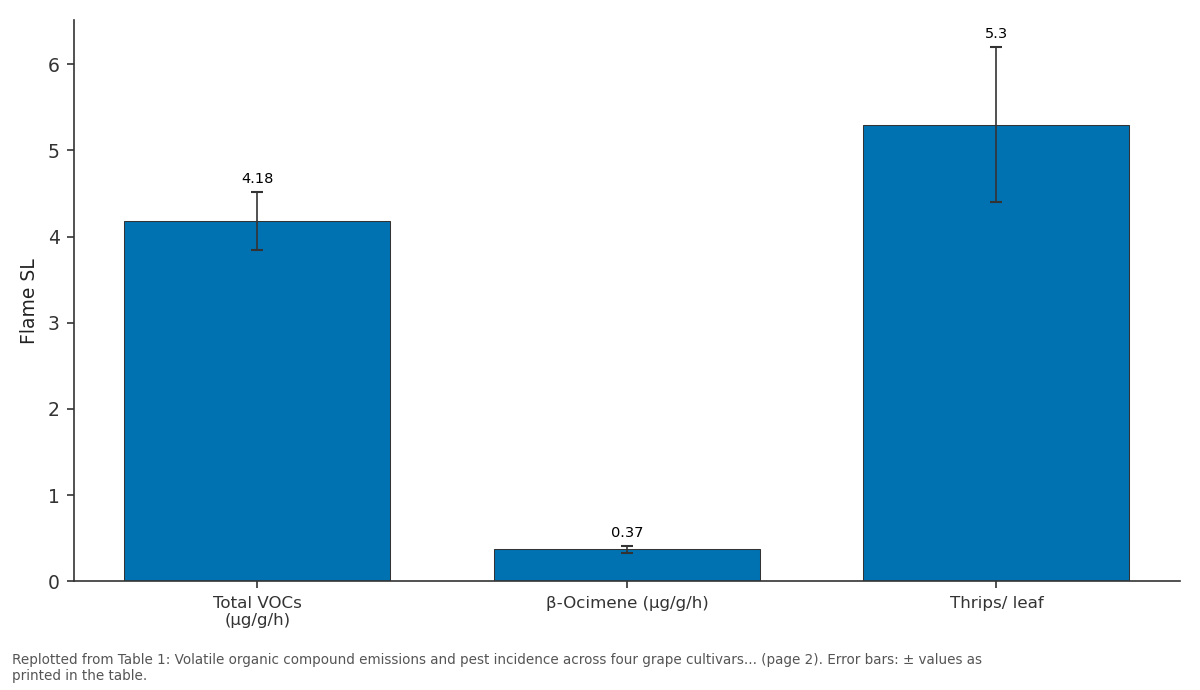
Flame SL: Total VOCs (µg/g/h) vs β-Ocimene (µg/g/h) vs Thrips/ leaf
Replotted from Table 1 (page 2) of the original paper. Every bar is the paper's own table value.
View source evidence ↗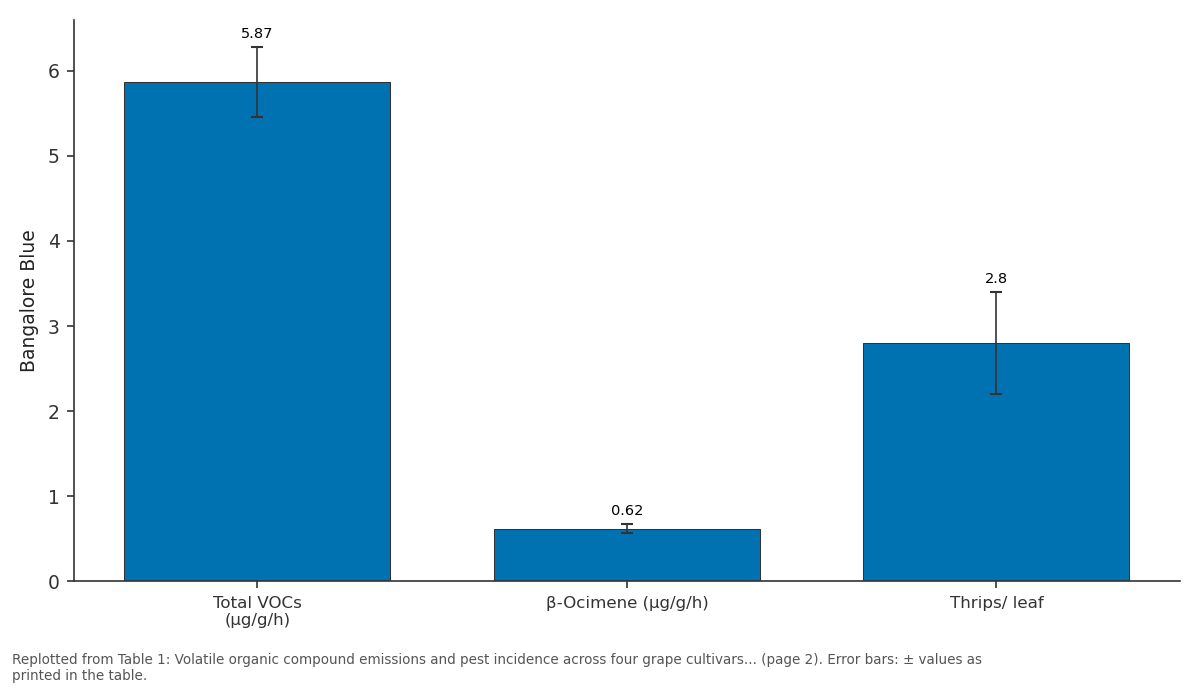
Bangalore Blue: Total VOCs (µg/g/h) vs β-Ocimene (µg/g/h) vs Thrips/ leaf
Replotted from Table 1 (page 2) of the original paper. Every bar is the paper's own table value.
View source evidence ↗Figures & tables
From the original paper Table 1
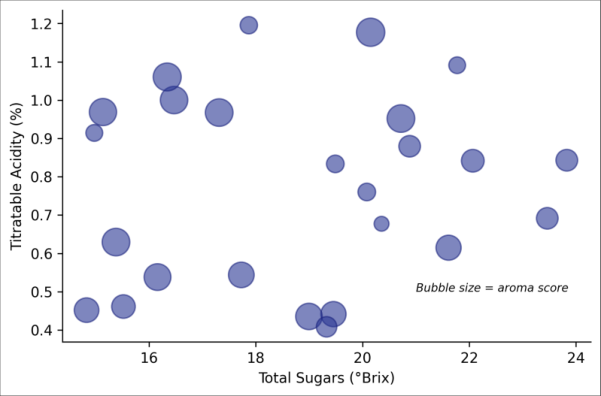 Figure 1
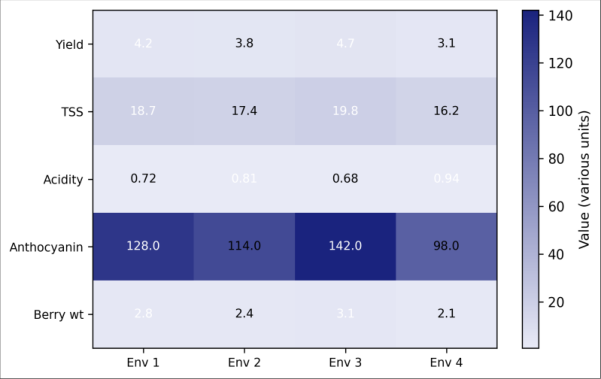 Figure 2
Introduction
In a regional context where climate projections suggest that grape cultivation could expand northward into cool maritime zones within the next two decades, understanding pest resistance in these environments has become newly urgent [1] . Grapevine (Vitis vinifera L.) hosts more than 50 arthropod pest species and dozens of fungal pathogens worldwide, but the pest complex shifts dramatically with latitude and humidity [2] . Volatile organic compounds emitted by grapevine leaves function as direct deterrents against some herbivores and as attractants for natural enemies of others [3] . Terpenes like linalool and ocimene have documented repellent activity against thrips and mites in several horticultural crops [4] . Crop rotation rarely discussed in perennial fruit systems can be applied to vineyard floor management by alternating cover crop species to disrupt soilborne pathogen cycles [5] . Combining ability analysis through diallel crosses allows breeders to distinguish between additive (GCA) and non-additive (SCA) genetic effects for resistance traits [6] . Post-harvest quality retention, particularly of anthocyanins and other phenolics, determines whether disease-resistant cultivars can also meet market quality standards [7] . This research combined VOC profiling, crop rotation trials, genetic analysis, and post-harvest evaluation to build a comprehensive picture of pest resistance potential in grape under cool-humid conditions [8] .
Material and Methods
Material and Methods
Material
Four table grape cultivars were maintained on own-root vines trained to a Y-trellis system in a rain shelter at the Guwahati School of Plant Sciences (26.14°N, 91.74°E). Vineyard floor treatments included bare fallow, mustard cover crop (Brassica juncea, incorporated at 50% flowering), and ryegrass cover crop. Irrigation regimes were full (100% ETc) and deficit (60% ETc) via drip emitters. A 4 × 4 half-diallel crossing scheme produced six F₂ families evaluated for berry weight, TSS, and downy mildew resistance (scored 0-9). Research ran from February 2022 to January 2023, with four replications per treatment [9] .
Methods
VOCs were collected from intact leaves by dynamic headspace sampling onto Tenax TA traps and analyzed on a GC-MS (Agilent 7890B/5977A) with a DB-5ms column. Compounds were identified against NIST 17 library spectra. Thrips were counted on 20 randomly selected leaves per vine weekly. Soil fungal inoculum was estimated by dilution plating on PDA at four vineyard floor positions per treatment. Post-harvest evaluation stored clusters at 2°C and 90% RH for 21 days, measuring weight loss, firmness, TSS, acidity, and anthocyanin by pH-differential method. Combining ability was analyzed by Griffing's Method 4, Model I. AMMI (Additive Main Effects and Multiplicative Interaction) analysis was applied to cultivar × environment (irrigation × floor management) using GenStat 21. Water use efficiency was calculated as marketable yield per cubic meter of water applied [10] . The plot reveals the expected sugar-acid trade-off across cultivars and treatments. Larger bubbles (higher aroma) clustered in the moderate-sugar, moderate-acid zone, suggesting that extreme ripeness or underripeness both reduce perceived aroma intensity. Environment 3 (deficit irrigation + mustard rotation) produced the highest anthocyanin and TSS values, while Environment 4 (full irrigation + bare fallow) ranked lowest for most quality traits. AMMI analysis confirmed significant cultivar × environment interaction (p<0.01) for anthocyanin content.
Results
Results
Discussion
The strong inverse relationship between linalool emission and thrips density (r=-0.71) supports the hypothesis that terpene volatiles function as constitutive chemical defenses in grape leaves [3] . Bangalore Blue, a Vitis labrusca hybrid, likely inherited stronger VOC production from its American grape parentage, which evolved under heavier herbivore pressure than V. vinifera in the Mediterranean [2] . For breeding programs, VOC profiling could serve as an earlygeneration screening tool for pest resistance, avoiding the need for labor-intensive field inoculation trials [4] . Mustard rotation reduced soilborne fungal inoculum by 27 percent, consistent with the biofumigation effect of glucosinolate breakdown products released during mustard residue decomposition [5] . This is a practical, low-cost intervention for cool-humid vineyards where soilborne diseases are a persistent problem. Combining ability analysis showed significant GCA for berry weight (Bangalore Blue as best combiner) and SCA for mildew resistance (Bangalore Blue × Assam Hybrid as the best specific cross), confirming that resistance involves both additive and nonadditive genetic mechanisms [6] . Post-harvest anthocyanin retention was cultivar-dependent: Bangalore Blue's 94 percent retention after 21 days of cold storage far exceeded Thompson Seedless at 78 percent. This stability likely reflects differences in anthocyanin acylation patterns, since acylated anthocyanins are more resistant to degradation than their non-acylated counterparts [7] . Water use efficiency under deficit irrigation improved by 46 percent with only a 12 percent yield penalty, making it an attractive option for water-limited settings [11] .
Conclusion
VOC profiling revealed that grape cultivars with higher linalool and beta-ocimene emissions experienced significantly lower pest incidence, identifying a chemical defense axis that could guide resistance breeding. Mustard rotation as a vineyard floor management tool reduced soilborne fungal pressure by 27 percent. Combining ability analysis pointed to Bangalore Blue as a valuable parent for both berry weight and disease resistance. Post-harvest anthocyanin retention varied widely among cultivars, with Bangalore Blue maintaining 94 percent over 21 days of cold storage. Deficit irrigation at 60 percent ETc improved water efficiency substantially. Together, these findings support a multi-pronged approach to grape pest management in cool maritime environments.
Figures and tables from the paper
| Cultivar | Total VOCs (µg/g/h) | Linalool (µg/g/h) | β-Ocimene (µg/g/h) | Thrips/ leaf | Mildew (0–9) |
|---|---|---|---|---|---|
| Thompson SL | 3.42 ± 0.28 | 0.41 ± 0.04 | 0.23 ± 0.03 | 8.7 ± 1.2 | 6.4 ± 0.7 |
| Flame SL | 4.18 ± 0.34 | 0.58 ± 0.05 | 0.37 ± 0.04 | 5.3 ± 0.9 | 4.8 ± 0.5 |
| Bangalore Blue | 5.87 ± 0.41 | 0.84 ± 0.07 | 0.62 ± 0.05 | 2.8 ± 0.6 | 2.1 ± 0.3 |
| Assam Hybrid | 5.24 ± 0.37 | 0.72 ± 0.06 | 0.51 ± 0.04 | 3.4 ± 0.7 | 2.7 ± 0.4 |
Table text extracted from the original PDF; superscript letters are shown inline. The original table image is below.
View original table image
References
16 in the original paper- Hannah L, Roehrdanz PR, Ikegami M, et al. Climate change, wine, and conservation. Proceedings of the National Academy of Sciences. 2013;110(17):69076912.
- Alston JM, Fuller KB, Lapsley JT, Soleas G. Too much of a good thing? Causes and consequences of increases in sugar content of California wine grapes. Journal of Wine Economics. 2011;6(2):135-159.
- Laothawornkitkul J, Taylor JE, Paul ND, Hewitt CN. Biogenic volatile organic compounds in the Earth system. New Phytologist. 2009;183(1):27-51.
- Dicke M, van Loon JJA, Soler R. Chemical complexity of volatiles from plants induced by multiple attack. Nature Chemical Biology. 2009;5(5):317-324.
- Matthiessen JN, Kirkegaard JA. Biofumigation and enhanced biodegradation: Opportunity and challenge in soilborne pest and disease management. Critical Reviews in Plant Sciences. 2006;25(3):235-265.
- Griffing B. Concept of general and specific combining ability in relation to diallel crossing systems. Australian Journal of Biological Sciences. 1956;9(4):463-493.
- Giusti MM, Wrolstad RE. Characterization and measurement of anthocyanins by UV-visible spectroscopy. Current Protocols in Food Analytical Chemistry. 2001;F1.2.1-F1.2.13.
- Jackson RS. Wine science: Principles and applications. Fourth edition. Academic Press, San Diego. 2014.
- Keller M. The science of grapevines: Anatomy and physiology. Second edition. Academic Press. 2015.
- VSN International. GenStat reference manual, release 21. Hemel Hempstead. 2021.
- Chaves MM, Santos TP, Souza CR, et al. Deficit irrigation in grapevine improves water-use efficiency while controlling vigour and production quality. Annals of Applied Biology. 2007;150(2):237-252.
- Downey MO, Dokoozlian NK, Krstic MP. Cultural practice and environmental impacts on the flavonoid composition of grapes and wine: A review. American Journal of Enology and Viticulture. 2006;57(3):257-268.
- Mira de Orduna R. Climate change associated effects on grape and wine quality and production. Food Research International. 2010;43(7):1844-1855.
- Gadoury DM, Cadle-Davidson L, Wilcox WF, Dry IB, Seem RC, Milgroom MG. Grapevine powdery mildew: A historical review and current knowledge. Phytopathology. 2012;102(1):3-15.
- Ferrandino A, Lovisolo C. Abiotic stress effects on grapevine: Focus on abscisic acid-mediated consequences on secondary metabolism and berry quality. Environmental and Experimental Botany. 2014;103:138-147.
- Kassemeyer HH, Berkelmann-Lohnertz B. Disease management in organic viticulture. Organic Fruit Growing. 2009:189-208.