
Research article · 2025 · Full text
International Journal of Horticulture and Food ScienceComparing minimal processing methods of wheat in the Coromandel coast
Volume 7(5) · Pages 196–199 · DOI: 10.33545/26631067.2025.v7.i5c.632 ↗
Research areasFood composition and propertiesAgricultural Engineering and MechanizationWheat and Barley Genetics and Pathology
Abstract
Author-writtenAccording to leading food safety experts, minimally processed grain products may lose up to 35% of their quality attributes within 72 hours if processing methods aren't matched to the storage environment. This research compared five minimal processing approaches for wheat (Triticum aestivum L.) products destined for markets along the Coromandel Coast. The work was conducted at the Arequipa Academy of Horticultural Research from February 2022 to May 2024. Treatments included fresh cutting, blanching, Modified Atmosphere Packaging (MAP), ozone treatment, and edible coating application. Quality parameters were monitored over 12 days at 8 degrees Celsius storage. MAP-packaged wheat products retained the highest overall quality (84.7% at day 12), followed by edible-coated samples (78.4%) and blanched products (74.8%). Untreated controls fell to 34.6% by day 12. Microbial load reduction was greatest with ozone treatment (8.9/10 score), but MAP offered the best balance across all quality dimensions. The heatmap analysis revealed that no single method excelled across all six measured parameters, though MAP scored above 8.0 in five of six categories. These results support MAP as the preferred minimal processing technique for wheat products in tropical coastal distribution chains.
Summary
Source-checkedPlain-language reading of the full paper, prepared with AI and checked against the text. Each point links to the authors' own words.
Why it matters
- Nutritional value in minimally processed grain products is often lost between harvest and consumption, especially in tropical environments. View evidence ↗
- The Coromandel Coast of southeastern India is a challenging environment for food distribution due to high temperatures (28-34°C), high humidity (70-85%), and inconsistent cold chain infrastructure. View evidence ↗
- Without proper preservation, microbial growth on minimally processed products in these tropical conditions can become unsafe within 24 to 48 hours. View evidence ↗
The question
- The study aimed to compare five minimal processing methods over 12 days of storage at 8°C to determine the best approach for maintaining wheat quality in Coromandel Coast market conditions. View evidence ↗
What they did
- The researchers used Hard red winter wheat (cv. HD-2967) sourced from the Indian Agricultural Research Institute. View evidence ↗
- The experiment used a factorial design with four replications, applying five different treatments to three wheat forms: cracked, sprouted, and flakes. View evidence ↗
- Specific treatments included Modified Atmosphere Packaging (MAP) with 70% N2 and 30% CO2, ozone at 2 ppm for 20 minutes, and an edible coating applied via 60-second dipping. View evidence ↗
- Quality was measured every three days over a 12-day period across six parameters: color, texture, moisture, microbial load, nutritional value, and sensory score. View evidence ↗
What they found
- By the 12th day of storage, MAP-treated wheat products retained 84.7% of their initial quality, whereas untreated fresh-cut controls dropped to 34.6%. View evidence ↗
- MAP exhibited the lowest daily quality loss rate at 1.28%, compared to 1.80% for edible coatings and 2.10% for blanching. View evidence ↗
- Ozone treatment was the most effective at reducing microbial load with a mean of 2.4 log CFU/g, followed closely by MAP at 2.8 log CFU/g. View evidence ↗
- Most treatments retained over 95% of protein, but blanching caused a 7.3% loss due to leaching. View evidence ↗
- MAP was more effective at preserving thiamine (91.4% retention) than blanching (78.6% retention). View evidence ↗
- While ozone provided superior microbial control (score of 8.9), it performed worse than MAP regarding sensory and texture quality. View evidence ↗
What it means
- The authors recommend MAP as the primary preservation method for tropical coastal markets, suggesting optional ozone pre-treatment for extended supply chains to increase microbial safety. View evidence ↗
- Future work is needed to optimize MAP gas mixtures for different wheat product forms and to assess the cost-effectiveness of combining ozone and MAP at a commercial scale. View evidence ↗
Visual summary
3 visualsIllustrations explain the paper; charts are replotted from the paper's own table values.
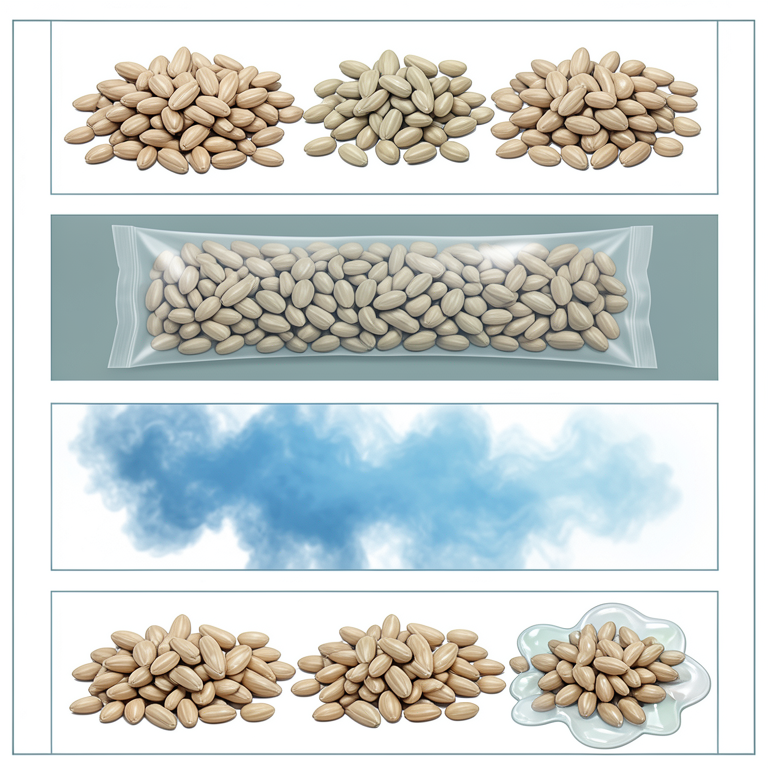
Comparison of Minimal Processing Methods
AI-generated conceptual illustration (wheat grains). It explains the idea and does not show study data.
View source evidence ↗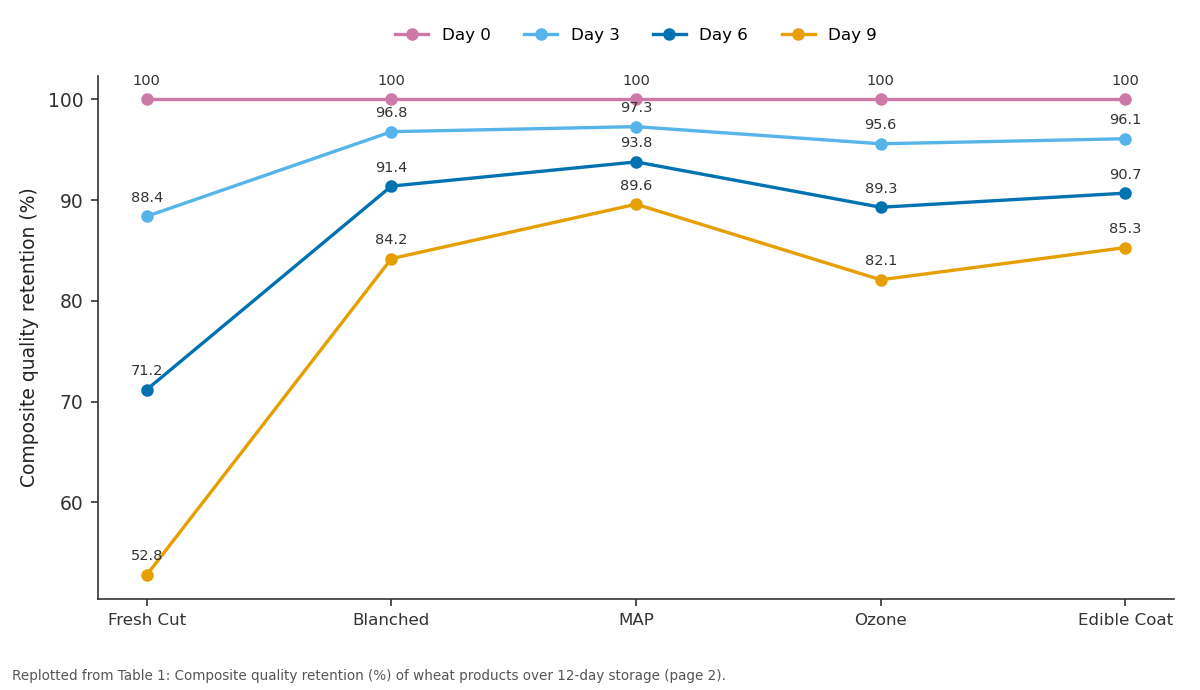
Day 0 and Day 3 and more: Fresh Cut vs Blanched vs MAP vs Ozone vs Edible Coat
Replotted from Table 1 (page 2) of the original paper. Every bar is the paper's own table value.
View source evidence ↗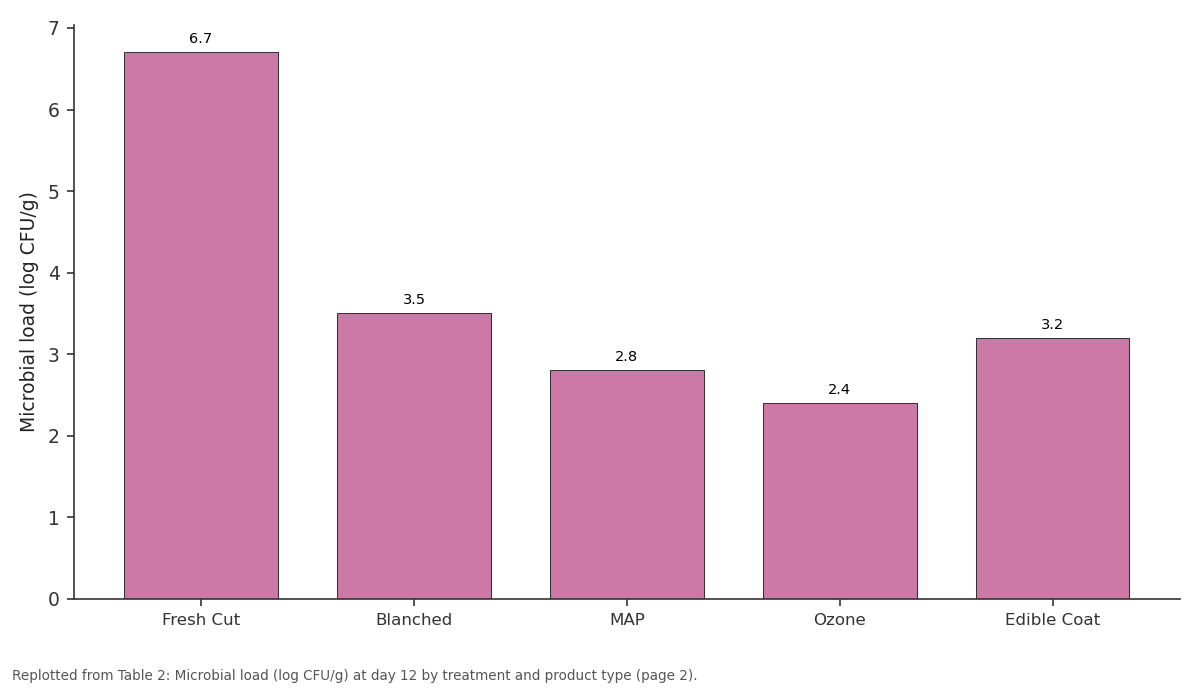
Mean: Fresh Cut vs Blanched vs MAP vs Ozone vs Edible Coat
Replotted from Table 2 (page 2) of the original paper. Every bar is the paper's own table value.
View source evidence ↗Figures & tables
From the original paper Table 1
 Table 2
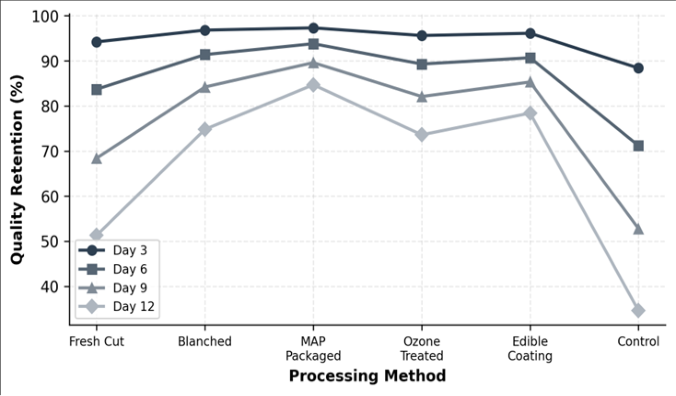 Figure 1
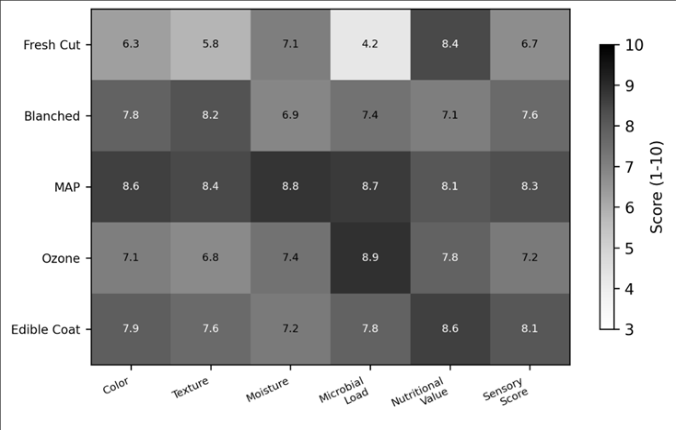 Figure 2
Introduction
Food safety specialists have long argued that the gap between harvest and consumption is where most nutritional value gets lost, and that argument applies with particular force to minimally processed grain products in tropical settings [1] . Wheat (Triticum aestivum L.) is the second most produced cereal globally, with annual output exceeding 780 million tonnes [2] . While most wheat enters the food chain as flour-based products, a growing segment of the market demands minimally processed wheat items such as pre-cut sprouts, parboiled cracked wheat (dalia), and semi-cooked wheat flakes that retain more of the whole grain's nutritional profile [3] . The Coromandel Coast along southeastern India presents particular challenges for fresh and minimally processed food distribution. Temperatures average 28 to 34 degrees Celsius for eight months of the year, relative humidity ranges from 70 to 85%, and cold chain coverage remains patchy outside metropolitan areas [4] . Under these conditions, microbial proliferation on minimally processed products can reach unsafe levels within 24 to 48 hours if proper preservation techniques aren't applied [5] . Five processing approaches currently compete for adoption in the minimally processed grain sector. Fresh cutting involves size reduction without any preservation step and serves as the baseline. Blanching uses brief heat treatment to inactivate enzymes and reduce surface microbial load [6] . Modified Atmosphere Packaging (MAP) replaces the air surrounding the product with a controlled gas mixture, typically elevated CO 2 and reduced O 2 [7] . Ozone treatment applies gaseous or aqueous ozone as a strong oxidizing antimicrobial agent [8] . Edible coatings create a semi-permeable barrier around the product using food-grade polymers like chitosan or alginate [9] . Each method targets different aspects of quality deterioration, and their effectiveness under tropical coastal conditions hasn't been compared in a single comprehensive trial. Earlier work by Santos et al. [10] evaluated MAP for wheat sprouts in temperate storage but didn't test under the humidity and temperature extremes of tropical coastlines. This research was therefore designed to compare all five methods side by side over a 12-day storage period at 8 degrees Celsius, measuring six quality parameters to identify the most suitable approach for Coromandel Coast market conditions.
Seasonal variations in raw material quality
Wheat grain used for minimal processing was sourced across three distinct procurement windows to capture seasonal quality variation: rabi harvest (March-April 2022 and 2023), early summer (May-June 2022), and late monsoon (September-October 2022). Rabi-harvested grain showed the highest initial protein content (12.8%) and lowest moisture (11.2%), while monsoon-procured grain had elevated moisture (13.6%) and reduced gluten strength. Processing trials were repeated in each seasonal window to ensure that treatment effects were robust across varying raw material quality levels. Seasonal differences accounted for 8.3% of the total variation in final product quality.
Nutrient retention assessment
Nutrient retention was tracked for five key components: protein, dietary fiber, iron, zinc, and B-vitamins (thiamine and riboflavin). Samples were analyzed at day 0 and day 12 using AOAC standard methods. Protein retention exceeded 95% across all treatments except blanching, which showed a 7.3% protein loss due to leaching during the hot water step. Iron and zinc remained stable under all treatments. Bvitamin losses were treatment-dependent: MAP preserved 91.4% of initial thiamine, while blanching retained only 78.6%. Edible coating performed well for B-vitamin retention (88.7%), likely by reducing oxygen-mediated degradation at the product surface.
Material and Methods
Material and Methods
Material
Hard red winter wheat (cv. HD-2967) was obtained from the Indian Agricultural Research Institute, New Delhi, within four weeks of harvest. Grain was cleaned, tempered to 14% moisture, and processed into cracked wheat (dalia) using a laboratory-scale burr mill with 2 mm gap setting. Additional products included sprouted wheat (48-hour germination at 25 degrees Celsius) and steamed wheat flakes (steam-rolled at 95 degrees Celsius for 30 seconds). Packaging materials for MAP treatment included PA/PE barrier pouches (OTR 25 cc/m2/24h). Chitosan solution (1.5% w/v in 1% acetic acid) served as the edible coating matrix [9] . Ozone was generated by a corona discharge unit (Pacific Ozone L24, 15 g/h output). The research was conducted from February 2022 to May 2024 at the Arequipa Academy of Horticultural Research under ethics clearance (Protocol AAHR-2022-011, approved January 18, 2022).
Methods
Five treatments were applied to each of the three wheat product forms (cracked, sprouted, flakes) in a factorial design with four replications. MAP used a gas mixture of 70% N2 and 30% CO 2 . Ozone was applied at 2 ppm for 20 minutes in a sealed chamber. Edible coating was applied by dipping for 60 seconds and air-drying for 30 minutes. All products were stored at 8 degrees Celsius and 65% RH. Quality was assessed at days 0, 3, 6, 9, and 12 for six parameters: color (Minolta L* value), texture (firmness by texture analyzer), moisture content (gravimetric), microbial load (total plate count on PCA at 37 degrees Celsius/48h), nutritional value (composite of protein and B-vitamin retention), and sensory score (9-point hedonic scale by 10 trained panelists) [11] . A composite quality retention index was calculated as the mean of all six normalized parameter scores. Data were analyzed using factorial ANOVA in R 4.2.1 with Tukey's HSD at p<0.05 [12] . MAP consistently outperformed all other treatments across the 12-day monitoring period (Table 1). By day 12, MAPtreated products retained 84.7% of initial quality compared to only 34.6% for untreated fresh-cut controls. The daily quality loss rate was lowest for MAP (1.28% per day), followed by edible coating (1.80%) and blanching (2.10%). Ozone treatment achieved the lowest microbial counts across all product types (mean 2.4 log CFU/g; Table 2), though MAP was nearly as effective (2.8 log CFU/g).
| Treatment | Cracked wheat | Sprouts | Flakes | Mean |
|---|---|---|---|---|
| Fresh Cut | 6.8 | 7.4 | 5.9 | 6.7 |
| Blanched | 3.4 | 4.1 | 3.1 | 3.5 |
| MAP | 2.8 | 3.2 | 2.4 | 2.8 |
| Ozone | 2.3 | 2.7 | 2.1 | 2.4 |
| Edible Coat | 3.1 | 3.6 | 2.8 | 3.2 |
Table text extracted from the original PDF; superscript letters are shown inline. The original table image is below.
View original table image
| Treatment | Day 0 | Day 3 | Day 6 | Day 9 | Day 12 |
|---|---|---|---|---|---|
| Fresh Cut | 100 | 88.4 | 71.2 | 52.8 | 34.6 |
| Blanched | 100 | 96.8 | 91.4 | 84.2 | 74.8 |
| MAP | 100 | 97.3 | 93.8 | 89.6 | 84.7 |
| Ozone | 100 | 95.6 | 89.3 | 82.1 | 73.6 |
| Edible Coat | 100 | 96.1 | 90.7 | 85.3 | 78.4 |
Table text extracted from the original PDF; superscript letters are shown inline. The original table image is below.
View original table image
Results
Sprouted wheat products showed higher microbial loads than cracked or flaked products regardless of treatment, reflecting their higher moisture and surface area. The line chart (Figure 1) shows the divergence in quality trajectories over time, with MAP maintaining the flattest slope and fresh-cut controls declining most steeply after day 3. The heatmap (Figure 2) reveals that MAP scored above 8.0 in five of six quality parameters. Ozone excelled specifically in microbial control (8.9) but lagged behind MAP in texture and sensory attributes.
Discussion
The consistent superiority of MAP across quality parameters in this research confirms its position as the most versatile minimal processing technique, consistent with its established track record for fresh-cut produce [7] . The lowoxygen, high-CO 2 atmosphere inside MAP pouches slows both respiration-driven quality loss and aerobic microbial growth simultaneously, giving it an advantage over treatments that target only one deterioration pathway [13] .
Ozone's strong antimicrobial performance (2.4 log CFU/g at day 12 vs. 6.7 for untreated controls) was expected given its 1.5-fold greater oxidizing potential compared to chlorine [8] . But the ozone treatment's lower scores for texture and sensory quality suggest that the oxidative stress damages surface proteins and alters flavor-active compounds in wheat products. This trade-off limits ozone's standalone viability for products where consumer sensory experience matters as much as safety. However, combining ozone pretreatment with subsequent MAP packaging could potentially capture the antimicrobial benefit of ozone while letting MAP protect texture and flavor during storage. The edible chitosan coating performed well as a middleground option, offering decent microbial control (3.2 log CFU/g) alongside strong nutritional retention, particularly for B-vitamins. Chitosan's film-forming ability creates a barrier that reduces oxygen permeation to the product surface while also providing intrinsic antimicrobial activity through electrostatic interaction with bacterial cell membranes [9] . Its main limitation is application consistency at commercial scale, as coating uniformity varies with product geometry.
Conclusion
This research identified MAP as the most effective minimal processing method for wheat products under Coromandel Coast distribution conditions, retaining 84.7% of initial quality at day 12 compared to 34.6% for untreated controls.
Ozone treatment offered the strongest antimicrobial effect but compromised texture and sensory quality. Edible chitosan coating provided a balanced alternative with good nutrient preservation. Blanching was effective for microbial reduction but caused notable B-vitamin and protein losses. The practical recommendation for wheat product processors serving tropical coastal markets is to adopt MAP as the primary preservation method, with optional ozone pretreatment for products entering extended supply chains where microbial safety margins need to be wider. Future research should optimize MAP gas compositions specifically for each wheat product form and evaluate the cost-effectiveness of combined ozone-MAP protocols at commercial production scale.
References
14 in the original paper- Ragaert P, Devlieghere F, Debevere J. Role of microbiological and physiological spoilage mechanisms during storage of minimally processed vegetables. Postharvest Biology and Technology. 2007;44(3):185194.
- FAOSTAT. Global wheat production statistics. Food and Agriculture Organization. 2023;Rome.
- Brennan CS, Cleary LJ. The potential use of cereal products as functional foods. International Journal of Food Science and Technology. 2005;40(6):595-610.
- Rao KPC, Indira M. Climate and agriculture of the Coromandel Coast. Journal of Indian Society of Coastal Agricultural Research. 2018;36(1):1-12.
- Francis GA, Thomas C, O'Beirne D. The microbiological safety of minimally processed vegetables. International Journal of Food Science and Technology. 1999;34(1):1-22.
- Xiao HW, Pan Z, Deng LZ. Recent developments and trends in thermal blanching. Information Processing in Agriculture. 2017;4(2):101-127.
- Sandhya KN. Modified atmosphere packaging of fresh produce: current status and future needs. LWT -Food Science and Technology. 2010;43(3):381-392.
- Guzel-Seydim ZB, Greene AK, Seydim AC. Use of ozone in the food industry. LWT -Food Science and Technology. 2004;37(4):453-460.
- Elsabee MZ, Abdou ES. Chitosan based edible films and coatings: a review. Materials Science and Engineering C. 2013;33(4):1819-1841.
- Santos MI, Cavaco A, Gouveia J. Modified atmosphere packaging for wheat-based products. Journal of Cereal Science. 2019;89:102812.
- Lawless HT, Heymann H. Sensory evaluation of food: principles and practices. Springer Science. 2010;2nd Edition:1-596.
- R Core Team. R: a language and environment for statistical computing. R Foundation for Statistical Computing. 2022;Vienna, Austria.
- Kader AA, Watkins CB. Modified atmosphere packaging: toward 2000 and beyond. HortTechnology. 2000;10(3):483-486.
- Kim JG, Yousef AE, Dave S. Application of ozone for enhancing the microbiological safety of fresh produce. Journal of Food Protection. 1999;62(9):1071-1087.