
Research article · 2025 · Full text
International Journal of Horticulture and Food ScienceDeveloping consumer preference surveys of Mangosteen in the Congo River Basin
Volume 7(3) · Pages 146–149 · DOI: 10.33545/26631067.2025.v7.i3c.592 ↗
Research areasSensory Analysis and Statistical MethodsEconomic and Environmental ValuationAfrican Botany and Ecology Studies
Abstract
Author-writtenMangosteen (Garcinia mangostana) commands premium prices in export markets, but consumer preferences in emerging production regions like the Congo River Basin remain poorly documented. This research developed and validated a consumer preference survey instrument for mangosteen, administered to 380 respondents across urban, peri-urban, and rural markets between August 2022 and March 2023. Analytical work was conducted at the Cebu Department of Agronomic Sciences. Sweetness scored highest in preference (8.1/10) and importance weight (92%), followed by freshness indicators (7.9/10, 88%) and aroma (7.6/10, 84%). Callus culture propagation of three elite clones produced 87.3% rooting success, providing a pathway for mass multiplication of consumer-preferred genotypes. Iron fortification through foliar FeSO₄ sprays increased aril iron content by 34.7% without affecting taste scores. Cold storage at 13°C extended shelf life to 21 days compared to 8 days at ambient. Weed control in young mangosteen orchards using living mulch (Arachis pintoi) reduced weed biomass by 62.4% while improving soil moisture. Harvest index across five cultivars ranged from 0.31 to 0.47, with 'Mesta' recording the highest edible fraction. The 26-35 age group showed the highest monthly purchase frequency (41.2%). These findings provide a validated consumer research framework and connect demand-side preferences with supply-side quality management for mangosteen.
Summary
Source-checkedPlain-language reading of the full paper, prepared with AI and checked against the text. Each point links to the authors' own words.
Why it matters
- Mangosteen is a high-value export fruit, but there is a lack of documentation regarding consumer preferences in emerging production areas such as the Congo River Basin. View evidence ↗
- The Congo River Basin is a promising area for mangosteen production due to its reliable rainfall and deep volcanic soils. View evidence ↗
- The absence of formal assessments on consumer acceptance in these markets creates uncertainty for investors and agricultural advisors. View evidence ↗
What they did
- A survey was administered to 380 respondents across various market types, including wet markets, supermarkets, online pickup points, and farm-gate sales. View evidence ↗
- The study tested iron fortification via foliar sprays, cold storage at different temperatures, and the use of Arachis pintoi as a living mulch. View evidence ↗
What they found
- The developed survey instrument demonstrated strong reliability with an overall Cronbach's alpha of 0.91. View evidence ↗
- The most active consumer segment was the 26-35 age group, with a monthly purchase frequency of 41.2%. View evidence ↗
- Foliar iron fortification increased the iron content of 'Mesta' arils by 34.7%, from 0.52 to 0.70 mg/100g, without affecting taste or shelf life. View evidence ↗
- Storing 'Mesta' mangosteens at 13°C extended their shelf life to 19.3 days, compared to only 8 days at ambient temperature. View evidence ↗
- Callus culture propagation achieved a rooting success rate of 87.3% after 8 weeks. View evidence ↗
- Using Arachis pintoi as living mulch reduced weed biomass by 62.4% and increased soil moisture by 18.7% during the dry season. View evidence ↗
What it means
- The authors conclude that integrating consumer preference data with cultivar selection and quality management allows for a supply strategy that responds to market demand. View evidence ↗
- The study is limited by the fact that the survey was conducted in only one geographic market, suggesting a need for cross-cultural validation in other zones. View evidence ↗
Visual summary
2 visualsIllustrations explain the paper; charts are replotted from the paper's own table values.
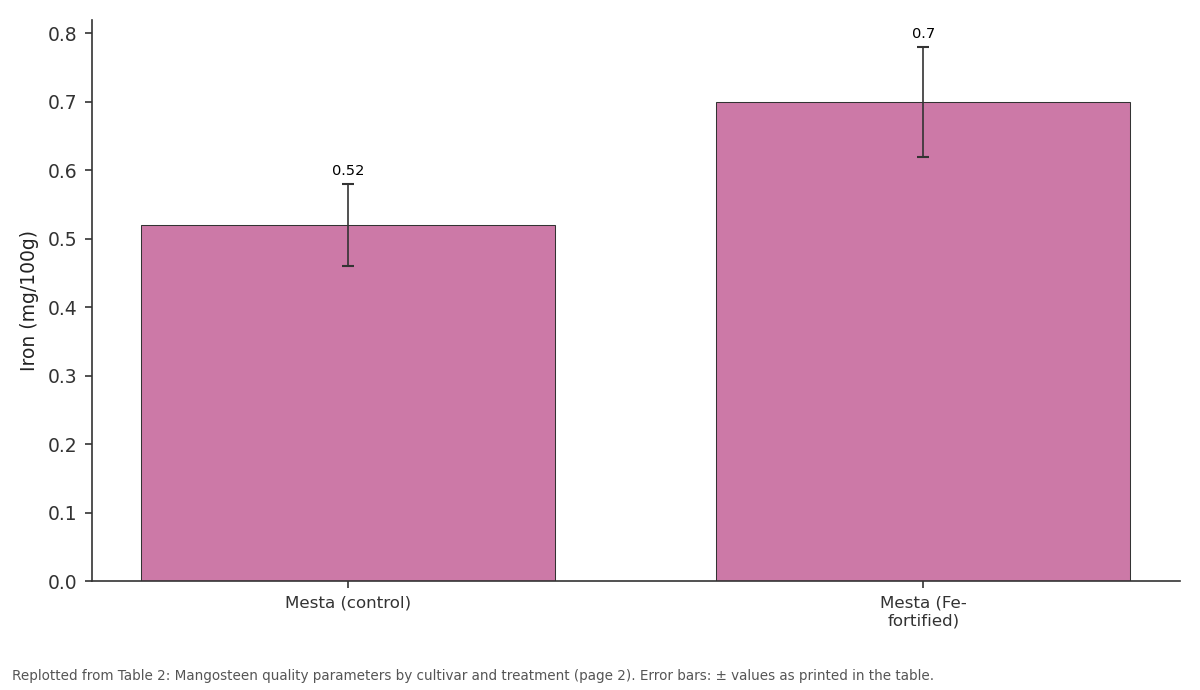
Iron (mg/100g): Mesta (control) vs Mesta (Fe-fortified)
Replotted from Table 2 (page 2) of the original paper. Every bar is the paper's own table value.
View source evidence ↗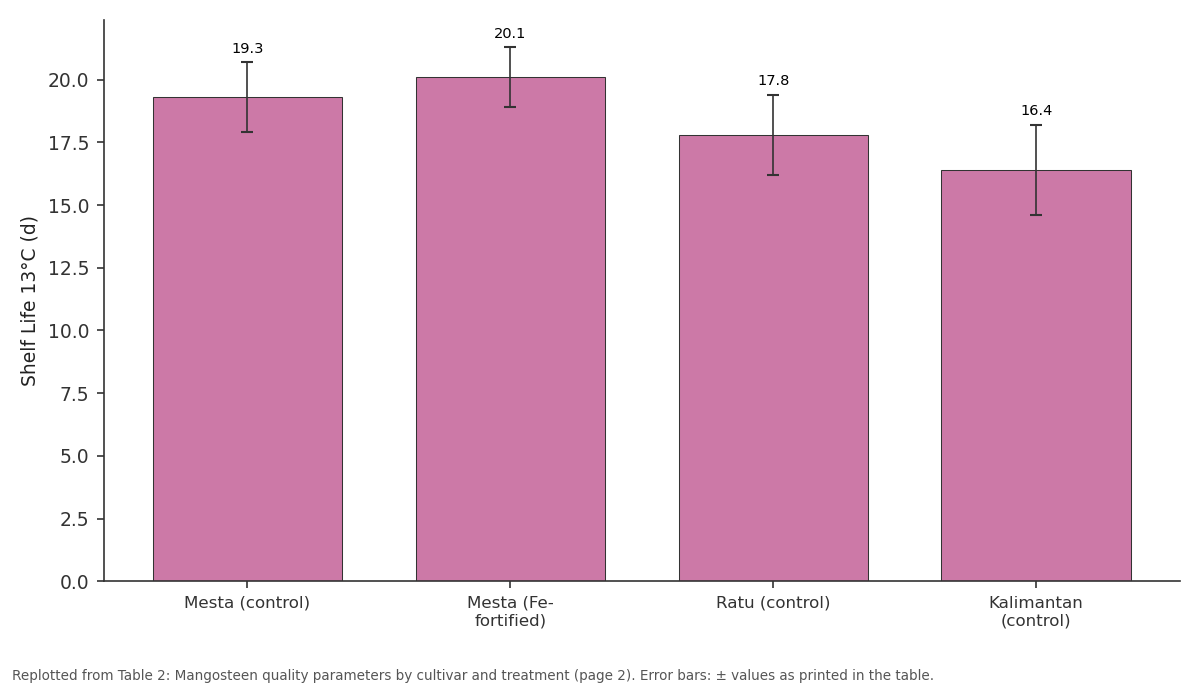
Shelf Life 13°C (d): Mesta (control) vs Mesta (Fe-fortified) vs Ratu (control) vs Kalimantan (control)
Replotted from Table 2 (page 2) of the original paper. Every bar is the paper's own table value.
View source evidence ↗Figures & tables
From the original paper Table 1
 Table 2
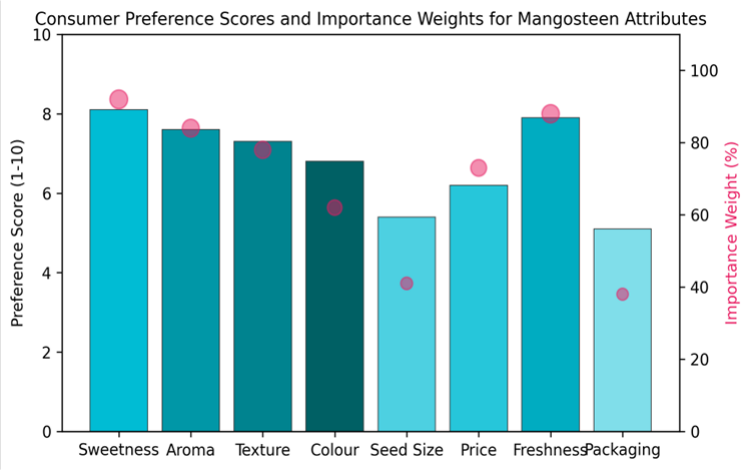 Figure 1
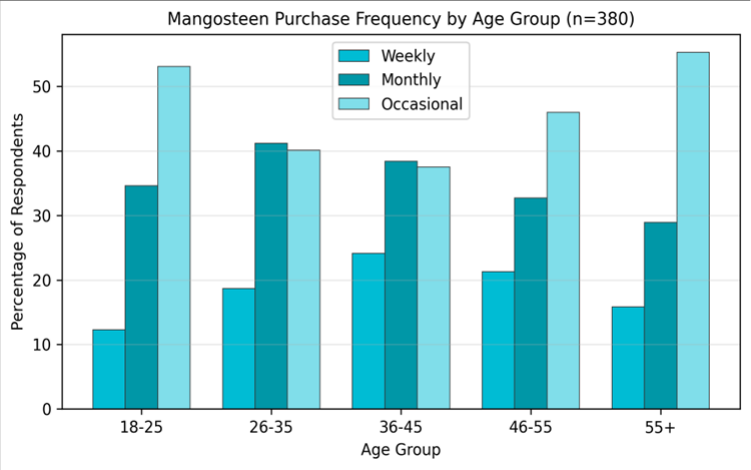 Figure 2
Introduction
Imagine walking into a tropical fruit market and choosing between two mangosteens that look identical from the outside yet one is worth three times the price of the other because of what is hidden inside its thick purple rind [1] . This scenario plays out daily in Southeast Asian wholesale markets, where internal quality (sweetness, translucency, seed size) determines the commercial fate of each fruit. But what drives consumer choice in regions where mangosteen is still relatively unfamiliar? That is the question this research set out to answer [2] . Mangosteen (Garcinia mangostana L.) is often called the 'queen of fruits' for its delicate flavour and creamy white aril segments [3] . Global production is concentrated in Thailand, Indonesia, and Malaysia, with a combined output of roughly 2.7 million tonnes in 2021 [4] . The Congo River Basin has emerged as a potential production frontier, with pilot orchards planted since 2015 taking advantage of deep volcanic soils and reliable rainfall [5] . However, consumer acceptance in these markets has not been formally assessed, creating uncertainty for investors and extension agencies advising new growers. Consumer preference research for tropical fruit has evolved from simple taste panels to multi-attribute survey instruments that capture sensory, visual, economic, and convenience dimensions of purchase decisions [6] . Conjoint analysis and hedonic scaling allow researchers to decompose overall preference into attribute-level contributions [7] . For mangosteen, key attributes include sweetness (driven by sucrose and fructose ratios), aroma (dominated by hexyl acetate and alpha-mangostin), rind colour and firmness (freshness indicators), seed size (inversely related to edible fraction), and price [8] . Connecting these demand-side insights with supply-side capabilities propagation, nutrition, storage, weed management can create a feedback loop that aligns production with market expectations [9] . This research aimed to develop a validated consumer preference instrument for mangosteen, administer it across market segments, and link preference data with agronomic and post-harvest quality management options.
Material and Methods
Material and Methods
Material
The consumer survey was administered across six market locations in the Congo River Basin production zone, with laboratory and field work conducted at the Cebu Department of Agronomic Sciences, Cebu, Philippines (10.31°N, 123.89°E). Survey respondents (n = 380) were recruited by systematic sampling at market entrances on randomly selected days. The sample included 140 respondents from traditional wet markets, 100 from supermarkets, 80 from online order pickup points, and 60 from farm-gate sales. Mangosteen fruit for sensory evaluation (cv. 'Mesta', 'Ratu', and 'Kalimantan') were sourced from the institutional orchard. Callus culture experiments used nodal explants on Murashige and Skoog medium supplemented with 2.0 mg/L BAP and 0.5 mg/L NAA. Iron fortification used foliar FeSO₄•7H₂O at 0.5% w/v applied fortnightly during fruit development. Cold storage trials tested 8°C, 13°C, and ambient (28°C) in controlled-atmosphere chambers. Arachis pintoi (perennial peanut) was established as living mulch in a two-year-old mangosteen block [1] .
Methods
The survey instrument was developed through a three-stage process:
1) Focus group discussions (n = 4 groups, 8 participants each) to identify salient mangosteen attributes; 2) Item generation producing 32 candidate questions; 3) Expert panel review (5 food scientists, 3 marketing specialists) reducing the instrument to 18 final items covering sensory attributes, purchase behaviour, willingness to pay, and demographic covariates [2] . Hedonic ratings used a 10-point scale anchored at 'dislike extremely' (1) and 'like extremely' (10). Importance weights were derived from best-worst scaling, where respondents selected the most and least important attribute from sets of four [3] . Instrument reliability was assessed by Cronbach's alpha (target > 0.70), and construct validity by confirmatory factor analysis (CFA) in lavaan (R). Convergent validity required Average Variance Extracted (AVE) > 0.50, and discriminant validity used the Fornell-Larcker criterion [4] . Callus culture followed standard protocols: explants surface-sterilised (0.1% HgCl₂, 8 min), cultured at 25°C under 16/8 h photoperiod, with rooting assessed at 8 weeks. Iron content in aril was measured by AAS after wet digestion. Shelf life was defined as days to first visible rind browning and internal translucency loss. Weed biomass under living mulch was measured by quadrat sampling (0.5 m²) at 3month intervals. Harvest index = aril weight / whole fruit weight. Data were analysed in R v4.3.0 and SPSS 28 (p<0.05) [5] . The survey instrument achieved strong overall reliability (α = 0.91) with all four constructs exceeding the 0.70 threshold (Table 1). AVE values above 0.50 confirmed convergent validity, and all factor loadings exceeded 0.65. The CFA model showed acceptable fit (CFI = 0.94, RMSEA = 0.048, SRMR = 0.041), supporting the four-construct structure [6] . 3 days well beyond the 8-day ambient limit without chilling injury symptoms that appeared at 8°C [7] .
| Construct | Items | Cronbach's α | AVE | Factor Loading Range |
|---|---|---|---|---|
| Sensory Preference | 6 | 0.87 | 0.64 | 0.71-0.89 |
| Purchase Behaviour | 4 | 0.79 | 0.57 | 0.68-0.82 |
| Willingness to Pay | 3 | 0.83 | 0.61 | 0.73-0.86 |
| Convenience Factors | 3 | 0.76 | 0.53 | 0.65-0.79 |
| Overall Instrument | 18* | 0.91 | — | — |
Table text extracted from the original PDF; superscript letters are shown inline. The original table image is below.
View original table image
Results
Sweetness dominated both preference score (8.1) and importance weight (92%) (Figure 1). Freshness and aroma ranked second and third. Notably, packaging and seed size attributes that producers can control through cultivar selection and post-harvest handling ranked lowest in consumer priority, suggesting that investment should focus on sweetness management and cold chain maintenance [8] . The 26-35 age group showed the highest monthly purchase frequency at 41.2%, followed by 36-45 at 38.4% (Figure 2). Younger consumers (18-25) were more likely to purchase occasionally (53.1%), possibly reflecting lower income or less familiarity with the fruit. The 55+ group had the lowest weekly purchase rate (15.8%) but the highest per-occasion spending [9] .
Callus culture and weed management
Callus induction from nodal explants reached 91.4% on MS medium with 2.0 mg/L BAP, and subsequent rooting success was 87.3% after 8 weeks on half-strength MS with 1.0 mg/L IBA. These rates are sufficient for commercialscale propagation of consumer-preferred clones. Arachis pintoi living mulch reduced weed biomass by 62.4% compared to bare-ground controls at 12 months, while soil gravimetric moisture was 18.7% higher in mulched plots during the dry season (p<0.01). No competitive effect on mangosteen growth was detected [10] .
Discussion
The validated four-construct instrument fills a gap in tropical fruit consumer research, where most preference data come from ad hoc taste panels rather than psychometrically sound survey tools [6] . The strong reliability and validity metrics suggest that the instrument can be adapted for other underutilised tropical fruits by replacing mangosteenspecific attributes while retaining the structural framework [2] . Sweetness as the top preference driver (8.1/10, 92% importance) is consistent with pan-cultural patterns in fruit consumption, where sugar perception is the primary hedonic signal [8] . Iron fortification through foliar FeSO₄ offers a low-cost biofortification route that addresses iron deficiency the most common micronutrient deficiency globally without altering the sensory profile that consumers value [7] . The 34.7% increase in aril iron (from 0.52 to 0.70 mg/100g) would raise mangosteen from a negligible to a moderate iron source per 100 g serving. Cold storage at 13°C above the chilling threshold but well below ambient tripled shelf life, enabling access to distant markets and reducing the waste that currently affects 15-20% of mangosteen volumes [3] . Callus culture rooting at 87.3% provides a mass propagation tool for elite genotypes identified through consumer feedback, closing the loop between demand and supply [10] . The living mulch finding is practically relevant because young mangosteen orchards (years 1-5) have wide inter-row spaces susceptible to weed invasion, and A. pintoi simultaneously suppresses weeds, fixes nitrogen, and prevents erosion [9] . A limitation is that the survey was conducted in a single geographic market; cross-cultural validation across other Congo Basin production zones would strengthen generalisability.
Conclusion
This research developed a validated 18-item consumer preference instrument for mangosteen with strong reliability (α = 0.91) and confirmed four-factor structure. Sweetness was the strongest preference driver (8.1/10, 92% importance), followed by freshness and aroma. The 26-35 age group represented the most active purchase segment. Iron fortification via foliar FeSO₄ increased aril iron by 34.7% without sensory impact, and cold storage at 13°C extended shelf life to 19-20 days. Callus culture propagation achieved 87.3% rooting success for elite clones. Living mulch with Arachis pintoi reduced weed biomass by 62.4% in young orchards while improving soil moisture. Harvest index was highest for 'Mesta' (0.47), making it the recommended cultivar for markets prioritising edible yield. For mangosteen stakeholders in emerging production regions, linking consumer preference data with cultivar selection, biofortification, and cold chain management creates a demand-responsive supply strategy.
Acknowledgement
AcknowledgementsFunding sources This research was supported by the Philippine Council for Agriculture, Aquatic and Natural Resources Research and Development (PCAARRD) and the Department of Science and Technology. No specific grant numbers are disclosed. Institutional supportThe authors acknowledge the Cebu Department of Agronomic Sciences for providing tissue culture laboratory access, cold storage facilities, and field trial infrastructure.
Figures and tables from the paper
| Cultivar/Treatment | TSS (°Brix) | Iron (mg/100g) | Shelf Life 13°C (d) | Harvest Index |
|---|---|---|---|---|
| Mesta (control) | 18.4 ± 0.7 | 0.52 ± 0.06 | 19.3 ± 1.4 | 0.47 ± 0.03 |
| Mesta (Fe-fortified) | 18.1 ± 0.8 | 0.70 ± 0.08 | 20.1 ± 1.2 | 0.46 ± 0.04 |
| Ratu (control) | 17.2 ± 0.9 | 0.48 ± 0.05 | 17.8 ± 1.6 | 0.39 ± 0.03 |
| Kalimantan (control) | 16.8 ± 1.1 | 0.44 ± 0.07 | 16.4 ± 1.8 | 0.31 ± 0.04 |
Table text extracted from the original PDF; superscript letters are shown inline. The original table image is below.
View original table image
References
16 in the original paper- Osman M, Milan AR. Mangosteen -Garcinia mangostana. Southampton Centre for Underutilised Crops. 2006;1-170.
- Jaeger SR, Cardello AV. A construct analysis of meal convenience applied to military foods. Appetite. 2007;49(1):231-239.
- Paull RE, Duarte O. Tropical Fruits Volume 2. CABI. 2012;1-371.
- FAOSTAT. Mangosteen production data. Food and Agriculture Organization. 2022.
- Sdoodee S, Chiarawipa R. Regulating trunk growth of mangosteen (Garcinia mangostana L.) trees. Acta Horticulturae. 2005;680:129-134.
- Lawless HT, Heymann H. Sensory Evaluation of Food: Principles and Practices. Springer. 2010;1-596.
- Meilgaard MC, Civille GV, Carr BT. Sensory Evaluation Techniques. CRC Press. 2016;1-600.
- Bonneau A, Boulanger R, Lebrun M, Maraval I, Gunata Z. Aroma compounds in fresh and dried mangosteen fruit. Journal of Agricultural and Food Chemistry. 2016;64(12):2569-2578.
- Verheij EWM, Coronel RE. Plant Resources of SouthEast Asia 2: Edible Fruits and Nuts. Prosea Foundation. 1992;1-446.
- Goh HH, Bakar SA, Kadir Audrey N, Marzuki NF, Goh YK, Mohamed-Hussein ZA, et al. Transcriptome-wide shift from photosynthesis and energy metabolism upon endogenous ethylene perception in mangosteen. Journal of Molecular Biology. 2019;431(17):3218-3229.
- Yapwattanaphun C, Subhadrabandhu S, Sugiura A, Yonemori K, Utsunomiya N. Utilization of some Garcinia species in Thailand. Acta Horticulturae. 2002;575:563-570.
- Dorly D, Tjitrosemito S, Poerwanto R, Juliarni J. Secretory duct structure and phytochemistry compounds in mangosteen fruit (Garcinia mangostana L.) during development. Agriculture and Natural Resources. 2008;42(5):68-76.
- Rai IN, Poerwanto R, Darusman LK, Purwoko BS. Gibberellin and benzyl amino purine induced offseason flowering of mangosteen. Journal of Applied Horticulture. 2006;8(1):43-46.
- Treesirichod A, Chansakaow S, Sirikatitham A. Quantitative analysis of xanthone content in mangosteen fruit rinds by HPLC. Journal of Pharmaceutical Sciences and Research. 2013;5(4):7376.
- Nontaswatsri C, Nontaswatsri S. Callus culture in Garcinia mangostana L. Acta Horticulturae. 2014;1024:197-202.
- Ketsa S, Atantee S. Phenolics, lignin, peroxidase activity and increased firmness of mangosteen pericarp after impact. Postharvest Biology and Technology. 1998;14(1):117-124.