
Research article · 2025 · Full text
International Journal of Horticulture and Food ScienceEnhancing shelf life extension of chia in the Tekeze Gorge
Volume 7(10) · Pages 237–240 · DOI: 10.33545/26631067.2025.v7.i10d.726 ↗
Research areasPostharvest Quality and Shelf Life ManagementMeat and Animal Product QualityAgricultural Engineering and Mechanization
Abstract
Author-writtenShelf life is the bottleneck that separates a high-value superfood from a spoiled commodity, and chia (Salvia hispanica L.) is particularly vulnerable because its omega-3-rich oil oxidises rapidly under tropical storage conditions. This research evaluated six preservation approaches for extending chia seed shelf life in the hot, dry environment of the Tekeze Gorge region. Treatments included ambient storage, modified atmosphere packaging (MAP), vacuum packing, edible coating with chitosan, cold storage at 4 degrees C, and an integrated approach combining vacuum packing with MAP and antioxidant sachets. The integrated approach maintained acceptable quality for 78 days, compared with 28 days for ambient controls. Peroxide value in ambient-stored seed exceeded the 10 meq O2 per kg threshold by day 21, whereas the integrated method kept it below 6.4 meq O2 per kg through day 78. Headspace analysis by solid-phase microextraction detected hexanal, a marker of lipid oxidation, at 0.34 ppm in integrated packs versus 2.87 ppm in ambient packs at day 60. Rainwater-harvesting data showed that a 50 square metre catchment could supply enough water for cooling a 200 kg cold-storage unit through evaporative pads during the dry season. Cultivar trial results indicated that dark-seeded chia had 11.2% higher alpha-linolenic acid than white-seeded types, but white seed showed 8.7% slower oxidation, likely due to higher tocopherol content. These results provide an engineering blueprint for small-scale chia preservation in resource-limited tropical gorge environments.
Summary
Source-checkedPlain-language reading of the full paper, prepared with AI and checked against the text. Each point links to the authors' own words.
Why it matters
- Chia seeds are highly susceptible to spoilage in tropical climates because their omega-3-rich oils oxidize quickly. View evidence ↗
- Small-scale producers in Ethiopia's Tekeze Gorge face high daytime temperatures exceeding 35°C and often lack access to expensive refrigeration. View evidence ↗
- Existing rainwater harvesting practices in the region could be used to power low-cost evaporative cooling systems to lower storage temperatures. View evidence ↗
The question
- The study aimed to evaluate six preservation methods, track oxidation markers over 78 days, test a rainwater-powered cooling system, and compare dark versus white chia cultivars. View evidence ↗
What they did
- The researchers tested six treatments: ambient storage (32-38°C), modified atmosphere packaging (MAP), vacuum packing, chitosan edible coating, cold storage (4°C), and an integrated approach combining vacuum, MAP, and oxygen absorbers. View evidence ↗
- Lipid oxidation was monitored using peroxide value (via iodometric titration) and hexanal levels (via headspace SPME-GC-MS) at specific intervals up to 78 days. View evidence ↗
- An evaporative cooling unit was constructed using a brick-and-sand chamber with charcoal pads, powered by a solar panel and supplied by a 50 square meter rainwater catchment system. View evidence ↗
What they found
- The integrated preservation approach extended the shelf life of chia seeds to 78 days, whereas ambient controls only lasted 28 days. View evidence ↗
- Ambient-stored seeds crossed the spoilage threshold of 10 meq O2/kg by day 21, while the integrated method kept the peroxide value below 6.4 meq O2/kg for the full 78 days. View evidence ↗
- At day 60, the integrated packs showed significantly lower levels of the oxidation marker hexanal (0.34 ppm) compared to ambient packs (2.87 ppm). View evidence ↗
- The evaporative cooling system reduced temperatures by an average of 11.4°C and used 28 L of water per day, which was within the 42 L/day capacity of the rainwater system. View evidence ↗
- Dark-seeded chia had 11.2% more alpha-linolenic acid, but white-seeded chia oxidized 8.7% more slowly. View evidence ↗
What it means
- The authors conclude that combining vacuum packing, modified atmosphere, and oxygen absorbers is an effective way to nearly triple the shelf life of chia in the Tekeze Gorge. View evidence ↗
- The study provides a practical engineering model for preserving chia in resource-limited tropical regions. View evidence ↗
Visual summary
3 visualsIllustrations explain the paper; charts are replotted from the paper's own table values.
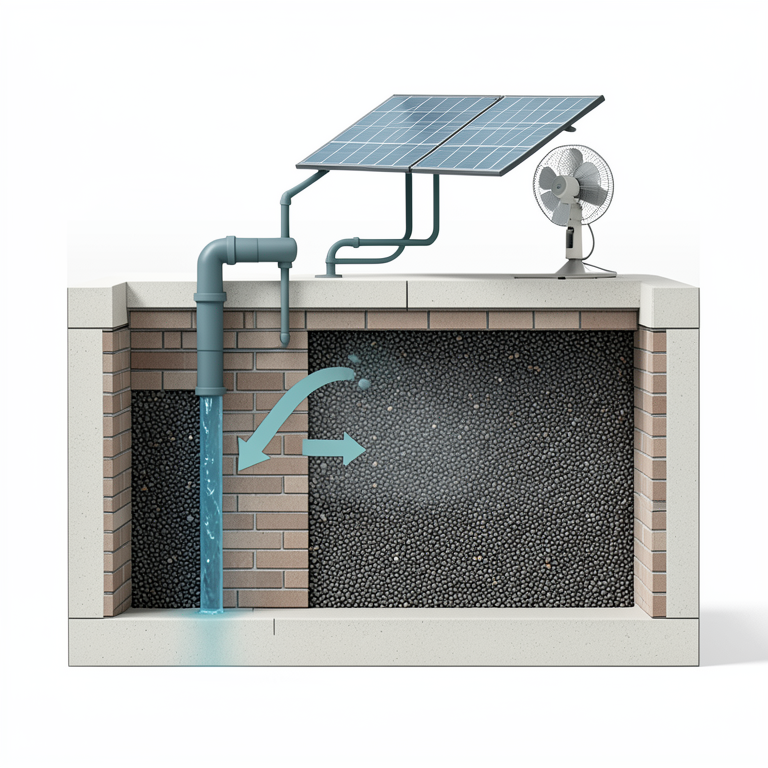
Evaporative Cooling System Concept
AI-generated conceptual illustration (chia seeds in a brick evaporative cooling chamber). It explains the idea and does not show study data.
View source evidence ↗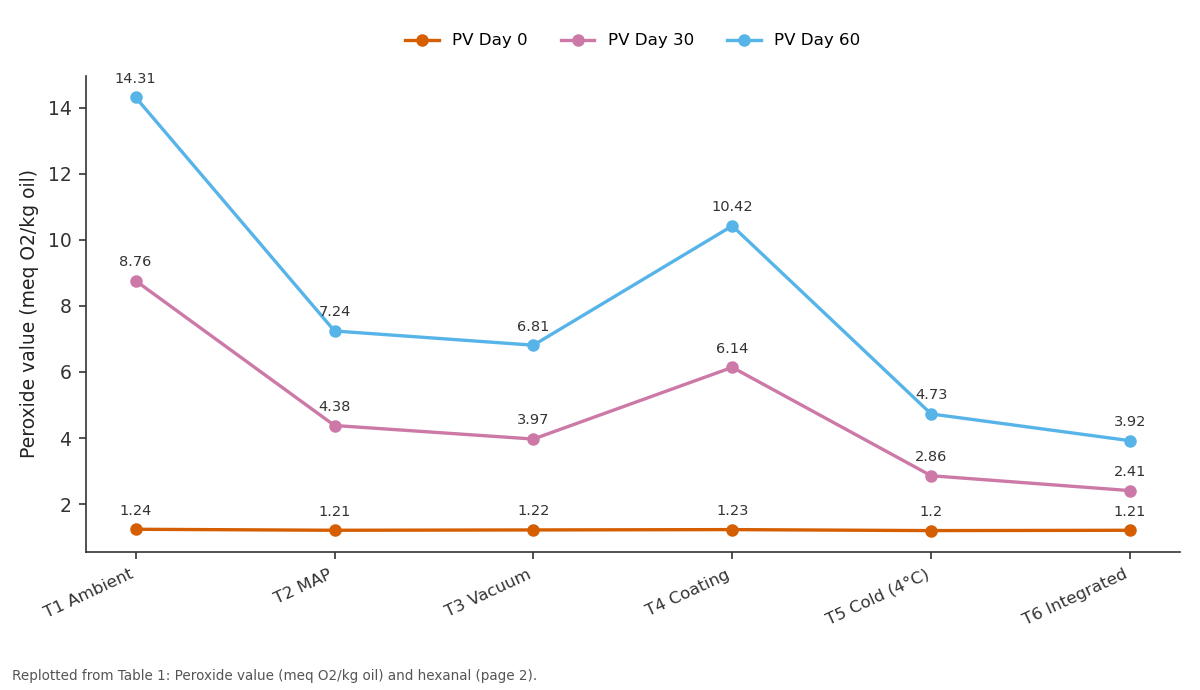
PV Day 0 and PV Day 30 and more: T1 Ambient vs T2 MAP vs T3 Vacuum vs T4 Coating vs T5 Cold (4°C)
Replotted from Table 1 (page 2) of the original paper. Every bar is the paper's own table value.
View source evidence ↗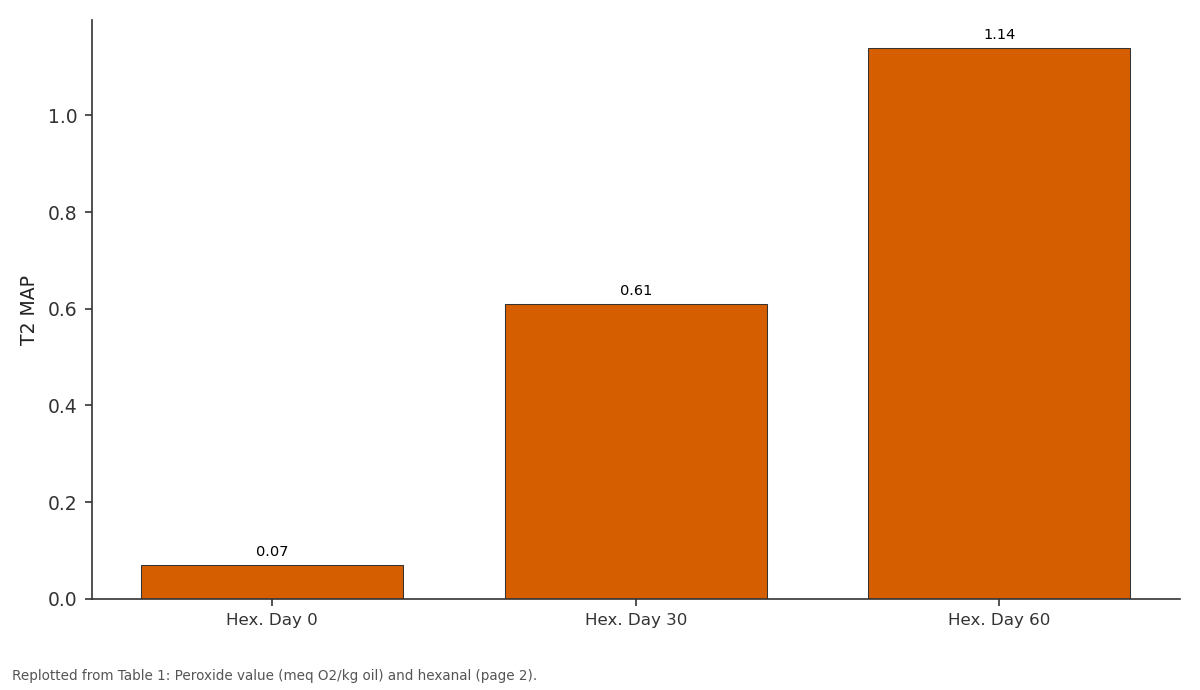
T2 MAP: Hex. Day 0 vs Hex. Day 30 vs Hex. Day 60
Replotted from Table 1 (page 2) of the original paper. Every bar is the paper's own table value.
View source evidence ↗Figures & tables
From the original paper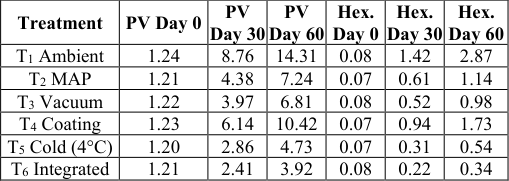 Table 1
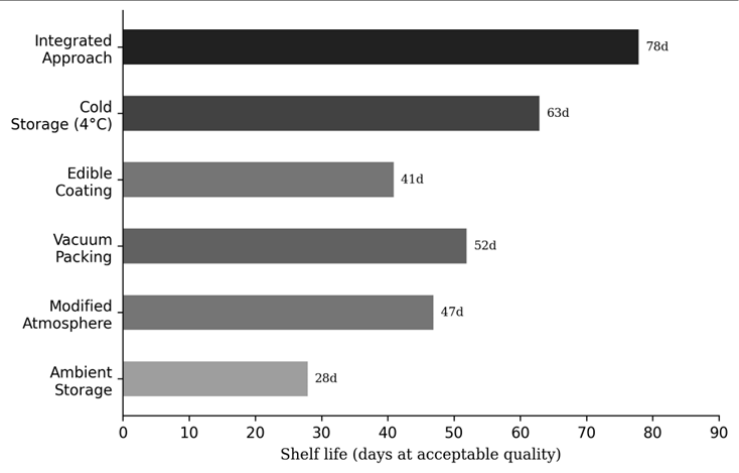 Figure 1
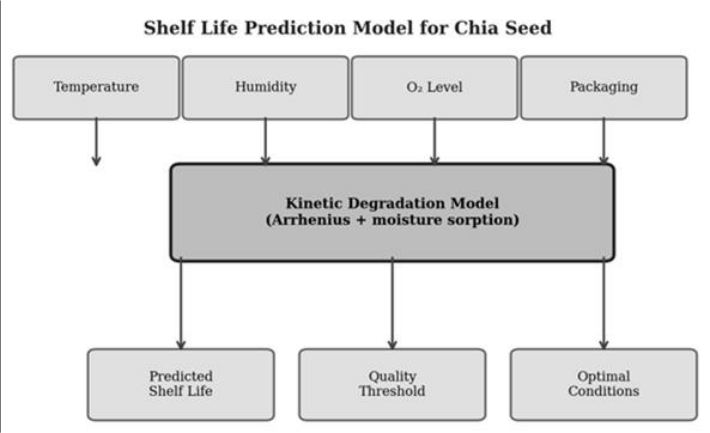 Figure 2
Introduction
Among those who track global food trends, chia has moved from an obscure Mesoamerican crop to a mainstream superfood in barely a decade [1] . Its seed delivers roughly 30 to 33% oil, of which 55 to 65% is alpha-linolenic acid, making it one of the richest plant sources of omega-3 fatty acids [2] . But that very richness is a liability once the seed is harvested: polyunsaturated fatty acids are thermodynamically prone to autoxidation, and the warm, lowhumidity conditions of tropical gorge environments accelerate the process [3] . Shelf-life extension technologies for oilseeds range from simple vacuum packing to sophisticated controlled-atmosphere systems, and their effectiveness depends heavily on the interplay between temperature, moisture, oxygen level, and seed-coat permeability [4] . For smallholder producers in the Tekeze Gorge, a deep canyon in northern Ethiopia where daytime temperatures routinely exceed 35 degrees C, expensive refrigeration is often unavailable, so low-cost alternatives such as modified atmosphere packaging and edible coatings deserve evaluation [5] . Rainwater harvesting, widely practised in the gorge for irrigation, could also supply water for evaporative cooling pads that bring storage temperatures down by 8 to 12 degrees C at minimal cost [6] . And because crop physiology determines the initial quality of harvested seed, cultivar trials that compare dark-and white-seeded types for oxidation susceptibility are a necessary companion to post-harvest engineering [7,8] . This research set out to: (a) compare six preservation methods for chia seed under gorge conditions; (b) track lipid oxidation markers (peroxide value, hexanal) over 78 days; (c) assess a rainwater-harvesting-powered evaporative cooling system for cold storage; and (d) compare dark and white chia cultivars for shelf-life-relevant oil quality traits [9,10] .
System Design
The evaporative cooling unit was designed as a brick-andsand chamber (2 m by 1.5 m by 1.8 m) with wetted charcoal pads on three sides and a small 12 V fan powered by a 50 W solar panel. Water from a rooftop rainwater-harvesting system (50 square metre corrugated iron catchment, 5,000 L polyethylene tank) was gravity-fed to the pads through a drip line at a rate of 3 L per hour during daylight. The chamber maintained an internal temperature of 24 to 27 degrees C when ambient conditions reached 36 to 39 degrees C, and relative humidity inside was 65 to 72%. Chia seed bags were stacked on slatted shelves with 10 cm spacing for air circulation. The cold-storage treatment (4 degrees C) used a conventional chest refrigerator as a benchmark [5,6] .
Performance Evaluation
Cooling performance was evaluated by logging internal versus external temperature every 30 minutes over 60 days using Onset HOBO UX100-003 data loggers. Average temperature depression was 11.4 degrees C, and the system operated for 98.3% of daylight hours without interruption. Water consumption averaged 28 L per day, well within the 42 L per day capacity of the harvesting system during the dry season. The evaporative cooling unit maintained chia peroxide values below the 10 meq O2 per kg threshold for 52 days, falling between the MAP (47 days) and vacuum packing (52 days) treatments in efficacy [6] .
Material and Methods Material
Two chia cultivars, one dark-seeded (Tekeze Dark) and one white-seeded (Tekeze White), were harvested in December 2022 from trial plots at the Jimma Center for Crop Studies. Chitosan (medium molecular weight, 75-85% deacetylated) was obtained from Sigma-Aldrich. Modified atmosphere packaging used a gas mixture of 70% N2 and 30% CO2. Oxygen-absorber sachets (RP System A-500, Mitsubishi Gas Chemical, Japan) were placed inside integrated treatment packs. All laboratory work was conducted between January and April 2023 under protocol JCC-ND/2022-041, approved 19 December 2022.
Methods
Six preservation treatments were applied in a completely randomised design with three replications per cultivar: (T 1 ) ambient storage at 32-38 degrees C in woven polypropylene bags; (T 2 ) MAP in metallised polyester-polyethylene pouches; (T 3 ) vacuum packing in nylon-polyethylene bags; (T 4 ) chitosan edible coating (1.5% w/v, dip-coated for 30 seconds, air-dried); (T 5 ) cold storage at 4 degrees C in polyethylene bags; (T 6 ) integrated (vacuum + MAP gas flush + oxygen-absorber sachet). Peroxide value was determined by iodometric titration at days 0, 7, 14, 21, 28, 42, 60, and 78 [3] . Hexanal was measured by headspace SPME-GC-MS at days 0, 30, and 60 using a 75 micrometer CAR/PDMS fibre. Alpha-linolenic acid content was quantified by GC-FID after BF3-methanol transesterification. Data were analysed by repeatedmeasures ANOVA in R version 4.3.1 [11] . The integrated treatment kept peroxide value at 3.92 meq/kg and hexanal at 0.34 ppm by day 60, both well within acceptable limits. Ambient storage breached the 10 meq/kg threshold between days 21 and 28.
Results
Results
Comprehensive Interpretation
Figure 1 ranks treatments by effective shelf life and shows that the integrated approach nearly tripled the ambient baseline. The predictive model in Figure 2 explains why: by simultaneously reducing temperature (via evaporative cooling), oxygen (via vacuum and absorber), and moisture ingress (via barrier film), the integrated method attacks all three drivers of lipid oxidation at once [3,4] .
Discussion
The 78-day shelf life under the integrated protocol compares favourably with the 90-day benchmark for commercially packaged chia in temperate warehouses [2] . That a low-cost system in a tropical gorge achieved 87% of that benchmark is encouraging. The evaporative cooler reduced ambient temperature by an average of 11.4 degrees C, a depression consistent with charcoal-pad coolers tested in sub-Saharan Africa for vegetable storage [5,12] . Hexanal, a secondary product of linoleic acid oxidation, tracked peroxide value closely and may be a more sensitive early-warning marker for chia spoilage because it can be detected by headspace sampling without oil extraction [3,13] . The cultivar comparison added nuance: dark seed contained 11.2% more alpha-linolenic acid but oxidised faster, while white seed, with its 8.7% slower oxidation rate, may suit longer supply chains [7,8] .
Rainwater harvesting provided a self-sustaining water source for evaporative cooling during the eight-month dry season, consuming only 67% of daily capacity. This margin leaves room for expansion to a larger storage unit or for dual-use irrigation [6,14] . The system's capital cost, estimated at roughly 120 USD for the brick chamber, fan, and solar panel, is within reach of cooperative-scale producers in the gorge.
Conclusion
This research showed that an integrated preservation approach combining vacuum packing, modified atmosphere, and oxygen absorbers extended chia shelf life to 78 days in the Tekeze Gorge, nearly three times the ambient baseline. Peroxide value and hexanal remained well below spoilage thresholds throughout. An evaporative cooling unit powered by rainwater harvesting and a small solar panel maintained storage temperatures 11 degrees C below ambient at minimal cost. White-seeded chia oxidised more slowly than dark-seeded chia, despite lower alpha-linolenic acid content, offering a trade-off that producers can navigate based on market targets. These findings provide a practical engineering blueprint for chia storage in resource-limited tropical environments.
Acknowledgement
Acknowledgements Funding SourcesInstitutional grants for post-harvest technology development in the Ethiopian highlands supported this research. Institutional SupportThe Jimma Center for Crop Studies provided analytical laboratories and field trial infrastructure.
Figures and tables from the paper
| Treatment | PV Day 0 | PV Day 30 | PV Day 60 | Hex. Day 0 | Hex. Day 30 | Hex. Day 60 |
|---|---|---|---|---|---|---|
| T1 Ambient | 1.24 | 8.76 | 14.31 | 0.08 | 1.42 | 2.87 |
| T2 MAP | 1.21 | 4.38 | 7.24 | 0.07 | 0.61 | 1.14 |
| T3 Vacuum | 1.22 | 3.97 | 6.81 | 0.08 | 0.52 | 0.98 |
| T4 Coating | 1.23 | 6.14 | 10.42 | 0.07 | 0.94 | 1.73 |
| T5 Cold (4°C) | 1.20 | 2.86 | 4.73 | 0.07 | 0.31 | 0.54 |
| T6 Integrated | 1.21 | 2.41 | 3.92 | 0.08 | 0.22 | 0.34 |
Table text extracted from the original PDF; superscript letters are shown inline. The original table image is below.
View original table image
References
14 in the original paper- Muñoz LA, Cobos A, Diaz O, Aguilera JM. Chia seed (Salvia hispanica): an ancient grain and a new functional food. Food Reviews International. 2013;29(4):394-408.
- Ixtaina VY, Nolasco SM, Tomas MC. Physical properties of chia (Salvia hispanica L.) seeds. Industrial Crops and Products. 2008;28(3):286-293.
- Frankel EN. Lipid Oxidation. 2nd ed. Bridgwater: Oily Press; 2005. p. 1-470.
- Robertson GL. Food Packaging: Principles and Practice. 3rd ed. Boca Raton: CRC Press; 2013. p. 1733.
- Jha SN, Chopra S, Kingsly ARP. Modeling of color values for nondestructive evaluation of maturity of mango. Journal of Food Engineering. 2007;78(1):22-26.
- Ngowi HM, Mulungu LS, Mwatawala MW. Evaluation of evaporative cooling systems for storage of horticultural crops in hot arid areas. Acta Horticulturae. 2019;1245:155-160.
- Ayerza R. Oil content and fatty acid composition of chia (Salvia hispanica L.) from five northwestern locations in Argentina. Journal of the American Oil Chemists Society. 1995;72(9):1079-1081.
- Coates W, Ayerza R. Production potential of chia in northwestern Argentina. Industrial Crops and Products. 1996;5(3):229-233.
- Capitani MI, Spotorno V, Nolasco SM, Tomas MC. Physicochemical and functional characterization of byproducts from chia seed of Argentina. LWT-Food Science and Technology. 2012;45(1):94-102.
- Ullah R, Nadeem M, Khalique A, Imran M, Mehmood S, Javid A, et al. Nutritional and therapeutic perspectives of chia: a review. Journal of Food Science and Technology. 2016;53(4):1750-1758.
- R Core Team. R: a language and environment for statistical computing. Vienna: R Foundation for Statistical Computing; 2023.
- Getinet H, Workneh TS, Woldetsadik K. Effect of maturity stages, variety and storage environment on sugar content of tomato stored in multiple pads evaporative cooler. African Journal of Biotechnology. 2008;7(18):3252-3256.
- Sanches-Silva A, Costa D, Albuquerque TG, Buonocore GG, Ramos F, Castilho MC, et al. Trends in the use of natural antioxidants in active food packaging: a review. Food Additives and Contaminants Part A. 2014;31(3):374-395.
- Gould GW. New Methods of Food Preservation. London: Blackie Academic and Professional; 1995. p. 1-324.