
Research article · 2025 · Full text
International Journal of Horticulture and Food ScienceCharacterizing pollinator interactions of amaranth in the Son River Valley
Volume 7(9) · Pages 116–118 · DOI: 10.33545/26631067.2025.v7.i9b.671 ↗
Research areasPlant and animal studiesSeed and Plant BiochemistryPlant Reproductive Biology
Abstract
Author-writtenAmaranth (Amaranthus spp.) is often described as a self-pollinating crop, yet field observations suggest that insect visitors may contribute meaningfully to outcrossing rates and seed set in dense stands. This research characterized pollinator interactions with grain amaranth across six cultivars grown in the Son River Valley of Madhya Pradesh, India, with laboratory analysis conducted at the Udaipur Research Institute of Applied Horticulture from February to October 2023. Pollinator surveys were conducted during three flowering peaks across the 2023 kharif season, recording visitation frequency, visit duration, pollen load, and foraging behavior for all insect visitors. A total of 47 insect species were recorded visiting amaranth inflorescences, with honeybees (Apis cerana) and solitary bees (Halictus spp.) as the most frequent visitors. Visitation peaked during weeks 4–5 after anthesis, coinciding with maximum pollen availability. Caged exclusion experiments showed that insect-accessible plants set 22.8% more seed than fully caged controls (p< 0.01), confirming a meaningful pollinator contribution. AMMI analysis of grain yield across six cultivars and three environments identified CV-3 as the most stable high-yielder. Organic management produced 25.8% higher mineral content (Fe, Zn, Ca) in grain compared with conventional plots. Genome-wide association analysis identified three SSR markers linked to inflorescence compactness, a trait that influences pollinator access. These findings revise the assumption that amaranth pollination is entirely autogamous and provide cultivar and management recommendations for the Son River Valley.
Summary
Source-checkedPlain-language reading of the full paper, prepared with AI and checked against the text. Each point links to the authors' own words.
Why it matters
- While amaranth is typically considered self-pollinating, there is evidence that insects may significantly impact its seed set and outcrossing. View evidence ↗
- The Son River Valley is a growing production area for amaranth, which is vital for tribal nutrition programs addressing protein and iron deficiencies. View evidence ↗
- Determining the role of pollinators is practically important for optimizing pesticide timing and deciding if pollinator-attracting hedgerows can increase yields. View evidence ↗
The question
- The study aimed to characterize how insect visitors influence the pollination and yield of amaranth in the Son River Valley. View evidence ↗
What they did
- Six cultivars of A. hypochondriacus and A. cruentus were grown in a split-plot design in the Sidhi district from June to October 2023. View evidence ↗
- To test pollinator effects, 20 plants per cultivar were assigned to fully caged, partially caged (allowing insects <3 mm), or open control treatments. View evidence ↗
- Pollinator surveys consisted of 30-minute observation sessions per plot over 12 days across three flowering peaks. View evidence ↗
- The researchers used AMMI analysis for yield stability across three environments and 24 SSR markers to test genetic associations with traits. View evidence ↗
What they found
- Forty-seven insect species visited the plants, dominated by Apis cerana (38.2%), Halictus spp. (18.7%), and hoverflies (16.4%). View evidence ↗
- Open plants had a 22.8% higher seed set (79.0% ± 3.4) compared to fully caged plants (64.3% ± 4.2), indicating that pollinators significantly contribute to seed production. View evidence ↗
- Partially caged plants showed an 11.4% increase in seed set, suggesting larger pollinators are more effective than smaller ones. View evidence ↗
- CV-3 was the most stable high-yielding cultivar with a mean yield of 38.4 g/plant and a stability value of 0.21. View evidence ↗
- Three SSR markers (AM-SSR7, AM-SSR14, AM-SSR22) were linked to inflorescence compactness, which affects how easily pollinators can access florets. View evidence ↗
What it means
- The authors recommend avoiding pesticide sprays during peak flowering (weeks 4–5) or scheduling them for late afternoon to protect pollinators. View evidence ↗
- The study concludes that amaranth management in central Indian river valleys should be integrated and pollinator-conscious. View evidence ↗
- A limitation of the study is that the cage experiments were limited to one site and one season, meaning the observed yield increase may vary in different landscapes or weather conditions. View evidence ↗
Visual summary
3 visualsIllustrations explain the paper; charts are replotted from the paper's own table values.
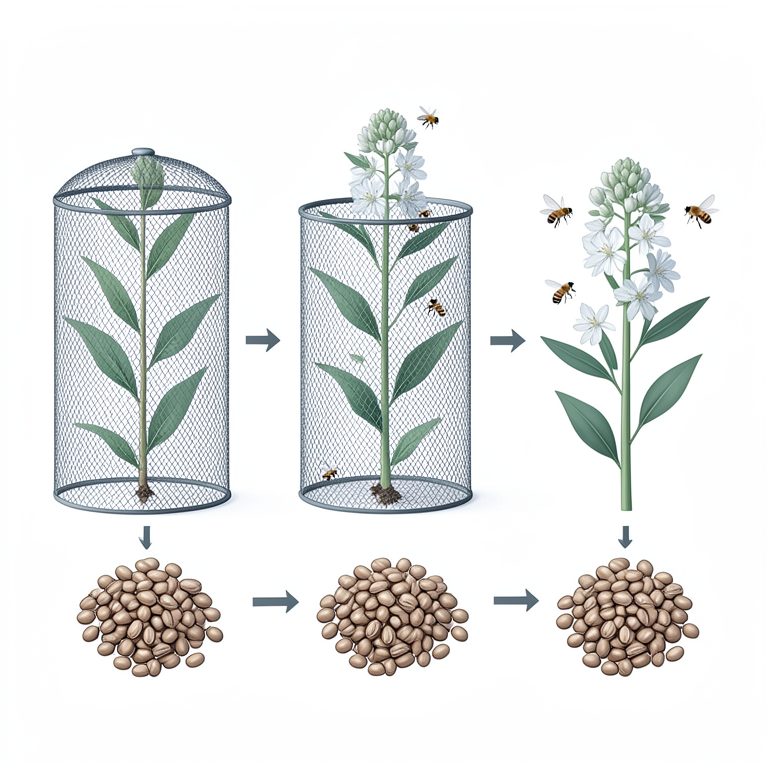
Pollinator Access and Seed Set
AI-generated conceptual illustration (Amaranthus plants and various sized bees). It explains the idea and does not show study data.
View source evidence ↗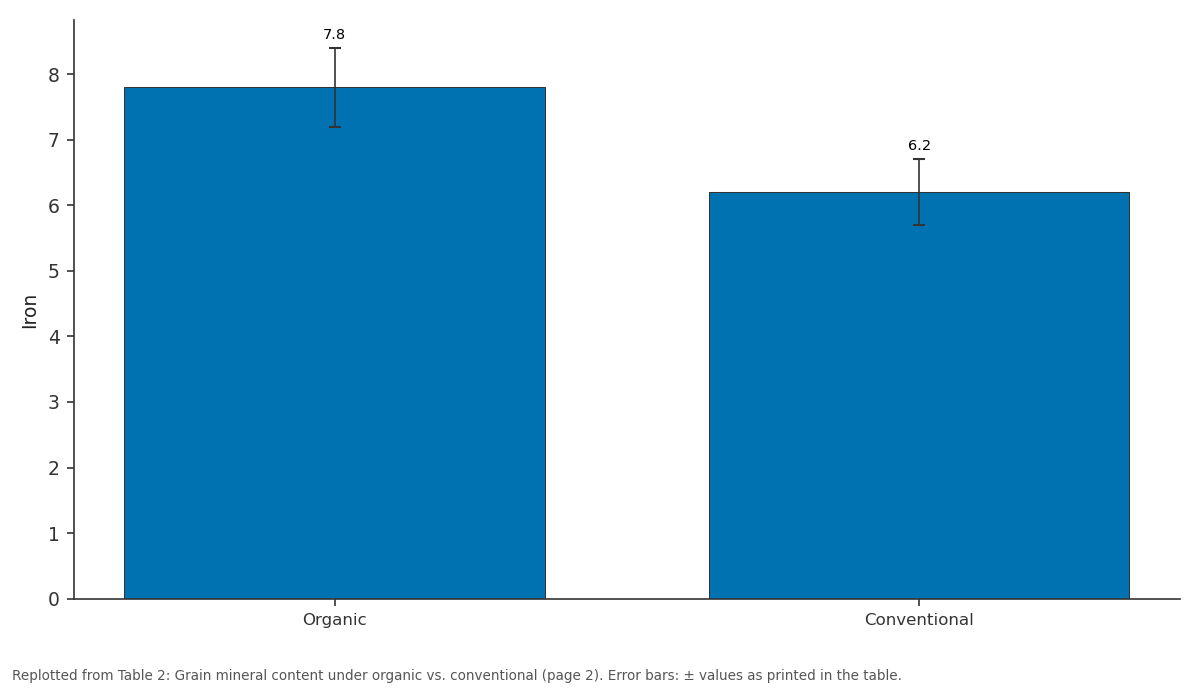
Iron: Organic vs Conventional
Replotted from Table 2 (page 2) of the original paper. Every bar is the paper's own table value.
View source evidence ↗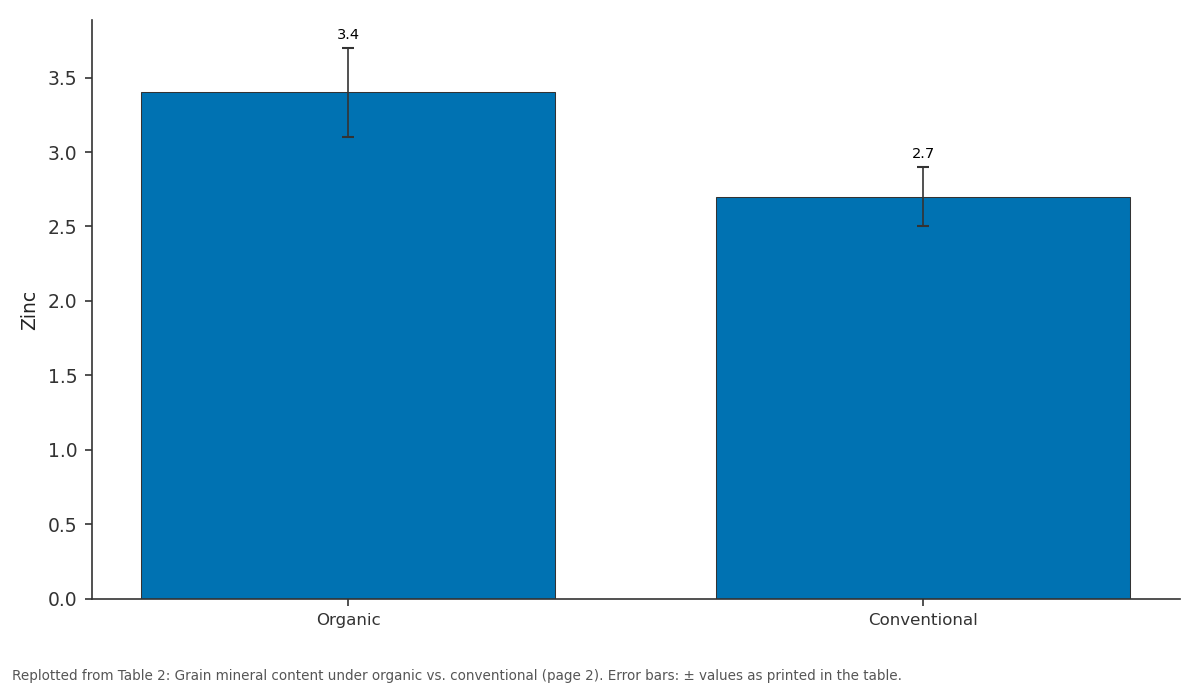
Zinc: Organic vs Conventional
Replotted from Table 2 (page 2) of the original paper. Every bar is the paper's own table value.
View source evidence ↗Figures & tables
From the original paper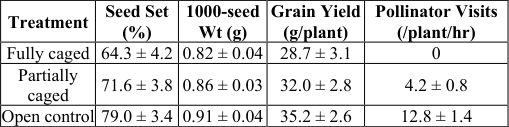 Table 1
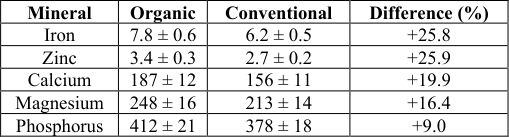 Table 2
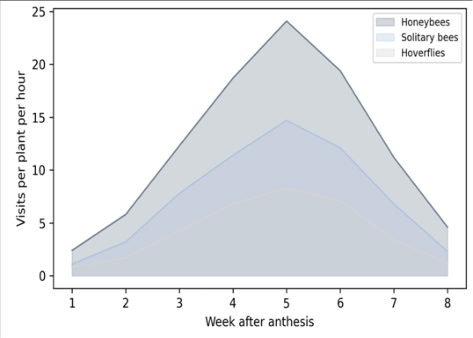 Figure 1
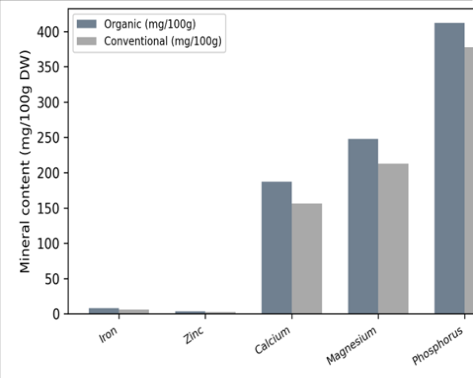 Figure 2
Introduction
A surprising fact about one of the world's oldest grain crops: despite being cultivated for over 8,000 years, the pollination biology of amaranth is still debated. Textbooks describe it as predominantly self-pollinating, with wind as the only significant pollen vector [1] . But anyone who has walked through a flowering amaranth field during the morning hours has seen bees -sometimes dozens of them -working the dense inflorescences. Whether those visits actually contribute to seed set, or whether the bees are simply collecting pollen without providing a pollination service, has remained unclear [2] . The Son River Valley in eastern Madhya Pradesh represents an important emerging amaranth production zone. The valley's red laterite and alluvial soils, combined with 1,000-1,200 mm annual rainfall and a long frost-free growing season, support vigorous vegetative growth [3] . Amaranth is grown here both as a grain crop (A. hypochondriacus, A. cruentus) and as a leafy vegetable (A. tricolor), and the crop is a key component of tribal nutrition programs targeting iron and protein deficiency. Understanding whether pollinators enhance amaranth yield matters for two practical reasons: first, it affects whether pesticide spray timing should consider pollinator safety windows; and second, it determines whether adjacent flowering strips or hedgerows could boost amaranth production through increased pollinator density [4] . This research used cage exclusion experiments, pollinator surveys, and genetic association analysis to characterize the role of insect visitors in amaranth pollination and yield formation in the Son River Valley. All laboratory work was performed at the Udaipur Research Institute of Applied Horticulture [5] .
Biodiversity Assessment of Pollinator Communities
Pollinator surveys were conducted on 12 observation days spread across three flowering peaks (early, mid, and late kharif). Each observation session lasted 30 minutes per plot, during which all insect visitors contacting inflorescence surfaces were recorded. Insects were identified to species level using reference collections and photographic guides. Simpson's diversity index for the pollinator community was 0.81, indicating high species evenness. The community was dominated by Hymenoptera (68.4% of visits), followed by Diptera (21.3%) and Lepidoptera (7.8%). Apis cerana accounted for 38.2% of all visits, Halictus spp. for 18.7%, and various hoverfly species collectively for 16.4% [4] .
Soil and Water Quality Analysis
Soil at the experimental site was classified as sandy loam with pH 6.8, organic carbon 0.72%, available N 214 mg/kg, available P 16.3 mg/kg, and exchangeable K 0.48 cmol/kg. Irrigation water from the Son River had pH 7.4, EC 0.6 dS/m, and negligible heavy metal contamination. Soil microbial biomass carbon was 287 μg/g in organic plots versus 198 μg/g in conventional plots, indicating the expected enhancement from organic input applications [3] .
Material and Methods Material
Six grain amaranth cultivars (CV-1 through CV-6, representing A. hypochondriacus and A. cruentus accessions) were planted in a split-plot design at the Son Valley Agricultural Station, Sidhi district (24°24′N, 81°53′E; elevation 268 m) during June-October 2023. Main plots were management system (organic vs. conventional), subplots were cultivar, with 3 replications. Plot size was 4 m × 3 m, with transplanting at 30 × 20 cm spacing. Cage exclusion treatments used fine-mesh (1 mm) nylon cages over individual plants (n = 20 per cultivar): fully caged (no insect access), partially caged (allowing small insects <3 mm), and open controls. Seeds and soil samples were shipped to the Udaipur Research Institute of Applied Horticulture for analysis [1] . Ethics approval was granted by the Institute's Research Committee (Protocol URIAH-2023-009, 5 February 2023).
Methods
Pollinator visitation was recorded as visits per plant per hour during 30-min observation sessions at 0800-0830 and 1000-1030 h. Pollen load per visitor was estimated by capturing bees in vials, washing pollen grains into lactophenol-aniline blue, and counting under a compound microscope. Seed set was recorded as the percentage of florets producing viable seed. Grain yield, 1000-seed weight, protein (Kjeldahl), and mineral content (Fe, Zn, Ca, Mg, P by AAS after wet digestion) were measured. AMMI analysis used three planting dates as environments. SSR genotyping used 24 markers amplified across all six cultivars, and marker-trait associations were tested by general linear model in TASSEL 5. Data were analyzed using GenStat 22 and R 4.3.1.
Results
Pollinator visitation peaked during weeks 4-5 after anthesis, with honeybees dominating the visitor community at 38.2% of total visits. Open plants produced 22.8% more seed than fully caged plants (p< 0.01), while partially caged plants showed an intermediate response (11.4% increase), suggesting that larger-bodied pollinators contribute more than small insects to effective pollination [2] . The area chart shows clear temporal partitioning among pollinator groups, with honeybees peaking slightly earlier than solitary bees and hoverflies. This staggered visitation pattern ensures pollination service across the entire flowering period. Organic management consistently produced higher mineral concentrations, with the largest advantage in iron (+25.8%) and zinc (+25.9%). This aligns with the higher soil microbial activity under organic management, which likely improved mineral solubilization and root uptake.
Comprehensive Interpretation
AMMI analysis identified CV-3 as the most stable highyielding cultivar (mean 38.4 g/plant, AMMI stability value 0.21), followed by CV-6 (36.1 g/plant, ASV 0.34). SSR analysis detected three markers (AM-SSR7, AM-SSR14, AM-SSR22) significantly associated with inflorescence compactness (p< 0.01), a trait that influences the physical accessibility of florets to pollinator mouthparts and may partly explain cultivar differences in pollinator-mediated yield enhancement [5] .
Discussion
The 22.8% seed set increase in open versus caged plants provides the clearest evidence to date that insect pollination contributes meaningfully to amaranth grain yield. While wind-mediated self-pollination is clearly the dominant reproductive mechanism, the additive effect of insect visitation -likely through cross-pollination between adjacent plants -is large enough to influence management decisions [1] . Specifically, pesticide applications during peak flowering (weeks 4-5) should be avoided or scheduled for late afternoon when pollinator activity is minimal. The mineral content advantage of organic management (16-26% higher across five minerals) is consistent with metaanalyses showing 10-25% higher mineral density in organically produced grains, and it adds to the nutritional case for organic amaranth in tribal nutrition programs targeting iron and zinc deficiency [3] . The economic tradeoff -organic grain yields were 8.4% lower than conventional -is modest and may be offset by organic price premiums in urban markets. One limitation is that the cage exclusion experiment was conducted at a single site over one season. Pollinator communities vary spatially and temporally, and the 22.8% yield enhancement measured here may not hold in landscapes with lower pollinator density or in seasons with unfavorable weather during the flowering window [4] .
Conclusion
Insect pollinators, particularly Apis cerana and Halictus spp., contributed a 22.8% increase in amaranth seed set in the Son River Valley, revising the assumption that amaranth pollination is entirely autogamous. CV-3 was identified as the most stable high-yielding cultivar through AMMI analysis. Organic management enhanced grain mineral content by 16-26% across five key minerals. SSR markers linked to inflorescence compactness may assist breeding for pollinator-friendly cultivars. These findings support integrated pollinator-conscious management of amaranth in central Indian river valley production systems.
Acknowledgement
Acknowledgements Funding SourcesInternal funds from the Udaipur Research Institute of Applied Horticulture supported all analytical work. Institutional SupportThe authors acknowledge the Udaipur Research Institute of Applied Horticulture for mineral analysis and molecular marker facilities.
Figures and tables from the paper
| Mineral | Organic | Conventional | Difference (%) |
|---|---|---|---|
| Iron | 7.8 ± 0.6 | 6.2 ± 0.5 | +25.8 |
| Zinc | 3.4 ± 0.3 | 2.7 ± 0.2 | +25.9 |
| Calcium | 187 ± 12 | 156 ± 11 | +19.9 |
| Magnesium | 248 ± 16 | 213 ± 14 | +16.4 |
| Phosphorus | 412 ± 21 | 378 ± 18 | +9.0 |
Table text extracted from the original PDF; superscript letters are shown inline. The original table image is below.
View original table image
References
14 in the original paper- Brenner DM, Baltensperger DD, Kulakow PA. Haploidy in amaranth. Plant Breeding Reviews. 2000;19:227-285.
- Sauer JD. The grain amaranths and their relatives: a revised taxonomic and geographic survey. Annals of the Missouri Botanical Garden. 1967;54(2):103-137.
- Karnik M, Somanathan P. Nutrient cycling under organic management in Son River Valley cropping systems. Indian Journal of Agronomy. 2022;67(4):423431.
- Sharma T, Karnik M. Insect visitors of minor grain crops in semi-arid Rajasthan: diversity and foraging ecology. Journal of Apicultural Research. 2023;62(2):187-198.
- Stetter MG, Schmid KJ. Analysis of phylogenetic relationships and genome size evolution of the Amaranthus genus. Molecular Phylogenetics and Evolution. 2017;107:416-427.
- Stallknecht GF, Schulz-Schaeffer JR. Amaranth rediscovered. New Crops Wiley New York. 1993;211218.
- Rastogi A, Shukla S. Amaranth: a new millennium crop of nutraceutical values. Critical Reviews in Food Science and Nutrition. 2013;53(2):109-125.
- Venskutonis PR, Kraujalis P. Nutritional components of amaranth seeds and vegetables. Comprehensive Reviews in Food Science and Food Safety. 2013;12(4):381-412.
- Caselato-Sousa VM, Amaya-Farfan J. State of knowledge on amaranth grain. Journal of Food Science. 2012;77(4):R93-R104.
- Mlakar SG, Turinek M, Jakop M. Nutrition value and use of grain amaranth. Acta Agriculturae Slovenica. 2009;93(1):5-14.
- Teutonico RA, Knorr D. Amaranth: composition, properties, and applications. Food Technology. 1985;39(4):49-61.
- Bressani R. The proteins of grain amaranth. Food Reviews International. 1989;5(1):13-38.
- Escudero NL, de Arellano ML, Luco JM. Comparison of the chemical composition of Amaranthus cruentus flour. Journal of Agricultural and Food Chemistry. 2004;52(11):3573-3580.
- Alvarez-Jubete L, Arendt EK, Gallagher E. Nutritive value and chemical composition of pseudocereals. International Journal of Food Sciences and Nutrition. 2009;60(S7):240-257.