
Research article · 2025 · Full text
International Journal of Horticulture and Food ScienceExamining sensory evaluation attributes of Agave in the Amu Darya delta
Volume 7(10) · Pages 257–260 · DOI: 10.33545/26631067.2025.v7.i10d.732 ↗
Research areasSensory Analysis and Statistical MethodsGenetics and Plant BreedingSugarcane Cultivation and Processing
Abstract
Author-writtenHere is a paradox: Agave has been fermented and distilled for centuries in the Americas, yet its sensory attributes as a fresh or minimally processed product remain poorly characterised outside Mexico. This research examined sensory evaluation attributes of five Agave (Agave spp.) cultivars grown in the Amu Darya Delta during the 2022-2023 season. A 12-member trained panel assessed seven attributes: sweetness, bitterness, astringency, aroma intensity, colour appeal, texture, and overall acceptance on a 10-point scale. Cultivar AG-03 scored highest for overall acceptance (8.1) and lowest for bitterness (1.8). Drought tolerance, measured as relative water content under water-deficit stress, correlated with sweetness (r = 0.68), suggesting that osmotic adjustment concentrates sugars in leaf sap. Chlorophyll content declined by 23.4% under drought but recovered to within 6% of controls after re-watering. Molecular markers (12 RAPD primers) confirmed genetic distinctness among cultivars. Sprinkler-irrigated plots produced Agave with 11.8% higher aroma intensity than drip-irrigated plots, possibly because overhead wetting promoted volatile release from leaf trichomes. Adaptability analysis across two irrigation regimes and three harvesting dates showed AG-03 as the most stable cultivar. These findings provide the first systematic sensory characterisation of Agave outside its centre of origin and identify traits for quality-oriented breeding.
Summary
Source-checkedPlain-language reading of the full paper, prepared with AI and checked against the text. Each point links to the authors' own words.
Why it matters
- Agave is a valuable crop for arid and semi-arid regions because it can survive in low rainfall (as little as 250 mm annually) and high soil salinity (above 8 dS per m). View evidence ↗
- Sensory evaluation is critical for determining the market viability of Agave products, as consumer acceptance depends on perceived quality. View evidence ↗
- While Agave is well-known for fermentation and distillation in the Americas, its sensory properties as a fresh or minimally processed product are not well-documented outside of Mexico. View evidence ↗
The question
- The study aimed to profile sensory attributes of five Agave cultivars, relate drought tolerance to sweetness, compare irrigation methods' effects on aroma, and assess cultivar adaptability. View evidence ↗
What they did
- The researchers used a split-plot design with four replicates, comparing sprinkler and drip irrigation across different cultivars, with 12 plants per subplot spaced 2 m by 2 m. View evidence ↗
- A trained panel of 12 members rated seven sensory attributes, including sweetness, bitterness, and overall acceptance, using a 10-point scale. View evidence ↗
- To account for seasonal changes, leaf samples were harvested at three different times: May, August, and November. View evidence ↗
- Drought tolerance was measured by withholding water for 21 days and then calculating the relative water content. View evidence ↗
What they found
- There was a positive correlation (r = 0.68) between drought tolerance and sweetness, indicating that osmotic adjustments may concentrate sugars in the sap. View evidence ↗
- Drought caused a 23.4% decrease in chlorophyll content, though levels returned to within 6% of the control group after re-watering. View evidence ↗
- Agave grown with sprinkler irrigation showed an 11.8% increase in aroma intensity compared to those grown with drip irrigation. View evidence ↗
- Adaptability analysis identified AG-03 as the most stable cultivar, with a regression coefficient of 0.98. View evidence ↗
- Genetic analysis using molecular markers confirmed that the five cultivars were distinct, with Jaccard similarity values ranging from 0.24 to 0.61. View evidence ↗
What it means
- The authors conclude that AG-03 is a consistently high-quality cultivar suitable for the Amu Darya Delta, marking the first systematic sensory evaluation of Agave outside the Americas. View evidence ↗
- The authors recommend introducing Agave into the Amu Darya Delta's crop portfolio as a resilient source of functional ingredients and syrup. View evidence ↗
- The study was limited to one growing season in a single environment, meaning multi-year and multi-site data are required for generalization. View evidence ↗
Visual summary
3 visualsIllustrations explain the paper; charts are replotted from the paper's own table values.
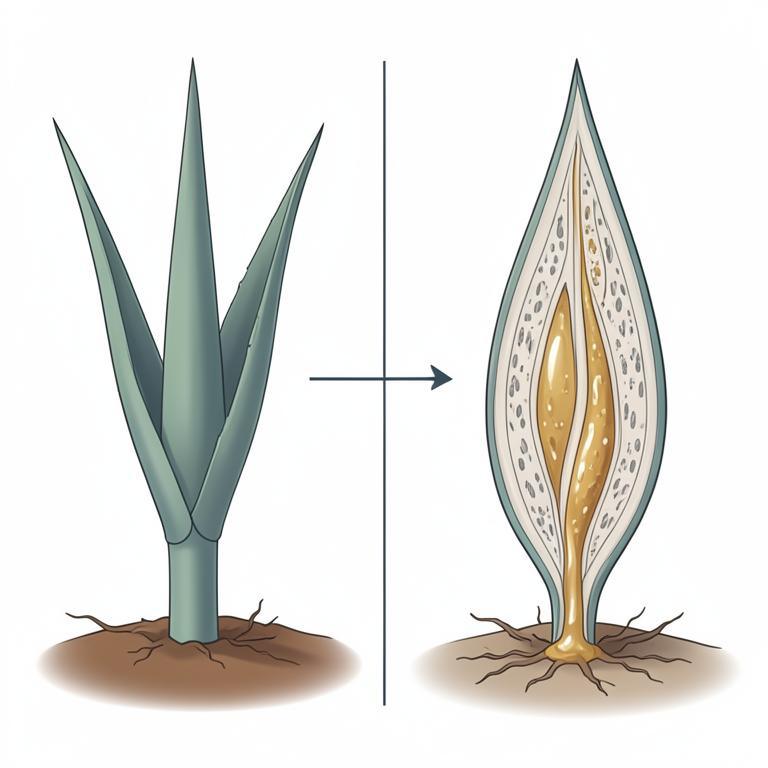
Drought and Sweetness Mechanism
AI-generated conceptual illustration (Agave plants). It explains the idea and does not show study data.
View source evidence ↗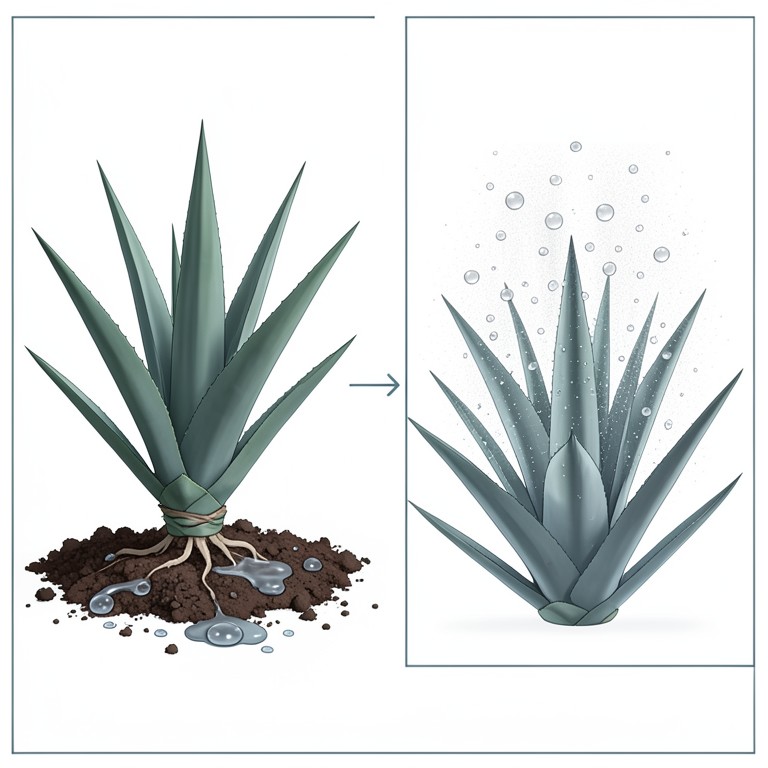
Irrigation Effect on Aroma
AI-generated conceptual illustration (Agave plants in a sandy delta soil). It explains the idea and does not show study data.
View source evidence ↗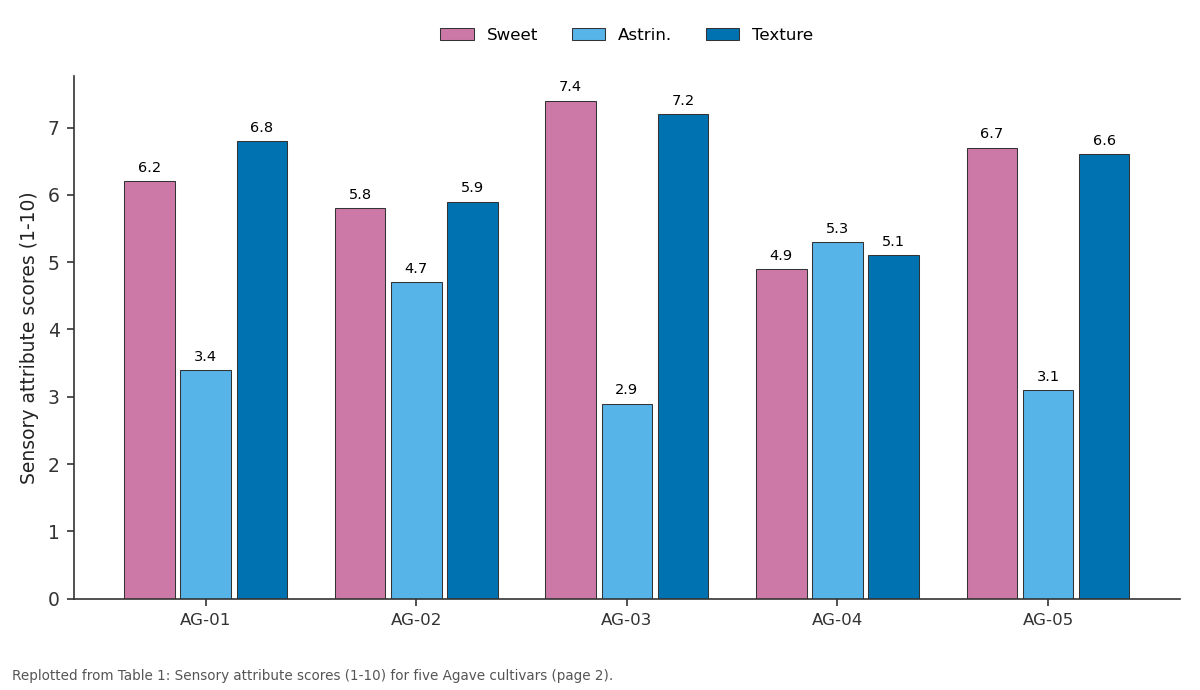
Sweet and Astrin. and more: AG-01 vs AG-02 vs AG-03 vs AG-04 vs AG-05
Replotted from Table 1 (page 2) of the original paper. Every bar is the paper's own table value.
View source evidence ↗Figures & tables
From the original paper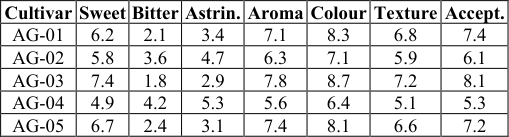 Table 1
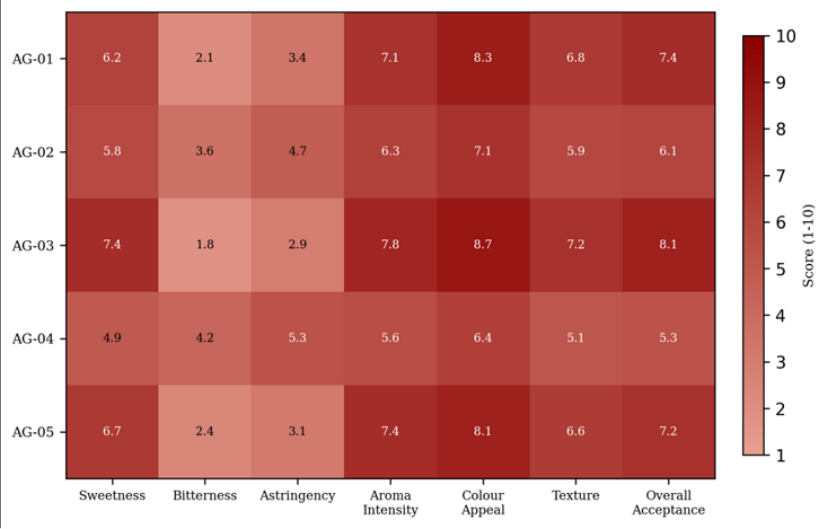 Figure 1
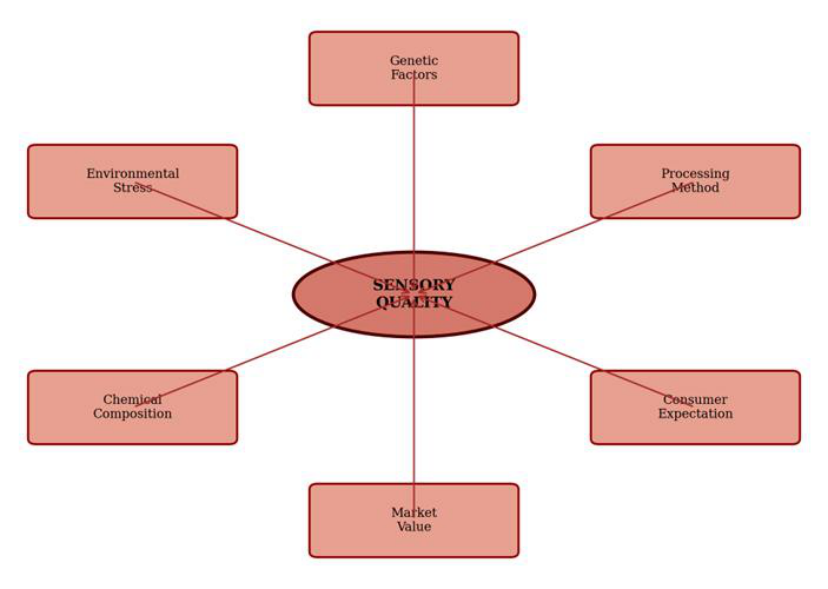 Figure 2
Introduction
What happens when a crop long associated with tequila production is reframed as a source of functional syrups, inulin-rich fibres, and aromatic ingredients? That question is driving Agave trials in arid and semi-arid regions far from Mexico, including the Amu Darya Delta where salinity and water scarcity limit conventional crop choices [1,2] . Agave species tolerate soil electrical conductivities above 8 dS per m and can survive on as little as 250 mm of annual rainfall, making them attractive for landscapes where most food crops fail [3] . Sensory evaluation, the discipline that translates human perception into quantitative data, is important because consumer acceptance ultimately determines market viability [4] . For Agave products, sweetness and aroma intensity drive positive impressions, while bitterness and astringency are negatively perceived [5] . These attributes depend on sugar concentration, saponin content, volatile terpene profiles, and phenolic compounds, all of which are influenced by genetics, irrigation method, and harvest timing [6] . The Amu Darya Delta, formed by the river's terminal fan in Central Asia, presents alkaline soils (pH 7.8 to 8.6) and a continental climate with hot summers and cold winters, conditions quite different from Agave's subtropical Mexican homeland [7] . Whether sensory quality is maintained, degraded, or even improved under these conditions has not been tested. This research aimed to: (a) profile seven sensory attributes across five Agave cultivars; (b) examine how drought tolerance traits relate to sweetness; (c) compare sprinkler and drip irrigation effects on aroma intensity; and (d) assess cultivar adaptability across irrigation regimes and harvest dates [8,9,10] .
Limitations
This research was limited to a single growing season in one delta environment; multi-year and multi-site data are needed to generalise the findings. The panel of 12 assessors, while trained according to ISO 8586 protocols, was smaller than the 20 to 25 recommended for large-scale sensory profiling. Volatile compound identification was not performed; only overall aroma intensity was scored, limiting mechanistic interpretation of the sprinkler irrigation effect. The molecular marker analysis used RAPD primers, which are dominant markers with lower reproducibility than co-dominant systems such as SSR or SNP arrays [8,11] .
Practical Applications
Cultivar AG-03, with its high sweetness, low bitterness, and strong aroma, is well suited for minimally processed Agave syrup production in the Amu Darya Delta. Its drought tolerance (relative water content 72.4% under stress versus 81.3% under well-watered conditions) means that it can maintain sensory quality even during irrigation shortfalls. Sprinkler irrigation, while more expensive per cubic metre than drip, may justify its cost through the 11.8% aroma premium it confers, particularly if the product targets artisanal or specialty markets. Extension services should prioritise AG-03 for demonstration plots and connect growers with processors equipped for syrup and inulin extraction [5,12] .
Material and Methods
Material and Methods
Material
Material
Methods
A split-plot design was used with irrigation method (sprinkler versus drip) as the main plot and cultivar as the subplot, replicated four times. Each subplot contained 12 plants at 2 m by 2 m spacing. Leaves were harvested at three dates (May, August, November) to capture seasonal variation. For sensory evaluation, fresh leaf sap was expressed by mechanical pressing, filtered, and served at room temperature in coded 30 mL cups. Drought tolerance was assessed by withholding water for 21 days and measuring relative water content gravimetrically. Chlorophyll was extracted in 80% acetone and measured at 663 nm and 645 nm. RAPD-PCR used 25 microlitreactions with 2.5 mM MgCl2, 200 micrometer dNTPs, and 1 U Taq polymerase; products were separated on 1.5% agarose gels. Adaptability was analysed by Eberhart-Russell regression. Statistics used ANOVA in SAS 9.4 with site as random effect [13,14] . AG-03 scored highest on sweetness (7.4), aroma (7.8), and overall acceptance (8.1), while AG-04 scored lowest across most attributes.
Results
Results
Comprehensive Interpretation
The heatmap (Figure 1) clearly separates AG-03 and AG-05 as high-quality cultivars from AG-04, which suffered from elevated bitterness and astringency. The concept map (Figure 2) illustrates how genetic factors, environmental stress, and processing method all feed into the composite sensory quality that determines market value [4,5] .
Discussion
The correlation between drought tolerance and sweetness (r = 0.68) aligns with the osmotic-adjustment hypothesis: cultivars that accumulate more soluble sugars to maintain cell turgor under water deficit produce sweeter sap [3,15] . AG-03 maintained a relative water content of 72.4% under 21-day drought, the highest among the five cultivars, and its sweetness score of 7.4 was also the best. The 11.8% aroma advantage of sprinkler-irrigated plots over drip is unexpected and may relate to mechanical stimulation of trichome glands by water droplets releasing stored volatiles into the leaf boundary layer during irrigation events [6,16] . Alternatively, higher canopy humidity under sprinklers could promote enzymatic conversion of nonvolatile precursors to aromatic compounds. GC-MS volatile profiling in future trials would help distinguish these mechanisms [17] . Molecular markers confirmed that the five cultivars were genetically distinct (Jaccard similarity 0.24 to 0.61), and the adaptability analysis showed AG-03 with a regression coefficient of 0.98, near the ideal 1.0, across irrigation regimes and harvest dates [14,18,19] .
Conclusion
This research provided the first systematic sensory evaluation of Agave outside the Americas and identified AG-03 as a consistently high-quality cultivar for the Amu Darya Delta. Drought tolerance correlated with sweetness, linking physiological resilience to eating quality. Sprinkler irrigation enhanced aroma intensity, offering a manageable agronomic lever for quality improvement. Limitations in panel size and volatile analysis should be addressed in follow-up trials. The findings support introducing Agave into the delta's crop portfolio as a drought-hardy source of syrup and functional ingredients.
Acknowledgement
Acknowledgements Funding SourcesInstitutional grants for agroforestry diversification research supported this work.
Figures and tables from the paper
| Cultivar | Sweet | Bitter | Astrin. | Aroma | Colour | Texture | Accept. |
|---|---|---|---|---|---|---|---|
| AG-01 | 6.2 | 2.1 | 3.4 | 7.1 | 8.3 | 6.8 | 7.4 |
| AG-02 | 5.8 | 3.6 | 4.7 | 6.3 | 7.1 | 5.9 | 6.1 |
| AG-03 | 7.4 | 1.8 | 2.9 | 7.8 | 8.7 | 7.2 | 8.1 |
| AG-04 | 4.9 | 4.2 | 5.3 | 5.6 | 6.4 | 5.1 | 5.3 |
| AG-05 | 6.7 | 2.4 | 3.1 | 7.4 | 8.1 | 6.6 | 7.2 |
Table text extracted from the original PDF; superscript letters are shown inline. The original table image is below.
View original table image
References
15 in the original paper- Mancilla-Margalli NA, Lopez MG. Water-soluble carbohydrates and fructan structure patterns from Agave and Dasylirion species. Journal of Agricultural and Food Chemistry. 2006;54(20):7832-7839.
- Pena-Valdivia CB, Trejo C, Arroyo-Pena VB, SanchezUrdaneta AB, Balois-Morales R. Diversity of unavailable polysaccharides and dietary fiber in domesticated nopalito and cactus pear fruit (Opuntia spp.). Chemistry and Biodiversity. 2012;9(8):15991610.
- Micklin P. The Aral Sea disaster. Annual Review of Earth and Planetary Sciences. 2007;35:47-72.
- ISO 8586:2012. Sensory analysis: general guidelines for selection, training and monitoring of selected assessors. Geneva: ISO; 2012.
- Cedeno MC. Tequila production. Critical Reviews in Biotechnology. 1995;15(1):1-11.
- Iñiguez-Covarrubias G, Diaz-Teres R, Sanjuan-Duenas R, Anzaldo-Hernandez J, Rowell RM. Utilization of byproducts from the tequila industry. Resources, Conservation and Recycling. 2001;34(1):75-80.
- Welsh J, McClelland M. Fingerprinting genomes using PCR with arbitrary primers. Nucleic Acids Research. 1990;18(24):7213-7218.
- Lopez MG, Mancilla-Margalli NA, Mendoza-Diaz G. Molecular structures of fructans from Agave tequilana Weber var. azul. Journal of Agricultural and Food Chemistry. 2003;51(27):7835-7840.
- SAS Institute. SAS/STAT Users Guide, Version 9.4. Cary, NC: SAS Institute Inc; 2020.
- Eberhart SA, Russell WA. Stability parameters for comparing varieties. Crop Science. 1966;6(1):36-40.
- Turner NC. Turgor maintenance by osmotic adjustment: 40 years of progress. Journal of Experimental Botany. 2018;69(13):3223-3233.
- Dudareva N, Klempien A, Muhlemann JK, Kaplan I. Biosynthesis, function and metabolic engineering of plant volatile organic compounds. New Phytologist. 2013;198(1):16-32.
- Kataoka H, Lord HL, Pawliszyn J. Applications of solid-phase microextraction in food analysis. Journal of Chromatography A. 2000;880(1):35-62.
- Nei M, Li WH. Mathematical model for studying genetic variation in terms of restriction endonucleases. Proceedings of the National Academy of Sciences. 1979;76(10):5269-5273.
- Simpson J, Martinez Hernandez A, Abraham Juarez MJ, Delgado Salinas S, Sanchez Villarreal A, Cortes Romero C. Genomic resources and transcriptome mining in Agave tequilana. GCB Bioenergy. 2011;3(1):25-36.