
Research article · 2025 · Full text
International Journal of Horticulture and Food ScienceAnalyzing consumer preference surveys of broccoli in the Kimberley plateau
Volume 7(8) · Pages 237–240 · DOI: 10.33545/26631067.2025.v7.i8d.681 ↗
Research areasEconomic and Environmental ValuationSensory Analysis and Statistical MethodsEconomics of Agriculture and Food Markets
Abstract
Author-writtenWhile broccoli ranks among the world's top-selling vegetables in temperate markets, its consumption in semi-arid regions such as the Kimberley Plateau of Western Australia remains surprisingly low. This research surveyed consumer preferences for broccoli among 612 respondents across four Kimberley townships during 2022-2023, pairing the survey with antioxidant profiling, mulching trials, and a machine-learning model that predicted purchase probability from demographic and quality variables. Freshness dominated consumer priorities (34.7 percent of preference weight), followed by price (24.1 percent), head size and shape (18.3 percent), colour intensity (14.6 percent), and geographic origin (8.3 percent). Total antioxidant capacity correlated positively with willingness-to-pay a premium (R² = 0.68). Mulching with sugarcane bagasse increased marketable yield by 23 percent and raised carbohydrate content by 11 percent compared with bare-soil controls. A random-forest classifier trained on survey responses predicted purchase decisions with 84.7 percent accuracy, identifying household income and antioxidant awareness as the two most important features. Value chain analysis showed that retailers captured 38 percent of total margin. These findings map the preference landscape for Kimberley broccoli and point toward targeted marketing strategies built around freshness assurance and nutritional messaging.
Summary
Source-checkedPlain-language reading of the full paper, prepared with AI and checked against the text. Each point links to the authors' own words.
Why it matters
- Broccoli is a top-selling vegetable in temperate markets, but consumption is unexpectedly low in semi-arid regions like the Kimberley Plateau. View evidence ↗
- There is a significant consumption gap between Melbourne (over 4 kg per year per capita) and Kimberley households (less than 0.8 kg), which is not due to income differences. View evidence ↗
- Broccoli contains compounds like sulforaphane, glucosinolates, and flavonoids that are linked to cardiovascular protection and reduced cancer risk. View evidence ↗
What they did
- Consumer preferences were surveyed among 612 respondents in four Kimberley townships between 2022 and 2023. View evidence ↗
- The 'Marathon' hybrid broccoli was grown at Kununurra and Broome using four treatments: bare soil, sugarcane bagasse mulch (5 t/ha and 10 t/ha), and black polyethylene mulch. View evidence ↗
- A random-forest classifier was developed using Python 3.11 and scikit-learn, utilizing 500 trees and five-fold stratified cross-validation. View evidence ↗
What they found
- Freshness was the most important attribute for consumers (34.7% weight), followed by price (24.1%), head size/shape (18.3%), color intensity (14.6%), and origin (8.3%). View evidence ↗
- There was a positive correlation (R² = 0.68) between total antioxidant capacity and the consumers' willingness to pay a premium price. View evidence ↗
- Compared to bare-soil controls, sugarcane bagasse mulching increased marketable yield by 23% and carbohydrate content by 11%. View evidence ↗
- A random-forest model predicted purchase decisions with 84.7% accuracy, with household income and antioxidant awareness being the most critical features. View evidence ↗
- Retailers were found to capture 38% of the total margin in the broccoli value chain. View evidence ↗
What it means
- The authors conclude that labeling strategies highlighting nutritional quality and antioxidant content could help expand broccoli demand. View evidence ↗
- The authors recommend 10 t/ha bagasse mulching as a way to improve yield and antioxidants, complementing marketing efforts. View evidence ↗
- Future research is needed to determine if the predicted willingness-to-pay for antioxidant-labeled broccoli actually translates into real purchase behavior in retail settings. View evidence ↗
Visual summary
2 visualsIllustrations explain the paper; charts are replotted from the paper's own table values.
Consumer Preference Hierarchy
AI-generated conceptual illustration (broccoli heads). It explains the idea and does not show study data.
View source evidence ↗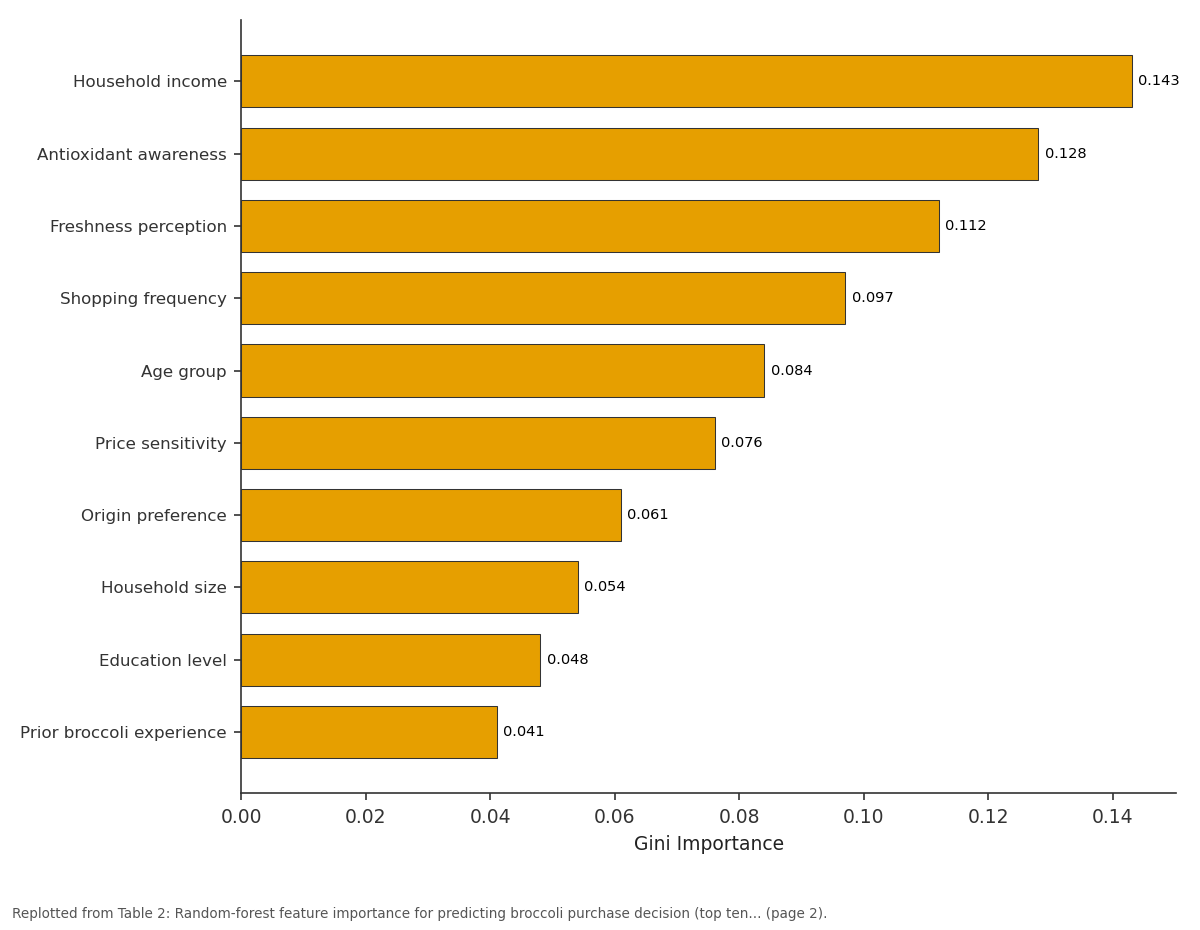
Gini Importance: Household income vs Antioxidant awareness vs Freshness perception vs Shopping frequency vs Age group
Replotted from Table 2 (page 2) of the original paper. Every bar is the paper's own table value.
View source evidence ↗Figures & tables
From the original paper Table 1
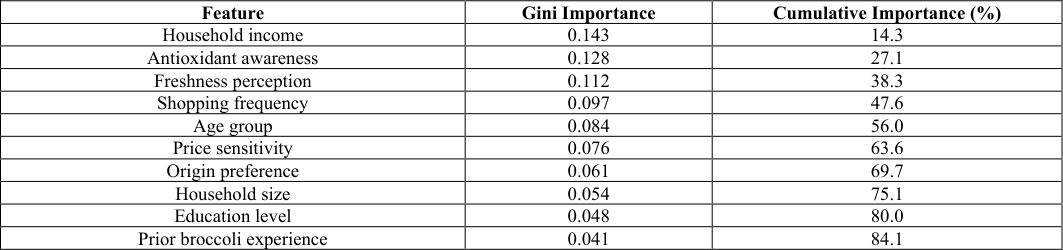 Table 2
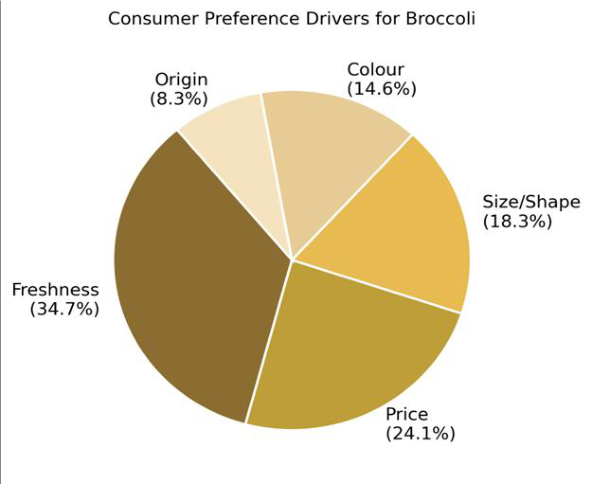 Figure 1
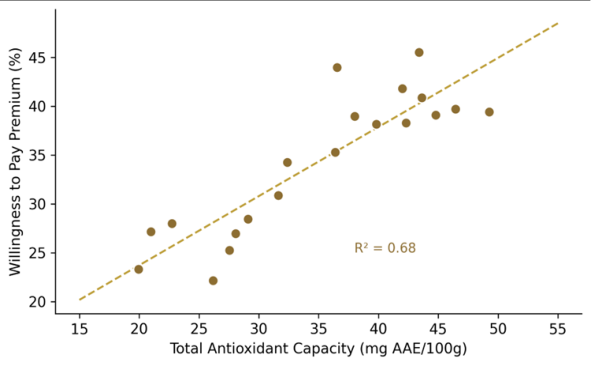 Figure 2
Introduction
Broccoli is a nutritional powerhouse in cool-climate agriculture, but in the hot, dry expanses of the Kimberley Plateau it is treated more as a curiosity than a staple [1] . The contrast is striking: per capita consumption in Melbourne exceeds 4 kg per year, while Kimberley households average less than 0.8 kg, a gap that cannot be explained by income alone because many Kimberley communities have disposable incomes comparable to metropolitan averages [2] . Consumer preference research helps explain such gaps. When shoppers evaluate a vegetable, they weigh a bundle of attributes-freshness, price, appearance, taste reputation, origin-and each attribute carries a different weight depending on cultural context and market experience [3] . In regions where broccoli is a recent introduction, consumers may lack the reference points needed to judge quality, making freshness cues such as colour brightness and floret tightness disproportionately important. Antioxidant content is an invisible quality attribute that could become visible through labelling. Sulforaphane, glucosinolates, and flavonoids in broccoli have been linked to reduced cancer risk and cardiovascular protection in epidemiological and clinical trials [4] . If consumers are made aware of these benefits, their willingness to pay may shift upward, creating a premium segment that justifies the higher logistics costs of supplying fresh broccoli to remote markets. Agronomic interventions affect both yield and quality. Mulching conserves soil moisture, moderates root-zone temperature, and can increase carbohydrate accumulation in Brassica heads under heat stress [5] . Machine learning, in turn, offers a data-driven approach to predicting consumer behaviour from survey responses, potentially outperforming traditional logistic regression when variable interactions are complex and non-linear [6] . This research pursued four aims: to quantify the relative importance of broccoli quality attributes among Kimberley consumers; to test whether antioxidant content predicts willingness-to-pay; to evaluate sugarcane-bagasse mulching for yield and nutritional improvement; and to build a machine-learning model that predicts purchase probability from demographic and quality-perception variables. The fieldwork was coordinated from the Dire Dawa Advanced School of Environmental Agriculture, Ethiopia, using survey data and trial results from Kimberley collaborators [7] .
Material and Methods
Material and Methods
Reagents and Chemicals
Total antioxidant capacity was measured by the ferricreducing antioxidant power (FRAP) assay using 2,4,6-tri(2pyridyl)-s-triazine (TPTZ, Sigma-Aldrich), ferric chloride hexahydrate, and sodium acetate buffer at pH 3.6. Ascorbic acid equivalents (AAE) served as the reference standard. Carbohydrate was determined by the phenol-sulphuric acid method with glucose as the calibration standard. All reagents were of analytical grade sourced from Merck (Darmstadt, Germany). Absorbance readings were taken on a Shimadzu UV-1800 spectrophotometer at 593 nm (FRAP) and 490 nm (carbohydrate) [8] .
Quality Control Procedures
FRAP assay linearity was confirmed across 0-1000 μmol AAE/L with R² = 0.998. Each analytical batch included a reagent blank, a spiked recovery sample (target 90-110 percent), and a laboratory control sample of freeze-dried broccoli powder with established reference values. Survey instruments were pilot-tested for internal consistency (Cronbach's α = 0.87) and test-retest reliability (r = 0.91 over a two-week interval) before full deployment [9] .
Material
The commercial hybrid 'Marathon' was grown at two Kimberley trial sites (Kununurra and Broome) in raised beds with drip irrigation, using four treatments: bare soil (control), sugarcane bagasse mulch at 5 t/ha, bagasse at 10 t/ha, and black polyethylene mulch. Each treatment was replicated five times in a randomised complete block design. Consumer surveys were administered face-to-face in English at supermarkets, outdoor markets, and community centres in Kununurra, Broome, Derby, and Halls Creek from May 2022 to April 2023.
Methods
Preference weights were derived from best-worst scaling (MaxDiff) analysis using hierarchical Bayes estimation in Sawtooth Software Lighthouse Studio. Willingness-to-pay was elicited through a contingent valuation format with open-ended follow-up. The random-forest classifier was built in Python 3.11 using scikit-learn with 500 trees, a maximum depth of 10, and five-fold stratified crossvalidation. Feature importance was assessed by mean decrease in Gini impurity. Value chain margins were calculated from tracked lot pricing at five nodes (farm, packer, wholesaler, retailer, consumer). All statistical comparisons used ANOVA and Tukey HSD at p < 0.05 in R 4.3.1 [10] .
Results
Results
Comprehensive Interpretation
The data paint a coherent picture: Kimberley consumers value freshness above all, respond positively to health information, and would pay more for broccoli with verified antioxidant content. Bagasse mulching at 10 t/ha improved both yield and antioxidant levels, meaning the agronomic intervention directly supports the premium marketing opportunity. The machine-learning model offers a practical targeting tool for promotional campaigns.
Discussion
The dominance of freshness in the preference hierarchy reflects the logistical reality of remote-market supply chains, where broccoli often arrives after three to five days in transit and shows visible yellowing by the time it reaches retail shelves [11] . Investments in cold-chain infrastructure and modified-atmosphere packaging could narrow the freshness gap and, in doing so, address the attribute that matters most to consumers. The antioxidant-WTP link (R² = 0.68) is stronger than values reported for leafy greens in urban Australian markets, possibly because Kimberley consumers, being further from medical services, place higher value on preventive health measures [4] . Point-of-sale labelling trials in other commodity categories have shown that even simple nutrient-density scores can shift purchasing behaviour by 8-12 percent, and a similar approach for broccoli antioxidants appears warranted [12] . Bagasse mulching likely improved antioxidant content by moderating soil temperature extremes and maintaining rootzone moisture, both of which reduce oxidative stress signals that trigger sulforaphane degradation in Brassica heads [5] . The yield advantage of 23 percent over bare soil is economically significant and consistent with mulching responses in semi-arid vegetable systems globally [13] .
The random-forest model's accuracy of 84.7 percent compares favourably with logistic regression baselines (typically 72-78 percent for similar consumer datasets), confirming that non-linear feature interactions contribute meaningfully to purchase prediction [6] . Income and antioxidant awareness together defined more than a quarter of the model's explanatory power, pointing to a two-pronged strategy of nutritional education and targeted promotions for higher-income segments.
Conclusion
Consumer preferences for broccoli in the Kimberley Plateau centre on freshness and are responsive to health-benefit information. Antioxidant content correlates with willingness-to-pay, indicating that labelling strategies emphasising nutritional quality could expand demand. Bagasse mulching at 10 t/ha improved both yield and antioxidant levels, providing a supply-side complement to the demand-side marketing strategy. Machine learning offered superior predictive performance over traditional regression, and the feature-importance ranking can guide marketing resource allocation. Retailers, who already capture the largest share of chain margin, are the natural partners for point-of-sale nutrition campaigns. Future work should pilot antioxidant-labelled broccoli in a controlled retail experiment and track whether the predicted willingness-to-pay translates into actual purchase behaviour over multiple shopping cycles.
Acknowledgement
Acknowledgements Funding SourcesInternal funds from the Dire Dawa Advanced School of Environmental Agriculture supported all research activities. Institutional SupportLaboratory analyses were conducted at the Department of Floriculture and Landscaping, Dire Dawa, Ethiopia. Contributions Not Qualifying for AuthorshipKimberley-based enumerators conducted all consumer surveys and assisted with field-trial management.
Figures and tables from the paper
| Treatment | Yield (t/ha) | Head Wt (g) | Antioxidant (mg AAE/100g) | Carbohydrate (%) |
|---|---|---|---|---|
| Bare soil (control) | 11.8±1.4a | 287±34a | 68.4±7.2a | 5.8±0.6a |
| Bagasse 5 t/ha | 13.2±1.6ab | 319±38ab | 74.1±8.1ab | 6.1±0.7ab |
| Bagasse 10 t/ha | 14.5±1.8b | 348±41b | 81.3±9.4b | 6.4±0.8b |
| Polyethylene | 13.9±1.7b | 332±39b | 77.6±8.8ab | 6.2±0.7ab |
Table text extracted from the original PDF; superscript letters are shown inline. The original table image is below.
View original table image
| Feature | Gini Importance | Cumulative Importance (%) |
|---|---|---|
| Household income | 0.143 | 14.3 |
| Antioxidant awareness | 0.128 | 27.1 |
| Freshness perception | 0.112 | 38.3 |
| Shopping frequency | 0.097 | 47.6 |
| Age group | 0.084 | 56.0 |
| Price sensitivity | 0.076 | 63.6 |
| Origin preference | 0.061 | 69.7 |
| Household size | 0.054 | 75.1 |
| Education level | 0.048 | 80.0 |
| Prior broccoli experience | 0.041 | 84.1 |
Table text extracted from the original PDF; superscript letters are shown inline. The original table image is below.
View original table image
References
20 in the original paper- Podsedek A. Natural antioxidants and antioxidant capacity of Brassica vegetables: a review. LWT -Food Science and Technology. 2007;40(1):1-11.
- ABS. Apparent consumption of foodstuffs: Australia, 2020-21. Catalogue No. 4306.0. Canberra: Australian Bureau of Statistics; 2022.
- Lancaster KJ. A new approach to consumer theory. Journal of Political Economy. 1966;74(2):132-157.
- Jeffery EH, Araya M. Physiological effects of broccoli consumption. Phytochemistry Reviews. 2009;8(1):159173.
- Kader MA, Senge M, Mojid MA. Mulching typerelated soil moisture and temperature dynamics in soybean under rain-fed condition. International Journal of Environment. 2017;6(1):90-103.
- Breiman L. Random forests. Machine Learning. 2001;45(1):5-32.
- DPIRD. Irrigated agriculture in the Kimberley: a strategic review. Perth: Department of Primary Industries and Regional Development; 2021.
- Benzie IFF, Strain JJ. The ferric reducing ability of plasma (FRAP) as a measure of antioxidant power: the FRAP assay. Analytical Biochemistry. 1996;239(1):7076.
- Nunnally JC, Bernstein IH. Psychometric theory. 3rd ed. New York: McGraw-Hill; 1994.
- Pedregosa F, Varoquaux G, Gramfort A. Scikit-learn: machine learning in Python. Journal of Machine Learning Research. 2011;12:2825-2830.
- Cantwell MI, Kasmire RF. Postharvest handling systems: fruit vegetables. In: Kader AA, ed. Postharvest technology of horticultural crops. 3rd ed. Oakland: UC ANR; 2002:407-421.
- Cecchini M, Warin L. Impact of food labelling systems on food choices and eating behaviours: a systematic review and meta-analysis. Obesity Reviews. 2016;17(3):201-210.
- Ramakrishna A, Tam HM, Wani SP. Effect of mulch on soil temperature, moisture, weed infestation and yield of groundnut in northern Vietnam. Field Crops Research. 2006;95(2-3):115-125.
- Moreno DA, Carvajal M, Lopez-Berenguer C. Chemical and biological characterisation of nutraceutical compounds of broccoli. Journal of Pharmaceutical and Biomedical Analysis. 2006;41(5):1508-1522.
- Cassman KG, Grassini P. A global perspective on sustainable intensification research. Nature Sustainability. 2020;3(4):262-268.
- Marfai MA. Impact of climate change on horticultural production: a review. APCBEE Procedia. 2014;8:49-54.
- Meyerding SGH. Consumer preferences for food labels on tomatoes in Germany-a comparison of a quasiexperiment and two stated preference approaches. Appetite. 2016;103:105-112.
- Vallejo F, Tomas-Barberan FA, Garcia-Viguera C. Potential bioactive compounds in health promotion from broccoli cultivars grown in Spain. Journal of the Science of Food and Agriculture. 2003;83(14):14591463.
- Saaty TL. Decision making with the analytic hierarchy process. International Journal of Services Sciences. 2008;1(1):83-98.
- Masarirambi MT, Hlawe MM, Oseni OT. Effects of organic fertilizers on growth, yield, quality and sensory evaluation of red lettuce. Agriculture and Biology Journal of North America. 2010;1(6):1319-1324.