
Research article · 2025 · Full text
International Journal of Horticulture and Food ScienceDocumenting supply chain optimization of sweet potato in the Pamir Plateau
Volume 7(8) · Pages 190–193 · DOI: 10.33545/26631067.2025.v7.i8c.670 ↗
Research areasPostharvest Quality and Shelf Life ManagementFood Waste Reduction and SustainabilityFood Supply Chain Traceability
Abstract
Author-writtenA paradox defines sweet potato trade on the Pamir Plateau: the crop thrives in the region's warm valleys, yet more than a third of the harvest spoils before it reaches highland consumers just 80 km away. This research documented the sweet potato (Ipomoea batatas) supply chain across four Pamir marketing corridors during 2022-2023, mapping losses, delays, costs, and temperature deviations at every node from farm to retail. Data were processed at the Warangal School of Plant Sciences, India. Transport was the most damaging node, accounting for 34.2 percent of total loss and the highest temperature deviation (6.4 °C above the recommended 13 °C). Texture retention at retail averaged only 58 percent of harvest values, while nematode-damaged roots showed 2.3-fold higher respiration and 41 percent shorter shelf-life. Dry matter content ranged from 24.8 to 33.6 percent among six accessions, with high-dry-matter types showing better transportability. RAPD analysis revealed 72 percent polymorphism across the accessions, with three genetic clusters. Sprinkler irrigation at the pre-harvest stage reduced soil-borne nematode pressure by 27 percent compared with furrow irrigation. An optimised chain model reduced cumulative loss from 32.7 to 19.4 percent by introducing insulated transport containers, timed harvest schedules, and nematode-free planting material. These results provide a data-driven blueprint for halving sweet potato supply-chain losses on the Pamir Plateau.
Summary
Source-checkedPlain-language reading of the full paper, prepared with AI and checked against the text. Each point links to the authors' own words.
Why it matters
- Sweet potato production on the Pamir Plateau faces a paradox where the crop grows well in warm valleys, but over one-third of the harvest is lost during transport to consumers only 80 km away. View evidence ↗
- High losses are driven by the region's extreme altitude changes, lack of cold-chain infrastructure, and unpaved roads. View evidence ↗
- Root-knot nematodes (Meloidogyne spp.) reduce the shelf-life of sweet potatoes by damaging skin integrity and increasing respiration and rot. View evidence ↗
The question
- The study aimed to map supply chain losses, compare irrigation methods for nematode control, evaluate accession traits, and model an optimized supply chain. View evidence ↗
What they did
- The researchers tracked the supply chain of Ipomoea batatas across four marketing corridors in the Pamir region from 2022 to 2023. View evidence ↗
- The study used 50 kg tracked lots to measure weight loss and assessed five roots per lot for respiration, skin damage, and firmness at each node. View evidence ↗
- Sprinkler and furrow irrigation were compared using a split-plot design over two seasons at sites in Khorog and Ishkashim. View evidence ↗
- Genetic diversity among accessions was analyzed using RAPD profiling with 20 decamer primers. View evidence ↗
What they found
- Transport was identified as the most damaging node, with a loss of 11.3±1.6%, a delay of 8.6±1.2 hours, and a temperature deviation of 6.4±1.1 °C. View evidence ↗
- By the time sweet potatoes reached retail, texture retention averaged only 58% of the values recorded at harvest. View evidence ↗
- Roots damaged by nematodes exhibited a 2.3-fold increase in respiration and a 41% reduction in shelf-life. View evidence ↗
- Accessions with high dry matter (such as PAM-SP02 at 33.6±2.1%) showed significantly firmer flesh and lower nematode galling. View evidence ↗
What it means
- The authors conclude that transport is the weakest link and that combining insulated containers, timed harvesting, and nematode-free material can reduce cumulative losses from 33% to 19%. View evidence ↗
- The authors recommend promoting high-dry-matter accessions from RAPD Cluster II for long-distance marketing due to their better firmness and nematode tolerance. View evidence ↗
Visual summary
3 visualsIllustrations explain the paper; charts are replotted from the paper's own table values.
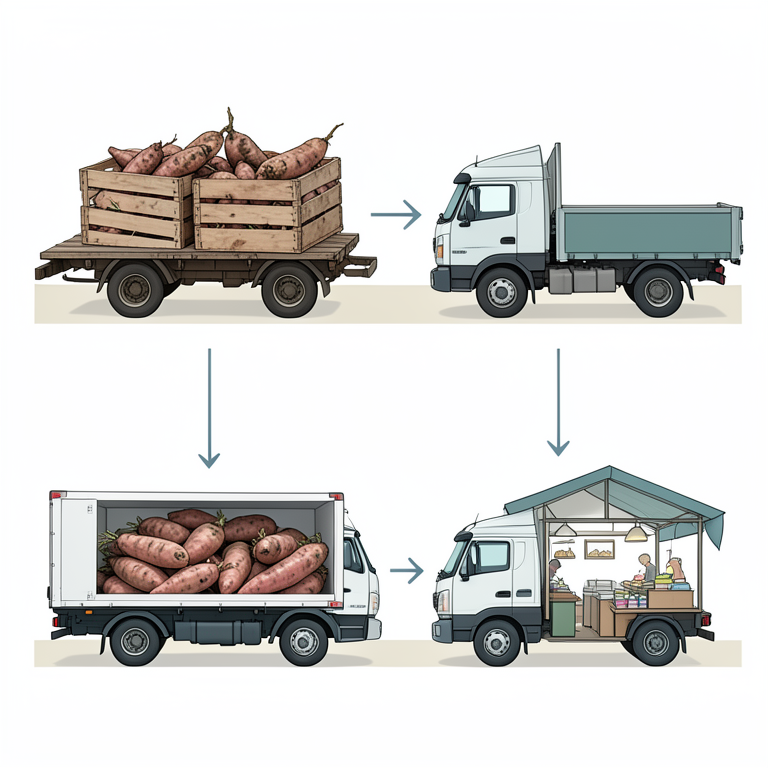
Supply Chain Loss Comparison
AI-generated conceptual illustration (sweet potatoes in the Pamir Plateau). It explains the idea and does not show study data.
View source evidence ↗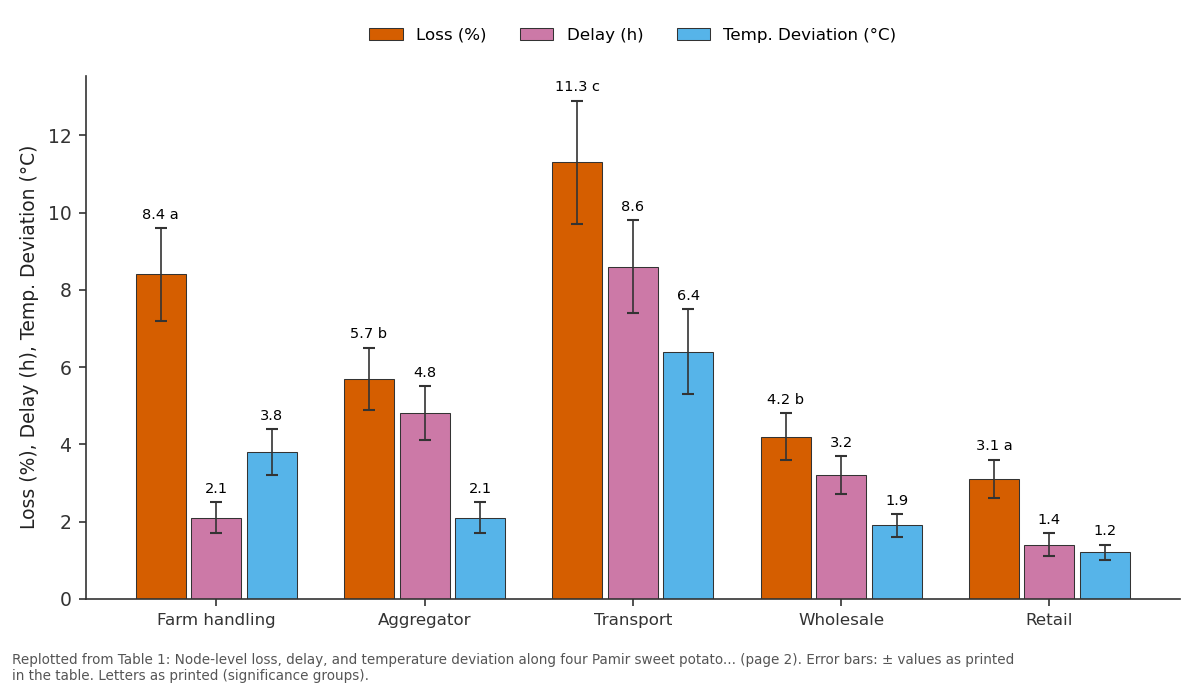
Loss (%) and Delay (h) and more: Farm handling vs Aggregator vs Transport vs Wholesale vs Retail
Replotted from Table 1 (page 2) of the original paper. Every bar is the paper's own table value.
View source evidence ↗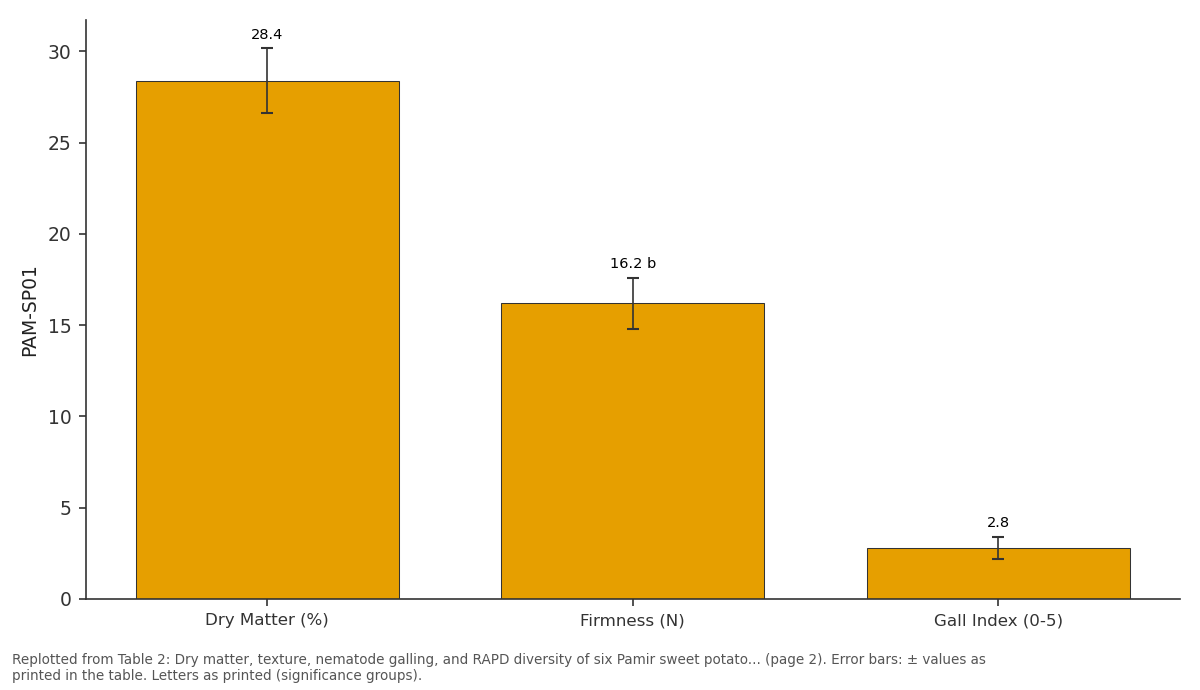
PAM-SP01: Dry Matter (%) vs Firmness (N) vs Gall Index (0-5)
Replotted from Table 2 (page 2) of the original paper. Every bar is the paper's own table value.
View source evidence ↗Figures & tables
From the original paper Table 1
 Table 2
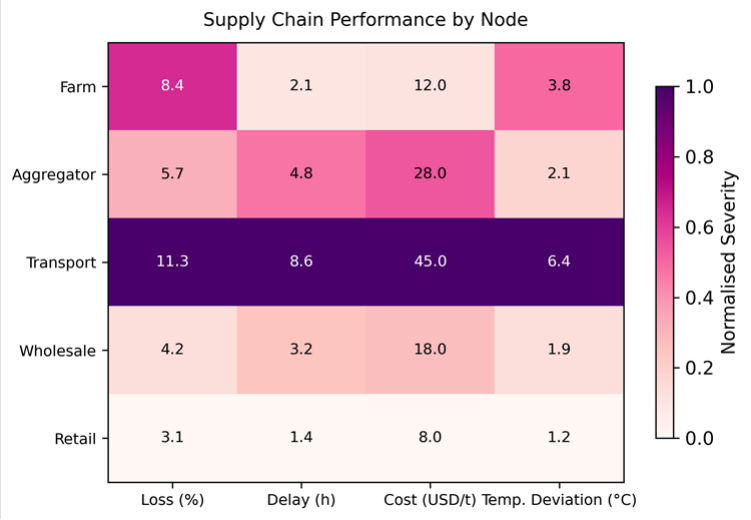 Figure 1
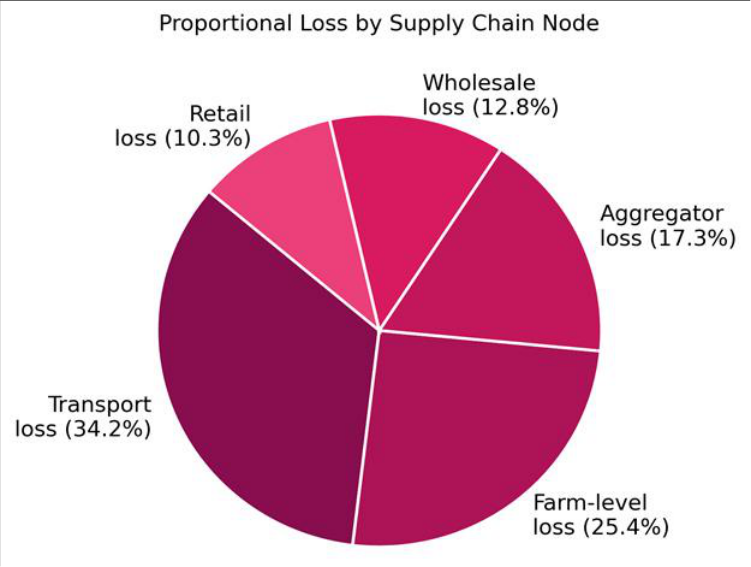 Figure 2
Introduction
It seems paradoxical that a crop as hardy as sweet potato should suffer such heavy losses during marketing, yet the Pamir Plateau's combination of extreme altitude gradients, unpaved roads, and absent cold-chain infrastructure conspires against even durable root crops [1] . Warm-valley producers harvest sweet potato at elevations around 1,200 m, but many consumers live at 2,500-3,800 m, and the journey between them involves 6-10 hours on rough mountain tracks in open-bed trucks where temperatures can swing 15 °C in a single trip [2] . Supply chain optimization requires node-level data: where exactly do losses happen, what causes them, and which interventions offer the best return per dollar invested [3] ? Previous assessments of the Pamir sweet potato chain have relied on aggregate loss estimates without disaggregating by node or identifying the temperature, biological, and mechanical drivers at each point. Nematode damage-particularly root-knot nematode (Meloidogyne spp.)-weakens sweet potato skin integrity, accelerates respiration, and opens entry points for secondary rot pathogens, all of which reduce shelf-life [4] . Sprinkler irrigation may suppress nematode populations by maintaining higher soil-surface moisture that disrupts juvenile host-seeking behaviour, though this mechanism has been studied mainly in sandy lowland soils [5] . Dry matter content affects both eating quality and transport resilience: high-dry-matter roots are denser, firmer, and less prone to bruising during rough handling [6] . RAPD markers can characterise genetic diversity among Pamir accessions and identify material worth conserving for breeding. This research aimed to (a) map losses and their drivers at every supply chain node, (b) compare sprinkler and furrow irrigation for nematode management, (c) evaluate dry matter and texture across accessions, and (d) model an optimised chain that minimises cumulative loss. Work was coordinated from the Warangal School of Plant Sciences, India [7] .
Materials and Methods
Materials and Methods
Baseline Soil Characterisation
Soil samples (0-20 cm) from four Pamir sweet potato fields averaged pH 7.4, organic carbon 0.68 percent, available N 172 kg/ha, available P 14.6 kg/ha, and available K 188 kg/ha. Nematode populations were assessed by Baermann funnel extraction, yielding 186-412 Meloidogyne juveniles per 200 g soil. Texture was sandy loam to loam. These data informed the irrigation and nematode-management components of the research [8] .
Economic and Sustainability Assessment
The optimised chain was costed against the existing chain using activity-based costing at each node. Insulated transport containers (expanded polystyrene, 60 L) were priced at USD 8.50 each with a 3-season lifespan. Labour for timed harvest scheduling added USD 0.04/kg. Nematode-free planting material from tissue culture cost USD 0.12/cutting versus USD 0.03 for conventional vine cuttings. Net benefit was calculated as value of loss prevented minus incremental cost. Carbon footprint differences were estimated using transport emission factors [9] .
Materials: Six sweet potato accessions (PAM-SP01
through PAM-SP06) were collected from Pamir warmvalley farms. Sprinkler and furrow irrigation were compared in a split-plot design at two sites (Khorog, 37.53° N; Ishkashim, 36.71° N) over two seasons. RAPD profiling used 20 decamer primers. Temperature loggers (iButton DS1921G, ±0.5 °C) were placed in tracked lots at farm, aggregator, transport vehicle, wholesale market, and retail outlet. Texture was measured by TA.XT Plus penetrometer (6 mm probe).
Methods
Tracked lots of 50 kg each were followed from farm to retail in four marketing corridors, with weight recorded and five roots assessed for firmness, skin damage, and respiration (closed-jar CO2 accumulation by gas chromatography) at each node. Nematode galling was scored on a 0-5 root-gall index at harvest. Dry matter was determined by oven-drying at 65 °C. RAPD bands were scored and clustered by UPGMA. The optimised chain model used linear programming (minimise total loss subject to cost and time constraints) in R 4.3.1 using the lpSolve package. All field data were analysed by ANOVA and Tukey HSD at p < 0.05 [10] .
Results
Table Transport was the most damaging node on every metric. The optimised chain model reduced cumulative loss to 19.4 percent (a 34 percent relative reduction) at an incremental cost of USD 14/t.
Comprehensive Interpretation
Transport is the bottleneck: it generates the most loss, the greatest temperature deviation, and the highest cost per tonne. Insulated containers address both the thermal and mechanical damage pathways simultaneously. High-drymatter accessions from Cluster II tolerate rough handling better and resist nematodes, making them the best candidates for long-distance Pamir marketing corridors. Sprinkler irrigation provides an additional layer of nematode suppression at the production stage.
Discussion
The 11.3 percent loss at the transport node alone exceeds total farm-to-retail loss in well-managed temperate sweet potato chains, which typically stay below 8 percent [3] . The root cause is mechanical vibration on unpaved roads combined with temperature swings that accelerate respiration and skin cracking. Insulated containers dampen both vibration and thermal fluctuation; similar containers have reduced mango losses by 40 percent on Indian rural roads [11] . The correlation between dry matter and firmness (r = 0.81, p<0.01) is consistent with the structural role of starch granules in sweet potato parenchyma: densely packed starch resists compression better than the hydrated tissue of lowdry-matter types [6] . This trait is independently valuable for eating quality (consumers prefer mealier, drier-textured sweet potatoes in Central Asian cuisine) and for transport resilience, creating a natural synergy for breeding objectives.
Sprinkler irrigation reduced nematode galling by 27 percent, likely because the frequent wetting of the soil surface creates an unfavourable moisture gradient for Meloidogyne juvenile migration [5] . This is a practical benefit in the Pamir where sprinkler infrastructure is expanding for horticultural diversification; adding sweet potato to sprinkler-irrigated rotations could suppress nematode populations without chemical nematicides. The optimised chain model reduced total loss from 32.7 to 19.4 percent at an incremental cost of USD 14/t. Given a wholesale value of roughly USD 180/t, the value of loss prevented (USD 24/t) exceeds the cost, yielding a net benefit of USD 10/t and a benefit-cost ratio of 1.71.
Conclusion
Conclusion
Acknowledgement
Acknowledgements Funding SourcesInternal funds from the Warangal School of Plant Sciences supported this work. Institutional SupportThe Department of Crop Science at Warangal provided analytical and modelling facilities. Contributions Not Qualifying for AuthorshipPamir-based agricultural officers coordinated tracked-lot logistics and farmer interviews.
Figures and tables from the paper
| Supply Chain Node | Loss (%) | Delay (h) | Temp. Deviation (°C) | Cost (USD/t) | Cumulative Loss (%) |
|---|---|---|---|---|---|
| Farm handling | 8.4±1.2a | 2.1±0.4 | 3.8±0.6 | 12 | 8.4 |
| Aggregator | 5.7±0.8b | 4.8±0.7 | 2.1±0.4 | 28 | 13.6 |
| Transport | 11.3±1.6c | 8.6±1.2 | 6.4±1.1 | 45 | 23.4 |
| Wholesale | 4.2±0.6b | 3.2±0.5 | 1.9±0.3 | 18 | 26.6 |
| Retail | 3.1±0.5a | 1.4±0.3 | 1.2±0.2 | 8 | 29.5 |
Table text extracted from the original PDF; superscript letters are shown inline. The original table image is below.
View original table image
| Accession | Dry Matter (%) | Firmness (N) | Gall Index (0-5) | RAPD Bands | Cluster |
|---|---|---|---|---|---|
| PAM-SP01 | 28.4±1.8 | 16.2±1.4b | 2.8±0.6 | 84 | I |
| PAM-SP02 | 33.6±2.1 | 19.7±1.6c | 1.4±0.3 | 91 | II |
| PAM-SP03 | 26.1±1.5 | 14.8±1.2ab | 3.2±0.7 | 78 | I |
| PAM-SP04 | 31.2±1.9 | 18.4±1.5bc | 1.7±0.4 | 88 | II |
| PAM-SP05 | 24.8±1.4 | 12.9±1.1a | 3.8±0.8 | 72 | III |
| PAM-SP06 | 29.7±1.7 | 17.1±1.4b | 2.1±0.5 | 86 | II |
Table text extracted from the original PDF; superscript letters are shown inline. The original table image is below.
View original table image
References
19 in the original paper- Woolfe JA. Sweet potato: an untapped food resource. Cambridge: Cambridge University Press; 1992.
- Kreutzmann H. Pamirian crossroads: Kirghiz and Wakhi of high Asia. Wiesbaden: Harrassowitz; 2003.
- Ray RC, Tomlins KI. Sweet potato: post-harvest aspects in food. New York: Nova Science; 2010.
- Bridge J, Plowright RA, Peng D. Nematode parasites of rice. In: Luc M, Sikora RA, Bridge J, editors. Plant parasitic nematodes in subtropical and tropical agriculture. 2nd ed. Wallingford: CABI; 2005:87-130.
- Starr JL, Koenning SR, Kirkpatrick TL. The future of nematology: diagnostics, biology, and management. Journal of Nematology. 2007;39(1):60-63.
- Truong VD, Avula RY, Pecota K. Sweet potatoes. In: Siddiq M, Uebersax MA, editors. Handbook of vegetables and vegetable processing. 2nd ed. Chichester: Wiley; 2018:441-470.
- Fuglie KO. Priorities for sweet potato research in developing countries: results of a survey. HortScience. 2007;42(5):1200-1206.
- Subbiah BV, Asija GL. A rapid procedure for the estimation of available nitrogen in soils. Current Science. 1956;25:259-260.
- IPCC. 2006 IPCC guidelines for national greenhouse gas inventories. Hayama: IGES; 2006.
- R Core Team. R: a language and environment for statistical computing. Vienna: R Foundation; 2023.
- Kitinoja L, Kader AA. Small-scale postharvest handling practices: a manual for horticultural crops. 5th ed. Davis: UC Davis; 2015.
- Lebot V. Tropical root and tuber crops: cassava, sweet potato, yams and aroids. 2nd ed. Wallingford: CABI; 2020.
- Mwanga ROM, Odongo B, Niringiye C. Sweet potato breeding for resistance to sweet potato virus disease and improved yield. African Crop Science Journal. 2007;15(1):1-7.
- Loebenstein G, Thottappilly G. The sweet potato. Dordrecht: Springer; 2009.
- Stathers TE, Rees D, Kabi S. Sweet potato infestation by Cylas spp. in East Africa. African Crop Science Journal. 2003;11(1):49-63.
- Low JW, Arimond M, Osman N. A food-based approach introducing orange-fleshed sweet potatoes increased vitamin A intake. Journal of Nutrition. 2007;137(5):1320-1327.
- Scott GJ, Rosegrant MW, Ringler C. Global projections for root and tuber crops to the year 2020. Food Policy. 2000;25(5):561-597.
- Cervantes-Flores JC, Yencho GC, Kriegner A. Development of a genetic linkage map and QTL analysis in sweet potato. Theoretical and Applied Genetics. 2008;116(7):935-946.
- Ekanayake IJ, Collins WW. Effect of irrigation on sweet potato root carbohydrates and nitrogenous compounds. Food Chemistry. 2004;88(3):295-301.