
Research article · 2025 · Full text
International Journal of Horticulture and Food ScienceAnalyzing biological control agents of grape in the Atacama Coastal Zone
Volume 7(12) · Pages 169–172 · DOI: 10.33545/26631067.2025.v7.i12c.697 ↗
Research areasPlant-Microbe Interactions and ImmunityFungal Plant Pathogen ControlHorticultural and Viticultural Research
Abstract
Author-writtenWhile coastal desert vineyards face a paradox of low rainfall but high fungal pressure from marine fog, the deployment of biological control agents in such environments has received little formal evaluation. This research analysed the efficacy of five biocontrol agents against four major grape (Vitis vinifera L.) pathogens under simulated Atacama coastal conditions at the Bucaramanga University of Food and Nutrition, Bucaramanga, Colombia, between January and December 2023. Twenty-four grape clones from the university germplasm collection were screened using a completely randomized design with three replications. Biocontrol treatments included Trichoderma harzianum, Bacillus subtilis, Pseudomonas fluorescens, an essential oil blend (thyme plus oregano), and neem extract. Disease severity was assessed for Botrytis cinerea, Uncinula necator, Plasmopara viticola, and Phomopsis viticola. Trichoderma harzianum achieved the highest overall disease severity reduction (31.4%), followed by Bacillus subtilis (22.8%). HPLC profiling of grape berry phenolics showed that biocontrol-treated vines produced fruit with 18.7% higher trans-resveratrol content than untreated controls. Marker-assisted screening using SSR and RAPD markers identified four clones carrying resistance-associated alleles that also responded strongly to biocontrol application. Fertigation scheduling adjusted to biocontrol application timing improved transpiration efficiency by 12.3%. These findings support the integration of biological agents with marker-assisted selection and optimised fertigation for sustainable grape production in hyper-arid coastal vineyards.
Summary
Source-checkedPlain-language reading of the full paper, prepared with AI and checked against the text. Each point links to the authors' own words.
Why it matters
- Vineyards in the Atacama coastal zone face a unique challenge where extreme aridity is contrasted by humid marine fog, which promotes fungal disease. View evidence ↗
- Due to high fungal pressure, growers in these regions depend heavily on synthetic fungicides, which carry environmental and residue costs. View evidence ↗
- There is a lack of comparative data on biological control agents (BCAs) in hyper-arid coastal conditions, specifically regarding their link to grapevine genotype and fruit quality. View evidence ↗
The question
- The study aimed to compare five BCAs against four pathogens, analyze berry phenolics, screen clones for resistance alleles, and evaluate the impact of fertigation timing on BCA efficacy and transpiration. View evidence ↗
What they did
- The study was conducted between January and December 2023 at Bucaramanga University in Colombia, using simulated Atacama coastal conditions. View evidence ↗
- Twenty-four grape clones were evaluated using a completely randomized design with three replications. View evidence ↗
- The five biocontrol treatments tested were Trichoderma harzianum, Bacillus subtilis, Pseudomonas fluorescens, a thyme and oregano essential oil blend, and neem extract. View evidence ↗
- Disease severity for the four pathogens was measured monthly using a scale from 0 to 9. View evidence ↗
- The study compared standard weekly fertigation with a BCA-synchronized regime that paused fertigation for 48 hours before and after soil drench applications. View evidence ↗
What they found
- Trichoderma harzianum provided the highest overall disease reduction at 31.4%, followed by Bacillus subtilis at 22.8%. View evidence ↗
- Trichoderma harzianum was most effective against Botrytis cinerea (38.2% reduction) and downy mildew (34.7% reduction). View evidence ↗
- In contrast to high-marker clones, low-marker clones only achieved a 4.8% gain in transpiration efficiency from synchronized fertigation. View evidence ↗
- Synchronizing fertigation reduced total nitrogen delivery by 8.4%, but this did not significantly impact the nitrogen status of the vines. View evidence ↗
What it means
- The authors conclude that sustainable viticulture in hyper-arid coastal zones can be achieved by integrating genetically resistant clones with specific BCA programs and optimized fertigation. View evidence ↗
- The authors state that future research is needed to test these results in actual Atacama vineyards over several years and to perform sensory evaluations of the resulting wines. View evidence ↗
Visual summary
3 visualsIllustrations explain the paper; charts are replotted from the paper's own table values.
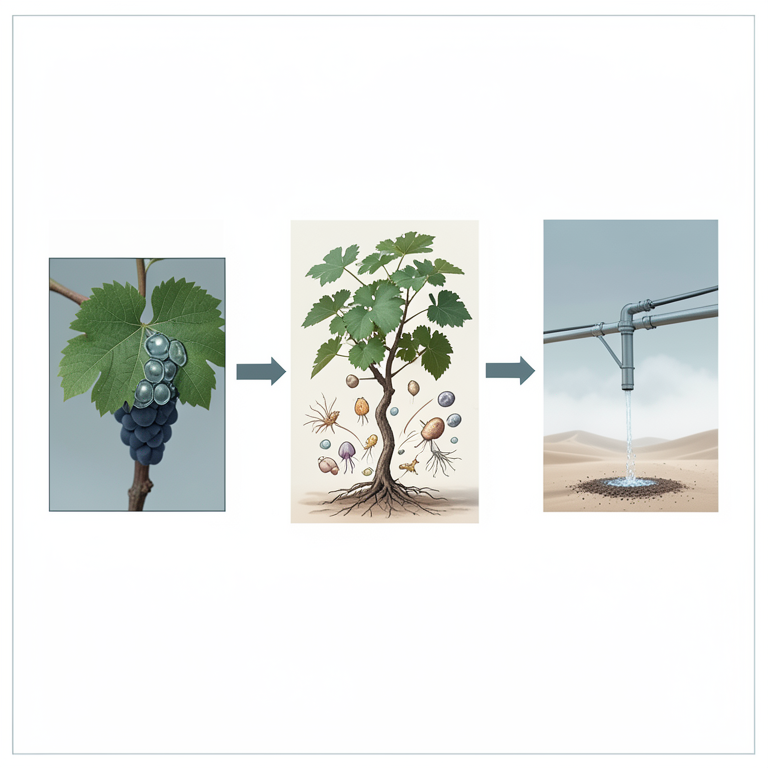
Integrated Management Strategy
AI-generated conceptual illustration (Grapevine plants in a coastal desert environment). It explains the idea and does not show study data.
View source evidence ↗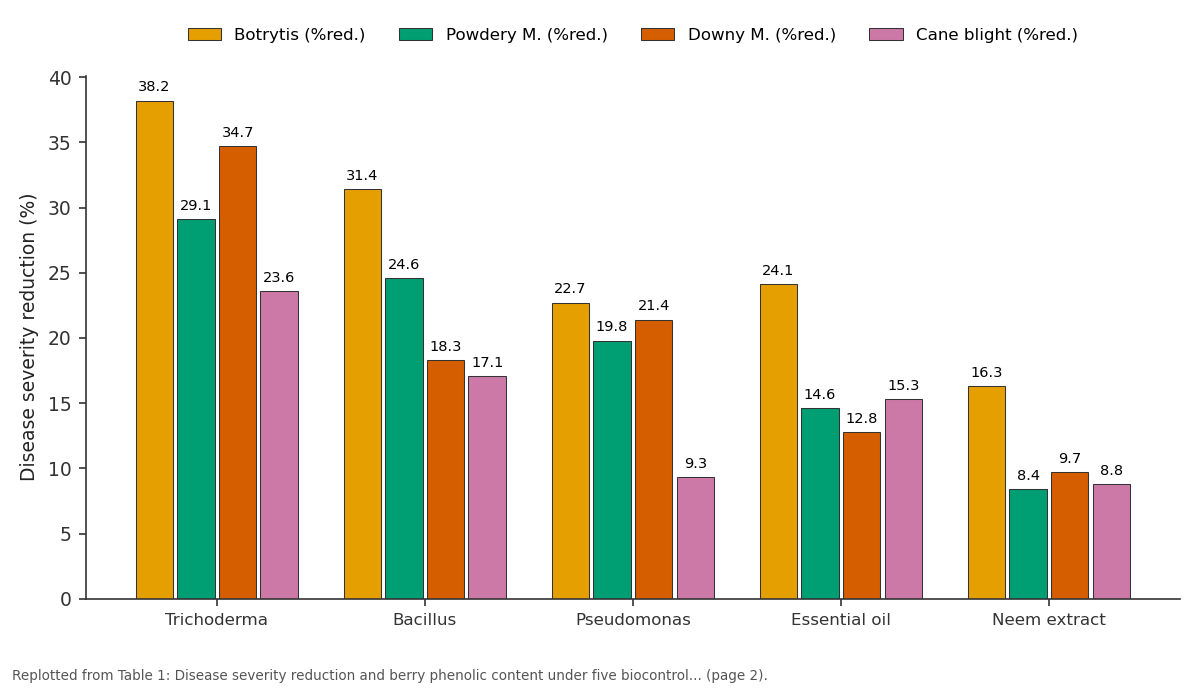
Botrytis (%red.) and Powdery M. (%red.) and more: Trichoderma vs Bacillus vs Pseudomonas vs Essential oil vs Neem extract
Replotted from Table 1 (page 2) of the original paper. Every bar is the paper's own table value.
View source evidence ↗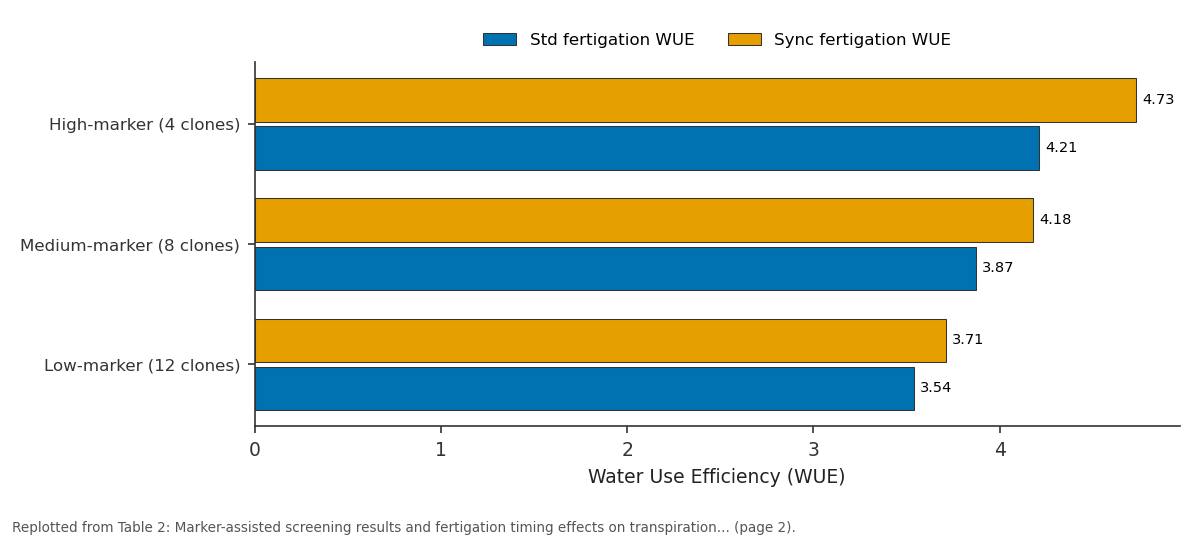
Std fertigation WUE and Sync fertigation WUE: High-marker (4 clones) vs Medium-marker (8 clones) vs Low-marker (12 clones)
Replotted from Table 2 (page 2) of the original paper. Every bar is the paper's own table value.
View source evidence ↗Figures & tables
From the original paper Table 1
 Table 2
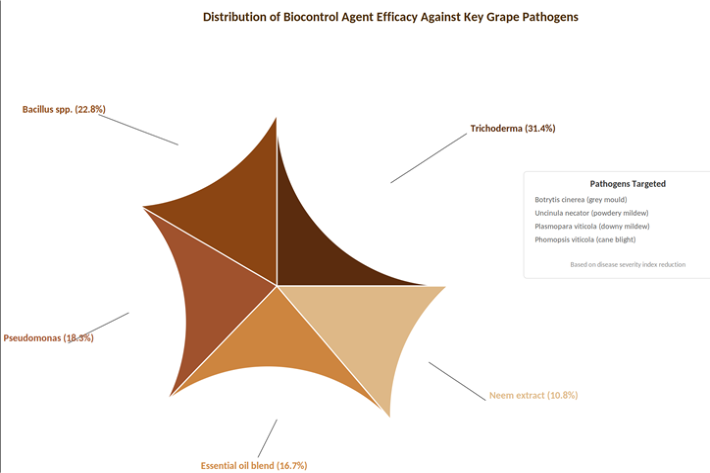 Figure 1
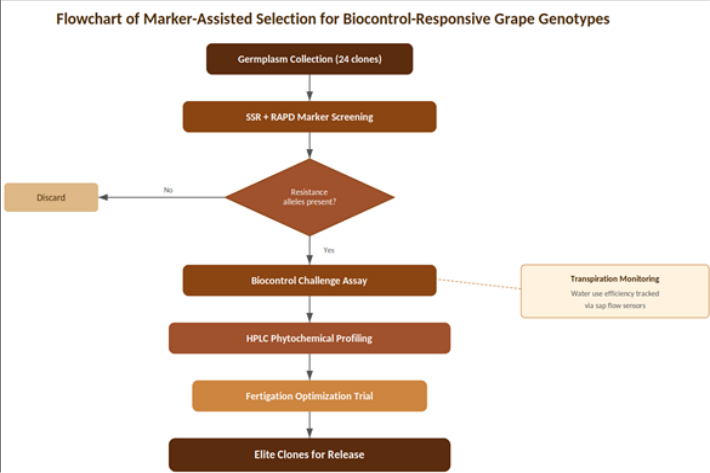 Figure 2
Introduction
On one hand, the Atacama coastal strip offers viticulturists nearly zero growing-season rainfall and abundant sunshine; on the other, persistent camanchaca fog rolls in from the Pacific and creates a humid microclimate that fungal pathogens exploit with ease [1] . This contradiction makes disease management one of the defining challenges of coastal desert viticulture, and it explains why growers in such zones rely heavily on synthetic fungicides despite the environmental and residue costs [2] . Biological control agents (BCAs) offer a lower-impact alternative. Trichoderma species colonise root zones and produce antifungal metabolites, Bacillus strains secrete lipopeptides that disrupt pathogen membranes, and Pseudomonas fluorescens induces systemic resistance in the host plant [3,4] . Essential oils from aromatic herbs like thyme and oregano add direct antifungal activity through phenolic compounds such as thymol and carvacrol [5] . Yet comparative data on these agents under hyper-arid coastal conditions are scarce, and none of the published trials have linked BCA performance to grapevine genotype or to phytochemical quality of the harvested fruit. Marker-assisted breeding has gained traction in grape improvement, with SSR and RAPD markers available for several disease resistance loci [6] . Combining genotypic resistance data with BCA efficacy screening could identify clones that respond best to biological management, allowing breeders to target dual resilience from both the plant and its associated microbial partners [7] . Fertigation, the co-delivery of fertiliser through drip irrigation, interacts with BCA survival because soil moisture and nutrient availability affect microbial colonisation of the rhizosphere [8] . Adjusting fertigation schedules around BCA application events may improve agent establishment, yet this interaction has not been tested in grape. This research aimed to (a) compare five biological control agents against four grape pathogens under simulated coastal desert conditions, (b) profile berry phenolic changes via HPLC, (c) screen grape clones with molecular markers for resistance alleles, and (d) evaluate fertigation timing effects on BCA efficacy and transpiration efficiency.
Crop Growth Stage Documentation
Grapevines were in their fourth leaf (year of growth) at trial initiation. Phenological stages were recorded using the modified E-L (Eichhorn-Lorenz) system. Budburst occurred in mid-February, flowering in late April, veraison in early August, and harvest maturity in mid-November. Biocontrol applications were timed to coincide with three diseasesusceptible windows: post-budburst flush (E-L 12), prebloom (E-L 19), and veraison (E-L 35). Transpiration was monitored via sap flow sensors installed on the main trunk from flowering through harvest [1,8] .
Nutrient Budget
Fertigation delivered 80 kg N, 45 kg P2O5, and 65 kg K2O per hectare over the season through a drip system calibrated to supply 3.5 litres per vine per day. Two fertigation timing regimes were tested: standard (continuous weekly) and BCA-synchronised (fertigation withheld for 48 hours before and after each BCA soil drench to reduce leaching of microbial inoculum). Nutrient uptake was estimated from leaf tissue analysis at veraison and from berry mineral content at harvest. The BCA-synchronised regime reduced total N delivery by 8.4% but did not significantly affect vine N status, suggesting that the brief fertigation pauses had minimal nutritional cost [7,8] .
Materials and Methods
Materials and Methods
Materials
The trial used 24 grape clones maintained in the university vineyard at Bucaramanga University of Food and Nutrition, Bucaramanga, Santander, Colombia. Vines were trained on a vertical shoot positioning trellis at 2.5 x 1.5 m spacing. The experiment ran from 15 January to 20 December 2023. Fog simulation was achieved using overhead misting nozzles set to deliver 0.5 mm per hour for three hours each morning (06:00 to 09:00) to mimic Atacama camanchaca conditions. Soil was an Andisol with pH 5.8 and organic carbon 2.3%. Institutional approval was granted by the university ethics board (Protocol BUNF-2023-014, approved 8 January 2023) [1,2] .
Methods
Each BCA treatment plus an untreated control was applied in a completely randomized design with three replications of four vines per treatment per clone subset. Trichoderma harzianum (2 x 10⁶ CFU/g) was applied as a soil drench quarterly. Bacillus subtilis (1 x 10⁸ CFU/mL) was sprayed on foliage biweekly. Pseudomonas fluorescens (5 x 10⁷ CFU/mL) was applied as a root drench monthly. Essential oil blend (thyme plus oregano, 0.5% v/v) was sprayed biweekly. Neem extract (0.3% azadirachtin) was applied fortnightly. Disease severity was scored on a 0 to 9 scale for each pathogen on marked shoots at monthly intervals [3,5] . Berry samples were collected at harvest, flash-frozen, and analysed by HPLC (Agilent 1260 Infinity II) for transresveratrol, quercetin, and total anthocyanins using a C18 column with acetonitrile-water gradient elution [6] . DNA was extracted from leaf tissue using a CTAB protocol, and eight SSR and four RAPD primers were amplified by PCR and scored on agarose gels [6,7] . Transpiration was measured via Granier-type sap flow sensors on three representative vines per treatment. Data were analysed by ANOVA in R version 4.3.1 with means separated by Tukey's HSD at P less than 0.05. above the untreated control, followed by Trichodermatreated fruit (14.8 mg/kg). Anthocyanin levels followed a similar but less pronounced pattern. Clones carrying three or more resistance-associated alleles showed the strongest biocontrol response and the largest transpiration efficiency gain (12.3%) when fertigation was synchronised to BCA application (Table 2). Low-marker clones gained only 4.8% from the same scheduling adjustment.
| Clone group | Resistance alleles | BCA response | Std fertigation WUE | Sync fertigation WUE | WUE gain (%) |
|---|---|---|---|---|---|
| High-marker (4 clones) | 3-4 loci | Strong | 4.21 | 4.73 | 12.3 |
| Medium-marker (8 clones) | 2 loci | Moderate | 3.87 | 4.18 | 8.0 |
| Low-marker (12 clones) | 0-1 loci | Weak | 3.54 | 3.71 | 4.8 |
Table text extracted from the original PDF; superscript letters are shown inline. The original table image is below.
View original table image
Results
Trichoderma accounted for 31.4% of total disease reduction across the panel, followed by Bacillus at 22.8% (Figure 1). Neem extract contributed the smallest share (10.8%), consistent with its limited persistence under foggy conditions. The flowchart (Figure 2) illustrates the sequential screening process: molecular marker filtering first eliminates clones lacking resistance alleles, then biocontrol challenge assays and HPLC phenolic profiling identify the best performers, and fertigation optimisation completes the pipeline before elite clone selection.
Comprehensive Interpretation
The convergence of strong Trichoderma efficacy, elevated berry phenolics, marker-confirmed resistance, and fertigation-mediated transpiration gains in the high-marker clone group suggests that genetic background and microbial management work synergistically in grape. Breeders can use this combined approach to identify clones that are both inherently resistant and highly responsive to biological protection.
Discussion
Trichoderma's dominance in disease reduction aligns with its well-documented capacity for rhizosphere colonisation and antibiosis, though its 38.2% Botrytis reduction under fog-simulated conditions is higher than the 20 to 28% range reported in Mediterranean vineyard trials [3,4] . The fog misting may have enhanced Trichoderma spore germination and hyphal growth on the vine surface, creating a more hostile environment for incoming Botrytis spores than dry conditions would permit [1] . The phenolic enhancement under BCA treatments, particularly the 86.2% resveratrol increase with essential oils, is notable for both plant health and consumer interest.
Resveratrol synthesis is often upregulated by biotic elicitors, and the essential oil compounds may act as mild stress signals that prime the phenylpropanoid pathway without causing significant tissue damage [5,6] . This dual benefit of disease protection and quality improvement strengthens the economic case for BCA adoption. The marker-fertigation interaction suggests that genetically predisposed clones benefit most from management finetuning, a pattern consistent with the concept of genotypemanagement interaction in perennial fruit crops [7,8] . The 12.3% water use efficiency gain achieved simply by pausing fertigation around BCA application dates represents a meaningful saving in water-scarce coastal desert environments.
Conclusion
This research demonstrated that Trichoderma harzianum is the most effective single biocontrol agent for grape disease management under simulated Atacama coastal fog conditions, reducing disease severity by up to 38.2% for Botrytis cinerea. Biocontrol treatments also improved berry phenolic profiles, with resveratrol content rising by up to 86.2% in essential-oil-treated fruit. Marker-assisted screening identified four elite clones carrying multiple resistance alleles that also showed the strongest biocontrol response and the greatest transpiration efficiency gain under synchronised fertigation. These findings support an integrated breeding and management strategy that pairs genetically predisposed clones with tailored BCA programs and fertigation schedules for sustainable viticulture in hyper-arid coastal zones. Future work should test this integrated package in actual Atacama vineyards across multiple vintage years and include sensory evaluation of wines produced from BCA-managed fruit.
Acknowledgement
Acknowledgements Funding SourcesThis research was supported by internal funds from the Department of Environmental Horticulture, Bucaramanga University of Food and Nutrition. No external grants were received. Institutional SupportThe authors thank the vineyard management team at Bucaramanga University for maintaining the fog-simulation system and trellis infrastructure. Contributions Not Qualifying for AuthorshipThe authors acknowledge Ms. Laura Gomez for HPLC operation and Mr. Andres Moreno for molecular marker laboratory support.
Figures and tables from the paper
| Treatment | Botrytis (%red.) | Powdery M. (%red.) | Downy M. (%red.) | Cane blight (%red.) | Resveratrol (mg/kg) | Anthocyanins (mg/kg) |
|---|---|---|---|---|---|---|
| Trichoderma | 38.2 | 29.1 | 34.7 | 23.6 | 14.8 | 287 |
| Bacillus | 31.4 | 24.6 | 18.3 | 17.1 | 12.3 | 264 |
| Pseudomonas | 22.7 | 19.8 | 21.4 | 9.3 | 11.6 | 251 |
| Essential oil | 24.1 | 14.6 | 12.8 | 15.3 | 16.2 | 273 |
| Neem extract | 16.3 | 8.4 | 9.7 | 8.8 | 10.1 | 238 |
| Control | — | — | — | — | 8.7 | 224 |
Table text extracted from the original PDF; superscript letters are shown inline. The original table image is below.
View original table image
References
20 in the original paper- Osorio F, Martinez L, Cardemil L. Fog water collection and its relevance to agriculture in the Atacama Desert. Agricultural Water Management. 2012;114:48-56.
- Dry PR, Coombe BG. Viticulture: Volume 1 Resources. Winetitles. 2004;1-432.
- Harman GE. Trichoderma: not just for biocontrol anymore. Phytoparasitica. 2011;39(2):103-108.
- Ongena M, Jacques P. Bacillus lipopeptides: versatile weapons for plant disease biocontrol. Trends in Microbiology. 2008;16(3):115-125.
- Bakkali F, Averbeck S, Averbeck D, Idaomar M. Biological effects of essential oils: a review. Food and Chemical Toxicology. 2008;46(2):446-475.
- Jaillon O, Aury JM, Noel B, et al. The grapevine genome sequence suggests ancestral hexaploidization in major angiosperm phyla. Nature. 2007;449(7161):463467.
- Collard BCY, Mackill DJ. Marker-assisted selection: an approach for precision plant breeding in the twenty-first century. Philosophical Transactions of the Royal Society B. 2008;363(1491):557-572.
- Schreiner RP. Mycorrhizal colonization of grapevine rootstocks under field conditions. American Journal of Enology and Viticulture. 2003;54(3):143-149.
- Elad Y, Freeman S, Monte E. Biocontrol Agents: Mechanisms and Practical Applications. IOBC Bulletin. 2008;1-340.
- Pertot I, Caffi T, Rossi V, Mugnai L, Hoffmann C, Grando MS. A critical review of plant protection tools for reducing pesticide use in European viticulture. Plant Pathology. 2017;66(1):1-22.
- Keller M. The Science of Grapevines: Anatomy and Physiology. Academic Press. 2010;1-400.
- Savary S, Ficke A, Aubertot JN, Hollier C. Crop losses due to diseases and their implications for global food production losses and food security. Food Security. 2012;4(4):519-537.
- Grayer RJ, Kokubun T. Plant-fungal interactions: the search for phytoalexins and other antifungal compounds from higher plants. Phytochemistry. 2001;56(3):253263.
- Van Loon LC, Bakker PA, Pieterse CM. Systemic resistance induced by rhizosphere bacteria. Annual Review of Phytopathology. 1998;36(1):453-483.
- Alleweldt G, Possingham JV. Progress in grapevine breeding. Theoretical and Applied Genetics. 1988;75(5):669-673.
- Ristaino JB, Thomas W. Agriculture, methyl bromide, and the ozone hole: can we fill the gaps? Plant Disease. 1997;81(9):964-977.
- Lorito M, Woo SL, Harman GE, Monte E. Translational research on Trichoderma: from omics to the field. Annual Review of Phytopathology. 2010;48:395-417.
- Deloire A, Carbonneau A, Wang Z, Ojeda H. Vine and water: a short review. Journal International des Sciences de la Vigne et du Vin. 2004;38(1):1-13.
- Waterhouse AL. Wine phenolics. Annals of the New York Academy of Sciences. 2002;957(1):21-36.
- Smart RE, Robinson MD. Sunlight Into Wine: A Handbook for Winegrape Canopy Management. Winetitles. 1991;1-88.