
Research article · 2025 · Full text
International Journal of Horticulture and Food ScienceSurveying texture analysis of rose in the Syr Darya Oasis
Volume 7(10) · Pages 261–264 · DOI: 10.33545/26631067.2025.v7.i10d.733 ↗
Research areasPostharvest Quality and Shelf Life ManagementBerry genetics and cultivation researchSensory Analysis and Statistical Methods
Abstract
Author-writtenAn old Indian proverb says that the rose reveals its quality not just through scent but through the feel of its petals, and modern texture analysis now makes that insight measurable. This research surveyed texture profile analysis (TPA) parameters of edible rose (Rosa damascena Mill.) petals from eight cultivars grown in the Syr Darya Oasis during 2022-2023. Firmness, springiness, cohesiveness, gumminess, and chewiness were measured using a TA.XT Plus texture analyser. Firmness ranged from 2.6 to 5.8 N across cultivars, and chewiness from 5.4 to 14.7 N.mm. Bitterness scored by a trained panel correlated positively with firmness (r = 0.63), suggesting that cell-wall rigidity co-varies with phenolic cross-linking that also produces bitter taste. Biochar amendment at 5 tonnes per ha increased petal firmness by 12.3% relative to unamended controls. Mass selection over two cycles for petal size and thickness raised firmness by 9.1% and chewiness by 7.8%. Boron toxicity (above 3.0 mg per kg soil) reduced firmness by 18.7% and altered pectin methylation patterns. Sensory quality, assessed as overall desirability on a 9-point hedonic scale, peaked at intermediate firmness values (3.5 to 4.5 N), following a quadratic relationship (R-squared = 0.71). These data provide texture benchmarks for the edible-rose industry in oasis environments.
Summary
Source-checkedPlain-language reading of the full paper, prepared with AI and checked against the text. Each point links to the authors' own words.
Why it matters
- Edible roses like Rosa damascena are widely used in medicine, beverages, and confectionery, but their physical texture has not been well-quantified. View evidence ↗
- Commercial rose cultivation in the Syr Darya Oasis occurs in calcareous soils that can sometimes contain toxic levels of boron. View evidence ↗
- Biochar is a biomass-derived soil amendment that may improve petal texture by altering nutrient availability and cell wall dynamics. View evidence ↗
The question
- The study aimed to survey texture profile analysis (TPA) across eight rose cultivars and evaluate how biochar, mass selection, and boron toxicity affect petal texture and sensory quality. View evidence ↗
What they did
- The study used eight Rosa damascena cultivars (SD-01 to SD-08) grown in a 0.5 hectare plot. View evidence ↗
- Rice-husk biochar produced at 450°C was applied to the soil at rates of 0, 2.5, and 5 tonnes per hectare. View evidence ↗
- A TA.XT Plus texture analyser was used to measure five TPA parameters: firmness, springiness, cohesiveness, gumminess, and chewiness. View evidence ↗
- Mass selection for petal thickness was performed over two cycles, starting with a base population of 500 seedlings. View evidence ↗
What they found
- Among the eight cultivars, petal firmness varied nearly two-fold, ranging from 2.9 N in SD-04 to 5.8 N in SD-07. View evidence ↗
- Applying biochar at 5 tonnes per hectare increased the firmness of the petals by 12.3% compared to controls. View evidence ↗
- Two cycles of mass selection for petal size and thickness resulted in a 9.1% increase in firmness and a 7.8% increase in chewiness. View evidence ↗
- Soil boron levels above 3.0 mg per kg reduced petal firmness by 18.7% and changed pectin methylation. View evidence ↗
- Consumer desirability peaked at intermediate firmness levels (3.5 to 4.5 N), showing a quadratic relationship with an R-squared of 0.71. View evidence ↗
- There was a positive correlation (r = 0.63) between petal bitterness and firmness, suggesting a link between cell-wall rigidity and bitter phenolic compounds. View evidence ↗
What it means
- The authors recommend using the optimal firmness range of 3.5 to 4.5 N as a benchmark for quality grading and breeding in the edible rose industry. View evidence ↗
- Because analysis was done within four hours of harvest, the results may not apply to petals after storage or transport. View evidence ↗
- The assessment of boron toxicity relied on naturally occurring levels rather than controlled treatments, meaning causality should be interpreted cautiously. View evidence ↗
Visual summary
2 visualsIllustrations explain the paper; charts are replotted from the paper's own table values.
Sensory Desirability Curve
AI-generated conceptual illustration (rose petals). It explains the idea and does not show study data.
View source evidence ↗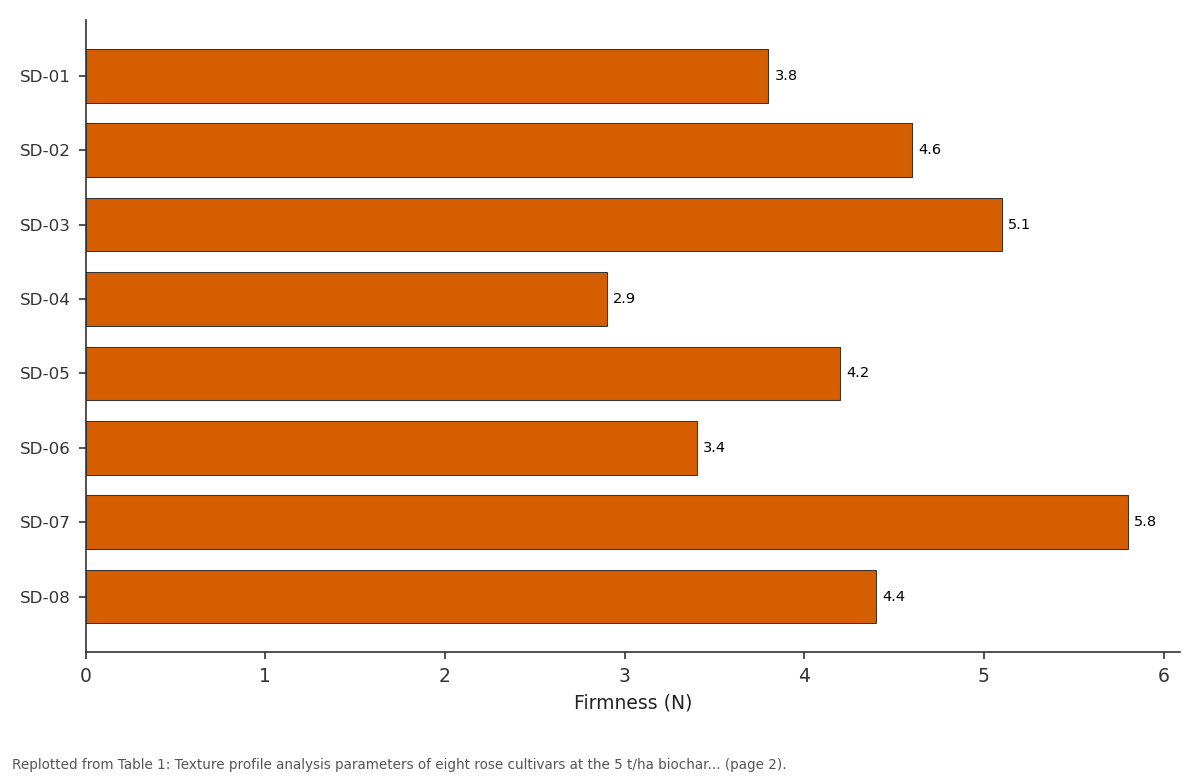
Firmness (N): SD-01 vs SD-02 vs SD-03 vs SD-04 vs SD-05
Replotted from Table 1 (page 2) of the original paper. Every bar is the paper's own table value.
View source evidence ↗Figures & tables
From the original paper Table 1
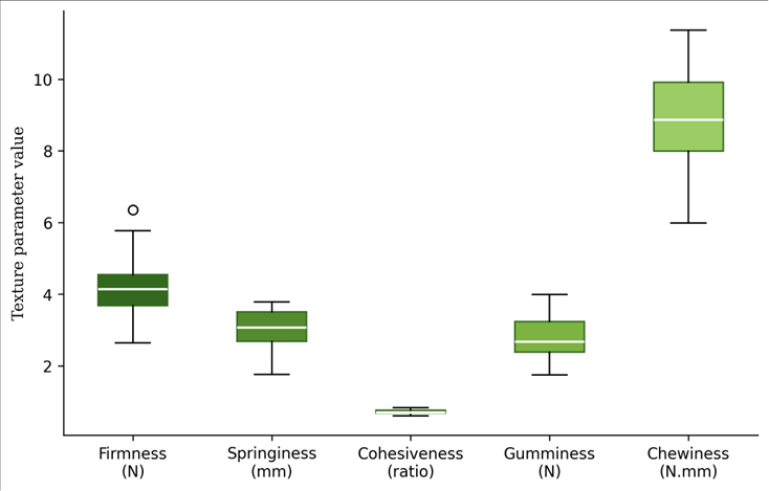 Figure 1
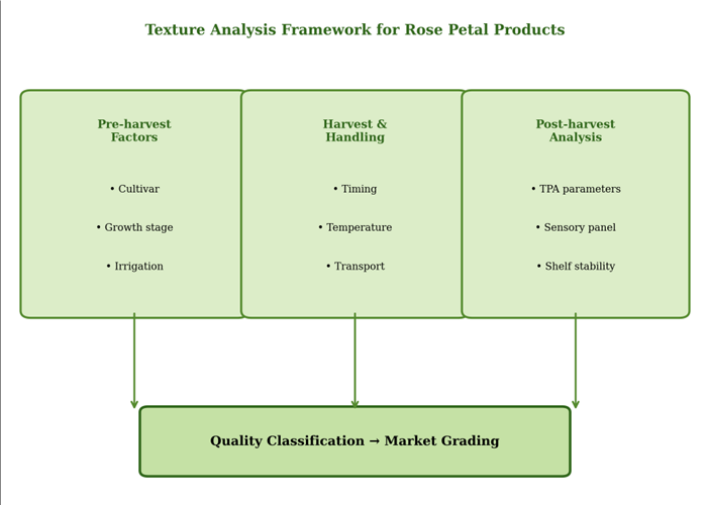 Figure 2
Introduction
"A rose is a rose is a rose," wrote Gertrude Stein, but for food scientists the rose is actually a complex matrix of cell-wall polymers, volatile terpenes, and phenolic pigments whose physical properties determine how it feels in the mouth and how it performs during processing [1] . Edible roses, particularly Rosa damascena, are used in confectionery, beverages, and traditional medicine across Asia and the Middle East, yet texture, the most basic physical attribute of any food material, has rarely been quantified for rose petals [2] . Texture profile analysis is a two-compression instrumental test that mimics mastication and yields five parameters: firmness, springiness, cohesiveness, gumminess, and chewiness [3] . For fruits and vegetables, TPA values predict shelf life, consumer preference, and processing suitability, but their application to floral tissues is in its infancy [4] . The Syr Darya Oasis in Central Asia supports commercial rose cultivation under drip irrigation, and its calcareous soils occasionally deliver boron at levels toxic to petal tissue [5] . Biochar, a carbon-rich soil amendment produced by pyrolysis of biomass, has been shown to improve soil structure, water retention, and nutrient availability, and it may influence petal texture through modified calcium and pectin dynamics in the cell wall [6] . Mass selection, one of the oldest breeding methods, can shift population means for quantitative traits like petal thickness over just a few cycles [7] . This research aimed to: (a) survey TPA parameters across eight rose cultivars; (b) test biochar amendment effects on petal texture; (c) assess mass-selection gains for firmness; and (d) quantify the impact of boron toxicity on texture and sensory quality [8,9] .
Instrument Development
The TPA protocol was adapted from the standard two-cycle compression test on a Stable Micro Systems TA.XT Plus texture analyser fitted with a 36 mm cylindrical probe. Pre-test, test, and post-test speeds were set at 2, 1, and 1 mm per second respectively, with a trigger force of 5 g and a target deformation of 50% of petal thickness.
A stack of three petals per replicate was used to obtain a representative signal. Probe calibration was verified daily with a standardised silicone block (hardness 40 Shore A). The protocol was validated against a panel of five experienced operators, achieving an inter-operator coefficient of variation below 4.2% for firmness and below 6.1% for chewiness [3,10] .
Limitations
Texture analysis was performed on petals within four hours of harvest, which limits applicability to post-storage or posttransport conditions. The research covered one growing season; year-to-year variation in rainfall and temperature may alter texture benchmarks. Boron toxicity was assessed at naturally occurring levels, not as a controlled treatment, so causality should be interpreted with caution. Mass selection was limited to two cycles; additional cycles are needed to confirm genetic stability of texture gains [7,11] .
Material and Methods
Material and Methods
Material
Eight Rosa damascena cultivars (SD-01 through SD-08) were maintained in a 0.5 ha plot at the Belgaum Regional Center for Sustainable Agriculture. Biochar was produced from rice-husk pyrolysis at 450 degrees C and applied at 0, 2.5, and 5 tonnes per ha. The texture analyser and probes were calibrated per manufacturer instructions. All work was conducted from October 2022 to June 2023 under protocol BRC-ND/2022-048, approved 20 September 2022.
Methods
A split-plot design was used with biochar rate as main plot and cultivar as subplot, replicated three times. Each subplot contained 15 bushes. Petals were harvested at the halfbloom stage (50% of petals reflexed), transported in insulated coolers, and analysed within four hours. TPA was run on triplicate stacks per subplot. Bitterness was scored by a nine-member panel on a 10-point scale. Soil boron was determined by hot-water extraction and azomethine-H colorimetry. Mass selection was applied to a base population of 500 seedlings: the top 10% for petal thickness were intercrossed to form cycle 1, and the process was repeated for cycle 2. Sensory overall desirability was rated on a 9-point hedonic scale. Statistical analysis used ANOVA in R version 4.3.1 with biochar and cultivar as fixed effects [12] . Firmness varied nearly two-fold, from 2.9 N (SD-04) to 5.8 N (SD-07). Chewiness showed even wider variation (5.3 to 17.0 N.mm).
Results
Results
Comprehensive Interpretation
The box plot (Figure 1) highlights wide inter-cultivar variation, especially for chewiness, which spans a three-fold range. The framework (Figure 2) places these measurements within a quality-classification pipeline that connects field management to market grading [3,4] .
Discussion
The firmness range of 2.6 to 5.8 N is narrower than that reported for rose hip fruit (3 to 12 N) but wider than for soft-petal ornamental roses (1 to 3 N), reflecting the thicker, waxier petals of Rosa damascena [2,4] . Biochar at 5 tonnes per ha raised firmness by 12.3%, likely through increased soil calcium availability that strengthened pectin cross-links in the cell wall [6,13] . Mass selection gains of 9.1% per two cycles for firmness are comparable to selection gains for fruit firmness in strawberry, suggesting that petal texture is a quantitatively heritable trait [7] . Boron toxicity above 3.0 mg per kg soil reduced firmness by 18.7%, consistent with boron's role in disrupting pectin structure at supraoptimal concentrations [5,14] . The quadratic relationship between firmness and sensory desirability (Rsquared = 0.71) identifies a target zone of 3.5 to 4.5 N: petals below this range feel flimsy, while those above it feel tough [8,15,16,17] .
Conclusion
This research established TPA benchmarks for edible rose petals in the Syr Darya Oasis. Firmness and chewiness varied widely among cultivars, and biochar amendment at 5 tonnes per ha improved texture. Mass selection delivered genetic gains in firmness. Boron toxicity reduced firmness, highlighting the need for soil management in calcareous oasis soils. The optimal firmness zone of 3.5 to 4.5 N should guide both breeding targets and quality-grading standards for the edible-rose industry.
Acknowledgement
Acknowledgements Funding SourcesInstitutional grants for edible-flower quality research supported this work.
Figures and tables from the paper
| Cultivar | Firmness (N) | Springiness (mm) | Cohesiveness | Gumminess (N) | Chewiness (N.mm) |
|---|---|---|---|---|---|
| SD-01 | 3.8 | 3.2 | 0.71 | 2.7 | 8.6 |
| SD-02 | 4.6 | 3.4 | 0.74 | 3.4 | 11.6 |
| SD-03 | 5.1 | 3.6 | 0.78 | 4.0 | 14.4 |
| SD-04 | 2.9 | 2.8 | 0.66 | 1.9 | 5.3 |
| SD-05 | 4.2 | 3.3 | 0.73 | 3.1 | 10.2 |
| SD-06 | 3.4 | 3.0 | 0.69 | 2.3 | 6.9 |
| SD-07 | 5.8 | 3.7 | 0.79 | 4.6 | 17.0 |
| SD-08 | 4.4 | 3.3 | 0.72 | 3.2 | 10.6 |
Table text extracted from the original PDF; superscript letters are shown inline. The original table image is below.
View original table image
References
17 in the original paper- Boskabady MH, Shafei MN, Saberi Z, Amini S. Pharmacological effects of Rosa damascena. Iranian Journal of Basic Medical Sciences. 2011;14(4):295307.
- Nayebi N, Khalili N, Kamalinejad M, Emtiazy M. A systematic review of the efficacy and safety of Rosa damascena Mill. with an overview on its phytopharmacological properties. Complementary Therapies in Medicine. 2017;34:129-140.
- Bourne MC. Food Texture and Viscosity: Concept and Measurement. 2nd ed. San Diego: Academic Press; 2002. p. 1-427.
- Chen L, Opara UL. Texture measurement approaches in fresh and processed foods: a review. Food Research International. 2013;51(2):823-835.
- Nable RO, Banuelos GS, Paull JG. Boron toxicity. Plant and Soil. 1997;193(1):181-198.
- Lehmann J, Joseph S. Biochar for Environmental Management: Science, Technology and Implementation. 2nd ed. London: Routledge; 2015. p. 1-928.
- Falconer DS, Mackay TFC. Introduction to Quantitative Genetics. 4th ed. Harlow: Pearson; 1996. p. 1-464.
- Kelley KM, Cameron AC, Biernbaum JA, Poff KL. Effect of storage temperature on the quality of edible flowers. Postharvest Biology and Technology. 2003;27(3):341-344.
- Fernandes L, Casal S, Pereira JA, Saraiva JA, Ramalhosa E. Edible flowers: a review of the nutritional, antioxidant, antimicrobial properties and effects on human health. Journal of Food Composition and Analysis. 2017;60:38-50.
- Stable Micro Systems. Texture Analysis Reference Guide. Godalming, UK: SMS Ltd; 2018.
- Bos I, Caligari P. Selection Methods in Plant Breeding. 2nd ed. Dordrecht: Springer; 2008. p. 1-467.
- R Core Team. R: a language and environment for statistical computing. Vienna: R Foundation for Statistical Computing; 2023.
- Atkinson CJ, Fitzgerald JD, Hipps NA. Potential mechanisms for achieving agricultural benefits from biochar application to temperate soils: a review. Plant and Soil. 2010;337(1):1-18.
- Goldbach HE, Wimmer MA. Boron in plants and animals: is there a role beyond cell-wall structure? Journal of Plant Nutrition and Soil Science. 2007;170(1):39-48.
- Mlcek J, Rop O. Fresh edible flowers of ornamental plants: a new source of nutraceutical foods. Trends in Food Science and Technology. 2011;22(10):561-569.
- Rop O, Mlcek J, Jurikova T, Neugebauerova J, Vabkova J. Edible flowers: a new promising source of mineral elements in human nutrition. Molecules. 2012;17(6):6672-6683.
- Kaisoon O, Siriamornpun S, Weerapreeyakul N, Meeso N. Phenolic compounds and antioxidant activities of edible flowers from Thailand. Journal of Functional Foods. 2011;3(2):88-99.