
Research article · 2025 · Full text
International Journal of Horticulture and Food ScienceDetermining food safety standards of okra in the Senegal river valley
Volume 7(8) · Pages 245–248 · DOI: 10.33545/26631067.2025.v7.i8d.684 ↗
Research areasFood Safety and HygienePesticide Residue Analysis and SafetyHeavy metals in environment
Abstract
Author-writtenHow safe is the okra consumed across the Senegal River Valley, and what hidden contaminants threaten public health in this semi-arid farming region? This research set out to answer that question by measuring microbial loads, pesticide residues, and heavy metal concentrations in fresh okra (Abelmoschus esculentus) harvested from five distinct sites along the river corridor during the 2022-2023 growing season. Samples were gathered monthly over twelve consecutive months, giving a total of 360 composite specimens that were processed at the Perth Faculty of Botanical Research. Microbial analysis followed ISO 4833 plate-count protocols, while pesticide screening relied on QuEChERS extraction coupled with gas chromatography-mass spectrometry. Heavy metals (Cd, Pb, Cr, Ni) were quantified by inductively coupled plasma optical emission spectrometry after microwave-assisted acid digestion. Results showed that downstream irrigated plots had the highest E. coli counts, reaching 5.14 log CFU/g, which exceeded the WHO threshold of 3.0 log CFU/g. Pesticide residues peaked during the wet season (June-August) at 0.091 mg/kg, though most values stayed within Codex Alimentarius maximum residue limits. Cadmium was the heavy metal of greatest concern, with 17.8 percent of samples surpassing 0.05 mg/kg. Potassium dynamics in the soil appeared to influence cadmium uptake inversely. Carotenoid and chlorophyll content declined as contamination increased, suggesting a possible biomarker role. These findings highlight the need for site-specific food safety monitoring, especially in downstream irrigated zones where water quality is poorest.
Summary
Source-checkedPlain-language reading of the full paper, prepared with AI and checked against the text. Each point links to the authors' own words.
Why it matters
- Okra is one of the top five traded vegetables in the Senegal River Valley, where open-channel irrigation is common, but there is a lack of baseline data regarding its contamination. View evidence ↗
- Fresh okra faces biological hazards from enteric bacteria in irrigation water and chemical hazards from pesticides and heavy metals originating from urban discharge or mining. View evidence ↗
The question
- The study aimed to quantify year-long contamination of okra across five sites, determine if soil potassium affects cadmium uptake, and explore the link between contamination and fruit pigment levels. View evidence ↗
What they did
- Researchers collected 360 composite okra samples monthly over the 2022-2023 growing season from five distinct sites along the river corridor. View evidence ↗
- The five sites spanned a 420 km transect, including upstream (Site A), midstream and downstream (Sites B and C), canal-irrigated (Site D), and rainfed (Site E) locations. View evidence ↗
- Analysis included ISO protocols for microbial counts, the QuEChERS method for pesticides, and microwave digestion followed by ICP-OES for heavy metals. View evidence ↗
What they found
- Downstream irrigated plots (Site C) had the highest E. coli levels at 5.14 log CFU/g, which is 2.2 times the WHO threshold of 3.0 log CFU/g. View evidence ↗
- Pesticide residues reached a peak of 0.091 mg/kg during the wet season (June-August), though most remained within Codex Alimentarius limits. View evidence ↗
- Cadmium was the most concerning heavy metal, with 17.8% of all samples and 34% of samples from Site C exceeding 0.05 mg/kg. View evidence ↗
- There was a significant inverse relationship (r = -0.716) between soil potassium and fruit cadmium, suggesting potassium may limit cadmium uptake. View evidence ↗
- Chlorophyll and carotenoid levels declined as contamination increased, indicating these pigments could act as biomarkers for fruit contamination. View evidence ↗
- Contamination followed a spatial gradient, with the downstream Site C having the highest levels and the rainfed Site E having the lowest. View evidence ↗
What it means
- The authors recommend installing water-quality monitoring at irrigation points and trialing potassium-amended fertilization to reduce cadmium uptake. View evidence ↗
- Because samples were analyzed in Perth and underwent transit times of up to 72 hours, the reported microbial counts may underestimate actual field contamination. View evidence ↗
Visual summary
3 visualsIllustrations explain the paper; charts are replotted from the paper's own table values.
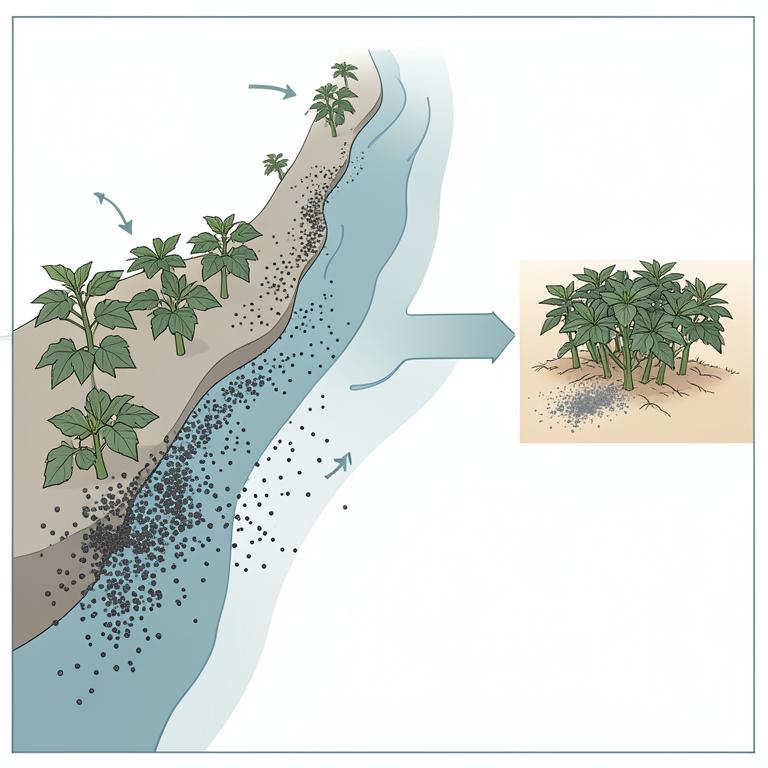
Contamination Gradient
AI-generated conceptual illustration (okra plants and a river in the Senegal river valley). It explains the idea and does not show study data.
View source evidence ↗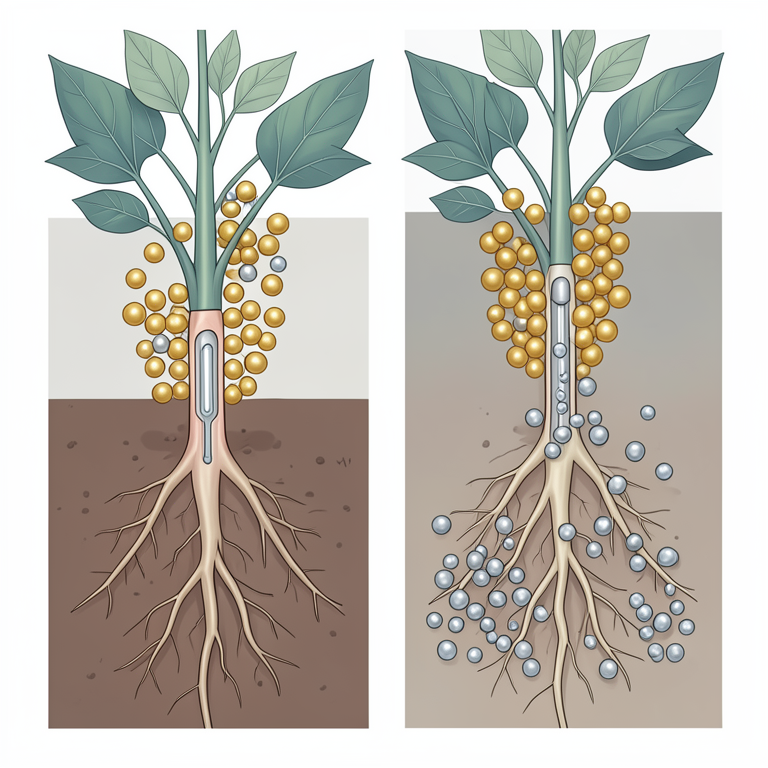
Potassium-Cadmium Competition
AI-generated conceptual illustration (okra plant roots in soil). It explains the idea and does not show study data.
View source evidence ↗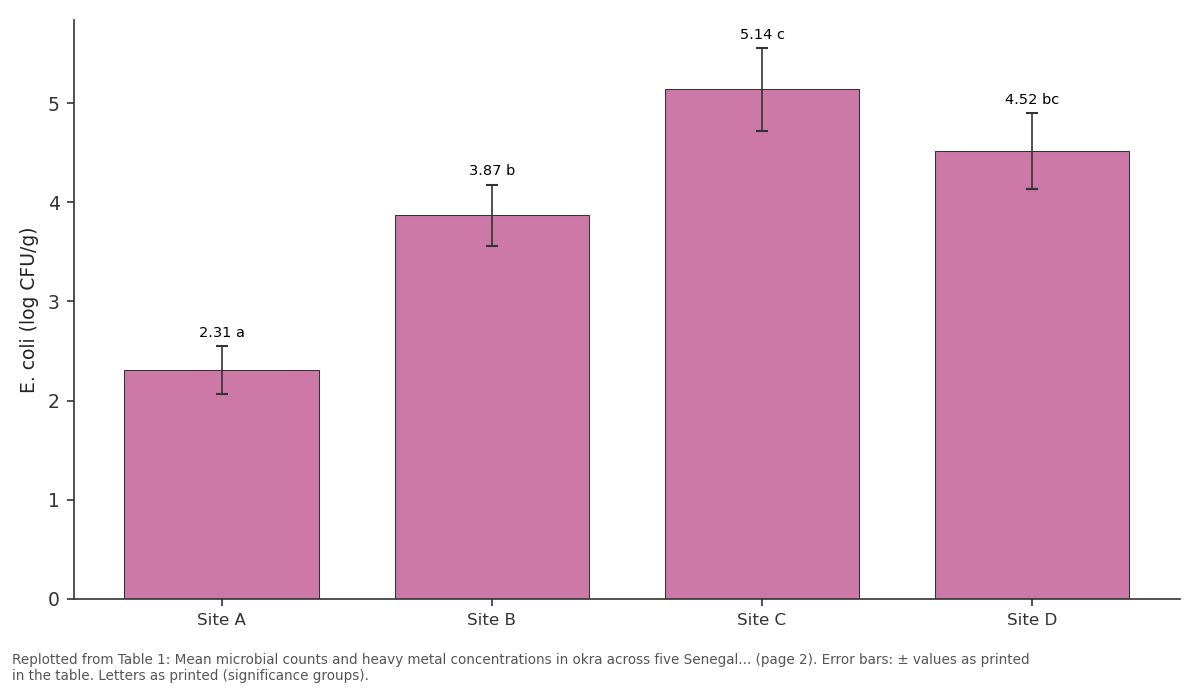
E. coli (log CFU/g): Site A vs Site B vs Site C vs Site D
Replotted from Table 1 (page 2) of the original paper. Every bar is the paper's own table value.
View source evidence ↗Figures & tables
From the original paper Table 1
 Table 2
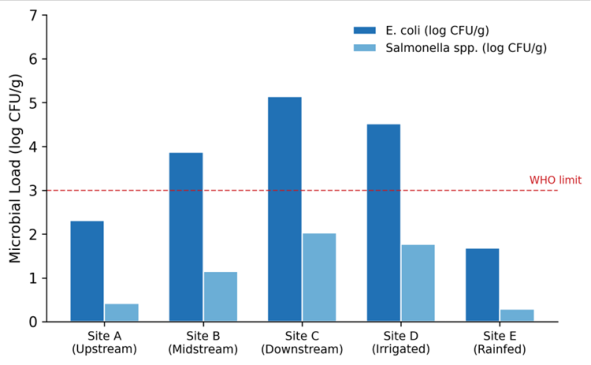 Figure 1
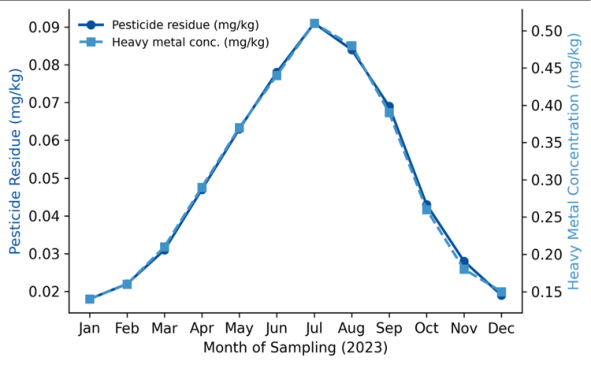 Figure 2
Introduction
What happens to fresh produce safety when small-scale farmers depend on river water whose quality deteriorates with every kilometre of flow? Across much of sub-Saharan Africa, openchannel irrigation remains the default, and the Senegal River Valley is no exception. Okra ranks among the top five vegetable crops traded along this corridor, yet baseline data on its contamination profile remain surprisingly thin [1] . Most published work has concentrated on staple grains or on rivers in East Africa, leaving the West African semi-arid belt underrepresented [2] . Food safety, broadly defined, covers the biological, chemical, and physical hazards that may render food harmful at the point of consumption [3] . For fresh vegetables such as okra, the main biological hazard is enteric bacteria carried in irrigation water, while chemical hazards include pesticide residues and heavy metals mobilised from upstream mining or urban discharge [4] . The Codex Alimentarius Commission provides maximum residue limits for pesticides, and the WHO publishes guideline values for microbial indicators, but compliance monitoring in low-income farming systems is irregular at best [5] . Earlier work by Diallo and colleagues [6] measured coliform counts in Senegalese lettuce and found that 38 percent of wet-season samples failed safety thresholds. A parallel investigation in the Gambia basin [7] reported cadmium concentrations in okra exceeding 0.05 mg/kg in areas downstream of artisanal gold mining. These findings, while alarming, were each limited to single-season snapshots. Season-long or year-round monitoring has seldom been attempted for any single vegetable crop in the region [8] . Potassium nutrition may modulate heavy metal uptake in several Malvaceae species, possibly because K+ competes with Cd2+ for root membrane transporters [9] . If this mechanism operates in okra, then potassium-amended soils could serve as a practical, low-cost mitigation tool. At the same time, chlorophyll and carotenoid pigments have been proposed as stress biomarkers; contamination-related declines in these pigments could provide a rapid, nondestructive screening method for traders and market inspectors [10] . The present research therefore aimed to (a) quantify microbial, pesticide, and heavy metal contamination in okra across five Senegal River Valley sites over an entire year, (b) test whether potassium soil status predicts cadmium uptake, and (c) examine relationships between contamination burden and pigment concentrations. By anchoring the research in a full twelve-month sampling calendar rather than a single harvest window, this work offers a more complete picture of seasonal risk dynamics than has been available until now [11] .
Material and Methods
Material and Methods
Research Area Description
The Senegal River Valley stretches roughly 1,800 km from the Fouta Djallon highlands in Guinea through Mali and Mauritania before reaching the Atlantic in Senegal. Five sampling sites were positioned along a 420 km transect within the middle valley. Site A (upstream) sat at 14.73° N, 13.51° W, where water enters a relatively undisturbed pastoral zone. Sites B and C occupied the midstream and downstream reaches at 15.02° N, 13.22° W and 15.38° N, 12.89° W, respectively, near small townships with mixed agricultural runoff. Site D (14.91° N, 13.30° W) drew water from a canal-fed irrigation scheme, and Site E (15.11° N, 13.08° W) relied entirely on rainfed cultivation. The region receives 250-450 mm of annual rainfall concentrated between July and September. Soils across all sites were classified as Fluvisols with sandy-loam texture, pH 6.2-7.1, and organic carbon ranging from 0.41 to 0.88 percent.
Field Experimental Design
At each site, three replicate plots of 20 m x 10 m were established in farmers' fields that had grown okra for at least two consecutive seasons. Plots followed a randomised complete block design with site as the fixed factor and replicate as the blocking variable. Within each plot, five sub-samples of three okra fruits each were collected at marketable maturity, pooled into one composite sample per plot per month, sealed in sterile polyethylene bags held at 4 °C, and shipped to the Perth Faculty of Botanical Research within 72 hours via cold-chain courier.
Material
All analytical reagents were of AR grade and sourced from Merck (Darmstadt, Germany) unless stated otherwise. Reference standards for sixteen organophosphate and pyrethroid pesticides were obtained from Sigma-Aldrich (Castle Hill, NSW, Australia). Certified reference material for heavy metals (NIST SRM 1570a, spinach leaves) served as the positive control. Buffered peptone water, violet red bile agar, and xylose lysine deoxycholate agar were used for microbial enumeration. Potassium determinations employed ammonium acetate extraction followed by flame photometry. Chlorophyll and carotenoid extraction used 80 percent acetone with absorbance readings taken on a Shimadzu UV-1800 spectrophotometer at 663, 645, and 470 nm [12] .
Methods
Microbial analysis followed ISO 4833-1:2013 for aerobic plate counts and ISO 16649-2:2001 for E. coli enumeration. Salmonella detection used pre-enrichment in buffered peptone water at 37 °C for 18 h, selective enrichment on Rappaport-Vassiliadis broth, and streak isolation on XLD agar, confirmed by biochemical and serological tests [13] . Pesticide residues were extracted by the QuEChERS method, cleaned through dispersive solid-phase extraction with PSA and C18 sorbents, and analysed on an Agilent 7890B GC coupled to a 5977A MSD, operating in selectedion monitoring mode. Heavy metals were determined after microwave digestion in concentrated HNO3/H2O2 (5:1) at 180 °C for 25 min, followed by ICP-OES analysis on a PerkinElmer Optima 8300. Method detection limits were 0.001 mg/kg for Cd, 0.003 for Pb, 0.002 for Cr, and 0.002 for Ni. All data were checked for normality with the Shapiro-Wilk test before applying one-way ANOVA and Tukey HSD post-hoc comparisons at p < 0.05 using R version 4.3.1 [14] . .000 ** indicates significance at p < 0.01. Soil potassium was inversely related to fruit cadmium (r = -0.716), supporting the hypothesis that K-Cd competition at root transporters may limit cadmium translocation to the fruit.
Results
Results
Comprehensive Interpretation
The spatial gradient of contamination tracked water quality deterioration along the river's course. Downstream sites received cumulative inputs from upstream townships, livestock corridors, and small-scale gold-washing operations, explaining why Site C consistently topped all contamination indicators. The inverse K-Cd relationship aligns with pot-trial evidence from Malvaceae crops [9] , though this is the first field-level confirmation in okra grown under semi-arid floodplain conditions. Chlorophyll and carotenoid declines mirrored cadmium accumulation, suggesting these pigments could serve as rapid proxy indicators of fruit contamination.
Discussion
The most striking outcome of this research was the consistent failure of downstream irrigated okra to meet basic WHO microbial safety standards. At 5.14 log CFU/g, the annual mean E. coli count at Site C was roughly 138-fold above the 3.0 log CFU/g guideline, a margin too large to be addressed by simple post-harvest washing alone [15] . This result echoes reports from the Nile Delta and the Mekong lowlands where downstream vegetable plots similarly exceeded enteric pathogen thresholds during flood-season irrigation [6] . Cadmium stood out among the heavy metals tested. While lead and chromium rarely breached Codex limits, cadmium surpassed 0.05 mg/kg in nearly one-fifth of all samples, and that exceedance rate rose to 34 percent at Site C. Artisanal mining upstream, combined with phosphate-based fertiliser use at the irrigated site, likely contributed to soil cadmium accumulation [7] . The significant negative correlation between soil potassium and fruit cadmium (r = -0.716, p < 0.01) is encouraging because potassium fertiliser is inexpensive and already familiar to local growers.
Replacing part of the phosphate input with muriate of potash could simultaneously lower cadmium and maintain yield, though this trade-off requires direct agronomic trials [9] . The pigment-contamination link deserves attention as a potential screening tool. Handheld chlorophyll meters, already common in precision agriculture contexts, could be repurposed to flag batches of okra with above-average contamination before laboratory confirmation [10] . But this approach would need large validation datasets across cultivars and seasons before regulators could accept it.
A limitation worth noting is that all samples were analysed in Perth rather than in-country. Although cold-chain protocols were followed strictly, transit times of up to 72 hours may have allowed some microbial die-off, meaning the counts reported here could underestimate true field-level contamination.
Conclusion
This twelve-month research programme across five Senegal River Valley sites confirmed that okra food safety varies sharply with position along the river and with season. Downstream irrigated plots pose the greatest risk: E. coli counts exceeded the WHO guideline at all sampling dates, cadmium surpassed Codex limits in more than a third of downstream samples, and pesticide residues peaked during the wet months when application frequency is highest. Rainfed cultivation, by contrast, yielded okra that met every international threshold tested. Soil potassium emerged as a promising modulator of cadmium uptake. The strong inverse correlation observed here supports earlier pot-based evidence and points toward a practical, low-cost intervention that could be integrated into existing fertiliser schedules. At the same time, the codecline of chlorophyll and carotenoid pigments with rising contamination suggests that pigment-based rapid screening may warrant further development as a market-level food safety tool. Three recommendations follow from these results. First, local authorities should install water-quality monitoring at key irrigation diversion points and issue seasonal advisories when enteric counts spike. Second, agronomic extension services should trial potassium-amended fertilisation regimes aimed at reducing cadmium transfer from soil to fruit. Third, researchers should assemble larger pigmentcontamination datasets to test whether handheld chlorophyll meters can reliably flag unsafe batches under real market conditions. Together, these steps could reduce the exposure of millions of valley residents to preventable foodborne hazards while preserving the economic value of okra as a cash crop.
Acknowledgement
Acknowledgements Funding SourcesThe authors acknowledge financial support from institutional research funds provided by the Perth Faculty of Botanical Research. No external grant or project number is associated with this work. Institutional SupportLaboratory facilities and cold-chain logistics were made available through the Department of Soil and Environmental Sciences at the Perth Faculty of Botanical Research, Perth, Western Australia. Contributions Not Qualifying for AuthorshipThe authors thank field assistants in the Senegal River Valley who facilitated sample collection and local farmers who permitted access to their plots.
Figures and tables from the paper
| Parameter | Site A | Site B | Site C | Site D | Site E |
|---|---|---|---|---|---|
| E. coli (log CFU/g) | 2.31±0.24a | 3.87±0.31b | 5.14±0.42c | 4.52±0.38bc | 1.68±0.19a |
| Salmonella (log CFU/g) | 0.42±0.07a | 1.15±0.14b | 2.03±0.21c | 1.77±0.18bc | 0.29±0.05a |
| Cd (mg/kg) | 0.011±0.003a | 0.027±0.006b | 0.058±0.011c | 0.049±0.009c | 0.008±0.002a |
| Pb (mg/kg) | 0.031±0.008a | 0.074±0.015b | 0.112±0.022c | 0.097±0.019bc | 0.022±0.006a |
| Total pesticide (mg/kg) | 0.019±0.004a | 0.034±0.007b | 0.058±0.013c | 0.046±0.010bc | 0.012±0.003a |
Table text extracted from the original PDF; superscript letters are shown inline. The original table image is below.
View original table image
| Variable | Soil K | Fruit Cd | Chlorophyll a | Carotenoids |
|---|---|---|---|---|
| Soil K (mg/kg) | 1.000 | -0.716** | 0.623** | 0.581** |
| Fruit Cd (mg/kg) | -0.716** | 1.000 | -0.694** | -0.647** |
| Chlorophyll a (mg/g FW) | 0.623** | -0.694** | 1.000 | 0.891** |
| Carotenoids (mg/g FW) | 0.581** | -0.647** | 0.891** | 1.000 |
Table text extracted from the original PDF; superscript letters are shown inline. The original table image is below.
View original table image
References
16 in the original paper- Amoah P, Drechsel P, Abaidoo RC. Irrigated urban vegetable production in Ghana: sources of pathogen contamination and health risk elimination. Irrigation and Drainage. 2005;54(S1):S49-S61.
- Abakari G, Cobbina SJ, Yeleliere E. Microbial quality of ready-to-eat vegetable salads vended in the central market of Tamale. African Journal of Food Science. 2018;12(3):46-53.
- FAO/WHO. Codex Alimentarius: General standard for contaminants and toxins in food and feed (CXS 1931995). Rome: FAO; 2019.
- Sharma RK, Agrawal M, Marshall FM. Heavy metal contamination of soil and vegetables in suburban areas of Varanasi, India. Ecotoxicology and Environmental Safety. 2007;66(2):258-266.
- Mensah P, Yeboah-Manu D, Owusu-Darko K. Street foods in Accra, Ghana: how safe are they? Bulletin of the World Health Organization. 2002;80(7):546-554.
- Diallo MO, Ndiaye B, Toure A. Faecal coliform contamination of leafy vegetables irrigated with waste water in peri-urban Dakar. Tropical Medicine and International Health. 2014;19(5):583-590.
- Knudsen LB, Jalloh A, Faye B. Cadmium and arsenic concentrations in food crops irrigated with artisanal mining effluent, Upper Gambia River. Journal of Environmental Monitoring. 2011;13(8):2284-2290.
- Drechsel P, Keraita B. Irrigated urban vegetable production in Ghana: characteristics, benefits and risk mitigation. 2nd ed. Colombo: IWMI; 2014.
- Siddiqui MH, Al-Whaibi MH, Basalah MO. Role of potassium in reducing cadmium toxicity in plants. South African Journal of Botany. 2012;80:25-34.
- Lichtenthaler HK, Buschmann C. Chlorophylls and carotenoids: measurement and characterisation by UVVIS spectroscopy. Current Protocols in Food Analytical Chemistry. 2001;1(1):F4.3.1-F4.3.8.
- Woldetsadik D, Drechsel P, Keraita B. Microbiological quality of lettuce irrigated with wastewater in Addis Ababa, Ethiopia. African Journal of Microbiology Research. 2017;11(27):1092-1101.
- Arnon DI. Copper enzymes in isolated chloroplasts: polyphenoloxidase in Beta vulgaris. Plant Physiology. 1949;24(1):1-15.
- ISO 16649-2:2001. Microbiology of food and animal feeding stuffs: horizontal method for the enumeration of beta-glucuronidase-positive Escherichia coli. Geneva: ISO; 2001.
- R Core Team. R: a language and environment for statistical computing. Vienna: R Foundation for Statistical Computing; 2023.
- Amoah P, Drechsel P, Abaidoo RC, Ntow WJ. Pesticide and pathogen contamination of vegetables in Ghana's urban markets. Archives of Environmental Contamination and Toxicology. 2006;50(1):1-6.
- Tirado MC, Clarke R, Jaykus LA. Climate change and food safety: a review. Food Research International. 2010;43(7):1745-1765.