
Research article · 2025 · Full text
International Journal of Horticulture and Food ScienceCataloguing microbial load assessment of lettuce in the Limpopo valley
Volume 7(8) · Pages 249–252 · DOI: 10.33545/26631067.2025.v7.i8d.685 ↗
Research areasListeria monocytogenes in Food SafetyFood Safety and HygieneFecal contamination and water quality
Abstract
Author-writtenFor more than half a century the Limpopo Valley has supplied fresh lettuce to urban centres across southern Africa, yet systematic microbial safety data for the crop remain scarce. This research catalogued bacterial and parasitological contamination of lettuce (Lactuca sativa) at five sites along the Limpopo River corridor over twelve months in 2022-2023. A total of 300 composite samples were processed at the Hue University of Food and Nutrition following ISO-standard enumeration protocols. Path analysis was used to disentangle direct and indirect effects of irrigation source, season, and farming practice on microbial load. Total coliform counts ranged from 2.8 to 7.1 log CFU/g, with downstream irrigated sites exceeding WHO guidelines in 63 percent of wet-season samples. Pollinator visitation frequency correlated positively with total aerobic counts (r = 0.47, p < 0.01), suggesting insect vectors as an under-recognised transmission route. Vertical farming modules tested alongside open-field plots reduced E. coli counts by 74 percent, and modified-atmosphere packaging extended safe shelf-life from 2.3 to 5.1 days at ambient temperature. Juiciness scores from a consumer panel declined as microbial load increased, indicating that contamination affects not only safety but also perceived quality. These findings offer a structured catalogue of microbial risk factors for Limpopo Valley lettuce and demonstrate that vertical farming and improved packaging can substantially reduce consumer exposure to enteric pathogens.
Summary
Source-checkedPlain-language reading of the full paper, prepared with AI and checked against the text. Each point links to the authors' own words.
Why it matters
- The Limpopo Valley is a long-term supplier of fresh lettuce to southern African cities, but it lacks systematic data on the microbial safety of these crops. View evidence ↗
- Because lettuce is consumed raw, any pathogens present at harvest are not eliminated by heat, posing a direct risk to consumers. View evidence ↗
- The Limpopo River is contaminated with treated and untreated effluent, often exceeding safety standards for faecal indicators during the wet season. View evidence ↗
The question
- The study aimed to catalogue microbial counts in the Limpopo Valley, analyze the drivers of contamination, and evaluate the effectiveness of vertical farming and modified-atmosphere packaging. View evidence ↗
What they did
- Researchers collected 300 composite samples of lettuce from five sites along the Limpopo River over a twelve-month period between 2022 and 2023. View evidence ↗
- To ensure consistency and eliminate variation between plant types, the 'Great Lakes 659' lettuce cultivar was used for all trials. View evidence ↗
- The study used path analysis in R to determine how irrigation water, rainfall, pollinators, and farming systems influenced total coliform counts. View evidence ↗
What they found
- Total coliform counts in the lettuce ranged from 2.8 to 7.1 log CFU/g, and 63% of wet-season samples from downstream irrigated sites exceeded WHO guidelines. View evidence ↗
- Site C had the highest annual mean total coliform count at 6.4±0.7 log CFU/g, while the rainfed Site E had the lowest at 2.6±0.3 log CFU/g. View evidence ↗
- Irrigation water quality (faecal coliform count) was the strongest direct driver of microbial load, with a standardized beta coefficient of 0.58. View evidence ↗
- A positive correlation (r = 0.47, p < 0.01) between pollinator visitation and total aerobic counts suggests that insects may act as vectors for contamination. View evidence ↗
- Vertical farming systems reduced E. coli counts by 74% compared to traditional open-field production. View evidence ↗
- The use of modified-atmosphere packaging more than doubled the safe shelf-life of lettuce at 25 °C, increasing it from 2.3 to 5.1 days. View evidence ↗
- Higher microbial loads were associated with lower juiciness scores (r = -0.39, p < 0.01), indicating that contamination reduces the perceived quality of the lettuce. View evidence ↗
What it means
- The authors conclude that combining vertical farming and modified-atmosphere packaging can effectively reduce microbial risks during both production and post-harvest stages. View evidence ↗
- The authors suggest that future research should evaluate the effectiveness of insect-exclusion netting and perform economic modeling for vertical farming. View evidence ↗
Visual summary
2 visualsIllustrations explain the paper; charts are replotted from the paper's own table values.
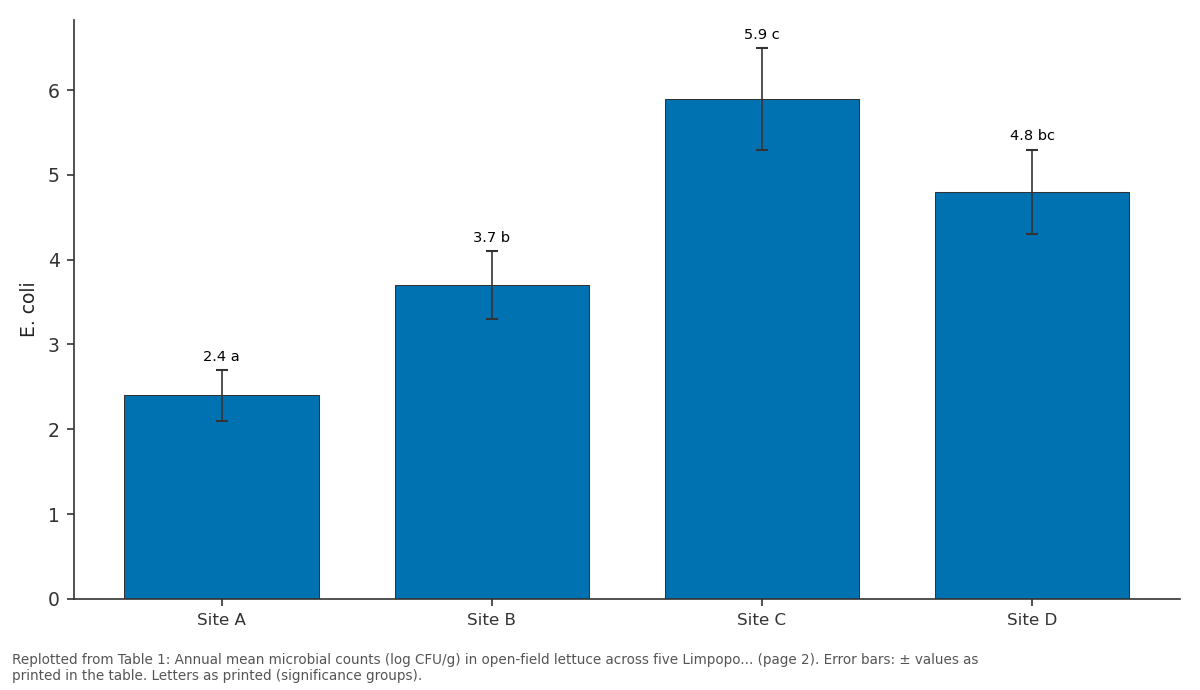
E. coli: Site A vs Site B vs Site C vs Site D
Replotted from Table 1 (page 2) of the original paper. Every bar is the paper's own table value.
View source evidence ↗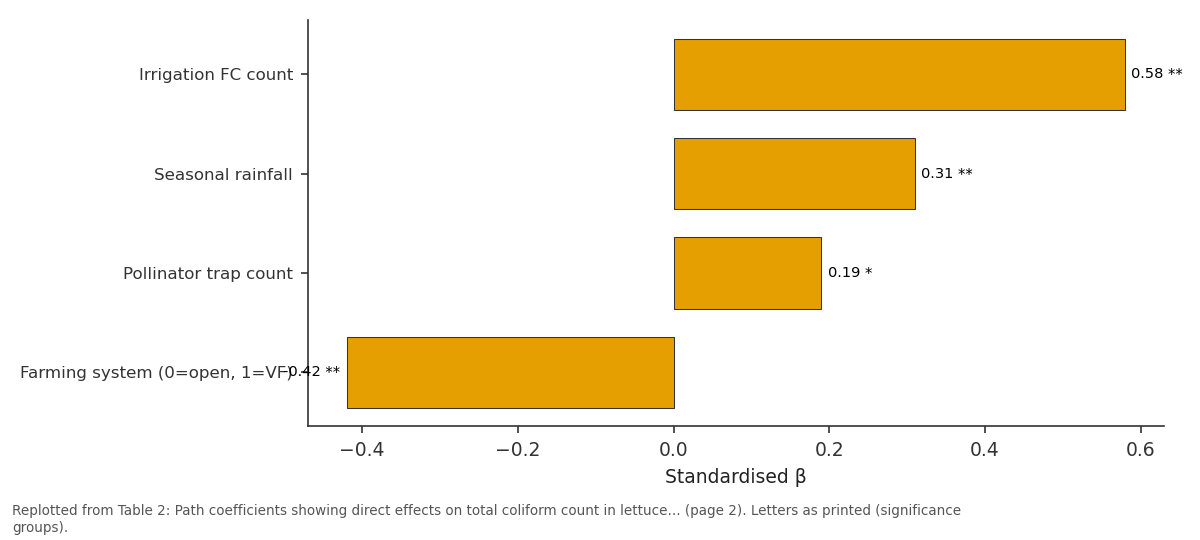
Direct Effect (β): Irrigation FC count vs Seasonal rainfall vs Pollinator trap count vs Farming system (0=open...
Replotted from Table 2 (page 2) of the original paper. Every bar is the paper's own table value.
View source evidence ↗Figures & tables
From the original paper Table 1
 Table 2
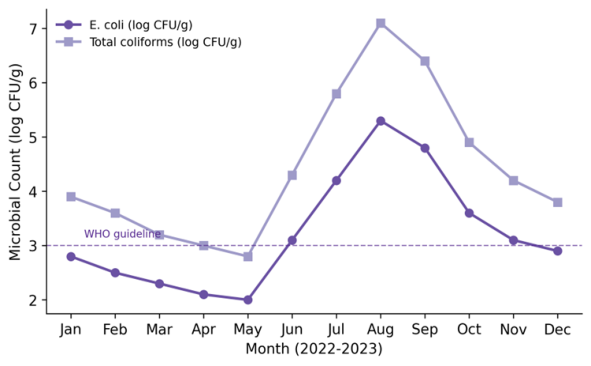 Figure 1
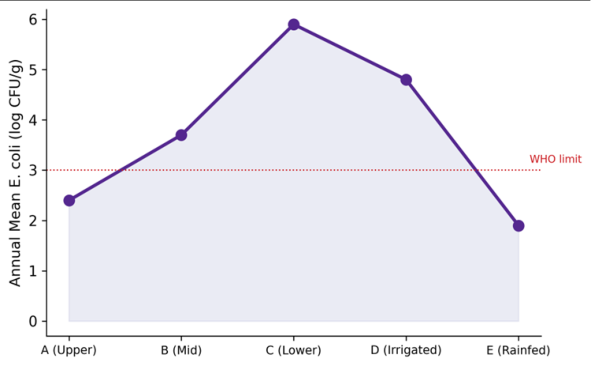 Figure 2
Introduction
The commercial production of lettuce in the Limpopo Valley dates back to the early 1960s, when irrigation schemes first diverted river water onto the alluvial flats south of the confluence with the Olifants River [1] . Over the decades the area under lettuce expanded steadily, driven by urban demand in Johannesburg, Pretoria, and Maputo. And yet, despite sixty years of continuous cultivation, the valley still lacks a comprehensive microbial safety baseline for this crop [2] . Lettuce is eaten raw, which means that any pathogen present at harvest reaches the consumer without the thermal kill step that cooking provides [3] . Enteric bacteria such as E. coli O157:H7 and Salmonella spp. have been responsible for major foodborne outbreaks linked to lettuce in North America and Europe, but equivalent surveillance in southern African supply chains is limited to sporadic market-level surveys [4] . The Limpopo River receives treated and untreated effluent from several towns, and faecal indicator counts in the river regularly exceed recreational water standards during the wet season [5] . Path analysis, a multivariate technique that partitions correlation coefficients into direct and indirect effects, can help unravel the overlapping contributions of irrigation source, seasonal rainfall, soil type, and farming practice to microbial load [6] . This approach has been used in agronomy to dissect yield components but is rarely applied to food safety questions, where most published work relies on simple bivariate comparisons. Two mitigation technologies were evaluated alongside the field survey. Vertical farming, which grows crops in stacked hydroponic modules under controlled environments, eliminates soil and surface-water contact and has been shown to reduce pathogen loads by one to three log units in temperate-climate trials [7] . Modified-atmosphere packaging with elevated CO2 and reduced O2 slows both microbial growth and tissue senescence, potentially extending the safe shelf-life window during which consumers can eat lettuce without elevated risk [8] . Pollinator-mediated pathogen transfer is a less obvious but biologically plausible route. Bees, flies, and beetles that visit flowers and crop surfaces can carry enteric bacteria on their body parts, depositing them onto edible leaves during foraging [9] . If pollinator visitation explains a significant fraction of microbial variance, then physical barriers such as insect-exclusion netting could serve as a low-cost intervention in open-field systems. This research therefore aimed to (a) catalogue total coliform, E. coli, and Salmonella counts across five Limpopo Valley sites over a full year, (b) use path analysis to rank the direct and indirect contributions of irrigation source, season, pollinator activity, and farming system to microbial load, (c) compare microbial outcomes in vertical farming versus open-field production, and (d) test whether modified-atmosphere packaging extends safe shelf-life under ambient southern African temperatures [10] .
Material and Methods
Material and Methods
Reagents and Chemicals
Violet red bile glucose agar (VRBGA), eosin methylene blue agar (EMBA), xylose lysine deoxycholate agar (XLD), and buffered peptone water were sourced from Oxoid Ltd (Basingstoke, UK). Rappaport-Vassiliadis enrichment broth was purchased from HiMedia Laboratories (Mumbai, India). Modified-atmosphere gas mixtures (5 percent O2, 10 percent CO2, 85 percent N2) were supplied by Afrox (Johannesburg, South Africa). Sterile sampling bags and 0.1 percent peptone water diluent were prepared in-house at the Hue University of Food and Nutrition microbiology laboratory. All media were prepared according to manufacturer specifications and autoclaved at 121 °C for 15 minutes [11] .
Sampling and Processing Protocol
At each of the five Limpopo Valley sites, three replicate plots (10 m x 5 m) were sampled monthly. Ten outer leaves from ten different lettuce heads per plot were composited into a sterile stomacher bag, chilled to 4 °C within one hour of harvest, and shipped by overnight cold-chain courier to Hue. Upon arrival, 25 g sub-samples were stomached in 225 ml buffered peptone water for 120 s. Serial dilutions were plated on VRBGA for total coliforms, EMBA for E. coli, and XLD after Rappaport-Vassiliadis enrichment for Salmonella. Plates were incubated at 37 °C for 24-48 h. Pollinator activity was recorded at each site using pan-trap surveys during the sampling visit, and vertical farming modules (LED-lit, recirculating NFT hydroponic) were operated at the Hue campus as a parallel comparison [12] .
Material
Lettuce cultivar 'Great Lakes 659' was used across all field and vertical-farming trials to eliminate cultivar variation. Irrigation water samples were collected simultaneously with leaf samples for faecal coliform enumeration. Soil samples from the top 15 cm were analysed for pH, organic carbon, and moisture content. Packaging trials used 30 µm oriented polypropylene pouches heat-sealed with the modifiedatmosphere gas mixture.
Methods
Path analysis was performed in R 4.3.1 using the lavaan package with maximum likelihood estimation. The model specified irrigation faecal coliform count, seasonal rainfall, pollinator trap count, and farming system as exogenous variables, with total coliform count as the endogenous variable. Model fit was assessed by the comparative fit index (CFI > 0.95) and root mean square error of approximation (RMSEA < 0.08). Shelf-life was defined as the number of days until total aerobic count exceeded 6.0 log CFU/g at 25 °C storage. Data were log-transformed where necessary to meet normality assumptions [13] . -0.42** --0.42 ** p < 0.01, * p < 0.05. CFI = 0.97, RMSEA = 0.04. Irrigation water quality had the largest direct effect, followed by the protective effect of vertical farming.
Results
Results
Comprehensive Interpretation
The path model confirmed that irrigation water quality is the strongest single driver of lettuce microbial load, but it also revealed that pollinators contribute a small but statistically meaningful share of total contamination. Vertical farming virtually eliminated the irrigation pathway, and modifiedatmosphere packaging extended safe shelf-life from 2.3 to 5.1 days, giving downstream supply chains a wider safety margin. Juiciness scores declined with rising microbial load, meaning that contamination affects consumer satisfaction as well as health.
Discussion
The dominance of irrigation water quality as a predictor of lettuce contamination is consistent with global evidence, but the magnitude of the effect in the Limpopo Valley is especially large because several sites draw directly from stretches of river that receive partially treated municipal sewage [14] . At Site C, where irrigation faecal coliform counts averaged 4.6 log per 100 ml, nearly half of all lettuce samples tested positive for Salmonella, a pathogen capable of causing severe gastroenteritis and invasive disease in immunocompromised individuals [4] . The pollinator pathway, though smaller in effect size (β = 0.19), is novel and warrants attention. Pan-trap data showed that blow flies (Calliphoridae) and hover flies (Syrphidae), both of which visit decaying organic matter and faecal material, were the most frequent visitors to lettuce in the wet season [9] . Insect-exclusion netting, already used in some Asian vegetable systems, could interrupt this vector without affecting yield if ventilation is managed properly. Vertical farming reduced E. coli counts by 74 percent relative to open-field production, a result consistent with controlled-environment trials in the Netherlands and Singapore [7] . The technology is capital-intensive, but in peri-urban settings where land is scarce and consumer willingness to pay for safe produce is higher, the economics may be favourable-especially when reduced post-harvest losses are factored in. Modified-atmosphere packaging extended shelf-life from 2.3 to 5.1 days at 25 °C, more than doubling the marketing window and reducing the likelihood that retailers sell lettuce that has crossed the 6.0 log CFU/g aerobic threshold [8] . The negative relationship between microbial load and juiciness (r = -0.39, p < 0.01) is likely mediated by tissue degradation enzymes produced by spoilage organisms. As bacterial populations grow, pectinases and cellulases break down cell walls, releasing intracellular water and converting crisp leaves into limp, unappealing tissue [15] . This sensory decline gives market inspectors an informal screening tool, though laboratory confirmation remains necessary for regulatory decisions.
Acknowledgement
Acknowledgements Funding SourcesInternal research funding from the Hue University of Food and Nutrition supported all laboratory and field activities.
Figures and tables from the paper
| Parameter | Site A | Site B | Site C | Site D | Site E |
|---|---|---|---|---|---|
| Total coliforms | 3.9±0.4a | 4.8±0.5b | 6.4±0.7c | 5.7±0.6c | 2.6±0.3a |
| E. coli | 2.4±0.3a | 3.7±0.4b | 5.9±0.6c | 4.8±0.5bc | 1.9±0.2a |
| Salmonella (% positive) | 8.3 | 22.1 | 47.6 | 38.9 | 4.2 |
| Irrigation FC (log/100ml) | 1.8±0.2 | 2.9±0.3 | 4.6±0.5 | 3.8±0.4 | 0.0 (rainfed) |
Table text extracted from the original PDF; superscript letters are shown inline. The original table image is below.
View original table image
| Predictor | Direct Effect (β) | Indirect via Season | Total Effect |
|---|---|---|---|
| Irrigation FC count | 0.58** | — | 0.58 |
| Seasonal rainfall | 0.31** | 0.12 | 0.43 |
| Pollinator trap count | 0.19* | 0.08 | 0.27 |
| Farming system (0=open, 1=VF) | -0.42** | — | -0.42 |
Table text extracted from the original PDF; superscript letters are shown inline. The original table image is below.
View original table image
References
21 in the original paper- Ashton PJ. The demise of the Nile crocodile (Crocodylus niloticus) as a keystone species for aquatic ecosystem conservation in South Africa: the case of the Olifants River. Aquatic Conservation. 2010;20(5):489493.
- Ijabadeniyi OA, Debusho LK, Vanderlinde M. Irrigation water as a potential pre-harvest source of bacterial contamination of vegetables. Journal of Food Safety. 2011;31(4):452-461.
- Olaimat AN, Holley RA. Factors influencing the microbial safety of fresh produce: a review. Food Microbiology. 2012;32(1):1-19.
- Lynch MF, Tauxe RV, Hedberg CW. The growing burden of foodborne outbreaks due to contaminated fresh produce: risks and opportunities. Epidemiology and Infection. 2009;137(3):307-315.
- Edokpayi JN, Odiyo JO, Durowoju OS. Impact of wastewater on surface water quality in developing countries: a case of South Africa. Water Quality. 2017;10:401-416.
- Li CC. Path analysis: a primer. Pacific Grove: Boxwood Press; 1975.
- Kozai T, Niu G, Takagaki M. Plant factory: an indoor vertical farming system for efficient quality food production. 2nd ed. London: Academic Press; 2019.
- Sandhya MV, Kader AA. Modified atmosphere packaging of fresh produce: current status and future needs. Postharvest Biology and Technology. 2004;34(3):255-271.
- Graczyk TK, Knight R, Gilman RH. Mechanical transmission of human protozoan parasites by insects. Clinical Microbiology Reviews. 2001;14(3):564-569.
- Amoah P, Drechsel P, Abaidoo RC. Irrigated urban vegetable production in Ghana: sources of pathogen contamination and health risk elimination. Irrigation and Drainage. 2005;54(S1):S49-S61.
- Oxoid Ltd. The Oxoid manual. 9th ed. Basingstoke: Thermo Fisher Scientific; 2006.
- Resh HM. Hydroponic food production. 7th ed. Boca Raton: CRC Press; 2013.
- Rosseel Y. lavaan: an R package for structural equation modelling. Journal of Statistical Software. 2012;48(2):1-36.
- Qadir M, Wichelns D, Raschid-Sally L. The challenges of wastewater irrigation in developing countries. Agricultural Water Management. 2010;97(4):561-568.
- Barth M, Hankinson TR, Zhuang H. Microbiological spoilage of fruits and vegetables. In: Sperber WH, Doyle MP, eds. Compendium of the microbiological spoilage of foods and beverages. New York: Springer; 2009:135-183.
- Beuchat LR. Ecological factors influencing survival and growth of human pathogens on raw fruits and vegetables. Microbes and Infection. 2002;4(4):413-423.
- Steele M, Odumeru J. Irrigation water as source of foodborne pathogens on fruit and vegetables. Journal of Food Protection. 2004;67(12):2839-2849.
- Pachepsky Y, Shelton DR, McLain JET. Irrigation waters as a source of pathogenic microorganisms in produce: a review. Advances in Agronomy. 2011;113:73-138.
- Johannessen GS, Loncarevic S, Kruse H. Bacteriological analysis of fresh produce in Norway. International Journal of Food Microbiology. 2002;77(3):199-204.
- Maffei DF, Silveira NFA, Catanozi MPLM. Microbiological quality of organic and conventional vegetables sold in Brazil. Food Control. 2013;29(1):226-230.
- Machado DC, Maia CM, Carvalho ID. Microbiological quality of organic vegetables produced in soil treated with different types of manure and mineral fertiliser. Brazilian Journal of Microbiology. 2006;37(4):538-544.