
Research article · 2026 · Full text
International Journal of Horticulture and Food ScienceFormulation of herbal gulal and its assessment on stability and quality parameters
Volume 8(4) · Pages 55–59 · DOI: 10.33545/26631067.2026.v8.i4a.528 ↗
Research areasBotanical Research and ApplicationsDye analysis and toxicityAgricultural and Biological Research
Abstract
Author-writtenThe present study entitled “formulation of herbal gulal and its assessment on stability and quality parameters” was conducted during 2024-2025 at the Department of Post Harvest Management, College of Horticulture and Research Station, Sankara-Patan, Durg (C.G.). Herbal gulal was formulated using natural extracts of bougainvillea, marigold, rose, hibiscus, amaltas, beetroot and turmeric blended with rice flour and 1% alum. Eight treatments, including a control, were evaluated under a Completely Randomized Design with three replications. The formulations were assessed for physical, biochemical, qualitative and sensory parameters under ambient conditions. Results indicated that storage duration significantly affected all quality attributes. Herbal gulal formulations performed better than the control in terms of solubility, washability, colour acceptability, texture and skin safety. Among all treatments, beetroot extract (T₆) (4.25) showed the best overall performance, followed by turmeric (T₇) (4.25) and marigold (T₂) (4.0). Amaltas extract (T₅) (3.70) recorded comparatively poor stability.
Summary
Source-checkedPlain-language reading of the full paper, prepared with AI and checked against the text. Each point links to the authors' own words.
Why it matters
- Herbal gulal made from plant sources is biodegradable, non-toxic, and skin-friendly compared to synthetic alternatives. View evidence ↗
- Commercial industrial dyes used in modern gulal often contain hazardous chemicals like lead and endotoxins, which can cause severe health problems. View evidence ↗
- Synthetic gulal powders can lead to respiratory problems and irritation of the eyes and skin. View evidence ↗
The question
- The study aimed to develop an economical, eco-friendly, and skin-safe herbal gulal using various plant materials. View evidence ↗
What they did
- The researchers used a Completely Randomized Design with eight treatments (including a control), blending extracts from seven different plants with rice flour and 1% alum. View evidence ↗
- Flower petals were boiled at 100 °C for 20 minutes, while beetroot and turmeric were boiled for 1 hour to extract pigments. View evidence ↗
- The extracts were mixed with a carrier, shade-dried for 6-7 days, and then ground and sieved through an 8 mm mesh. View evidence ↗
- Skin safety was assessed via a 24-hour patch test on the elbow creases of 100 participants. View evidence ↗
What they found
- The control (T0) had the best powder flow (angle of repose 29.00), while Amaltas (T5) had the poorest flow (34.10). View evidence ↗
- Amaltas (T5) exhibited the highest moisture content at 13.20%, whereas the control (T0) was the lowest at 8.55%. View evidence ↗
- At the end of the storage period, beetroot-based gulal (T6) had the highest solubility (3.68), outperforming the control (T0) at 3.20. View evidence ↗
- Turmeric (T7) and marigold (T2) showed the best resistance to color loss, with stability scores of 3.85 and 3.80, respectively. View evidence ↗
- Beetroot-based gulal (T6) demonstrated the highest washability (3.38) after 60 days. View evidence ↗
- Rose (T3) had the highest fragrance score (4.40), followed by turmeric (T7) at 4.35 and hibiscus (T4) at 4.20. View evidence ↗
- Beetroot (T6) showed the best skin compatibility with a sensitivity score of 4.61, followed by turmeric (T7) at 4.49. View evidence ↗
- Beetroot (T6), turmeric (T7), and marigold (T2) were the most acceptable formulations, scoring 4.25, 4.20, and 4.15, respectively. View evidence ↗
What it means
- The authors concluded that beetroot extract (T6) was the best performing formulation across most quality and stability parameters. View evidence ↗
- The study recommends herbal gulal as safe, eco-friendly alternatives to synthetic versions, remaining acceptable for up to 60 days. View evidence ↗
Visual summary
3 visualsIllustrations explain the paper; charts are replotted from the paper's own table values.
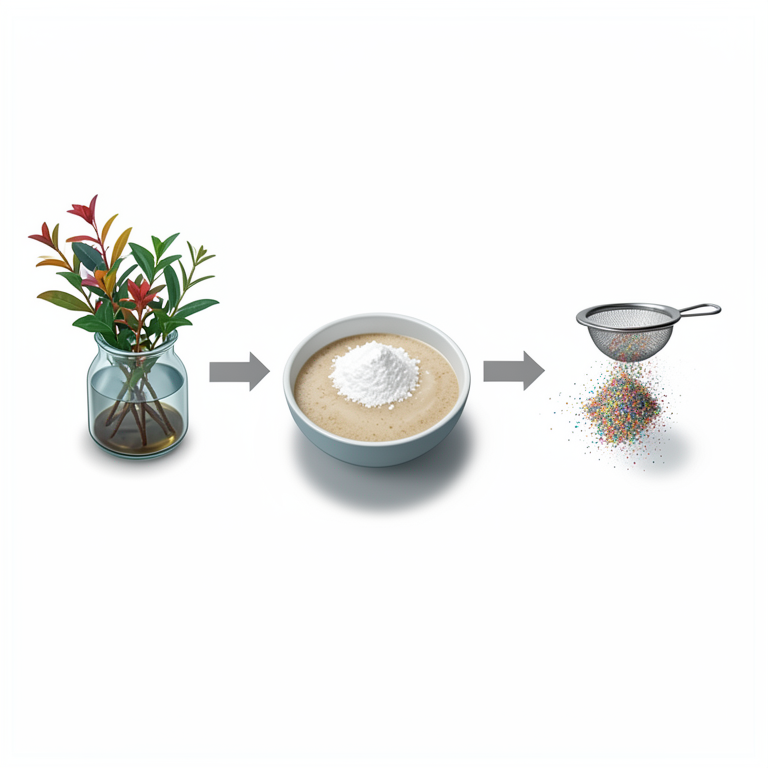
Herbal Gulal Production Process
AI-generated conceptual illustration (Flower petals, beetroot, turmeric, and rice flour). It explains the idea and does not show study data.
View source evidence ↗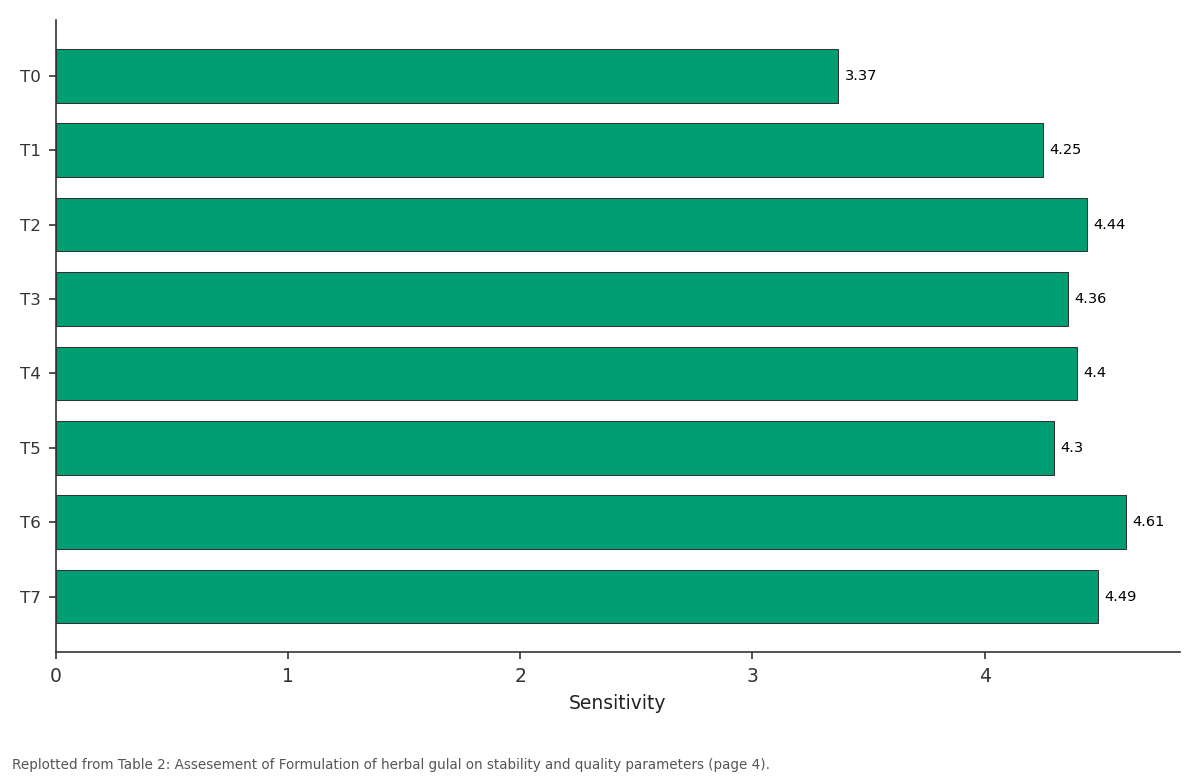
Sensitivity: T0 vs T1 vs T2 vs T3 vs T4
Replotted from Table 2 (page 4) of the original paper. Every bar is the paper's own table value.
View source evidence ↗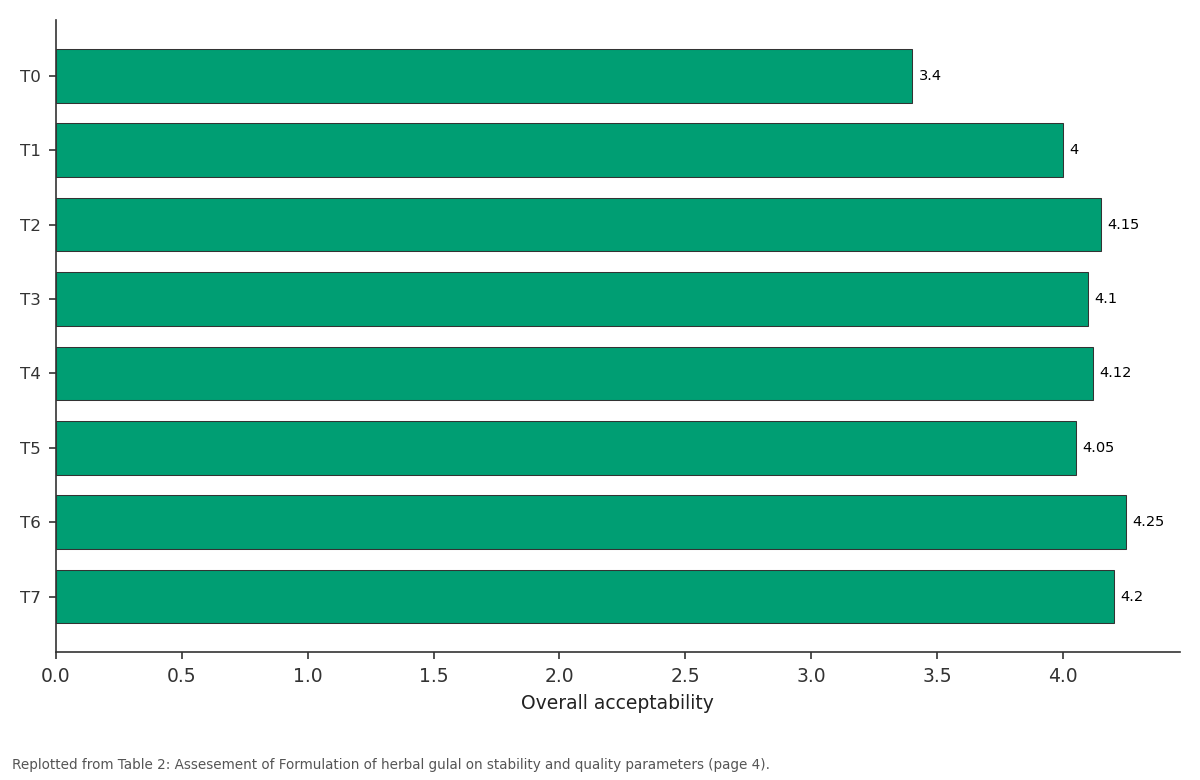
Overall acceptability: T0 vs T1 vs T2 vs T3 vs T4
Replotted from Table 2 (page 4) of the original paper. Every bar is the paper's own table value.
View source evidence ↗Figures & tables
From the original paper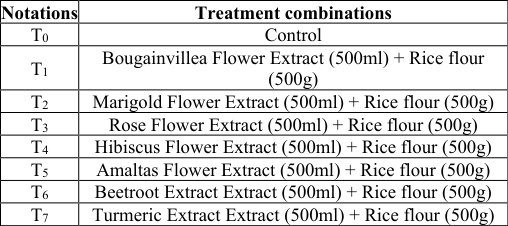 Table 1
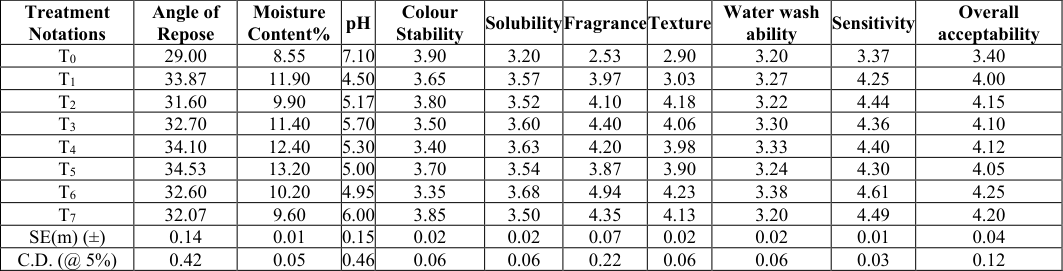 Table 2
Introduction
Gulal, also known as Abeer, is the traditional name given to the coloured powders used for the typical Hindu rituals, in particular for the Holi festival. Holi' is the unique festival of colours celebrated in India. Holi, or the festival of colours, is celebrated by smearing colours on each other. Holi is a Hindu festival that takes place on the full moon day in the month of Phalgun. It is also recognized as the Spring Festival because it coincides with the arrival of spring. In Ancient played Holi using Tessu flowers which are found in abundance during the season. colours for 'Holi' were prepared from the flowers and leaves of trees that bloomed in spring and traditionally the colours of Holi were derived from plants: green was made from ground neem leaves (Azadirachta indica), yellow, red from turmeric (Curcuma longa). Turmeric a popular spice is bright yellow at or Henna leaves as another shade of green, marigolds or chrysanthemums as yellow, flame of the forest (Butea monosperma), pomegranateas blue and charcoal as black were among the other plant-based colours used as pastes powders or in water. Floral and herbal gulal are prepared from natural plant sources such as marigold, rose, hibiscus, turmeric, neem and beetroot, which are rich in natural pigments and free from toxic chemicals. These colours are biodegradable, non-toxic, skin-friendly and environmentally safe. Their use minimizes soil and water pollution, supports biodiversity and ensures human safety. Thus replacing synthetic dyes with herbal and floral gulal contributes to environmental conservation, promotes sustainable practices, and ensures a healthy balance between human activities and nature (Gardner and Lal, 2012; Sheetal et al., 2012) [2,4] . Modern times, these natural colours have been replaced by commercial industrial dyes prepared by chemical processes. Even products that claim to use organic colours, use synthetic pigments to enhance the brightness of hues. Such synthetic holi colours are sold as herbal colours in an unregulated manner in local markets and no checks can be enforced on the product composition. Also the quality and the amount of information about the ingredients of the particular packets are missing.
These colours sold in the local market often contain hazardous chemicals such as endotoxins and heavy metals like lead, potentially causing moderate to severe health problem (Goswami et al., 2022) [5] . These gulal powder may lead to adverse health effects such as skin and eye irritation, as well as respiratory problems. Thus, realizing the adverse effect of synthetic gulal and importance of herbal gulal different flowers and herbs were selected to formulate of herbal gulal from Bougainvillea glabra, Tagetes erecta, Rosa indica, Hibiscus spp., Cassia fistula, Beta vulgaris and Curcuma longa. The aim of this work is to utilize these plant materials as an economical, natural source of colour that is herbal, eco-friendly and safe for skin without harmful effects.
Materials and Methods
The present study, "Formulation of Herbal Gulal and its Assessment on Stability and Quality Parameters", was conducted during the 2024-25. Department of Post-Harvest Management, College of Horticulture and Research Station, Sankara Patan, Durg (C.G.) during the academic year 2024-25. The experiment followed a Completely Randomized Design (CRD) with eight treatments replicated thrice. Fresh flower petals were cleaned, cut into small pieces, and mixed with water (1000 ml/kg), then boiled at 100 °C for 20 minutes. Beetroot and turmeric were boiled for 1 hour for better pigment extraction. The extract was cooled, squeezed, filtered and about 500 ml was obtained. Alum (1%) was added to enhance colour. The extract was mixed with a carrier, shade-dried for 6-7 days with regular turning, then ground and sieved (8 mm) to obtain uniform powder. Finally, the herbal gulal was packed in transparent polythene bags.
Evaluation of Herbal Gulal Angle of Repose:
To assess the sample's flow behaviour, the angle of repose was calculated using the funnel. The following formula was applied to arrive at the result: tan α = H/R where, α = angle of repose, H = height of the pile of powder, R = radius of the pile of powder Moisture content: After proper drying and grinding, the moisture content of all the treatments were taken. The method is based on removing moisture by oven drying of the sample until the weight remains constant. The moisture content (%) is calculated from the sample weight before and after drying. The formula used for calculating moisture content percentage is as follows.
Where (IW) is the initial weight of the sample and (DW) is the dry weight of the sample.
pH:
The pH of freshly extracted colour extract and after giving different treatments to it were recorded with the help of pH meter.
Solubility:
To assess the solubility profile of the prepared formulation, a pre-determined amount of sample was placed in test tube, various solvents were added and test tube was shaken well and observed.
Colour Stability: The formulated herbal gulal samples were stored in airtight transparent containers under ambient conditions and observed daily for 7 days to assess colour stability. Changes in colour intensity, shade, or fading were compared with freshly prepared samples to evaluate pigment retention and overall stability.
Water washability: Water washability of the herbal gulal was tested by applying a small amount to the back of the hand, allowing it to adhere for a few minutes, and then rinsing with plain running water without soap. Residual staining was observed visually, and washability was categorized as easily, moderately, or poorly washable.
Fragrance: Fragrance of the herbal gulal was evaluated through sensory analysis by 10 selected volunteers under controlled conditions. Participants assessed the sample for nature, intensity, and pleasantness of aroma, classifying it as mild, strong, pleasant, pungent, or unpleasant. The test determined product acceptability and consumer appeal.
Texture: It was evaluated by feel method. After grinding the different treatment combinations of herbal gulal was felt and score out of 5 was allotted. It was divided into 5 categories i.e., very smooth (5 points), 3.9.4.3 smooth (4), medium (3), rough (2) and very rough (1).
Sensitivity:
The skin sensitivity of the herbal gulal was evaluated using a patch test. A small quantity of the gulal was applied to the elbow crease of 100 participants and left for 24 hours. The test area was observed for any allergic reactions, including redness, itching, or irritation, to assess the product's dermal safety.
Overall acceptability: Overall acceptability the overall acceptability of herbal gulal was evaluated after the storage duration of 30 days under packaging materials. It was evaluated of using of Nine-point hedonic scale.
Statistical analysis
The data recorded on various parameters in the laboratory were subjected to statistical analysis using the analysis of variance (ANOVA) technique, as outlined by Gomez and Gomez (1985). Initially, the control showed the highest stability, while turmeric and marigold performed best among herbal treatments. A slight decline was observed up to 15 days, followed by a greater reduction at later stages due to oxidation and ageing. At the end of storage, turmeric and marigold retained higher colour stability, whereas beetroot showed the lowest. Overall, storage duration significantly affected colour stability, with turmeric (T 7 ) (3.85) and marigold (T 2 ) (3.80) showing better resistance to colour loss.
Preparation method Result and Discussion
Washability: Washability of gulal decreased gradually in all treatments during storage, indicating reduced removability over time. Initially, herbal treatments showed higher washability than the control, with beetroot (T 6 ) (3.38), hibiscus (T 4 ) (3.33) and rose (T 3 ) (3.30) performing best. The decline may be due to increased particle cohesion and pigment binding during storage. However, herbal gulal maintained higher washability than the control (T 0 ) (3.20) throughout. At 60 days, beetroot-based gulal showed the highest washability, confirming its suitability for safe and easy removal.
Fragrance: Fragrance of herbal gulal decreased gradually during storage in all treatments. Initially, herbal treatments showed higher fragrance than the control due to natural aromatic compounds. Rose (T₃) (4.40) recorded the highest fragrance, followed by Turmeric (T₇) (4.35) and Hibiscus (T₄) (4.20). The decline in fragrance may be due to volatilization and oxidation of aromatic compounds. However, herbal treatments retained noticeable aroma even after 60 days, while the control lost fragrance rapidly, indicating better sensory stability of herbal gulal.
Texture: Texture scores of gulal decreased gradually in all treatments during storage, indicating slight loss of smoothness over time. Initially, herbal treatments showed higher texture scores than the control, with Beetroot (T₆) (4.23), Turmeric (T₇) (4.13) and Hibiscus (T₄) (3.98) performing best. The decline may be due to moisture absorption and particle aggregation. However, herbal formulations maintained better texture than the control (T 0 ) (
Acknowledgement
Acknowledgement:The authors gratefully acknowledge the guidance, encouragement, and constructive suggestions provided by the Advisory Committee during the course of this research work. We also extend sincere thanks to the Department of Post-Harvest Management for providing the necessary facilities and support. Lastly, we are thankful to all individuals who directly or indirectly contributed to the successful completion of this study
Figures and tables from the paper
| Treatment Notations | Angle of Repose | Moisture Content% | pH | Colour Stability | Solubility | Fragrance | Texture | Water wash ability | Sensitivity | Overall acceptability |
|---|---|---|---|---|---|---|---|---|---|---|
| T0 | 29.00 | 8.55 | 7.10 | 3.90 | 3.20 | 2.53 | 2.90 | 3.20 | 3.37 | 3.40 |
| T1 | 33.87 | 11.90 | 4.50 | 3.65 | 3.57 | 3.97 | 3.03 | 3.27 | 4.25 | 4.00 |
| T2 | 31.60 | 9.90 | 5.17 | 3.80 | 3.52 | 4.10 | 4.18 | 3.22 | 4.44 | 4.15 |
| T3 | 32.70 | 11.40 | 5.70 | 3.50 | 3.60 | 4.40 | 4.06 | 3.30 | 4.36 | 4.10 |
| T4 | 34.10 | 12.40 | 5.30 | 3.40 | 3.63 | 4.20 | 3.98 | 3.33 | 4.40 | 4.12 |
| T5 | 34.53 | 13.20 | 5.00 | 3.70 | 3.54 | 3.87 | 3.90 | 3.24 | 4.30 | 4.05 |
| T6 | 32.60 | 10.20 | 4.95 | 3.35 | 3.68 | 4.94 | 4.23 | 3.38 | 4.61 | 4.25 |
| T7 | 32.07 | 9.60 | 6.00 | 3.85 | 3.50 | 4.35 | 4.13 | 3.20 | 4.49 | 4.20 |
| SE(m) (±) | 0.14 | 0.01 | 0.15 | 0.02 | 0.02 | 0.07 | 0.02 | 0.02 | 0.01 | 0.04 |
| C.D. (@ 5%) | 0.42 | 0.05 | 0.46 | 0.06 | 0.06 | 0.22 | 0.06 | 0.06 | 0.03 | 0.12 |
Table text extracted from the original PDF; superscript letters are shown inline. The original table image is below.
View original table image
References
10 in the original paper- Bossmann K, Bach S, Höflich C, Valtanen K, Heinze R, Neumann A, et al. Holi colours contain PM10 and can induce pro-inflammatory responses. Journal of Occupational Medicine and Toxicology. 2016;11:1-11.
- Gardner JJ, Deepanjali L. Impact of 'Holi' on the environment, a scientific study. Archives of Applied Science Research. 2012;4:1403-1410.
- Sahu S, Tiwari S, Sahu T. A review on preparation of natural dye and herbal gulal from Beta vulgaris and study of its dyeing properties. International Journal of Current Microbiology and Applied Sciences. 2020;12(11):3830-3839.
- Sheetal V. Analysis of water after Holi festival. Research Journal of Recent Sciences. 2012;1:2502.
- Goswami K, Mazumdar I. A study of the levels of some toxic substances present in dry Holi colours in Kolkata, India. Indian Journal of Clinical Biochemistry. 2022;37(2):206-211.
- Ceclu L, Nistor OV. Red beetroot: composition and health effects-a review. Journal of Nutritional Medicine and Diet Care. 2020;6(1):1-9.
- Chengaiah B, Rao KM, Kumar KM, Alagusundaram M, Chetty CM. Medicinal importance of natural dyes-a review. International Journal of PharmTech Research. 2010;2(1):144-154.
- Deepika, Kabir J, Dhua RS. Quality and utilization of pigment extract from marigold petals. International Journal of Advances in Engineering and Management. 2024;6(5):705-712.
- Elshemy N, Megaly M, Haggag K, Hashem A. Development and optimization of a non-traditional extraction process of yellow colorant from safflower petals as a natural colorant. Egyptian Journal of Chemistry. 2019;62:231-245.
- Hewlings SJ, Kalman DS. Curcumin: a review of its effects on human health. Foods. 2017;6(10):92.