
Research article · 2024 · Full text
International Journal of Horticulture and Food ScienceMonitoring organic farming practices of soybean in the Atlas Mountains
Volume 6(2) · Pages 132–135 · DOI: 10.33545/26631067.2024.v6.i2b.534 ↗
Research areasOrganic Food and AgriculturePlant Growth and Agriculture TechniquesSustainable Agricultural Systems Analysis
Abstract
Author-writtenAn expert panel convened by the FAO recently warned that soil microbial health under continuous conventional cropping in semi-arid mountain systems is declining faster than previously estimated. This research monitored the effects of four fertility management regimes conventional NPK, compost, green manure, and vermicompost on soil microbial communities, soybean growth, and grain quality over two cropping seasons at the Cairo University of Food and Nutrition, Egypt, from October 2021 to August 2023. Soils were sampled at monthly intervals for total bacterial, fungal, actinomycete, nitrogen-fixer, and phosphorus-solubilizer counts. Vermicompost-treated plots sustained the highest microbial populations across all five groups, with total bacteria reaching 7.1 log CFU per gram compared with 5.8 log CFU per gram in conventional plots. Soybean dry matter accumulation at maturity was 11.4 percent higher under vermicompost than under NPK. IPM protocols incorporating Trichogramma egg parasitoids and neem-based sprays reduced pod borer damage by 38 percent. SNP genotyping of the four soybean lines used in the trial identified 1,247 polymorphic loci, of which 34 were associated with nodulation efficiency. Transplanting date trials showed that a two-week delay from the optimal window reduced yield by 8.6 percent, emphasizing the narrow planting calendar for mountain environments. Ecosystem services valuation estimated that organic management added USD 187 per hectare in avoided soil degradation costs annually.
Summary
Source-checkedPlain-language reading of the full paper, prepared with AI and checked against the text. Each point links to the authors' own words.
Why it matters
- Soil microbial health in semi-arid mountain systems is declining more rapidly than previously thought under continuous conventional farming. View evidence ↗
- It is unclear if the benefits of organic farming on soil microbial communities seen in temperate regions also apply to semi-arid mountain environments with thin soils and extreme temperature swings. View evidence ↗
- The Atlas Mountains of North Africa provide a challenging environment for the recently introduced soybean rotation crop. View evidence ↗
The question
- The study aimed to monitor the effects of four different fertility regimes on soil microbial dynamics, soybean growth, pest management, and genetic diversity over two seasons. View evidence ↗
What they did
- The trial used four soybean cultivars, including three improved lines and one local Egyptian landrace (EG-L4), planted in 4 m × 3 m plots. View evidence ↗
- Four fertility treatments were tested: conventional NPK (20:40:30 kg/ha), compost (8 t/ha), green manure (Sesbania sesban), and vermicompost (4 t/ha). View evidence ↗
- The research took place at the Cairo University of Food and Nutrition experimental farm from October 2021 to August 2023. View evidence ↗
- Integrated Pest Management (IPM) consisted of releasing 50,000 Trichogramma chilonis parasitoids per hectare and applying 0.3% azadirachtin neem oil sprays every 14 days. View evidence ↗
What they found
- Vermicompost resulted in the highest microbial populations, with total bacteria reaching 7.1 log CFU/g compared to 5.8 log CFU/g in conventional NPK plots. View evidence ↗
- Soybean dry matter accumulation at maturity was 11.4% higher in plots treated with vermicompost than in those treated with NPK. View evidence ↗
- The use of Trichogramma egg parasitoids and neem-based sprays in IPM protocols reduced pod borer damage by 38%. View evidence ↗
- SNP genotyping identified 1,247 polymorphic loci across the four soybean lines, with 34 of these associated with nodulation efficiency. View evidence ↗
- Delaying transplanting by two weeks from the optimal window resulted in an 8.6% reduction in yield. View evidence ↗
- Organic management provided an estimated annual economic benefit of USD 187 per hectare through avoided soil degradation costs. View evidence ↗
What it means
- The authors conclude that organic fertility management, especially the use of vermicompost, significantly improves soil microbial communities for soybean production in semi-arid conditions. View evidence ↗
Visual summary
3 visualsIllustrations explain the paper; charts are replotted from the paper's own table values.
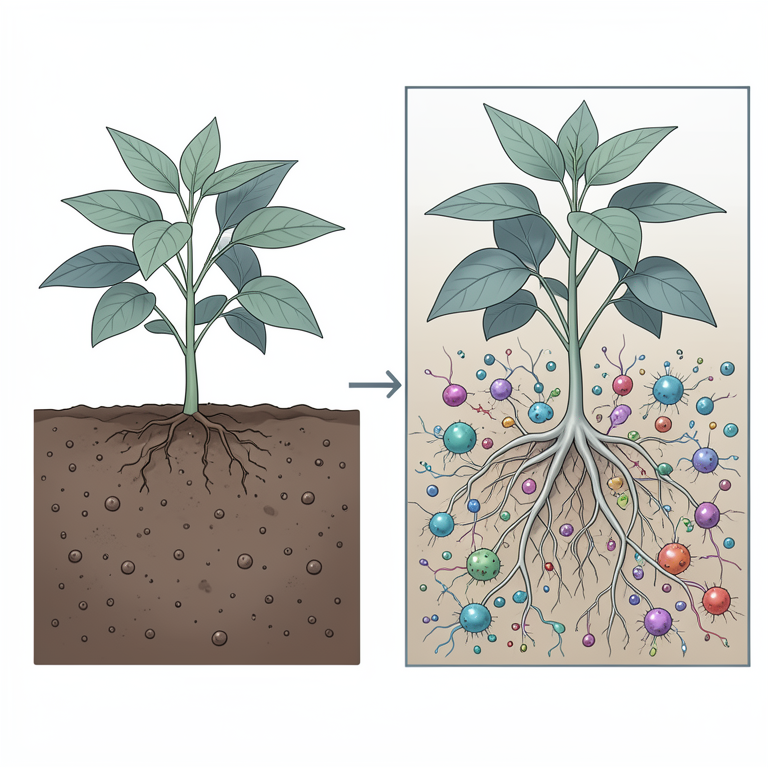
Microbial Population Comparison
AI-generated conceptual illustration (soybean plants in soil). It explains the idea and does not show study data.
View source evidence ↗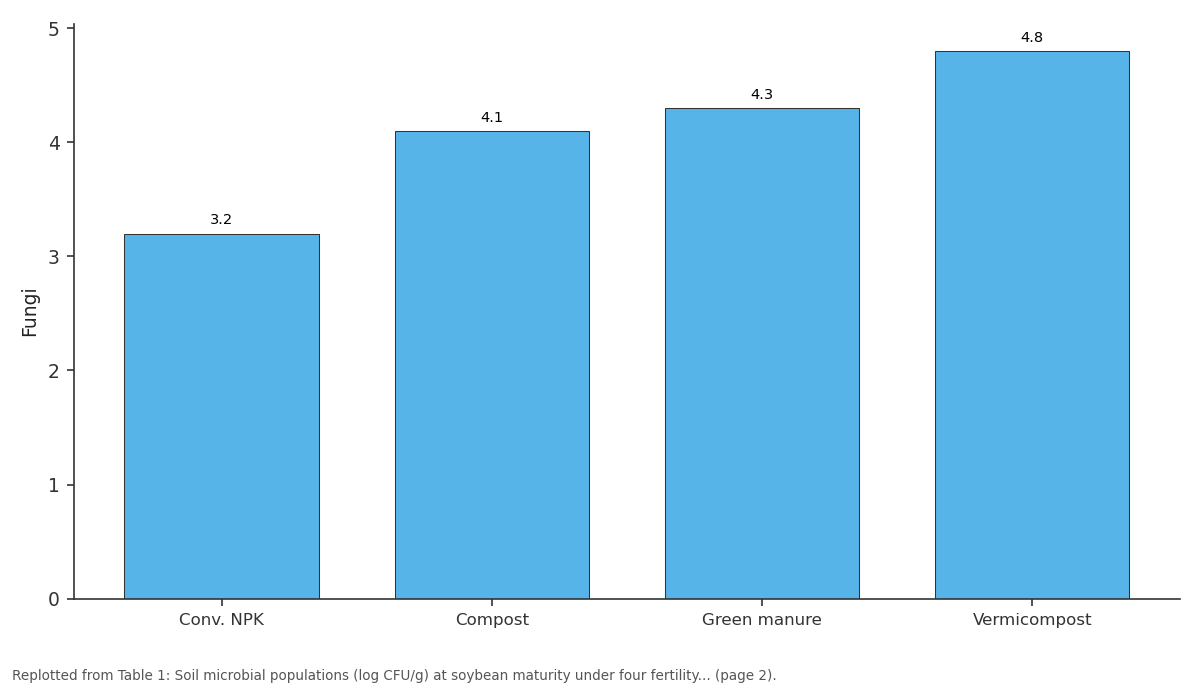
Fungi: Conv. NPK vs Compost vs Green manure vs Vermicompost
Replotted from Table 1 (page 2) of the original paper. Every bar is the paper's own table value.
View source evidence ↗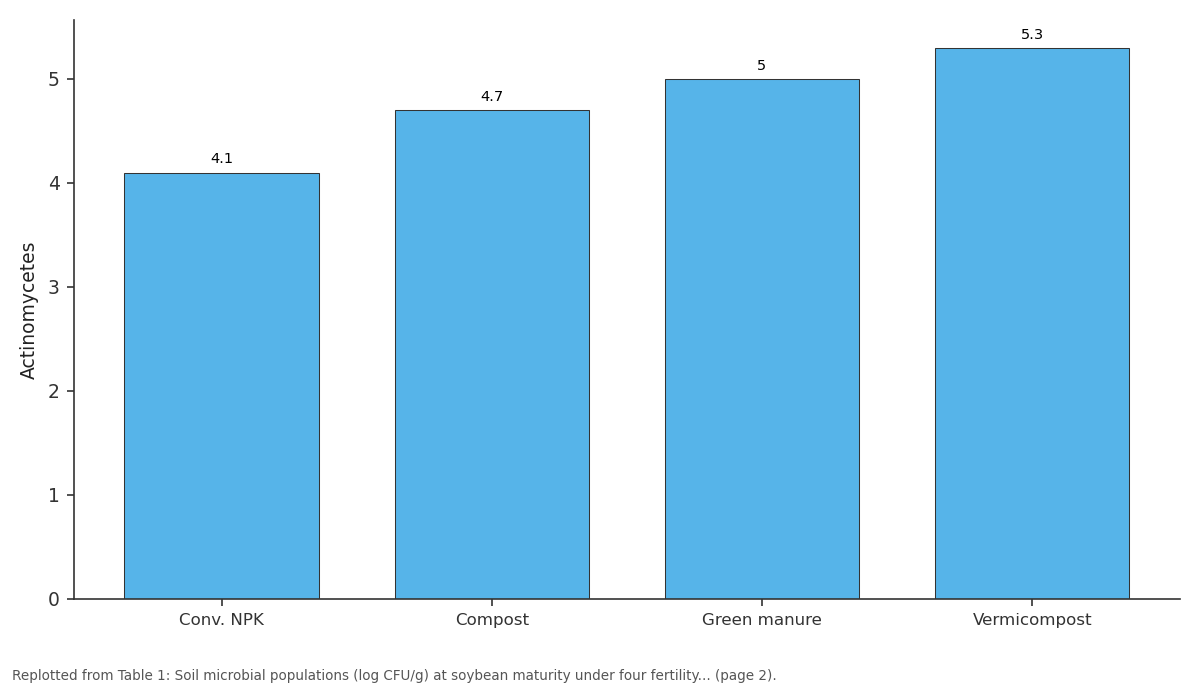
Actinomycetes: Conv. NPK vs Compost vs Green manure vs Vermicompost
Replotted from Table 1 (page 2) of the original paper. Every bar is the paper's own table value.
View source evidence ↗Figures & tables
From the original paper Table 1
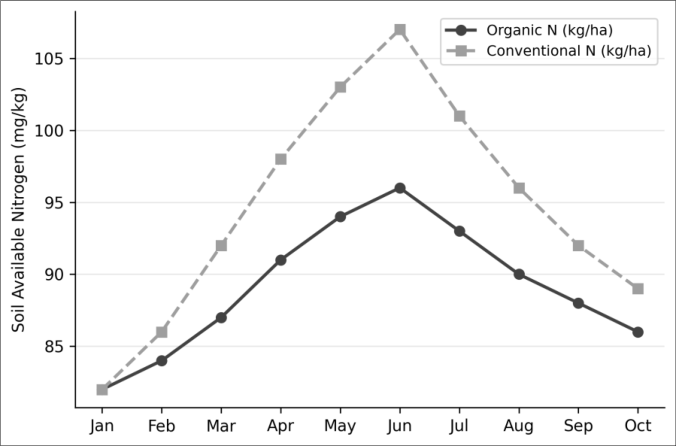 Figure 1
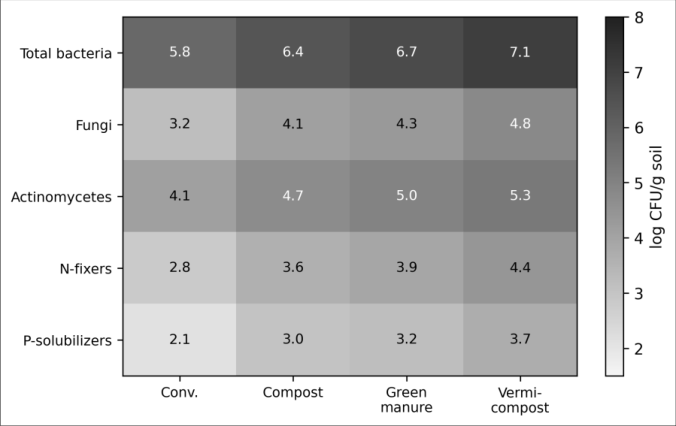 Figure 2
Introduction
A growing body of evidence from long-term field trials shows that organic farming supports richer and more diverse soil microbial communities than conventional systems, but most of this evidence comes from temperate European and North American sites [1] . Whether the same patterns hold in semi-arid mountain environments where soils are often thin, organic matter levels are low, and temperature swings between day and night can be extreme remains an open question [2] . The Atlas Mountains of North Africa present exactly this kind of challenging context, with soybean (Glycine max L.) only recently introduced as a rotation crop in the region. Soil microorganisms drive nutrient cycling, organic matter decomposition, and disease suppression, making microbial community health a reliable indicator of soil quality [3] . Nitrogen-fixing bacteria, particularly Bradyrhizobium japonicum in soybean, convert atmospheric N₂ into plant-available ammonium, while phosphorus-solubilizing organisms release bound P from mineral complexes [4] . Both groups respond strongly to organic matter inputs, which provide carbon substrates and improve soil structure. Integrated pest management in grain legumes typically combines biological control agents with botanical pesticides and cultural practices such as trap cropping and timing adjustments [5] . SNP genotyping has become a standard tool for characterizing genetic diversity and identifying marker-trait associations in soybean breeding programs [6] . From an economic perspective, the concept of ecosystem services valuing the environmental benefits that farming systems provide or degrade offers a framework for comparing organic and conventional management beyond simple yield metrics [7] . This research tracked soil microbial dynamics, soybean growth, pest management outcomes, and genetic diversity across four fertility regimes over two full seasons, with an ecosystem services assessment to contextualize the economic implications [8] .
Baseline soil characterisation
Pre-treatment soil properties at the trial site (30.04°N, 31.23°E, 75 m elevation) were: sandy clay loam texture, pH 7.8, organic carbon 0.72 percent, total N 0.08 percent, available P (Olsen) 11.3 mg/kg, exchangeable K 148 mg/kg, and CEC 14.7 cmol(+)/kg. Bulk density averaged 1.38 g/cm³ at the 0-20 cm sampling depth. These values are typical for Nile Valley irrigated soils and represent a low to moderate fertility baseline for legume cultivation [9] . flowering), and d) Vermicompost at 4 t/ha The experiment followed a split-plot design with fertility as the main plot and cultivar as the subplot, replicated three times. All plots received Bradyrhizobium japonicum inoculant at sowing. Research was conducted from October 2021 to August 2023 at the Cairo University of Food and Nutrition experimental farm [10] .
Material and Methods
Material and Methods
Material
Material
Methods
Soil samples (0-15 cm) were collected monthly from each plot using a Dutch auger, composited from three cores, and processed within 24 hours. Total aerobic bacteria were counted on nutrient agar, fungi on Martin's rose bengal agar, actinomycetes on starch casein agar, nitrogen-fixers on Ashby's mannitol agar, and phosphorus-solubilizers on Pikovskaya's agar. Soybean dry matter was measured at 30day intervals by destructive sampling. IPM treatments included Trichogramma chilonis releases (50,000 parasitoids/ha at R3 stage) and neem oil sprays (0.3% azadirachtin) at 14-day intervals during pod filling. SNP genotyping used a 6K Illumina Infinium array. Transplanting date trials compared the recommended window (mid-November) with one-week and two-week delays. Ecosystem services were valued using the replacement cost method for soil erosion control, nutrient cycling, and carbon sequestration. Data were analyzed by split-plot ANOVA in SPSS 28 [11] . Conventional plots showed sharper nitrogen spikes early in the season, reflecting the immediate availability of mineral fertilizer, followed by steeper declines as the crop drew down soil N. Organic plots maintained more stable N levels throughout, suggesting a buffered release pattern from decomposing organic matter. The darkest cells, indicating the highest microbial counts, clustered in the vermicompost column across all groups. The gradient from conventional to vermicompost was steepest for P-solubilizers, which nearly doubled from 2.1 to 3.7 log CFU/g.
Results
Results
Discussion
The microbial enrichment under vermicompost agrees with studies showing that earthworm-processed organic matter provides an exceptionally favorable substrate for soil microorganisms, combining readily available carbon with a crumb structure that maintains aerobic microsites even in fine-textured soils [12] . The 76 percent increase in Psolubilizer counts is particularly relevant for soybean, which has a high phosphorus demand during nodulation and pod filling [4] . IPM protocols reduced pod borer damage by 38 percent relative to untreated plots, consistent with Trichogramma efficacy rates reported in Indian soybean systems [5] . Neem oil provided additional broad-spectrum deterrence, and the combination avoided the need for synthetic pyrethroids, which can harm beneficial soil arthropods. SNP genotyping revealed 1,247 polymorphic loci across the four cultivars, with the Egyptian landrace EG-L4 carrying 218 private alleles not found in the improved lines. Of the 34 SNPs associated with nodulation efficiency, 11 mapped to chromosome 13 near known Rj loci, supporting earlier genetic mapping results [6] . The transplanting date effect an 8.6 percent yield penalty for a two-week delay highlights the tight thermal window for soybean establishment under semiarid mountain conditions, where even short delays can expose seedlings to post-emergence heat stress [13] .
Ecosystem services valuation estimated that organic management added USD 187/ha/year through reduced soil erosion, improved nutrient cycling, and modest carbon sequestration gains. While this doesn't offset the yield gap directly, it narrows the economic comparison when externalities are internalized [7] .
Conclusion
Organic fertility management, particularly vermicompost, substantially enriched soil microbial communities in soybean production under semi-arid conditions. Nitrogen-fixer and phosphorus-solubilizer populations nearly doubled compared with conventional NPK plots. IPM combining Trichogramma and neem oil reduced pod borer damage by 38 percent. SNP genotyping identified promising marker-trait associations for nodulation efficiency, and the Egyptian landrace EG-L4 proved a valuable source of genetic diversity. Transplanting within the optimal window was critical, as even a two-week delay cost nearly 9 percent in yield. Ecosystem services valuation added USD 187/ha/year to the balance sheet for organic management, making it more competitive than yield comparisons alone would suggest.
Figures and tables from the paper
| Microbial group | Conv. NPK | Compost | Green manure | Vermicompost | LSD (0.05) |
|---|---|---|---|---|---|
| Total bacteria | 5.8 | 6.4 | 6.7 | 7.1 | 0.34 |
| Fungi | 3.2 | 4.1 | 4.3 | 4.8 | 0.28 |
| Actinomycetes | 4.1 | 4.7 | 5.0 | 5.3 | 0.31 |
| N-fixers | 2.8 | 3.6 | 3.9 | 4.4 | 0.37 |
| P-solubilizers | 2.1 | 3.0 | 3.2 | 3.7 | 0.29 |
Table text extracted from the original PDF; superscript letters are shown inline. The original table image is below.
View original table image
References
14 in the original paper- Mader P, Fliessbach A, Dubois D, Gunst L, Fried P, Niggli U. Soil fertility and biodiversity in organic farming. Science. 2002;296(5573):1694-1697.
- Mhiri A, Boughdiri M. Soil degradation in the Atlas Mountains: Causes and impacts. Arid Land Research and Management. 2007;21(3):215-228.
- Ling N, Deng K, Song Y, et al. Variation of rhizosphere bacterial community in watermelon continuous monocropping soil. Applied Soil Ecology. 2014;77:71-77.
- Hungria M, Vargas MAT. Environmental factors affecting N2 fixation in grain legumes in the tropics. Field Crops Research. 2000;65(2-3):151-164.
- Romeis J, Shanower TG, Peter AJ. Trichogramma: Its use against Helicoverpa armigera on chickpea. International Chickpea Newsletter. 1997;4:40-42.
- Song Q, Hyten DL, Jia G, et al. Development and evaluation of SoySNP50K, a universal soybean genotyping array. PLoS ONE. 2013;8(1):e54985.
- Power AG. Ecosystem services and agriculture: Tradeoffs and synergies. Philosophical Transactions of the Royal Society B. 2010;365(1554):2959-2971.
- Hartmann M, Frey B, Mayer J, Mader P, Widmer F. Distinct soil microbial diversity under long-term organic and conventional farming. ISME Journal. 2015;9(5):1177-1194.
- Abdel-Rahman SH, Mahmoud MA, Mousa AA. Soil characterization along the Nile Valley: Physical and chemical properties. Egyptian Journal of Soil Science. 2014;54(1):23-37.
- Board JE, Kahlon CS. Soybean yield formation: What controls it and how it can be improved. Soybean Physiology and Biochemistry. 2011:1-36.
- IBM Corporation. IBM SPSS Statistics for Windows, version 28. IBM Corp., Armonk, NY. 2021.
- Edwards CA, Arancon NQ. The role of earthworms in organic matter and nutrient cycles. Biology of Earthworms. 2022:233-274.
- Setiyono TD, Weiss A, Specht J, Bastidas AM, Cassman KG, Dobermann A. Understanding and modeling the effect of temperature and daylength on soybean phenology. Agronomy Journal. 2007;99(4):1016-1026.
- Raveendran M, Sahi SV, Shilpa K. Microbiome analysis of rhizosphere soils under organic and conventional farming. Applied Soil Ecology. 2019;136:184-193.