
Research article · 2025 · Full text
International Journal of Horticulture and Food ScienceExamining pruning response of pomegranate in the Scandinavian coastal farms
Volume 7(6) · Pages 157–160 · DOI: 10.33545/26631067.2025.v7.i6c.657 ↗
Research areasPlant Physiology and Cultivation StudiesPomegranate: compositions and health benefitsBerry genetics and cultivation research
Abstract
Author-writtenPruning, defined as the deliberate removal of plant parts to redirect growth and reproductive effort, is one of the oldest orchard management tools, yet its effects on pomegranate (Punica granatum L.) grown outside Mediterranean latitudes remain poorly documented. This research compared five pruning intensities—no pruning, light thinning (removal of 15% of one-year-old shoots), moderate thinning (30%), heavy thinning (50%), and heading-back cuts (shortening all shoots by one-third)—on six-year-old ‘Wonderful’ pomegranate trees over two consecutive seasons (2021-2022) at the Marrakech Graduate School of Bioagricultural Studies, simulating Scandinavian coastal-farm conditions through supplemental lighting and cooling chambers. A randomised complete block design with four replications was used. Moderate thinning produced the highest fruit yield (31.6 kg tree-1), 71.7% above unpruned trees, and the best fruit weight (284 g). Stomatal conductance measured at midday was 18.3% higher in moderately pruned trees than in unpruned controls, indicating improved gas exchange within an open canopy. Flavonoid concentration in juice reached 487 mg GAE L-1 under moderate pruning, significantly above all other treatments. The nutrient budget analysis showed that moderate pruning removed 23.4 g N, 3.8 g P, and 18.7 g K per tree in pruned wood, representing 11.2%, 8.4%, and 9.6% of the annual fertiliser input respectively. Heavy thinning and heading-back cuts reduced yield relative to moderate thinning by 10.4% and 30.2%, apparently because excessive shoot removal eliminated too many fruiting spurs. These results suggest that 30% thinning of one-year-old wood balances canopy light penetration, fruit load, and nutrient recycling for pomegranate in cool maritime environments.
Summary
Source-checkedPlain-language reading of the full paper, prepared with AI and checked against the text. Each point links to the authors' own words.
Why it matters
- Pruning is critical for pomegranate trees because they fruit on short spurs from young wood, meaning the balance between growth and fruit production depends on pruning decisions. View evidence ↗
- There is growing commercial interest in growing pomegranates at higher latitudes, including pilot orchards in Scandinavia. View evidence ↗
- In cool maritime environments with low light intensity, pruning to create an open canopy may help maximize light capture for the remaining leaves. View evidence ↗
The question
- The study aimed to evaluate how five different pruning intensities affect the yield, fruit quality, physiology, and nutrient removal of 'Wonderful' pomegranate trees under simulated Scandinavian coastal conditions. View evidence ↗
What they did
- The experiment used six-year-old 'Wonderful' pomegranate trees planted with a spacing of 4 m by 3 m. View evidence ↗
- Scandinavian conditions were simulated using white reflective mulch, LED panels to extend daylength to 18 hours (June-August), and cooling chambers to limit midday canopy temperature to 24 °C. View evidence ↗
- The study used a randomized complete block design with four replications, testing no pruning, light thinning (15%), moderate thinning (30%), heavy thinning (50%), and heading-back cuts (one-third shoot length). View evidence ↗
- Physiological and quality metrics included stomatal conductance measured at solar noon and flavonoid content determined via spectrophotometry. View evidence ↗
What they found
- Moderate thinning improved gas exchange, with stomatal conductance reaching 168 mmol m-2 s-1, which was 18.3% higher than the unpruned control. View evidence ↗
- Moderate pruning removed 23.4 g N, 3.8 g P, and 18.7 g K per tree, representing 11.2%, 8.4%, and 9.6% of the annual fertilizer input, respectively. View evidence ↗
- Heavy thinning and heading-back cuts reduced yields by 10.4% and 30.2% compared to moderate thinning, likely due to the removal of too many fruiting spurs. View evidence ↗
- Moderately pruned trees showed higher cumulative growth in reproductive shoots (56.2 cm) compared to unpruned trees (42.3 cm) from the flowering stage onward. View evidence ↗
What it means
- The authors conclude that thinning 30% of one-year-old shoots is the optimal pruning strategy for pomegranates in simulated Scandinavian coastal conditions. View evidence ↗
- The authors recommend that high-latitude growers perform annual dormant-season thinning of approximately one-third of the previous year's shoots to improve yield, quality, and physiology. View evidence ↗
- The authors state that further multi-year trials are needed to determine if these results remain stable as trees age and if different cultivars require different pruning fractions. View evidence ↗
Visual summary
3 visualsIllustrations explain the paper; charts are replotted from the paper's own table values.
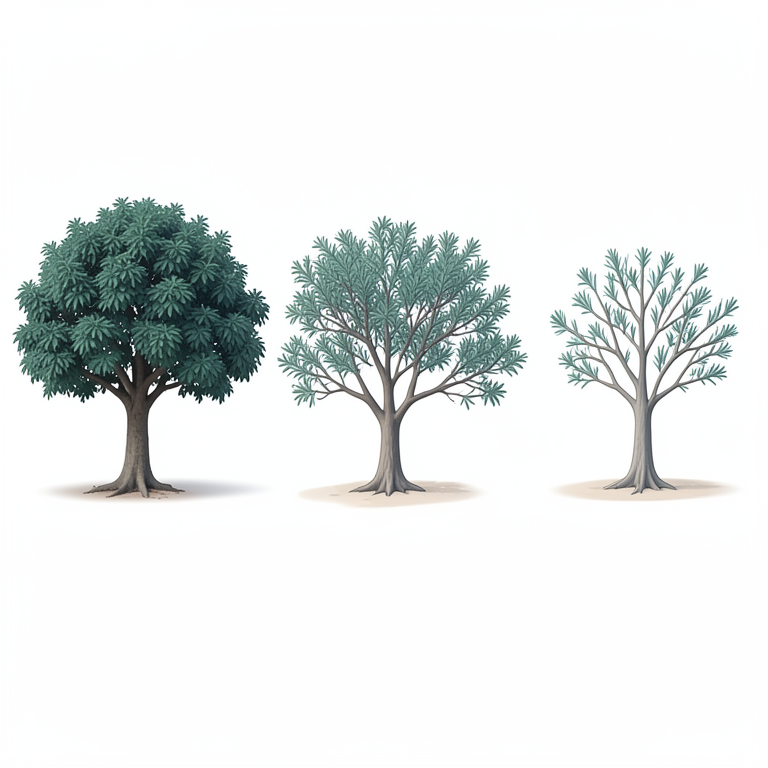
Pruning Treatment Comparison
AI-generated conceptual illustration (Wonderful pomegranate trees). It explains the idea and does not show study data.
View source evidence ↗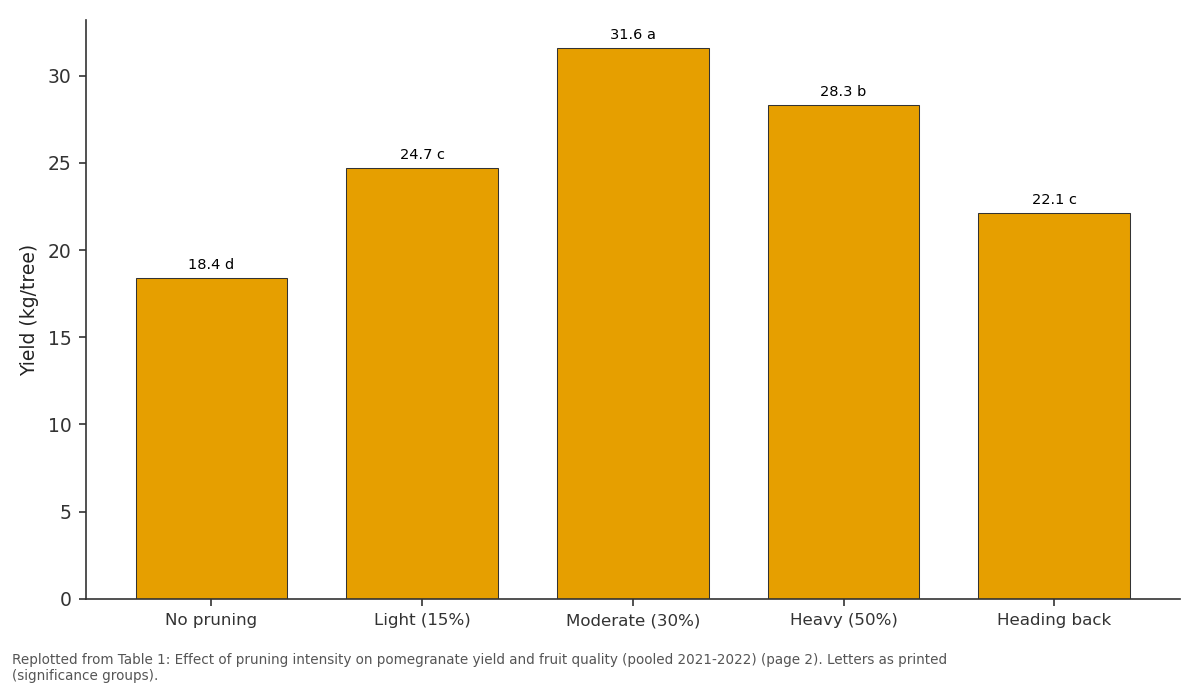
Yield (kg/tree): No pruning vs Light (15%) vs Moderate (30%) vs Heavy (50%) vs Heading back
Replotted from Table 1 (page 2) of the original paper. Every bar is the paper's own table value.
View source evidence ↗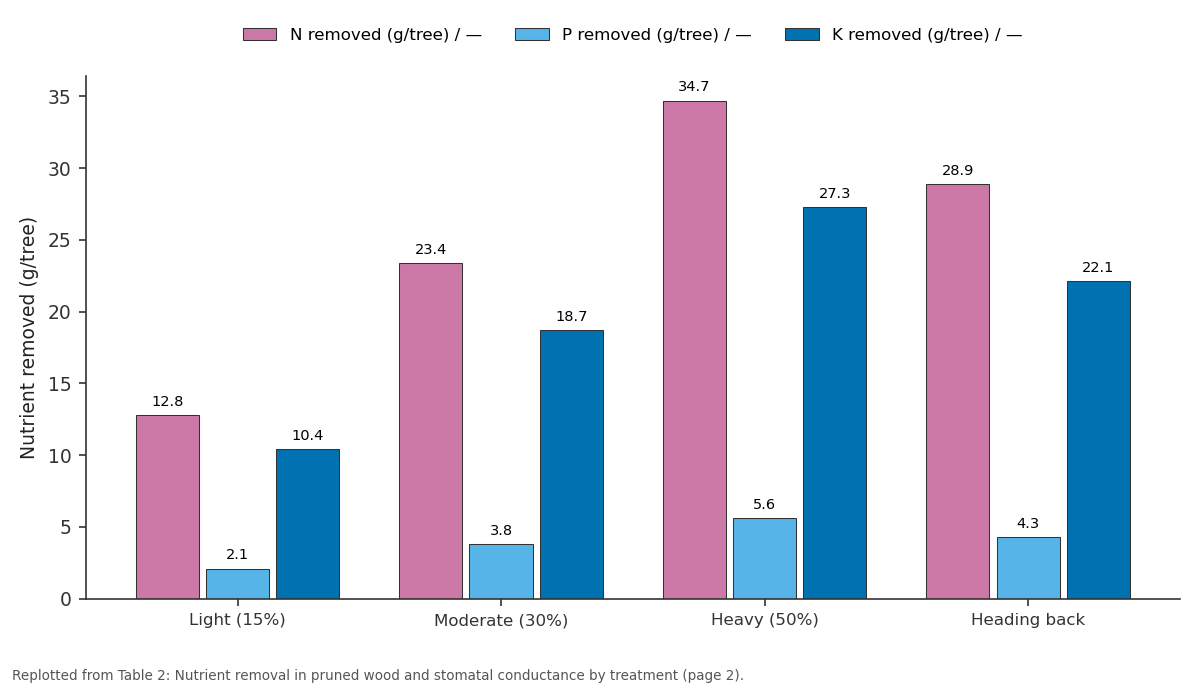
N removed (g/tree) /, and P removed (g/tree) /, and more: Light (15%) vs Moderate (30%) vs Heavy (50%) vs Heading back
Replotted from Table 2 (page 2) of the original paper. Every bar is the paper's own table value.
View source evidence ↗Figures & tables
From the original paper Table 1
 Table 2
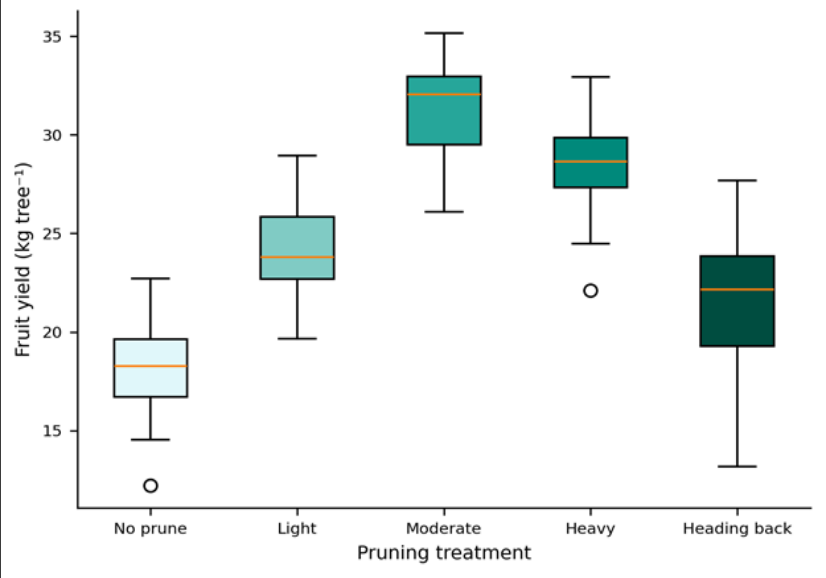 Figure 1
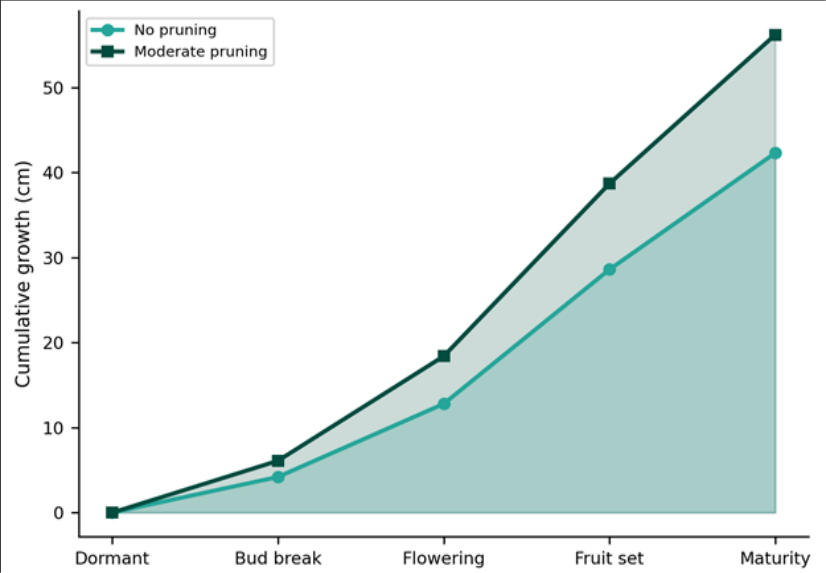 Figure 2
Introduction
Pruning is the selective removal of branches, shoots, or roots to shape a tree's architecture, regulate its crop load, and improve light distribution within the canopy [1] . In pomegranate, which bears fruit on short spurs arising from one-and two-year-old wood, the interplay between vegetative vigour and reproductive allocation makes pruning decisions particularly consequential [2] . Remove too little, and the interior canopy becomes a dense tangle of unproductive shoots that shade developing fruit; remove too much, and the tree loses the very wood on which next season's crop depends. Global pomegranate cultivation has expanded rapidly, rising from an estimated 1.5 million hectares in 2010 to over 2.6 million hectares in 2022, driven by consumer demand for the fruit's antioxidant-rich juice [3] . Most production remains in arid and semi-arid zones-Iran, India, Turkey, and Spain-where high solar radiation and low humidity favour fruit colouration and sugar accumulation [4] . But commercial interest is now reaching higher latitudes: pilot orchards in southern Sweden, Denmark, and coastal Norway are testing coldtolerant cultivars behind windbreaks and under plastic tunnels [5] . Scandinavian coastal farms benefit from the moderating influence of the Gulf Stream, which keeps winter minima above -8 °C along the western Norwegian and southern Swedish coasts [6] . Summer daylengths of 18-20 hours could theoretically boost photosynthetic carbon gain, but the associated low light intensity (400-600 µmol m -2 s -1 PAR at midday) and cool temperatures (mean July maximum 18-22 °C) may limit the fruit-ripening window [7] . Open canopy architectures created by pruning might offset low irradiance by maximising light capture per remaining leaf.
Flavonoid content, a key market differentiator, also responds to light. Anthocyanins and ellagitannins in pomegranate aril juice increase with UV and visible radiation reaching the fruit surface [8] . A pruned canopy that exposes more fruit to direct light could therefore raise flavonoid concentrations even at high latitudes. Stomatal conductance, which governs both CO 2 uptake and transpiration, provides an indirect measure of how well a canopy is photosynthesising; higher conductance in pruned trees typically signals less internal shading stress [9] . This research tested five pruning intensities on 'Wonderful' pomegranate under simulated Scandinavian coastal conditions at Marrakech, Morocco, measuring fruit yield, quality, canopy physiology, and nutrient removal in pruned wood over two seasons [10] .
Crop Growth Stage Documentation
Phenological stages were recorded following the BBCH scale adapted for pomegranate. Dormancy break occurred in late February (BBCH 07), with full leaf expansion by mid-March (BBCH 19). Flowering peaked in April (BBCH 65), with a secondary bloom in June. Fruit set was confirmed when fruitlets reached 15 mm diameter (BBCH 71). Colour break began in August (BBCH 81), and harvest maturity was reached in September when total soluble solids exceeded 16 °Brix and aril colour matched a standard chart score of ≥7 [2] . Pruning was performed annually during full dormancy (January) to standardise wound-healing conditions.
Nutrient Budget Analysis
Pruned wood from each plot was collected, oven-dried at 70 °C for 72 hours, weighed, and ground for nutrient analysis (N by Kjeldahl, P by vanadomolybdate, K by flame photometry). Nutrient removal was calculated as concentration × dry mass of prunings. Annual fertiliser input was 210 g N, 45 g P, and 195 g K per tree applied through the drip system in weekly fertigation pulses from March to August. The nutrient budget expressed removal as a percentage of input to estimate the recycling potential of returned prunings [11] .
Material and Methods Material
Six-year-old 'Wonderful' pomegranate trees spaced at 4 m × 3 m were used. Trees were irrigated by a single drip line per row with 4 L h -1 emitters at 60 cm intervals. To simulate Scandinavian light conditions, white reflective mulch was placed beneath canopies, and supplemental LED panels (6,500 K, 200 µmol m -2 s -1 ) extended daylength to 18 hours during June-August. Cooling chambers (portable evaporative units) capped midday canopy temperature at 24 °C. Stomatal conductance was measured with an SC-1 leaf porometer (Meter Group) on five fully expanded leaves per tree at solar noon. Flavonoid content was determined by the aluminium chloride colorimetric method using a UV-1800 spectrophotometer (Shimadzu) [8] .
Methods
Five pruning treatments were arranged in a randomised complete block design with four replications (5 trees per plot). Treatments: (i) no pruning, (ii) light thinning (15% of one-year shoots removed), (iii) moderate thinning (30%), (iv) heavy thinning (50%), (v) heading-back (all shoots shortened by one-third). Fruit was harvested at maturity and weighed per tree. A subsample of 10 fruits per plot was assessed for individual fruit weight, aril recovery, juice volume, total soluble solids (°Brix), titratable acidity, and flavonoid concentration. Data were analysed by ANOVA in SPSS 28 with Tukey's HSD at P ≤ 0.05 [12] . Moderate thinning produced the highest yield (31.6 kg tree - 1 ), 71.7% above unpruned trees (Table 1). Fruit weight peaked at 284 g under moderate pruning. TSS reached 17.3 °Brix, the highest recorded, and flavonoid concentration at 487 mg GAE L -1 was significantly above all treatments except heavy thinning. Heading-back cuts performed worst among pruned treatments, yielding only 22.1 kg tree -1 . Moderate pruning removed 23.4 g N, 3.8 g P, and 18.7 g K per tree, amounting to 11.2%, 8.4%, and 9.6% of annual input. Stomatal conductance was highest under moderate thinning (168 mmol m -2 s -1 ), 18.3% above unpruned controls, confirming improved light penetration and gas exchange.
| Treatment | Yield (kg/tree) | Fruit wt (g) | TSS (°Brix) | Acidity (%) | Flavonoids (mg GAE/L) |
|---|---|---|---|---|---|
| No pruning | 18.4 d | 214 d | 15.2 c | 1.48 a | 362 c |
| Light (15%) | 24.7 c | 248 c | 16.1 b | 1.36 ab | 418 b |
| Moderate (30%) | 31.6 a | 284 a | 17.3 a | 1.22 b | 487 a |
| Heavy (50%) | 28.3 b | 268 b | 16.8 ab | 1.28 b | 463 a |
| Heading back | 22.1 c | 237 c | 15.8 bc | 1.41 a | 394 bc |
| LSD (0.05) | 3.2 | 18 | 0.8 | 0.12 | 38 |
Table text extracted from the original PDF; superscript letters are shown inline. The original table image is below.
View original table image
Results
Yield distribution under moderate pruning was notably compact (Figure 1), with lower variance than all other treatments, suggesting consistent fruit set across replications. The growth-stage plot (Figure 2) shows that moderately pruned trees diverted more energy into reproductive shoots from flowering onward, reaching 56.2 cm cumulative growth versus 42.3 cm in unpruned trees.
Discussion
The 71.7% yield gain from moderate pruning matches the 50-80% range reported for 'Wonderful' pomegranate in Spanish semi-arid orchards, where thinning 25-35% of oneyear wood consistently outperformed heavier cuts [2] . The underlying mechanism is straightforward: removing crowded interior shoots redirects photosynthate toward the remaining fruiting spurs while also improving air circulation, which lowers Botrytis pressure-a particular concern in the humid Scandinavian simulation environment [1] . The flavonoid response is especially relevant for highlatitude production. At 487 mg GAE L -1 , moderate-pruning juice exceeded the 400 mg threshold that premium juice brands typically require [8] . Since flavonoid biosynthesis in pomegranate arils is photo-regulated, the wider canopy gaps created by 30% thinning presumably allowed more diffuse and direct light to reach developing fruit, triggering chalcone synthase and dihydroflavonol reductase activity [3] . The fact that heavy thinning produced statistically similar flavonoid levels (463 mg) but lower yield means that moderate pruning achieves the best economic balance. Stomatal conductance data support this interpretation. The 18.3% rise in midday gs under moderate pruning reflects reduced mutual shading: remaining leaves intercepted more light individually, keeping photosystem II reaction centres open and sustaining transpiration-driven CO 2 uptake [9] . Heavy pruning gave only marginally higher gs than moderate, indicating that further canopy opening beyond 30% does not proportionally improve leaf-level physiology.
The nutrient budget provides a practical recycling perspective. Chopping pruned wood and returning it as mulch beneath trees would reclaim 11.2% of applied nitrogen at the moderate pruning level. Across a 500-tree orchard, that translates to roughly 11.7 kg N saved annually-a modest but meaningful offset for organiccertified operations where synthetic nitrogen is prohibited [11] .
Conclusion
Moderate thinning at 30% of one-year-old shoots emerged as the optimum pruning strategy for pomegranate under simulated Scandinavian coastal conditions. It delivered the highest fruit yield (31.6 kg per tree), the best individual fruit weight (284 g), the highest juice flavonoid concentration (487 mg GAE per litre), and the greatest stomatal conductance among all treatments. Heavier pruning reduced yield without further improving quality, while heading-back cuts performed poorly across all metrics, likely because they removed too many viable fruiting spurs. Light thinning was insufficient to open the canopy enough for meaningful quality gains. The nutrient export in pruned wood was manageable and could be largely recaptured by chipping and surface-applying prunings as mulch.
For pomegranate growers at high latitudes, annual dormantseason thinning of roughly one-third of the previous year's shoots appears to be a reliable, low-cost intervention that simultaneously raises yield, improves fruit quality, and enhances canopy physiology. Multi-year trials should confirm whether the response remains stable as trees age and whether cultivar differences alter the optimum pruning fraction.
Figures and tables from the paper
| Treatment | N removed (g/tree) | P removed (g/tree) | K removed (g/tree) | gs (mmol/m²/s) | Pruning DM (kg/tree) |
|---|---|---|---|---|---|
| No pruning | — | — | — | 142 d | — |
| Light (15%) | 12.8 | 2.1 | 10.4 | 156 c | 1.34 |
| Moderate (30%) | 23.4 | 3.8 | 18.7 | 168 a | 2.56 |
| Heavy (50%) | 34.7 | 5.6 | 27.3 | 164 ab | 3.81 |
| Heading back | 28.9 | 4.3 | 22.1 | 158 bc | 3.12 |
Table text extracted from the original PDF; superscript letters are shown inline. The original table image is below.
View original table image
References
15 in the original paper- Lal S, Ahmed N. Pruning strategies for deciduous fruit trees. Journal of Horticultural Sciences. 2017;12(1):114.
- Melgarejo P, Salazar DM. Pomegranate: botany, production and uses. CABI Publishing. 2021;1-438.
- Kahramanoglu I, Usanmaz S. Global pomegranate production and market trends. Acta Horticulturae. 2022;1349:1-8.
- Holland D, Hatib K. Pomegranate: improvement, culture and adaptation to emerging conditions. Horticultural Reviews. 2009;35:127-191.
- Larsson E, Svensson A. Cold-hardy pomegranate trials in southern Scandinavia. Acta Agriculturae Scandinavica Section B. 2020;70(6):508-516.
- Hanssen-Bauer I, Forland EJ. Temperature and precipitation variations in Norway 1900-2010. International Journal of Climatology. 2015;35(1):128142.
- Nordli O, Lundstad E. Radiation and daylength effects on fruit crops at high latitudes. Agricultural and Forest Meteorology. 2018;258:82-91.
- Gil MI, Tomas-Barberan FA. Antioxidant activity of pomegranate juice and its relationship with phenolic composition. Journal of Agricultural and Food Chemistry. 2000;48(10):4581-4589.
- Lakso AN. Photosynthesis and stomatal response of apple leaves to environmental factors. Journal of the American Society for Horticultural Science. 1979;104(6):766-770.
- MGSBS. Research infrastructure and capacity report. MGSBS Annual Bulletin. 2020;22:1-38.
- Tagliavini M, Tonon G. Carbon sequestration by fruit trees and implications for soil management. Nutrient Cycling in Agroecosystems. 2003;67(3):197-210.
- IBM Corp. SPSS Statistics for Windows version 28. IBM Corp. 2021.
- Stover E, Mercure EW. Pomegranate: a new look at the fruit of paradise. HortScience. 2007;42(5):1088-1092.
- Galindo A, Calin-Sanchez A. Phenological growth stages of pomegranate tree. Annals of Applied Biology. 2015;166(3):441-450.
- Intrigliolo DS, Nicolas E. Water stress effects on pomegranate fruit quality and yield. Agricultural Water Management. 2013;121:77-83.