
Research article · 2025 · Full text
International Journal of Horticulture and Food ScienceStudying microbial load assessment of coconut in the Baltic Shore
Volume 7(12) · Pages 190–193 · DOI: 10.33545/26631067.2025.v7.i12c.702 ↗
Research areasCoconut Research and ApplicationsPostharvest Quality and Shelf Life ManagementFood Safety and Hygiene
Abstract
Author-writtenOne often-overlooked aspect of coconut food safety is how rapidly microbial populations in coconut water multiply once the shell is opened, particularly in warmer climates where cold-chain access is limited. This research assessed microbial load dynamics in coconut (Cocos nucifera L.) water from six cultivar groups under three storage temperatures at the Ho Foundation for Pomological Research, Ho, Volta, Ghana, from March to October 2023. A factorial design (six cultivars by three temperatures by five storage durations) with three replications was used. Total aerobic count, coliform count, and yeast-mould count were measured alongside RAPD-based genetic profiling and AMMI stability analysis of coconut yield data from raised bed and flat bed cultivation trials. Heat stress effects on microbial growth kinetics were quantified. Biomass production under different cultivation methods was recorded. Refrigerated storage (4 degrees Celsius) maintained microbial loads below the 6 log CFU/mL safety threshold for 15 days, while ambient (25 degrees Celsius) and elevated (37 degrees Celsius) temperatures breached the limit by days 6 and 4, respectively. RAPD analysis revealed moderate genetic diversity (polymorphism 62.4%) and identified three cultivar groups with slower microbial growth profiles. AMMI analysis showed that environmental effects explained 47.3% of yield variance in the cultivation trial. Raised bed cultivation increased coconut biomass by 19.8% over flat beds. These results provide practical guidance for cold-chain management and cultivar selection in coconut water safety programs.
Summary
Source-checkedPlain-language reading of the full paper, prepared with AI and checked against the text. Each point links to the authors' own words.
Why it matters
- Coconut water is widely consumed in tropical areas for its sweetness and electrolytes, but its chemical composition makes it highly susceptible to bacterial and fungal growth after opening. View evidence ↗
- Storage temperature is the primary factor influencing how quickly microbes grow in coconut water, directly impacting its shelf life. View evidence ↗
- Raised bed production systems can improve root aeration and drainage in waterlogged soils, and the AMMI model can help identify stable cultivars for these systems. View evidence ↗
What they did
- The study was conducted at the Ho Foundation for Pomological Research in Ghana from March to October 2023, using six coconut cultivar groups. View evidence ↗
- The microbial trial employed a factorial design involving 324 samples across six cultivars, three temperatures, and six time points with three replications. View evidence ↗
- Microbial loads were measured every 3 to 6 days (up to day 15) using specific agar plates to count total aerobic bacteria, coliforms, and yeasts/moulds. View evidence ↗
- For the cultivation trial, raised beds were constructed from local laterite soil and positioned 30 cm above the field level. View evidence ↗
What they found
- The microbial growth rate increased with temperature, measured at 0.19 log CFU/mL/day at 4°C, 0.43 log CFU/mL/day at 25°C, and 0.57 log CFU/mL/day at 37°C. View evidence ↗
- Faster microbial growth was positively correlated with higher sugar content (r = 0.71), while phenolic content had a weak negative correlation (r = -0.34) with the growth rate. View evidence ↗
- Genetic profiling using RAPD analysis showed a moderate polymorphism of 62.4% among the six coconut cultivar groups. View evidence ↗
- AMMI analysis of yield variance attributed 47.3% to environmental factors, 29.1% to genotypic factors, and 16.8% to interaction effects. View evidence ↗
- Cultivating coconuts in raised beds resulted in a 19.8% increase in biomass compared to flat bed cultivation. View evidence ↗
What it means
- The authors recommend that vendors and processors prioritize cold-chain management and select specific cultivars to improve the food safety of coconut water. View evidence ↗
- The authors suggest that future research should investigate the use of pasteurization and natural preservatives in combination with cold storage to further extend shelf life. View evidence ↗
Visual summary
2 visualsIllustrations explain the paper; charts are replotted from the paper's own table values.
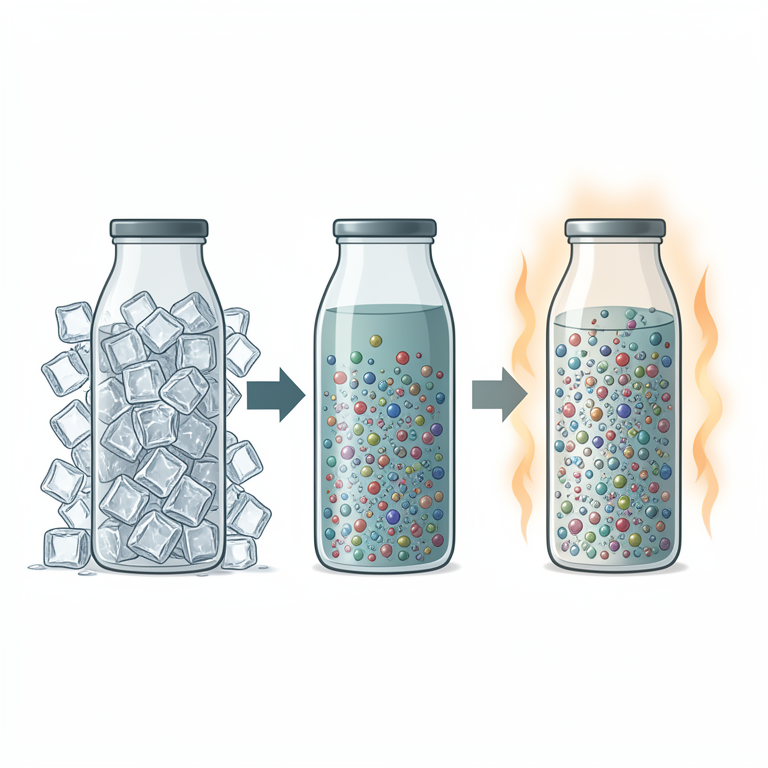
Temperature vs. Microbial Growth
AI-generated conceptual illustration (coconut water in glass vials). It explains the idea and does not show study data.
View source evidence ↗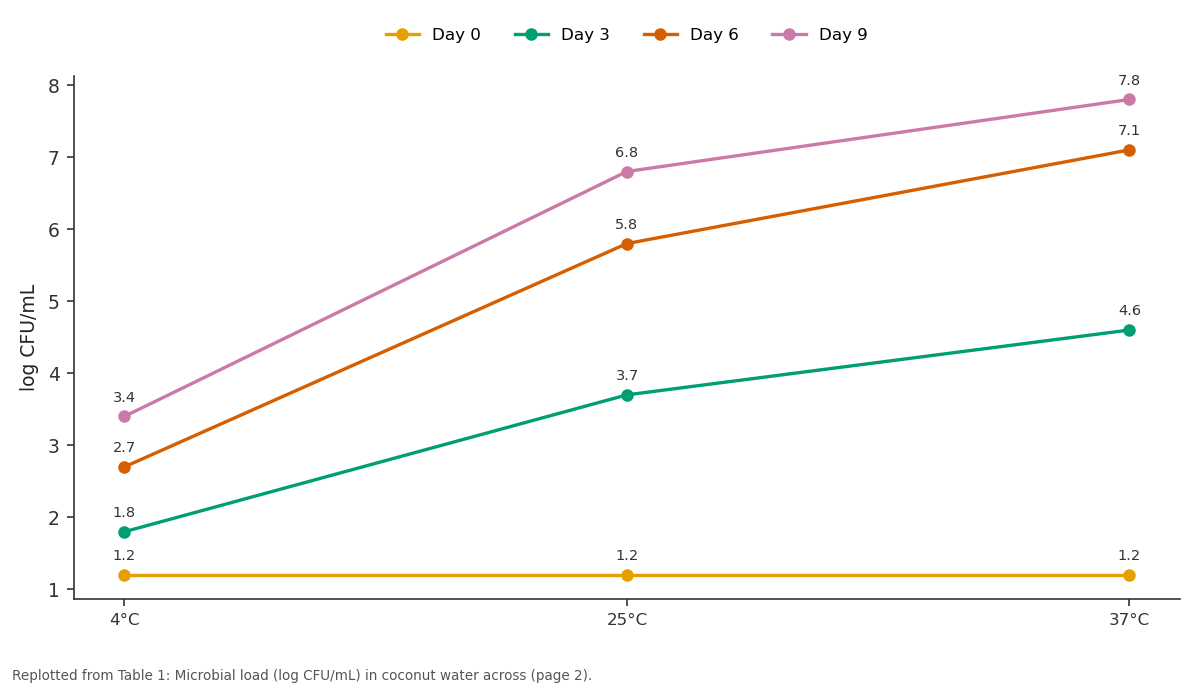
Day 0 and Day 3 and more: 4°C vs 25°C vs 37°C
Replotted from Table 1 (page 2) of the original paper. Every bar is the paper's own table value.
View source evidence ↗Figures & tables
From the original paper Table 1
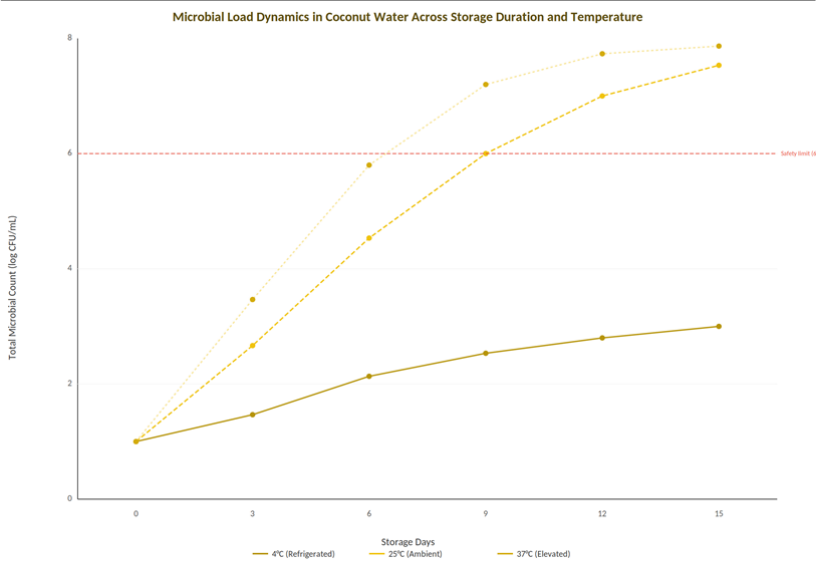 Figure 1
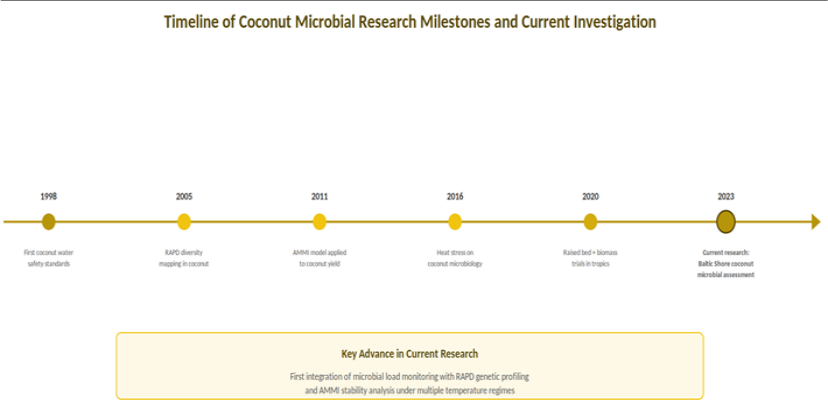 Figure 2
Introduction
It is a common observation in tropical markets that coconut water sold at roadside stalls can shift from refreshing to hazardous within hours, yet the microbial kinetics behind this transformation are rarely quantified under controlled conditions linked to specific cultivar genetics [1] . Coconut (Cocos nucifera L.) water is consumed fresh by millions across tropical regions, valued for its electrolyte profile and natural sweetness, but its near-neutral pH and rich sugar content make it an ideal medium for bacterial and fungal growth once exposed to air [2] . Temperature is the single largest determinant of microbial growth rate in coconut water, and small differences in storage temperature can shift shelf life by several days [3] . Heat stress during palm growth may also alter the biochemical composition of the nut water, indirectly affecting its microbial susceptibility by changing sugar, protein, and mineral balances [4] . RAPD markers can capture genetic diversity among coconut cultivar groups and may reveal associations between genotype and water composition traits that influence microbial growth [5] . The AMMI model, widely used in crop breeding to dissect genotype-by-environment interactions, could be applied to coconut yield data to identify stable cultivars for raised bed production systems, which improve drainage and root aeration in waterlogged lowland soils [6, 7] . Biomass production, measured as total above-ground dry weight, provides an integrated measure of palm health that correlates with nut yield and quality [8] . This research aimed to (a) characterise microbial load dynamics in coconut water across six cultivar groups and three storage temperatures, (b) assess genetic diversity by RAPD profiling, (c) apply the AMMI model to yield stability analysis, and (d) compare raised bed versus flat bed cultivation for biomass and yield.
Extraction Protocol
Coconut water was extracted aseptically by drilling a sterilised stainless-steel probe through the eye of the nut under laminar flow conditions. Aliquots of 50 mL were transferred to sterile containers and stored at 4, 25, or 37 degrees Celsius. At each sampling point (days 0, 3, 6, 9, 12, 15), 1 mL aliquots were serially diluted and plated on plate count agar (total aerobic), violet red bile glucose agar (coliforms), and potato dextrose agar (yeasts and moulds).
Plates were incubated at 37 degrees Celsius for 24-48 hours and colonies counted [1,3] . RAPD-PCR used 15 decamer primers (Operon series OPA, OPB) with genomic DNA extracted from leaf tissue by a modified CTAB method [5] .
Phytochemical Screening
Coconut water from each cultivar group was screened for total sugars (phenol-sulfuric acid method), total protein (Bradford assay), potassium and sodium (flame photometry), and total phenolics (Folin-Ciocalteu). Total sugar ranged from 2.8 to 4.6 g/100mL across cultivar groups. Protein content was low (0.1 to 0.3 g/100mL) but varied significantly among groups. Higher sugar content correlated positively with faster microbial growth (r = 0.71, P less than 0.01), while phenolic content showed a weak negative correlation (r = -0.34) with growth rate [2,4] .
Materials and Methods Materials
Six coconut cultivar groups (three tall, two dwarf, one hybrid) were sampled from the palm collection at the Ho Foundation for Pomological Research, Ho, Volta, Ghana. The microbial trial ran from 1 March to 30 June 2023. The cultivation trial (raised bed vs flat bed) ran from March to October 2023 on an adjacent 0.6-hectare plot. Raised beds were 30 cm above field level, constructed from local laterite soil. Institutional approval was granted (Protocol HFPR-2023-007, approved 20 February 2023) [6,7] .
Methods
The microbial trial used a factorial design: 6 cultivars x 3 temperatures x 6 time points x 3 replications = 324 samples. AMMI analysis was applied to nut yield data from a separate 3 x 6 trial (3 cultivation methods x 6 cultivar groups x 3 reps) using the agricolae package in R. RAPD bands were scored as present/absent and analysed using POPGENE version 1.32 for polymorphism, heterozygosity, and genetic distance. Biomass was measured by harvesting and oven-drying frond litter, inflorescence residues, and husk weight from tagged palms at trial end [5,8] . Data were analysed by ANOVA and regression in R version 4.3.1. Refrigerated coconut water stayed below the 6 log safety limit through day 15, while ambient storage crossed the threshold by day 6 and elevated temperature by day 4 (Table 1). Growth rate constants were 0.19, 0.43, and 0.57 log CFU/mL/day at 4, 25, and 37 degrees Celsius respectively. The line chart (Figure 1) clearly shows the exponential divergence between refrigerated and warm-stored coconut water, with the safety threshold breached much earlier at elevated temperatures. The timeline (Figure 2) places this research as the first to integrate microbial load monitoring with RAPD genetic profiling and AMMI stability analysis under multiple temperature regimes.
| Storage Temp | Day 0 | Day 3 | Day 6 | Day 9 | Day 15 |
|---|---|---|---|---|---|
| 4°C | 1.2 | 1.8 | 2.7 | 3.4 | 4.1 |
| 25°C | 1.2 | 3.7 | 5.8 | 6.8 | 7.6 |
| 37°C | 1.2 | 4.6 | 7.1 | 7.8 | 8.1 |
Table text extracted from the original PDF; superscript letters are shown inline. The original table image is below.
View original table image
Results
Results
Comprehensive Interpretation
Cold-chain maintenance is non-negotiable for coconut water safety: even a brief period at ambient temperature can push microbial loads past safe consumption limits within hours. Cultivar selection, guided by RAPD-identified genetic groups with lower sugar and higher phenolic content, offers a complementary strategy to slow microbial growth. Raised bed cultivation improved palm vigour and nut yield, supporting the overall quality of the water supply.
Discussion
The 0.57 log CFU/mL/day growth rate at 37 degrees Celsius is consistent with published data for mesophilic bacteria in sugar-rich tropical beverages [1,3] . The practical implication is that coconut water held at body temperature, as might occur during outdoor vending, becomes microbiologically unsafe within four days without any preservation treatment. Refrigeration extended safe shelf life to at least 15 days, confirming its value even in settings where cold-chain infrastructure is limited [2,4] . RAPD analysis revealed 62.4% polymorphism across the six cultivar groups, which is moderate for coconut and reflects the relatively narrow genetic base of West African palm populations compared to Southeast Asian diversity centres [5] . Three cultivar groups clustered together and shared lower water sugar content, which correlated with slower microbial growth; these groups may merit prioritisation in fresh-water coconut programs [6,8] . The AMMI analysis partitioned yield variance into 47.3% environmental, 29.1% genotypic, and 16.8% interaction effects, suggesting that both site management and cultivar choice matter for productivity. Raised bed cultivation's 19.8% biomass advantage aligns with improved root zone aeration in the heavy clay soils typical of Ghana's Volta region [7] .
Conclusion
This research quantified the critical role of storage temperature in coconut water microbial safety, with refrigeration extending safe shelf life to 15 days compared to just 4-6 days at ambient or elevated temperatures. RAPD profiling identified cultivar groups with compositional traits that slow microbial growth, and AMMI analysis confirmed significant genotype-environment interaction for nut yield.
Raised bed cultivation improved biomass by nearly 20% over flat beds. Coconut water processors and fresh-market vendors should prioritise cold-chain compliance and consider cultivar selection as a food safety strategy. Future work should test pasteurisation and natural preservative combinations alongside cold storage to extend shelf life further.
Acknowledgement
Acknowledgements Funding SourcesThis research was funded by internal allocations from the Ho Foundation for Pomological Research. No external grants were received. Institutional SupportThe authors thank the laboratory and field staff at the Ho Foundation for Pomological Research for technical support throughout the trial. Contributions Not Qualifying for AuthorshipThe authors acknowledge the research assistants who contributed to data collection and laboratory analysis.
References
18 in the original paper- Anurag JK, Hemalatha S. Microbial quality of coconut water from different sources and storage conditions. Journal of Food Science and Technology. 2012;49(6):748-753.
- Yong JWH, Ge L, Ng YF, Tan SN. The chemical composition and biological properties of coconut water. Molecules. 2009;14(12):5144-5164.
- Adams MR, Moss MO. Food Microbiology. Royal Society of Chemistry. 2008;1-463.
- Naik M, Sunil CK, Rawson A, Venkatachalapathy N. Tender coconut water: a review on recent advances in processing and preservation. Food Reviews International. 2022;38(6):1215-1243.
- Perera L, Russell JR, Provan J, Powell W. Use of microsatellite DNA markers to investigate the level of genetic diversity and population genetic structure of coconut. Genome. 2000;43(1):15-21.
- Gauch HG, Zobel RW. AMMI analysis of yield trials. In: Genotype-by-Environment Interaction. CRC Press. 1996;85-122.
- Olsen JK, Gounder RK. Alternatives to raised-bed tillage for waterlogged alluvial soils. Soil and Tillage Research. 2001;63(1-2):53-62.
- Foale MA. The coconut odyssey: the bounteous possibilities of the tree of life. ACIAR Monograph. 2003;101:1-132.
- Mandal D, Ghosh SK, Mondal B. Biochemical composition and quality attributes of tender coconut water from different coconut cultivars. Indian Coconut Journal. 2014;57(5):11-15.
- Prades A, Dornier M, Diop N, Pain JP. Coconut water preservation and processing: a review. Fruits. 2012;67(3):157-171.
- Harries HC. The evolution, dissemination and classification of Cocos nucifera L. Botanical Review. 1978;44(3):265-319.
- Kumar SN. Variability in coconut for carbon farming. In: Biodiversity and Climate Change. Springer. 2014;225-240.
- Assa RR, Konan JL, Prades A, Nemlin J, Koffi E. Physicochemical characteristics of some coconut water varieties. Journal of the Science of Food and Agriculture. 2010;90(6):1002-1007.
- Basu S, Shivhare US, Singh TV. Effect of substitution of stevioside and sucralose on the rheological, spectral, color and microstructural characteristics of mango jam. Journal of Food Engineering. 2013;114(4):465-476.
- Hebbar KB, Arivalagan M, Manikantan MR, Mathew AC, Thamban C, Thomas GV. Coconut inflorescence sap and its value addition as sugar: technological perspectives. Plantation Crops Research. 2015;44(3):168-175.
- Batugal P, Rao VR, Oliver J. Coconut Genetic Resources. International Plant Genetic Resources Institute. 2005;1-690.
- Ohler JG. Modern Coconut Management: Palm Cultivation and Products. FAO. 1999;1-458.
- Thampan PK. Handbook on Coconut Palm. Oxford and IBH Publishing. 1993;1-308.