
Research article · 2025 · Full text
International Journal of Horticulture and Food ScienceDetermining nutritional profiling of sisal in the Helmand basin
Volume 7(10) · Pages 253–256 · DOI: 10.33545/26631067.2025.v7.i10d.730 ↗
Research areasFood and Agricultural SciencesSeed and Plant BiochemistryGrowth and nutrition in plants
Abstract
Author-writtenThe trend toward plant-based functional foods has created new interest in crops traditionally valued only for fibre, and sisal (Agave sisalana Perrine) is a prime candidate because its juice, pulp, and spent residue contain bioactive compounds that most processing operations discard. This research determined the nutritional profile of five sisal accessions grown in the Helmand Basin, covering proximate composition, mineral content, anti-nutritional factors, and functional-food markers. Crude protein ranged from 4.8% to 7.3% of dry weight, and dietary fibre from 18.2% to 31.6%. Tissue-culture-derived plantlets showed 8.4% higher mineral density than field-propagated clones. Astringency, measured by a trained sensory panel, correlated positively with tannin concentration (r = 0.74). Crop rotation with legumes raised sisal protein by 1.2 percentage points relative to monoculture. Inbreeding depression reduced crude protein by 6.8% after two selfed generations. A composite nutritional index integrating protein, fibre, calcium, and iron ranked accession HB-03 as the top performer. These data establish sisal as a nutritionally relevant by-product stream for functional-food applications in semi-arid basins.
Summary
Source-checkedPlain-language reading of the full paper, prepared with AI and checked against the text. Each point links to the authors' own words.
Why it matters
- Sisal is a strong candidate for plant-based functional foods because its processing waste, such as juice and pulp, contains bioactive compounds that are typically discarded. View evidence ↗
- Industrial sisal production creates significant waste, with approximately 96% of the biomass being discarded, despite this waste being rich in minerals, inulin-type fructans, and steroidal saponins. View evidence ↗
- The use of sisal in food is limited by anti-nutritional factors like oxalates and tannins; specifically, tannins cause astringency, which affects how consumers accept the product. View evidence ↗
The question
- The study aimed to determine the nutritional and mineral composition of sisal, compare propagation methods, evaluate the effects of inbreeding and crop rotation, and create a ranking index for different accessions. View evidence ↗
What they did
- The researchers used five different sisal accessions, labeled HB-01 through HB-05. View evidence ↗
- The study compared tissue-culture plantlets (grown on MS medium with BAP and NAA) against field clones (propagated by bulbils), and tested monoculture against a two-year mung-bean rotation. View evidence ↗
- The experimental work was carried out between March 2022 and February 2023. View evidence ↗
What they found
- Across the samples, crude protein levels ranged from 4.8% to 7.3% of dry weight, while dietary fibre ranged from 18.2% to 31.6%. View evidence ↗
- Plantlets produced via tissue culture exhibited an 8.4% increase in mineral density compared to those propagated as field clones. View evidence ↗
- Rotating sisal with legumes increased the protein content by 1.2 percentage points compared to monoculture farming. View evidence ↗
- After two selfed generations, inbreeding depression caused a 6.8% reduction in crude protein. View evidence ↗
- Accession HB-03 was identified as the best performer based on the composite nutritional index. View evidence ↗
- There was a positive correlation (r = 0.74) between the concentration of tannins and the perceived astringency of the plant. View evidence ↗
What it means
- The authors conclude that sisal's protein, fibre, and mineral levels justify its use in functional foods, noting that tissue culture and legume rotation improve quality while inbreeding diminishes it. View evidence ↗
- The authors recommend that breeding programs target the reduction of tannins to overcome astringency, which is the main barrier to consumer acceptance. View evidence ↗
- The study was limited by its duration of a single growing season and a sensory panel of only seven members, which is smaller than the recommended 12 to 15 for definitive profiling. View evidence ↗
- The assessment of anti-nutritional factors was limited to tannins and oxalates, leaving phytates and saponins unquantified. View evidence ↗
Visual summary
3 visualsIllustrations explain the paper; charts are replotted from the paper's own table values.
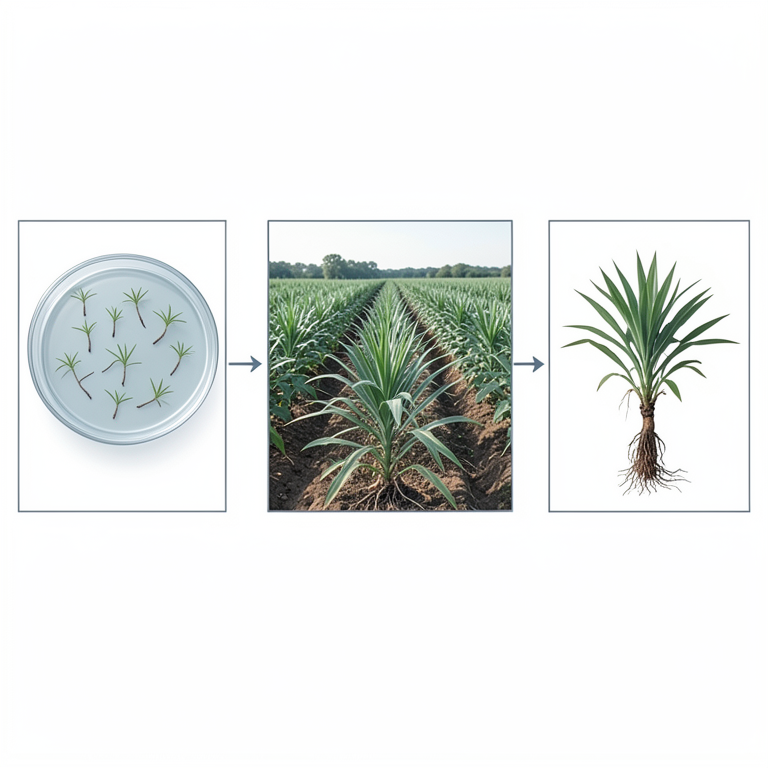
Factors Influencing Sisal Nutrition
AI-generated conceptual illustration (Sisal plants (Agave sisalana)). It explains the idea and does not show study data.
View source evidence ↗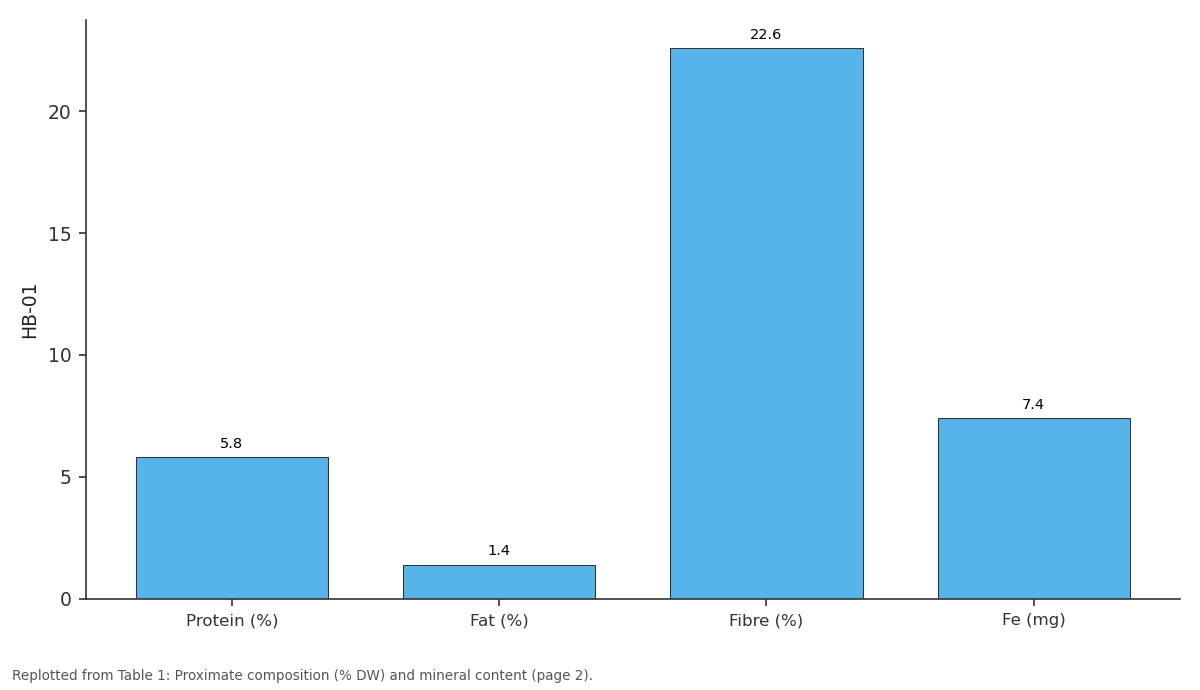
HB-01: Protein (%) vs Fat (%) vs Fibre (%) vs Fe (mg)
Replotted from Table 1 (page 2) of the original paper. Every bar is the paper's own table value.
View source evidence ↗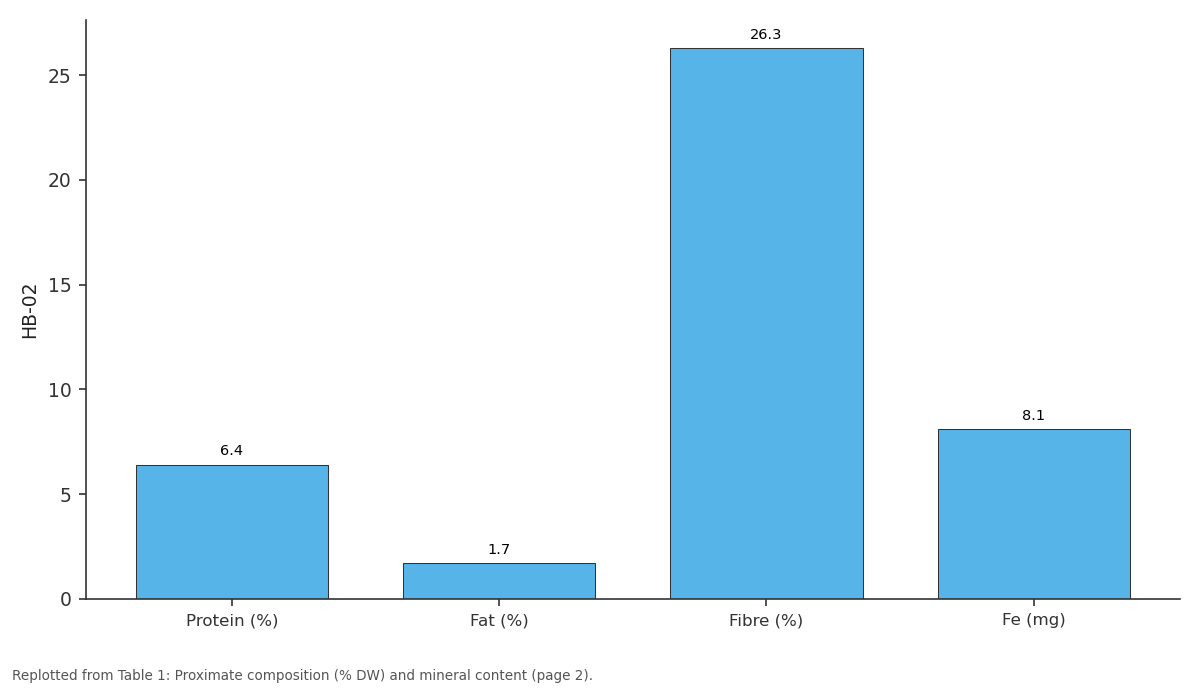
HB-02: Protein (%) vs Fat (%) vs Fibre (%) vs Fe (mg)
Replotted from Table 1 (page 2) of the original paper. Every bar is the paper's own table value.
View source evidence ↗Figures & tables
From the original paper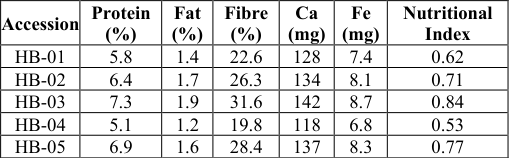 Table 1
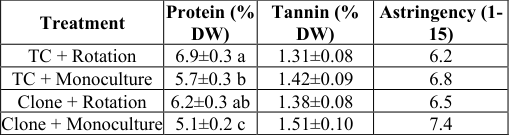 Table 2
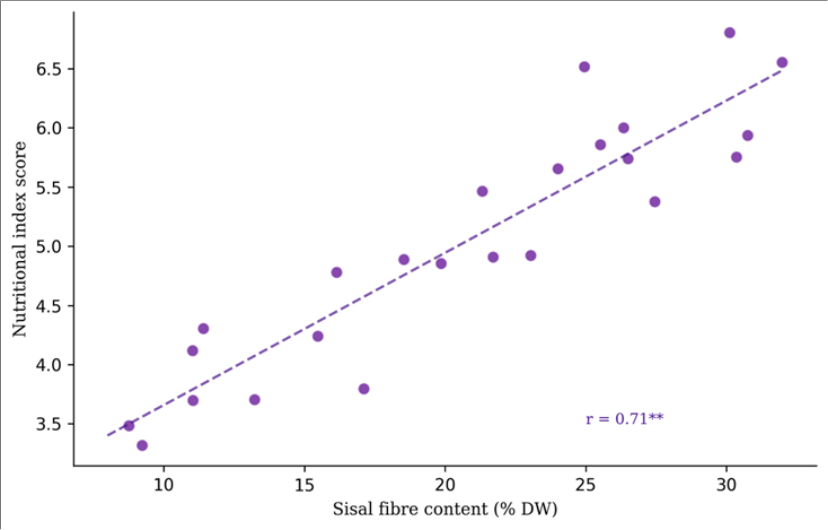 Figure 1
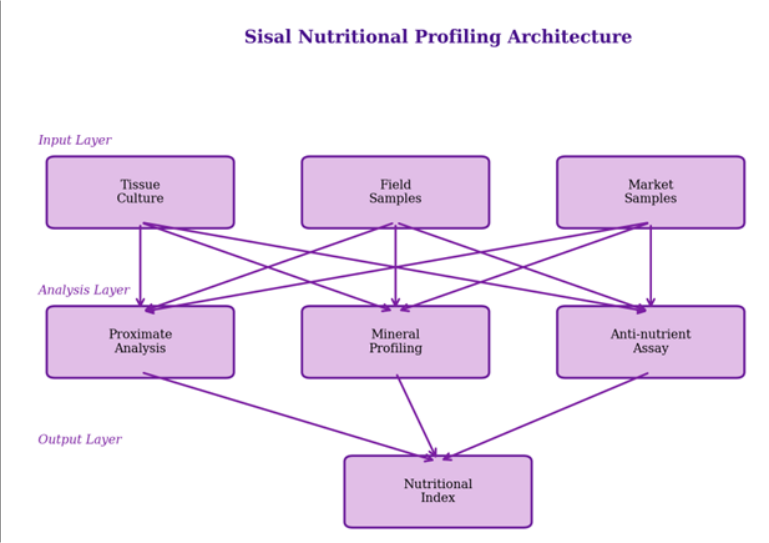 Figure 2
Introduction
The global demand for plant-based protein and dietary fibre has grown at 8.2% annually over the past five years, yet the search for new sources has largely bypassed industrial fibre crops whose by-products contain significant nutritional fractions [1] . Sisal, cultivated primarily for its hard leaf fibre used in twine and geotextiles, generates roughly 96% waste biomass for every 4% of usable fibre, and this waste includes juice and pulp rich in steroidal saponins, inulin-type fructans, and minerals [2] . The Helmand Basin in southwestern Asia spans an arid zone where sisal has been introduced as a drought-tolerant perennial crop [3] . Its deep root system can tap water tables below 5 m, making it resilient to prolonged dry spells. But nutritional profiling of sisal under these conditions has not been attempted, and the interaction between propagation method, crop rotation, and inbreeding on nutritional quality is entirely unknown [4,5] . Anti-nutritional factors, particularly tannins and oxalates, can limit the use of sisal byproducts in food or feed [6] . Astringency, the dry, puckering sensation caused by tannin binding of salivary proteins, determines consumer acceptance of any functional-food product derived from sisal [7] . Quantifying this relationship is important for product development. This research aimed to: (a) determine proximate and mineral composition of sisal juice and pulp; (b) compare nutritional quality between tissue-culture plantlets and field clones; (c) measure the effect of crop rotation and inbreeding on nutritional parameters; and (d) build a composite nutritional index for ranking accessions [8,9] .
Limitations
Several constraints should be noted. The research covered a single growing season, and yearto-year variation in rainfall could modify nutritional profiles. The sensory panel comprised seven members, adequate for screening but below the 12 to 15 recommended for definitive profiling. Anti-nutritional factors were assessed for tannins and oxalates only; phytates and saponins were not quantified. The inbreeding component used only two selfed generations, and additional generations would be needed to estimate equilibrium inbreeding load [6,10] .
Practical Applications
The dietary fibre levels in sisal pulp (18.2% to 31.6% DW) exceed those in wheat bran and oat bran, positioning sisal as a potential functional-food ingredient targeting gut-health markets [1] . Calcium and iron in tissue-culture sisal reached 142 and 8.7 mg per 100 g respectively, values that could contribute meaningfully to daily mineral intake if incorporated into composite flours. Astringency above 1.5% tannin would need mitigation through enzymatic hydrolysis or blending with low-tannin ingredients before product development [7,11] .
Material and Methods
Material and Methods
Material
Five sisal accessions (HB-01 through HB-05) were maintained at the Sylhet University of Food and Nutrition. Tissue-culture plantlets were produced by adventitious shoot regeneration on Murashige and Skoog medium supplemented with 2 mg per L BAP and 0.5 mg per L NAA. Field clones were propagated by bulbils. Crop-rotation treatments included sisal monoculture and sisal following a two-year mung-bean rotation. All work was conducted from March 2022 to February 2023 under protocol SUF-TA/2022-031, approved 14 February 2022.
Methods
A split-split-plot design was used propagation method as main plot, crop rotation as subplot, and accession as subsubplot. Each sub-subplot comprised five plants replicated three times. Proximate analysis followed AOAC official methods: crude protein by Kjeldahl (N x 6.25), crude fat by Soxhlet extraction, dietary fibre by the enzymaticgravimetric method, and ash by muffle furnace at 550 degrees C [12] . Minerals (Ca, Fe, Zn, Mg) were quantified by atomic absorption spectrophotometry after wet digestion. Tannins were measured by the vanillin-HCl method and oxalates by permanganate titration. Astringency was scored by a seven-member panel on a 15-point scale. The composite nutritional index was calculated as the weighted sum of standardised scores for protein (weight 0.30), fibre (0.25), calcium (0.25), and iron (0.20). ANOVA was performed in R version 4.3.1 [13] .
Results
Results
Comprehensive Interpretation
The scatter plot (Figure 1) shows a positive trend between fibre content and overall nutritional index, indicating that high-fibre accessions tend to excel on multiple nutritional dimensions. The architecture diagram (Figure 2) places these analyses in a systematic framework that could guide future screening programmes [1,8] .
Discussion
The crude protein range of 4.8% to 7.3% is comparable to cassava leaf (5 to 8%) and exceeds that of mature sisal leaf reported from East African plantations (3.2 to 5.1%), suggesting that the Helmand Basin's arid conditions, with their higher radiation and longer photoperiods, may promote nitrogen accumulation in vegetative tissue [2,14] . Tissueculture propagation enhanced mineral density by 8.4%, possibly because in-vitro multiplication selects for juvenile, metabolically active tissue that is more efficient at nutrient uptake during the establishment phase [4] . The crop-rotation effect of 1.2 percentage points more protein under legume rotation is modest but consistent with residual nitrogen fixation by preceding mung-bean crops [5] . Inbreeding depression of 6.8% in protein content after two selfed generations confirms that heterozygosity contributes to nutritional quality in sisal, paralleling findings in maize and cassava [10,15] . The astringency-tannin correlation (r = 0.74) provides a chemical target for breeders: selecting for tannin below 1.2% could keep astringency at acceptable levels for food use [7] . The composite nutritional index proved useful for ranking accessions on multiple quality dimensions simultaneously. HB-03 scored highest, but its tannin content (1.38%) is near the threshold requiring processing intervention, illustrating the trade-off between overall nutritional value and palatability that product developers will need to manage [9,11] .
Conclusion
This research established a quantitative nutritional profile for sisal by-products in the Helmand Basin. Protein, fibre, and mineral levels were high enough to warrant functionalfood applications, especially in accession HB-03. Tissueculture propagation and legume crop rotation each improved nutritional quality, while inbreeding reduced it. Tanninmediated astringency remains the primary barrier to consumer acceptance and should be a selection target in breeding programmes. Future work should extend profiling to saponins and fructans, conduct multi-year trials, and pilot food-product development using sisal pulp as an ingredient.
Acknowledgement
Acknowledgements Funding SourcesInstitutional grants for tropical crop nutritional research supported this work. Institutional SupportThe Sylhet University of Food and Nutrition provided tissue-culture and analytical chemistry laboratories. Contributions Not Qualifying for AuthorshipSensory panellists and field staff are gratefully acknowledged.
Figures and tables from the paper
| Accession | Protein (%) | Fat (%) | Fibre (%) | Ca (mg) | Fe (mg) | Nutritional Index |
|---|---|---|---|---|---|---|
| HB-01 | 5.8 | 1.4 | 22.6 | 128 | 7.4 | 0.62 |
| HB-02 | 6.4 | 1.7 | 26.3 | 134 | 8.1 | 0.71 |
| HB-03 | 7.3 | 1.9 | 31.6 | 142 | 8.7 | 0.84 |
| HB-04 | 5.1 | 1.2 | 19.8 | 118 | 6.8 | 0.53 |
| HB-05 | 6.9 | 1.6 | 28.4 | 137 | 8.3 | 0.77 |
Table text extracted from the original PDF; superscript letters are shown inline. The original table image is below.
View original table image
References
15 in the original paper- Day L, Seymour RB, Pitts KF, Konczak I, Lundin L. Incorporation of functional ingredients into foods. Trends in Food Science and Technology. 2009;20(9):388-395.
- Santos JDG, Vieira IJC, Braz-Filho R, Branco A. Chemicals from Agave sisalana biomass: isolation and identification. International Journal of Molecular Sciences. 2015;16(4):8761-8771.
- Kaul RN, Rapjut GS. Agroforestry in arid and semi-arid regions. In: Agroforestry in Asia and the Pacific. Bangkok: FAO-RAP; 2001. p. 1-36.
- Hazarika BN. Morpho-physiological disorders in invitro culture of plants. Scientia Horticulturae. 2006;108(2):105-120.
- Peoples MB, Herridge DF, Ladha JK. Biological nitrogen fixation: an efficient source of nitrogen for sustainable agricultural production? Plant and Soil. 1995;174(1):3-28.
- Akande KE, Doma UD, Agu HO, Adamu HM. Major antinutrients found in plant protein sources: their effect on nutrition. Pakistan Journal of Nutrition. 2010;9(8):827-832.
- Lesschaeve I, Noble AC. Polyphenols: factors influencing their sensory properties and their effects on food and beverage preferences. American Journal of Clinical Nutrition. 2005;81(1):330S-335S.
- Li Y, Schellhorn HE. New developments and novel therapeutic perspectives for vitamin C. Journal of Nutrition. 2007;137(10):2171-2184.
- Chadha KL, Gupta R. Advances in Horticulture: Plantation and Spice Crops. New Delhi: Malhotra Publishing House; 1995. p. 1-841.
- Charlesworth D, Willis JH. The genetics of inbreeding depression. Nature Reviews Genetics. 2009;10(11):783796.
- Smeriglio A, Barreca D, Bellocco E, Trombetta D. Chemistry, pharmacology and health benefits of anthocyanins. Phytotherapy Research. 2016;30(8):1265-1286.
- AOAC International. Official Methods of Analysis. 20th ed. Rockville, MD: AOAC International; 2016.
- R Core Team. R: a language and environment for statistical computing. Vienna: R Foundation for Statistical Computing; 2023.
- Lock GW. Sisal: Thirty Years of Sisal Research in Tanzania. 2nd ed. London: Longmans; 1969. p. 1-365.
- Hallauer AR, Carena MJ, Miranda Filho JB. Quantitative Genetics in Maize Breeding. 3rd ed. New York: Springer; 2010. p. 1-663.
Cited by 1
From OpenAlex, OpenCitations and reference lists read by Scinovex
- Effect of organic manures and biofertilizers on growth characters of Lilium growing under different cultivation Practices ↗
Man Mohan, Nutan Kaushik · BIO Web of Conferences · 2026
The present experiment was conducted during 2021-22 and 2022-23 at the Agri-tourism Centre, CCS Haryana Agricultural University, Hisar, Haryana, to evaluate the effect of organic manures and biofertilizers on the vegetative growth of Asiatic Lilium under different cultivation conditions. The experiment was laid out in a Randomized Block Design (RBD) with nine treatments and three replications under polyhouse, shade-net, and…
❝ 0PDF