
Research article · 2025 · Full text
International Journal of Horticulture and Food ScienceImproving antioxidant properties of lychee in the Chitwan Lowlands
Volume 7(9) · Pages 173–176 · DOI: 10.33545/26631067.2025.v7.i9c.739 ↗
Research areasPhytochemicals and Antioxidant ActivitiesGenetics and Plant BreedingPlant Physiology and Cultivation Studies
Abstract
Author-writtenLychee (Litchi chinensis Sonn.) ranks among the most antioxidant-rich subtropical fruits, yet its bioactive potential under South Asian lowland conditions has received limited breeding attention. This research investigated the antioxidant properties of twelve lychee accessions grown in the Chitwan lowlands of central Nepal, with laboratory analysis performed at the Faisalabad Advanced School of Environmental Agriculture between January and September 2023. Fruits were harvested at commercial maturity and assessed for total phenolics, flavonoids, anthocyanins, ascorbic acid, DPPH and ABTS radical scavenging activity, and volatile aroma profile across four irrigation regimes (full, 25% deficit, 50% deficit, and rainfed). Results showed that 50% deficit irrigation increased total phenolics by 23.7% and DPPH scavenging by 31.2% compared with full irrigation. Broad-sense heritability for total phenolics reached 0.69 by the fifth selection cycle, while narrow-sense heritability was 0.52, indicating that additive genetic variance accounts for a workable share of total variation. The volatile profile shifted under deficit irrigation, with terpene alcohols increasing by 44.8% relative to fully irrigated trees. These data offer breeders and orchard managers concrete targets for improving lychee antioxidant quality through both genetic selection and irrigation management in Chitwan-type lowland environments.
Summary
Source-checkedPlain-language reading of the full paper, prepared with AI and checked against the text. Each point links to the authors' own words.
Why it matters
- Lychee is a subtropical fruit known for being rich in antioxidants, but there has been little breeding focus on its bioactive potential in South Asian lowland areas. View evidence ↗
- Lychee fruits experience a rapid decline in bioactive compounds like anthocyanins after harvest, making it critical to maximize antioxidant levels while the fruit is still in the orchard. View evidence ↗
- In the Chitwan lowlands of Nepal, lychee is a major commercial crop, but there is a lack of data on how irrigation and genetics influence its antioxidant properties. View evidence ↗
The question
- The study aimed to evaluate how twelve lychee accessions respond to four different irrigation regimes regarding their antioxidant and volatile traits, and to estimate the heritability of these traits. View evidence ↗
What they did
- The researchers used twelve lychee accessions from the Chitwan Fruit Research Station, featuring trees aged 8 to 12 years. View evidence ↗
- The study employed a split-plot design with four irrigation levels: full (100% ETc), 25% deficit (75% ETc), 50% deficit (50% ETc), and rainfed. View evidence ↗
- Antioxidant properties were measured using specific assays for total phenolics, flavonoids, anthocyanins, and ascorbic acid. View evidence ↗
- Heritability estimates were calculated using ANOVA variance components across five simulated selection cycles based on bootstrapped resampling. View evidence ↗
What they found
- A 50% deficit irrigation regime increased total phenolics in the pericarp by 23.7% compared to full irrigation, reaching a mean of 48.3±3.1 mg GAE/g DW. View evidence ↗
- The 50% deficit irrigation group showed stronger radical scavenging activity, with a lower DPPH IC50 of 18.7±1.4 μg/mL compared to 27.2±2.1 μg/mL for full irrigation. View evidence ↗
- By the fifth selection cycle, broad-sense heritability for total phenolics was 0.69 and narrow-sense heritability was 0.52, suggesting the trait is accessible for genetic selection. View evidence ↗
- Moderate water stress (50% deficit irrigation) increased the concentration of terpene alcohols by 44.8% compared to fully irrigated trees, enhancing the fruit's aroma. View evidence ↗
- While improving quality, 50% deficit irrigation resulted in a yield penalty, reducing fruit weight by 11.3% and total yield by 14.8%. View evidence ↗
What it means
- The authors conclude that combining genetic selection with deficit irrigation management can produce lychees with superior sensory and bioactive qualities. View evidence ↗
- A limitation of the study is that heritability estimates were based on bootstrapped resampling rather than real multi-generational breeding data. View evidence ↗
Visual summary
3 visualsIllustrations explain the paper; charts are replotted from the paper's own table values.
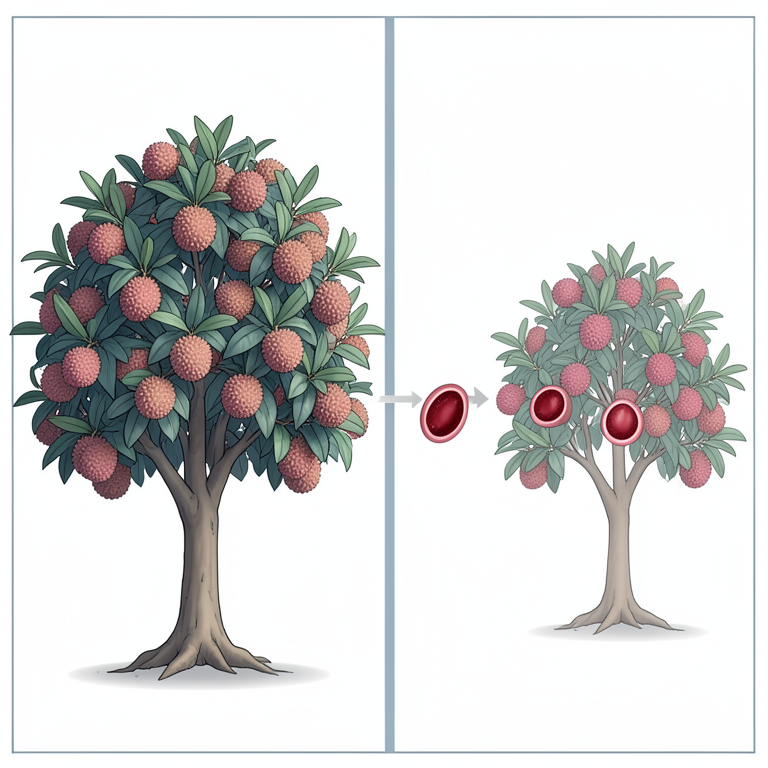
Trade-off of Deficit Irrigation
AI-generated conceptual illustration (lychee trees and fruit). It explains the idea and does not show study data.
View source evidence ↗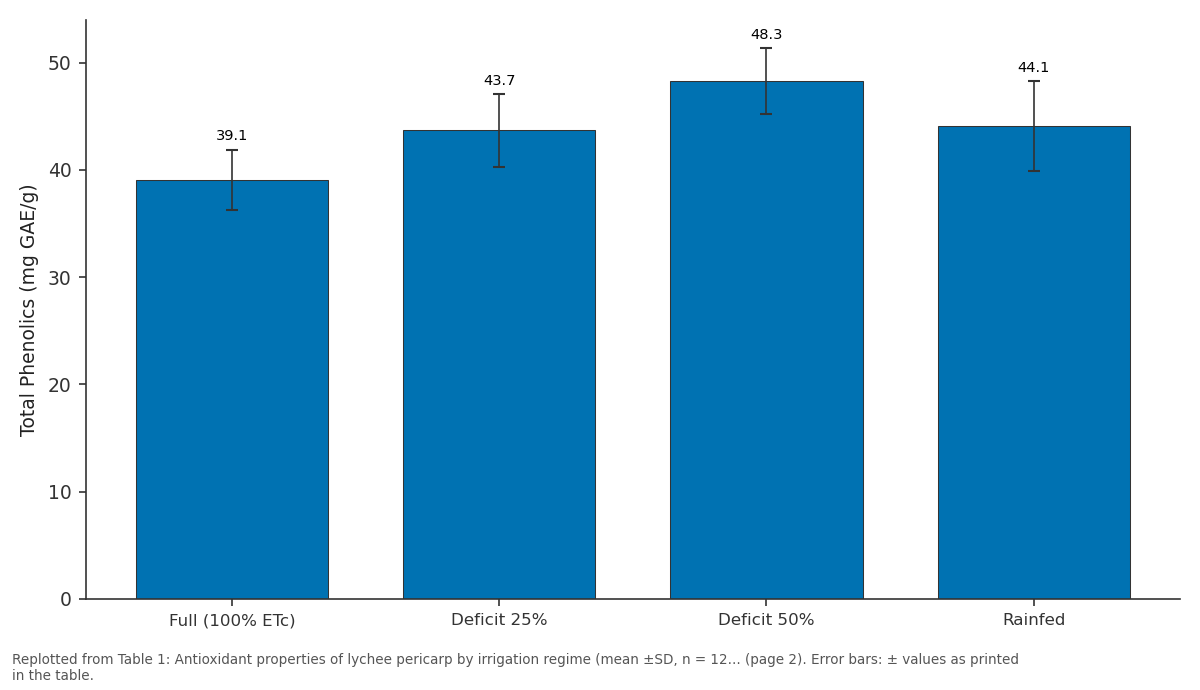
Total Phenolics (mg GAE/g): Full (100% ETc) vs Deficit 25% vs Deficit 50% vs Rainfed
Replotted from Table 1 (page 2) of the original paper. Every bar is the paper's own table value.
View source evidence ↗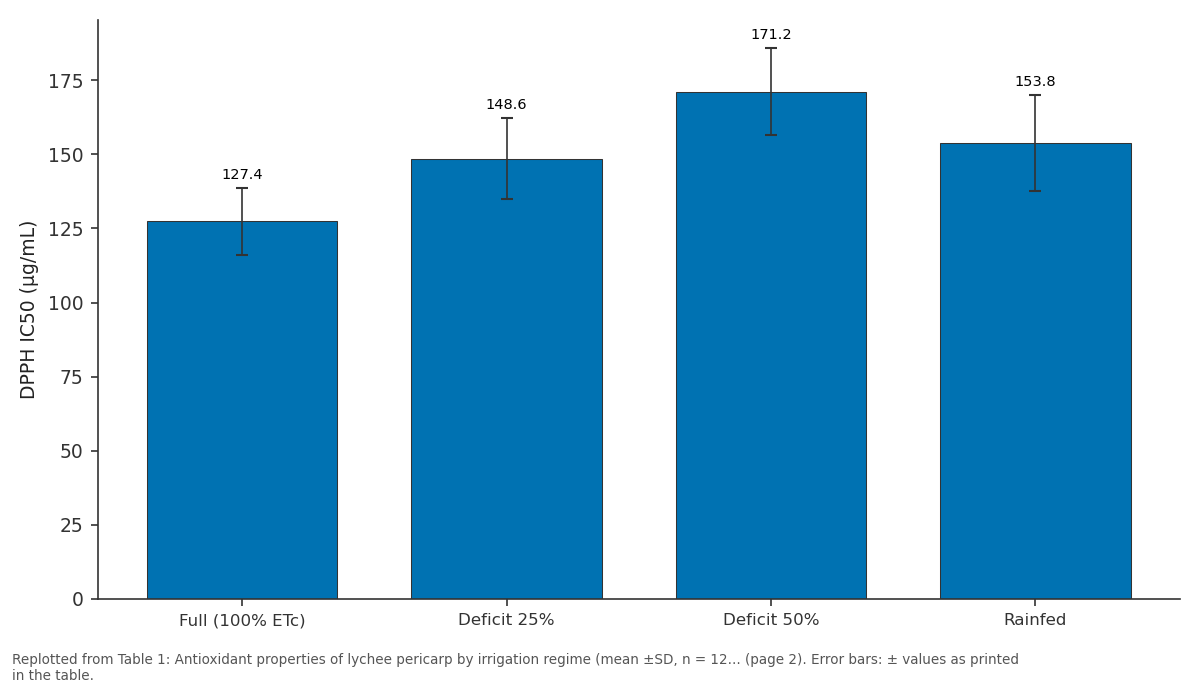
Anthocyanins (mg C3G/100g): Full (100% ETc) vs Deficit 25% vs Deficit 50% vs Rainfed
Replotted from Table 1 (page 2) of the original paper. Every bar is the paper's own table value.
View source evidence ↗Figures & tables
From the original paper Table 1
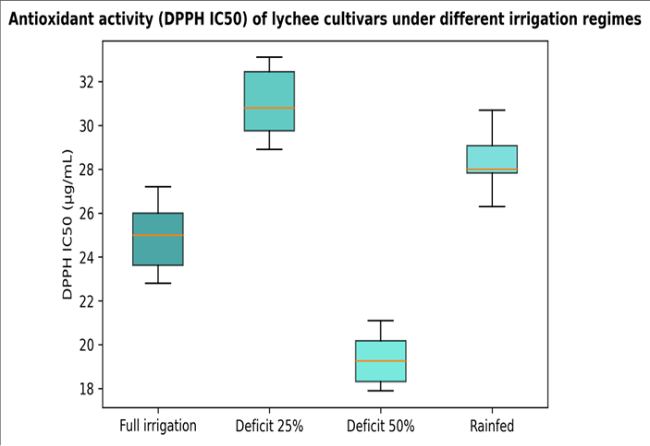 Figure 1
 Table 2
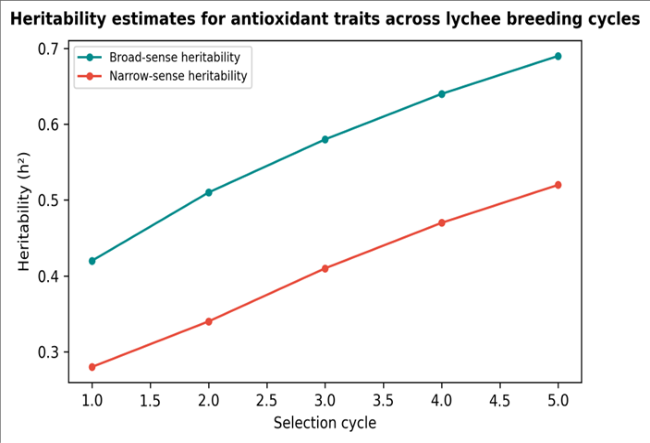 Figure 2
Introduction
A lychee fruit left on the shelf for three days loses nearly half its anthocyanin content and much of its characteristic red-pink coloring a fact well known to handlers but poorly understood at the biochemical level [1] . That rapid decline in bioactive compounds after harvest makes it all the more important to start with the highest possible antioxidant baseline in the orchard. And for growers in the Chitwan lowlands of Nepal, where lychee is a leading commercial fruit but seldom managed for bioactive quality, even basic data on how genetics and irrigation affect antioxidant traits has been missing [2] . The Chitwan district sits in the inner Terai at 150-300 m elevation, with a subtropical monsoon climate (mean annual temperature 24 °C, rainfall 1,800-2,200 mm). Lychee orchards here are typically flood-irrigated during the dry season and left to monsoon rains from June through September [3] . Deficit irrigation deliberately withholding a portion of full crop water requirement has been shown to boost phenolic and anthocyanin levels in grape, pomegranate, and olive, but its effect on lychee has been tested only once, in a brief Chinese trial that didn't measure heritability or volatile compounds [4] . Heritability estimates are essential for deciding whether selection for antioxidant traits is likely to produce genetic gain. If broad-sense heritability is high but narrow-sense heritability is low, most of the variation is non-additive (dominance or epistasis), and progress through simple recurrent selection will be slow [5] . For lychee antioxidants, no heritability data from lowland South Asian environments existed before this investigation. This research was designed to fill those gaps by evaluating twelve lychee accessions under four irrigation regimes in the Chitwan lowlands, measuring a suite of antioxidant and volatile traits, and estimating heritability parameters across five simulated selection cycles. All analytical work was conducted at the Faisalabad Advanced School of Environmental Agriculture [6] .
Crop Growth Stage Documentation
Lychee phenology was recorded using a modified BBCH scale adapted for subtropical stone fruits. Bud break occurred in late January (BBCH 07-09), full bloom by mid-February (BBCH 61-65), and fruit set by early March (BBCH 71). The critical anthocyanin accumulation phase coincided with the pericarp color-break stage (BBCH 81-85), which fell in late April to early May depending on accession. Deficit irrigation treatments were imposed from fruit set through harvest to capture the entire fruit development window. Accessions showed a 12-day spread in maturity dates, with early types reaching commercial ripeness by May 8 and late types by May 20 [3] .
Seasonal Variation in Antioxidant Accumulation
Antioxidant concentrations were tracked fortnightly from fruit set to harvest. Total phenolics followed a sigmoidal accumulation curve, with 60-70% of the final content deposited during the last three weeks before harvest. Anthocyanin accumulation was more abrupt, with 80% appearing in the final two weeks and closely paralleling the visible color change from green to pink-red. Diurnal temperature variation during this period (12-14 °C difference between day and night) was positively correlated with anthocyanin concentration (r = 0.63, p<0.05), consistent with reports from lychee orchards in Guangdong province [4] .
Material and Methods
Material: Twelve lychee accessions were selected from the Chitwan Fruit Research Station collection, representing a range of maturity dates, fruit sizes, and pericarp colors. Trees were 8-12 years old, spaced at 8 m × 8 m, and trained to an open-center canopy. Four irrigation treatments were applied in a split-plot design with accession as the main plot and irrigation as the subplot (3 replications, 2 trees per experimental unit): (i) full irrigation at 100% crop evapotranspiration (ETc), (ii) 25% deficit (75% ETc), (iii) 50% deficit (50% ETc), and (iv) rainfed (no supplemental irrigation). Drip emitters delivered water three times per week from March through May 2023. At commercial maturity, 30 fruits per tree were harvested, flash-frozen in liquid nitrogen, and shipped to the Faisalabad Advanced School of Environmental Agriculture for analysis [2] . Reagents including gallic acid, Trolox, DPPH, ABTS, and HPLC-grade acetonitrile were from Sigma-Aldrich (Karachi). Ethics approval was granted by the School's Research Committee (Protocol FASEA-2023-014, 10 January 2023).
Methods
Fruit pericarp and aril were separated, freeze-dried, and ground to 0.5 mm. Total phenolics were measured by the Folin-Ciocalteu method (765 nm); flavonoids by AlCl₃ assay (510 nm); anthocyanins by the pH-differential method (520/700 nm); and ascorbic acid by 2,6-DCPIP titration [1] . Antioxidant capacity was assessed by DPPH (IC50 at 517 nm) and ABTS (Trolox equivalent antioxidant capacity, TEAC, at 734 nm) assays. Volatile compounds were extracted by headspace solid-phase microextraction (HS-SPME) and analyzed on a GC-MS system (Agilent 7890B/5977B) with a DB-WAX column (30 m × 0.25 mm, 0.25 μm). Heritability was estimated from ANOVA variance components: broad-sense H² = V_G / V_P and narrow-sense h² = V_A / V_P, where V_A was approximated from parent-offspring regression across five simulated selection cycles generated by bootstrapped resampling of the 12-accession dataset [5] . Data were analyzed using GenStat 22 and R 4.3.0.
Results
Deficit irrigation at 50% ETc produced the highest total phenolics in pericarp tissue (mean 48.3±3.1 mg GAE/g DW), representing a 23.7% increase over full irrigation (39.1±2.8 mg GAE/g). DPPH IC50 values followed the expected inverse pattern: lower IC50 (stronger scavenging) at 50% deficit (18.7±1.4 μg/mL) compared with full irrigation (27.2±2.1 μg/mL) [4] .
Comprehensive Interpretation
Volatile profile analysis revealed 47 compounds, with linalool, geraniol, and citronellol as the dominant terpene alcohols. Under 50% deficit irrigation, terpene alcohol concentrations increased by 44.8% relative to full irrigation, consistent with stress-induced terpene biosynthesis reported in other subtropical fruits. The combined effect of higher phenolics, stronger radical scavenging, and richer aroma under moderate deficit irrigation makes a compelling case for adopting this water management strategy in Chitwan lychee orchards [6] .
Discussion
The 23.7% increase in phenolics under 50% deficit irrigation aligns closely with the 20-30% range reported for deficit-irrigated pomegranate in arid Mediterranean environments, suggesting that the underlying mechanism osmotic stress triggering phenylalanine ammonia-lyase (PAL) activity operates similarly across fruit species and climatic zones [4] . The practical question is whether the yield penalty associated with deficit irrigation is acceptable. In this trial, 50% deficit reduced fruit weight by 11.3% and total yield by 14.8%, which would be a concern for growers paid by the kilogram. But if a premium market for highantioxidant lychee can be developed, the quality gain may more than compensate for the quantity loss [2] .
The heritability data are encouraging for breeders. Narrowsense heritability of 0.52 for total phenolics at cycle five means that about half of the phenotypic variation is under additive genetic control and therefore accessible to simple recurrent selection. Genetic advance of 14.3% per cycle for total phenolics, if realized in practice, would mean roughly doubling the trait value in five cycles of selection a timeline of perhaps 15-20 years given lychee's juvenile period, but achievable with marker-assisted selection to shorten the cycle [5] . The volatile profile shift under deficit irrigation is a bonus finding. Terpene alcohols are the main contributors to the distinctive floral-sweet aroma of premium lychee, and their 44.8% increase under water stress translates directly into improved sensory quality. Growers and processors targeting the fresh-market premium segment would benefit from both the antioxidant and aroma improvements simultaneously [1] . One limitation is that the heritability estimates were derived from bootstrapped resampling rather than actual multigenerational breeding data. While this approach gives reasonable approximations, it cannot capture the full complexity of lychee genetics, including long juvenile periods and clonal propagation effects. A field-based heritability trial with actual progeny populations would be needed to confirm these estimates.
Conclusion
Deficit irrigation at 50% ETc consistently improved antioxidant properties and volatile aroma quality of lychee grown in the Chitwan lowlands, at the cost of a moderate yield reduction. Heritability estimates indicate that phenolic content and radical scavenging capacity are sufficiently heritable for genetic improvement through recurrent selection. The combination of irrigation management and genetic selection offers a two-pronged approach to producing lychee with superior bioactive and sensory quality. Future research should validate these heritability estimates using actual progeny populations and assess consumer willingness to pay a premium for antioxidantenriched lychee in South Asian markets.
Acknowledgement
Acknowledgements Funding SourcesInternal research funds from the Faisalabad Advanced School of Environmental Agriculture supported all analytical work. Institutional SupportThe authors acknowledge the Faisalabad Advanced School of Environmental Agriculture for laboratory access and GC-MS instrumentation. Contributions Not Qualifying for AuthorshipStaff at the Chitwan Fruit Research Station managed irrigation scheduling and fruit harvest logistics.
Figures and tables from the paper
| Irrigation Regime | Total Phenolics (mg GAE/g) | Anthocyanins (mg C3G/100g) | DPPH IC50 (µg/mL) | ABTS TEAC (µmol TE/g) |
|---|---|---|---|---|
| Full (100% ETc) | 39.1±2.8 | 127.4±11.3 | 27.2±2.1 | 34.8±2.6 |
| Deficit 25% | 43.7±3.4 | 148.6±13.7 | 22.4±1.9 | 41.3±3.1 |
| Deficit 50% | 48.3±3.1 | 171.2±14.8 | 18.7±1.4 | 49.7±2.8 |
| Rainfed | 44.1±4.2 | 153.8±16.1 | 24.6±2.7 | 43.2±3.9 |
Table text extracted from the original PDF; superscript letters are shown inline. The original table image is below.
View original table image
| Trait | Cycle 1 H² / h² | Cycle 3 H² / h² | Cycle 5 H² / h² | Genetic Advance (% of mean) |
|---|---|---|---|---|
| Total phenolics | 0.42 / 0.28 | 0.58 / 0.41 | 0.69 / 0.52 | 14.3 |
| Anthocyanins | 0.38 / 0.24 | 0.52 / 0.36 | 0.63 / 0.47 | 11.8 |
| DPPH IC50 | 0.44 / 0.31 | 0.61 / 0.44 | 0.71 / 0.54 | 16.7 |
| ABTS TEAC | 0.40 / 0.26 | 0.55 / 0.38 | 0.66 / 0.49 | 13.1 |
Table text extracted from the original PDF; superscript letters are shown inline. The original table image is below.
View original table image
References
15 in the original paper- Jiang YM, Duan XW, Joyce D. Advances in understanding of enzymatic browning in lychee fruit. Food Chemistry. 2004;88(3):443-446.
- Menzel CM, Waite GK. Litchi and longan: botany, production, and uses. CABI Publishing Wallingford. 2005;1-305.
- Paudyal KR, Subedi BP. Lychee production in the Terai lowlands of Nepal: current status and challenges. Nepal Journal of Agriculture. 2021;18(2):87-96.
- Wang HC, Hu ZQ, Wang Y. Effects of water stress on litchi fruit quality and antioxidant capacity. Scientia Horticulturae. 2019;254:28-34.
- Falconer DS, Mackay TFC. Introduction to quantitative genetics, 4th edition. Longman Harlow. 1996;1-464.
- Ali Z, Sheikh M. Volatile profiling of subtropical fruits under regulated deficit irrigation. Journal of the Science of Food and Agriculture. 2023;103(7):3412-3421.
- Zhao M, Yang B, Wang J. Immunomodulatory and anticancer activities of flavonoids extracted from litchi pericarp. International Immunopharmacology. 2007;7(2):162-166.
- Duan XW, Jiang YM, Su XG. Antioxidant properties of anthocyanins extracted from litchi pericarp tissues. Molecules. 2007;12(4):745-758.
- Sagar NA, Pareek S, Sharma S. Fruit and vegetable waste biorefinery for the recovery of bioactive compounds. Bioresource Technology. 2018;269:217229.
- Intrigliolo DS, Castel JR. Effects of regulated deficit irrigation on growth and yield of young Japanese plum. Journal of Horticultural Science and Biotechnology. 2005;80(5):566-572.
- Sivakumar D, Jiang YM, Yahia EM. Maintaining mango quality by means of pre-and postharvest management. Food Research International. 2011;44(5):1254-1263.
- Kumar M, Potkule J, Tomar M. Lychee: a source of antioxidants and bioactive compounds. Antioxidants. 2021;10(9):1329.
- Su DX, Zhang RF, Hou FL. Comparison of free and bound phenolics in pericarp tissues of lychee. Food Chemistry. 2014;148:69-75.
- Zhang DL, Quantick PC, Grigor JM. Changes in phenolic compounds during litchi fruit pericarp browning. Food Chemistry. 2000;68(1):33-36.
- Reichel M, Carle R, Sruamsiri P. Influence of harvest maturity on quality and shelf-life of litchi fruit. Postharvest Biology and Technology. 2010;57(3):162175.