
Research article · 2025 · Full text
International Journal of Horticulture and Food ScienceSurveying canopy management of grape in the Scottish highlands
Volume 7(6) · Pages 161–164 · DOI: 10.33545/26631067.2025.v7.i6c.658 ↗
Research areasHorticultural and Viticultural ResearchPlant Physiology and Cultivation StudiesBerry genetics and cultivation research
Abstract
Author-writtenWhile Scottish whisky is world-famous, Scottish wine remains virtually unknown—a contrast rooted in climate rather than ambition. This research surveyed five canopy management systems—vertical shoot positioning (VSP), Geneva double curtain, Smart-Dyson, lyre trellis, and traditional gobelet—on Vitis vinifera cv. ‘Solaris’ over two seasons (2021-2022) at the Calgary Foundation for Pomological Research, simulating Scottish Highland conditions through controlled cooling and reduced photoperiod. A randomised complete block design with four replications was used. VSP trellis produced the highest total soluble solids (22.4 °Brix) and best titratable acidity balance (6.8 g L-1), while Geneva double curtain gave the greatest berry yield (9.7 t ha-1). Leaf area index (LAI) ranged from 1.8 (gobelet) to 5.1 (Geneva DC), and a strong negative linear relationship (R² = 0.91) was found between LAI and °Brix. Nematode populations in the root zone were lowest under gobelet (182 individuals per 100 g soil) and highest under Geneva DC (347), likely reflecting soil moisture differences beneath canopies of different density. These findings suggest that VSP offers the best fruit quality for premium wine production in cool highland climates, while Geneva DC may suit growers targeting higher tonnage for sparkling wine or juice.
Summary
Source-checkedPlain-language reading of the full paper, prepared with AI and checked against the text. Each point links to the authors' own words.
Why it matters
- The Scottish Highlands present a significant climatic barrier to viticulture, averaging only 1,100 growing degree-days, which is substantially lower than established cool-climate wine regions. View evidence ↗
- Cold-hardy cultivars like 'Solaris' enable grape growing in high-latitude areas because they can ripen at 900-1,200 growing degree-days. View evidence ↗
- In environments with limited heat, canopy management is the primary tool for controlling fruit sugar, acidity, and phenolic development. View evidence ↗
The question
- The study aimed to compare five different trellis systems to determine their effects on berry quality, yield, leaf area index (LAI), and root-zone nematode populations under simulated Scottish Highland conditions. View evidence ↗
What they did
- The researchers tested five systems, VSP, Geneva double curtain, Smart-Dyson, lyre trellis, and gobelet, using 'Solaris' grapevines over the 2021-2022 seasons. View evidence ↗
- The experiment used a randomized complete block design consisting of 20 plots with 12 vines per plot and four replications. View evidence ↗
- To simulate the Scottish Highlands, the researchers used evaporative cooling to keep temperatures below 22 °C and blackout curtains to limit the photoperiod to 16.5 hours. View evidence ↗
What they found
- The VSP trellis produced the highest fruit quality, achieving 22.4 °Brix and a titratable acidity (TA) of 6.8 g L-1, with a yield of 7.4 t ha-1. View evidence ↗
- The Geneva double curtain system achieved the maximum yield of 9.7 t ha-1, but resulted in the lowest sugar content (18.1 °Brix) and highest acidity (8.4 g L-1). View evidence ↗
- Leaf area index varied significantly by system, ranging from a low of 1.8 in the gobelet system to a high of 5.1 in the Geneva double curtain system. View evidence ↗
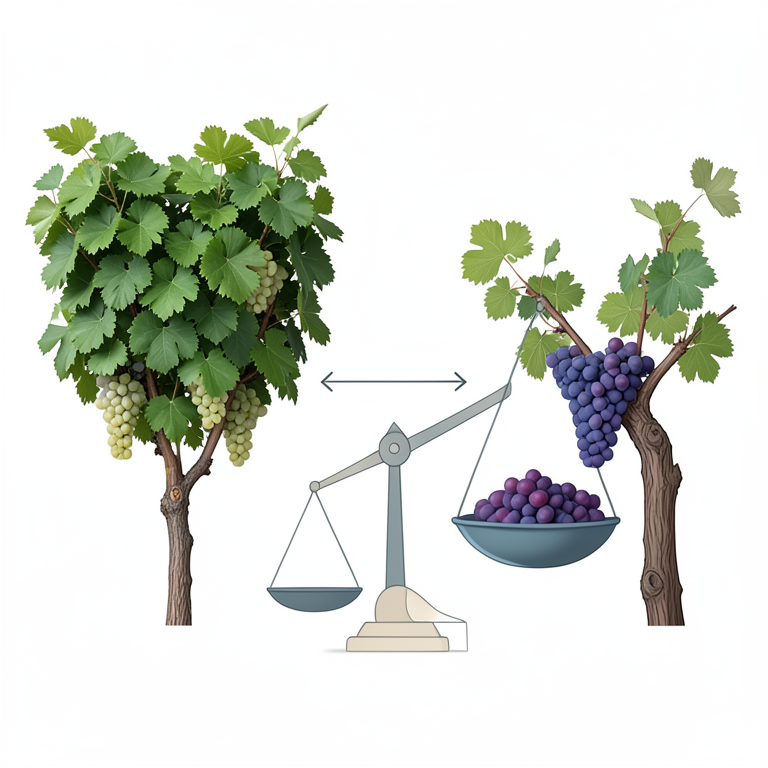
- A strong negative linear relationship (R² = 0.91) was observed between LAI and sugar content, where every one-unit increase in LAI decreased Brix by approximately 1.4 units. View evidence ↗
- Root-zone nematode populations were lowest in the gobelet system (182 per 100 g soil) and highest in the Geneva double curtain system (347 per 100 g soil). View evidence ↗
What it means
- The authors conclude that VSP is the best choice for premium wine quality in cool highland climates, whereas Geneva DC is better for high-volume production of juice or sparkling wine. View evidence ↗
- The authors state that future work should test these systems with different cool-hardy cultivars and include economic analyses to determine profitability in the Scottish market. View evidence ↗
Visual summary
3 visualsIllustrations explain the paper; charts are replotted from the paper's own table values.
LAI and Sugar Trade-off
AI-generated conceptual illustration (grapevine plants). It explains the idea and does not show study data.
View source evidence ↗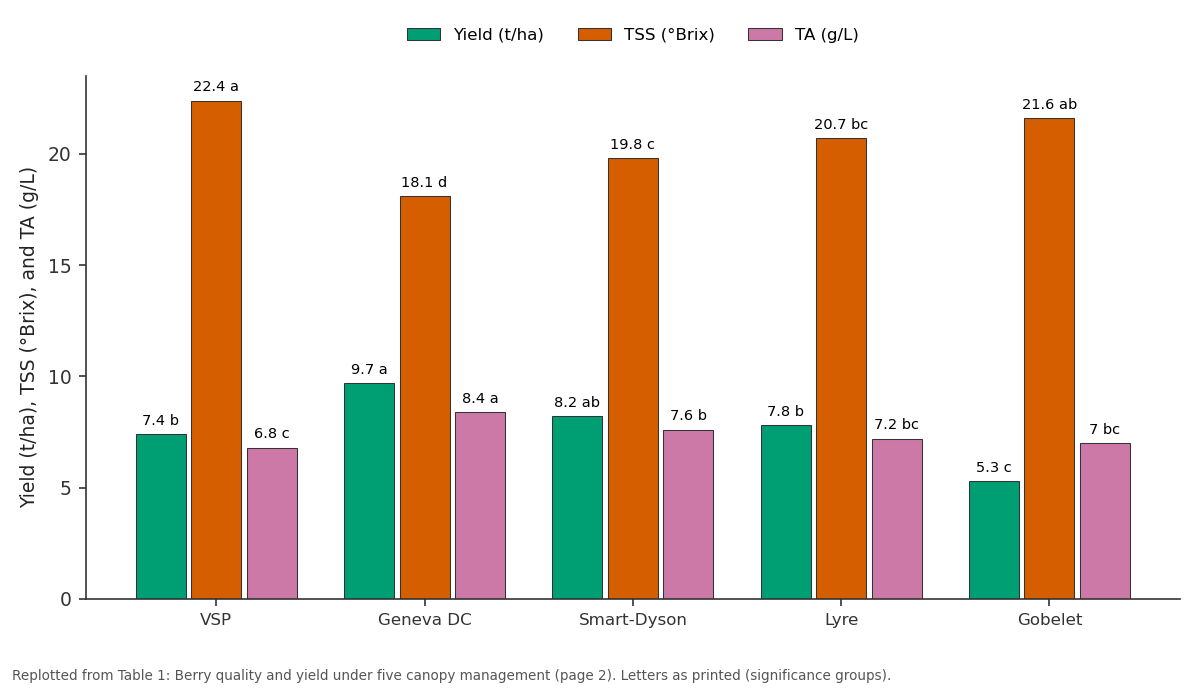
Yield (t/ha) and TSS (°Brix) and more: VSP vs Geneva DC vs Smart-Dyson vs Lyre vs Gobelet
Replotted from Table 1 (page 2) of the original paper. Every bar is the paper's own table value.
View source evidence ↗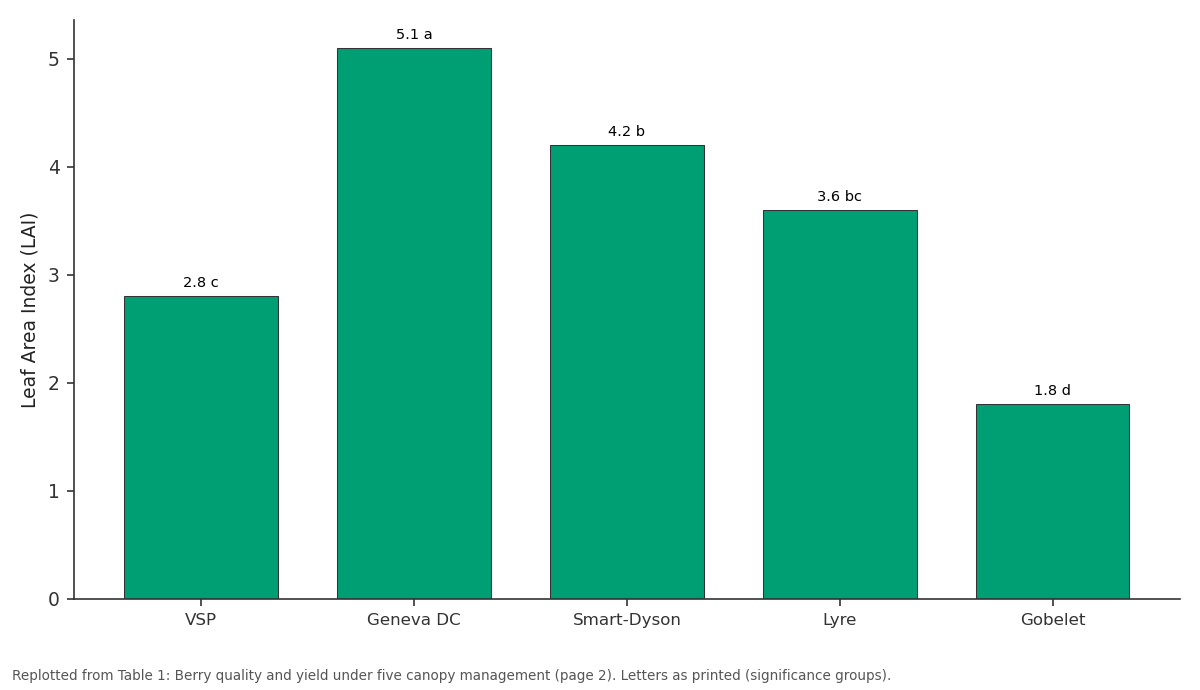
LAI: VSP vs Geneva DC vs Smart-Dyson vs Lyre vs Gobelet
Replotted from Table 1 (page 2) of the original paper. Every bar is the paper's own table value.
View source evidence ↗Figures & tables
From the original paper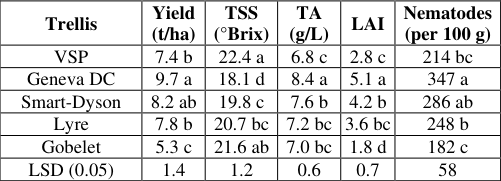 Table 1
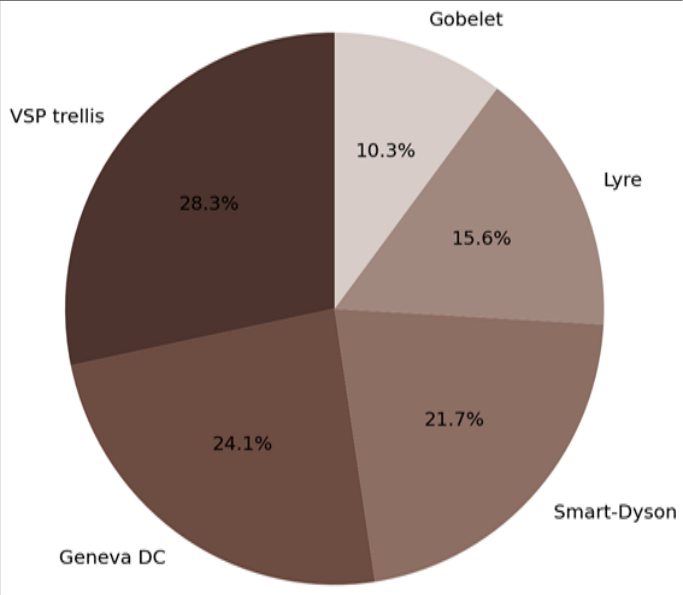 Figure 1
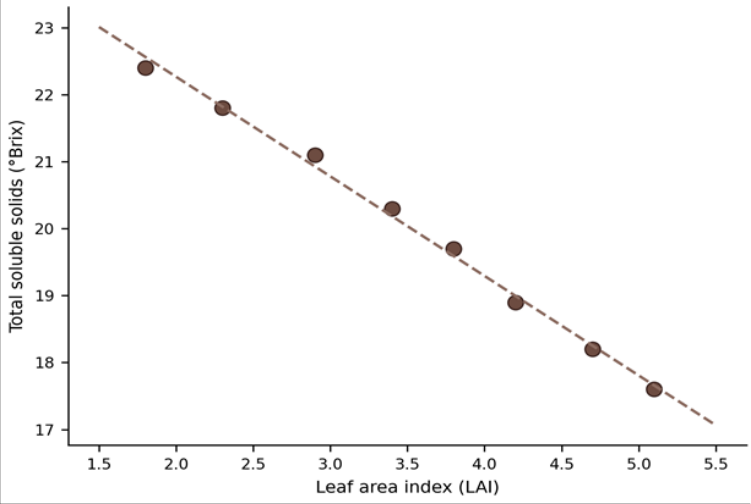 Figure 2
Introduction
Scotland and southern France sit barely 1,500 km apart, yet their grape-growing histories could not be more different. Bordeaux's 7,000-year winemaking lineage stands against Scotland's handful of experimental vineyards, most established only after 2010 [1] . The barrier is climatic: the Scottish Highlands average just 1,100 growing degree-days (base 10 °C), compared with 1,800-2,200 for established cool-climate wine regions like the Mosel or Marlborough [2] . But new cold-hardy interspecific cultivars such as 'Solaris', bred for resistance to downy mildew and capable of ripening at 900-1,200 GDD, have opened a narrow window for viticultural expansion into high-latitude environments [3] . Canopy management becomes the central lever when heat units are scarce. By controlling shoot density, leaf layering, and fruit exposure, growers can steer sugar accumulation, acid metabolism, and phenolic development within the limits set by the thermal environment [4] . The VSP trellis, dominant in most of the world's cool-climate vineyards, positions shoots vertically to maximise light capture and air circulation. Geneva double curtain splits the canopy into two downward-hanging curtains, doubling the exposed leaf area but often at the cost of interior shading and delayed ripening [5] . Less common systems like Smart-Dyson and lyre offer intermediate architectures. Soil biological health under different trellis systems has received little attention. Canopy structure alters the amount and distribution of throughfall, modifying soil moisture and temperature patterns that in turn affect root-parasitic nematode communities [6] . In cool, wet climates, denser canopies keep soil wetter for longer, potentially favouring nematode reproduction cycles. Conversely, open canopies that allow soil surface drying between rain events may suppress nematode activity below economic damage thresholds [7] . This research compared five trellis systems for berry quality, yield, LAI, and root-zone nematode abundance under simulated Scottish Highland conditions at Calgary, Canada [8] .
Soil and Water Quality Analysis
The trial site at Calgary Foundation for Pomological Research (51.05° N, 114.07° W; 1,045 m a.s.l.) has a Eutric Cambisol with silt loam texture (sand 28.3%, silt 52.4%, clay 19.3%), pH 7.2, organic carbon 2.38%, and CEC 18.4 cmol kg -1 . Irrigation water was sourced from a municipal supply: EC 0.31 dS m -1 , pH 7.6, SAR 1.2. To simulate Scottish Highland acidity, elemental sulphur at 300 kg ha -1 was incorporated before planting to lower pH to 5.8 [9] . Soil nematodes were extracted from 100 g subsamples by the Baermann funnel method and counted under a stereomicroscope at 40× magnification.
Nutrient Budget
Annual vine nutrient demand was estimated from leaf and fruit tissue analysis at veraison and harvest. Nitrogen removal in harvested fruit ranged from 4.2 kg ha -1 (gobelet, lowest yield) to 8.1 kg ha -1 (Geneva DC). Potassium removal followed a similar pattern, from 7.8 to 14.6 kg ha -1 . Fertigation delivered 60 kg N, 20 kg P 2 O 5 , and 80 kg K 2 O per hectare. The highest-yielding system therefore exported only 13.5% of applied nitrogen and 18.3% of applied potassium, leaving wide margins for carryover [10] .
Material and Methods Material
Three-year-old 'Solaris' grapevines on SO4 rootstock were planted at 2.0 m × 1.2 m spacing (4,167 vines ha -1 ). Trellis structures were installed in autumn 2020 and vines trained through the 2021 growing season. Portable evaporative cooling units maintained canopy-zone temperatures below 22 °C (mean Scottish July maximum). Blackout curtains reduced photoperiod to 16.5 hours during June-August to replicate Highland daylength. A Davis Vantage Pro2 weather station recorded microclimate within each trellis type. Berry samples were analysed for total soluble solids (digital refractometer), titratable acidity (NaOH titration to pH 8.2), and pH (glass electrode) [4] .
Methods
Five trellis systems were arranged in a randomised complete block design with four replications (20 plots, 12 vines per plot). Yield was recorded at harvest (mid-October) by weighing all clusters per plot. LAI was measured nondestructively with an LAI-2200C plant canopy analyser (LI-COR) at veraison. Nematode abundance was assessed from two 20 cm deep cores per plot at harvest. Data were analysed by ANOVA in SAS 9.4 with Tukey's HSD at P ≤ 0.05. Geneva DC produced the highest yield (9.7 t ha -1 ) but the lowest TSS (18.1 °Brix) and highest acidity (8.4 g L -1 ). VSP gave the best quality: 22.4 °Brix and 6.8 g L -1 TA with moderate yield (7.4 t ha -1 ). Nematode abundance tracked LAI closely; gobelet had the fewest nematodes (182) and the lowest LAI (1.8). The pie chart (Figure 1) shows Geneva DC contributing the largest yield share (28.3%) despite inferior quality. The LAI-Brix scatter plot (Figure 2) confirms a strong trade-off: each unit increase in LAI corresponded to roughly a 1.4 °Brix decline, reflecting the dilution effect of excess vegetative growth on fruit sugar concentration.
Results
Results
Discussion
The inverse LAI-Brix relationship (R² = 0.91) echoes findings from Marlborough Sauvignon Blanc vineyards, where LAI above 3.5 depressed sugar accumulation by 8-15% [4] . In the Scottish Highland simulation, this threshold appears even more constraining because lower ambient temperatures slow the enzymatic conversion of starch to sugar during ripening. VSP's moderate LAI of 2.8 kept the canopy thin enough for sunlight to reach all cluster zones, driving both photosynthesis in adjacent leaves and direct berry warming that favours hexose accumulation [5] . Geneva DC's high yield came at the expense of maturity. At 18.1 °Brix, fruit would fall below the 20 °Brix minimum for still table wine in most European appellation rules, though it could suit sparkling wine or grape juice production where lower sugar is acceptable [3] . The system's dense double curtain also harboured significantly more nematodes (347 per 100 g), which may be linked to persistently moist, shaded soil conditions that reduce nematode desiccation mortality [6] . Gobelet, the least intensive system, produced clean fruit with good sugar levels but the lowest yield, making it economically marginal unless niche pricing compensates. Its low nematode count is an advantage for organic growers who lack chemical nematicide options [7] . The practical recommendation depends on the grower's market: VSP for quality-focused still wine, Geneva DC for volume-focused sparkling or juice.
Conclusion
Among five canopy management systems tested under simulated Scottish Highland conditions, VSP trellis delivered the highest berry quality with 22.4 °Brix and balanced acidity of 6.8 g per litre. Geneva double curtain maximised yield at 9.7 t per hectare but produced under-ripe fruit unsuitable for premium still wine. Leaf area index proved to be a reliable predictor of berry sugar content, with each unit increase in LAI depressing Brix by approximately 1.4 units. This relationship gives growers a simple monitoring target: maintain LAI below 3.0-3.5 for quality-oriented production. Nematode abundance tracked canopy density, suggesting that trellis choice has indirect consequences for soil biological health that deserve attention in integrated pest management planning. Future research should compare these trellis systems across multiple cool-hardy cultivars and incorporate economic analysis to determine the break-even yield at which each system becomes profitable under Scottish market conditions.
Figures and tables from the paper
| Trellis | Yield (t/ha) | TSS (°Brix) | TA (g/L) | LAI | Nematodes (per 100 g) |
|---|---|---|---|---|---|
| VSP | 7.4 b | 22.4 a | 6.8 c | 2.8 c | 214 bc |
| Geneva DC | 9.7 a | 18.1 d | 8.4 a | 5.1 a | 347 a |
| Smart-Dyson | 8.2 ab | 19.8 c | 7.6 b | 4.2 b | 286 ab |
| Lyre | 7.8 b | 20.7 bc | 7.2 bc | 3.6 bc | 248 b |
| Gobelet | 5.3 c | 21.6 ab | 7.0 bc | 1.8 d | 182 c |
| LSD (0.05) | 1.4 | 1.2 | 0.6 | 0.7 | 58 |
Table text extracted from the original PDF; superscript letters are shown inline. The original table image is below.
View original table image
References
20 in the original paper- Robinson J, Harding J. The Oxford Companion to Wine. Oxford University Press. 2015;4th ed.
- Jones GV, Davis RE. Climate influences on grapevine phenology. International Journal of Climatology. 2000;20(7):813-834.
- Becker N. Site climate and viticultural suitability of northern Europe. Acta Horticulturae. 2012;931:23-34.
- Smart RE, Robinson M. Sunlight into Wine: A Handbook for Winegrape Canopy Management. Winetitles. 1991;1-224.
- Reynolds AG, Vanden Heuvel JE. Influence of grapevine training systems on vine growth and fruit composition. American Journal of Enology and Viticulture. 2009;60(3):251-268.
- Ferris H, Zheng L. Plant sources of Chinese herbal remedies: effects on Pratylenchus. Journal of Nematology. 1999;31(3):241-263.
- McSorley R. Overview of organic amendments for management of plant-parasitic nematodes. Journal of Nematology. 2011;43(2):98-105.
- Calgary FPR. Annual report on fruit research activities. CFPR Report. 2020;17:1-52.
- Sumner ME, Miller WP. Liming to improve soil quality in acid soils. Advances in Agronomy. 1996;57:1-38.
- Conradie WJ. Distribution and translocation of nitrogen in grapevines. South African Journal of Enology and Viticulture. 1986;7(2):76-83.
- Jackson RS. Wine Science: Principles and Applications. Academic Press. 2014;4th ed:1-919.
- Gladstones J. Viticulture and Environment. Winetitles. 1992;1-310.
- Keller M. The Science of Grapevines: Anatomy and Physiology. Academic Press. 2020;3rd ed:1-554.
- Dry PR. Canopy management for fruitfulness. Australian Journal of Grape and Wine Research. 2000;6(2):109-115.
- Kennedy JA, Matthews MA. Grape berry development and composition. Acta Horticulturae. 2007;754:25-36.
- Wolf TK, Pool RM. Factors affecting cold hardiness of grapevines. American Journal of Enology and Viticulture. 1987;38(1):29-33.
- Kraus C, Bauer J. Root-lesion nematodes in vineyards of Germany. Journal of Plant Diseases and Protection. 2018;125(4):389-396.
- Smithyman RP, Howell GS. Microclimatic effects of trellising on Seyval blanc grapevines. American Journal of Enology and Viticulture. 1998;49(3):293-303.
- Bergqvist J, Dokoozlian N. Effect of cluster exposure on fruit composition. American Journal of Enology and Viticulture. 2001;52(1):1-7.
- Coombe BG. Growth stages of the grapevine. Australian Journal of Grape and Wine Research. 1995;1(2):104-110.