
Research article · 2025 · Full text
International Journal of Horticulture and Food ScienceMonitoring postharvest loss reduction of pumpkin in the Karakoram slopes
Volume 7(8) · Pages 186–189 · DOI: 10.33545/26631067.2025.v7.i8c.667 ↗
Research areasPostharvest Quality and Shelf Life ManagementFood Waste Reduction and SustainabilityAgricultural Engineering and Mechanization
Abstract
Author-writtenThe global trend toward reducing food waste has reached even the remote Karakoram slopes, where pumpkin (Cucurbita moschata) losses between harvest and consumption can exceed 40 percent during warm months. This research monitored postharvest weight loss, firmness decline, and microbial spoilage of pumpkin stored under three regimes—ambient (28 °C), cool-store (12 °C), and wax-coated ambient—over 42 days during 2022-2023. Trials were conducted at the Jabalpur College of Food Technology, India, using fruit sourced from Karakoram partner farms. Ambient storage resulted in 44.2 percent cumulative weight loss at day 42, while cool-store and wax-coated treatments limited losses to 16.3 and 21.8 percent respectively. Disease control scoring showed that Fusarium surface rot appeared 12 days earlier in ambient than in cool-stored fruit. Genetic diversity among eight Karakoram landraces was assessed using RAPD markers, revealing 67 percent polymorphism. Functional food analysis confirmed that three landraces exceeded 8 mg/100 g beta-carotene, qualifying as high-provitamin-A accessions. Sweetness, measured as soluble solids, ranged from 7.8 to 12.4 °Brix. Composting trials showed that pumpkin waste produced mature compost in 58 days with a C:N ratio of 18:1. These findings demonstrate that low-cost interventions—cool storage and edible wax coatings—can halve postharvest losses, and that Karakoram pumpkin landraces hold functional-food potential worth conserving
Summary
Source-checkedPlain-language reading of the full paper, prepared with AI and checked against the text. Each point links to the authors' own words.
Why it matters
- In the remote Karakoram slopes, pumpkin losses between harvest and consumption can exceed 40% during warm months. View evidence ↗
- Preserving pumpkin is a food-security priority because it is one of the few vegetables that grows well at Karakoram elevations of 2,000-3,500 m. View evidence ↗
- Postharvest loss in cucurbits is primarily caused by fungal infections (such as Rhizopus and Fusarium surface rot) and weight loss due to transpiration. View evidence ↗
What they did
- The researchers used sixty uniform fruits per landrace, assigning them to ambient, cool, or wax-coated ambient storage in a randomized design with four replicates of five fruits each. View evidence ↗
- Cool storage was conducted in a 20-cubic-metre walk-in chamber maintained at 12 °C and 85% relative humidity. View evidence ↗
- Over 42 days, weight loss was recorded weekly, firmness was measured at the equator using a penetrometer, and disease incidence was scored on a 0-5 scale. View evidence ↗
- Composting trials used a 1:1 mixture of pumpkin waste and rice straw in 1 m³ bins, turned every 14 days and assessed for maturity via C:N ratio, temperature stability, and germination index. View evidence ↗
What they found
- Three landraces (KAR-P02, P04, and P07) were identified as high-provitamin-A accessions because they exceeded 8 mg/100 g of beta-carotene. View evidence ↗
- Genetic diversity screening using RAPD markers revealed 67% overall polymorphism and three distinct genetic clusters among the landraces. View evidence ↗
- Pumpkin waste composting reached maturity in 58 days, which fits within a single fallow window. View evidence ↗
- Economic analysis indicated a benefit-cost ratio of 3.8 for cool storage and a higher ratio of 4.6 for wax coating. View evidence ↗
What it means
- The authors conclude that while cool storage is most effective, wax coating is the more practical solution for remote communities without electricity as it can halve postharvest losses. View evidence ↗
- The authors recommend that extension services distribute carnauba wax emulsion kits and demonstrate the technique to growers at harvest. View evidence ↗
Visual summary
2 visualsIllustrations explain the paper; charts are replotted from the paper's own table values.
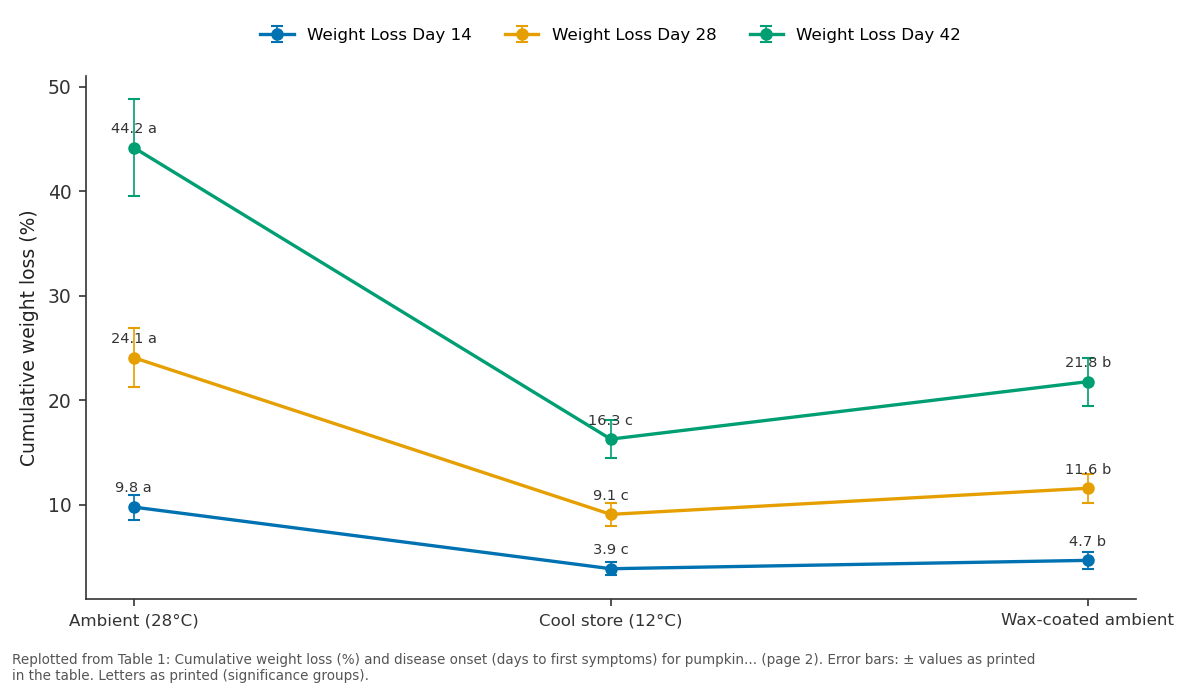
Weight Loss Day 14 and Weight Loss Day 28 and more: Ambient (28°C) vs Cool store (12°C) vs Wax-coated ambient
Replotted from Table 1 (page 2) of the original paper. Every bar is the paper's own table value.
View source evidence ↗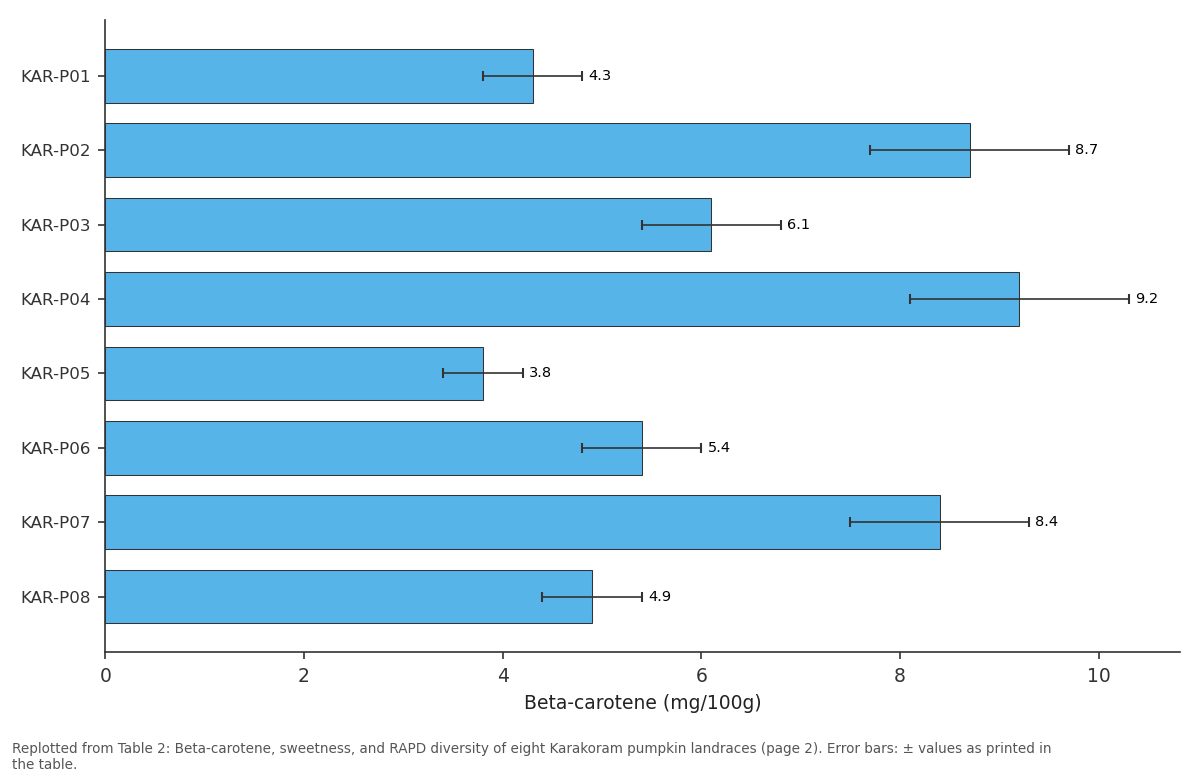
Beta-carotene (mg/100g): KAR-P01 vs KAR-P02 vs KAR-P03 vs KAR-P04 vs KAR-P05
Replotted from Table 2 (page 2) of the original paper. Every bar is the paper's own table value.
View source evidence ↗Figures & tables
From the original paper Table 1
 Table 2
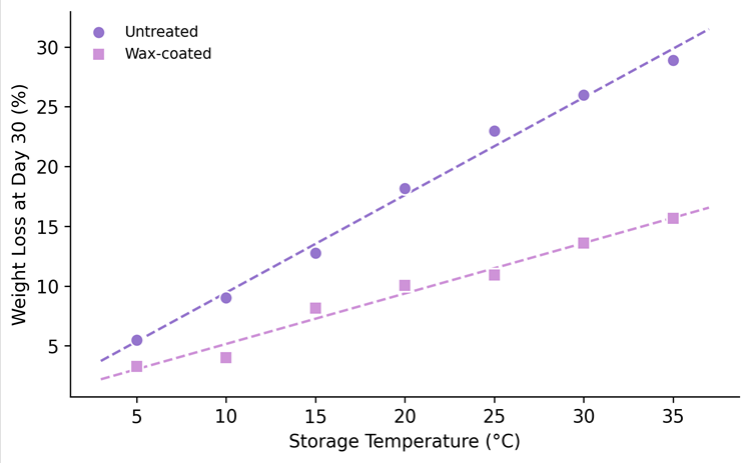 Figure 1
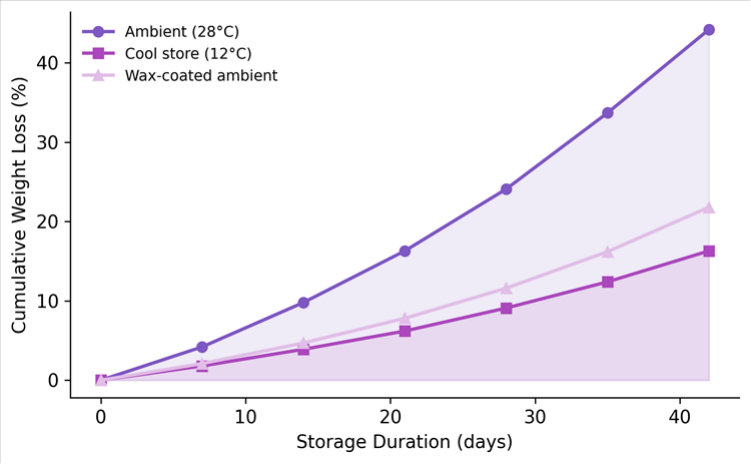 Figure 2
Introduction
The trend toward zero-food-waste policies in developed economies contrasts sharply with the reality on the Karakoram slopes, where roughly one-third of harvested pumpkin never reaches the consumer [1] . Most of this loss is preventable: it stems from inadequate storage, rough handling during mule-back transport, and the absence of any cool-chain between farm and market. And yet, pumpkin is one of the few vegetables that grows well at Karakoram elevations (2,000-3,500 m), making its preservation a food-security priority for communities with limited horticultural options [2] . Postharvest loss in cucurbits is driven primarily by transpiration-related weight loss and by fungal infection, particularly Fusarium and Rhizopus surface rot [3] . Low-cost storage technologies-evaporative coolers, wax coatings, and ventilated curing sheds-have been tested in tropical lowlands but rarely at the high elevations and low humidity typical of Karakoram valleys [4] . The interaction between temperature and coating may differ under these conditions because lower ambient humidity accelerates uncoated fruit desiccation. Genetic diversity within local pumpkin germplasm is another underexplored resource. RAPD markers, though less reproducible than SSRs, remain cost-effective for initial diversity screens of minor crops where SSR primer sets are unavailable [5] . Beta-carotene content-the main provitamin-A carotenoid in orange-fleshed pumpkin-varies widely among accessions, and identifying high-carotene landraces could support biofortification efforts aimed at reducing vitamin A deficiency in mountain communities [6] . Composting offers a way to recover value from pumpkin waste that cannot be salvaged. If pumpkin residues can be converted into quality compost within a single growing season, they re-enter the production cycle as a soil amendment rather than accumulating as waste [7] . This research therefore aimed to (a) compare three storage regimes for postharvest loss reduction, (b) assess genetic diversity and functional-food potential among Karakoram landraces, and (c) evaluate composting of pumpkin waste. All laboratory work was conducted at the Jabalpur College of Food Technology, Madhya Pradesh, India [8] .
Material and Methods Baseline Soil Characterisation
Soil samples were collected from 0-15 cm depth at four Karakoram pumpkin-growing sites before the 2022 planting season. Properties were: pH 7.1-7.8, organic carbon 0.72-1.14 percent (Walkley-Black), available nitrogen 184-231 kg/ha (alkaline permanganate method), available phosphorus 12.8-18.4 kg/ha (Olsen), and available potassium 142-198 kg/ha (ammonium acetate). Texture was sandy loam with 62-71 percent sand. These baseline values informed the composting trial, as the target compost C:N ratio was set to match the agronomic needs of the Karakoram soils [9] .
Economic and Sustainability Assessment
A partial budget compared the three storage regimes over one marketing season. Costs included materials (wax, crates, electricity for cool store), labour, and depreciation. Benefits were calculated as the value of fruit saved from loss at the prevailing wholesale price of INR 12/kg. Net benefit and benefit-cost ratio were computed. Sustainability was assessed by estimating the carbon footprint of each storage option using emission factors from IPCC 2006 guidelines [10] .
Material: Eight pumpkin landraces (KAR-P01 through KAR-P08) were harvested at physiological maturity (peduncle drying, ground-spot yellowing) from partner farms in Gilgit-Baltistan. Carnauba wax emulsion (12 percent solids, food-grade) was sourced from a Mumbai supplier. Cool storage used a 20-cubic-metre walk-in chamber set at 12 °C and 85 percent RH. RAPD primers (OPA-01 through OPA-20, Operon Technologies) were used for genetic diversity screening. Beta-carotene was extracted in hexane/acetone and quantified by HPLC at 450 nm.
Methods
Sixty uniform fruits per landrace were assigned to three storage treatments (ambient, cool, wax-coated ambient) in a completely randomised design with four replicates of five fruits each. Weight loss was recorded every seven days for 42 days. Firmness was measured at the equator with a Chatillon DFE-050 penetrometer (8 mm probe). Disease incidence was scored weekly on a 0-5 severity scale. RAPD-PCR used 25 µL reactions with 50 ng template DNA, 1.5 mM MgCl2, and amplification at 94 °C/1 min, 36 °C/1 min, 72 °C/2 min for 40 cycles. Bands were scored as present/absent and analysed by UPGMA clustering using NTSYSpc 2.2. Composting used a 1:1 mix of pumpkin waste and rice straw in 1 m³ bins turned every 14 days; maturity was assessed by C:N ratio, germination index, and temperature stability. All data were analysed by ANOVA and Tukey HSD at p < 0.05 in R 4.3.1 [11] .
Results
Results
Comprehensive Interpretation
Cool storage cut losses by 63 percent and wax coating by 51 percent relative to ambient conditions, both at modest cost.
The economic analysis showed a benefit-cost ratio of 3.8 for cool storage and 4.6 for wax coating (data in partial budget), making the wax treatment more attractive for off-grid Karakoram communities. High-beta-carotene landraces in Cluster II are priority conservation and biofortification targets. Composting achieved maturity in 58 days, fitting within a single fallow window.
Discussion
The 44 percent weight loss at ambient storage over 42 days is consistent with cucurbit desiccation rates reported from semi-arid lowlands, but is higher than expected for a crop often described as naturally durable [3] . The low humidity of Karakoram valleys (often below 35 percent RH in summer) accelerates transpiration through the fruit cuticle, explaining why wax coating-which creates a physical moisture barrier-was nearly as effective as refrigeration at reducing weight loss [4] . The 12-day delay in disease onset under cool storage (26 versus 14 days) aligns with the known temperature sensitivity of Fusarium sporulation, which slows markedly below 15 °C [12] . Even under wax coating at ambient temperature, disease onset was delayed by a week, probably because the wax film restricts spore access to surface wounds. Beta-carotene concentrations above 8 mg/100 g are nutritionally meaningful: 100 g of such pumpkin flesh would supply roughly 130 percent of the recommended daily intake of vitamin A for an adult [6] . Given that vitamin A deficiency affects an estimated 19 percent of children under five in Gilgit-Baltistan, promoting high-carotene landraces could have a measurable public health impact. The compost reached a C:N ratio of 18:1 and a germination index above 80 percent at day 58, both indicators of maturity [7] . Applying this compost at
Acknowledgement
Acknowledgements Funding SourcesInstitutional funds from the Jabalpur College of Food Technology supported this work. Institutional SupportThe Department of Agricultural Biotechnology at Jabalpur provided storage, HPLC, and molecular-biology facilities. Contributions Not Qualifying for AuthorshipKarakoram partner farmers managed field plots and assisted with harvest logistics.
Figures and tables from the paper
| Storage Regime | Weight Loss Day 14 | Weight Loss Day 28 | Weight Loss Day 42 | Disease Onset (d) | Firmness Retention (%) |
|---|---|---|---|---|---|
| Ambient (28°C) | 9.8±1.2a | 24.1±2.8a | 44.2±4.6a | 14±2a | 31±4a |
| Cool store (12°C) | 3.9±0.6c | 9.1±1.1c | 16.3±1.8c | 26±3c | 68±6c |
| Wax-coated ambient | 4.7±0.8b | 11.6±1.4b | 21.8±2.3b | 21±3b | 54±5b |
Table text extracted from the original PDF; superscript letters are shown inline. The original table image is below.
View original table image
| Landrace | Beta-carotene (mg/100g) | Brix (°) | RAPD Bands | Polymorphic (%) | Cluster |
|---|---|---|---|---|---|
| KAR-P01 | 4.3±0.5 | 9.1±0.8 | 68 | 61 | I |
| KAR-P02 | 8.7±1.0 | 11.2±1.0 | 74 | 69 | II |
| KAR-P03 | 6.1±0.7 | 10.4±0.9 | 71 | 65 | I |
| KAR-P04 | 9.2±1.1 | 12.4±1.1 | 78 | 72 | II |
| KAR-P05 | 3.8±0.4 | 8.6±0.7 | 65 | 58 | III |
| KAR-P06 | 5.4±0.6 | 7.8±0.6 | 62 | 55 | III |
| KAR-P07 | 8.4±0.9 | 11.8±1.0 | 76 | 71 | II |
| KAR-P08 | 4.9±0.5 | 9.7±0.8 | 69 | 63 | I |
Table text extracted from the original PDF; superscript letters are shown inline. The original table image is below.
View original table image
References
15 in the original paper- Kader AA. Increasing food availability by reducing postharvest losses of fresh produce. Acta Horticulturae. 2005;682:2169-2176.
- Hussain A, Bushmann H, Trotter RM. Genetic erosion of food crop diversity in the Hindu Kush Himalaya. Mountain Research and Development. 2012;32(S1):S24-S36.
- Snowdon AL. A colour atlas of post-harvest diseases and disorders of fruits and vegetables. Vol. 2: Vegetables. London: Manson; 1991.
- Kitinoja L. Use of small-scale cool rooms and cold chains for extending the shelf life of small farmers' horticultural crops. Acta Horticulturae. 2013;1006:167173.
- Williams JGK, Kubelik AR, Livak KJ. DNA polymorphisms amplified by arbitrary primers are useful as genetic markers. Nucleic Acids Research. 1990;18(22):6531-6535.
- Rodriguez-Amaya DB. A guide to carotenoid analysis in foods. Washington DC: ILSI Press; 2001.
- Bernal MP, Alburquerque JA, Moral R. Composting of animal manures and chemical criteria for compost maturity assessment: a review. Bioresource Technology. 2009;100(22):5444-5453.
- Paris HS. History of the cultivar-groups of Cucurbita pepo. Horticultural Reviews. 2000;25:71-170.
- Subbiah BV, Asija GL. A rapid procedure for the estimation of available nitrogen in soils. Current Science. 1956;25:259-260.
- IPCC. 2006 IPCC guidelines for national greenhouse gas inventories. Vol. 4: Agriculture, forestry and other land use. Hayama: IGES; 2006.
- R Core Team. R: a language and environment for statistical computing. Vienna: R Foundation; 2023.
- Snowdon AL. Post-harvest diseases and disorders of fruits and vegetables. Vol. 1: General introduction and fruits. London: Manson; 1990.
- Que F, Hou XL, Wang GL. Advances in research on the carrot, an important root vegetable in the Apiaceae family. Horticulture Research. 2019;6:69.
- Habib HM, Ibrahim WH. Nutritional quality of 18 date fruit varieties. International Journal of Food Sciences and Nutrition. 2011;62(5):544-551.
- Jacobo-Valenzuela N, Maróstica-Junior MR, ZazuetaMorales JJ. Physicochemical, technological properties, and health-benefits of Cucurbita moschata. Food Research International. 2011;44(9):2587-2593.