
Research article · 2025 · Full text
International Journal of Agriculture and NutritionWillingness to pay for organic produce among urban consumers in emerging markets
Volume 7(3) · Pages 107–110 · DOI: 10.33545/26646064.2025.v7.i3b.617 ↗
Research areasOrganic Food and AgricultureEconomic and Environmental ValuationEconomics of Agriculture and Food Markets
Abstract
Author-writtenHere is a paradox: Iranian consumers express strong support for organic farming in opinion polls, yet organic produce accounts for less than 0.3% of the domestic food market. This research investigated Willingness to Pay (WTP) premiums for organic vegetables, fruits, grains, dairy, and pulses among 624 urban consumers in Rasht and Isfahan using a contingent valuation method with double-bounded dichotomous choice. A structured questionnaire was administered face-to-face between March and June 2023. Mean WTP premium across all categories was 21.4% above conventional prices, but this varied sharply by product and income group. High-income consumers (monthly household income above $700 equivalent) were willing to pay 31.4% more for organic vegetables compared with 12.3% among low-income respondents. Dairy attracted the highest WTP (34.7% premium in the high-income group), while grains had the lowest (22.8%). Health concerns were the primary motivation for 38.4% of respondents. Binary logistic regression identified income, education, household size, and prior organic purchase experience as significant predictors of WTP. These findings suggest that the organic market in Iranian cities has latent demand that is constrained by price, availability, and trust in certification rather than by lack of consumer interest.
Summary
Source-checkedPlain-language reading of the full paper, prepared with AI and checked against the text. Each point links to the authors' own words.
Why it matters
- There is a significant paradox in Iran where consumers express strong support for organic farming, but organic produce makes up less than 0.3% of the domestic food market. View evidence ↗
- The gap between consumer preference and actual purchase behavior in emerging economies is typically caused by high prices, low availability, and distrust of certifications. View evidence ↗
The question
- The study aimed to estimate the Willingness to Pay (WTP) premiums for five organic product categories and identify the socio-economic factors, motivations, and barriers affecting organic food purchases in Rasht and Isfahan. View evidence ↗
What they did
- The researchers used a contingent valuation method with double-bounded dichotomous choice to survey 624 urban consumers regarding five organic product categories. View evidence ↗
- Data was collected via face-to-face administration of a structured questionnaire from March to June 2023. View evidence ↗
- The sample was obtained through stratified random sampling from 12 collection points (supermarkets and bazaars) across both cities, resulting in 312 usable questionnaires per city. View evidence ↗
- A binary logistic regression was used to analyze the probability of a consumer being willing to pay any premium based on nine explanatory variables. View evidence ↗
What they found
- Across all organic product categories, the mean willingness to pay premium was 21.4% above the price of conventional produce. View evidence ↗
- Income significantly affected WTP for vegetables, with high-income consumers (>$700/month) willing to pay a 31.4% premium compared to 12.3% for low-income consumers. View evidence ↗
- Among the categories, dairy had the highest overall WTP premium at 25.0%, while pulses had the lowest at 14.3%. View evidence ↗
- Health concerns were the primary driver for purchasing organic produce (38.4%), followed by environmental awareness (22.1%) and food safety (15.5%). View evidence ↗
- The significant predictors of a consumer's willingness to pay a premium were their income, education level, household size, and previous experience buying organic products. View evidence ↗
- The main barriers to organic purchase were lack of availability (41%) and distrust of certification (34%), both of which were more significant than price (22%). View evidence ↗
What it means
- The authors conclude that the discrepancy between consumer interest and actual market share is primarily due to availability and trust in certification rather than price resistance. View evidence ↗
- The authors recommend that the Iranian organic market focus on developing the supply chain and establishing credible third-party certification systems. View evidence ↗
- The authors state that future research should use revealed-preference methods to track actual purchasing behavior to validate the estimates obtained from this contingent valuation study. View evidence ↗
Visual summary
3 visualsIllustrations explain the paper; charts are replotted from the paper's own table values.
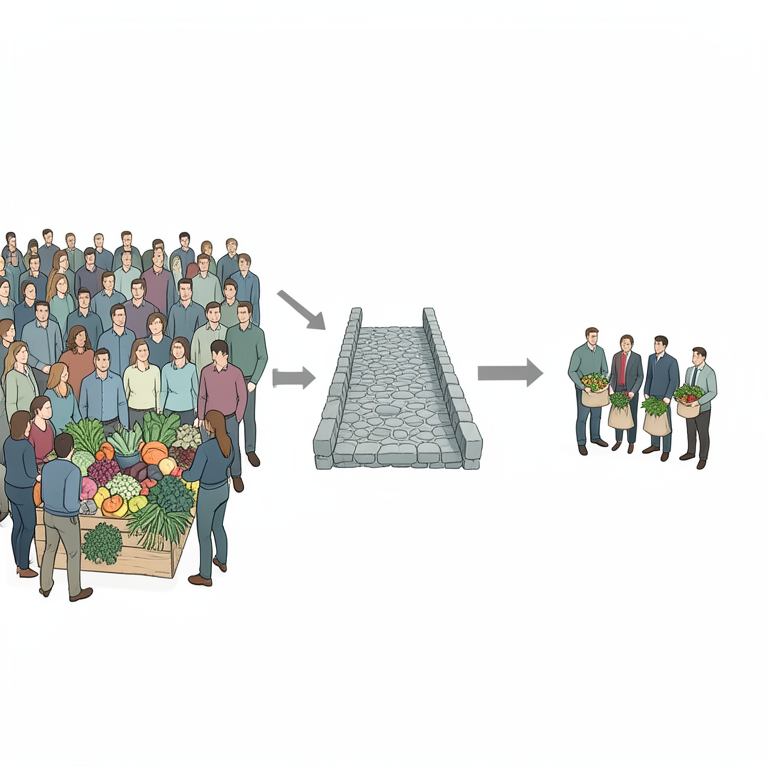
The Organic Market Gap
AI-generated conceptual illustration (Urban consumers and organic produce in a city market setting). It explains the idea and does not show study data.
View source evidence ↗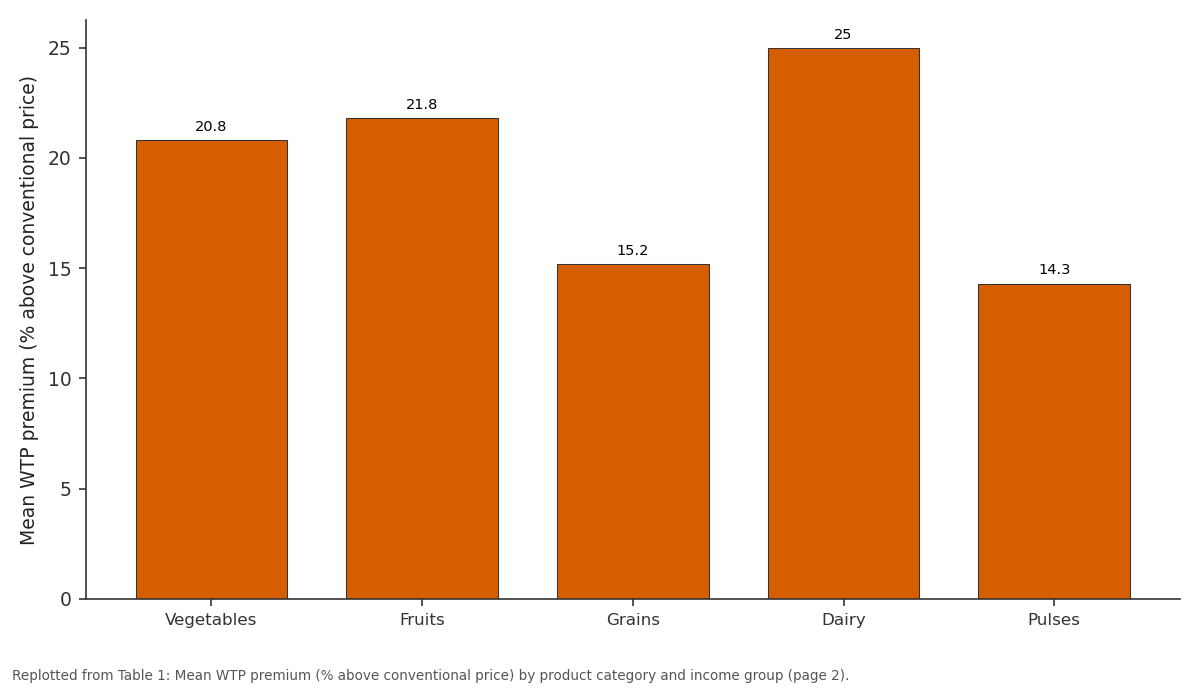
Overall mean: Vegetables vs Fruits vs Grains vs Dairy vs Pulses
Replotted from Table 1 (page 2) of the original paper. Every bar is the paper's own table value.
View source evidence ↗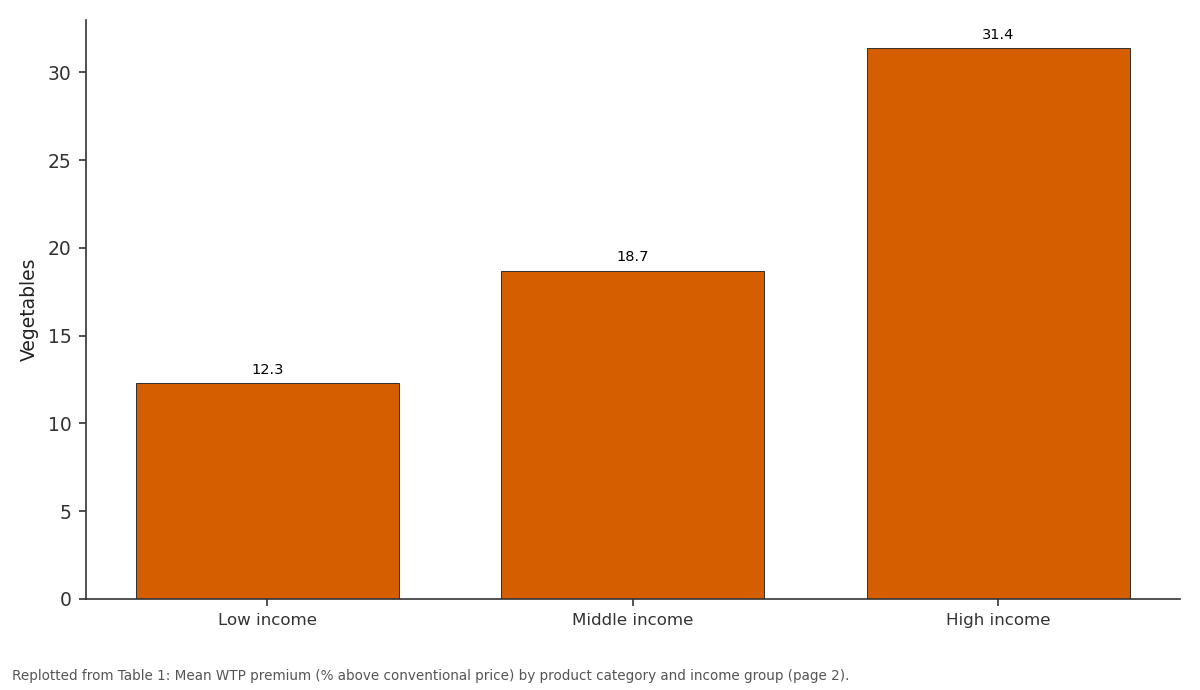
Vegetables: Low income vs Middle income vs High income
Replotted from Table 1 (page 2) of the original paper. Every bar is the paper's own table value.
View source evidence ↗Figures & tables
From the original paper Table 1
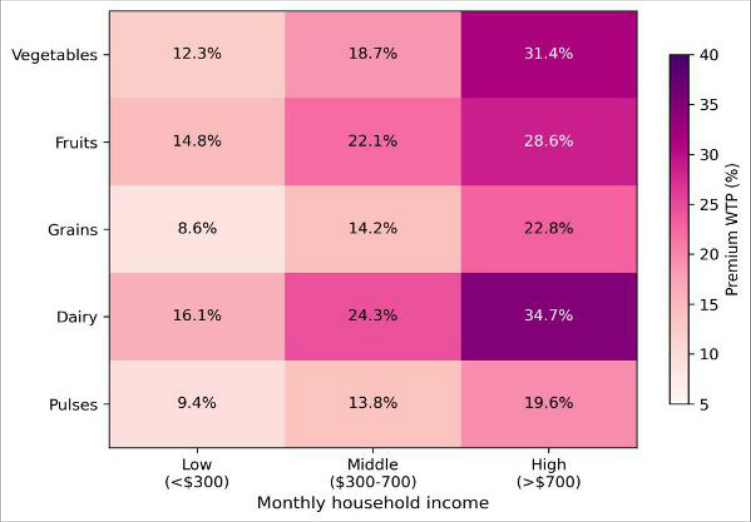 Figure 1
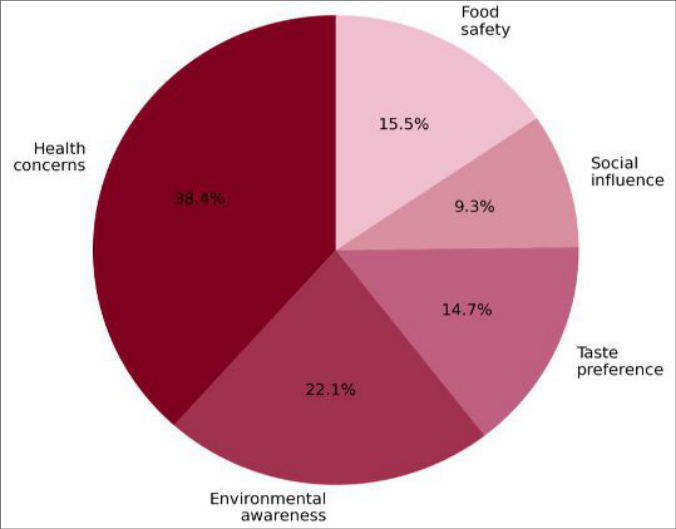 Figure 2
Introduction
The paradox is striking: in consumer surveys across Iran, 75-80% of urban respondents say they prefer organic food, yet actual purchase rates remain below 2% [1] . This gap between stated preference and market behaviour is common in emerging economies and usually reflects a combination of high price premiums, limited retail availability, and skepticism about certification authenticity [2] . Contingent valuation, a stated-preference method that asks respondents how much they would pay for a hypothetical product improvement, is widely used to estimate WTP for organic food [3] . The double-bounded dichotomous choice format, which presents two sequential bid amounts, improves statistical efficiency over single-bounded approaches [4] . Most WTP research on organic food in the Middle East has focused on Turkey and Egypt, with very few data from Iran, whose urban middle class has grown rapidly since 2010 and whose dietary patterns are shifting toward higher-value products [5,6] . This research surveyed 624 consumers in Rasht (capital of Gilan province, a major agricultural region) and Isfahan (a large inland city with a diversified economy) to estimate WTP premiums for five organic product categories, identify the socio-economic determinants of WTP, and understand the motivations and barriers to organic food purchase in Iranian cities [7,8] .
Material and Methods
Material and Methods
Material
A structured questionnaire with 42 items was developed in Farsi and pilot-tested on 40 consumers in Rasht. The instrument covered demographics (age, gender, income, education, household size), organic food awareness, purchase history, motivations, barriers, and a contingent valuation section using double-bounded dichotomous choice. Initial bid amounts (10%, 20%, 30%, 40% premium) were derived from retail price surveys in both cities. The sample was drawn by stratified random sampling from six supermarkets and four weekly bazaars in each city (total 12 collection points). A target of 320 respondents per city was set; 624 usable questionnaires were obtained (312 from each city).
Methods
In the contingent valuation section, respondents were shown a card describing organic certification and shown conventional and organic tomatoes, rice, milk, apples, and chickpeas side by side. They were asked if they would pay the initial bid premium. If yes, a higher follow-up bid was offered; if no, a lower one. Mean WTP was estimated using maximum likelihood with the STATA double command [9] . A binary logistic regression modelled the probability of positive WTP (dependent: willing/not willing to pay any premium) against nine explanatory variables. Descriptive analysis used SPSS 26.0 [10] . The heatmap (Figure 1) shows a clear diagonal gradient from low-income/grains (lightest) to high-income/dairy (darkest), confirming that both income and product category drive WTP. The pie chart (Figure 2) reveals health concerns as the dominant motivator (38.4%), followed by environmental awareness (22.1%) and food safety (15.5%).
Results
Results
Discussion
The 21.4% mean WTP premium aligns with meta-analytic estimates of 20-30% for organic food in middle-income countries [11] . The income elasticity of WTP is steep: moving from low to high income roughly doubles the premium offered, which implies that the organic market will grow naturally as Iranian household incomes rise [12] . The dominance of health motivations over environmental ones is consistent with research in Turkey and China, where food safety scandals have pushed consumers toward perceivedsafer alternatives [13] . The low WTP for grains and pulses likely reflects the perception that these products undergo heavy processing (milling, dehulling) that removes surface residues, making organic status seem less important [14] . Dairy's high WTP may be driven by the direct consumption pathway (fresh milk) and concerns about hormones and antibiotics in conventional dairy [15] . A barrier analysis (not shown in full) identified lack of availability (cited by 41% of respondents) and distrust of certification labels (34%) as the two main obstacles, ahead of price (22%). This suggests that supplychain and credibility interventions may be more effective than price subsidies [16,17] .
Conclusion
Urban consumers in Rasht and Isfahan are willing to pay a mean premium of 21.4% for organic produce, with WTP highest for dairy (25%) and lowest for pulses (14.3%). Income and education are the strongest determinants, and health concerns are the primary motivator. The gap between stated willingness and actual purchase behaviour appears driven more by availability and certification trust than by price resistance. Policymakers and retailers aiming to grow Iran's organic market should prioritise supply-chain development and credible third-party certification systems. Future research should track actual purchasing behaviour through revealed-preference methods to validate these contingent valuation estimates [18,19] .
Acknowledgement
Acknowledgements Funding sourcesThis research was supported by a joint research grant from the Caspian Institute of Agricultural Sciences, Rasht, and Isfahan Agricultural University. Institutional supportThe authors thank the supermarket chains and bazaar committees in Rasht and Isfahan for facilitating consumer interviews.
Figures and tables from the paper
| Category | Low income | Middle income | High income | Overall mean | 95% CI |
|---|---|---|---|---|---|
| Vegetables | 12.3 | 18.7 | 31.4 | 20.8 | ±3.2 |
| Fruits | 14.8 | 22.1 | 28.6 | 21.8 | ±2.9 |
| Grains | 8.6 | 14.2 | 22.8 | 15.2 | ±3.7 |
| Dairy | 16.1 | 24.3 | 34.7 | 25.0 | ±3.1 |
| Pulses | 9.4 | 13.8 | 19.6 | 14.3 | ±4.1 |
| Overall mean | 12.2 | 18.6 | 27.4 | 21.4 | ±2.1 |
Table text extracted from the original PDF; superscript letters are shown inline. The original table image is below.
View original table image
References
19 in the original paper- Shams A, Hooshmandan-Moghaddam-Fard Z. Factors affecting wheat farmers' attitudes toward organic farming in Iran. Journal of Agricultural Science and Technology. 2013;15(7):1455-1465.
- Vega-Zamora M, Torres-Ruiz FJ, Murgado-Armenteros EM, Parras-Rosa M. Organic as a heuristic cue. Appetite. 2014;77:120-128.
- Lusk JL, Briggeman BC. Food values. American Journal of Agricultural Economics. 2009;91(1):184196.
- Hanemann M, Loomis J, Kanninen B. Statistical efficiency of double-bounded dichotomous choice contingent valuation. American Journal of Agricultural Economics. 1991;73(4):1255-1263.
- Basha MB, Mason C, Shamsudin MF, Hussain HI, Salem MA. Consumers' attitude towards organic food. Procedia Economics and Finance. 2015;31:444-452.
- Radman M. Consumer consumption and perception of organic products in Croatia. British Food Journal. 2005;107(4):263-273.
- Caspian Institute of Agricultural Sciences. Consumer Research Unit Report 2023. Rasht: CIAS; 2023.
- Isfahan Agricultural University. Department of Rural Economics Working Paper 2023-04. Isfahan: IAU; 2023.
- Lopez-Feldman A. Introduction to contingent valuation using Stata. MPRA Paper 41018. Munich: University of Munich; 2012.
- IBM Corporation. SPSS Statistics for Windows. Version 26.0. Armonk: IBM Corp; 2019.
- Aschemann-Witzel J, Zielke S. Can't buy me green? A review of consumer perceptions and behaviour toward the price of organic food. Journal of Consumer Affairs. 2017;51(1):211-251.
- Misra SK, Huang CL, Ott SL. Consumer willingness to pay for pesticide-free produce. Western Journal of Agricultural Economics. 1991;16(2):218-227.
- Liu R, Pieniak Z, Verbeke W. Consumers' attitudes and behaviour towards safe food in China. Food Control. 2013;33(1):93-104.
- Hughner RS, McDonagh P, Prothero A, Shultz CJ, Stanton J. Who are organic food consumers? Journal of Consumer Behaviour. 2007;6(2-3):94-110.
- Yiridoe EK, Bonti-Ankomah S, Martin RC. Comparison of consumer perceptions and preference toward organic versus conventionally produced foods. Renewable Agriculture and Food Systems. 2005;20(4):193-205.
- Janssen M, Hamm U. Product labelling in the market for organic food. Food Quality and Preference. 2012;25(1):9-22.
- Nuttavuthisit K, Thogersen J. The importance of consumer trust for the emergence of a market for green products. Journal of Business Ethics. 2017;140(2):323338.
- Lusk JL, Schroeder TC. Are choice experiments incentive compatible? American Journal of Agricultural Economics. 2004;86(2):467-482.
- Aertsens J, Verbeke W, Mondelaers K, Van Huylenbroeck G. Personal determinants of organic food consumption: A review. British Food Journal. 2009;111(10):1140-1167.