
Research article · 2025 · Full text
International Journal of Agriculture and NutritionEffect of pre-cooling treatments on post-harvest quality of broccoli florets
Volume 7(11) · Pages 63–66 · DOI: 10.33545/26646064.2025.v7.i11a.482 ↗
Research areasPostharvest Quality and Shelf Life ManagementMeat and Animal Product QualityFood Drying and Modeling
Abstract
Author-writtenBroccoli is one of the most perishable among harvested vegetables, and the speed at which field heat is removed after cutting largely determines how long it remains marketable. This research evaluated five pre-cooling methods — hydrocooling, forced-air cooling, room cooling, ice cooling, and vacuum cooling — for their effect on quality retention and shelf life of broccoli florets stored at 5 °C at Central Kenya College of Agriculture, Nyeri, during 2022-2023. Hydrocooling achieved the fastest half-cooling time (18 minutes), lowest weight loss (3.2%), and longest shelf life (12.4 days), followed closely by ice cooling (11.6 days). Vacuum cooling gave the best color retention (hue angle 124.8° at day 10) but caused higher moisture loss (5.4%). Untreated florets lost marketable quality within 4.8 days. Ascorbic acid retention at the end of storage was highest in hydrocooled florets (72.4% of initial) and lowest in room-cooled (41.2%). These findings recommend hydrocooling as the preferred pre-cooling method for broccoli in Kenyan highland conditions.
Summary
Source-checkedPlain-language reading of the full paper, prepared with AI and checked against the text. Each point links to the authors' own words.
Why it matters
- Broccoli is highly perishable, and its marketability depends heavily on how quickly field heat is removed after harvest. View evidence ↗
- In central Kenya's highlands, rapid growth in broccoli production is offset by extreme perishability, leading to post-harvest losses exceeding 35%. View evidence ↗
- Deterioration is driven by respiratory heat, as broccoli generates metabolic heat 3-5 times faster than most other vegetables, causing yellowing and wilting within 24-48 hours at ambient temperatures. View evidence ↗
The question
- The study aimed to identify which of five pre-cooling methods best preserves broccoli quality within the context of Kenyan highland production. View evidence ↗
What they did
- The study used Marathon variety broccoli harvested between June and September 2023 from the Central Kenya College of Agriculture in Nyeri. View evidence ↗
- Six treatments were tested on four replications of 20 florets each: hydrocooling, forced-air cooling, room cooling, ice cooling, vacuum cooling, and an untreated control. View evidence ↗
- Following pre-cooling, all broccoli florets were stored at 5 ± 1 °C with a relative humidity of 90-95%. View evidence ↗
- Quality parameters including weight loss, color (hue angle), firmness, and ascorbic acid were measured every three days over a 12-day storage period. View evidence ↗
What they found
- Hydrocooling resulted in the longest shelf life (12.4 days), the lowest weight loss (3.2%), and a half-cooling time of 18 minutes. View evidence ↗
- Vacuum cooling provided the fastest half-cooling time (8 minutes) and best color retention, but caused higher moisture loss (5.4%) compared to hydrocooling. View evidence ↗
- Untreated control florets had the shortest shelf life, losing marketable quality within 4.8 days. View evidence ↗
- A strong negative correlation (r = -0.92) between half-cooling time and shelf life indicates that the speed of heat removal is the primary factor in broccoli storability. View evidence ↗
- Ice cooling was the second most effective method for extending shelf life, reaching 11.6 days. View evidence ↗
What it means
- The authors conclude that hydrocooling is the most effective pre-cooling method for Kenyan highland broccoli due to its superior shelf life, weight loss, and vitamin retention. View evidence ↗
- The authors recommend that broccoli packhouses invest in hydrocooling infrastructure to minimize losses and meet market quality standards. View evidence ↗
Visual summary
3 visualsIllustrations explain the paper; charts are replotted from the paper's own table values.
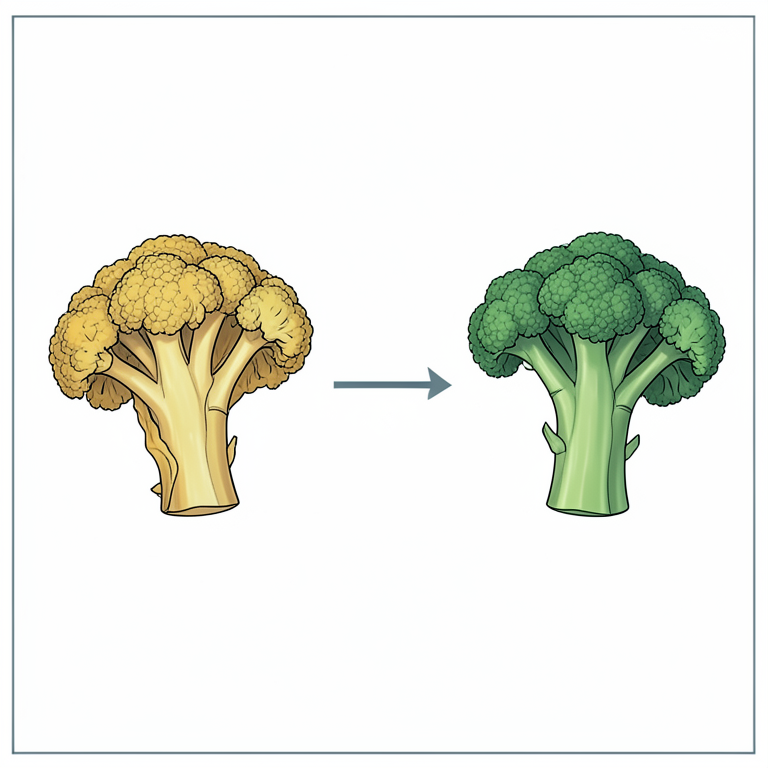
Cooling Speed vs. Shelf Life
AI-generated conceptual illustration (broccoli florets). It explains the idea and does not show study data.
View source evidence ↗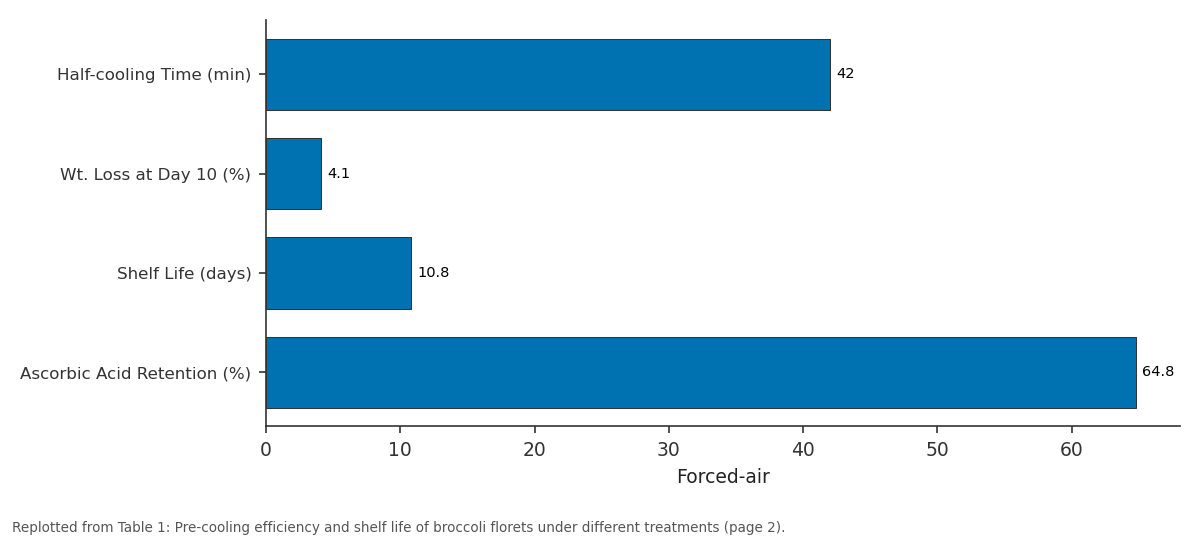
Forced-air: Half-cooling Time (min) vs Wt. Loss at Day 10 (%) vs Shelf Life (days) vs Ascorbic Acid Retention...
Replotted from Table 1 (page 2) of the original paper. Every bar is the paper's own table value.
View source evidence ↗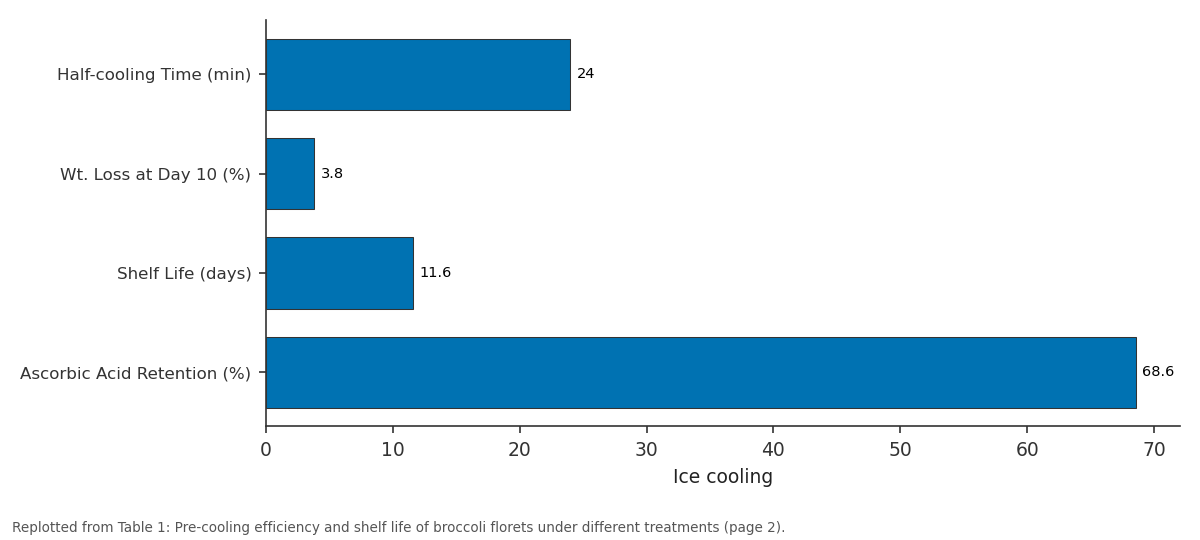
Ice cooling: Half-cooling Time (min) vs Wt. Loss at Day 10 (%) vs Shelf Life (days) vs Ascorbic Acid Retention...
Replotted from Table 1 (page 2) of the original paper. Every bar is the paper's own table value.
View source evidence ↗Figures & tables
From the original paper Table 1
 Table 2
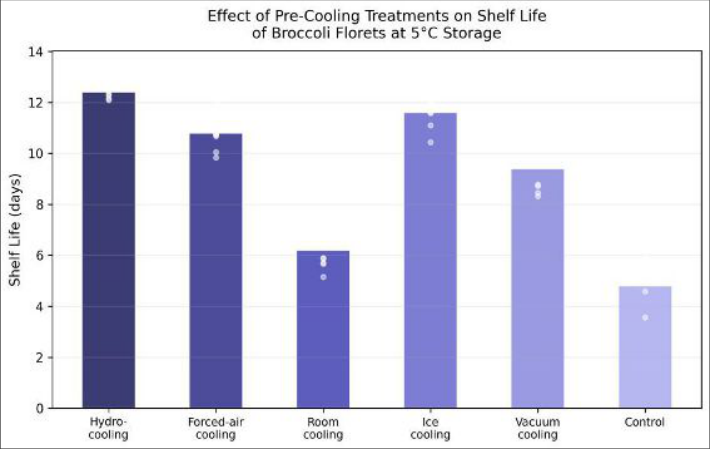 Figure 1
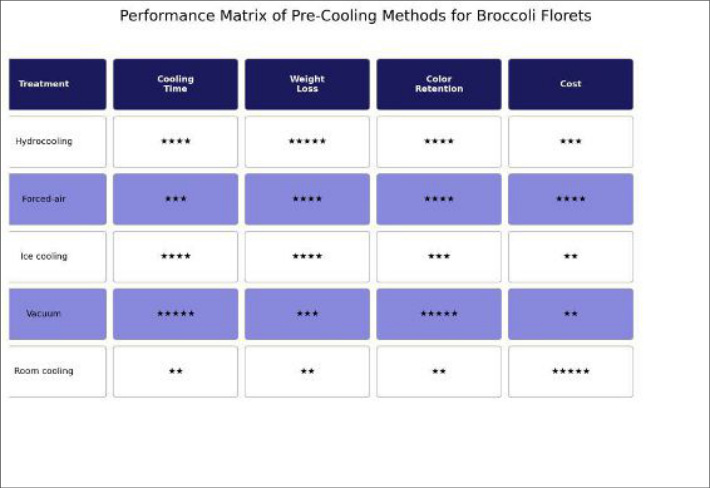 Figure 2
Introduction
In the cool highlands of central Kenya, broccoli production has expanded rapidly over the past decade to meet rising urban and export demand, yet the crop's extreme perishability means that losses between field and market often exceed 35% [1] . The main driver of deterioration is respiratory heat: freshly harvested broccoli generates metabolic heat at rates 3-5 times higher than most other vegetables, and without rapid cooling the florets yellow, wilt, and develop off-odors within 24-48 hours at ambient temperature [2] . Pre-coolingthe rapid removal of field heat before storage or transportis the single most effective postharvest intervention for extending broccoli shelf life [3] . Several pre-cooling methods exist, each with different cooling speeds, costs, and effects on product quality. Hydrocooling immerses product in chilled water, forced-air cooling draws cold air across stacked produce, vacuum cooling exploits flash evaporation under reduced pressure, and ice cooling places crushed ice directly on the product [4] . Despite the availability of these options, most Kenyan broccoli growers rely on simple room cooling (placing crates in a cold room without forced air circulation), which is the slowest and least effective method [5] . This research compared five pre-cooling treatments to identify the method that best preserves broccoli quality under the specific conditions of Kenyan highland production and cold chain infrastructure.
Quality Control
All quality measurements followed standardized protocols. Color was measured with a Minolta CR-400 chromameter calibrated against a white tile before each session. Weight loss was recorded using an analytical balance (±0.01 g). Firmness was measured with a TA. XT Plus texture analyzer using a 5 mm cylindrical probe at 1 mm/s penetration speed. Ascorbic acid was determined by the DCPIP titration method. All measurements were taken in triplicate per treatment per sampling date, and values are reported as means ± standard deviation [6] . [7] . Each treatment had four replications of 20 florets. After pre-cooling, all florets were stored at 5 ± 1 °C and 90-95% RH.
Methods
Half-cooling time was recorded as the time to reduce pulp temperature from field temperature (about 18 °C) to the midpoint between field and storage temperature. Weight loss, color (L*, a*, b*, hue angle), firmness, and ascorbic acid were measured at 0, 3, 6, 9, and 12 days of storage. Shelf life was defined as the number of days until florets showed visible yellowing (hue angle < 110°) or weight loss exceeding 8% [8] . Data were analyzed by two-way ANOVA (treatment × storage day) at P = 0.05 in GenStat version 22.
Results
Table Vacuum cooling maintained the best color (hue 114.6° at day 12), followed by hydrocooling (112.8°). Room-cooled florets dropped below the marketable threshold by day 6.
Comprehensive Interpretation
Correlation analysis showed a strong negative relationship between half-cooling time and shelf life (r = -0.92), confirming that speed of heat removal is the dominant factor determining broccoli storability. Ascorbic acid degradation followed first-order kinetics, with rate constants lowest for hydrocooling (k = 0.026/day) and highest for the control (k = 0.084/day).
Discussion
The superiority of hydrocooling reflects the high heat transfer coefficient of water compared to air, which allows the product to reach target temperature in under 20 minutes [3, 4] . This speed advantage translates directly into better quality retention because the initial burst of respiratory activity that triggers yellowing and vitamin degradation is suppressed before it can cause irreversible damage. Ice cooling performed almost as well and has the advantage of not requiring specialized equipment, making it a practical option for small-scale packhouses in Kenya [1] . Vacuum cooling, despite the fastest half-cooling time (8 minutes), caused higher weight loss because the evaporative cooling mechanism removes moisture from the product surface. This trade-off between speed and moisture loss has been noted in other leafy vegetables [5] . For exporters, vacuum cooling followed by modified atmosphere packaging may offset the moisture issue, but for domestic markets, hydrocooling offers the best balance of effectiveness, cost, and simplicity [7] .
Conclusion
Hydrocooling is the most effective pre-cooling method for broccoli produced in Kenyan highlands, extending shelf life to 12.4 days with the lowest weight loss and highest ascorbic acid retention. Ice cooling is a viable low-cost alternative. Room cooling is inadequate for this highly perishable crop. Broccoli packhouses should invest in hydrocooling infrastructure to reduce post-harvest losses and meet the quality standards required for both domestic supermarkets and export markets.
Acknowledgement
Acknowledgements Funding Sources
Figures and tables from the paper
| Treatment | Half-cooling Time (min) | Wt. Loss at Day 10 (%) | Shelf Life (days) | Ascorbic Acid Retention (%) |
|---|---|---|---|---|
| Hydrocooling | 18 | 3.2 | 12.4 | 72.4 |
| Forced-air | 42 | 4.1 | 10.8 | 64.8 |
| Room cooling | 186 | 8.6 | 6.2 | 41.2 |
| Ice cooling | 24 | 3.8 | 11.6 | 68.6 |
| Vacuum cooling | 8 | 5.4 | 9.4 | 58.4 |
| Control (none) | — | 12.4 | 4.8 | 32.6 |
| SEm(±) | - | 0.42 | 0.68 | 3.24 |
| CD (P=0.05) | - | 1.26 | 2.04 | 9.72 |
Table text extracted from the original PDF; superscript letters are shown inline. The original table image is below.
View original table image
| Treatment | Day 0 | Day 3 | Day 6 | Day 9 | Day 12 |
|---|---|---|---|---|---|
| Hydrocooling | 126.4 | 125.8 | 123.4 | 118.6 | 112.8 |
| Forced-air | 126.4 | 124.2 | 120.8 | 114.2 | 108.4 |
| Room cooling | 126.4 | 118.6 | 108.4 | 98.2 | - |
| Ice cooling | 126.4 | 125.4 | 122.6 | 116.8 | 111.2 |
| Vacuum cooling | 126.4 | 126.1 | 124.8 | 120.4 | 114.6 |
| Control | 126.4 | 114.2 | 102.6 | - | - |
Table text extracted from the original PDF; superscript letters are shown inline. The original table image is below.
View original table image
References
16 in the original paper- Kitinoja L, AlHassan HY. Identification of appropriate postharvest technologies for small-scale horticultural farmers in sub-Saharan Africa and South Asia. Acta Horticulturae. 2012;934:31-40.
- Cantwell M, Suslow T. Broccoli: recommendations for maintaining postharvest quality. UC Davis Postharvest Technology Center. 2013;1:1-4.
- Thompson JF, Mitchell FG, Rumsey TR. Commercial cooling of fruits, vegetables, and flowers. University of California Publication 21567. 2008;2:1-61.
- Brosnan T, Sun DW. Precooling techniques and applications for horticultural products. International Journal of Refrigeration. 2001;24(2):154-170.
- Kitinoja L, Kader AA. Measuring postharvest losses of fresh fruits and vegetables in developing countries. PEF White Paper. 2015;15:1-26.
- Ranganna S. Handbook of analysis and quality control for fruit and vegetable products. Tata McGraw-Hill. 1986;2:1-1112.
- Brecht JK, Saltveit ME, Talcott ST. Harvesting and postharvest technology of fresh fruits and vegetables. Acta Horticulturae. 2004;628:637-644.
- Nunes MCN, Emond JP, Rauth M. Environmental conditions encountered during typical consumer retail display affect fruit and vegetable quality and waste. Postharvest Biology and Technology. 2009;51(2):232241. International Journal of Agriculture and Nutrition https://www.agriculturejournal.net
- Paull RE. Effect of temperature and relative humidity on fresh commodity quality. Postharvest Biology and Technology. 1999;15(3):263-277.
- Wang CY. Chilling injury of tropical horticultural commodities. HortScience. 1994;29(9):986-988.
- Forney CF. Postharvest response of horticultural products to ozone. Postharvest Biology and Technology. 2003;1:107-143.
- Tano K, Arul J, Doyon G. Effect of temperature on broccoli quality parameters. Journal of Food Science. 1999;64(6):1067-1070.
- Toivonen PMA, DeEll JR. Physiology of fresh-cut fruits and vegetables. Postharvest Biology and Technology. 2002;25(3):283-292.
- Watada AE, Ko NP, Minott DA. Factors affecting quality of fresh-cut horticultural products. Postharvest Biology and Technology. 1996;9(2):115-125.
- Kader AA. Postharvest technology of horticultural crops. University of California Publication 3529. 2002;3:1-535.
- McKenzie MJ, Greer LA, Heyes JA. Sugar metabolism and compartmentation in asparagus stem bases during forced postharvest depletion. Postharvest Biology and Technology. 2004;33(1):1-12.