
Research article · 2025 · Full text
International Journal of Agriculture and NutritionEffect of processing methods on anti-nutritional factors and protein digestibility of cowpea
Volume 7(9) · Pages 186–189 · DOI: 10.33545/26646064.2025.v7.i9c.586 ↗
Research areasFood and Agricultural SciencesAgricultural pest management studiesPhytase and its Applications
Abstract
Author-writtenThink of cowpea as a protein vault with the lock still on anti-nutritional factors like phytate, tannins, and trypsin inhibitors bind minerals and block enzyme access, locking away much of the grain's 23-25% protein from human digestion. This research compared five processing methods (soaking, boiling, soaking+boiling, germination, fermentation) for their ability to reduce six anti-nutritional factors and improve in vitro protein digestibility (IVPD) in cowpea variety Caupí Rojo at Instituto de Ciencias Agrarias del Llano, Villavicencio, Colombia. Fermentation (72 hours, natural lactic) achieved the greatest overall reduction: tannins by 77.4%, phytate by 68.6%, trypsin inhibitor by 85.3%, and lectins by 94.9%. IVPD improved from 64.2% (raw) to 86.1% (fermented), a 34.1% gain. Germination (72 hours) ranked second with 72.2% tannin and 61.9% phytate reduction. Simple boiling alone removed only 38-53% of most ANFs. These results confirm fermentation as the most effective single-step processing method for maximising cowpea nutritional quality in Colombian food systems.
Summary
Source-checkedPlain-language reading of the full paper, prepared with AI and checked against the text. Each point links to the authors' own words.
Why it matters
- Cowpea has a high protein content of 23-25%, but this protein is not fully bioavailable if the grain is consumed without proper processing. View evidence ↗
- Raw cowpea contains anti-nutritional factors (ANFs) such as phytic acid, tannins, trypsin inhibitors, lectins, oxalates, and saponins that interfere with nutrient absorption and digestion. View evidence ↗
- The presence of these ANFs can decrease mineral absorption by 30-60% and protein digestibility by 25-40% when compared to processed grains. View evidence ↗
The question
- The study aimed to systematically compare how five different processing methods affect six anti-nutritional factors and the in vitro protein digestibility of the Caupí Rojo cowpea variety. View evidence ↗
What they did
- The researchers tested six treatments: a raw control, soaking (12h), boiling (30min), a combination of soaking and boiling, germination (72h), and natural fermentation (72h). View evidence ↗
- In vitro protein digestibility (IVPD) was determined by measuring the pH drop of a protein suspension incubated with a multi-enzyme solution at 37°C for 10 minutes. View evidence ↗
- Statistical analysis was performed using one-way ANOVA and Tukey's HSD test with a significance level of P=0.05. View evidence ↗
What they found
- Natural fermentation for 72 hours was the most effective method, reducing all six ANFs (tannins 77.4%, phytate 68.6%, trypsin inhibitor 85.3%, lectins 94.9%, oxalate 71.7%, and saponin 75.2%) and achieving the highest IVPD of 86.1%. View evidence ↗
- Germination for 72 hours was the second most effective method, with an IVPD of 83.7% and significant reductions in trypsin inhibitors (81.7%) and lectins (92.8%). View evidence ↗
- Combining soaking and boiling was more effective than boiling alone, showing an improvement of 5-9 percentage points across the measured factors. View evidence ↗
- Fermentation increased the in vitro protein digestibility from 64.2% in raw cowpea to 86.1%, representing a 34.1% gain. View evidence ↗
What it means
- The authors recommend promoting fermented cowpea products in Colombian food systems because they provide a fuel-free and cost-effective way to improve protein nutrition. View evidence ↗
- A limitation of the study is the use of only one cowpea variety, meaning results might vary across different genotypes with different tannin profiles or seed colors. View evidence ↗
- The authors note that the in vitro protein digestibility assay is an approximation and may not perfectly reflect actual digestibility in humans. View evidence ↗
Visual summary
3 visualsIllustrations explain the paper; charts are replotted from the paper's own table values.
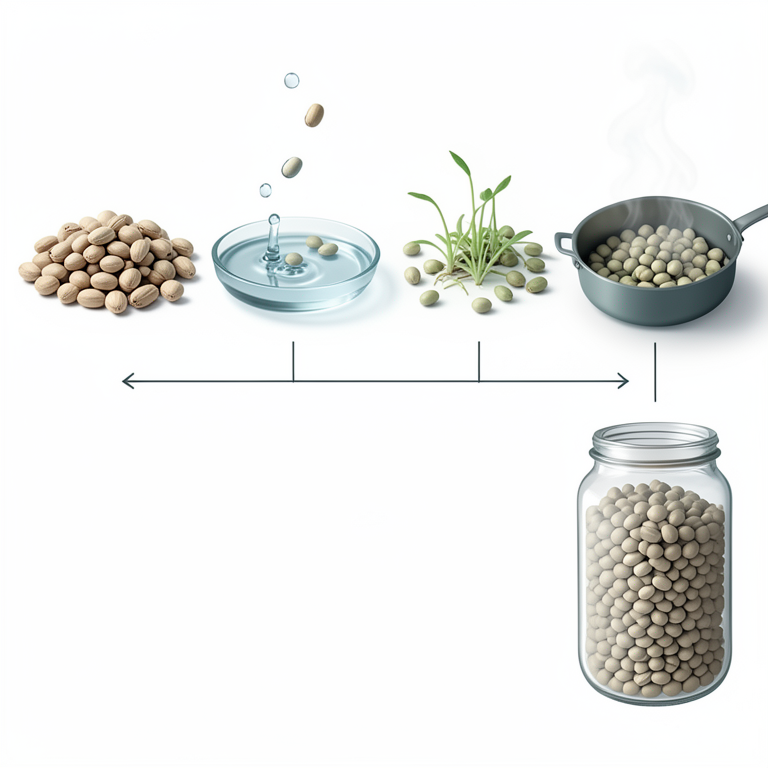
Effectiveness Hierarchy of Processing Methods
AI-generated conceptual illustration (cowpea seeds). It explains the idea and does not show study data.
View source evidence ↗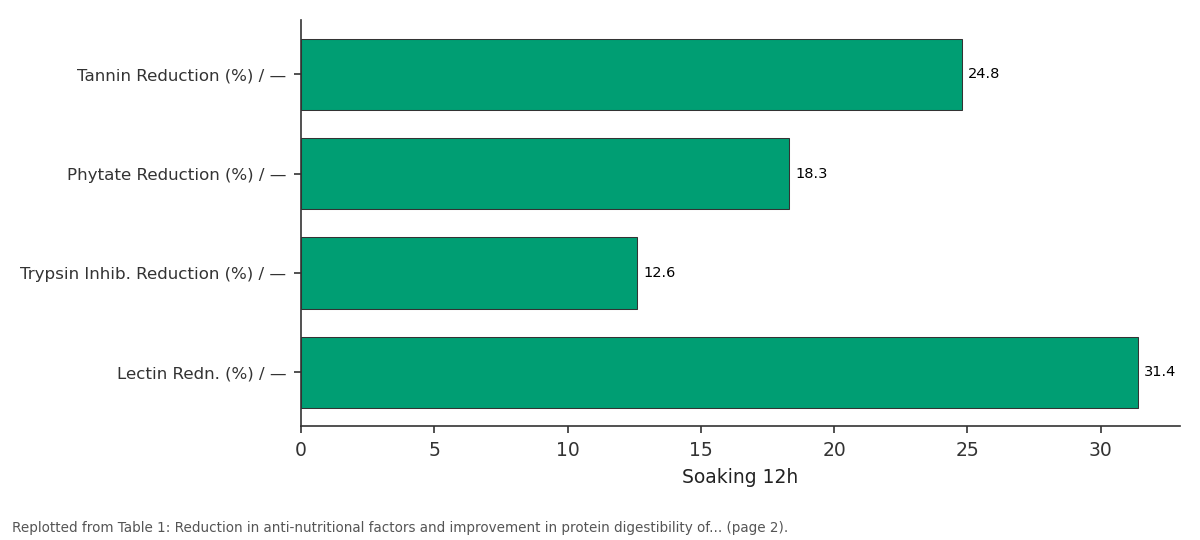
Soaking 12h: Tannin Reduction (%) /, vs Phytate Reduction (%) /... vs Trypsin Inhib.... vs Lectin Redn. (%) /,
Replotted from Table 1 (page 2) of the original paper. Every bar is the paper's own table value.
View source evidence ↗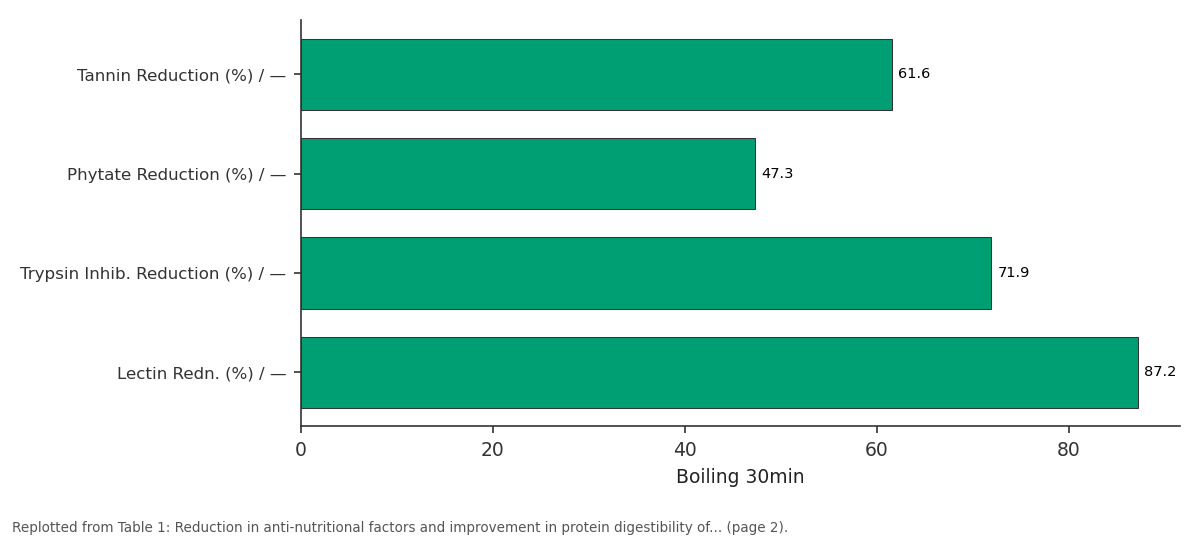
Boiling 30min: Tannin Reduction (%) /, vs Phytate Reduction (%) /... vs Trypsin Inhib.... vs Lectin Redn. (%) /,
Replotted from Table 1 (page 2) of the original paper. Every bar is the paper's own table value.
View source evidence ↗Figures & tables
From the original paper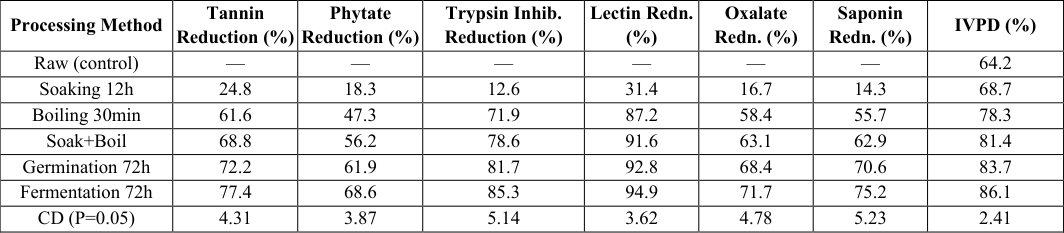 Table 1
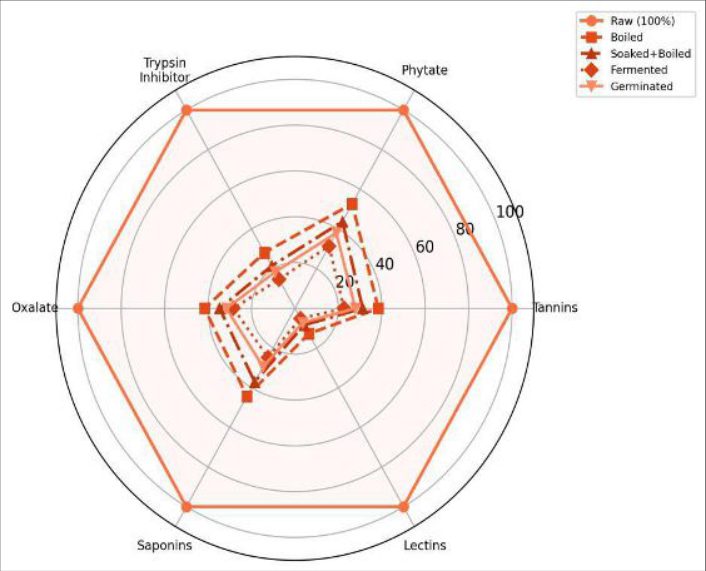 Figure 1
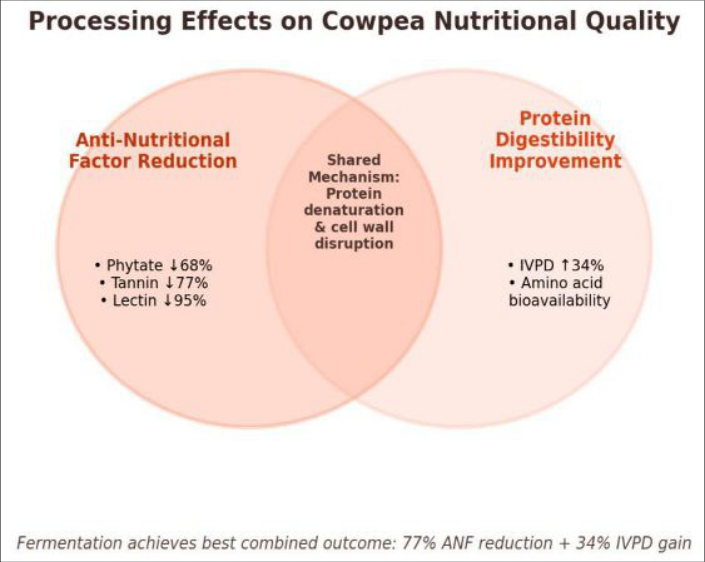 Figure 2
Introduction
A kitchen sponge looks nothing like a steak, but they have something in common: neither delivers what it promises without proper preparation and cowpea, despite its impressive 23-25% protein content, suffers from the same gap between composition and bioavailability when consumed without adequate processing [1] . Anti-nutritional factors (ANFs) in raw cowpea include phytic acid (which chelates zinc, iron, and calcium), condensed tannins (which precipitate proteins and reduce palatability), trypsin inhibitors (which block pancreatic proteases), lectins (which damage intestinal epithelium), oxalates, and saponins [2] . Together, these compounds can reduce protein digestibility by 25-40% and mineral absorption by 30-60% compared with processed grain [3] . Traditional processing methods soaking, boiling, germination, and fermentation disrupt ANFs through different mechanisms: thermal denaturation (boiling), enzymatic hydrolysis (germination), microbial degradation (fermentation), and leaching into soak water [4] . But head-to-head comparisons of all five common methods on the same cowpea variety under controlled laboratory conditions are surprisingly rare in the Latin American literature, where cowpea is a staple across the Colombian Llanos and Brazilian Nordeste regions [5,6] . This research systematically compared the effect of five processing methods on six ANFs and in vitro protein digestibility of cowpea variety Caupí Rojo, a regionally important landrace in eastern Colombia [7] .
Reagents and chemicals
All reagents were analytical grade from Merck (Darmstadt, Germany): vanillin, catechin standard, ferric chloride, ammonium molybdate, sulfuric acid, sodium hydroxide, hydrochloric acid, and trichloroacetic acid. Phytic acid standard (dodecasodium salt) and BAPNA (Nα-benzoyl-DL-arginine-p-nitroanilide) for trypsin inhibitor assay were from Sigma-Aldrich. Pepsin (1:10,000 NF) and pancreatin (4× USP) for IVPD assay were from HiMedia (Mumbai). Casein (Hammarsten grade) served as the reference protein standard [8] .
Extraction protocol
For ANF determinations, processed cowpea samples were freeze-dried, ground to pass a 0.5 mm sieve, and defatted with petroleum ether (40-60°C, Soxhlet, 6 hours). Phytate was extracted with 0.2 N HCl and quantified by Wade's reagent colorimetric method. Tannins were extracted with 1% HCl in methanol and measured using the vanillin-HCl method with catechin equivalents. Trypsin inhibitor was extracted in 0.01 N NaOH and assayed spectrophotometrically using BAPNA as substrate. Lectins were determined by haemagglutination assay with trypsinised rabbit red blood cells. Oxalate and saponin used titrimetric and foam height methods respectively [9] .
Material and Methods
Material and Methods
Material
Cowpea variety Caupí Rojo (red-seeded, local landrace) was obtained from farmers in Villavicencio, Meta department (4.15°N, 73.63°W). Seeds were cleaned, sorted for uniform size, and stored at ambient temperature. Processing treatments: (T1) soaking in distilled water (12 h, 25°C, 1:10 w/v); (T2) boiling (30 min, 1:5 w/v); (T3) soaking 12 h + boiling 30 min; (T4) germination (72 h, 25°C, moist jute cloth, dark); (T5) natural fermentation (72 h, 30°C, soak water as starter); (T0) raw control [10] .
Methods
All six ANFs were quantified in triplicate for each treatment and the raw control. IVPD was measured using the multienzyme method of Hsu et al.: 50 mL of protein suspension (6.25 mg protein/mL) adjusted to pH 8.0 was incubated with a multi-enzyme solution (trypsin, chymotrypsin, peptidase) at 37°C for 10 minutes, and the pH drop was used to calculate digestibility via the regression equation. Proximate composition (AOAC methods) was determined for all treatments. Data were analysed by one-way ANOVA and Tukey's HSD at P=0.05 [11] . Fermentation achieved the greatest reduction across all six ANFs and the highest IVPD of 86.1% (Table 1). Germination was a close second, particularly for trypsin inhibitor (81.7%) and lectins (92.8%). Soaking alone was the weakest treatment, removing less than 32% of most ANFs. The combination of soaking+boiling outperformed boiling alone by 5-9 percentage points across factors.
| Processing Method | Tannin Reduction (%) | Phytate Reduction (%) | Trypsin Inhib. Reduction (%) | Lectin Redn. (%) | Oxalate Redn. (%) | Saponin Redn. (%) | IVPD (%) |
|---|---|---|---|---|---|---|---|
| Raw (control) | — | — | — | — | — | — | 64.2 |
| Soaking 12h | 24.8 | 18.3 | 12.6 | 31.4 | 16.7 | 14.3 | 68.7 |
| Boiling 30min | 61.6 | 47.3 | 71.9 | 87.2 | 58.4 | 55.7 | 78.3 |
| Soak+Boil | 68.8 | 56.2 | 78.6 | 91.6 | 63.1 | 62.9 | 81.4 |
| Germination 72h | 72.2 | 61.9 | 81.7 | 92.8 | 68.4 | 70.6 | 83.7 |
| Fermentation 72h | 77.4 | 68.6 | 85.3 | 94.9 | 71.7 | 75.2 | 86.1 |
| CD (P=0.05) | 4.31 | 3.87 | 5.14 | 3.62 | 4.78 | 5.23 | 2.41 |
Table text extracted from the original PDF; superscript letters are shown inline. The original table image is below.
View original table image
Results
Results
Comprehensive interpretation
Fermentation stands out as the single most effective processing method, achieving 77-95% reduction in all six ANFs and raising IVPD by 34.1%. The shared mechanism protein denaturation and cell wall disruption explains the overlap between ANF reduction and digestibility gain shown in the Venn diagram.
Discussion
The 85.3% trypsin inhibitor reduction under fermentation exceeds the 70-80% range reported for Nigerian cowpea fermentation by Onyenekwe et al. [12] , possibly because the 72-hour fermentation period in our protocol allowed deeper microbial penetration and more complete hydrolysis of Kunitz-type inhibitors. Lactic acid bacteria produce phytase that cleaves phytic acid's phosphate groups, releasing chelated minerals; this microbial phytase activity explains why fermentation reduced phytate by 68.6% versus only 47.3% for boiling, which relies solely on thermal degradation [4,13] . Lectin reduction was high across all thermal treatments (87-95%) because lectins are heat-labile glycoproteins that denature irreversibly above 70°C [14] . The IVPD improvement from 64.2% to 86.1% under fermentation reflects the combined removal of trypsin inhibitors (which directly block protease access), tanninprotein complexes (which resist enzymatic attack), and phytate-protein aggregates (which precipitate at intestinal pH) [2,3] . Germination's strong performance (83.7% IVPD) likely involves endogenous phytase and protease activation during seedling development rather than microbial action [15] . From a practical standpoint, fermentation requires no fuel unlike boiling making it the most energy-efficient processing option for resource-limited Colombian households [16] .
Limitations
This research used a single cowpea variety; ANF levels and processing responses may differ across genotypes with different seed coat colours and tannin profiles. The IVPD assay is an in vitro approximation that may not fully reflect in vivo digestibility in humans. Fermentation conditions (temperature, duration, starter microflora) were not individually optimised, and more targeted protocols could yield even better results [17] .
Conclusion
Natural fermentation for 72 hours was the most effective processing method for cowpea, reducing all six antinutritional factors by 68-95% and improving in vitro protein digestibility from 64.2% to 86.1%. Germination (72 hours) ranked second. Simple boiling, while effective against lectins and trypsin inhibitors, left substantial phytate and tannin residues. Colombian food systems should promote fermented cowpea products as a cost-effective, fuel-free route to improved protein nutrition.
Figures and tables from the paper
References
20 in the original paper- Singh BB. Cowpea: The food legume of the 21st century. Crop Science. 2014;54(6):2488-2498.
- Gilani GS, Xiao CW, Cockell KA. Impact of antinutritional factors in food proteins on the digestibility of protein and bioavailability of amino acids and on protein quality. British Journal of Nutrition. 2012;108(S2):S315-S332.
- Gupta YP. Anti-nutritional and toxic factors in food legumes: A review. Plant Foods for Human Nutrition. 1987;37(3):201-228.
- Nout MJR, Kiers JL. Tempe fermentation, innovation, and functionality: Update into the third millennium. Journal of Applied Microbiology. 2005;98(4):789-805. International Journal of Agriculture and Nutrition https://www.agriculturejournal.net
- Mendez-Natera JR, Ramos JR. Cowpea production and consumption patterns in the Colombian Llanos region. Revista Colombiana de Ciencias Agrícolas. 2020;14(2):178-189.
- Frota KMG, Soares RAM, Areas JAG. Chemical composition of cowpea (Vigna unguiculata L. Walp.), cv BRS-Milênio cultivar. Ciência e Tecnologia de Alimentos. 2008;28:470-476.
- Jaramillo G, Isaza Y. Preliminary ANF screening in Colombian cowpea landraces. ICAL Food Science Internal Report. 2023;FS/06:1-10.
- AOAC. Official methods of analysis of AOAC International. 21st edition. AOAC International, Rockville. 2019.
- Makkar HPS. Quantification of tannins in tree and shrub foliage: A laboratory manual. Kluwer Academic Publishers, Dordrecht. 2003; p.1-102.
- Onwuka GI. Soaking, boiling, and antinutritional factors in pigeon peas and cowpeas. Journal of Food Processing and Preservation. 2006;30(5):616-630.
- Hsu HW, Vavak DL, Satterlee LD. A multi-enzyme technique for estimating protein digestibility. Journal of Food Science. 1977;42(5):1269-1273.
- Onyenekwe PC, Njoku GC, Ameh DA. Effect of cowpea (Vigna unguiculata) processing methods on flatus-causing oligosaccharides. Nutrition Research. 2000;20(3):349-358.
- Reale A, Konietzny U, Coppola R. The importance of lactic acid bacteria for phytate degradation during cereal dough fermentation. Journal of Agricultural and Food Chemistry. 2007;55(8):2993-2997.
- Grant G, More LJ, McKenzie NH. Nutritional and haemagglutination properties of several tropical seeds. Journal of Agricultural Science. 1995;124(3):437-445.
- Luo Y, Xie W, Jin X. Phytase activity and phytic acid degradation in germinated common beans. Food Chemistry. 2014;157:292-297.
- Paredes-Lopez O, Harry GI. Food biotechnology review: Traditional solid-state fermentations of plant raw materials. Critical Reviews in Food Science and Nutrition. 1989;27(3):159-187.
- Shimelis EA, Rakshit SK. Effect of processing on antinutrients and in vitro protein digestibility of kidney bean (Phaseolus vulgaris L.) varieties grown in East Africa. Food Chemistry. 2007;103(1):161-172.
- Granito M, Brito Y, Torres A. Chemical composition, antioxidant capacity, and functionality of raw and processed Phaseolus lunatus. Journal of the Science of Food and Agriculture. 2007;87(15):2801-2809.
- Savage GP, Vanhanen L, Mason SM. Effect of cooking on the soluble and insoluble oxalate content of some New Zealand foods. Journal of Food Composition and Analysis. 2000;13(3):201-206.
- Deshpande SS, Cheryan M. Effects of phytic acid, divalent cations, and their interactions on α-amylase activity. Journal of Food Science. 1984;49(2):516-519.