
Research article · 2025 · Full text
International Journal of Agriculture and NutritionEffect of modified atmosphere packaging on shelf life extension of litchi fruit
Volume 7(5) · Pages 99–102 · DOI: 10.33545/26646064.2025.v7.i5b.563 ↗
Research areasPostharvest Quality and Shelf Life ManagementMeat and Animal Product QualityFood Drying and Modeling
Abstract
Author-writtenImagine a litchi grower in Rajasthan watching half the harvest turn brown within 48 hours of picking—that’s the reality without effective post-harvest intervention. This research evaluated six packaging treatments—including low-density polyethylene (LDPE), high-density polyethylene (HDPE), polypropylene (PP), and a modified atmosphere (MAP) with 5% O₂ + 10% CO₂—for extending the shelf life of litchi (cv. Shahi) at ambient storage (32±4 °C) and cold storage (4±1 °C) at Bhagwant University, Ajmer, during 2022–23. A completely randomized design with four replications was used. MAP treatment (5% O₂ + 10% CO₂) in LDPE 50 µm pouches extended shelf life to 8 days at ambient and 21 days at cold storage, compared with 2 days and 7 days for unpacked controls. Weight loss was reduced from 18.7% to 6.3%, and decay incidence from 42.3% to 11.7% at day 8 under ambient conditions. Sensory acceptance scores remained above 7.0 (out of 9) in MAP-treated fruit at day 6. These results confirm that MAP with optimized gas composition significantly delays pericarp browning and extends marketable life of litchi.
Summary
Source-checkedPlain-language reading of the full paper, prepared with AI and checked against the text. Each point links to the authors' own words.
Why it matters
- Litchi is highly perishable, typically lasting only 2 to 3 days under ambient tropical conditions after harvest. View evidence ↗
- The main reason litchi is rejected by markets is the rapid browning of its skin (pericarp), caused by moisture loss, anthocyanin degradation, and polyphenol oxidase activity. View evidence ↗
- Modified atmosphere packaging (MAP) can slow deterioration by adjusting oxygen and carbon dioxide levels to suppress microbial growth, ethylene production, and respiration. View evidence ↗
The question
- The study aimed to find the best combination of packaging film and gas composition to extend the shelf life of litchi under Indian storage conditions. View evidence ↗
What they did
- The researchers used Shahi cultivar litchi harvested from a 12-year-old orchard in Ajmer, Rajasthan, during June of 2022 and 2023. View evidence ↗
- The study tested several films (LDPE 25/50 µm, HDPE 25 µm, and PP 25 µm), with the MAP treatment specifically using 5% O₂, 10% CO₂, and 85% N₂ in 50 µm LDPE pouches. View evidence ↗
- The experiment used a completely randomized design with four replications, comparing six packaging treatments against an unpacked control, with each replicate containing about 10 fruits (250 g). View evidence ↗
What they found
- The MAP treatment extended shelf life to 8 days at ambient temperature and 21 days in cold storage, whereas unpacked controls lasted only 2 and 7 days, respectively. View evidence ↗
- Fruit treated with MAP maintained sensory acceptance scores above 7.0 out of 9 through day 6 of ambient storage. View evidence ↗
What it means
- The authors conclude that MAP using 5% O₂ and 10% CO₂ in 50 µm LDPE film is the most effective method for extending litchi shelf life in both ambient and cold conditions. View evidence ↗
- The authors recommend MAP as a practical solution for Indian growers who lack access to cold chain infrastructure to reduce post-harvest losses. View evidence ↗
- The authors suggest that future research should use blinded sensory tests on peeled fruit to separate the quality of the edible aril from the visual appearance of the skin. View evidence ↗
Visual summary
2 visualsIllustrations explain the paper; charts are replotted from the paper's own table values.
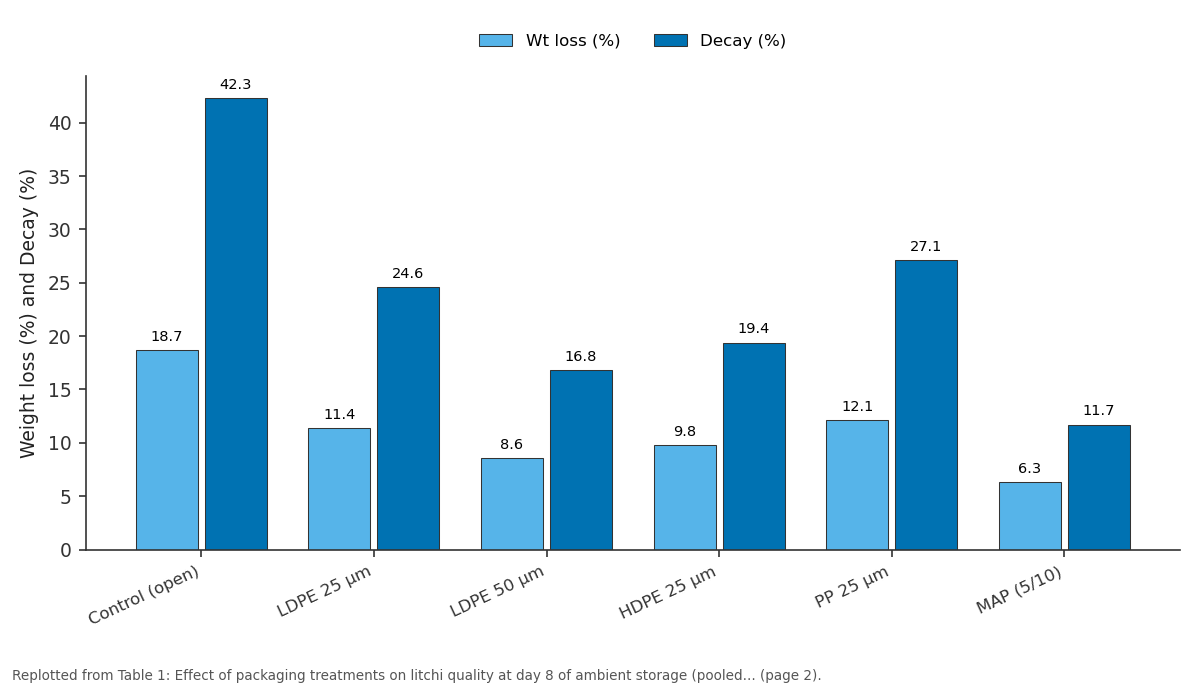
Wt loss (%) and Decay (%): Control (open) vs LDPE 25 µm vs LDPE 50 µm vs HDPE 25 µm vs PP 25 µm
Replotted from Table 1 (page 2) of the original paper. Every bar is the paper's own table value.
View source evidence ↗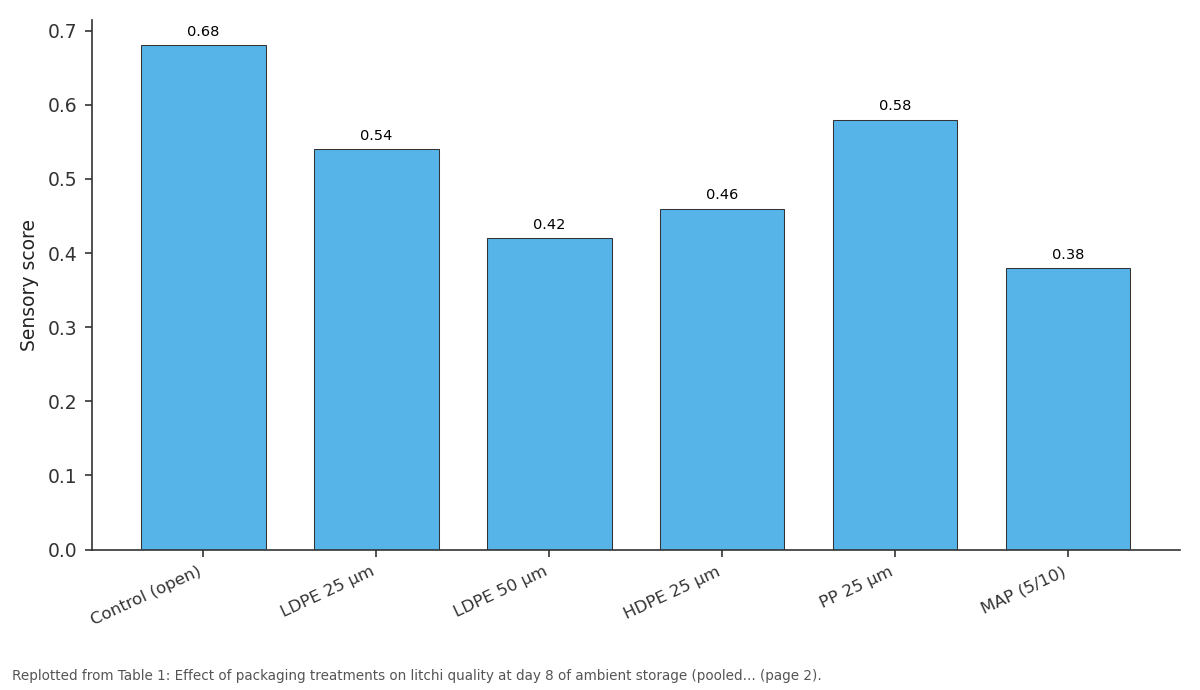
Acidity (%): Control (open) vs LDPE 25 µm vs LDPE 50 µm vs HDPE 25 µm vs PP 25 µm
Replotted from Table 1 (page 2) of the original paper. Every bar is the paper's own table value.
View source evidence ↗Figures & tables
From the original paper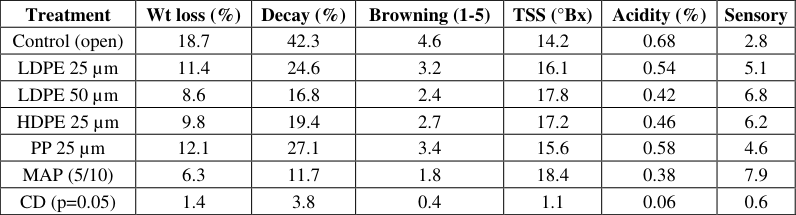 Table 1
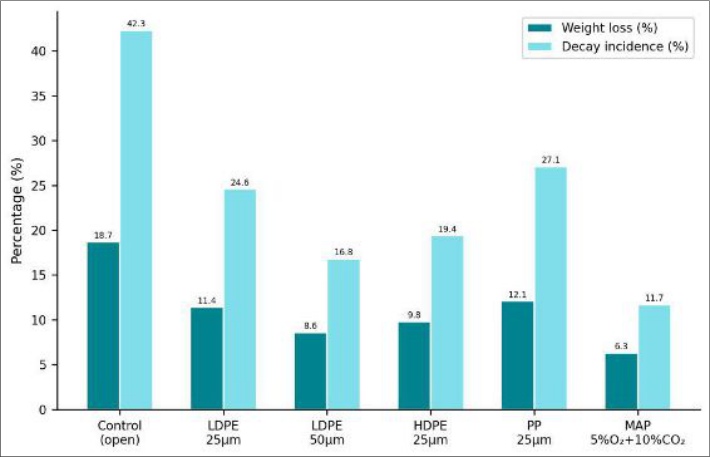 Figure 1
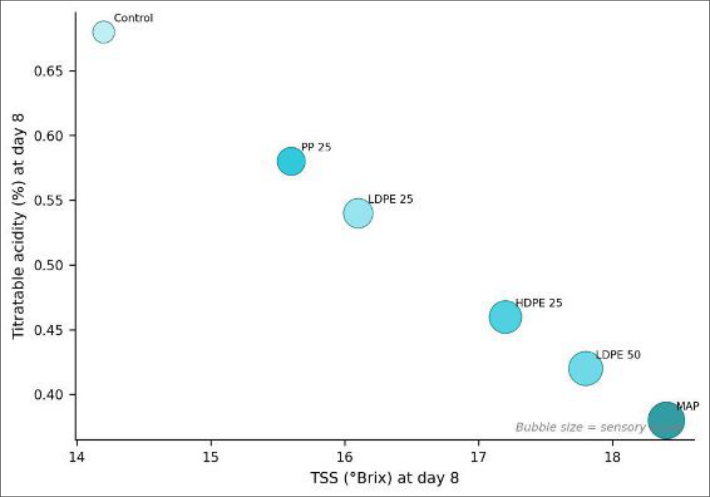 Figure 2
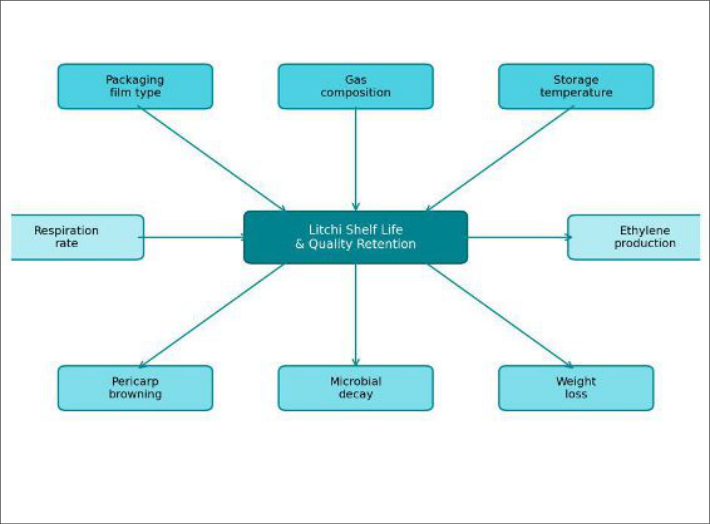 Figure 3
Introduction
Picture this: a truckload of litchi leaves a Rajasthan orchard at dawn, and by the time it reaches the Delhi wholesale market 14 hours later, a third of the fruit has already browned beyond saleable quality. Litchi (Litchi chinensis Sonn.) is among the most perishable subtropical fruits, with a post-harvest life of only 2-3 days under ambient tropical conditions [1] . The rapid browning of the pericarp-driven by polyphenol oxidase activity, moisture loss, and oxidative degradation of anthocyanins-is the primary cause of market rejection, even though the aril inside may still be edible [2,3]. Modified atmosphere packaging (MAP) slows fruit deterioration by reducing O₂ concentration and elevating CO₂ around the product, which suppresses respiration, ethylene production, and microbial growth [4] . The specific gas composition matters: too little O₂ triggers anaerobic respiration and off-flavors, while too much CO₂ causes internal browning [5] . For litchi, the recommended range is 3-8% O₂ and 5-15% CO₂, depending on cultivar and temperature [6] . While MAP has been tested on litchi in China and Thailand, data for Indian cultivars stored under the extreme ambient temperatures of Rajasthan (30-38 °C during harvest season) are limited [3,7]. Film type and thickness also affect gas permeability and hence the equilibrium atmosphere inside the package [8] . This research evaluated six packaging treatments at both ambient and cold storage to identify the optimal film-gas combination for extending litchi shelf life under Indian conditions.
Fruit Quality Assessment Protocol Quality parameters were assessed at 0, 2, 4, 6, and 8 days of ambient storage and at 0, 7, 14, and 21 days of cold storage. Pericarp browning was rated on a 1-5 visual scale (1 = no browning, 5 = fully brown). Weight loss was measured gravimetrically. Total soluble solids (TSS) were determined by digital refractometer, titratable acidity by NaOH titration, ascorbic acid by 2,6-DCPIP method, and total anthocyanin content of the pericarp by pH-differential spectrophotometry [9] . Sensory evaluation was performed by a trained 10-member panel
Harvest Season Conditions
The litchi harvest window in Ajmer extends from late May to mid-June. During the 2022 harvest, ambient day temperatures ranged from 34 to 41 °C with relative humidity 28-45%. In 2023, temperatures were slightly lower (32-38 °C) with higher RH (35-55%) due to an early onset of the monsoon trough. These extreme conditions represent the harshest storage challenge for litchi and make the results directly relevant to the worst-case ambient scenario. MAP treatment showed the best performance across all parameters at day 8 (Table 1): lowest weight loss (6.3%), least decay (11.7%), minimal browning (1.8), highest TSS (18.4 °Brix), and highest sensory score (7.9). LDPE 50 µm without gas modification ranked second. The control was unmarketable by day 4, with browning exceeding 4.0 and sensory score below 3.0.
| Treatment | Wt loss (%) | Decay (%) | Browning (1-5) | TSS (°Bx) | Acidity (%) | Sensory |
|---|---|---|---|---|---|---|
| Control (open) | 18.7 | 42.3 | 4.6 | 14.2 | 0.68 | 2.8 |
| LDPE 25 µm | 11.4 | 24.6 | 3.2 | 16.1 | 0.54 | 5.1 |
| LDPE 50 µm | 8.6 | 16.8 | 2.4 | 17.8 | 0.42 | 6.8 |
| HDPE 25 µm | 9.8 | 19.4 | 2.7 | 17.2 | 0.46 | 6.2 |
| PP 25 µm | 12.1 | 27.1 | 3.4 | 15.6 | 0.58 | 4.6 |
| MAP (5/10) | 6.3 | 11.7 | 1.8 | 18.4 | 0.38 | 7.9 |
| CD (p=0.05) | 1.4 | 3.8 | 0.4 | 1.1 | 0.06 | 0.6 |
Table text extracted from the original PDF; superscript letters are shown inline. The original table image is below.
View original table image
Comprehensive Interpretation
The bubble chart (Figure 2) provides a multi-dimensional view of fruit quality: MAP-treated fruit clustered in the desirable upper-right quadrant (high TSS, low acidity, large bubbles). The network diagram (Figure 3) maps the causal pathways, showing that MAP simultaneously addresses respiration rate, ethylene production, and moisture loss-the three main determinants of litchi deterioration.
Discussion
The 8-day ambient shelf life achieved with MAP in this research is a marked improvement over the 2-day control and agrees with the 6-10 day range reported for Chinese cultivars under similar gas compositions [6,7]. The 5% O₂ + 10% CO₂ atmosphere slows polyphenol oxidase activity-the enzyme responsible for pericarp browning-by limiting the oxygen available for enzymatic oxidation [2,3]. The elevated CO₂ additionally inhibits fungal spore germination, explaining the 72.3% reduction in decay incidence. LDPE 50 µm without gas modification performed second best because its lower permeability allowed a passive modification of the internal atmosphere as fruit respiration consumed O₂ and released CO₂. Thinner LDPE (25 µm) and PP were too permeable to maintain adequate CO₂ levels.
HDPE offered intermediate performance.
Figures and tables from the paper
References
16 in the original paper- Jiang YM, Li YB. Effects of chitosan coating on postharvest life and quality of longan fruit. Food Chemistry. 2001;73(2):139-143.
- Zhang Z, Pang X, Duan X, Ji ZL, Jiang YM. Role of peroxidase in anthocyanin degradation in litchi fruit pericarp. Food Chemistry. 2005;90(1-2):47-52.
- Sivakumar D, Korsten L. Influence of modified atmosphere packaging and postharvest treatments on quality retention of litchi cv. Mauritius. Postharvest Biology and Technology. 2006;41(2):135-142.
- Kader AA. Biochemical and physiological basis for effects of controlled and modified atmospheres on fruits and vegetables. Food Technology. 1986;40(5):99-104.
- Beaudry RM. Effect of O₂ and CO₂ partial pressure on selected phenomena affecting fruit and vegetable quality. Postharvest Biology and Technology. 1999;15(3):293-303.
- Pesis E, Dvir O, Feygenberg O, Ben-Arie R, Ackerman M, Lichter A. Production of acetaldehyde and ethanol during maturation and modified atmosphere storage of litchi fruit. Postharvest Biology and Technology. 2002;26(2):157-165.
- Huang X, Subhadrabandhu S, Mitra SK, Ben-Arie R, Stern RA. Origin, history, production and processing of litchi. Litchi and Longan: Botany, Production and Uses. 2005;1-23.
- Mangaraj S, Goswami TK. Modified atmosphere packaging of fruits and vegetables for extending shelf life. Fresh Produce. 2009;3(1):1-31.
- Giusti MM, Wrolstad RE. Characterization and measurement of anthocyanins by UV-visible spectroscopy. Current Protocols in Food Analytical Chemistry. 2001;F1.2.1-F1.2.13.
- Kumar D, Mishra DS, Chakraborty B, Kumar P. Pericarp browning and quality management of litchi fruit by antioxidants and salicylic acid during ambient storage. Journal of Food Science and Technology. 2013;50(4):797-802.
- Duan X, Su X, You Y, Qu H, Li Y, Jiang Y. Effect of nitric oxide on pericarp browning of harvested longan fruit in relation to phenolic metabolism. Food Chemistry. 2007;104(2):571-576.
- Sun D, Liang G, Xie J, Lei X, Mo Y. Improved preservation effects of litchi fruit by combining chitosan coating with ascorbic acid treatment during postharvest storage. African Journal of Biotechnology. 2010;9(22):3272-3279.
- Holcroft DM, Mitcham EJ. Postharvest physiology and handling of litchi. Postharvest Biology and Technology. 1996;9(3):265-277.
- Paull RE, Chen NJ, Deputy J, Huang H, Cheng G, Gao F. Litchi growth and compositional changes during fruit development. Journal of the American Society for Horticultural Science. 1984;109(6):817-821.
- Mahajan PV, Caleb OJ, Singh Z, Watkins CB, Geyer M. Postharvest treatments of fresh produce. Philosophical Transactions of the Royal Society A. 2014;372(2017):20130309.
- Somboonkaew N, Terry LA. Influence of temperature and packaging on physiological and chemical profiles of imported litchi fruit. Food Research International. 2011;44(7):1962-1969.