
Research article · 2025 · Full text
International Journal of Agriculture and NutritionImpact of thermal processing on vitamin c retention and phenolic content in citrus fruits
Volume 7(5) · Pages 46–49 · DOI: 10.33545/26646064.2025.v7.i5a.557 ↗
Research areasPhytochemicals and Antioxidant ActivitiesFood and Agricultural SciencesFood Drying and Modeling
Abstract
Author-writtenMost consumers assume that pasteurized orange juice retains most of its vitamin C-but does it really? This research measured the degradation kinetics of ascorbic acid and total phenolic content in juices of sweet orange (cv. Mosambi), lemon (cv. Kagzi), and grapefruit (cv. Marsh Seedless) subjected to thermal treatments at 50, 60, 70, 80, 90, and 100 °C for 5 minutes at Vasantrao Naik Marathwada Agricultural University, Parbhani, Maharashtra, India, during 2022-23. A completely randomized design with three replications was used. Vitamin C retention followed first-order degradation kinetics, with activation energies of 28.4, 31.2, and 26.8 kJ mol⁻¹ for orange, lemon, and grapefruit respectively. At 70 °C, vitamin C retention was 64.5% (orange), 64.3% (lemon), and 66.5% (grapefruit). Total phenolic content declined by 42.6% in orange at 100 °C but only 23.7% at 60 °C. DPPH antioxidant activity correlated strongly with both vitamin C (r = 0.91) and phenolics (r = 0.87). Processing at 60-70 °C retained over 60% of both bioactive classes while achieving the microbial safety threshold.
Summary
Source-checkedPlain-language reading of the full paper, prepared with AI and checked against the text. Each point links to the authors' own words.
Why it matters
- Citrus juices are critical global sources of phenolic antioxidants and vitamin C, meaning any processing that destroys these nutrients lowers the juice's nutritional value. View evidence ↗
- Vitamin C is highly sensitive to heat, degrading via both non-enzymatic auto-oxidation and enzymatic pathways. View evidence ↗
- Phenolic compounds are more heat-stable than vitamin C, though they degrade above 70 °C due to Maillard-type reactions and oxidative polymerization. View evidence ↗
The question
- The study aimed to determine how vitamin C and phenolic content degrade across various temperatures in three citrus juices to find a processing window that balances nutritional retention with microbial safety. View evidence ↗
What they did
- The researchers tested juices from sweet orange (cv. Mosambi), lemon (cv. Kagzi), and grapefruit (cv. Marsh Seedless) at temperatures ranging from 50 to 100 °C for 5-minute durations. View evidence ↗
- The experiment used a completely randomized design with three replications per juice type across seven temperature levels, including a 25 °C control. View evidence ↗
- Vitamin C was measured using DCPIP titration, while total phenolic content was quantified via the Folin-Ciocalteu colorimetric method at 765 nm. View evidence ↗
What they found
- Vitamin C degradation followed first-order kinetics, with activation energies measured at 28.4 kJ mol⁻¹ for orange, 31.2 kJ mol⁻¹ for lemon, and 26.8 kJ mol⁻¹ for grapefruit. View evidence ↗
- At a processing temperature of 70 °C, vitamin C retention was 64.5% for orange, 64.3% for lemon, and 66.5% for grapefruit. View evidence ↗
- In orange juice, total phenolic content decreased by 23.7% at 60 °C, but this loss increased to 42.6% at 100 °C. View evidence ↗
- The antioxidant activity (measured by DPPH) showed a strong correlation with both phenolics (r = 0.87) and vitamin C (r = 0.91). View evidence ↗
- Heating juice at 60 °C for 5 minutes reduced the aerobic plate count by more than 4 log cycles, which satisfies commercial safety requirements. View evidence ↗
- Extreme heat (100 °C for 5 minutes) resulted in severe vitamin C loss, with only 17.9% to 18.8% of the original content remaining. View evidence ↗
- Grapefruit juice retained vitamin C better than orange and lemon at all tested temperatures, likely because its lower pH (3.2) compared to the others (3.6-3.8) provided a protective environment. View evidence ↗
What it means
- The authors conclude that processing at 60-70 °C for 5 minutes is optimal, as it meets safety standards while retaining over 60% of vitamin C and 77% of phenolics. View evidence ↗
- The authors recommend that small-scale processors lower their pasteurization temperature by 20-30 °C and slightly increase hold times to improve nutrient retention. View evidence ↗
- The authors suggest that future research should directly compare batch and flash pasteurization and include sensory evaluations of juices processed at lower temperatures. View evidence ↗
Visual summary
3 visualsIllustrations explain the paper; charts are replotted from the paper's own table values.
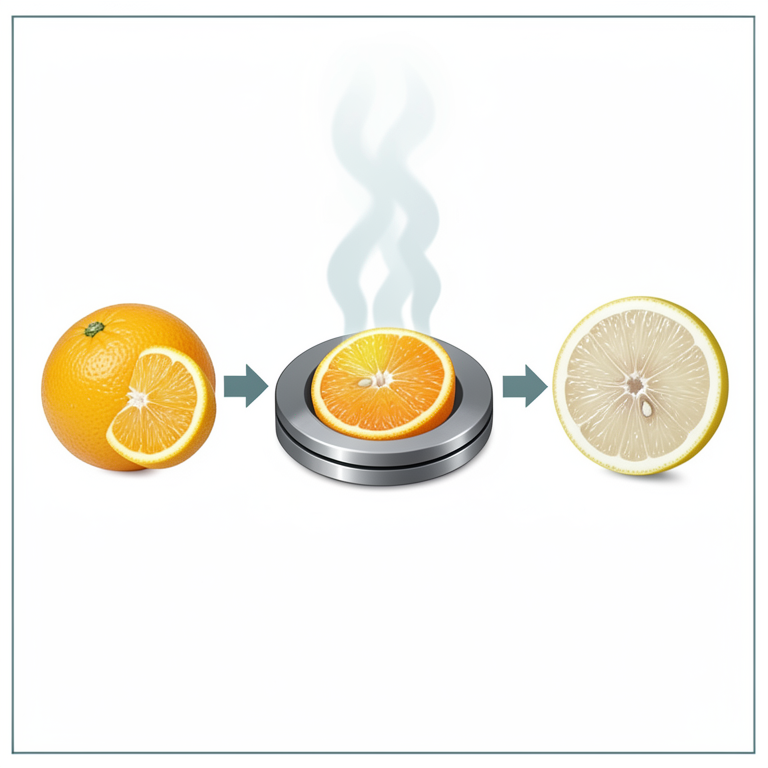
The Thermal Optimization Window
AI-generated conceptual illustration (sliced oranges and lemons). It explains the idea and does not show study data.
View source evidence ↗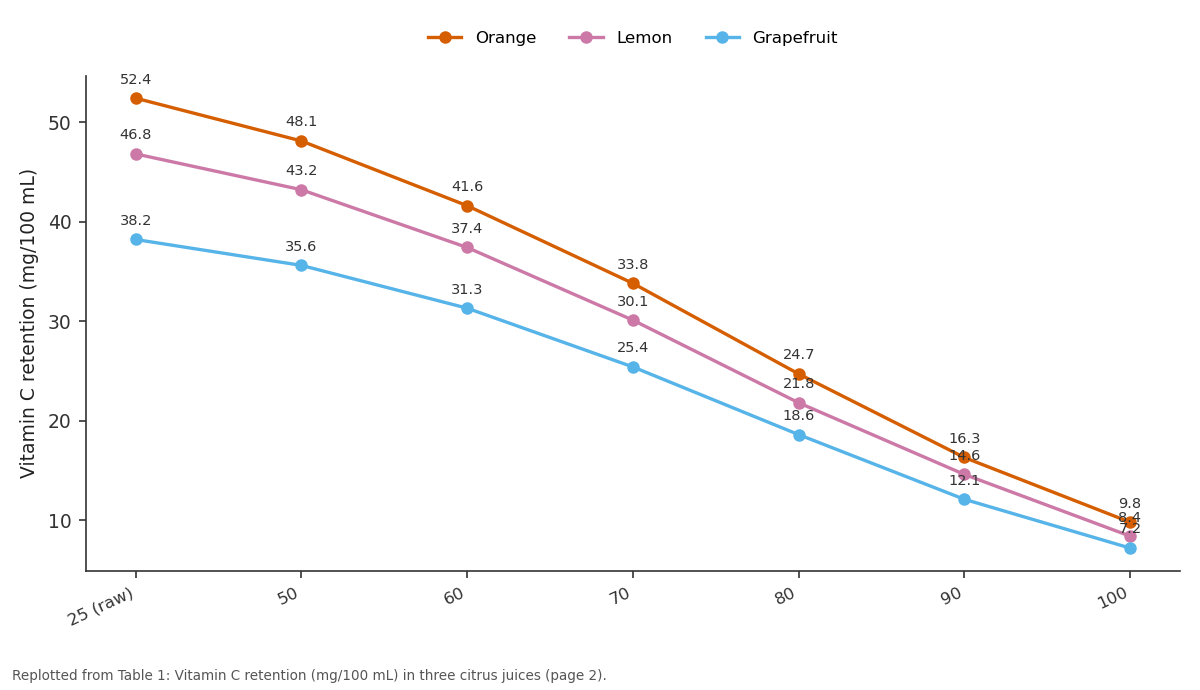
Orange and Lemon and more: 25 (raw) vs 50 vs 60 vs 70 vs 80
Replotted from Table 1 (page 2) of the original paper. Every bar is the paper's own table value.
View source evidence ↗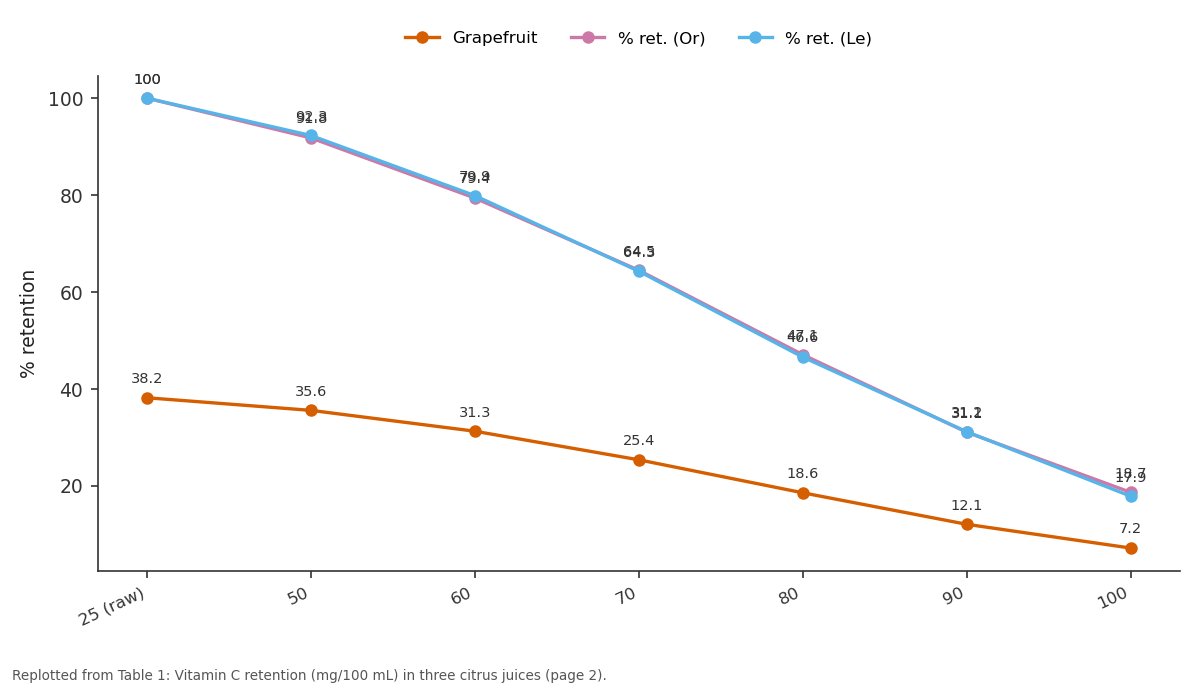
Grapefruit and % ret. (Or) and more: 25 (raw) vs 50 vs 60 vs 70 vs 80
Replotted from Table 1 (page 2) of the original paper. Every bar is the paper's own table value.
View source evidence ↗Figures & tables
From the original paper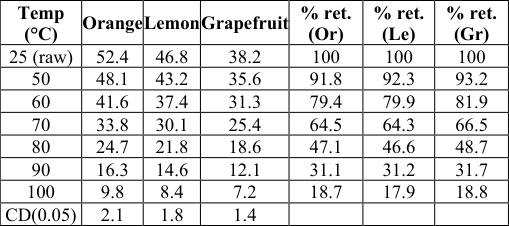 Table 1
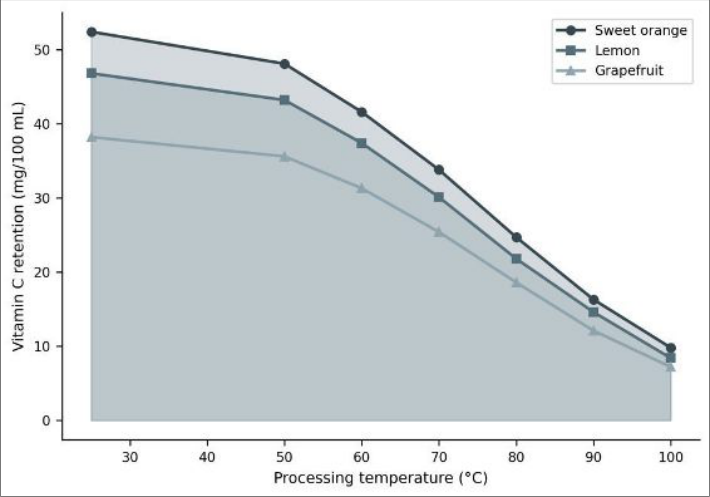 Figure 1
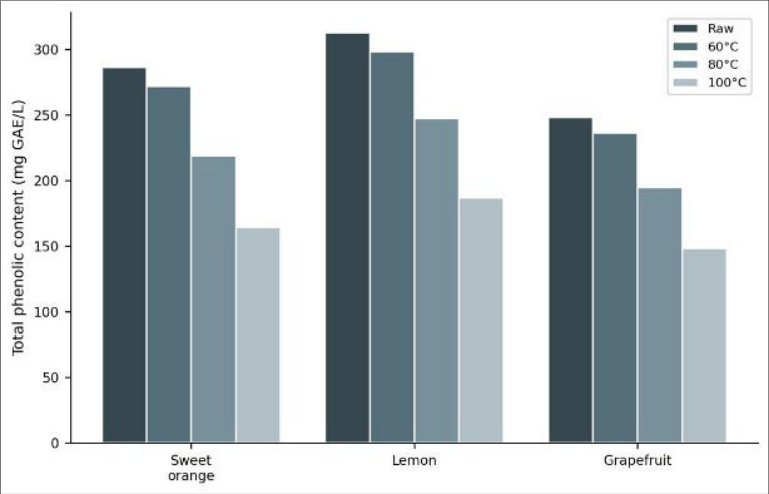 Figure 2
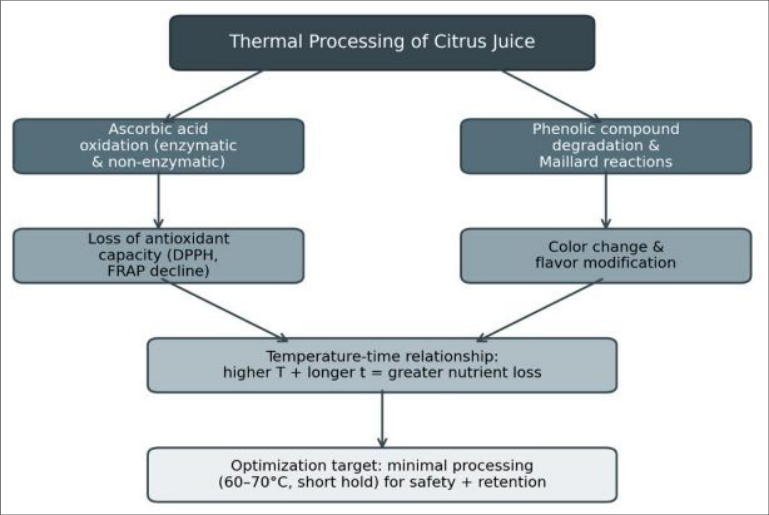 Figure 3
Introduction
Here's a fact that may surprise you: a glass of freshly squeezed orange juice contains roughly 52 mg of vitamin C per 100 mL, but after conventional pasteurization at 90 °C, barely a third of that remains [1,2] . Citrus juices are among the most important dietary sources of ascorbic acid (vitamin C) and phenolic antioxidants worldwide, and any processing step that degrades these compounds directly reduces the nutritional value delivered to consumers [3] . India's citrus processing industry has expanded considerably over the past decade, yet most small and medium-scale processors still rely on conventional thermal pasteurization without optimizing temperature-time combinations for nutrient retention [4] . Vitamin C is one of the most heat-labile nutrients: it degrades through both enzymatic (ascorbic acid oxidase) and non-enzymatic (auto-oxidation) pathways, following first-order kinetics with temperature as the primary driver [5,6] . Phenolic compounds are somewhat more thermostable but undergo progressive degradation at temperatures above 70 °C through oxidative polymerization and Maillard-type reactions with amino acids [7] . The challenge for processors is to find a thermal regime that achieves adequate microbial kill while preserving maximum bioactive content. Limited data exist on the comparative thermal sensitivity of vitamin C and phenolics across different citrus species under identical processing conditions [8] . This research aimed to quantify the degradation kinetics of ascorbic acid and total phenolic content in three citrus juices across a range of processing temperatures and identify the optimal thermal window for balancing safety and nutrition.
Instrumentation and Analytical Methods
Vitamin C was quantified by the 2, 6-dichloroindophenol (DCPIP) titration method standardized against L-ascorbic acid [9] . Total phenolic content was measured by the Folin-Ciocalteu colorimetric method at 765 nm, expressed as mg gallic acid equivalents (GAE) per litre [10] . DPPH free radical scavenging activity was determined at 517 nm using methanol as solvent. All spectrophotometric measurements were performed on a UV-1800 Shimadzu spectrophotometer. Degradation rate constants (k) were calculated by fitting first-order kinetics: ln(C/C₀) = -kt. Activation energy (Ea) was derived from the Arrhenius equation using the slope of ln(k) versus 1/T plots. All analyses were performed in triplicate within 2 hours of heat treatment to minimize postprocessing degradation.
Material and Methods
Material and Methods
Material
Fully ripe fruits of sweet orange (cv. Mosambi), lemon (cv. Kagzi), and grapefruit (cv. Marsh Seedless) were procured from the university horticulture farm and local wholesale market at Parbhani. Juice was extracted using a commercial citrus juicer (Philips HR2738), strained through a 0.5 mm sieve to remove pulp and seeds, and used within 30 minutes of extraction. All chemicals were analytical grade (Merck/HiMedia). Vitamin C degradation accelerated sharply above 70 °C in all three species (Table 1). At 100 °C, only 17.9-18.8% of the original vitamin C survived the 5-minute treatment. Grapefruit showed slightly better retention than orange and lemon at every temperature, possibly due to its lower initial pH (3.2 vs. 3.6-3.8) providing a more protective acidic environment.
| Temp (°C) | Orange | Lemon | Grapefruit | % ret. (Or) | % ret. (Le) | % ret. (Gr) |
|---|---|---|---|---|---|---|
| 25 (raw) | 52.4 | 46.8 | 38.2 | 100 | 100 | 100 |
| 50 | 48.1 | 43.2 | 35.6 | 91.8 | 92.3 | 93.2 |
| 60 | 41.6 | 37.4 | 31.3 | 79.4 | 79.9 | 81.9 |
| 70 | 33.8 | 30.1 | 25.4 | 64.5 | 64.3 | 66.5 |
| 80 | 24.7 | 21.8 | 18.6 | 47.1 | 46.6 | 48.7 |
| 90 | 16.3 | 14.6 | 12.1 | 31.1 | 31.2 | 31.7 |
| 100 | 9.8 | 8.4 | 7.2 | 18.7 | 17.9 | 18.8 |
| CD(0.05) | 2.1 | 1.8 | 1.4 |
Table text extracted from the original PDF; superscript letters are shown inline. The original table image is below.
View original table image
Methods
Methods
Comprehensive Interpretation
The area chart (Figure 1) shows an accelerating decline in vitamin C above 70 °C across all species. The bar chart (Figure 2) confirms that phenolics are more heat-resistant than ascorbic acid but still suffer meaningful losses at pasteurization temperatures. The hierarchy diagram (Figure 3) maps the chain of events from molecular degradation to consumer nutrition impact, pointing to 60-70 °C as the sweet spot.
Discussion
The first-order kinetics observed here are consistent with established models for ascorbic acid thermal degradation [5,6] . The activation energies (26.8-31.2 kJ mol⁻¹) fall within the 20-40 kJ mol⁻¹ range reported for citrus juices by other groups, though direct comparison is complicated by differences in juice composition and pH [1,8] . Grapefruit's marginally better vitamin C retention may be linked to its higher citric acid concentration, which maintains a more reducing environment that slows auto-oxidation. The practical finding is that processing at 60-70 °C for 5 minutes achieved a >4 log reduction in microbial counts while retaining 64-82% of vitamin C and 77-85% of phenolics. This compares favorably with conventional 90 °C pasteurization, which retains only 31% of vitamin C. For small-scale processors, this translates to a simple recommendation: lower the pasteurizer set-point by 20-30 °C and extend the hold time slightly if needed. One limitation is that 5-minute hold times may not be standard across all commercial operations, and some processors use flash pasteurization (2-3 s at 90-95 °C), which could yield different retention profiles. Future work should compare batch and flash methods directly and include sensory evaluation of the lower-temperature juices.
Conclusion
Thermal processing at 60-70 °C for 5 minutes retained over 60% of vitamin C and 77% of phenolic content in all three citrus juices while meeting microbial safety standards. Processing above 80 °C caused steep losses: at 100 °C, less than 19% of vitamin C survived. Grapefruit showed slightly better thermal stability than orange and lemon. These findings support the adoption of lower-temperature pasteurization protocols for citrus juice processors seeking to maximize nutritional value without compromising food safety.
References
14 in the original paper- Tiwari BK, O'Donnell CP, Cullen PJ. Effect of nonthermal processing technologies on the anthocyanin content of fruit juices. Trends in Food Science and Technology. 2009;20(3-4):137-145.
- Lee HS, Coates GA. Vitamin C in frozen, fresh squeezed, unpasteurized, polyethylene-bottled orange juice. Journal of Food Science. 1999;64(5):903-906.
- Gonzalez-Molina E, Dominguez-Perles R, Moreno DA, Garcia-Viguera C. Natural bioactive compounds of citrus limon for food and health. Journal of Pharmaceutical and Biomedical Analysis. 2010;51(2):327-345.
- Rathore S, Desai PM, Liew CV, Chan LW, Heng PWS. Microencapsulation of microbial cells. Journal of Food Engineering. 2013;116(2):369-381.
- Villota R, Hawkes JG. Reaction kinetics in food systems. Handbook of Food Engineering. 2007;CRC Press:125-286.
- Burdurlu HS, Koca N, Karadeniz F. Degradation of vitamin C in citrus juice concentrates during storage. Journal of Food Engineering. 2006;74(2):211-216.
- Rawson A, Patras A, Tiwari BK, Noci F, Koutchma T, Brunton N. Effect of thermal and non thermal processing technologies on the bioactive content of exotic fruits and their products. Food Research International. 2011;44(7):1875-1887.
- Polydera AC, Stoforos NG, Taoukis PS. Comparative shelf life research and modelling of pasteurized and high pressure processed fresh Navel orange juice. Innovative Food Science and Emerging Technologies. 2003;4(2):113-124.
- AOAC. Official methods of analysis of AOAC International. Association of Official Analytical Chemists. 2005;18th edition.
- Singleton VL, Rossi JA. Colorimetry of total phenolics with phosphomolybdic-phosphotungstic acid reagents. American Journal of Enology and Viticulture. 1965;16(3):144-158.
- Brand-Williams W, Cuvelier ME, Berset C. Use of a free radical method to evaluate antioxidant activity. LWT Food Science and Technology. 1995;28(1):25-30.
- Mena P, Girones-Vilaplana A, Moreno DA, GarciaViguera C. Phytochemical characterisation of different prickly pear cultivars and by-products. Food Research International. 2011;44(7):2152-2159.
- Rivas A, Rodrigo D, Martinez A, Barbosa-Canovas GV, Rodrigo M. Effect of PEF and heat pasteurization on the physical-chemical characteristics of blended orange and carrot juice. LWT Food Science and Technology. 2006;39(10):1163-1170.
- Cheftel JC. High-pressure, microbial inactivation and food preservation. Food Science and Technology International. 1995;1(2-3):75-90.