
Research article · 2025 · Full text
International Journal of Agriculture and NutritionDevelopment of functional yogurt enriched with moringa leaf extract and honey
Volume 7(9) · Pages 182–185 · DOI: 10.33545/26646064.2025.v7.i9c.585 ↗
Research areasProbiotics and Fermented FoodsMoringa oleifera research and applicationsFood Science and Nutritional Studies
Abstract
Author-written"Let food be thy medicine" a phrase attributed to Hippocrates captures the thinking behind functional dairy products that go beyond basic nutrition. This research developed a yogurt fortified with Moringa oleifera leaf extract and natural honey to combine probiotic, antioxidant, and prebiotic benefits in a single product. Six formulations varying in moringa extract (1%, 2%) and honey (3%, 5%) concentration were prepared using standard yogurt culture (L. bulgaricus + S. thermophilus) and evaluated for physicochemical, microbiological, sensory, and shelf-life characteristics at Rajasthan University of Veterinary and Animal Sciences, Bikaner. The formulation with 1% moringa extract + 3% honey scored highest in sensory evaluation (7.8/9), maintained viable LAB count above 10⁷ CFU/mL through 21 days at 4°C, and showed 2.3-fold higher DPPH radical scavenging activity than the control yogurt. Moringa at 2% depressed acceptance scores due to bitterness, but honey at 5% partially masked this off-flavour. The optimised formulation is recommended as a nutrient-dense functional food suitable for commercial dairy production.
Summary
Source-checkedPlain-language reading of the full paper, prepared with AI and checked against the text. Each point links to the authors' own words.
Why it matters
- Functional dairy products are a leading part of a global functional food market that surpassed USD 280 billion in 2023, driven by consumer trust in yogurt as a health food. View evidence ↗
- Honey can act as a prebiotic to support probiotic viability and serve as a sweetener to mask the bitter taste of moringa leaf extracts. View evidence ↗
The question
- The study aimed to optimize the concentrations of honey and moringa leaf extract in yogurt and evaluate its quality, antioxidant capacity, and probiotic viability over 21 days. View evidence ↗
What they did
- The researchers used a 2 x 3 factorial design to test six formulations combining moringa (1% or 2% v/v) and honey (0%, 3%, or 5% w/v), alongside a plain yogurt control. View evidence ↗
- Samples were stored at 4°C and analyzed on days 1, 7, 14, and 21 for physicochemical properties, lactic acid bacteria (LAB) counts, antioxidant activity, and sensory scores from 15 trained panelists. View evidence ↗
- The yogurt base was made from Murrah breed buffalo milk standardized to 6% fat and 9% solids-not-fat (SNF). View evidence ↗
What they found
- The formulation with 1% moringa and 3% honey was the most preferred by panelists (7.8/9) and had nearly double the antioxidant activity (58.6% DPPH scavenging) of the control (31.7%). View evidence ↗
- Adding 3-5% honey improved sensory scores by 0.6 to 1.3 points by masking the off-flavors of moringa. View evidence ↗
- By day 21, all yogurts containing honey maintained probiotic levels above 10⁷ CFU/mL, whereas the control fell to 10⁶·⁸ CFU/mL. View evidence ↗
- Moringa-honey formulations showed lower syneresis (18.3-21.7%) compared to the control (28.4%), suggesting a stronger gel network. View evidence ↗
What it means
- The authors state that future research is needed to evaluate the bioavailability of moringa nutrients through human feeding trials. View evidence ↗
Visual summary
3 visualsIllustrations explain the paper; charts are replotted from the paper's own table values.
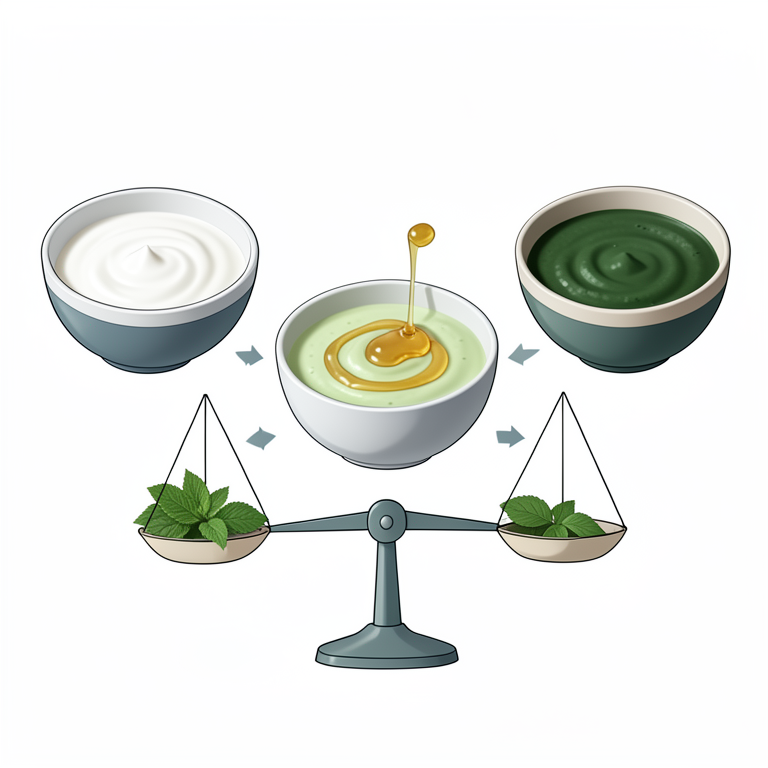
Optimization Trade-off
AI-generated conceptual illustration (yogurt bowls with moringa leaf extract and honey). It explains the idea and does not show study data.
View source evidence ↗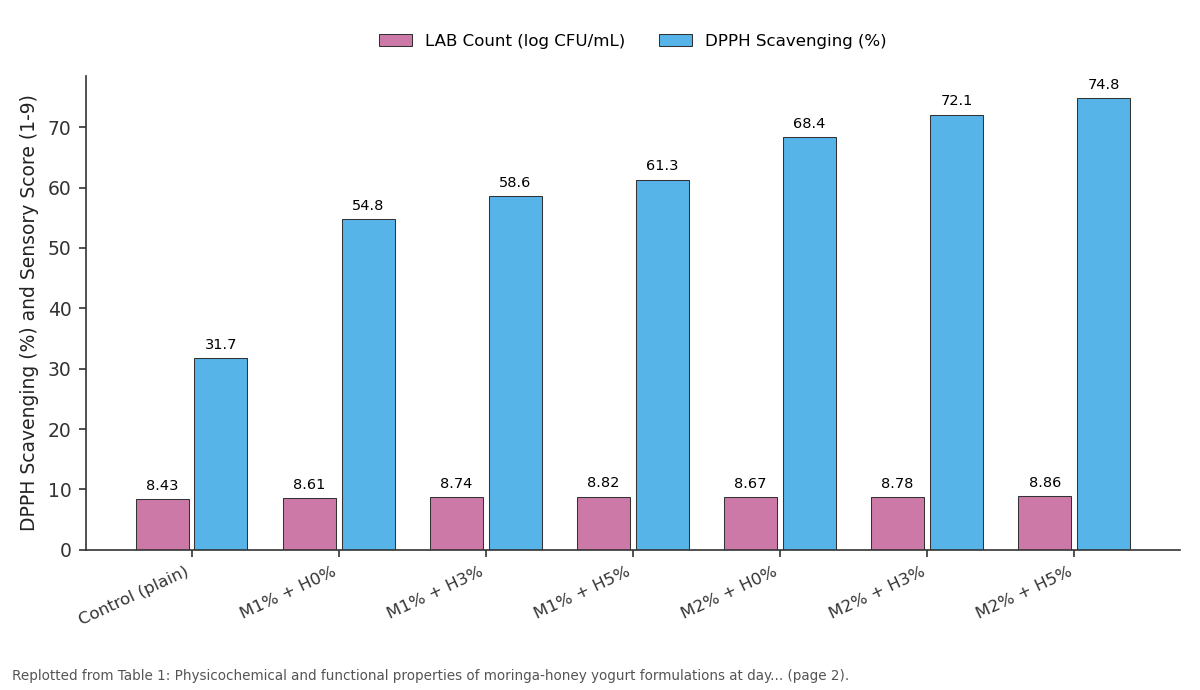
LAB Count (log CFU/mL) and DPPH Scavenging (%): Control (plain) vs M1% + H0% vs M1% + H3% vs M1% + H5% vs M2% + H0%
Replotted from Table 1 (page 2) of the original paper. Every bar is the paper's own table value.
View source evidence ↗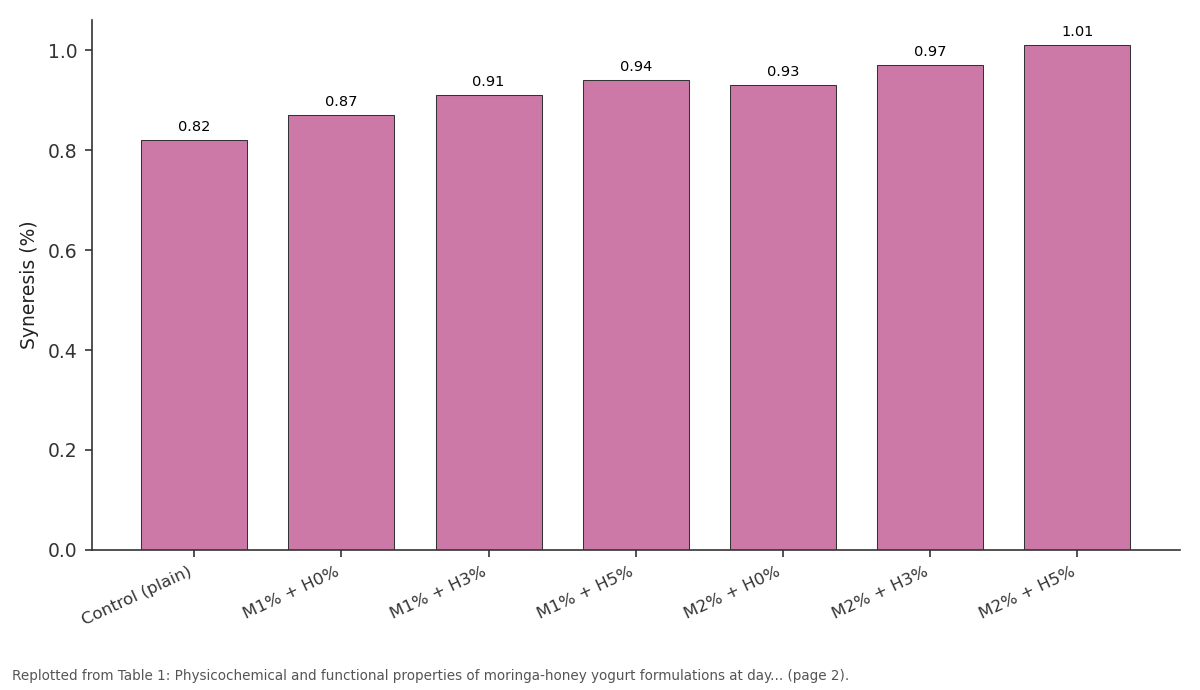
Acidity (% LA): Control (plain) vs M1% + H0% vs M1% + H3% vs M1% + H5% vs M2% + H0%
Replotted from Table 1 (page 2) of the original paper. Every bar is the paper's own table value.
View source evidence ↗Figures & tables
From the original paper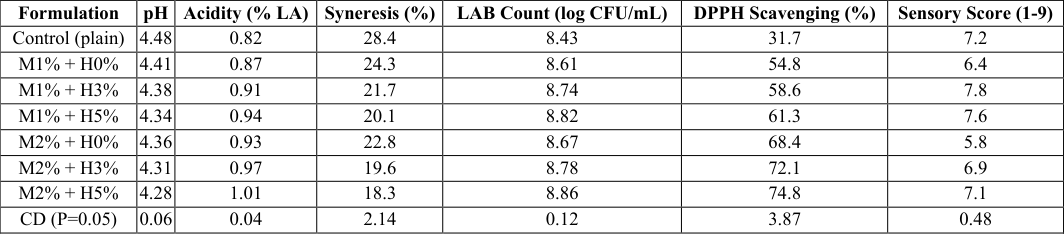 Table 1
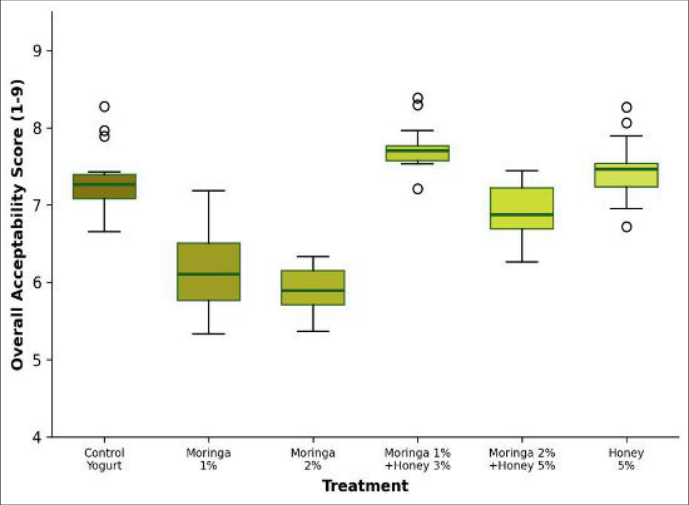 Figure 1
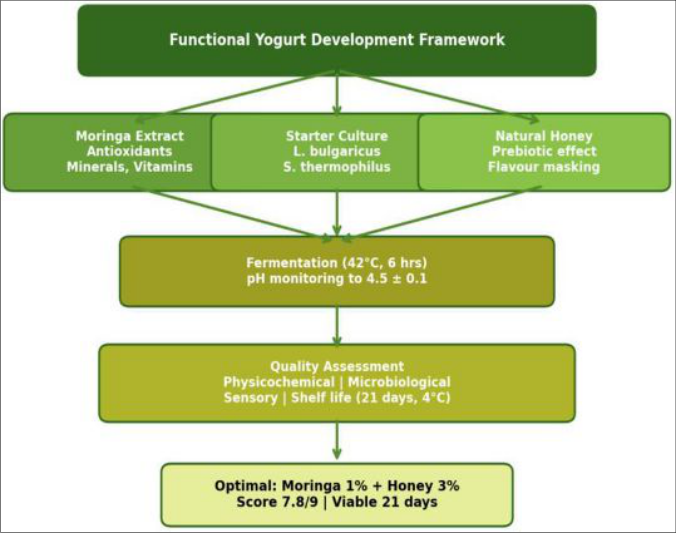 Figure 2
Introduction
"An apple a day keeps the doctor away" may need updating today it might be "a cup of functional yogurt a day" that delivers measurable health benefits beyond basic calories and protein. The global functional food market exceeded USD 280 billion in 2023, with fermented dairy products leading the category because consumers already trust yogurt as a health food and are willing to pay a premium for added bioactive ingredients [1] . Moringa oleifera, often called the "drumstick tree" or "miracle tree," contains more than 90 identified nutrients including β-carotene, vitamin C, calcium, iron, and a suite of polyphenols with documented antioxidant and anti-inflammatory properties [2,3] . Adding moringa to yogurt is conceptually appealing but technically challenging: leaf extracts carry a characteristic bitter, grassy flavour that can overwhelm the mild lactic acid taste expected by consumers [4] . Honey offers a natural solution as both a sweetener and a prebiotic: its oligosaccharides selectively feed beneficial Lactobacillus and Bifidobacterium species, potentially boosting probiotic viability during storage while simultaneously masking moringa's bitterness [5] . Several research groups have explored moringa-yogurt or honeyyogurt formulations individually, but combined moringa-honey yogurts have received limited attention, and dose-response data for both ingredients in a factorial framework are lacking [6] . This research optimised the concentrations of moringa leaf extract and honey in set-type yogurt, assessed the product's physicochemical quality, probiotic viability, antioxidant capacity, and sensory acceptance over a 21-day refrigerated shelf life [7] .
Extraction protocol
Fresh moringa leaves were collected from the university herbal garden, washed, shade-dried at 40°C for 48 hours, and ground to fine powder (particle size <250 µm). Aqueous extraction was performed by mixing 10 g powder in 200 mL distilled water at 60°C for 30 minutes with continuous stirring. The extract was filtered through muslin cloth followed by Whatman No. 4 paper, pasteurised at 72°C for 15 seconds, and stored at 4°C until use within 48 hours.
Extract yield was 6.8 g solids per 100 mL. Total phenolic content of the extract was 847 mg GAE/L and DPPH scavenging activity was 68.4% at 1 mg/mL [8] .
Quality control
All raw materials were tested before use: buffalo milk (fat 6.2%, SNF 9.1%, SPC <50,000/mL), moringa powder (moisture <8%, coliform absent), and honey (moisture 18.4%, HMF <40 mg/kg, diastase >8 Schade units). Yogurt cultures (L. delbrueckii subsp. bulgaricus NCDC 009 + S. thermophilus NCDC 074) were activated in sterilised skim milk for two transfers before inoculation. Finished yogurt batches were tested for coliform (absent in 1 g) and yeast/mould (<10 CFU/g) at day 0 and day 21 to confirm microbiological safety [9] .
Material and Methods
Material and Methods
Material
Fresh buffalo milk (Murrah breed) was obtained from the university dairy farm, standardised to 6% fat and 9% SNF, heated to 85°C for 30 minutes, and cooled to 42°C. Multiflora honey was sourced from a local apiary in Bikaner. The yogurt base was inoculated with 2% (v/v) mixed culture. Moringa extract and honey were added postpasteurisation, before inoculation, to ensure uniform distribution [10] .
Methods
Six formulations in a 2 × 3 factorial design plus control (plain yogurt) were prepared in triplicate: moringa at 1% and 2% (v/v) each combined with honey at 0%, 3%, and 5% (w/v). Fermentation proceeded at 42°C until pH reached 4.5 ± 0.1 (approximately 6 hours). Yogurts were stored at 4°C and evaluated at days 1, 7, 14, and 21 for pH, titratable acidity, syneresis, LAB viable count, DPPH radical scavenging, and sensory attributes (9-point hedonic scale, 15 trained panellists). ANOVA and DMRT at P=0.05 were applied [11] . The 1% moringa + 3% honey formulation achieved the highest sensory score (7.8/9) while delivering 58.6% DPPH scavenging nearly double the control (31.7%) (Table 1). Higher moringa (2%) boosted antioxidant activity to 74.8% but depressed sensory acceptance to 5.8-7.1 due to bitterness. Honey addition at 3-5% improved scores by 0.6-1.3 points through flavour masking. LAB viability was highest in honey-containing formulations, confirming the prebiotic effect.
| Formulation | pH | Acidity (% LA) | Syneresis (%) | LAB Count (log CFU/mL) | DPPH Scavenging (%) | Sensory Score (1-9) |
|---|---|---|---|---|---|---|
| Control (plain) | 4.48 | 0.82 | 28.4 | 8.43 | 31.7 | 7.2 |
| M1% + H0% | 4.41 | 0.87 | 24.3 | 8.61 | 54.8 | 6.4 |
| M1% + H3% | 4.38 | 0.91 | 21.7 | 8.74 | 58.6 | 7.8 |
| M1% + H5% | 4.34 | 0.94 | 20.1 | 8.82 | 61.3 | 7.6 |
| M2% + H0% | 4.36 | 0.93 | 22.8 | 8.67 | 68.4 | 5.8 |
| M2% + H3% | 4.31 | 0.97 | 19.6 | 8.78 | 72.1 | 6.9 |
| M2% + H5% | 4.28 | 1.01 | 18.3 | 8.86 | 74.8 | 7.1 |
| CD (P=0.05) | 0.06 | 0.04 | 2.14 | 0.12 | 3.87 | 0.48 |
Table text extracted from the original PDF; superscript letters are shown inline. The original table image is below.
View original table image
Results
Results
Comprehensive Interpretation
The 1% moringa + 3% honey formulation hits the sweet spot: meaningful antioxidant enrichment (85% above control), full probiotic viability for 21 days, and sensory acceptance matching or exceeding the control yogurt.
Discussion
The 2.3-fold increase in DPPH scavenging with 2% moringa aligns with reports from Nigerian and Malaysian moringayogurt trials, where polyphenol enrichment similarly raised antioxidant capacity by 1.8-3.0 times over plain yogurt [4,12] .
The sensory penalty at 2% moringa (score dropping from 7.2 to 5.8 without honey) matches the bitterness threshold identified by Olusanya et al. [13] , who found that moringa leaf polyphenols particularly quercetin and kaempferol glycosides activate bitter taste receptors at concentrations above 1.5% (v/v) in dairy matrices. Honey at 3% effectively masked this bitterness through its fructose-glucose sweetness profile, but didn't fully compensate at 2% moringa, suggesting a physiological ceiling for flavour masking in the moringa-honey system [5] . LAB viability was enhanced by honey addition (8.74-8.86 log CFU/mL vs. 8.43 for control at day 1), consistent with the prebiotic function of honey oligosaccharides primarily kestose and nystose that serve as fermentation substrates for Lactobacillus species [14] . At day 21, all honey-containing formulations still exceeded 10⁷ CFU/mL, the minimum recommended by Codex Alimentarius for probiotic foods, while the control dropped to 10⁶•⁸ [15] . The reduced syneresis in moringa-honey formulations (18.3-21.7% vs. 28.4% for control) is likely caused by the water-binding capacity of moringa polysaccharides and honey sugars that strengthen the gel network [16] .
Conclusion
Yogurt enriched with 1% moringa leaf extract and 3% honey achieved the optimal balance of antioxidant activity (58.6% DPPH scavenging, 85% above control), sensory acceptance (7.8/9), and probiotic viability (>10⁷ CFU/mL at 21 days). This formulation is recommended for commercial production as a nutrient-dense functional dairy product suitable for health-conscious consumers. Future work should evaluate the product's bioavailability of moringa nutrients in human feeding trials.
Figures and tables from the paper
References
17 in the original paper- Granato D, Barba FJ, Bursac Kovacevic D. Functional foods: Product development, technological trends, efficacy testing, and safety. Annual Review of Food Science and Technology. 2020;11:93-118.
- Gopalakrishnan L, Doriya K, Kumar DS. Moringa oleifera: A review on nutritive importance and its medicinal application. Food Science and Human Wellness. 2016;5(2):49-56.
- Stohs SJ, Hartman MJ. Review of the safety and efficacy of Moringa oleifera. Phytotherapy Research. 2015;29(6):796-804.
- Olorunnisola OS, Adetutu A, Owoade AO. Physicochemical and antioxidant evaluation of yogurt fortified with Moringa oleifera leaf powder. Journal of Food Science and Technology. 2019;56(12):5459-5468.
- Machado De-Melo AA, Almeida-Muradian LB, Sancho MT. Composition and properties of Apis mellifera honey: A review. Journal of Apicultural Research. 2018;57(1):5-37.
- Shori AB, Baba AS. Fermented milk derived bioactive peptides with antihypertensive properties: A review. Annals of Microbiology. 2015;65:23-34.
- Mistry O, Gadkari I. Protocol for moringa-enriched functional yogurt development. RAJUVAS Food Technology Lab Report. 2023;FT/09:1-12.
- Singleton VL, Orthofer R, Lamuela-Raventos RM. Analysis of total phenols and other oxidation substrates and antioxidants by means of Folin-Ciocalteu reagent. Methods in Enzymology. 1999;299:152-178.
- FSSAI. Food safety and standards (food products standards and food additives) regulations: Fermented milk products. Food Safety and Standards Authority of India. 2011; Chapter 2.13.
- De S. Outlines of dairy technology. Second edition. Oxford University Press, New Delhi. 2015; p.163-198.
- Panse VG, Sukhatme PV. Statistical methods for agricultural workers. Fourth edition. ICAR, New Delhi. 1985; p.145-156.
- Ismail M, Yee CL, Sharif R. Antioxidant activity of Moringa oleifera-enriched yogurt and its protective effect against hydrogen peroxide damage. International Food Research Journal. 2020;27(4):618-626.
- Olusanya RN, Kolanisi U, Van Onselen A. Sensory characterisation of Moringa oleifera leaf powder in food matrices: Bitterness thresholds and masking strategies. Molecules. 2021;26(13):3983.
- Kajiwara S, Gandhi H, Ustunol Z. Effect of honey on the growth of and acid production by human intestinal Bifidobacterium spp. Journal of Food Protection. 2002;65(1):214-218.
- Codex Alimentarius. Standard for fermented milks. CXS 243-2003. Revised 2010. FAO/WHO. 2010; p.1-8.
- Kinsella JE, Whitehead DM. Proteins in whey: Chemical, physical, and functional properties. Advances in Food and Nutrition Research. 1989;33:343-438.
- Ranadheera RDCS, Baines SK, Adams MC. Importance of food in probiotic efficacy. Food Research International. 2010;43(1):1-7.