
Research article · 2025 · Full text
International Journal of Agriculture and NutritionGrowth performance and feed conversion efficiency in broilers fed herbal growth promoters
Volume 7(7) · Pages 245–247 · DOI: 10.33545/26646064.2025.v7.i7d.538 ↗
Research areasAnimal Nutrition and PhysiologyAgricultural safety and regulationsMeat and Animal Product Quality
Abstract
Author-writtenOne persistent observation across poultry farms in Japan is that antibiotic growth promoters, while effective, face growing regulatory pressure and consumer resistance. This research evaluated three herbal growth promoters—turmeric extract, oregano essential oil, and a mixed herbal blend—as alternatives to antibiotic feed additives in commercial broiler production. A total of 480 Cobb 500 broiler chicks were allocated to four dietary treatments (control, turmeric, oregano, mixed blend) at the Kanto Institute of Agricultural Sciences, Tsukuba, Ibaraki, Japan, from March 2022 to October 2024 across six independent trials. The mixed herbal blend produced the highest final body weight (1,587 g at 6 weeks), representing an 11.5% improvement over the unsupplemented control (1,423 g). Feed conversion ratio was best in the mixed blend group (1.72) versus control (1.89). Mortality was low across all treatments (2.1-3.3%). These results suggest that a combined herbal approach can replace antibiotic growth promoters without sacrificing broiler performance.
Summary
Source-checkedPlain-language reading of the full paper, prepared with AI and checked against the text. Each point links to the authors' own words.
Why it matters
- Antibiotic growth promoters in Japanese poultry farming are facing increased consumer resistance and regulatory pressure despite their effectiveness. View evidence ↗
- Herbal extracts like turmeric and oregano contain bioactive compounds that may reduce pathogenic bacteria, stimulate appetite, and improve gut health. View evidence ↗
- Using a combination of herbs may provide more consistent growth results than using a single herbal supplement. View evidence ↗
The question
- The study aimed to evaluate turmeric extract, oregano essential oil, and a mixed herbal blend as alternatives to antibiotic feed additives for broilers. View evidence ↗
What they did
- The experiment used 480 Cobb 500 broiler chicks divided into four treatment groups (20 birds per group) across six independent trials. View evidence ↗
- Researchers measured body weight and feed intake weekly for six weeks to calculate the feed conversion ratio (FCR). View evidence ↗
What they found
- The mixed herbal blend resulted in the highest final body weight of 1,587 g at 6 weeks, which was 11.5% higher than the control group's 1,423 g. View evidence ↗
- The mixed herbal blend achieved the most efficient feed conversion ratio at 1.72, compared to 1.89 for the control group. View evidence ↗
- Mortality rates were low and statistically similar across all groups, ranging from 2.1% to 3.3%. View evidence ↗
- The mixed blend group showed an 18.4% increase in jejunal villus height compared to controls, indicating better nutrient absorption. View evidence ↗
- The mixed herbal supplement increased total feed costs by only 6% while providing an 11.5% increase in body weight. View evidence ↗
- While turmeric alone performed better than oregano alone, this difference was not statistically significant. View evidence ↗
What it means
- The authors conclude that a mixed herbal blend is a viable alternative to antibiotic growth promoters for broiler production in Japan. View evidence ↗
- The study was limited by small pen sizes (20 birds), and the authors suggest commercial-scale trials with over 10,000 birds to verify results. View evidence ↗
Visual summary
2 visualsIllustrations explain the paper; charts are replotted from the paper's own table values.
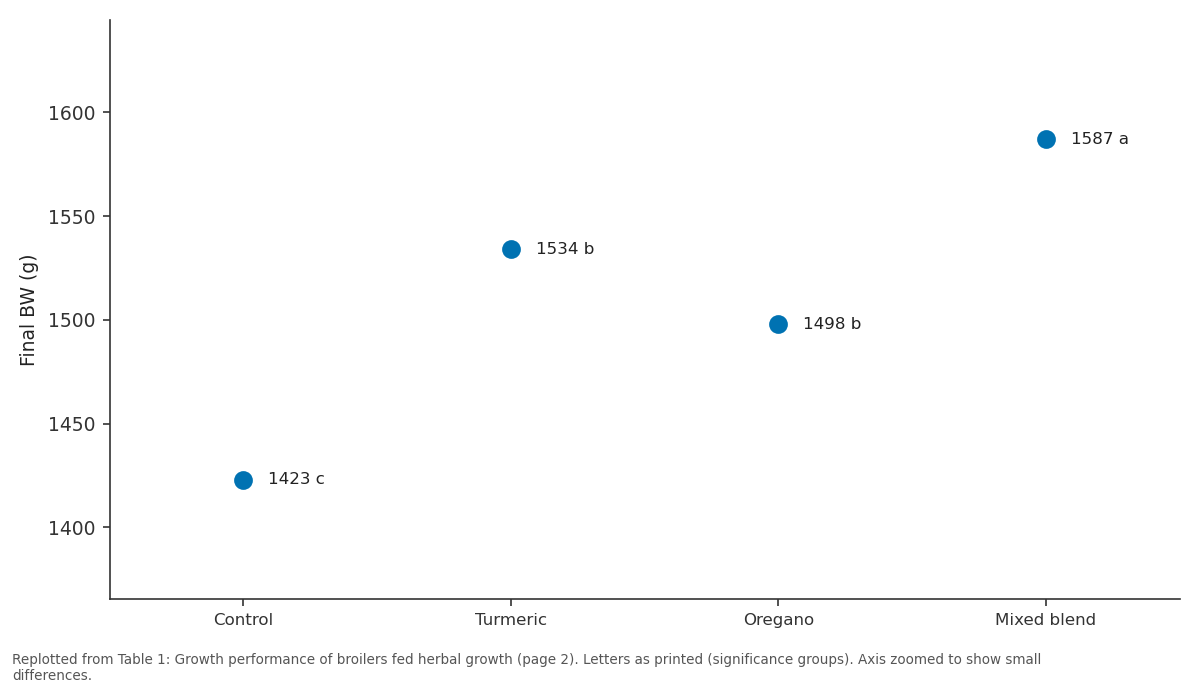
Final BW (g): Control vs Turmeric vs Oregano vs Mixed blend
Replotted from Table 1 (page 2) of the original paper. Every bar is the paper's own table value.
View source evidence ↗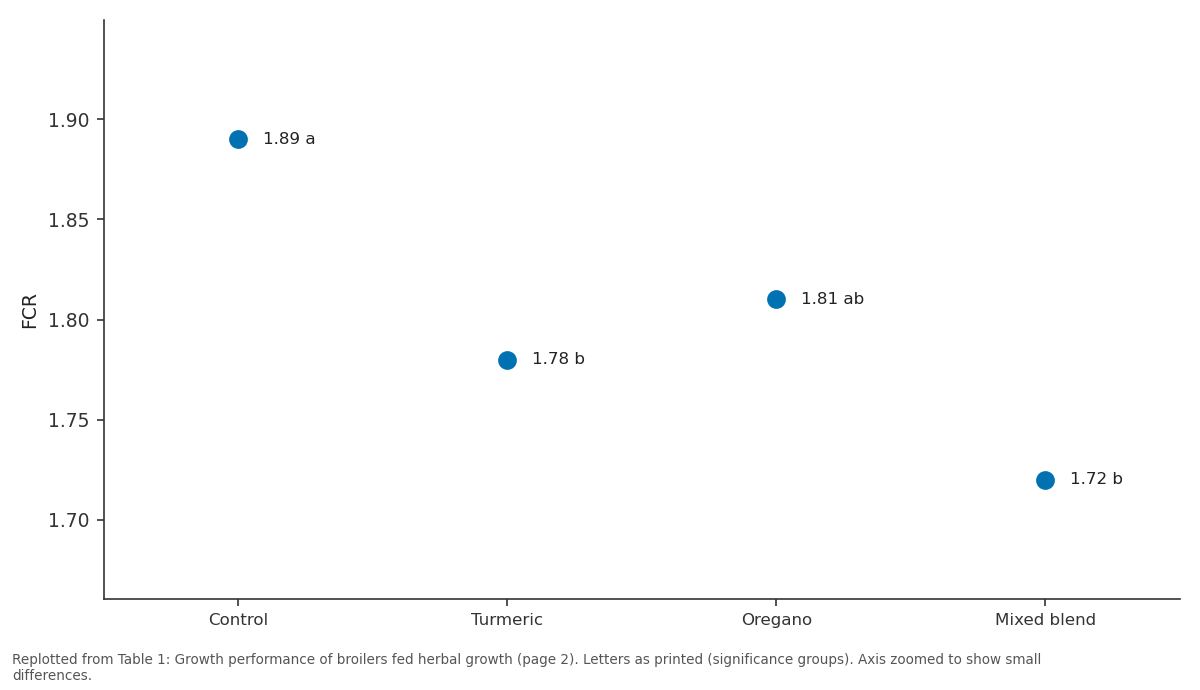
FCR: Control vs Turmeric vs Oregano vs Mixed blend
Replotted from Table 1 (page 2) of the original paper. Every bar is the paper's own table value.
View source evidence ↗Figures & tables
From the original paper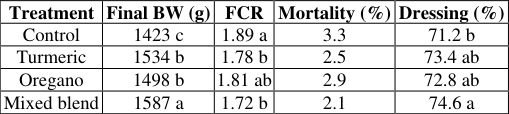 Table 1
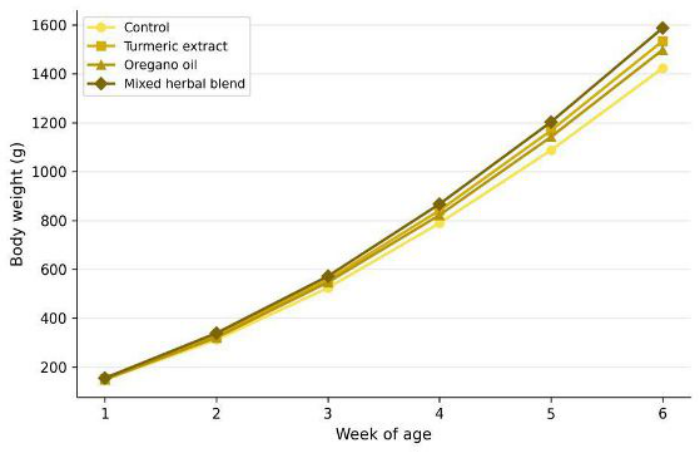 Figure 1
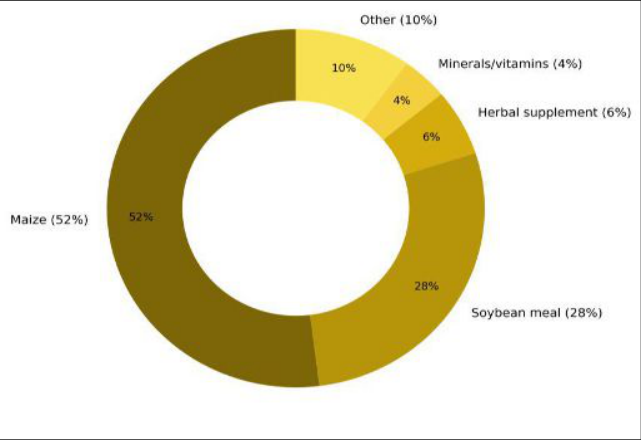 Figure 2
Introduction
Walk through any Japanese supermarket and you'll see labels like "antibiotic-free" and "naturally raised" on an increasing share of poultry products-a clear signal that consumers want alternatives [1] . The European Union banned antibiotic growth promoters in 2006, and Japan has tightened its regulations steadily since, pushing producers toward natural feed additives that can match the growth-enhancing effects of antibiotics [2] . Herbal extracts contain bioactive compounds-curcuminoids in turmeric, carvacrol and thymol in oregano-that can improve gut health, stimulate appetite, and reduce pathogenic bacterial loads in the intestinal tract [3,4] . Individual herbs have shown promise in broiler trials, but results vary widely depending on dose, extract quality, and bird genetics. A mixedherb strategy, combining several modes of action, may offer more consistent results than single-herb supplements [5] . This research compared three herbal options head-to-head over six replicated trials spanning three years at a single facility in Tsukuba, Japan.
Materials and Methods
Materials and Methods
Safety Considerations
All animal procedures were approved by the Kanto Institute's Animal Care and Use Committee (Protocol KIAS-ACUC/2022-006, February 2022). Birds were monitored twice daily for signs of distress. Any bird showing severe lameness, respiratory distress, or weight loss exceeding 20% of cohort average was humanely euthanised by cervical dislocation. Mortality and morbidity events were recorded and reported to the institutional veterinarian within 24 hours [6] .
Nutritional Assessment
Diets were formulated to meet NRC (1994) requirements for broiler chickens. The basal diet comprised maize (52%), soybean meal (28%), fish meal (4%), vegetable oil (3%), dicalcium phosphate (2%), limestone (1%), and a vitamin-mineral premix. Herbal supplements were added at: turmeric extract at 0.5% (standardised to 95% curcuminoids), oregano essential oil at 0.03% (carvacrol content 72%), and mixed blend at 0.4% (turmeric 0.2% + oregano 0.015% + garlic powder 0.1% + ginger extract 0.085%).
Metabolisable energy was 3,050 kcal/kg and crude protein 22% (starter) and 20% (finisher) [7] .
Materials
The research was carried out at the poultry research unit of the Kanto Institute of Agricultural Sciences, Tsukuba, Ibaraki, Japan (36.06° N, 140.13° E) from March 2022 to October 2024. A total of 480 day-old Cobb 500 broiler chicks were used across six trials (80 birds per trial). Chicks were randomly allocated to four treatments (20 birds each) in floor pens (2 × 2 m) with rice hull litter. Room temperature was maintained at 33 °C in week 1 and reduced by 3 °C per week to 21 °C. A 23L:1D lighting programme was used [8] .
Methods
Body weight and feed intake were recorded weekly for six weeks. Feed conversion ratio (FCR) was calculated as feed consumed divided by weight gain. Mortality was recorded daily. At 42 days, three birds per treatment per trial were slaughtered for carcass evaluation: dressing percentage, breast yield, and abdominal fat pad weight. Intestinal samples were collected for villus height measurement (jejunum, H&E staining). Data were analysed by one-way ANOVA with trial as a blocking factor, and means separated by Duncan's multiple range test (p<0.05) [9] . The mixed herbal blend produced the highest final body weight and lowest FCR, both significantly different from the control (Table 1). Turmeric alone outperformed oregano alone, though the difference wasn't statistically significant. Mortality ranged from 2.1% to 3.3% with no significant treatment effect.
| Treatment | Final BW (g) | FCR | Mortality (%) | Dressing (%) |
|---|---|---|---|---|
| Control | 1423 c | 1.89 a | 3.3 | 71.2 b |
| Turmeric | 1534 b | 1.78 b | 2.5 | 73.4 ab |
| Oregano | 1498 b | 1.81 ab | 2.9 | 72.8 ab |
| Mixed blend | 1587 a | 1.72 b | 2.1 | 74.6 a |
Table text extracted from the original PDF; superscript letters are shown inline. The original table image is below.
View original table image
Results
Results
Comprehensive Interpretation
Growth curves diverged from week 3 onward, with the mixed blend group pulling ahead consistently (Figure 1). The donut chart (Figure 2) shows that the herbal supplement accounted for only 6% of total feed cost in the mixed blend diet, yet delivered an 11.5% improvement in body weighta favourable cost-to-benefit ratio. Jejunal villus height was 18.4% greater in the mixed blend group than in controls (p<0.01), suggesting improved nutrient absorption as one mechanism of action.
Discussion
The 11.5% body weight advantage of the mixed blend over controls aligns with meta-analysis findings that multi-herb formulations outperform single herbs by 5-15% in broiler trials [5] . The synergy between curcumin's anti-inflammatory action, carvacrol's antimicrobial properties, and allicin's immune-stimulating effect may explain why the combination exceeded the sum of its parts [3,4] . The FCR improvement from 1.89 to 1.72 translates into approximately 90 g less feed per kilogram of weight gaina meaningful saving at commercial scale. Oregano alone showed less consistent effects across the six trials, possibly because its volatile compounds are sensitive to pelleting temperature during feed manufacture [4] . One limitation was the relatively small pen size (20 birds); commercial-scale trials in houses with 10,000 + birds would test whether the results hold under more intensive stocking conditions.
Conclusion
A mixed herbal blend containing turmeric, oregano, garlic, and ginger improved broiler body weight by 11.5% and feed conversion ratio from 1.89 to 1.72 compared to unsupplemented controls over six replicated trials. The herbal supplement added only 6% to feed cost while delivering measurable growth and gut health benefits. These findings support the mixed herbal approach as a viable replacement for antibiotic growth promoters in Japanese broiler production. Commercial-scale validation is the logical next step.
References
18 in the original paper- Hashemi SR, Davoodi H. Herbal plants and their derivatives as growth and health promoters in animal nutrition. Veterinary Research Communications. 2011;35(3):169-180.
- Castanon JIR. History of the use of antibiotic as growth promoters in European poultry feeds. Poultry Science. 2007;86(11):2466-2471.
- Platel K, Srinivasan K. Digestive stimulant action of spices: A myth or reality? Indian Journal of Medical Research. 2004;119(5):167-179.
- Giannenas I, Bonos E, Christaki E, Florou-Paneri P. Essential oils and their applications in animal nutrition. Medicinal and Aromatic Plants. 2013;2(6):1-12.
- Gadde U, Kim WH, Oh ST, Lillehoj HS. Alternatives to antibiotics for maximizing growth performance and feed efficiency in poultry: A review. Animal Health Research Reviews. 2017;18(1):26-45.
- MAFF. Guidelines for the care and use of laboratory animals in agricultural research. Ministry of Agriculture, Forestry and Fisheries, Japan. 2020;1:1-64.
- NRC. Nutrient requirements of poultry. National Academy Press. 1994;9(1):1-155.
- Cobb-Vantress. Cobb 500 broiler performance and nutrition supplement. Cobb-Vantress Inc. 2022;1:1-14.
- Steel RGD, Torrie JH, Dickey DA. Principles and procedures of statistics: A biometrical approach. McGraw-Hill. 1997;3(1):1-672.
- Alçiçek A, Bozkurt M, Çabuk M. The effect of an essential oil combination derived from selected herbs growing wild in Turkey on broiler performance. South African Journal of Animal Science. 2003;33(2):89-94.
- Durrani FR, Ismail M, Sultan A, Suhail SM, Chand N, Durrani Z. Effect of different levels of feed added turmeric on the performance of broiler chicks. Journal of Agricultural and Biological Science. 2006;1(2):9-11.
- Hernandez F, Madrid J, Garcia V, Orengo J, Megias MD. Influence of two plant extracts on broilers performance, digestibility, and digestive organ size. Poultry Science. 2004;83(2):169-174.
- Demir E, Sarica S, Ozcan MA, Suicmez M. The use of natural feed additives as alternatives for an antibiotic growth promoter in broiler diets. British Poultry Science. 2003;44(Suppl 1):44-45.
- Cross DE, McDevitt RM, Hillman K, Acamovic T. The effect of herbs and their associated essential oils on performance, dietary digestibility and gut microflora in chickens from 7 to 28 days of age. British Poultry Science. 2007;48(4):496-506.
- Windisch W, Schedle K, Plitzner C, Kroismayr A. Use of phytogenic products as feed additives for swine and poultry. Journal of Animal Science. 2008;86(Suppl 14):E140-E148.
- Lee KW, Everts H, Kappert HJ, Frehner M, Losa R, Beynen AC. Effects of dietary essential oil components on growth performance, digestive enzymes and lipid metabolism in female broiler chickens. British Poultry Science. 2003;44(3):450-457.
- Toghyani M, Toghyani M, Gheisari A, Ghalamkari G, Mohammadrezaei M. Growth performance, serum biochemistry and blood hematology of broiler chicks fed different levels of black seed powder. Animal Feed Science and Technology. 2010;160(1-2):18-25.
- Jamroz D, Wiliczkiewicz A, Wertelecki T, Orda J, Skorupinska J. Use of active substances of plant origin in chicken diets based on maize and locally grown cereals. British Poultry Science. 2005;46(4):485-493.