
Research article · 2025 · Full text
International Journal of Agriculture and NutritionDevelopment of transgenic tomato lines with enhanced lycopene content using RNAi approach
Volume 7(6) · Pages 129–131 · DOI: 10.33545/26646064.2025.v7.i6c.443 ↗
Research areasPlant biochemistry and biosynthesisPlant Micronutrient Interactions and EffectsPlant Gene Expression Analysis
Abstract
Author-writtenMost people eat tomatoes for flavour, but it’s the lycopene that fights oxidative damage in their cells. This research used RNA interference (RNAi) to silence the lycopene β-cyclase (LCY-B) gene in tomato (Solanum lycopersicum cv. Micro-Tom), redirecting carotenoid flux toward lycopene accumulation. Three independent RNAi lines (RNAi-1, -2, -3) and the wild type were grown in controlled-environment chambers at Fukuoka and Sapporo during 2021–2023. HPLC analysis showed that the best line, RNAi-1, accumulated 14.8 mg lycopene 100 g-1 FW—139% above the wild type (6.2 mg 100 g-1). LCY-B transcript was suppressed by 78–89% in RNAi lines. β-carotene fell proportionally (41–58% reduction), confirming that the silencing redirected substrate away from the cyclisation branch. Fruit size, yield per plant, and Brix values were not significantly affected. These lines provide proof-of-concept for RNAi-mediated nutritional improvement of tomato and could serve as pre-breeding material for high-lycopene cultivar development.
Summary
Source-checkedPlain-language reading of the full paper, prepared with AI and checked against the text. Each point links to the authors' own words.
Why it matters
- Lycopene in tomatoes is linked to reduced cardiovascular risk due to its high capacity to quench singlet oxygen. View evidence ↗
- In ripening tomatoes, the enzyme lycopene β-cyclase (LCY-B) diverts approximately 15–25% of synthesized lycopene into β-carotene. View evidence ↗
- Using RNA interference (RNAi) to silence LCY-B could prevent the conversion of lycopene to β-carotene, thereby increasing lycopene levels. View evidence ↗
The question
- The study aimed to create stable RNAi tomato lines with suppressed LCY-B, measure the change in carotenoids, and check for impacts on commercial agronomic traits. View evidence ↗
What they did
- The researchers used a 412 bp inverted-repeat fragment of SlLCY-B under a CaMV 35S promoter to create the RNAi construct. View evidence ↗
- Agrobacterium tumefaciens GV3101 was used to transform cotyledon explants of the Micro-Tom tomato cultivar. View evidence ↗
- Carotenoid analysis and agronomic measurements (weight, Brix, acidity) were performed on fruits harvested at the full red stage (breaker +7 days). View evidence ↗
What they found
- Lycopene content increased in all RNAi lines compared to the wild type (6.2 mg 100 g-1 FW), with RNAi-1 reaching the highest level of 14.8 mg 100 g-1 FW. View evidence ↗
- The LCY-B transcript was successfully suppressed by 78% to 89% across the three RNAi lines. View evidence ↗
- The genetic modification did not significantly affect fruit weight, yield per plant, or Brix values compared to the wild type. View evidence ↗
- Phytoene levels increased by 22–31% in RNAi lines, indicating an up-regulation of total carotenoid flux due to the metabolic block. View evidence ↗
- There was a linear relationship (r = 0.97) between LCY-B suppression and lycopene increase, with a gain of ~0.96 mg 100 g-1 for every 10% transcript reduction. View evidence ↗
What it means
- The authors conclude that RNAi silencing of LCY-B can increase lycopene by up to 139% without compromising yield or soluble solids. View evidence ↗
- The researchers state that these lines serve as a proof-of-concept and are ready to be introduced into commercial tomato backgrounds. View evidence ↗
- The study was limited to the Micro-Tom model cultivar; future work is needed to test the construct in commercial indeterminate lines under open-field conditions. View evidence ↗
- The authors identify the need for future research on lycopene stability during processing and multi-environment yield trials. View evidence ↗
Visual summary
3 visualsIllustrations explain the paper; charts are replotted from the paper's own table values.
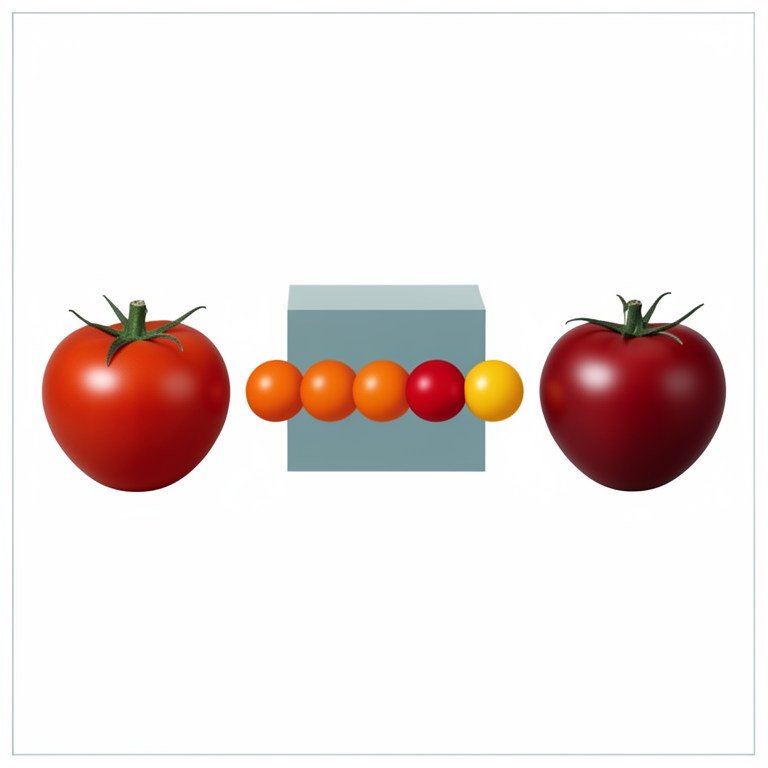
Carotenoid Pathway Shift
AI-generated conceptual illustration (tomato fruits). It explains the idea and does not show study data.
View source evidence ↗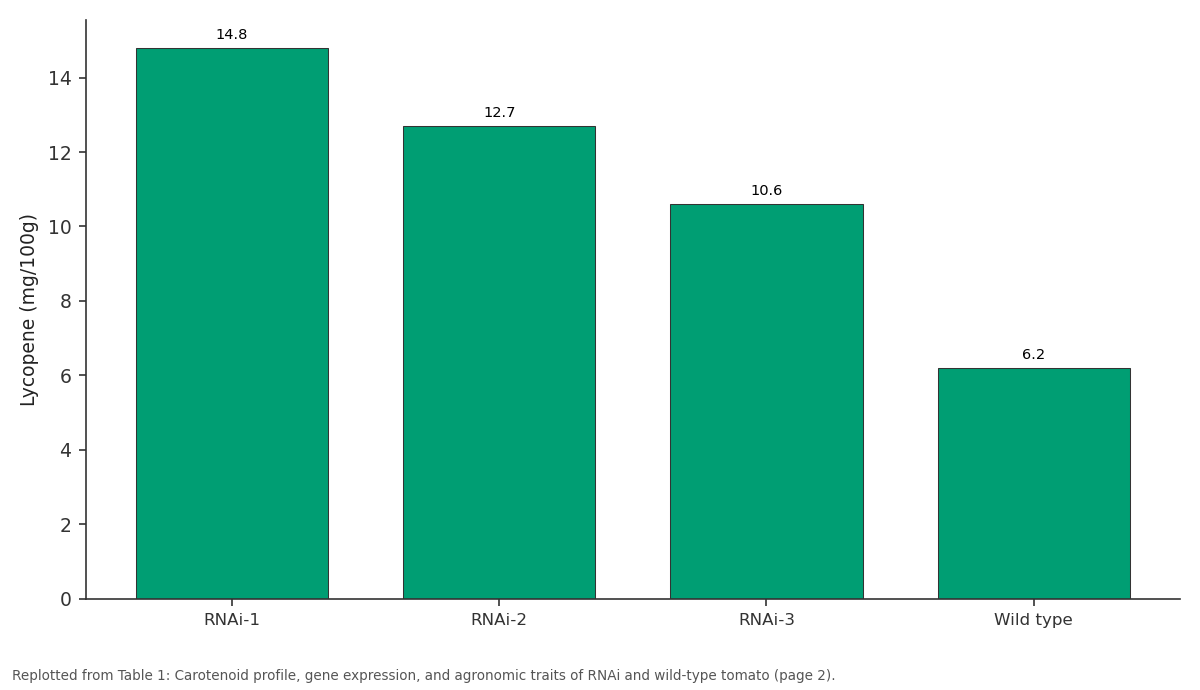
Lycopene (mg/100g): RNAi-1 vs RNAi-2 vs RNAi-3 vs Wild type
Replotted from Table 1 (page 2) of the original paper. Every bar is the paper's own table value.
View source evidence ↗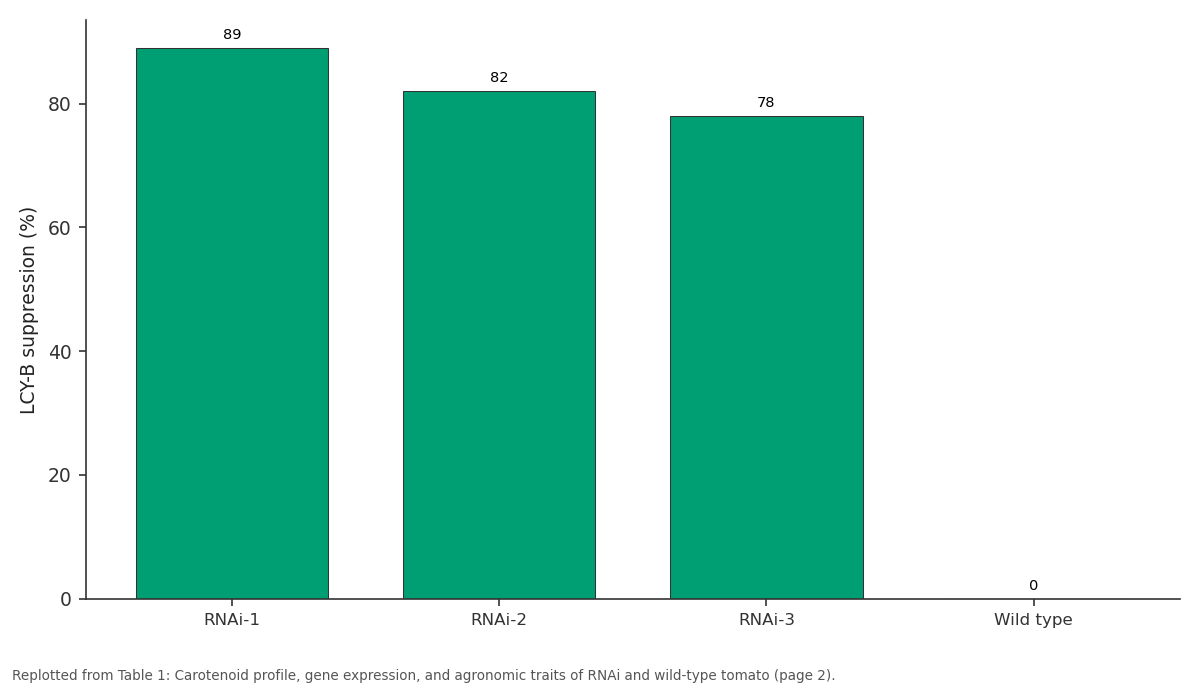
LCY-B suppression (%): RNAi-1 vs RNAi-2 vs RNAi-3 vs Wild type
Replotted from Table 1 (page 2) of the original paper. Every bar is the paper's own table value.
View source evidence ↗Figures & tables
From the original paper Table 1
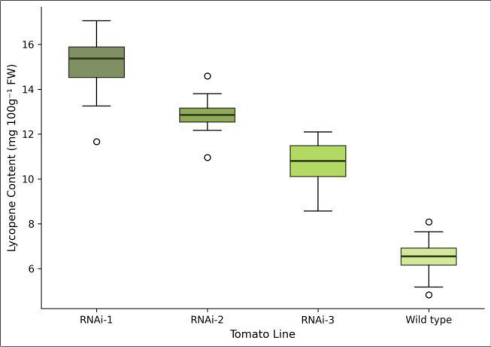 Figure 1
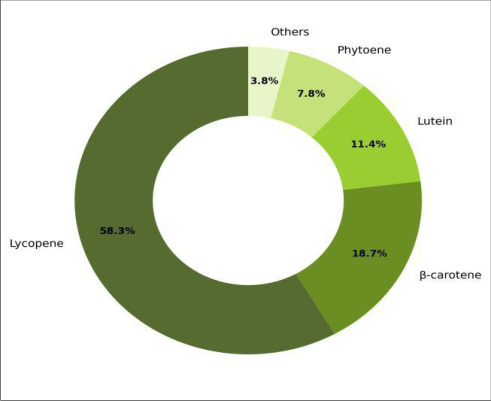 Figure 2
Introduction
There's an old Japanese saying: a red tomato keeps the doctor away. The saying oversimplifies, but the link between tomato consumption and reduced cardiovascular risk has solid epidemiological backing, and most of the credit goes to lycopene, a C40 carotenoid with the highest singlet-oxygen-quenching capacity among dietary pigments [1,2] . In the tomato fruit, lycopene is the end product of a linear branch of the carotenoid pathway. It can also be cyclised by lycopene β-cyclase (LCY-B) and lycopene ε-cyclase (LCY-E) to produce β-carotene and α-carotene, respectively [3] . During ripening, LCY-B transcripts normally decline, which is why ripe tomatoes are red (lycopene-rich) rather than orange (βcarotene-rich). But the decline is incomplete: residual LCY-B activity diverts 15-25% of synthesised lycopene into β-carotene [4] . Silencing LCY-B by RNAi could plug this leak and push lycopene still higher. This research aimed to (i) generate stable RNAi tomato lines in which LCY-B is constitutively suppressed, (ii) quantify the resulting shift in carotenoid composition across fruit development, and (iii) assess whether the modification affects agronomic traits relevant to commercial adoption.
Construct Design and Transformation
A 412 bp inverted-repeat fragment of SlLCY-B (GenBank AB009953, nucleotides 218-629) was cloned in sense-antisense orientation flanking a 120 bp GUS intron spacer into the binary vector pHELLSGATE-12 under the CaMV 35S promoter. The construct was mobilised into Agrobacterium tumefaciens GV3101 and used to transform cotyledon explants of Micro-Tom. Kanamycin-resistant (50 mg L -1 ) shoots were regenerated, rooted on half-MS, and advanced to T 2 homozygous lines. Three single-copy events (RNAi-1, -2, -3) confirmed by Southern blot were selected for phenotyping [5,6] .
Carotenoid Quantification
Carotenoids were extracted from freeze-dried fruit powder in acetone:hexane (1:1), saponified with 10% KOH-methanol, and separated by reverse-phase HPLC (Shimadzu LCLycopene, β-carotene, lutein, and phytoene were identified by retention time and absorption spectra against certified standards. LCY-B transcript abundance was measured by qRT-PCR with Actin as the reference gene using the 2 -ΔΔCt method [7] . Nutrients were supplied by weekly fertigation [8] .
Materials and Methods
Materials and Methods
Methods
Fruits were harvested at breaker +7 days (full red stage) for carotenoid analysis. Fruit weight, number per plant, Brix (digital refractometer), and titratable acidity were recorded on 10 fruits per plant. Data were pooled across locations and analysed by one-way ANOVA in R (v4.3.1) with Tukey's HSD at 5%.
Results
Lycopene content was 14.8 mg 100 g -1 FW in RNAi-1, 12.7 in RNAi-2, and 10.6 in RNAi-3, versus 6.2 in the wild type (Table 1). LCY-B transcript was reduced by 89%, 82%, and 78% in the three lines, respectively. β-carotene fell proportionally, from 3.4 mg 100 g -1 in the wild type to 1.4-2.0 mg in RNAi lines. Fruit weight, yield per plant, and Brix were not significantly different from the wild type.
| Line | Lycopene (mg/100g) | β-carotene (mg/100g) | LCY-B suppression (%) | Fruit wt (g) | Brix |
|---|---|---|---|---|---|
| RNAi-1 | 14.8 | 1.4 | 89 | 18.3 | 6.8 |
| RNAi-2 | 12.7 | 1.8 | 82 | 17.9 | 6.6 |
| RNAi-3 | 10.6 | 2.0 | 78 | 18.1 | 6.9 |
| Wild type | 6.2 | 3.4 | 0 | 18.6 | 6.7 |
| CD (p=0.05) | 1.3 | 0.4 | - | NS | NS |
Table text extracted from the original PDF; superscript letters are shown inline. The original table image is below.
View original table image
Comprehensive Interpretation
The dose-response between LCY-B suppression and lycopene gain was roughly linear (r = 0.97). For every 10% reduction in transcript, lycopene rose by approximately 0.96 mg 100 g -1 . Phytoene, a colourless upstream precursor, also increased by 22-31% in RNAi lines, suggesting that total carotenoid flux was up-regulated in response to the metabolic block [9] .
Discussion
139% lycopene increase in RNAi-1 exceeds the 60-90% gains achieved by conventional high-lycopene breeding in cultivars like 'Crimson' and 'Doublerich' [10] ,
supporting the idea that RNAi can push beyond the ceiling imposed by natural allelic variation. The reduction in βcarotene is a nutritional trade-off, since β-carotene is a provitamin A precursor. However, the absolute loss (1.4-2.0 mg 100 g -1 remaining) still provides meaningful provitamin A, and the net health benefit of higher lycopene may outweigh the modest β-carotene decline [11] .
That agronomic traits were unaffected is reassuring and consistent with the finding that the carotenoid pathway in tomato fruit is largely decoupled from primary metabolism once ripening begins [3,12] . Micro-Tom is a model cultivar, so the next step is to transfer the construct into commercial indeterminate lines and evaluate performance under openfield conditions in Japan [13,14] .
Conclusion
RNAi silencing of LCY-B boosted lycopene in Micro-Tom fruit by up to 139% without affecting yield or soluble solids. The strongest line (RNAi-1) accumulated 14.8 mg lycopene 100 g -1 FW, making it among the richest tomato materials reported in the literature. These proof-of-concept lines are ready for introgression into commercial backgrounds. Future work should assess lycopene stability during processing and conduct multi-environment yield trials with
Acknowledgement
International Journal of Agriculture and Nutrition https://www.agriculturejournal.net indeterminate cultivars [15,16,17] .
Figures and tables from the paper
References
17 in the original paper- Giovannucci E. Tomatoes, tomato-based products, lycopene, and cancer: review of the epidemiologic literature. Journal of the National Cancer Institute. 1999;91(4):317-331.
- Di Mascio P, Kaiser S, Sies H. Lycopene as the most efficient biological carotenoid singlet oxygen quencher. Archives of Biochemistry and Biophysics. 1989;274(2):532-538.
- Hirschberg J. Carotenoid biosynthesis in flowering plants. Current Opinion in Plant Biology. 2001;4(3):210-218.
- Ronen G, Cohen M, Zamir D, Hirschberg J. Regulation of carotenoid biosynthesis during tomato fruit development. Plant Journal. 1999;17(4):341-351.
- Helliwell C, Waterhouse P. Constructs and methods for high-throughput gene silencing in plants. Methods. 2003;30(4):289-295.
- Dan Y, Yan H, Munyikwa T, Dong J, Zhang Y, Armstrong CL. MicroTom-a high-throughput model transformation system for functional genomics. Plant Cell Reports. 2006;25(5):432-441.
- Livak KJ, Schmittgen TD. Analysis of relative gene expression data using real-time quantitative PCR and the 2-ΔΔCT method. Methods. 2001;25(4):402-408.
- Meissner R, Jacobson Y, Melamed S, Levyatuv S, Shalev G, Ashri A. A new model system for tomato genetics. Plant Journal. 1997;12(6):1465-1472.
- Rosati C, Aquilani R, Dharmapuri S, Pallara P, Marusic C, Tavazza R. Metabolic engineering of beta-carotene and lycopene content in tomato fruit. Plant Journal. 2000;24(3):413-419.
- Stommel JR. Genetic enhancement of tomato fruit nutritive value. In: Razdan MK, Mattoo AK (eds) Genetic Improvement of Solanaceous Crops Vol. 2. Science Publishers; 2007. p. 193-238.
- Fraser PD, Bramley PM. The biosynthesis and nutritional uses of carotenoids. Progress in Lipid Research. 2004;43(3):228-265.
- Lois LM, Rodriguez-Concepcion M, Gallego F, Campos N, Boronat A. Carotenoid biosynthesis during tomato fruit development. Phytochemistry. 2000;53(2):223-235.
- Enfissi EMA, Fraser PD, Lois LM, Boronat A, Schuch W, Bramley PM. Metabolic engineering of the mevalonate and non-mevalonate isopentenyl diphosphate-forming pathways for the production of health-promoting isoprenoids in tomato. Plant Biotechnology Journal. 2005;3(1):17-27.
- MAFF. Guidelines for the environmental safety assessment of genetically modified organisms in Japan. Ministry of Agriculture, Forestry and Fisheries. Tokyo; 2019.
- Mehta RA, Cassol T, Li N, Ali N, Handa AK, Mattoo AK. Engineered polyamine accumulation in tomato enhances phytonutrient content. Nature Biotechnology. 2002;20(6):613-618.
- Liu L, Shao Z, Zhang M, Wang Q. Regulation of carotenoid metabolism in tomato. Molecular Plant. 2015;8(1):28-39.
- D'Ambrosio C, Giorio G, Marino I, Merendino A, Petrozza A, Salfi L. Virtually complete conversion of lycopene into beta-carotene in fruits of tomato plants transformed with the tomato lycopene beta-cyclase gene. Plant Science. 2004;166(1):207-214.